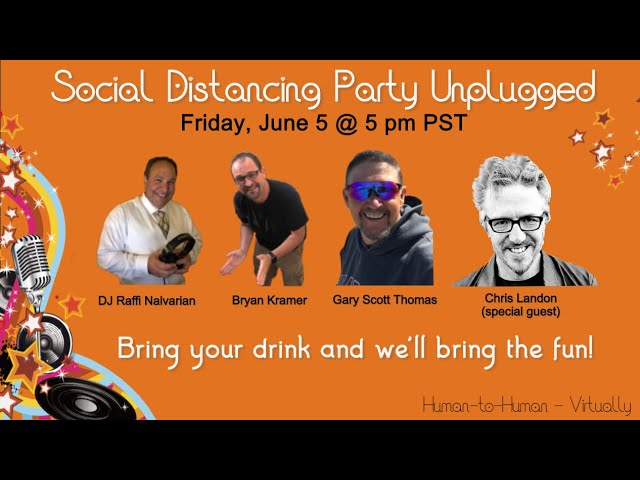
#H2HChat Achieving the Ultimate in Collaboration and Efficiency, Chris Heuer Founder of @WillSomeone

In this live #H2HChat, host Bryan Kramer interviews Chris Heuer, founder of WillSomeone, about the challenges of modern collaboration, productivity, and remote work. Heuer traces his journey from social media community building (Social Media Club) to a systems‑thinking approach that highlights the gap between what people say they will do and what they actually deliver. The conversation covers the distinction between "tasking" and "asking," the importance of clarity on purpose, objectives, and expectations, and the cultural and psychological factors that hinder commitment. They discuss the pitfalls of fragmented collaboration tools (BYOD/BYOS), the need for safety and open questioning in teams, the role of leadership versus middle‑management, and the balance between data‑driven hiring (personality tests) and human mentorship. Heuer also revisits his earlier claim that "social business is dead," explaining why the term fell out of favor while the underlying collaborative economy persists. The chat ends with practical advice on 21st‑century collaborator skills and a soft launch of the WillSomeone platform, which aims to enlist coworkers, community, and crowds to improve alignment and efficiency.
Chapters
Hey guys, how you doing? We are live on another H2H chat. So excited to be here because we are talking with one of my good friends, Chris Heuer. Chris is just an amazing person who's been through so much in life. We won't get into the bad stuff. No, I'm kidding. But we— I'm going to turn on the Periscope here. Nice. So we can, we can be efficient, and maybe, uh, Suzy, if you wanted to Meerkat, we could have the Meerkats, the Periscopes, and all kinds of stuff going on here. Um, so, uh, before we do that, I just wanted to give a shout out to Suzy, my co-host, who is, uh, as you know, uh, the, the lady with the red hair, just in case you missed her. Um, she is going to be running the second half of this, although we'll hear from her throughout, I'm sure. But she's going to be running the questions throughout, so please on the Twitter chat that is going on right now live, you can jump in on #H2Hchat, and that will allow you to see everyone that's participating, and this is truly interactive, so pose your questions at any time. Suzy is going to be taking those questions and posing them right back to Chris, so that's going to be way fun, I promise you. Now on for the main show. We want to introduce a good friend, expert in all things social media and productivity, collaboration, and those are just a few of the things that I know because he's done all kinds of stuff. And I can just say this because I know he's owned digital agencies, he's started startups, he's worked for corporate America and run big social programs, and he started the Social Media Club, which is, as you guys know, world-renowned and available in just about every city in this country, if not the world. He is now founder of Will Someone, @WillSomeone_, empowering people— sorry?
I hate the underscore, that's all. Eventually I'll own the other one.
Will someone take away the underscore?
Yes.
Empowering people to get more done by enlisting the help of their coworkers. I'm really intrigued by this. I just talked to Chris about it a little bit last time we were in Vegas, so we're going to unveil or share a little bit about that later in the program. But anyway, he is enlisting with this new idea of Tasking people and being responsible for what you've done or what you've been asked for with coworkers, community, and even the crowd. So anyway, all that said, Chris, welcome. How are you doing?
I'm doing really well, thank you very much. I get a chance to use my stand-up desk here again and get some exercise during the show, so that's one way to be efficient, a form of multitasking that doesn't require too much of the brain and leverages a little bit of your body.
It sure does, and I'm wondering what— let's just jump in, okay? How did you transition from social media and all things community to now the world of efficiency and collaboration?
Well, it's funny, I don't know that it's so much of a transition rather than it's a different lens on it because You know, social was about what we do together, and of course sharing is a big part about it. In fact, of course, the mantra of Social Media Club was to embrace that value of if you get it, share it. Don't just like, you know, make fun of people who don't understand this new emerging world, help them to understand it. So it was always about working together and doing things together. And so it's just something I've always had, a systems orientation. Systems thinking, systems design. That's what led me to actually create Social Media Club really. And as I went to work at Deloitte, I saw that the biggest problem in organizations large and small was that people didn't always do what they said they were going to do. And this isn't a thing that is done intentionally or maliciously so often. In fact, our research showed that, you know, less than a couple of percent was really the case there. But more often than not, what was really happening was that people misunderstood each other. People didn't have clarity. They didn't have visibility into what it was that they were doing. Other than that, so they say yes right away because, you know, we're in this culture at work where your boss or somebody tells you to do something and you're like, oh, I've got to do it. You can't question it. And so that was really one of the first insights that we'll get into a little bit, which is the idea of asking, not tasking. and how we produce better results together if we start from a position of mutual respect instead of from a position of using our authority to try to control other people. So as you can see, as we start looking at the idea of social media collaboration, a lot of the similar principles apply. And I could go on and on, but I'll stop there and we'll talk a little bit more about that later.
And I'm letting Periscope see you because they're questioning where they can reach this at. And if you follow the hashtag #H2Hchat, you'll get a link there that will allow you to listen, because everyone is on Periscope saying, what the heck is this guy saying? Because it sounds intriguing. And so I want to make sure they have a chance to hear you. So go to hashtag #H2Hchat, and you'll get the link there. So thank you. So Chris, Chris, I get the transition. It was an easy one because it is a part of everything that we already do. And that makes a lot of sense. Now, people are making promises in this world and not committing, not fulfilling them. I know Susie and I talk about this, and my whole team, we all talk about this all the time because we're all busy. We all get nuts. There's lists of things that happen, and it's not that we don't want to commit, it's just that we don't have The right, you know, who has the right productivity tool, who has the right, I mean, there's so many of them. And I mean, at the same time, you know, you've got these paper-based, you know, lists that we make, online lists that we make. We're trying everything, everyone tries everything, and at the end of the day, we misstep because we're all human, right? Right. And by the way, I need to tell you, every time you use the word human, you will get a hand clap. And just so you know, this is a— this is— it sounds like this. And just so you know, the predecessors, the people that you had on before this, have been racking up records. So at first it was Joel Comm at 5 hand claps. Let's see, we had Jay Baer at 6, and then Bryan Moran last week broke the record for 7. 7. So if you'd like to break the record, you can hit an 8. of integrating human throughout this entire talk. So I will count for you if you wanted to participate.
As you know, as we've discussed, I'm not into the gaming stuff so much myself with these sorts of things, but you know, it's the core of what we do. It is about understanding our evolving humanity. I don't know if that word counts, but it's a big part of the movement. We'll count it. And so I won't do that again purposely, but But it truly is at the heart of everything we've been focused on. You know, you talk about customer centricity from when that started 20 years ago and what that means today, and it is all about human to human, person to person, and what we do with each other more so than anything else. So that's why I love your book so much and why I love having a chance to learn from you as we go here too.
Thanks, man. You know, what you're doing right now is a large nut to crack. Yeah. There's— this is the— I mean, the efficiency of what we do, right, because we don't— especially even in marketing, it's no longer about, you know, billboards, radio, TV. It's— we have more channels and more options to market than we ever have before. So in knowing that and trying to be everywhere that our client or potential customer is, we have to recognize that and we have to broaden our team in order to do that. Like, there's no way that one person can take all that on. So how do you manage, and this is reaching back into both your social side and into your now productivity side and collaboration, how do you combine all that to make it efficient?
Well, first of all, you have to realize that— oh gosh, I hate these claps— humans are the problem and humans are the solution, right? It's our own humanity that's preventing us from doing this because we're complex individuals, and we just have to understand a little bit more of the psychology to put this together. We also have to have a little bit more of a tolerance, and we also have to really focus on alignment. You know, I tweeted out or I posted on Facebook over the weekend that humanity's interests are already aligned. It's just not visible, nor do we pay attention to it regularly. And what we perceive usually is this philosophy where it's not a zero-sum— or where it is a zero-sum game, right, where I can win, and if I win, that means you have to lose. And we know that's no longer the case. The network effects and what's possible today is that we both can win. Me being successful doesn't take away from you being successful, even though we are dealing with a world where the most finite resource, our time and attention, is inhibiting our ability to access all the different things we really want, and we are all competing with each other for that attention from individuals. We still have this abundance that we're living in right now, and it's about having that abundance mindset instead of that scarcity mindset. But it's also about being more purposeful in our actions and where we direct our attention and with the stories we tell. Like, what is it that we want to focus on? An example I'm dealing with right now is I'm really proud of the last 2 and a half years developing a line and focusing on this broad solution that's, you know, literally like dozens and dozens of modules that I've built for enterprise and team productivity. But the reality is, is that we distilled all of that down into this new product called Will Someone, and I've realized as I've been talking to people about it, I can't talk about Aligned anymore. Because if I talk about Aligned, it confuses people and it eats up the time I might have to connect with the real story, which is the go-forward story We have with Will Someone.
So let's dive a little bit deeper. I want to come back to that and talk about the Will Someone and how it works, because I know everyone is very intrigued with finding something that gets everybody aligned. But I'm curious, how do you define
efficiency? Well, it's interesting. I think it's— first of all, it's different for everyone because it is somewhat subjective to it. But for me, it's actually about waste reduction. And it's funny, I've actually been obsessed with this idea of how do we stop being so wasteful since I was a little kid, from conservation movements and everything else, but really about energy. And so that's why I really like Tony Schwartz's book about managing energy, right? and I forget the name, I should remember that name off the top of my head, but about these cycles of how do we manage our energy instead of how do we manage our time. And I think that, you know, efficiency to me is meaning that we are able to measure twice and cut once. I don't need to, you know, cut wrong, come back and do it again, come back and do it again. So I think that's a very important part about it. But the economic definition, when we really start looking at it, is really about productivity. It's actually about how much progress can we make with our efforts. And if we look at it from that perspective, you understand why it's so important to get clear up front. Now, this doesn't mean that we can't operate in an agile and iterative way. We certainly should. But we should have clarity around our purpose, around our objectives, and around what is expected. And if we can get clarity on those things with one another and communicate that so that everyone understands the exact meaning of the words and symbols I'm putting forward, To represent what it is we're doing together. I think that's really the focus and that's how we succeed.
And you said, just to reiterate that, that's clarity on purpose, and what were the other 2?
Oh goodness, I'll say things and then I'll forget. Clarity on purpose, clarity on objectives and outcomes, and clarity on expectations. You know, it's oftentimes that we've got clarity on what we need to do, but that we don't take time to enunciate the expectations. And as we're moving outside of traditional organizational work cultures and working in a much more decentralized way, literally with global partners and cohorts, we need to look at this more closely than ever. And because of digital, there's 2 principles in digital that are really killing us. The first one is don't make us think, and a lot of software is designed to not make us think, and I think that's one of the biggest problems, because as humans we do need to think. We have to slow down to process and then And then the second component is just, you know, and it's a similar thing, but it's about this, you know, got to do it fast, got to do it now. I actually met somebody a few months ago who said that if you don't reply to my email in 2 hours, I think you're blowing me off and I'm never going to have anything to do with you. And I'm like, but wait, I'm offline for a few days. Wait, I'm not in email every day, I'm in meetings. So you're going to penalize me if I don't respond to your email in 2 hours? And again, this comes back to the problem being us and the solution being us, and having to like create this kind of shared understanding with one another in order to get the best outcomes for us both.
I love that. The problem is humans, the solution is humans. That's great. So let's talk about that. Excuse me, let's talk about communication between people. What is missing? You know, we're becoming more of a remote society. We're becoming more, you know, as you look at companies, they're starting to accept, you know, Suzy's in New York. We're here in San Jose. We work great together for the most part. We're looking at how do we enhance that? How do we get better at working virtually? She's smiling because it's not perfect. You know, working remotely isn't perfect, and you lose touch with people. You lose, and you want that, right? You need to know— You know, that you're still part of the team and you belong, and that goes both ways. So how do you do that? How do you build a remote task-driven human network? Is that a fair question? Are you comfortable asking that?
No, it totally is. I think, well, the first element is safety. We have to feel that we're in a safe space where we can actually talk and engage openly. And that means, you know, like, so I have a little bit of ADD, and sometimes that makes me snap or be blunt, and I don't mean to, but like, you know, that's how my brain works, and that's one of my human imperfections at the end of the day. But we have to have safety so that we can actually talk openly with one another. I found that one of the biggest problems, particularly in large organizations like the one I was in, is that the junior people don't feel they can ask questions when they're given an assignment. The senior people don't want to ask questions because they don't want to look stupid. So everyone here is like not necessarily certain about what's going on, but putting on a mask as if they do. And so we have to throw out those masks and be able to talk with one another openly and honestly and feel safe in doing so. The second most important component of this is underlying in that first answer, and that's actually the power of questions. We need to learn to ask better questions, not leading questions that get to dig in about the last time you, you know, are you going to be able to do this this time? Because I know last time you didn't. Like, that's not a good question. It's like, do you have time and do you have everything you need in order to be successful with what it is that I'm asking you to do? Right? That's a much more powerful question. So a lot of it really is about our culture and about our nature of communication and interaction. And it depends on that relationship. So in order to build the trust that we need inside of it, we need to have this sense that we're being open and honest with one another, that I can trust what you're saying is true, and that I can also trust that if I ask you a question, I'm not going to get my head bitten off for doing so.
Right, yeah, so okay, so that's— I love it. It is, you're right, it is cultural. It's a way of working, and it comes down to how people work together. How do they start with that? How do they fix that? What is the way to build that across, you know, across a virtual workplace? How do you start to put people into that mindset?
You know, when we were deploying the Align solution, I got a few pilots out and a few other people using it. We tried with a few others, and just trying to get new tools adopted is very hard. So we really felt very much that it was actually about workshop facilitation training and actually setting new expectations and being able to bring the team together. And you can do this virtually as well, but to have that first dialogue about what is working and what's not.
Right.
And actually know we have to invest the time in doing so. I mean, as a consultant, you know, I've done— I think it's 5 agencies that I've started over the last 20 years or been a part of in some way. And then of course my time at Deloitte as well. And what I found inside all of these was invariably that my clients never wanted to talk about, okay, where are we going to do this? Are we going to be using PowerPoint, are we going to be using Word? Are you okay using Google Docs? Okay, you know, how do you work with email? We actually have to learn each other's modalities and actually start hiring for that modality fit. Now what I found in, as I was starting to get into before with the pilots that we rolled out for Align, was that more and more because of BYOD, bring your own device, we're seeing BYOS, bring your own software. And there was actually 2 different projects that I worked with where literally one of the people were trying to use Smartsheets, another one was using MS Project, the senior people only wanted to use Outlook, somebody else was using Trello. and somebody else wanted to use Basecamp. And so they were all competing over what their favorite tool is. Now in this case it was a little bit different, but this is part of the balkanization of our collaboration environments that literally, you know, Lotus 1-2-3 and Microsoft Office and Google's suite of apps are all trying to solve by unifying people together. But what I found more often than not was that leadership didn't want to impose a tool on a superstar performer when it might inhibit them from their highest performance, and in so doing so, it creates some potential conflict. Like you tell somebody they can't use Smartsheets, no, we're going to use this new tool Align, they're not necessarily very happy about that, so they're not going to produce their best work. So being able to have that open conversation about why we need to do it, talk about the challenges and benefits. I mean, if you really start looking at it, I see this BYOS problem Instead of actually making us more productive like the technology is supposed to do, it's actually eating up 20% more of our time because we're posting the same information in 3 different systems. And then we have to stay on top of these different threads, and it's just as bad if not worse than Facebook, Twitter, Periscope, LinkedIn, etc., in terms of getting all this information across and getting everyone literally on the same page.
Well, so let's— okay, so we've covered the communication, the human nature, the collaborative nature, starting with questions. I really like where this is going because it's kind of setting the foundation for how we set teams up as much as we can do in 15 minutes because, you know, there's a lot more than just that. But I like the— I like where this is heading. So let's Let's get into now the actual doing, the task setting, and between 2 people, the commitment. Let's talk about that. Let's talk about the commitment. How do you define commitment and where are we lacking in commitment?
Well, you know, I actually have learned a lot from my German friends in this regard. And in fact, One of them in particular pointed out something I thought that was interesting culturally, and he was talking about the relationship between German and American workers and when they work together on projects. And he says basically, we really have a problem with trying to get a commitment out of you Americans because you'll commit to everything and finish nothing. And the Americans get very frustrated with us Germans because we won't commit to anything unless we're absolutely sure we can actually do it. And I think that really summarizes the problem broadly and shows it within a specific cultural kind of construct that you might be able to understand on a personal level here. And at the end of the day, it is about understanding that we are all different. We all have these different philosophies in terms of how we do it. But now I'm getting lost on the question because I spent about 2 minutes trying to remember his name and give him credit, and I didn't remember the name, and now I'm lost. So could you just repeat the question to bring me back to the point?
Yes, so what I'm— absolutely, and no problem, because this is such a big, big conversation to have in so little time. But what is— how do you define commitment?
Thank you.
And what— and where are we falling down on that?
Well, I think one of the things that we found out during our pilots and our research with Aligned was pretty much that People feel that a commitment is heavy and that they always want to leave their options open. It's kind of like, Bryan, if you sent me an invitation to a Christmas party right now and it was on the 23rd or something like that, I wouldn't necessarily want to commit to it as much as I want to hang out with you because I don't know what's going on then. So we want to leave our options open. So making a commitment to something means closing off all the other options. And in the rugged individualism that is the American society, we don't necessarily like that so much. The other thing is that—
Before you get into the other thing, real quick, I'm going to— just real quick, can you hold your mic out away from you, only because we're getting a lot of feedback on that.
Okay, I think it's— I was probably just yelling. Sorry, I was getting excited. Is that better? That's great, thank you. I think I was just— actually, it wasn't that. The feedback was the echo off my screen Back into the mic.
Oh, okay, alright.
So I will lower my voice.
You're fine, man.
So I was on the second part of the commitment. The other part is that oftentimes people want the commitment in a second. They're like, you know, I need you to do this, can you do this for me by next Tuesday? Well, I don't know, I don't have visibility into everything else I did, so in the moment I'm often willing to say yes, and then the reality is I find out later I have to say no. So now what I do is I try to juggle it all and make it all happen, and I end up producing a lower quality of work. So I don't want to disappoint you, and particularly if there's a power relationship between a superior and a junior inside of an organizational hierarchy, right. And so I think we just— the word itself has a lot of weight to it. It's actually one of the reasons why with the new Will Someone product, we don't use the word commitment. I mean, it's still at the heart of the methodology in it, But we don't even use that word because for so many people it's a hot-button word. I mean, it's almost the same as— I mean, how many guys did you know in their 20s who wanted to get committed in a relationship and get married, right? It's like, oh, this is for life. I'm going to avoid that commitment, right? Right. And what we actually find though is that oftentimes in the world that we live in, things are constantly changing. So that's another reason why we want to do it. I don't know what's going to come up between now and December 23rd. I don't know if I'm going to get invited to the White House and go to a White House Christmas on the 23rd, so I want to leave that open so that I can do it. So instead we say maybe, or we social RSVP, right? And what it really comes down to, I think, when we're looking at tasks and commitments in work, it's really about honoring the commitment as opposed to keeping it. What I mean by that is it's about the intention and the spirit of what it is that we're trying to accomplish. So if I'm clear about the purpose and I'm clear about the objectives and what I want success to look like. It might not look exactly like it is when we talked about it 2 weeks ago because we found out it's going to cost more to do this thing or this thing here isn't possible. So it's about being in communication as the nature of what it is we agreed to changes to honor that commitment. It might even be that something comes up between now and then that's more important and you actually tell me over here you want me to do this thing for this other client But meanwhile I've got this commitment to do this other thing for you on Monday, and guess what, we don't have that conversation that says, hey Bryan, I'm going to— if you want this by like Friday, I'm not going to be able to do this by Tuesday. And so those are the sorts of things that we built into the suite, into my productivity solution to help you like facilitate those conversations.
Yeah.
Because those conversations aren't happening. So it's about honoring the spirit of the commitment Rather than the binary precise commitment.
So Chris, I, I'm asking this question, this next question, not— and I want to make sure that my team knows that it has nothing to do with my team, but because my— I really feel like we have a great team. But, but I'm curious because I have worked on other teams and I know you have too. And, and what we're talking about is, is somebody managing their own work levels. But who's to say that they can't take on more? That, I mean, what makes somebody busy or too busy to take on a commitment? They determine that themselves, but how does— how do you know that they're not working at 70% versus 100%? Do you know what I mean?
Well, that's where— well, let's put it like this. In the current world of annual or even semiannual performance reviews, You're not going to know that. You know, in the world where we're getting a constant feedback loop on everything we're doing and we're working together and we're literally, you know, engaged in this activity together, and that means that we care about it. You know, my definition of engagement is an interaction with intention that goes beyond concern for the transaction. And it's very similar here as you apply that to collaboration. There's something deeper and more meaningful in what it is that we're doing with one another. another, and if I care about it, that's going to show. But you get to the important point, the idea of putting a stretch goal in front of somebody and how that's been done over the years. I'll never forget when I sat down with my boss who was the Director of the United States Mint. Actually, I had another boss in between, Michelle Bartram, who was wonderful, so no disrespect to Michelle, I love her to death. But I had a chance to talk to the Director of the United States Mint when I was working there. And he had that sort of stretch, like I'm going to give everyone more work than they could possibly do to stretch them to like be their best and be their all. But there's a point at which it doesn't stretch, there's a point at which it snaps. And you have to be able to watch for that too, and I think all too often that managers, traditional managers who have that mentality snap more people than they actually do stretch to grow. And you know, you just have to be engaged a little more and paying more attention. So you can't manage by spreadsheet. You need to actually engage in relationships with the people you're working with, working for, or who are working for you to actually understand what that capacity is. And the other thing is that when you see that person doing 70% consistently and sandbagging and working underneath their levels, we know that they don't care as much, that they're less engaged, and there should be a conversation about that. relative to are you happy here. Maybe this isn't the best place for you. I mean, Zappos did this recently with their switch to holacracy when they shifted their culture, and basically I think it's what, 18% or 17% of the workforce left as a result of it, right. Because you have to realize that sometimes firing people is for their betterment, not just for the organization and its bottom line. If somebody is not a fit, they need to have the opportunity To hear that, to grow, and maybe, you know, be kicked in the butt a little bit harder than just a reprimand for it. But to your point earlier, and I know this is long-winded because these are very deep subject matters, but you talked about the idea of self-management, and I can't emphasize this enough. Morningstar Institute and Doug and a bunch of other people over there have created the Self-Management Institute behind this. Right, and the idea here is to expand on self-management as a principle, and in the decentralized workforce or the decentralized world that we're living in today, and that's only going to continue to decentralize further and further with more and more people working as independent contractors or gigging. This is going to be more paramount than ever. And when you see all these individuals as entrepreneurs, whether it's going as a freelance independent contractor or creating a food truck or their own business out of their home, which is a vast number of people in society more than ever before because of the digital technology that's in front of us, you understand that those people who can self-manage and produce greater yields are going to be the ones who get ahead, and those who can't are going to be the ones struggling to find even a job to get by in the future.
Well, you know, we could keep talking about a lot of this stuff, but I want to make sure that the crowd has a— that our audience has a chance to because the tweets are flying, so I want to make sure that they have a chance to ask you some questions as well. I'm going to chime back in because I do have more questions for you, but let's jump over to Suzy. Just before I do that, I want to make sure everyone watching, you're posing your questions at #H2Hchat. We have plenty of questions, but we'll be able to fit more in as we go, and I want to hear from everybody that has questions because this is a fascinating topic. This isn't just a topic that This is something that touches everybody no matter who you are. I don't care what you do, you have to work with one or more people, and when you do that, that's why Chris left his well-paying, big top executive job to focus on just this. So we've got the guy here, take the moment to ask him questions please. So anyway, Suzy, I'm going to jump over to you, pass the baton, and I know there's plenty of questions here, and Chris, I'll touch back in.
Yeah, absolutely. So thanks, Kris. This is just, this is great. I love how in-depth all of this is. I'm learning so much. So yes, please everyone be tweeting your questions. Feel free to tweet them directly at me as well using the #H2Hchat hashtag and I'll grab them. So we're finding what I'm seeing are kind of 2 different categories of questions right now. Some are, some Speaking to kind of some bigger— to definitely the culture and atmosphere within a company. The other ones are talking about collaboration tools and implementation. So I'm going to try and balance the two. Right now, though, I really want to focus— I think we want to start by moving with where Bryan's going in terms of talking about the greater theoretical sense. Does that sound good?
Great.
All right. We'll do applications towards the end. So one, Alan Berkson wants to know, says, can you have Chris talk about the impact of culture within global teams? When you're dealing with different international cultures.
Just real quick, complete transparency, Alan is from Freshdesk, who is one of the sponsors of this tweet chat, and Freshdesk is all about helping in community and support, as you know, Chris. So I just want to make sure that you knew where Hans is.
And in fact, we rolled out Freshdesk for WilsonOne as well, so yes, very familiar.
Damn, I didn't know that.
Yeah, so you know, the international culture is really important, you know, and I think Alan might remember this, maybe he doesn't, but while I was at Deloitte, I was part of the team helping lead up the strategy and deployment, marketing, communications, training, adoption, and launch of Yammer globally. And you know, we were dealing with Germany and we were dealing with Australia and UK, and you know, we had to take into these considerations. And as a result of that, there are certain things actually with our deployment that we we didn't turn on in deference to some of the foreign counterparts that we were working with in this stuff. And I think what it really comes down to is that you really have to have that global mindset and that sort of tolerance. You know, we constantly get dinged in the US for not having many people with passports, and that, you know, our percentage of citizens who actually have a passport is abysmally low. But what I see in metropolitan areas at least is a great respect for global cultures and an interest for them. And so I think it really comes down to, again, one of the core principles of collaboration, which is about mutual respect. And if you start with that and you end with that, that's a great place to just be right there. But it is important to understand that people say and do things different than us. So what it comes down to is not laughing at it, because there's always an unfortunate ability for it to be taken in the wrong light and feel that you're laughing at somebody instead of laughing with them for something that's unusual. So I mean, there's some really simple things you can do, but I just want to define what culture really is. And I think culture is really about a shared set of values. that we have with one another about what's important to us. And that actually having those values clear and having that as the basis of our relationship with one another is a great basis upon which to build trust. And certainly what happened with Social Media Club as it grew globally is that the value was sharing and helping other people. And we met people all around the world, in Kenya, in Nairobi, in Sweden, in in Germany, in Australia, in Moscow, and all over the Mideast including Bahrain and Qatar, who were just lovely people who wanted to share. So they were coming together around these values. Now of course a traditional organization is oftentimes filled with several people who are just there for the paycheck, and I think that that's one of the things that, you know, we really end up railing against a little if you will. is that if you're there and you care, and you keep running into people at all levels of the organization who are just there for the paycheck, you know, people self-select their way out of that, or the leaders create a culture that embraces that and brings people together around that instead. It's such a big topic, I don't know I can answer it any better than that unless you get more specific. So we'll go on, I think, and come back to it as necessary.
Yeah, I think that's great. That actually plays into a personal question I had. So when we're talking about culture, we're talking about collaboration, all of these different aspects, it sounds that leadership seems to be very important, and yet we have something like Zappos where they're changing the model, right. So how does that really fit within collaboration, because it sounds like there needs to be someone setting the tone or a group.
I'm going to be very polite and not use the term I normally use when talking about middle management here. But middle management inside traditional organizations became the problem, and middle management is not leadership. It became about paper pushing, maintaining control and authority, and being a go-between that determines what information flows up to the top and what doesn't, and what aspects of the report out from the leadership comes down. I think that everyone is a leader inside of a modern organization today, or they have the potential to be if they so choose, or they can actually lead by being a good follower, or being by, you know, just being a part of it. But today more than ever, the world that we live in requires everyone to contribute some form of value, and pushing papers around as a manager or clicking the approval buttons as a manager is not about leadership. It's about actually yield optimizations, financial controls, and quality controls, and all those are important and they still have a role in it. But even Zappos isn't abandoning the leadership model. In fact, what they're doing is they're actually moving and decentralizing the leadership to different circles focused on different areas of responsibility of the organization, like shipping or customer support. And then within customer support, it might actually be that there is actually a roundup of 10 different other circles that have different aspects of customer support, the IT systems, the ticket queue, the systems impact of why are we actually getting these customer support complaints, is there something we can do differently with our shipping, how do we fix operations to do this. And so in fact it's 10 different circles with a different leader on each one of them, and then they come together in a broader circle looking at all customer support. But leadership is about inspiration, can we actually help to inspire our people to see a brighter future, to see a shared vision, to come together to solve problems, to get past some of the petty differences that might arise as a result of maybe a salary difference or just, you know, somebody having a bad day and creating an unnecessary conflict. You know, how do we get past that one incident and see the bigger picture so we can come together for our mutual benefit. And I think leaders have always been about that. It's just now in this world, this decentralized world, it's more prominent and important than ever.
Okay, that's really, really interesting. So Joel Renner, shout out to Joel, one of our frequent participants, tweeted out an article from Time Magazine that came out a few days ago that's talking about using data personality tests. ahead of hiring. So basically this idea of fielding out candidates ahead of time to see if they're that right match for the company. Now when I'm kind of— this, it seems like this is a bit of— I'm a huge data geek, right? So I love that, right? But there's also a point when you're hiring someone and you're, you know, especially someone young, there's a mentorship component, right, where you're working to kind of bring things out That they may have that potential within them, but they're not quite realizing it. So it seems like there's a bit of a balance here between efficiency where you're saying, all right, you need the kick in the butt, maybe you're not the right fit, etc., pre-filtering things out ahead of time, taking the time to mentor, doing that human aspect. It seems like that's such a huge balance.
Yeah.
I know that's
loaded.
I get a clap.
Well, we're all different. I think the biggest problem with it— first of all, I absolutely think that it's worthwhile, whether you believe in Myers-Briggs or you're using Buckingham's and Gallup StrengthsFinder or whatever it is, to understand what people's predilections are upfront so that you can be aware of what you're getting into. It's kind of like why we don't just marry the person who we meet when we fall right in love, because we want to get to know each other a little bit and kind of date. That's why I always like actually trying out small work projects with people I'm going to work with before we actually commit to the long-term component. If you are in an organization where the overhead exists or the capacity exists to administer personality tests and look at some elements of the data and look at past performance, I think that's very helpful and it can be. But the problem is the same problem we had with cloud. It is not a single number or magic bullet to anything. It doesn't tell you what the necessary fire in the gut is going to be. It doesn't tell you how insightful they are about the topic and the subject matter that you're focused on as a business. It doesn't get to competency, so we have to look at a range of things, and I think it's important to have one of these, because if your entire team is extroverted You know, sticking in one introvert in the middle of that would be dangerous for the introvert, that is, maybe for the outcome of the team too. But you have to at least have the conversation about it upfront going into it so that we can be aware and we can mitigate the potential conflicts and other problems that arise as a result.
I like— yeah, yeah, that makes a lot of sense. And I do think, I think that that balance So as a social strategist, when I'm working with data, first question I ask people is, what's the story you want to tell? Where is this data going before you even touch it? That's something we talked about last week as well during H2H Chat, was just how do you balance that. I think the same thing goes for personality tests. But you so much want to be able to quantify someone down and be able to do that predictive combination, but as humans, humans, we are so much more complicated than that. So JS Gilbert wants to know, he says, Chris, 2 years ago you wrote that social business was dead. Do you still feel that way now?
You know, I actually just on Saturday had a chance to finally meet Dr. Eunice who coined the real social business term. And in the beginning, actually 4 or 5 years ago, maybe longer than that now, yeah, 5 years at least, I actually avoided the term social business because I thought it infringed upon his use of the term. And his use of the term as he defined it the other day, and I think I tweeted out, is actually a business, a non-dividend company, right. It's one that there is no profit taken out of the company. It is the money is put in to get it going, and then like a perpetual motion machine, it just keeps going for the benefit of the people that it's serving. It tries to get its products out at the lowest possible price to serve a wider audience of people, and it's a social benefit organization. And we now in the US have B corporations to fill this role. But you know, the reason why I wrote Social Business Is Dead is because no one's buying it, and I would have to say that that's more true than ever. I've seen that when our— you know, disclosure, I've been a part of the IBM program that PureMatter has been running now for the past 6, 7, 8 months, something like that, working with IBM, so I've seen it firsthand. I also previously sat on the IBM Social Business Council representing Deloitte, and you know, people just weren't buying it. Just like in the beginning, if you were trying to sell a wiki, you know, people weren't going to buy a wiki, they were going to buy a collaborative document solution. Right. Because there's a point pain. So I still hold that social business is dead. It's still a useful term for talking to some people in shorthand so that we can move forward to the deeper, more practical applications of what we mean. The vision of where we're going to with it is still valid, but there's not money that I can see flowing into social business to the degree that we would have expected. When I first advised Deloitte that we should pursue social business as our practice name, Because of the fact that IBM was investing so much money here, certainly it should be as successful as e-business was, you know, 15 years ago, 20 years ago. And the reality is it wasn't, and I still hold that that's a problem. But what we're seeing is a new era of tools like the ones that I've been building and some of my friends have been building that empower that world, but they're not called social business tools.
Right, right, right, right. Hey Chris, if you wouldn't mind just moving your mic
a
little bit. Yeah, if you don't mind, we're getting the feedback.
I'll talk lower.
Oh, you know, I get excited.
I can go pretty low when we have to really get— but it's still loud. If Christy was here, she'd be yelling at me.
So yeah, I like that because I'm always— I think that sometimes we almost use terms In some ways, we can end up looking at these catchphrases the same way as we look at this data, right? Where it's, you know, this one phrase embodies everything I'm talking about and everything that we should be pursuing. It's a social business, you know, and you use that and, oh yeah, that's where we're going. And so I, you know, I would agree in some ways it becomes so powerful and it just, or it just kind of encapsulates so many concepts.
Well, the problem isn't that so many concepts become meaningless. The problem is that it gets so complicated, and then in today's world where everyone is a guru, there's all the people pushing forward their version of it and trying to create a unique flavor that will distinguish them from others in the market, and that creates market confusion instead of cohesion. And you know, the same thing is happening now with the sharing economy and the collaborative economy, and now there's the local on-demand economy. And you know, the reality is, as I've realized, is that it's just the emergent economy. It's how things are evolving, and these different terms just represent different facets or characteristics and traits of what it is that's changing. And that to encompass them all in one is very difficult. So we really sometimes need to embrace the complexity, even though our human minds want to simplify it down to the most baseline
Yeah, I think sometimes the thing that's always so interesting is that it also comes from your own background. If I have a tech background, I'm going to look at something and call it X because that's what my community is talking about. If I'm in social media marketing, I'm going to look and be like, oh, I know exactly what this is. This is the collaborative economy, or all sorts of things like that. When I was in academia, that was something we dealt with all the time in social science. You're talking with sociologists and they're like, oh yeah, it's X. Political scientists, oh no, no, no, it's Y. And then you look at the actual theories and it's the same thing. You need to be able to talk to each other. So I think it goes beyond terms. Anyway, not to get into— as you can see, this is like one of my things. I'm like, ah, catchphrases. Okay, so you mentioned tools. Perfect segue. Thank you very much. It's like we planned this. So, Ksenia, and I apologize for— I'm sure I mispronounced your name, but it's @LisaGirl. She's great. Love her. She's asking, what's your favorite collaboration tool for running projects?
Hmm.
You have collaboration tools.
It's hard to say, there are so many out there. I think it's about picking the right one for the purpose, and many times it depends on what people are using. I think that for the last several years in particular, the lowest common denominator for us lazy humans has been that conversations are being used as collaboration tools, right. And because it is simple, and actually Jay Cross said to me a long time ago that one of the great things, the most perfect store and mechanism for transferring knowledge is conversation, right. And I totally believe that and I understand why, but you know, we see a big move into the agile technologies and there's a lot of really smart things in there that are unique for engineering, for developing code and software and technology products and all this stuff. Applying the agile method to it. But what I've been studying and what I've been working on is how do we apply those agile methods so that everyday people can actually understand how to use them and make the most use of them directly. You know, I'm actually, as a part of what we're doing with building our own tools in this space, we use Slack, because Slack is a great conversation collaboration platform where we're able to document and store and access pieces of information behind it. I know a lot of people who are really big fans of Trello and Asana and the similar, and I think that they are great for what they do. They can be overcomplicated, but philosophically I have a problem with it, and this is where I started building our own tools, was that it's all based on telling people what to do.
Hmm.
And instead of telling people what to do, if we really want to create better outcomes, I feel very much that we should ask them. to do it, and that if they have the ability to do it, they are going to say yes, and if they don't, they won't. And so I moved over to the culture, so I'm going to go back to the tool side of the house. The most important thing is, can we track what it is that I have to do, when it's done, and all the information associated with it? My challenges with the current crop of collaboration tools over the years has been, how do I actually gather everything that I need to get this thing done? Like, can I have that all in one place? So I've used every type of tool that you can imagine. I have, you know, I have a Moleskine that I keep running with lists of notes. And then what I do is if I have to do something, I take it out of the middle of the book and I write it on the back page, and I can use that as a cross-off and put that into one of my online to-do lists. Now I'm putting it into my own product, of course. I use Google Docs a lot. I really like Google Docs for live, real-time editing. You know, I think that the problem is, is that depending on what we're trying to accomplish, there are different tools that are better suited to different purposes. And so it's about finding that and being able to use the one that everyone can get access to, which oftentimes means the free one, right? And so that's a whole other problem inherent in it. And I don't want to promote my own stuff too much because it's not really ready to promote yet and everything on top of it, but I've used everything out there depending on what it is, and I don't have a recommendation because I haven't found one that was simple enough to really work for what I need in order to do everything that it is that I need to do.
Yeah, yeah.
Just real quick, Chris, what do you think of things like Evernote? You know, they're collaborative, but they're also note-taking, task lists. They're kind of a That one specifically kind of is a little bit of everything, but, you know, not specifically one thing. What's your thought on that? Only because you said that you've tried them all, I would imagine you've tried that one.
Well, I'll go through what I'm using now. So I'm using right now— well, I use Google Hangouts or Join.me for webinars. I use Evernote for capturing the majority of my notes. When I'm turning that into a requirements document, I post it into Google Docs. and I work with it through there. I use Slack to communicate with my teams. I use email to communicate with my advisory board. And so, you know, yeah, I mean, I'm stuck in all these different environments and switching environments, and, you know, at the end of the day, you end up really losing a lot of efficiency when you have to switch from one application window to another. I mean, if you look at how many times you do that in the course of a week, it's literally hundreds. And while you might think like, oh, it only takes me 30 seconds to go log into that other thing, You know, do that 100 times, you've lost an hour in the course of a week, right. Yeah. And so we just continue to see it stacked up, and you know, that's why what I was working towards building, and then when I realized the human resistance to new things and giving up the things that they like, because they like them for a reason, because they become comfortable, and of course it's what I know, right. I'd rather take the devil I know than the devil I don't, that they're afraid of not having it. And even in working with other people, I'll see people who choose a tool like, well, this one exports the columns to Excel in the way that I like to read it. So the email is first instead of fourth, and so I want to use this platform instead of this one because this one puts the email in the 7th row for some reason. That's just stupid, right? And literally that prevents people from using the same tool. But I think that what we're seeing right now, you know, my friend Ross Mayfield, former chairman of SocialText, Worked with SlideShare and Roshni and John to build that up and sell it to LinkedIn. He's got a new tool called PingPad that's coming out, I'm really excited to see. And there's a whole new crop of tools from a lot of people like myself that are coming out to help solve this problem, and we're in a day where I'm just excited that we might actually be able to solve it and waste less time and realize more of our human potential.
And you had 2 humans in there, I didn't want to clap in the middle, so I'll just give it to you now. And here's number 2. And by the way, Chris, you have just crossed the threshold and beat Joel Comm, Jay Baer, and Bryan Moran. So if everyone will tweet that Joel— @JoelComm, @JayBaer, and @BryanMoran just lost to @ChrisHewer, and the spelling of his name is all over the tweet chat, so just tweet out that.
Let me go one more, because I didn't get to say this before. In the beginning when we were talking about how I ended up in this space and focusing on this problem, one of the other reasons for it was a realization in social media as we started looking at it expanding and growing and the problem of our limited amount of time and attention was when I realized that humans don't scale. But systems do. And so anyways, if we're going to tweet out I birthed a vector, we might as well go with one more and really put the period on it because it's that understanding that requires us to build collaborative systems to get alignment with one another, to facilitate clarity, and to get each other on the same page.
That is absolutely brilliant and I completely agree. I could not agree more. That is the question. Suzy, I just want to make sure, is there any questions that are dying out there, or can I ask one more to end
it? I think we can go ahead and— oh, I do have one last thing from Alan again. A lot of the other questions are tool related, and Chris, I totally invite you to check out the stream and any specific stuff there. Great questions, guys. Alan asked, What are the key skills of a successful 21st century collaborator or team member? I think that's really interesting.
You know, I'm going to defer to John Hagel's answer on this. I think he really nailed it. We're looking for a questing disposition is John Hagel's answer to that. Somebody who is willing to seek out new answers, new experiences, and new approaches to solving problems. And that is really the key trait. The other one is integrity. You know, it's the same that it's always been, but I think we need to put more emphasis on it. Like the willingness to tell you, if you're giving me something to do or hopefully asking me to do it, the ability to say, you know what, I don't know how to do that. Now I can go learn and figure it out. Are you okay with that? As opposed to just kind of faking it until you make it with it, right? So I think those two in tandem are really important. And then the other one is just that willingness to, you know, have the Zen beginner's mind in approaching everything so that we can actually see it, and a willingness to seek out harmony instead of conflict.
I love that. I feel like that's a great way to end. But Bryan, so I'm turning it— I'm good turning it over to Bryan. Thanks, Chris.
Awesome.
Thank you, Susie. Good to see you.
Chris, we're going to close this out. Let me first ask you to tell everybody where to find you, where to find the product, how can they reach out to you and help?
Well, I pretty much have Chris Heuer on almost every major account system out there, but about.me/chriseuer to find photographs, etc., LinkedIn, yada yada yada. The new product is called Will Someone. It's a distillation of everything that I've been working on for the last 2 and a half actually 20+ years. It brings in the community element to it in particular, so you can get help not only from your coworkers but also from your community and your crowd. We just soft launched it a few weeks ago, so we only have a few hundred people in there right now, and I've already lined up a couple of really big partners that we're working on to bring this to market, the next version that's really going to be the alpha. You can just find that at willsomeone.com. Or will someone underscore until I can buy the other one?
Great. Well, thank you so much, Chris, for being on here and sharing all this great knowledge. You are always full of energy, and I really appreciate you bringing your energy here today for everyone. I know that there's a lot more questions. I know there's a lot more questions actually on here. We've got Ian Gertler, JS Gilbert, Terry Dupont. Dupron, Ursula Ringham, Brandon Stetteritz, Stettenbentz, sorry about that, Alan, Janet Fouts, Noah Holtzbard, Katarina Anderson, Ali Heathfield, and the list goes on and on and on and on. There are so many people asking questions. Hopefully you'll jump on Twitter afterwards and just answer a few just because we couldn't get to all of them.
I'll go through and answer them. I've got to get something to drink, but after I do that, I will come back and answer them all from the top of the chat. Good,
you're going to need a tall drink, but I really appreciate it. Thank you once again, Suzy, love working with you, and thanks again for co-hosting with me. Finally, to our partners/sponsors, the ones that make this possible for the Shareology series, which is for my upcoming book. Releases on July 14th. You can get the book, preorder it, and you get access to the Shareology system for free. So you can come in and order that at shareologybook.com. So finally, thank you so much to the partners: Newstar, MasterCard, Cisco, IBM, Little Bird, HootSuite, Freshdesk, Speakeasy, Influitive, Mutual Mind, and Cox Communications. You guys rock! Thank you. Rock, I really appreciate it. Again, thank you everyone out there who participated. All the tweets are just awesome, there are so many questions, so we'll get to you guys. But we'll see you again next Monday at noon Pacific Standard Time. It's going to be a great event actually sponsored by, specifically by IBM, and we are running a panel, so it will be a panel of people talking about a new way to work. So I hope that you will join us then. Chris, thank you again, and we will see you guys next Monday at noon. Cheers, guys.
Bye.
Thank you so much, Bryan. Thank you, Suzy. Have a great day.
You as well.
More from Bryan


AI Didn't Make Leadership Harder. It Made Fake Leadership Impossible | CODA Keynote | H2H 2.0
Why AI Makes Connection More Valuable | BOLD Awards Keynote Trailer | Human-to-Human H2H 2.0