#H2HChat Get Scrappy: Smarter Digital Marketing for Businesses Big and Small with Nick Westergaard
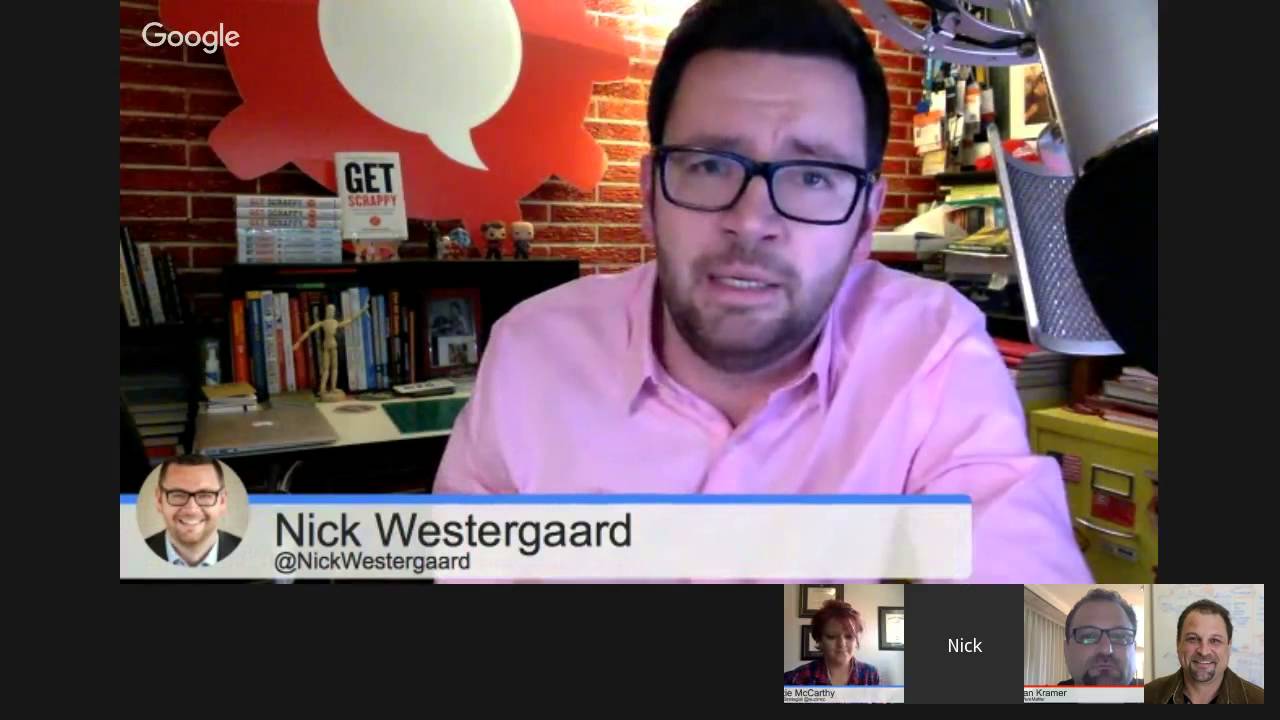
In this live H2H Chat, host Bryan Kramer (joined by co‑host Suzy) interviews Nick Westergaard, author of Get Scrappy: Smarter Digital Marketing for Businesses Big and Small. The conversation introduces Nick’s background (brand strategist, professor, podcast host) and the central premise of his book: every organization—whether a startup or a Fortune‑500—must adopt a "scrappy" mindset, meaning doing more with less by focusing on time, people, and strategic clarity rather than just money. Nick explains the Digital Compass (a 5W+H framework) for aligning business objectives with channel selection, distinguishes “money‑scrappy” from “smart‑scrappy,” and stresses the importance of employee advocacy (e.g., New Belgium Brewing, UPS drivers) as a low‑cost content engine. He discusses how to measure success by “measuring what matters,” prioritising metrics that move the needle over vanity numbers. The dialogue also covers testing vs. trying new platforms (Snapchat as a case study), the underdog mindset for large firms, content repurposing from podcasts to books, challenges in content volume versus strategy, and inclusive audience expansion (HubSpot’s growth‑show podcast). Throughout, Nick offers practical advice for solopreneurs, independent‑contractor networks, and brands of any size, reinforcing that a clear strategy—like a map—guides experimentation and prevents wasted effort.
Chapters
Hey everybody, how are you doing? This is Bryan Kramer, and I am very excited to be on another HT Chat, which means that it's Monday at noon Pacific Standard Time, or a different time other— everywhere else in the world. I'm not going to do all the calculations for you, you're going to have to look at your own watch. But here's the thing, It's H2H Chat, and we are going to kick some butt, because today is a great guest, one of my good friends. We are going to be talking about a topic that I think most of us should be talking about, because no matter how much money you have out there, we're all scrappy. And so we're going to get talking about that, whether you have a lot or a little, scrappy is good. Grappy is the way to go. That's how we do it at PureMatter too. I want to first, before I do a major introduction for our guest, I want to just say a quick shout out and hello to Suzy. How are you doing today?
I am doing well, very, very well. Not as well, I think, as you. I do think that you need to show everyone that view very quickly, just so that they can all feel the same jealousy that I'm feeling right now.
Alright, but you asked.
I asked. Although we do have some buddies who tune in from Puerto Rico, so, you know.
Yeah, we should invite them on sometime and we'll just do a viewing of everybody's home. That would be fun.
Oh yeah.
What if we did an H2H chat viewing of people's homes? That would be nice.
How about sponsored by HGTV?
Ooh, ooh,
a lot of H's in there.
He is always thinking. All right guys, here it is. I'm in Hawaii and this is my view out my window and it does not suck. No, I am not unhappy right now and Life is— life is good. There. I did it. Thank you for asking.
Yes.
I'm learning much from you.
Yes, and I need everyone else to share my jealousy. Do you know that it snowed? It snowed this weekend.
Really?
Yes, it snowed.
Wow. That's not good.
It's not good. It's very sad. Anyway, I was very happy about the snow. I was bragging all about it like 2 months ago. Kind of over it right now, just like, we're done. Anyway, enough about the weather, we have an epic guest.
We do, we do. So that said, I wanted to introduce Nick Westergaard. Nick, how are you doing and what's going on in your life?
Well, I am doing great and I am just thinking about weather and geography and I'm kind of splitting the difference. I'm in Iowa, so I guess probably closer to Suzy at this point geographically and probably weather-wise as well. We did have some snow spit at us a little bit on Friday, but then it's been shooed out of town.
Oh man.
I can't give you a great view. I'm on brand with an enormous logo right behind me. I guess I go that route instead of palm trees.
That's good, that's good. As a recent author, that is what you're supposed to do, so that is fantastic. And as both a friend and fellow author, I wanted to congratulate you on your recent book. That is a very exciting thing. And just real quick, before I let you kind of chime in, I wanted to give everybody an idea as to who Nick is. He helps build better brands at organizations of all sizes, so from small businesses to Fortune 500 companies to the President's Jobs Council, which is pretty awesome. I didn't know that. He is Chief Brand Strategist at Brand Driven Digital and host of the popular On Brand podcast, which I've had the honor of being a guest on. An in-demand speaker, as I know well, and probably most of you do, at conferences throughout the world. He also teaches brand branding and marketing. He is a professor at the University of Iowa. Nick lives with his family in Coralville, Iowa. You can connect with him at nickwestergaard.com. That's 2 A's in Westergaard. And @NickWestergaard. We'll put that up and we'll tweet that out for you guys. What we are talking about today, just so you guys have an understanding before I start going in on some questions for Nick is the title of his book, Get Scrappy: Smarter Digital Marketing for Businesses Big and Small. So whether you're a small, medium, or large business, the exponential growth of the digital marketing space can feel daunting. Add in the rapid explosion of new platforms, content mediums, and variables such as algorithms, and from a Monty Python quote comes to mind, run away! That's why we're so excited to announce that Mark Marketing strategist, author, and speaker, Nick is here with us today to talk about how to be and get scrappy. So this is meant for all of you, for all businesses of all sizes. That is a pretty large audience, so if you don't have any takeaways by the end of this, you probably weren't meant for H2H Chat. No, I'm kidding.
Out!
So Nick, tell me about the— let's get into the before, before you wrote the book. You and I know each other, go back a little bit, and I know you've been looking for a book to write. How did you come up with this idea?
Well, it is from my own indecisiveness, you know, as the other similar hat that we both wear is as an agency leader, and all of the smart advice there says to specialize on a particular industry or size of business or something. And I, as is reflected in my bio, have worked with small businesses, startups, entrepreneurs, also Fortune 500 companies, and I like working with all of these different types of businesses, so I never really drilled down as some do on a particular type of industry, SIC code, some other way of focusing my business, which a lot of smart people do and make a great deal of money doing. But I like the opportunities of working with all sorts of different organizations, but moreover, I started to see that marketers at organizations of all shapes and sizes were struggling with the same things, especially as it relates to digital marketing. You know, one of my favorite stories that I tell early on in the book is working with the folks at Schwinn, which we, all of us might think of as a great big brand. You know, we rode Schwinn, maybe our parents rode Schwinn, our kids are riding Schwinn, and they have a pretty small scrappy marketing team even though we think of them as this kind of monolithic brand. And I was explaining this kind of the seeds of this scrappy idea to Samantha Hersel, their digital marketing manager, and she said in response to that, as she was nodding along, she said, I think we could all use a few people or a few dollars more. And that's my favorite kind of definition of scrappy, because the fact of the matter is even the very big organizations are still both struggling to keep up and struggling to do more with less. And that's really what the book's about.
That's interesting. So it's fascinating because there was a quote— shoot, I'm not going to be able to quote who said it, so please, if you hear me from the last few weeks, jump forward and tell me I'm quoting you. But someone said, no matter how much money you have, you're always short on resources. And so in a sense, everyone's trying to be scrappy. Would you agree with that, or is that kind of, you know, no matter how big you are?
Absolutely. And it's not just— and that's the other thing, as you know, in kind of selling the idea for a book, it really, it was kind of the extra challenge here was really defining what this meant, because I think scrappy means something to a lot of people, but to some it means different things. And I think a real quick place to jump to is marketing on the cheap. And I don't think that the resource that's challenging, most challenging, is always money. I love the idea that you can make more money. You can't make any more time than you have. So, the time you have, the team you have, money is certainly a part of that, but it's not the only dimension.
Sure. Yeah, it's also about being smart. I'm sure you covered that as well. Now how did you go about the research towards the book? What was your process for looking at this huge topic?
Absolutely. Well, I want to make sure that if I really set out with this mission of really kind of a diverse book that could serve both small businesses and larger marketing teams at bigger organizations, I needed to both continue my consulting, coaching, our digital marketing work with those entities, but also set out to interview people from those different types of entities as well. And a great engine for doing that, I talk a bit about repurposing content in the book, but is my podcast, which you've been a guest on. Yes. And I want to say that I even pulled over material from the podcast that you were on specifically mentioned in the book. So for me, it is a big form of content that I'm creating, but it's also feeding this bigger piece of content as well.
So what you're saying really is that I'm in the book.
I am saying that I am. I believe specifically the Bryan Kramer focus of the book Is, uh, actually, it's a real— yeah, it's, it's, it's Get Scrappy: The Bryan Kramer Story. It was your unauthorized biography. I thought, I, I thought you signed off on this. Maybe it is unauthorized then.
I did, I did sign off. I now remember exactly doing that.
Yeah, yeah, we've already licensed it. It's gonna be a Lifetime movie, and I, I, I'm sorry you weren't in the loop.
I Yeah, I think it's because I thought it was Discover reaching out, and that goes through a whole different legal process.
No, actually though, actually, I do remember the quote from you from the podcast that is in the book plays on one of the bigger ideas, which is why I think now, this time in particular, is one of the most important for marketers to get scrappy because I think we've always been looking for ways to do more with less, but I think as new forms of media crop up constantly, I think we very easily fall into this trap of checklist marketing, of just doing all of the things, and it kind of gives us that quick hit of dopamine. We feel like, ah, I've got all the social media icons on my site. I'm creating all the different forms of content. Instead of focusing on what makes the most sense. I can't quote it off the top of my head, but I believe the Bryan Kramer quote is something to the effect of, even if it means producing less content, focus on better. That's a big message I try to build on as well.
Yeah, if I didn't say it, or if I did say it, that's a smart quote.
Sounds like something you might say.
That sounds like something I might say. So okay, let's get into the book. Walk us through just the general thought of the book, you know, the overview, beginning, middle, and end. Obviously we'll save a little bit for people to actually read the book, but give us a sense as to what we're going to get out of the book.
I will spend the rest of the chat reading the entire book aloud. No, but you said it, You said it yourself.
Oh, that's my quote. I'm
just kidding. I'll get straight to that. Well, you said it yourself talking about— I think you literally said, get smart, and the focus of the first part of the book is smart steps you can't skip. And I think that as much as we want to focus on all of the fun of the shiny new things, we have to first know what it is that we're trying to do. So I start by focusing on making sure— I talk about the marketing megaphone has changed. I talk about making sure that you understand the brand behind that megaphone, that you still have an ethos that you're working to communicate online as well. From there, we focus on scrappy strategy, including a construct called a digital compass that I call a digital compass in the book. Cool. to help you know what thing makes the most sense to focus on so that instead of trying to do everything, you're focusing on what makes the most sense for you.
That's great. I want to dive into that as a little bit of a focus on the digital compass, but before I do, I wanted to make sure that everyone out there— we'll just take a quick second to make sure anybody that's new here knows that you use the hashtag #H2Hchat, number 2 H chat, On Twitter, and there is a whole conversation going on on Twitter. In fact, it's like a stock ticker right now. I can see everybody tweeting. Just some of the most recent people that jumped on: Christy, Aldo, Glenda, Rachel, Terry, Adam, Jessica, Paul Bradley, Dawn, Mike, Lenka. Oh, there's Susie Smith. She's not only on this, she's also— I'm on it. On the Twitter chats, and Melanie, and the list goes on. So everybody is on there. If you wouldn't mind jumping over and not only partaking in the conversation and giving some commentary on what your thoughts are as Nick is giving us some of his background on the book, but also throw out your questions, because the second half of this, Suzy's going to be asking those questions of Nick, and I would take this time to make sure that you get those questions answered. So she's going to take those off of Twitter and read pose those verbally to him here. Okay, so let's talk about the digital compass, Nick. That is fascinating just in title, so how does that work?
Well, what I start with in the chapter on scrappy strategy, I love the old Rudyard Kipling poem of, I keep 6 honest serving men, they taught me all I knew. Their names are What and Why and When and How and Where and Who, and those simple 5 W's and 1 H that have been used through the years to help journalists suss out stories, to help managers plan new projects, can also be a scrappy tool for laying out that strategy for your digital marketing. So the first focus is again on that why, the business objective behind what it is that you're doing, and with that understood, you can then focus on who you're trying to reach and what action you want them to take, and from there it can help you flesh out the other points, the where and the when, and help you understand what works best when. And throughout that chapter, I also lay out a few examples channel by channel, within reason. It's hard to kind of COVID everything in an encyclopedic fashion, especially as fast as everything's changing. But you take a look at a new tool that everyone's talking about, like Snapchat, and you look at Taco Bell, which is one of the first brands that comes to mind as someone that is using Snapchat prolifically. But look at who they're trying to reach. It's not just because it is the shiny new thing. It's because it is very relevant to the people that they are trying to move to take action.
Nick, can you do me a favor and smile real quick? I'm going to do a quick snap of you. Say something, say cheese.
Cheese.
Okay, I'm sorry, I was supposed to do that in the beginning. Let's talk about money scrappy versus smart scrappy. And the differences between the two. I want to go back to that because it's a big difference. I actually opened up HTAchat, now I want to take it back. It's not just about money, it's also about smart. You said that yourself, and I wonder if you can give us kind of maybe a case study or an example or how maybe another brand uses smart scrappy.
Exactly, and that's a segue. The second part of the book is all about doing more with less, and one of the ways that I think we can do more With less is through embracing our people power. So often with social media, we are afraid of involving more of our employees, more of our team with what we're doing online, and oftentimes it's to our own detriment. A great example that I love is New Belgium Brewing, who make Fat Tire, all sorts of wonderful, wonderful beers. Yes. Wonderful beers.
I normally do this when people say human, but I'm gonna do it for Fat Tire and Beer.
Yes. I love what they're doing on Instagram, but they have one of the biggest followings among craft brewers on Instagram, I think only behind Sam Adams or something the last time I was doing a quick check, and that's even a very big Depends on your definition of craft also.
Yeah.
But what they're doing there is amazing, and you'd think that they must just be throwing people at this, and they are. They have 5 people, but it's not any of those 5 people's full-time jobs. They all do other things, but they're all co-creating and sharing in that Instagram responsibility. So I think that there's all sorts of ways that you can slice and dice the work without necessarily saying that that has to equal headcount.
You know, I'm just going to take just a quick sidebar here and ask you, because you're also a professor and you work with students, and so I'm curious, you know, as you were working on the book and you have this background with the up-and-comers of marketers. the up-and-coming marketers. What are you seeing in their world and how this applies? Like, how are you seeing their thinking on getting scrappy? Because they— I don't know, this is my opinion, but I think they tend to be scrappy, especially in college, but even more so as they get out in the workforce. I mean, you're fighting for everything, right? So how do you think this applies, not maybe to them, but also to the workforce going forward?
Well, kind of the course that I own that I'm actually on my way to teach later this evening is social media marketing. And if I were to add one more word to that course title, it would be social media marketing strategy. So I'd say one of the biggest things that I hope to leave those students with is, you know, putting that strategy— I don't know if it's in front of or underlying everything that we're doing online, because I think So many of them, it's interesting because we talk about digital natives like they're kind of this species on National Geographic that we're tagging and following. And I think they have a lot of experience with these tools, but not necessarily with connecting those to business objectives, to measurement, to all of these other aspects that we're all familiar with. I really enjoy that I get to both teach and consult because I'm working with students who have logged more Snapchat time than I could imagine personally, but they don't have the practical business application skills. Right. Then on the other side of things, you have businesses who understand their customers, what they're doing, but not necessarily the new media environment. So it's like both Groups are trying to do the same things and each one kind of has the other one's deficits. So I think my vantage point of working with both is getting to help both kind of overcome those obstacles. And strategy, I think, is one of the biggest pieces, but also being strategic with your decision-making also and knowing, back to the— the million-dollar Bryan Kramer quote that you can't do everything. And I think that that's a hard lesson for anyone, and I don't think it's just students because I think as marketers it's easy to fall into that trap of I'm going to do it all. Right. And instead of doing one or two things in a really unique and engaging way, I'm going to kind of be half-assing everything and, you know, so what I'm doing On Twitter, it doesn't really matter, that LinkedIn group, it's just I toss something there every now and then, instead of something that really means something to your audience.
That's great. You just made Susie's day, by the way. Her world is around—
Was it the beer thing? It wasn't just the beer thing.
It wasn't just the beer thing, actually, although that definitely brought it But no, strategy is— yes, strategy, strategy, strategy.
Suzy is one of the best strategists that I've met, and this is such a big focus on exactly— I mean, God, you hit it right on the head, Nick. It really is, because you can go onto social and you can do anything, so you forget about the strategy behind it, right?
It's so quick. Yeah, and I think it's a real interesting time too because, I mean, I'm not picking on Snapchat, but it's a great example because it is, with my students, it is ubiquitous in use. And then on the other side of that, you have those in leadership positions at client organizations, and they are, you know, kind of wagging the finger at a lot of the marketers I work directly with Even though they're not Snapchat users, they're saying, you'd better be thinking about Snapchat. And these kind of frustrated marketers are like, I don't know what to— I don't know exactly what we would do, or if there's not a strategic application, because I don't think there always is. And kind of that, I'd say, in the first and beginning of second quarter here, that's been a real big thing as Snapchat's prevalence has grown. It may not be the kind of panacea for everyone's specific business challenge that they're facing.
Yeah, and you know, I just have time for 2 more questions, so before we pass this over to everybody here, this is a great conversation. I think, you know, we really haven't touched on the strategy aspect of, you know, of this topic of getting scrappy. It's so wonderful that you're thinking along these lines. And so anyway, one of the things I want to make sure that we cover is Also the underdog theory that you cover in your book. Just before we get there, I want to make sure again that everybody is— I see the stream going on, but make sure that you throw your questions out now. #HTHchat for Nick. He's going to be taking that over in just about 2 questions. Throw it out. Put your questions out there, and we're going to take them and roll with them. All right. One of the things I wanted to ask you was about how— what the difference is between testing and trying. Like, okay, we've been talking about Snapchat, let's use that. Snapchat is one of those things where it's so new, you just have to get there and test it and try it, but what is the strategy behind Snapchat? There's not really one there. I mean, there could be, but there isn't yet maybe. What do you think? And it's not just about Snapchat, but just any social media, like what's the difference between testing and trying versus the strategy when you first jump into something in your theory of getting scrappy?
Well, actually, and that's even a little bit, I'd say, independent of anything that's in the book specifically, but even if something like Snapchat is not be a strategic fit for your organization. I think, you know, kind of where I've ended those conversations with the frustrated marketers who can't find an application but feel the pressure from the boss, I say to all of them and agree from my own approach as well in that we have to continue to experiment as marketers. So even if there's not an application for my business, I'm in marketing so it's a bad example, But even if there's not a specific application, I do think that we have to kind of wade in and experiment because there's also some of that that you're not going to know without playing around, without seeing how it works. And then, you know, you get under the hood of Snapchat and you realize, hey, this is kind of a neat way to provide special access, to go behind the scenes, and you start to learn some of what makes a particular tool useful or not. So I do think that you do have to test out before you can know if it is a good fit. But beyond that, I think that is where you can then segue into some of the frameworks in the book where I talk about some of the business objectives that we can use to ground some of these less focused social tactics.
That's great. Good, so congrats Nick, and congrats to the community out there. We are now trending on Twitter, so that's fantastic. We are— people like us, that's great. So final question Nick, not in your life but just for today on my segment, is the underdog theory. I am a true believer in the word underdog and how it can be applied. I'm curious How you've written about this in your book, what are your thoughts on the underdog theory?
Well, the biggest thing I think is, you know, I use that in the introduction in defining what scrappy is and isn't, and, you know, I do the— it's not just marketing on the cheap, it's not dumbing down your marketing, but that's one of my first on the what it is bulleted list, and I talk about, you know, it's thinking like an underdog even if you're not an underdog. Because that's what, you know, even though it sounds hard to get your mind around all of those different audiences that could find the book useful, I mean, I started getting protective not just of small businesses but of the marketers at larger organizations who I knew, you know, were dealing with, we've got less budget that we are expected to do more with, and to me, regardless of, you know, if they're Fortune 500, what their offices look like, how big their team is. To me, that's an underdog's dilemma. I have more to do and less to do it with. So I think that there's value in embracing that mindset.
I do too. It obviously is one of the things that stuck out to me in your description, whether it was in the beginning or just mentioned or something. It's one of those things where companies, when they start to rise to the top, they forget that being scrappy, that being an underdog is probably one of the most valuable things they can maintain as a mindset for their organization in order to get things done and continue to have fluidity in their organization. Once they start thinking that they're too big for themselves or that they've made too much money or they've grown too fast or whatever, then that scrappiness, they lose it, right?
Yeah.
Like, how do they— so how do you maintain the scrappy mindset?
Well, I think you said the other million-dollar Bryan Kramer quote just then, because I do find it as a mindset as opposed to it's something defined by the size of the business, the size of the budget, that it is, not to simplify things, but it's up here. And, you know, I think, yeah, you do start to have problems when you lose touch with that mindset as well. But beyond just saying it's a mindset, I also define that scrappy mindset as well about, you know, the various traits that that embodies.
Awesome. Well, I think everybody needs to read the book, and I think I need to too. So now my interest is
Do
it. So thank you so much, you have completely answered my questions here, although maybe I'll tweet them into Suzy, I don't know. But Suzy, that is going to be it for my round. You are up, I'm passing the baton. You're in good hands, Nick, and congrats again on trending on Twitter. And we will get everybody's questions here, try to get them answered. Suzy, he's all yours.
We have tons and tons of awesome questions coming in. We knew it was going to be awesome, but people are definitely, definitely being very taken by this concept of scrappy. As Bryan said, I am all about the strategy, so I'm very excited as well. Awesome. Thanks so much. Also, welcome to all of our H2H Chat community. I'm having a super fun time chatting with you guys. Please continue to tweet in your questions. I want to give a special shout out to our newest community member, Sabrina of Plumlytics. Everyone, please give her a nice little hand for joining us today. We're super excited to have you joining us from Canada. Hi, Sabrina. Alright, so let's get started with my buddy Tina Shakur. Hey Tina, so glad you can join us today. It's been way too long. She says, how do you get brands to overcome their fear of loss of control and allow employee advocacy to really bloom?
That is a huge issue, and kind of what I was just talking about with doing more with less, one of the kind of 3 tools to that, one of which is embracing your people power. And I think that's one of the challenges that gets in the way of utilizing the rest of your team, right, is this loss of control. What they're going to say, what our employees are going to say, what our audience is going to say, and that is very scary. But usually where I start with all of that, after you get the smelling salts out, is that we already have lost control. And I think you can look at case study after case study, gaffe after gaffe from brands, that there's not a way to put the toothpaste back in the tube. And, you know, not engaging, as we all know, isn't an option. So looking at All of this and, you know, kind of realizing that it's better to be involved, to have a plan for being involved, and to make your employees kind of a part of your army as well. You know, I love the story about the UPS drivers that, you know, came to the rescue of the brand when they got behind a couple of holiday seasons ago. And, you know, By having that army kind of at the ready, they were ready to weather the crisis that came their way.
I like that. I love the concept that you've already lost control. It's so true. You have to be in the conversation. That's like 101 of crisis management, right?
It is, especially in this day and age. And it sounds trite for those of us that do have our heads down on social digital stuff, but in terms of What they're talking about in the boardroom, in the C-suite, it's still an understanding that we need to drive home that there's not the control for the simple fact that our marketing channels aren't one-way broadcast channels.
So Monica Smith-Mullen, thanks so much for joining us, Monica. She joins us almost every week, shout out there. She says, what are 3 3 key things for measuring scrappy social media success to give you a sense that you're on the right track.
3?
It doesn't have to just be 3, maybe your top things.
Well, where I would start, I would expect an eye roll if it wasn't for the fact that I am talking with at least one fellow strategy nerd. Yes. And probably some others too based on all of this. But the first point I'd make about strategy is, you know, when the professor gets in the mode of wagging the finger about strategy, measurement is at the top of my mind when I'm doing that because we have all sorts of wonderful metrics, but they don't all matter. So knowing what it is that we're trying to do know what needle we're trying to move, it helps us know what gauge to look at. So I would say strategy is one. 2 is, you know, not getting lost in all of the numbers that we have. I'd say that that's an easy trap to fall into when you get into the confusion that can happen as you're sharing measurement. It's like everybody wants to know, everybody wants to see dashboards and scorecards.
Mm-hmm.
And I think as marketers, We can do evil with the information that we have, so it's on us to make sure that we're using numbers that are actually, you know, showing them the right gauge instead of, hey, here's a bunch of charts that go up and to the right, because we can all make them. We all probably have those numbers somewhere, but they might not be the ones that matter, which is, to sound like the corny book shill that I am, The chapter, or the title of the measurement chapter is called Measuring What Matters. And I think that that is tricky today, because we can measure a lot of things, we can look at a lot of numbers, but I think the advanced side of the homework comes in actually being able to narrow that down to what makes the most sense.
So how do you narrow them down? How do you go about creating that strategy? What's your go-to?
Well, again, I get back to the approach in the book of nailing down what business objective you're trying to affect, and I focus on 6 in the book of branding, community building, public relations, market research, customer service, and leads and sales. So if you have those kind of core business objectives that really aren't anything that new and surprising, but they are the Donald Rumsfeld, they're known knowns. And within that, I did not quote Rumsfeld in the book, only Bryan Kramer. But with those narrowed down, we can start to look at all of these different metrics that we have. And instead of viewing those as ends, I view them as the means To an end, and that they are ingredients in metric recipes that we can put together. So that if we are looking at branding, we can look at not just, you know, likes, but we can look at something more complex like share of voice. If we are looking at leads and sales, we can connect that data to what's happening over on the CRM side of things, which can be tricky. especially when it comes to systems integration, but it matters more than just looking at likes, followers, retweets, shares.
Impressions.
Yeah, exactly. I don't think I used this exact quote, but another mutual friend out there, Jason Falls, says impressions don't buy cheeseburgers.
Yes, that is true. Great question here from Jill Kurtz. She says, how do you avoid the temptation to just do it and not take time to create a strategy? I think this is so big, especially if you're talking about small business or all of that.
It is. It's also— I think that as much as I sound And kind of overusing finger waggy, but it's a hard time not to, because I think the momentum, all of this stuff is new and exciting, and you take that and cross-pollinate that with a little bit of kind of startup culture and fast prototyping, and there is this kind of momentum, and we're just going to quickly stand something up. And I think it is one of the hardest things about any of this is not just doing it, but having courage to do it as well. I mean, I think that there's some courageousness that comes with being scrappy and embracing that underdog mindset, but you've also got to speak some truth to power. I mean, I was joking about it earlier, but a lot of the marketers that I'm talking to that are saying, I don't think Snapchat is a great fit. I'm picking on Snapchat, but insert shiny new thing here.
Yeah.
But it's been especially prevalent in these types of conversations. They're saying, I understand it. I'm playing around with the platform. I don't see a fit for what we're trying to do right now. And they are afraid to say that because they sound like they're the unimaginative marketer.
Yeah.
And I think that It does involve really making the case that we don't have to do everything to be effective.
I wanted to clarify something because when I think of the term scrappy, in some ways I think of being able to pivot very quickly. I'm scrappy, I'm athletic, I'm moving here, moving there, but that's not quite what you're talking about here.
No, no, but I— exactly, but I don't think that they're as far apart. I think that pivoting is okay. I think the other, the previous question about just quickly standing up, just jumping in, and even that, I think Bryan made a good point earlier too about testing, because I do think, you know, even for the marketers grappling to find a fit for a new channel, a new medium, and what they're doing. I think we still need to be testing. You know, we see the growth in podcasting. We still need to be consuming different forms of content. We need to be kind of like, you know, it's not unlike someone in the food business. You know, I don't think you can be a picky eater and be responsible for putting together an innovative menu. It doesn't mean you have to like everything. It doesn't mean you have to eventually put everything on your menu. But I think you have to at least be open to trying new things.
So a question here from David Pepper, thanks so much for joining us Dave, he's one of our original H2H chatters, love you man. He says, who is the biggest brand that you believe continues to be scrappy?
The biggest brand that continues to be scrappy. You know, I cite a lot of different big brand examples. I cite the National Humane Society, not individual chapters, but the big Humane Society, and I think their approach in one-to-one response to their community is, you know, it's easy to to write that off, that that doesn't matter, that that's just a pile of likes. But I think that they embrace their people in that way. So that's one that I recognize in the book. Salesforce does some wonderfully scrappy things. I mean, they're a giant. But one of the scrappy ideas in the scrappy mindset that they employ that I love is, you know, The concept of seeing ideas everywhere, because I think in this day and age with all of these things and being as concerned as we are to do everything, we sometimes are a little too reliant on case studies.
Hmm.
And I think that sometimes we are, you know, we wait for a case study from a brand in our industry, in our business, in our same geographic region. What are they doing? And then we'll do that too. Right. And that's where, as Bryan knows with the whole H2H chat, I think sometimes we get so hung up on B2B, B2C, and even something simple as something like Valentine's Day that was a business-to-consumer created holiday. Salesforce created a Valentine's generator. to send Valentines to their customers. And I think that something like that is an idea that would have been easy to say, you know, that's, that's, you know, we're B2B, we don't do that. And thinking about little human connections, so remembering to see ideas everywhere is huge.
Waiting for that. Anytime you mention human, you do get applause. I don't—
Awesome.
Yes, it's a little surprise we like to break out on people. So Christy, thank you Christy so much for joining us today. She says, what strategies do you recommend for companies with many independent contractors? The example she gives is such as realtors or loan officers. How are they dealing with digital marketing and this get scrappy mentality?
Yeah, you know, I still think— Wanted to find a way to shoehorn and get the human applause in there again. But I think, like Pavlov's dog, but I think people are people. I know that sounds simplistic, but I think sometimes we think, oh, they're contractors, they're franchisees. We want to kind of create, not unlike what we were just saying with B2B, B2C, we want to make people different so that we can kind of fence them in and make rules around them instead of remembering, like my chapter says, that if we embrace our people power and flip that the other way and focus on how our people can help us, we can do big things. And I think you don't have to look far to find examples of that. Coldwell Banker does some great things. I actually just had their Chief Marketing Officer on a few weeks ago that talked about It was some ungodly number of, if you add them up, and they're independent contractors, they're realtors. But in their business, it's really obvious to see if you shut them out, that's probably the best example of people power that you need to use, that you could control, back to our previous point, Mm-hmm. your message, shut your people out, and only communicate as corporate, but you're leaving a whole lot of people power on the table.
How do you— so I have a question here from Constance. Constance, this is a really great question here. I'm going to rephrase it slightly. She's asking, how do we balance the concept of being an early adopter, so shiny thing syndrome, right, with the idea that, you know, with the worry about having unclear So big or small businesses with unclear objectives.
You know, that's a great concept because I also, I don't want to, I don't think we should give the impression either that just ignore everything new because I think as we all know in the businesses that we're in doing what we do, we can't because there are powerful new things. Like I've said, I'm worried that I sound like I'm picking on Snapchat, but I think it's kind of a poster child shiny new thing, but I also think it is an incredible tool that I think that anybody with marketing and social and strategy in their title, as all of us probably do and all of us know, we have to be dabbling, we have to be experimenting, we have to be playing with it. I would, again, I love metaphors, I would get back to the cooking example that we should be experimenting, we should be sampling, even if we're not experimenting As creators, I mean, that's like back to my podcasting example. Even if you're not podcasting, I think you should make sure that you're tuning in and that you have some experience even as a consumer. I think that that's not nothing. And I would say the same thing with Snapchat. I talk to all sorts of people that say, I've logged in, I don't know. Bryan's probably had it too when you're talking about Snapchat and you literally see people In the audience that are going and they're going back and they are either downloading or re-downloading as you're talking because they're, oh yes, yes. And I think that we are all again in the business of we need to be sampling, we need to be testing, we need to be trying.
So I have a question here from our buddies at PayCompliment who woke up at 5 in the morning in Australia to be with us. We love you guys. They always have awesome, awesome questions for me. They say, which scraps shouldn't you start? I think, what should we be worried about? What are the don't-dos for new players?
What are the don't-dos for new players?
If you're getting into digital marketing.
I think it's back to that point that you were asking earlier that it's easy to just get lost in the momentum. I would say don't start without a strategy. I think another important— back to Metaphors That I Like by Nick Westergaard. It's the name of my greatest hits album.
I like it.
But metaphors that I like, because I think sometimes you say, don't start without a strategy, and you kind of feel people— And I do think that bigger organizations have sort of ruined strategy because we all think about them in terms of those meetings. And that's why even startup culture hears strategy and it's like, ah, let's just start. Let's just stand something up. And I'm not in favor of the bad strategy stereotype either, of let's meet and sit around a conference table looking longingly into each other's eyes We'll wrap up, you know, tie up half the workforce in terms of marketing leadership here. We will put together a great big binder that's going to sit on the shelf next to the crisis plan. And it's not really going to help us do anything.
Yeah.
So that's why when I think about a metaphor that I like for a strategy, it's a map. And a map is simple because it helps us get from point A to point B. It helps us find our way if we're lost, and it also, if it has a clearly defined destination, that business objective that I was talking about earlier, if I know that I'm trying to get there, if I know that I'm trying to build a community online, if I know I'm trying to drive leads and sales, then along the way I might encounter a shiny new thing like Snapchat, and I might say, you know what? If I'm trying to build a community, I think there might be this interesting pocket of people that I'm not hitting with these other tools that I'm employing. It becomes a great filter for those new things that you encounter too.
I have a dual question here coming in from both Ralph and Molly. Thanks so much, you guys, for joining us today. They're both interested in the So Ralph is saying, what do you believe is the biggest challenge facing content marketing today and going forward? Molly wants to add to that and says, what is the biggest area of opportunity? So we have challenges, opportunities, and in the future.
Well, the challenges are easy, and only because it's also a known known. Data from the Content Marketing Institute shows us that it's still creating enough content, creating engaging content, and some of these other scrappy dilemmas that we've talked about in terms of budget, resources, things like that. And I think, to sound like a broken record, I think that it's really easy with our content to get into the more is better mindset. That as— that a more advanced content strategy always means that you are producing more content. And I think that we have to be more strategic with how all our content is coming together. When we look at things, you know, an easy example like I mentioned, the podcast interviews that I'm doing ended up feeding a much bigger content engine of my book. So I think that we have to get strategic with the content that we're producing because like our social media, it can't just be adding network after network. There has to be some sort of method to the madness, method to the marketing, or it is madness.
So I have a question here from our friends at Walk Off. They do some really cool stuff in terms of diversity in sports. And so they're interested in your take on diversity in social media and tech platforms, especially with content marketing. Where are we moving in that regard?
Diversity in terms of different forms of content?
No, in terms of representation.
That was a long pull of the coffee cup question.
Yes.
In terms of— talk me through the question just to be clear.
So in terms of different types of individuals, so perhaps brands reaching different demographics?
Yes, yeah.
Where are we going in that regard?
Well, and I think that that is where adding more content does make more sense. One of my favorite stories in the book is one from HubSpot. And they are a prolific inbound marketer, content marketer, and they have no shortage of blog posts, of infographics, of ebooks, and all of it tied to a very specific mission of lead generation to sales and marketing professionals, to us in the trenches marketers. They realized about a year ago that they had another audience demographic that they weren't talking to, and that was founders, CEOs, the people at the top of the organization that in many cases, especially in many new emerging organizations, were the ones that were the ultimate decision makers but weren't the tactical doers, and that space is closed up increasingly at organizations. So this is an audience that they weren't really addressing at all. And they also weren't going to be people that were going to read a HubSpot blog post, a listicle, an ebook, something else that they're creating out there. And at the same time, you had the— I always hesitate to call podcasting a shiny new thing. It's kind of a shiny old thing because it's been around for quite a while, but has steadily grown in recent years and has Only now kind of coming into the public spotlight more and more. And they realized you've got this CEO, entrepreneur, founder type who isn't going to be maybe as focused on sitting down and reading through this blog post or ebook, but this individual often has a commute with this time that many are reclaiming to kind of program their own podcast radio around. Their job. So they started the Growth Show podcast that is focused on, you know, as the name suggests, growth, and not just the in-the-trenches marketing and sales, but if you look at growth that is being driven by what the core of the HubSpot marketing engine is looking at, and they're talking with folks like Gary Vee. Seth Godin, Dan Pink, and more about these top-level issues, but they're kind of using content, additional content, as a way of reaching a more diverse audience demographic that they weren't talking to before.
Interesting. That just totally got my strategy wheels going. I'm like—
Strategy wheels engaged.
Strategy wheels engaged. Bryan, watch out. He loves the emails he gets from me. What if we did? So last question from Shival, and we just have about a minute left here. He says, what are strategies that solopreneurs can use in digital marketing to do better? So this is top tips.
Absolutely, absolutely. And I think that if you— I was kind of making the case for why it still matters at big organizations that might be losing budget. I don't have to make that case for the solopreneurs because you really can't jump into it without a strategy either. And I think also both crowds kind of bristle at strategy because a solopreneur doesn't have time for that bad strategy stereotype. But I think you have to know what it is you're trying to do, what needle you're trying to move. And if it's not the one that— if you're not the one doing it alone, There's all kinds of snake oil you can get sold out there in terms of marketing, digital marketing. So you have to know, you know, what it is you're trying to do. Is it drive sales? Is it build your brand? And based on that, you can put together a scrappy strategy to help you close that distance between where you are now and where you want to be as well. So I still get back to those SMART steps you can't skip. And if I would toss an asterisk into that, it would be reinforcing the idea that it's okay not to do everything. And I think especially that stigma can be amplified when you're a solopreneur, when you kind of feel the sad trombone, the wah-wah of, I don't have all the resources I need. See, Mike? Exactly. But you can feel like you're less, and I think that grabbing all the catchphrases, you know, you can lean into it a little bit more and say, I'm not doing everything. I'm doing what makes the most sense, what is a service to my audience. This is something that, you know, all of us on the marketing side, it comes from our industry, but I think look at Scott Monty. formerly of Ford, now Scott Monty Strategies, is a solopreneur. And the email that I just received today, so it's top of mind, it is going through all of the, you know, the huge amount of marketing news that we all know it's hard to keep up with. And I cheat because I get Scott's email that breaks down, from what I found, some of the most important stuff. Yeah. It might not have everything, but if I scan Scott's email, I've got most of the things that have happened this past week. It's incredibly valuable to his audience.
Yeah, love that. Seriously, we could go on for another hour. This is awesome. I did not get through all of the questions by far on the Twitter stream, so definitely if you get a chance, check out the hashtag. It has absolutely, absolutely been a pleasure to have you on the show today. I will let BK wrap it up from Hawaii. No less.
No sad trombone there.
No sad trombone. I'm tempted. Sad trombone for me.
Oh man, this has been fantastic. I've been managing the Twitter feed here while you guys have been talking. Doing the Q&A, and we've got some amazing conversations going. So Nick, if you— it doesn't have to be right after, I know you've got a class, but at some point you may jump on Twitter, and we didn't get to all the questions, so there may be some stuff there for you to answer. More importantly, I just wanted to thank you and congratulate you again on an amazing book, and obviously it was a great topic. Went went viral, literally. So we got scrappy and we went viral. So thanks again, Nick. Really appreciate it. That was fantastic. And congrats again on your book. Yeah, no problem. So next week we are going to have as a guest Brian Zmudzki. I can't say his last name, and he's a good friend of mine, and I tease him about this. Brian Zmudzki. Zmudzki. We're going to have a conversation just about his last name for the first 5 minutes. So he is the CEO of ZURB, which is a company almost like IDEO, but they produce IDEO-type products online for online experiences, and we're going to be walking through those online experiences that he's worked with over the years, including for toy companies and dot-coms and all kinds of fun businesses that I'm sure you guys will be excited to hear about. So he has an amazing process, something that he's writing a book on himself right now, himself around this process right now. We'll walk through that next Monday. Really exciting stuff. So thanks again everyone. You trended on Twitter chat because you were an amazing audience. We really appreciate everything that you do for HH Chat every week. With that said, cheers. I got to get to the beach, and so it's time to close out. Thank you all so much. We'll see you again next Monday at noon Pacific Standard Time, or whatever time that is for you around the world. Bye-bye. Bye.
More from Bryan


AI Didn't Make Leadership Harder. It Made Fake Leadership Impossible | CODA Keynote | H2H 2.0
Why AI Makes Connection More Valuable | BOLD Awards Keynote Trailer | Human-to-Human H2H 2.0