In this live H2H Chat interview, host Bryan Kramer talks with storytelling strategist, author, and comedian Kathy Klotz‑Guest about her new book Stop Boring Me: How to Create Kick‑Ass Marketing Content, Products and Ideas Through the Power of Improv. Kathy explains how her 20‑year background in high‑tech marketing and parallel career in improv and stand‑up comedy converged into a framework for making business communication more engaging. She identifies the core problem as today’s “boredom” epidemic—too much information, short attention spans, and transactional storytelling that fails to connect with human needs. By defining boring as the inability to hold attention and positioning the antithesis as meaningful, truth‑driven content, she shows how improv principles—truth‑telling, rapid idea generation, and the classic setup‑punchline structure—can be applied to marketing, product development, and idea generation. The conversation also covers the role of humor as a powerful emotion that creates connection, the mechanics of a good joke versus a bomb, and practical steps for translating comedic techniques into business storytelling. Throughout, the interview is informal, peppered with live audience comments, and emphasizes the human‑centric mission of “Keeping It Human.”
Chapters
Hey, everybody, how are you doing? This is Bryan Kramer. Welcome back to another H2H Chat. So excited to have my friend Kathy join us today. Kathy, how are you doing?
I'm great. How are you?
Doing great. Doing great. We are live going from San Jose to San Jose. And you know what's funny is the internet is probably routing our video signal around the world just to get us here. get back to your house.
I'm sure it is. It's probably true.
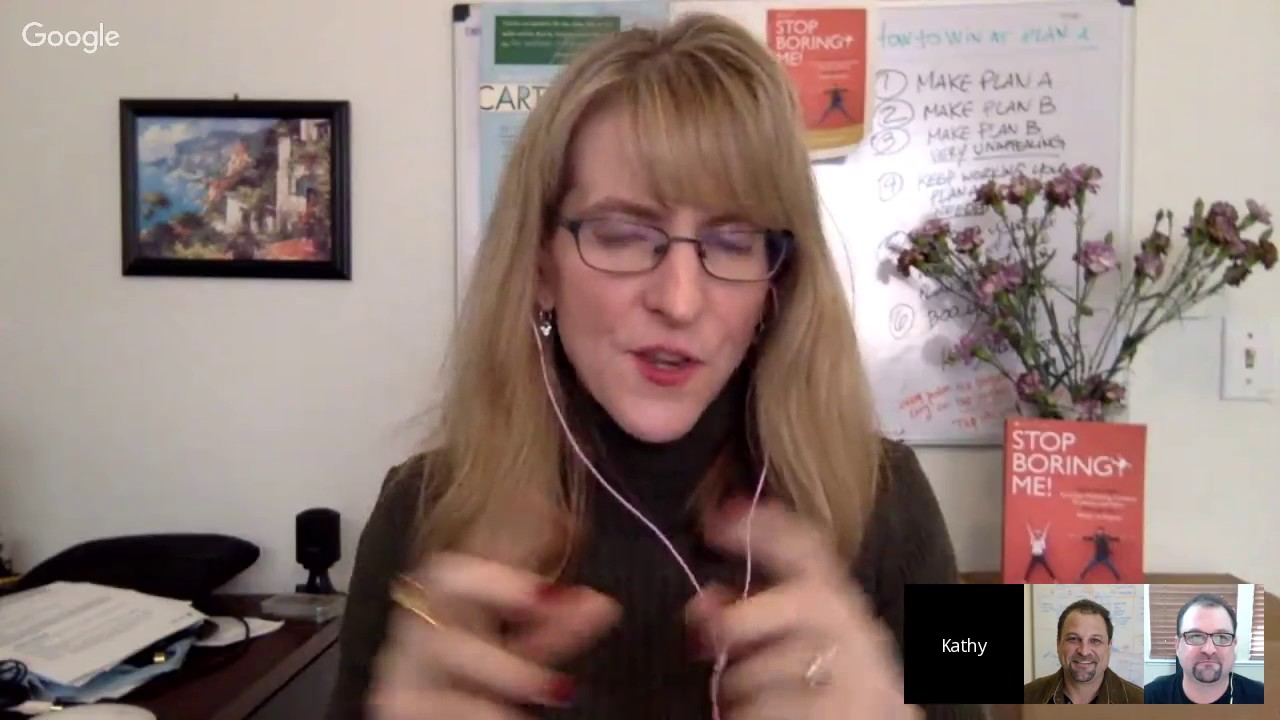
So funny. I actually didn't think about that till just now. Okay, so real quickly before we get into this, I want to get everybody who— if you haven't met or don't know Kathy yet, which would be rare, but if you don't, then here's who she is. Kathy Klotz Guest, she's an MBA, she's a storytelling strategist, an author, speaker, and Get this, she's a comedian, and that's part of why I love her so much, because she really does make me laugh. Founder of Keeping It Human. We have another thing in common— humans. Go humans! And by the way, Kathy, you know the rules. If you say the word human, there's going to be a sound, and I might even make that sound in the next 20 seconds, as if I could actually cue myself to do it. There we go. Little human error right there. OK, so her mission is to help organizations and teams turn jargon monoxide into— I like that, jargon monoxide— into compelling business stories, abolish boring marketing, and uncover bold ideas. She calls them idea orgasms. Wow. I love that. She's a podcaster, of which I've been on her show, a stand-up comic, an improviser. She's written 2 other short books on humor, content, and storytelling, The Executive's Bedtime Guide series, in addition to Stop Boring Me, which is her latest book, How to Create Kick-Ass Marketing Content, Products and Ideas Through the Power of Improv. That's not yet— that is this book right here. I'm like, did it say all that on the front? Yeah, it did. It's right here. So her work has been published in Convince and Convert, Business Story, Marketing Profs, Reagan.com, PR Daily, and the list goes on. Welcome, Kathy. How are you doing? And congrats on your new book.
Thank you, Bryan. It's great to be here. I love talking to you. So no, it's, um, things are going great. Busy and, and good. Somebody told me there was an election cycle going on. What's that?
Yeah, I don't, I don't, I think you misheard it somewhere.
I think I did.
Sorry. So, so excited to have you here. We, um, we want to talk about your new book, and I'd love to know First of all, great, great title.
Thank you.
Stop Boring Me. But tell me about the impetus behind the book. Where did you come up with the idea?
Well, it's funny because people have been asking me for years, you know, where's your book? Where's your book? And I— the work that I do takes from the 2 worlds that I spent years living in. For, you know, 20 years I did marketing for high tech. I came out of high tech. But I also, on a parallel path, have for the last 20 years done stage comedy, improv, I used to stand up and sketch. And I started noticing years ago that I was infusing all these principles I learned on stage to make narrative better, corporate storytelling better, was sort of coming into my work. And people would say, well, you know, how did you do that? And it became such second nature to me. I thought, you know, I'm getting so many great questions. And I think that there's a, I think, a misunderstanding about what improv is, and that improv's all about trying to be funny. And I thought, you know, If I could write a book and help people and explain to everybody at the same time what improv is and isn't and how it can help you and how it can help your narrative and your storytelling and your ideas, that could actually, you know, be transformative for hopefully a lot of people. So that was really the impetus of the book. I started getting all these questions and I felt like it was time.
It is time. It was your time, and I'm so glad that you did it. Tell me about the way that you framed the book. How did you come up with how to write the book? What was your process?
It's a great question because I did a mind mapping. And if people are familiar with that, it's just all these ideas connected. And I must have redone that mind map maybe 30 times. And I was like, the framing's not right. The framing's not right. And by the way, I never trust anybody with a clean whiteboard. That is just a good rule for life. You need to have a whiteboard that's got stuff on it. And I, I, it occurred to me that the 2 big things I kept coming back to with improv was what it did for me in terms of being able to do ideas and what it did for me in terms of storytelling. So the lens I took for the book is the biggest problem I think that companies have is there's too much information, too much information and not enough meaning. There's not enough meaning. So I think the biggest problem that companies have is in an era, in a time of reduced attention span and too much bad information chasing too little mindshare, I felt like there was a boredom problem. And you're not gonna get your message through if you're boring your audience. And I thought, well, maybe boring is the lens. And I can talk about storytelling and ideas and idea orgasms all through this lens of busting boring. So it took many, many iterations, but we got there.
Define boring. for me. Let's talk about boring versus— what would the antithesis of boring be? And define boring.
You know, boring to me is really just not being able to hold your audience's attention. And I think the antithesis of boring is being able to communicate with your audience in such a powerful way that they see meaning. It doesn't have to be funny. It can be poignant, it can be moving, it can be all these different things, but the number one thing that anything that isn't boring has in common is, I'm going to say it, it speaks to that humanity. It speaks to something— It speaks to something that's not transactional, and it occurred to me over the years as I thought about it more and more, most business marketing and storytelling is completely transactional. Transactional is like a book report. It's like a really bad book report and nobody wants it. Nobody needs it. And it says nothing of value about how you're going to make my life better. So the antithesis of boring is meaningful content that tells your audience how are you going to make their professional life and their personal life better.
So you're a— you are— you're not only an improv comedian, but also a stand-up, which I believe there is a difference between the two, right?
Yes. So, so when
you, when you look at the two, And you just think about comedy in general. It's one of many emotions to laugh.
Yes.
Laughing is, you know, if you look at different, depending upon the researchers or whoever you look at, the one that I've followed was Dov Seidman, and he outlined 6 different main emotions. Fun or laughing was one of them, humor. Where do you think humor falls in the grand scheme of emotions? I'm totally curious because your love, your passion is to make people laugh.
Yeah, yeah, absolutely. I think, I think humor is one of the most powerful emotions that grabs people and holds their attention. But, and when you, when you make people laugh, you have made a connection. Now your message can get through. So what it does is, in that laugh that you've shared with somebody, now they're going to listen to you. And it's sort of like when you see somebody come out and you're thinking, I don't know if they're going to be a good speaker, I'm bored, and then they make you laugh right off the bat. They have your attention. You're going, I want this person to be great because they've made me laugh and now I'm going to hear what they have to say. And I think humor actually, and I know you love humor too, Bryan, and I know you're a big fan of laughing and humor in general, but I think it's also one of the most feared and misunderstood emotions because people are afraid of making a mistake. Yeah. Right.
So let's, let's walk through, let's walk through some of the steps because I want to get into the book, but I feel like there are some steps that you probably take in, in your comedy that are aligned or in, in parallel to what you're talking about here about how to stop boring me. Yes. Let's talk about those steps.
Absolutely. I think, you know, when I step back and I look at what does business storytelling have to do with comedy, and the answer is really simple. It's this. It's the big, big human truth staring you in the face. Because what is comedy if not the truth? I almost missed it. Yay! And it's the real, real truth that we all acknowledge and laugh at because you're like, oh my God, that is so true. That's what comedy is. But great business storytelling takes the truth of the reality that your audience is struggling with, whether it's, you know, they're buying because they want to reduce their risk, they're worried about credibility, they're worried about their visibility. They don't care about your product. They have these human needs that are driving everything. And if you can speak to the truth of their aspirations, That's not gonna be boring. So the big, big thing you start with is, what's the truth of my audience? What are their struggles? What is at stake if they don't meet that need? What's the funny truth? And there's nothing funnier than watching, it's just a fact. I mean, you've talked about this with your inner fucker. When you watch somebody get blunted, they see what they want, they have a human need. You know, Ben Stiller's character, he wants Terry Polo, he wants the girl, and he desperately wants those in-laws to like him. But it keeps getting blocked and it keeps getting blocked and keeps getting blocked. Now we've built up the comedy because the truth is we've all been there and we feel for this guy. Then when we're ready to sort of release it, you see how part of that human need gets met and he gets the girl. Eventually he wins over Robert De Niro and he can't help but like the guy. And so you start to see some of this kind of by the end. That's, that's an approach for great business storytelling.
I love it. And I'm going to speak the truth right now. Um, I think your microphone might be hitting your, um, uh, your sweater. And so just in case you may— yep, it is. I just, I just heard it. So you may want to just hold it out a little bit. Um, because I would hate for that to interrupt your storytelling. See how I did that?
I did it.
Maybe, maybe it didn't work too well. I need to learn from you. Okay, so, um, So, so, okay, when you're telling a joke,
yeah,
what makes a joke funny? And when— what makes a joke bomb?
Oh gosh, there's a lot of factors. You have to speak from the truth, but it can't be mean. You know, for example, I, I like to joke around when I'm, when I'm doing stand-up, and I say, so I've been married 15 years. To the same guy and everybody claps, woo, woo. And, and, you know, people always ask me, Kathy, in 15 years of marriage, did you ever think about divorce? No, honestly, I never did. Murder? Hell yes, many times. Now every married person laughs their ass off at that, and you know who's married because they're like, preach it.
News sound.
There's truth. There's big truth in that, right? We love each other, but you get frustrated with each other sometimes.
Right.
That's truth. And so I think when you're telling the truth in a way that's not mean, that's real, people relate. That makes a joke work. The other things that don't make a joke work: meanness. So if you're making fun of somebody rather than laughing at the situation, that doesn't work. There's also structural things that don't make a joke work. There's a real setup and punchline. And you have to, you know, set up your joke just right to make the punchline work. You know, my husband and I share just an absolute love of music. He plays piano and he loves it when I don't sing. And so we just, you know, we just get along that way. And so you have to make sure that everything that you're setting up either leaves room for a twist or a big truth bomb. And so it I don't want to overcomplicate it, but what makes comedy work is being real and honest and raw and truthful and saying it in a way that people will hear, you know.
I love it. Sorry, you're getting all kinds of fun comments here on the side too. Mitch Jackson just said, we've been married for 28 years. Our secret is trust and understanding. She doesn't trust me and I don't trust her.
Exactly, exactly. And all the married people know the big Truth with a capital T that's in there. Yeah.
Oh, that's great. And, uh, it looks like we've got a lot of great people on. Uh, we've got Alan Berkson and Aldo Maragoni and Jennifer Merrick, uh, Sarah, um, Sarah Gopera, Molly. Um, let's see, we've got JS just popped in. Randy, Randy just posed a question. We'll get to that, uh, for sure, Randy. And David. Dawn. So we got a lot of really great people on. Thank you guys all for joining us here today. We're talking with Kathy, if you just joined us, Clotz guest. She just wrote the book Stop Boring Me. And if you don't understand what that title means, then you're on the wrong HHA chat. It's a wonderful book.