#H2HChat: Moments That Count: When Collaboration Sparks Innovation with IBM
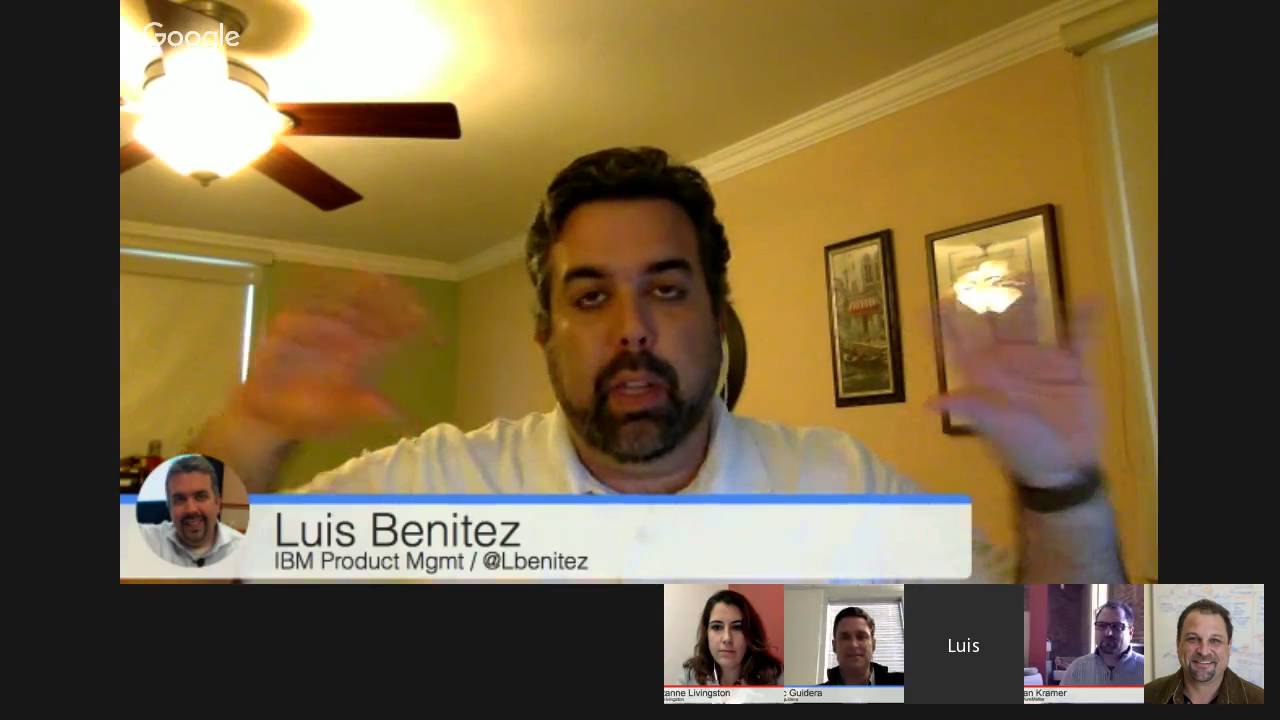
In this live #H2HChat panel hosted by Bryan Kramer, IBM veterans Suzanne Livingston, Mac Guedera, and Luis Benitez discuss how enterprise collaboration and social technologies can drive innovation. They trace the evolution of collaboration tools from mimicking face‑to‑face work to enabling new, border‑less ways of sharing expertise. The conversation covers cultural barriers such as the "knowledge is power" mindset, strategies for encouraging adoption (on‑ramps, advocacy programs, executive sponsorship, simple use‑case pilots, measurement of process improvements), handling different user personas (introverts, heavy collaborators, remote workers), and practical tips for building community (leadership involvement, champion networks, in‑person meet‑ups, clear guidelines). Audience questions are answered throughout, focusing on selecting the right technology, managing information overload, and keeping remote employees connected. The panel wraps with a preview of IBM Connect 2016 and a look at future directions for IBM’s collaboration suite.
Chapters
Hey everybody, welcome back to another HTH Chat. This chat is on a Tuesday because of the holiday yesterday, so we had a lot of questions yesterday with people showing up for an HTH Chat. I apologize that we had to delay it one day, but I'm really glad that you guys joined us here today. We are off and running. We've got our guests on this great panel. I'm just going to get right to it. and start making some introductions and talk about today's chat. I'm really excited about the topic about collaboration, when collaboration sparks innovation. It's going to be really fun to talk about. As you know, collaboration within any company is a massive undertaking to get done right. So again, the title here, Moments That Count: When Collaboration Sparks Innovation. We've got some IBM experts, and today is a partner— partnered chat with IBM, our partner IBM, which we're really excited about. So with the IBM experts we have here, we want to talk about how innovation and collaboration happens as a positive impact of enterprise social solutions out of any organization or an evolution of what we talk about all the time in social media. So how are key things considered when implementing social solutions within an organization? That's going to be our focus for today. I'm really excited to introduce my guests here. We've got Suzanne Livingston, Mac— here we go— Guedera, did I get that right?
You
got it. And Luis Benitez. Did I get that right?
That's pretty close.
Pretty close. Thank you guys. Man, I always— that's my one biggest thing as we get close to the names. Everything else from here is going to be great. So Suzanne, why don't we start with you? Why don't you go ahead and introduce yourself to everyone, give us a little bit of background about you.
Great, thank you, Bryan. Hi everyone, I'm Suzanne Livingston. I've been with IBM longer than I care to admit on screen, but since— for about 13 years. I actually started with IBM Research, so I was researching social technologies and their impact in the workplace, and lo and behold, we created an enterprise social software suite out of some of that research as well as others and brought that to market. And so I've been part of IBM Enterprise Social Solutions Since then, and now I manage the team of product managers who bring our solutions for mail, chat, meetings, cognitive solutions, as well as other technologies into the market. Thanks for having me, Bryan.
Great, thank you so much. It's going to be fun to integrate some of those things into the conversation here. Luis, why don't we have, have you introduce yourself as well, give us a little bit of background about yourself.
Sure. So I've been with IBM now, it's going to be close to 14 years, so about the same as Suzanne here. I've been working in collaboration my entire IBM career, different products, different solutions, but certainly always in the collaboration world. I started as a developer, moved on to our services arm. From there, did a little bit of sales. And now I serve as one of the product managers for our social collaboration solution. My windows are closed, so you cannot see. I have palm trees outside. I'm based out of Puerto Rico. And I'm happy to say that although it's a bit cold— it's about 72 outside— it hasn't snowed, so it's good.
OK, that definitely takes the cake for awesome location from an H2H chat. OK, so Mac. Why don't you give us a little bit of background about you?
Yeah, thank you. Happy to be here. I'm a social workforce strategist at IBM, and I spend time with our clients worldwide looking at how they collaborate within their organization, both internally and with partners and vendors and external customers that they might have. I spend a lot of time looking at how people are wasting time emailing or could enhance themselves by allowing for better chat or the growth of an enterprise social network within their organization and get people to share more, getting beyond file send and instead allowing people to share their expertise or the work that they are doing.
Great, great. Well, welcome all of you guys. That is, we definitely have some longtime experts here. Having all of you on and having been with IBM for so long, it's definitely bringing a sense of history alongside some really new ways of thinking. So I guess my first question, what I wanted to kick this off with was just, you know, and I think this might be even a softball, but let's just talk about collaboration in general and we can go from there. We'll dive deeper as we go. Real quickly, before I ask you to define collaboration and how you each see that, I wanted to make sure that everyone out there is posing your questions as we go, because the second half of this, as we always do— and if you're new to H2H Chat, then you'll definitely want to take part here— all you do is use the hashtag #H2HChat in the Twitter feed. And, and Then Susie's gonna be coming on for the second half of this. She'll be taking those questions and re-questioning or refocusing, redirecting them to our great panel here. So definitely make sure that you throw out your questions as we go, and we'll be happy to take them. So biggest question that I wanna start with is collaboration. Collaboration as it has to do with everything on the whole. I mean, Suzanne, you talked about You talk about mail and apps, and the other 2 here have also chimed in on social and strategy, and the list goes on when you think about all the different things out there that potentially have to do with collaboration. I mean, God, I have to Snapchat my daughter to get her to come down for dinner every night. If I yell, she doesn't listen to me. If I Snapchat her, she comes down. So when you think about collaboration in the sense of, you know, these enterprise systems and how you're going to get collaboration, the best collaboration out of people, what is your thinking there? Suzanne, do you want to kick it off?
Yeah, sure, I'll get started, Bryan. I think that if we look back, technology has played a huge role in enabling people to collaborate. You know, at first technology tried to support the way that people interacted normally. Like if you and I worked, Bryan, out of the same office, you know, how would we get something done? How would we work on a project together? I might go up to you, talk to you, and I may have documents that I need to share with you, or we may collaborate on a whiteboard, or we may work together in person. Right. And I think that technology has tried to replicate at first a lot of what people naturally do in their day-to-day world. But what technology has done over particularly the last 10 years or so has just jumped us even further so that we can do things that we couldn't do face-to-face, do things that we couldn't do in an environment like an office setting. You know, for example, if I'm starting a brand new project and I've never done it before, how do I find out the best way to get it done? And in the past, you may have asked, you know, a friend of a friend or a colleague or someone who might know. But today I have access to all of the expertise and knowledge that people within my organization have, as well as people outside of my organization. So I think today's role of technology is to push the boundaries even further beyond what we can imagine ourselves to be able to do when we are face-to-face, to what we can do that is unimaginable, that we can gain efficiencies from Without needing to ever even meet each other.
Mack, you want to take it from there?
Yeah, absolutely, and kind of resonating on the technology theme, but you know, getting back to the heart of it, as humans we're social animals, right, and we have a desire, there's a strong desire to connect and to share, right. Since the dawn of time, you know, we've come together to hunt and gather and work on things together, and that's not going to stop. We'll be able to, you know, look at our past history and where we're going and always map together other people and the expertise that they can bring and the value that that will help us in what we're doing there. And as Suzanne said, is if you're looking for, you know, the new ways to start a project, or if you're new in an organization and you're trying to understand, you know, how do I get started here? What do I do as a new employee? These tools and technologies that we have are going to enable that, but at the heart we're always going to be looking for the people to help us get there.
Fantastic. Luis, how about yourself?
Sure, so one of the things that I think was one of the big pain points when I first joined the workforce was just how many silos of information existed way back when, right. One of the things that we've been trying to do is how do we create a place where, like Suzanne and Mac were saying, make it easier to find the people that you need to work with or the humans that you need to work with, as well as once you find those experts, then allow them to collaborate easily, right? So especially for people like me that may be geographically dispersed, how do we make them feel connected to the enterprise and give them the right opportunities to perhaps you know, grow their career or, you know, connect to the right people and not be limited by where they may be located geographically.
So let's talk about the social part of collaboration, the encouragement of both internal and external social collaboration. Social has taken on a whole new meaning in the last 5 or 10 years, but social has been around As far as community goes forever. How do you see social changing in behavior, and how do you encourage the right kind of social? And I'm not just talking about Facebook here, I'm talking about social in the truest sense of the word, both digitally and not. Luis, do you want to start with that?
Sure. And it's an interesting question because it depends how you're asking the question and also where you're asking the question. So for example, living in Latin America or in the Caribbean, Central America, whatever you want to call it, one of the challenges that I started hearing a lot from organizations was, I don't want to do social because here it's all about knowledge is power. Right. And so they saw social as a way to distribute the knowledge and they had a fear of, well, if everybody has the same knowledge that I have, then I'm not needed. And so my value to the enterprise or to the organization is not there. And so it was interesting because when I was talking to organizations or enterprises kind of based in the US, I didn't see that as often. So one of the things that I've recommended to companies that are looking at this is Think about how not only you're sharing knowledge, but the influence that you're impacting or you're having on other people, right? So that's what you want to be able to drive to. And so if you have a platform where you can share your knowledge, influence, and let people know what it is that you know, that perhaps may open up yourself to other opportunities. So to be more concrete, one thing that I— very specific that I want people to know. Don't do social for the sake of doing social. Rather, what's the actual end benefit or productivity enhancement that you can drive to the individual humans that are out there? Don't tell them, oh yeah, you should do social because it's going to help our company network. They probably are not going to care about that. But if you tell them, hey, Listen, we now have this new platform. It's going to help you do your work 5 times faster than before. It's going to help you reduce email. It's going to help you perhaps grow your career. Those are things that people like, and so you'll grab their attention and it'll motivate them to learn more and engage more.
Great. Suzanne, what are your thoughts here?
Yeah, and I have to comment because Luis is awesome at doing this himself, so you could Google anything about our product, and I guarantee you it will land in one of Luis's online presences, either through his blog or through Twitter. And, you know, he's a living example of someone who makes knowledge available to other people, not simply just because he likes to share, but also because he recognizes that by doing that, he's enabling people to help themselves. And so a lot of times organizations, especially the ones that we've worked with who are interested in using social technology like that, there is some pressure. So it doesn't usually just come from the top saying, hey, we are going to do social. It's usually associated to something along the lines of, we have this business problem, or we are losing employee engagement, or we are losing customer engagement. And we need to figure out how to solve that problem. And social might not come up at all as one of the answers, but what that company might do is try to understand what are the business challenges they have and what are some of the approaches that they want to take to solving that business challenge. And often that leads them in the direction of some type of collaboration. How can they get A team of people to assess and put a plan together? How can they better understand what's happening in their market or from a competitive standpoint and, you know, put an action plan in place in order to achieve it? So it's more that it's coming from a place of need and a place of company wanting to have a stronger stance in an objective. And leading them down the road that it's the people who are part of their organization that can make this happen. They need to be engaged and they need to be part of the solution and getting people to come together in order to do that. So tying the humans into the technology.
That's a great way to end it. I know that's The big question moving forward is how technology and— I'm not going to clap myself— technology and human marketing really start to meld together and become something that you don't even know is happening, but it's just happening at the right place at the right time because it's a part of our lives and it makes sense versus being creepy and not working. Mac, any thoughts or suggestions there?
Yeah, I mean, the big thing is that you kind of alluded to this, right? In trying to communicate with your daughter, Snapchat is the way to go. And, you know, it's about finding a trust between people and where they will communicate and collaborate and have an understanding that, you know, you're in the right place at the right time. Social is an idea of being able to share things with people and making sure it gets to them, you know, where it's important and when it's important is the topmost of value. Luis talked about, you know, when he joined the workforce that things were in silos, and more and more I'm seeing the need across the world to break out of those silos in all sorts of organizations and industries because flattening the world and doing so inside your organization is going to be the key to success and helping you as a company kind of pull ahead of the others.
Great. Yeah, well, let's move on from there into looking at the differences between the people who are wanting to be social and the people that are having a hard time being social or collaborative. You know, you can go with either one, whichever you feel more comfortable with. But how do you encourage behavior that somebody's not feeling? Perhaps they're more of an introverted nature, although I tend to believe that introverts actually do better on social than they do in real life. But how do you move that kind of behavior where They feel like it's not— it's foreign nature. It's not— it doesn't feel right. How do you all believe that you can move them and move the needle into that kind of collaboration? Where then on the flip side, and I'll ask this maybe as a second question, but just think about it as you respond, is you've got people that maybe over-collaborate and are over-social. So, you know, maybe we could take that as a part A, part B. Let's start with the first one. Matt, do you want to start this off this time?
Yeah, when talking with a lot of my clients, I get back to the point of understanding your audience and knowing that there are going to be people that are going to be out there, they're going to be the ones to start the conversation, they're active in social media, they're like Mr. Benitez, you can't stop them, they're always out there saying the latest and greatest, and they're very comfortable doing so. But they're not the only ones that get benefits in working in this way. Having, you know, the set of people who will comment or will like something or be able to add in their 2 cents is just as important. And your largest set, as you're alluding to, Bryan, are maybe the introverted people that are reading and learning, gaining knowledge and expertise from what other people are doing, and then taking that model and bringing it forward to a close-knit or a smaller team or a group. Being able to express that, you know, allowing people to collaborate in the ways that are comfortable to them and being able to infuse it into what they're doing and make it comfortable is key to success. And allowing for everybody to work in a way that again they're confident and trust and know that what they're doing is appropriate and is going to help everybody else.
Hey, awesome. Suzanne, how about yourself?
I think there are significant differences for people who are trying to build a sort of a persona on the web as we see it today, you know, on Twitter with public-facing blogs versus inside the workplace. And I almost think it's easier for people to adjust to sharing and being more collaborative in the workplace for a few reasons if the right structure is in place. I do think the onus is on the company who is trying to adopt these technologies to put the right structure in place. So I'll give you a couple things that I've seen happen with some of the customers that we've worked with over the years. You know, one, I think certain types of companies have a certain level of resistance. This could be cultural, it could be, you know, based— and I don't mean cultural meaning geographic, I mean corporate culture-wise. You know, there's some resistance to wanting to share. Perhaps a lot of it is you are paid to have the knowledge that you have, why would you want to give it away? I think someone mentioned that earlier. Well, you know, I think some of our customers who have wanted to realize the benefits of social have said, look, we know we are going to have some resistance to this change. In order to deal with it, we need to understand where that's coming from and allow people to get past it. So one of our customers ended up doing a study of some of their least likely to adopt the technologies, and then they built personas around those people and shared them very publicly inside the company. You know, if you are the— you know, I'll give an example. Let's say you are a senior executive. You know, perhaps you are in a role or in a situation where you don't feel like you want to share, you don't want to overshare, you don't know what to share. They took that persona, described it in generic terms, and then shared examples of how they could benefit and how they can benefit others for those people who represented that population. That's one case. Now another case, maybe you don't have as much resistance, but people don't necessarily know what to do. What do I do? I've got, you know, all this stuff available to me. What am I supposed to share? Well, one strategy that customers have taken with that is get focused on really simple use cases. What are these people trying to do in their day-to-day role? What is their business objective? And show how using these tools will help them achieve that objective with the benefits that come with it. So take something simple, maybe you're someone who is in procurement. Well, how can you replicate what you do day-to-day inside of collaboration tools and what value do you get. Maybe you reduce the amount of time that it would take you to get through the process. Maybe you can engage other people who know how to work with another vendor that wasn't necessarily part of your list to begin with. And I think the other thing that companies have done, whether they have resistance or whether they have simplified use cases in place, is that they put put together some type of advocate programs within their companies so that others can learn the technologies that are available to them, how they can use them, understand how it applies to them. It's all about them and what— how can we make these real to them. So for example, you know, again, you might be a part of a company and not necessarily know how to use these tools. Maybe they'll buddy you up with someone from their advocate program and say, you know, learn from so-and-so how to utilize these technologies and see what the benefits are. And that gives you an easier way to get started without necessarily, you know, posting something for the entire world to see and, you know, feeling insecure about that, but, you know, giving you some real critical ideas on how you can get started and see benefit immediately. Those are a few things that I've seen customers do. There's certainly many, many more.
Fantastic stuff. There's a lot of takeaways there. Luis, how about yourself?
Yes, a couple of things. So, you know, when I'm thinking about getting people to kind of change their behavior or, you know, think about a new way to work perhaps, one of the things that we've seen is pretty successful is, you know, think about on-ramps or how can we get our users into the system or Even better, how can we bring social to the end user so that if they live and die in email or if they live and die in spreadsheets or CRM or whatever business tool, what can we do to enhance the capabilities that they have today to provide things like better search or better file sharing or expertise location like Suzanne was mentioning earlier? That's one of the things that you can do where as an organization, you can enhance the things that people use today and slowly but surely drive them into the new platform, if you will, rather than just, hey, here's this new platform, go at it, figure it out, see you next year. So that's the last thing that you want to do. And actually building on what Suzanne was just saying, one of the things that one of our customers did last year is as they started building more and more communities and they started getting more and more adoption with their end users, they actually were able to get all the community managers. And I think there were maybe like 300 managers, 300 community managers enterprise-wide, which is a large amount. But it speaks about how the company as a whole was fully committed to this new way to work. And what they did is they flew all 300 community managers to Brazil. And so they had a huge powwow where community managers were talking about and exchanging ideas of things that were working, things that were not working. And so it was just tremendous to see how the enterprise, all the way from the top, was fully supporting this new initiative to enhance productivity and just help the company be
Wow, so ironic that it's always better to get together in person in order to drive an online connectedness. That really speaks volumes to, you know, a lot of— I'm sure a lot of our community and helping them. I know, you know, every time I meet somebody whose picture on Twitter is this big and then all of a sudden I meet them, That little picture doesn't seem so small the next time I go to tweet them. They are real people all of a sudden, and it makes a big difference. And, you know, the ways that we connect with these collaborative tools, with the technologies, really drives a better relationship when you actually get offline and actually build the relationship. And so that's kind of where I think we should end things before we take everybody's questions. So again, Make sure that you pose all your questions in the #H2HChat. Suzy is going to be jumping on here in the next few minutes to take those questions and redirect them at our panel, at which time I will jump off and start helping with the community. So we'll be switching that around. So let's end this with a quick tip because we just have a couple minutes left for this segment. If you guys can each take about a minute to a minute and a half and give a quick tip, a takeaway for the best way to build community, build engagement, or build collaboration using, obviously using technology. Give us just one of your best tips there. Suzanne, you want to start with that?
Yeah, sure. I feel that most of the customers that we've worked with have sort of started with a process or a business organizational process that they have wanted to improve. And so my tip would be to any company who is looking to adopt technologies of this manner or looking to utilize technologies for the purpose of growing collaboration or social, to identify what process could benefit from these tools. Pick something, something that is a critical part of your business that would motivate people to join in and change the way that they work in order to make it better. And then set some measurements in place. So how is that process performing today? I'll give you an example. One of our customers had a a process where they were responsible for getting back to their own customers with proposals. And so, you know, that might take them, you know, a month, over a month to get the information that they needed collected and responded back to their customer. So measure, you know, what's critical to making that process a success, and then identify what you're going to use social to do. How are you going to improve that process using it? And then remeasure it, you know, take another set of measurements around how well that process is performing afterwards. So in this case, they were able to reduce from over a month down to a few days utilizing special tools. So there's definitely ways in which you can, you know, get started, and that's my tip. A lot of times companies think afterwards, oh, I should have measured that process beforehand. So do it now. Figure out what you're going to do now, and then— Once you've adopted these, once you've gotten a pilot, or once you're working with some of these technologies, then that'll give you a better sense of how far along you've come.
Great, fantastic. Thank you so much, Suzanne. Mac, why don't you go next?
Yeah, you know, the biggest thing that I could maybe give some words of wisdom to would be build it and they will come is not going to work. You need to have a plan Figure out kind of who your knowledge tippers are, people that want to work this way, and get them involved early. Have them help you shape what the platform should look like and, you know, what you want to get out of it. And in that terms, define success and make sure you come at it both from a grassroots point of view as well as a top level and meet in the middle. And as you're doing that, be prepared to Find new avenues that you didn't think about and explore those and not see them as failures or challenges, but maybe as just new opportunities to find new ways to work.
Love it. And I love that you actually just found a way to slide new way to work in there.
You like that, right?
I'll give you a new sound for that. That deserves a new sound. So Luis, how about yourself?
Now here's the challenge where, you know, about being last, all my tips were already taken by Suzanne and Mac. But, you know, one thing that I think worked well at IBM, and I've seen other companies kind of follow the same practices, so like as Mac was saying and Suzanne, kind of, you know, start small, right? Start, you know, have your grassroots effort. But one of the first initiatives that perhaps you can do with your knowledge tippers or the experts that are going to help you, you know, spread spread the word is get them together and get the company to work together on what are going to be your social business guidelines. What are the things that are going to be acceptable to discuss online? What are things that you should be staying away from and so forth? What we did at IBM, for example, is I think now like 8 or 9 years ago as we started rolling out social throughout IBM. We basically had an open wiki and everybody within the organization could put in their thoughts in terms of what would be good, what would be bad. And at the end of the day, HR had final say. But it was a good exercise to get people engaged, get them involved, and start getting them familiar with the new platform, right? Because it will give them an excuse or a motivation to start using them. One thing that I heard from one of our customers too is that They did it with their vacation policy. So one of the things that they wanted to get input on from employees was, what should be our new vacation policy? And of course, everybody wanted to pipe in at that point. So I think this goes back to Suzanne's point of you need to have a need, or you need to have a pain point that you want to solve. And then you can figure out if the social platform is the right thing to use for that.
Fantastic. Well, this has been an awesome first half. I'm really excited about the stuff that's coming out of the community here. We've got— it's like a stock ticker. It's just going crazy. So thank you everybody for all your great conversation around this. And that leads to the next half, so I'm going to pass the baton over. Just before I do that, I do want to say congratulations to our panel and to everybody because we are trending. Awesome. We are trending on Twitter, and we are trending in between #TasteTheFeeling and Glen Frey. So not a bad spot for us to be trending. Anyway, congrats on the trend, and everybody keep your questions coming. I'm going to swap places here with Suzy. You're in good hands, and I'll see you guys soon. Cheers. Cheers.
Thanks, Bryan.
Cheers.
All right. Hey guys, it's been super interesting to be behind the scenes and see— hear your conversation and see our community really reacting to it. We've actually had multiple individuals who have seen various tweets popping up on their feeds and have come over to check out the chat for the first time. So this— we're getting lots of awesome response. To everyone out there, I want to say please keep your questions coming. Bryan is going to continue to curate them and send them over to me. And also, we always ask our guests if they, you know, have a few minutes afterwards to stick around and answer any questions that didn't get asked on the chat. And so we'll make sure that that gets there. So I have a few great ones to start off with. First of all, I, I want to ask, I think, this awesome question from one of our H2H chatters, Christy. So she says, how do you sort through all of the ways to collaborate to find the best tech that makes it feel most human? I know several of you All 3 of you have had different thoughts in terms of figuring out the best— Thank you, thank you very much. Bryan is still controlling sound effects. So Mac, why don't we go ahead and start with you?
Yeah, you know, I talked about this a little bit before, but it's not about, you know, a new process or, you know, delivering a new platform. It's really about finding what people are doing and infusing into that and making sure that the technology will become part of what they do. Being disruptive is great and all, but when you slow down people and what they're doing to just try to get their job done or to connect to other people, it gets difficult. And so oftentimes people just go back to the old way. And what you want to do is be able to improve upon what they currently have and make it easy and comfortable for them, making sure that you have, you know, the right design, the right content, the right fit for how people are going to work.
That's a great answer. I love that. I love that. Suzanne, you want to weigh in?
Yeah, to reiterate, you know, the technology can't get in the way. If people are spending more time figuring out the technology than collaborating, then they're not going to use it. So, you know, the more natural that it can be, the easier it is for them to adopt. The simpler the technology is, the easier it is for them to adopt. One thing that we've done with our products is try to focus on key use cases. So rather than try to build for everything, what are those key use cases that people are driving these technologies towards? Because you can build a giant Swiss Army knife, but there's a number of tools that you put in there that's going to make it unusable.
Yeah, absolutely, like that random toothpick that I don't think anyone uses. and promptly throws away. Because why would you want that there? Luis?
Yeah, so one of the things to consider, too, is maybe people don't need new tools. Maybe we just have to improve what they have today. And so that kind of goes back to one of the on-ramps concepts that I mentioned earlier, is, hey, if people are comfortable using the current tools that they have because it's what they know and what they love, maybe. Can we infuse social into it to make it even better without having to force them to use a completely separate experience, completely separate capability, and have to start from scratch? I think that's what people want to avoid, starting from scratch. If you're really going to force people to do that, the value has to be very, very compelling. And so, you know, think about it the other way. You know, can you have a rich ecosystem of capabilities or integrations that make it a lot better to use what you have? And then slowly but surely, you start bringing them over to the new place.
I love that. I love that. And I feel like, you know, one thing I'm loving from this conversation is you guys are all sharing just awesome pro tips and really, you know, thinking through ways that, you know, you can work It's very obvious that you guys are collaboration experts, so this is super fun. So here's a great question from Kelly Hoffman. So, and I think, Louise, this probably is— I definitely want to start with you on this. So she says, what are some of the most significant cultural barriers you've encountered that resist this type of collaborative tech? I'd love to hear from you both in terms of perhaps workplace We have workplace culture, but also, you know, as you've, you know, switched, dealt with multiple cultures, how do you handle this?
Yeah, absolutely. I think, so yeah, so there's 2 key points. So I think from a workplace culture, the whole concept of knowledge is power has been a barrier that I've seen in many places. And, you know, the way I like to explain it is just maybe not think of it as knowledge is power, but rather knowledge shared is power. So the more that you share, kind of like book authors, the more books you write, the more articles in the press that you write, the more influence that you have and the more that people look at you as the expert. Typically, the people that push back on the whole knowledge is shared— knowledge is power concept is they have that sense of empowerment that they want to have some sort of power within the enterprise. When you kind of switch the conversation to, hey, listen, what you're doing here is you're influencing others to perhaps work on what it is that you want them to work on or know more about what you're doing so perhaps they can give you some ideas that will help your thing or your project be a lot better. Who doesn't want that, right? Like, who doesn't want to be better at what they do, right? So I think that's one of the things that comes up a lot. It's hard, and I'll be honest. Personally, I'll be the first one to admit that I was of that behavior. It was a challenge for me to become more open and become more social, but it was something that slowly but surely I did, and more because of being selfish, because what I noticed was that the more that I did it, the more productive that I became. So it was just to my benefit to eventually do it. From a geographical culture thing, this is where maybe the word social is a bad thing because in some places social just has the bad connotations, right? Data leakage or that's just to waste time. So this is not about wasting time, it's rather about becoming more productive. With that, one of the things that we recommend is, well, OK, well, don't worry about the word social. Let's find the right structure, the right word that may apply to your geography or the culture that's around you, so that we take that out of the equation.
I love that. I love that. Don't get hung up on the exact term. Make sure the concept behind there is what's powerful. Absolutely love that. All right. In between, which one of you is going to jump up?
Yeah, I'm happy to throw out one other thing on this one. I think personally the single biggest enabler of, you know, cultural issues, be they corporate or be they geographic, that I've seen with companies is— this is going to come as a surprise to many of you, but it's the senior management. It's the executive leadership. It doesn't take all of them, you know, they don't all have to be bought in, but if there's one or two really strong leaders who is willing to blaze the trail, it's amazing how quickly you can change a corporate culture or, you know, a sense of what people should be doing. So it could be, you know, one senior executive who's willing to blog their directives to their organization or talk about new initiatives more publicly or create a community where they run their business operations with their operations team. You know, it can be something very simple, but if people start to see that, they see an example, they see that it's okay to do, it helps get others over that hurdle and actually spreads a little bit like wildfire. We've seen sometimes with the executive populations where one will say, hey, you know, so-and-so is doing this community to raise awareness on some new initiatives that they have. Maybe I should do that too. And then all of a sudden you have, you know, a bunch of people starting to use technologies that they have been afraid to in the past. So that's one other approach that has helped tremendously.
I love that, and I have to say we've heard this so many times when we're talking about on H2H Chat, when we've talked about collaboration, different aspects of it. We've always heard that leadership is so important, and I think, you know, it definitely can get siloed in some of the conversations. So thank you so much for mentioning that. Last but not least, Mack, talk to me.
Yeah, you know, let's all remember that at one time we were kindergartners, right? And there's rules there, you know, ask for help. You know, share. These are common things that have been taught to us and, you know, our children. And, you know, we continue to pull these things forward. But yet when we get to work, you know, those things kind of wash away. Yeah. And to Suzanne's point, you know, getting management involved and making sure leader unders— leadership understands, making sure that you're ready to handle cultural issues, I think is key. But getting back to our roots, like I said earlier with Bryan, you know, We're social animals, and when we can, you know, bring the basics into life and the work that we do, we're all going to be successful.
I love that. I love that. And, you know, remember, don't eat the paste. It's just never a good idea. It just never works. You know, there's no— All right, awesome, guys. So we have another great question from our buddy Dan Gingas. So he says that this is actually a personal question. very personal from him. He says that he's facing this issue right now. He says, how do you make remote employees feel connected to the enterprise? How can we use collaborative tech to that end? What have you seen? What are some effective pro tips you guys have?
For me—
Eeny, meeny, miny— you'll go, yes.
Yeah, actually similar to Luis, I live in Orlando, Florida, but the teams that I've worked with at IBM have been scattered throughout the US as well as throughout Europe. There's not many IBMers that do what I do here at this organization. And so being able to connect and share, and for us it's been making people the center of our work. So when I see something, I can always understand who it's coming from and where and tie them back to the organization and understand, you know, what it is that they're doing. It gives me a tacit knowledge about them and builds that bond between us digitally. But at the same time makes it stronger and stronger as we kind of work forward.
Thank you, thank you. And I have to say too, I'm remote. I am the PureMatter employee based in New York. Everyone else is in the sunny West Coast, so absolutely love that.
And you know what's interesting is that I think in the early days, and hopefully people don't do this a lot these days, but in the early days of social, I I heard analogies where social is the new water cooler. Yes. Where it helps people come together, give you a sense of belonging, where you know what others are doing and so forth. The problem with that is, well, the water cooler is not essential. Sure, you need to have water at some point, but you want to have a system that's essential to people to do business. CEOs, kind of recent quotes. So Ginni Rometty said at some point, social is not the new water cooler, it's the new assembly line. So it's kind of where things come together from perhaps multiple divisions or departments, kind of breaking down walls and going after that flatter hierarchy that I think Mac was mentioning earlier. Because that way, that's how you become more agile and reduce the bureaucracy that perhaps often slows you down. So my recommendation would be certainly you can use social to build and understand what people are doing and working on, but don't leave it at just that, right? Because eventually people are just going to leave it in the background and forget about it. Rather, focus on it as a way to do business.
I like that. I like that so much. The water cooler is not essential. That sounds like the title for a book.
I
love it. Suzanne?
You know, it's funny because I don't think I've ever worked with a local, fully local team except for, you know, my early days in research, and even then we had remote labs. So I, in a way, I feel like I've grown up in a remote enterprise, and I haven't felt, you know, certainly I haven't heard from others, you know, what their experience has been like being a remote employee. You know, there are certainly times where I am remote either due to travel or just due to logistics, and so I find myself heavily dependent on the technologies to keep me connected. And in a way, I almost feel like I know more because it's at my fingertips when I need it. Meeting someone at the water cooler or in person in the cafeteria or walking down the hall is by happenstance. But when you have social technologies, you can do that all the time. It's not just, you know, a random occurrence that might happen. You can bump into people as often as you want and be open to the fact that there are lots of ideas out there that people are willing to share, and it's up to you to engage if you want to. It's really hard to do even face-to-face. You don't necessarily know everything that people are working on. Right. We've had companies of, you know, 5 people who've been interested in using our technology simply as a way to organize and keep each other in the loop on where things are at with the work that they do. So I do think that it's critical to have a way to collaborate if you're going to be remote, and you can feel connected if you're willing to engage at that level.
That's a great point, right, as we do— there are plenty of companies that are face-to- face that still aren't necessarily sharing information. This is something you go to conferences on and hear these other— these, you know, it's not, it's not just something that the remote workforce has to deal with. So that's, that's an excellent point. So I have a great additional question here from Monica. Thank you for joining us today, Monica. So she says, she says within social you have you can have both collaboration and a flood of information. How do you manage the two? I love this question. Suzanne, what if we stick with you?
We have dealt with this problem for a long time. You know, it's sort of, you know, there's like an on-ramp and then you have the flood. So, you know, many companies are struggling just to get adoption of these technologies, which is fair, and there are certainly techniques that you use to help get people to share more. And then once they're there, once they're sharing, how do you figure out what to pay attention to? Yes. And I think a lot of this is actually on the technologies. So being that we create tools in this space, this is an area that we're keenly interested in solving and helping people with. I think that as technology, we know a lot about you. We know what you're paying attention to right now, we know what you're interested in, we know who you connect with, we know who you respond to, we know who's in your management chain. I mean, this is all information that's just available to us. And so what we try to do is to use that information to help us better understand, well, what do you need to pay attention to right now? What if you have 3 minutes before your next meeting, what information is most important for you to pay attention to, and deliver that to you. Not force you to go into a tool and find it and do the right search and let's just hope you have the right hashtag, but actually surface it to you wherever you are. Right now I'm on my laptop, but what if I have taken my mobile device and I'm going out the door and something in a critical system of mine breaks. You know, tell me right now, I need to know that. So I do think the technology— we still have a long way to go, as does all the technologies in this space, but I do think it's on us to surface for you, you know, what— weed that— take away the chaff from the noise. What is it that you need to be paying attention to, and what can you safely ignore? Which is a good problem to have.
It is, right? We are talking about quality problems here. Lots of information. But yeah, it's huge, right? How do you separate the noise? Mac, did I hear you chime in? Oh no.
Go ahead, Mac.
Luis, I think it's your turn.
All right, I'll take it. One point that I wanted to make is this is not a problem that's unique to perhaps enterprise social, but consumer social has the same issue. I remember in the early days of Twitter, I started following like crazy a lot of people. That's probably the biggest mistake I did, right, because now Twitter just the flood of information is so hard. And so like Suzanne said, some technologies give you a way to kind of filter what it is that you're looking at. But now what I find myself doing a lot as new tools come about is I definitely become very careful about what I choose to follow and what I choose to subscribe to. And even to this day, I still see a lot of people trying to follow everything because they think that they just need to know everything. If they miss something, well, they're going to be behind. Right. And so sure, you may miss something, but the thing is, if it's really important, eventually it'll come back. Either one of the colleagues that you really work with closely will eventually maybe reshare it, and then at that point you'll see it. So sure, you may not see it immediately, but maybe you'll see it, I don't know, 5 minutes later, or whatever the case may be. So certainly don't feel compelled to follow everything and be very judicious, right? So, you know, pick the right experts that you want to follow or the right communities that you want to follow, and then slowly but surely grow from there so that way you don't get into the flood later on.
You are singing my tune right now. I love it. Absolutely love it. All right, Mac.
You know, my biggest thing is As humans, we are not good at multitasking. If you haven't figured that out yet, you will soon. Something will come and you realize, I gotta— there we go. I gotta, I gotta work in, you know, one thread at a time here. And if you are able to handle multiple things, you're probably ambidextrous and have a large right and a large left brain. So congratulations. But, you know, get your work done is the biggest thing. Just continue on that, but look for the stream and what's coming out of a social network, whether it's in the business or even for you and your family and friends. Pay attention to what's there, but at the same time, just do what you're doing and things will come to you. There's metadata that exists all around us, and being able to analyze that and make recommendations and having a system be aware of what's important, as Suzanne was saying, is going to be key to success. So planning for that and realizing, you know, how people are going to work is going to be paramount to making sure that, you know, people take this on and don't feel overwhelmed.
I love that. I absolutely love that. So I'm going to ask my last, my last question for you guys. I cannot believe how much the time has flown. This does not seem fair. So Obviously IBM Connect 2016 is coming up. We're all super psyched about it. And I'd love to hear you guys as experts in collaboration having been in this field, what tech are you excited to see or what even concepts are you excited to see kind of coming out of this event or what are you working on? Give me a sneak peek into the future. Mac? You're on screen. You go first.
You know, it's a yearly event for us, and it's always been the best in the collaborative world as far as events go. And what I like is coming away from there, not only learning the latest tech, but understanding what people are doing with it, learning how, you know, it's improved their lives, looking at how people have kind of taken, you know, new shape with what they're doing and kind of explored new grounds. Hearing those stories and connecting with people in that way For me, it always makes it a strong week here in Orlando.
Awesome, awesome. Suzanne, picking on you.
Yeah, sure. This is definitely my favorite conference because it is one of the chances that I have to interact with my customers and partners and share with them directions that our products are heading in and get their feedback, of which there is always plenty. There is always plenty of feedback. And, you know, as per the usual, what I'm most excited about is sharing with them some of the directions that we are looking at going in over not only this year but over the next few years, seeing how well they respond to those directions, if they're as excited about them as we are, and if they have suggestions on how to improve it, which they always do. So that is going to be where I'll be spending most of my time at Connect.
Can I get a sneak peek as to what those directions might be?
Unfortunately not right now. Ah. But follow the blogs, you'll be definitely getting a lot more in the future.
Awesome, awesome. And yeah, that's #IBMConnect. I know my eyes will definitely be glued onto that. That'll be exciting. All right, Luis, close us out.
Yeah, so 2 things. So I think I'm looking forward to hearing Jason Silva. So he's the host of Brain Games. On National Geographic. He's going to be our keynote speaker. If you follow him on Facebook or Twitter, you'll see that he's very into how the brain works and what can we do to help people be better in their human life. As they do their work or as they engage in their personal life, what does the brain do and how does the brain interact with everything? We saw him at Insight a couple of months ago, and he was great. So looking forward to seeing him again. And then I guess to close out is just interacting with all the other customers that are coming, right? So like I said before, I think the best way to learn about how to do something is kind of learn from others, right? So there's many others that have done it before, and so just looking forward to hearing all their success stories and applying them in the future. So interactions with humans will go a long way. I'm trying
here. I do not have my finger on the sound effect. That would be my fantastic co-host. All right, awesome. Thanks so much. You guys have just been fantastic, and our community is just absolutely loving it. I have to say, I answered— or I asked probably about 50% of the questions that are on the stream. So if you guys wouldn't mind at some point today going back, checking out the #H2HChat and interacting with some of our community members, that would be fantastic. Thanks so much. Everyone, thank you for tuning in today. I apologize once again for the confusion. Next week it is going to be back at our normally scheduled time on Monday at 12 PM Eastern. Pacific, 3 PM Eastern. And our guest next week is my super good friend Marsha Collier, who has sold over 1 million books. 1 million. Tons and tons of books, just absolutely amazing. And we'll be talking about the process of being an author. So it's going to be super exciting, and Bryan and I will see you back then. Thanks, and have a fantastic week. Bye.
Thanks for having us. Thanks.
More from Bryan


AI Didn't Make Leadership Harder. It Made Fake Leadership Impossible | CODA Keynote | H2H 2.0
Why AI Makes Connection More Valuable | BOLD Awards Keynote Trailer | Human-to-Human H2H 2.0