#H2HChat "You Don't Have to Shout to Stand Out" with Christine Clifton
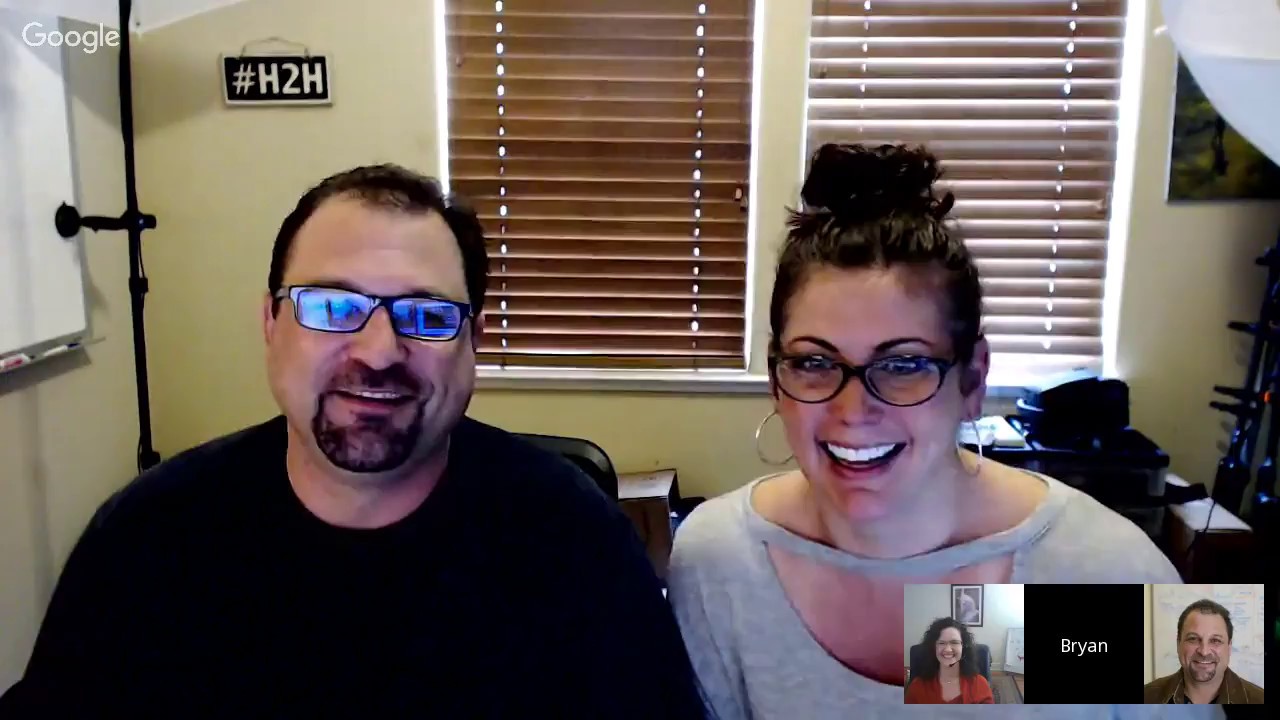
In this live #H2HChat episode, hosts Bryan Kramer and Courtney Smith Kramer interview service‑entrepreneur and author Christine Clifton about her new book You Don't Have to Shout to Stand Out. The conversation covers Clifton’s background, the four core elements of her framework, practical messaging tactics, networking strategies for introverts and extroverts, the ASK conversation model, Return on Time Investment (ROTI), technology stacks that support human‑to‑human interaction, the role of coaching, common pitfalls (e.g., “spray‑and‑pray” approach), and audience Q&A. Throughout, Clifton emphasizes quiet‑power techniques, micro‑messaging, energy‑output matching, and being a resource to build authentic relationships without shouting. The hosts also promote upcoming events (SXSW) and other guests.
Chapters
Hey everybody, how are you doing? This is Bryan Kramer and
Courtney Smith Kramer. How are you today?
That's my last name.
What?
Hey.
They told me
it was one of a kind. Good to see you guys today. We are coming to you live and a little bit silly today. I don't know why.
Because we're drinking kale smoothies, that's why.
Nothing better.
Right?
So we're, we're excited to be here. We've got some really cool stuff to talk about and a really cool guest and a really cool topic.
But real quick, can we just say this is our week leading up to going to South by Southwest? I'm very excited because we get to go to Austin to see all the Bay Area people that we never get to see here.
It is a great meetup for everybody that doesn't get a chance to see each other, and both locally and far. If you're going to be at South by, please do give us a, uh, send us a message or let us know so that we can all kind of hook up. That's the point of the whole thing. And, um, looking forward to speaking there a couple times while I'm there as well on Friday and Monday.
I know you're modest. He's speaking at W2O Summit on Friday, and then he is going to be hosting, uh, at the Dell Experience, which is really super cool. You should go check it out. It's right downtown Austin on— I don't know the name of the street, but it's right by the convention center and it's Super cool. So
yay, so fun. So, uh, gonna be lots of fun. So let's, let's introduce our guest.
Okay.
All right, so we have a wonderful guest today. I am actually really, uh, enjoying the fact that we get to, uh, interview Christine Clifton today because her personality jumps off the page when you, um, if you've had a chance to engage with, uh, Christine online, she's got Her personality offline just jumps right through the screen and grabs you and shakes you and says, wake up, we're going to have fun in life. And you know—
Wake up!
And you know it. And that's why I really wanted to interview her. And I've really backed her newest, latest book, which we're going to get a chance to talk about. And so just a little bit about Christine. She believes that everybody matters and deserves to be heard, Technology has pushed us behind the screens of all sizes and is causing our conversations, our conversation muscles to atrophy and our ability to collaborate to wane. She founded Mindful Business Matters to reinstate the art of human-to-human conversation. I need to actually have my own buzzer up so that I can— I didn't realize I've never had somebody have human-to-human inside of the bio description. So this is the first time in what, over 2 years I've ever had that
happen. You finally made it.
In order to bring those connections back into the workplace, fully support that, obviously, as possibilities, as a possibilities thinker, Christine's a collaborative rainmaker for professional services firms and entrepreneurs. She teaches them how to be fruitful conversationalists that create connections with the right people and resources. And she's a social introvert, believe it or not, just like myself. And I believe yourself.
Yeah.
Although you wouldn't know it on this one. Her quiet power techniques— and then in a nice way— her quiet power techniques enable relational, relational, relational business people to avoid the energy drain of promotion and the feast and famine of service entrepreneurship. She has an MBA. She's— let's see, she has an undergraduate degree in business administration as well as an MBA, is a professionally trained coach, mentor, teacher, and carries a lifelong love of connecting with people. She's bestselling author of You Don't Have to Shout to Stand Out. That's what we're here to talk about today. Christine, how are you doing?
I am doing fantastic. Thanks for having me.
You are welcome. You are welcome. What, what, what does your bio not tell us? What is there? What's something that, that didn't, that isn't on your bio that we should know?
Wow, that's a big one. Well, I have an addiction to organic stove-popped popcorn in coconut oil. If you've never tried it, you must. It is like crack. My friends call it crack popcorn. And I am the only girl in a family full of boys. I had 3— well, I have 3 brothers and all male cousins. I have 2 female cousins by marriage, and so I'm a little bit of a fluke in nature.
Wow, that's a lot of testosterone to grow up around. Is that in relation at all to the popcorn? I'm trying to find the connection. I so desperately want to find the connection.
Let's see, is there a connection? Well, I think that the strongest connection I can draw for you is that in our household Sunday night as kids, We would get ready to watch The Wonderful World of Disney, and we had a choice of 2 desserts. We could either choose popcorn or ice cream, and my mother would fill a brown grocery bag full of popcorn if that's what we chose. Now, we had to come to consensus on which dessert we wanted as a family, so that tells you a little something-something, right?
So that connection is you got a very early start in your coaching and powers of persuasion.
You got it. Absolutely.
Well, congratulations on your newest book. I'm curious, how did you bridge what you've done in your career to a book called You Don't Have to Shout to Stand Out?
Yes, that is a culmination of a lot of things that I've discovered along the way. I don't know about you, but when I started my business, I thought I kind of knew what I was getting into. And then I quickly found out I had no idea what I had just done to myself. And as I learned organically, I was teaching myself by going, taking classes and learning and studying, but also seeing what was actually working for me in my business. I left corporate after about 20 years. That was about 9 years ago. Wow. And so that 9 years of entrepreneurship has been a lot of trial and error. So this book represents what I consider 4 foundational elements of the work that I teach service entrepreneurs. And I distill it down to where they should start. These are 4 elements that probably wouldn't cost them anything to put into play— little time, little energy, a little practice. And could really transform their results in their business. So that's where I wanted to start, was with those foundational elements. And that's you don't have to shout to stand out.
That's really good.
I think we should whisper the rest of the chat. I want to stand out.
But you don't have to shout.
I don't. No. Thank you, Christine. You're welcome.
Yay! Did we stand out just now?
You did by whispering.
But all kidding aside, why don't you tell us what those 4 are? Do you mind sharing what the 4 ingredients are?
I don't mind sharing at all. The first 2 are messaging formats or messaging approaches. And As I mentioned to you guys, my specialty is voice-to-voice, human-to-human contact.
So— You didn't warn her.
Every single time you say human-to-human or the word human—
Oh, I see. All right.
Some people see it as a challenge and some people see it as a word to evade. Your choice.
A word to evade.
I might do a mix of those because I do use the— I'll call it the H word, and I'll dodge it this time, but I use the H word a lot. He's gonna make that count. You
can't hide from the word.
There's no—
All right, so go ahead and tell us, what are the 4 ingredients?
All right.
So she— I want to learn about the messaging constructs. Can you go into more detail about that?
Sure, as much as you want to know. Now, in the book, they're very basic tenets, but the 2 messaging components that I bring in in the book, the first one is about speaking about your calling or your purpose. Now, Simon Sinek brought this to the forefront in his book Start with Why, and I'm a huge fan of Yes. And there's some, I think, differing opinions out there about how you bring that to the consumer, how you bring your purpose to the consumer, especially if you're a firm or a company. And I happen to believe in gathering kindred spirits, which is the essence of part of this book. And the messaging component of speaking your purpose is one way to do it. If you are really true to yourself and are able to share what you stand for, then people are going to stand up and say, wait, what, what, what did I just hear? You know, and it's really important for them to hear and for you to articulate because I happen to believe that when we articulate something like that, it's also a way of bringing it forth. It's a way of calling it in and saying, hey, this is what I'm all about. This is what I stand for. Who's with me? It's like a rallying cry in a way. So that's the first element of messaging. The second is something I call micro-messaging, which those of you in marketing are no strangers to. Some people call it micro-marketing. The example I use in the book is my favorite one. I talk about Jell-O. So if you are selling the what, which is Jell-O, what does it mean to kids, right? It's wiggly, it's fun, you kind of squish it through your teeth, you know, you can throw it at your brother or sister at the table. To moms, it's a fast and easy dessert, right? It's fast and easy, it has nothing to do with the funness. Well, maybe some moms would be really fun and, and use Jell-O for that. So what's Jell-O to college kids?
Yeah, a means to get the shot in their mouth.
Exactly.
That's where I was going with that.
It's a conduit for alcohol. And so micromessaging is all about knowing your audience well enough to position your what in a way that matters to them. And when we take that extra time to think through of the different ways that we can articulate our what, Then when we're in conversation with people, we can be really agile and pull out the one that matters to the person, you know, right across, you know, the handshake from us. So those are the first 2 messaging topics in, in the book. The second 2 are more around connecting with people.
I see what you did there.
Yeah, yeah, you saw, you heard the pause, right? And the first one of those is styles. Now, we've all self-identified here as social introverts, and I happen to believe the introvert-extrovert is a, is a spectrum. It's not one or the other. There's not just an ambivert in the middle. We're on a spectrum. And I happen to be social, but I also happen to have been completely exhausted by all this self-promotion for my book launch last week. And I really just sat around and— Rejuvenated my energy this weekend as an introvert. And so it's more than just introvert or extrovert. I call that energy output. So looking at the energy output of the person that we're talking with can really help us match it so that they can hear us better. That's really the key. It's about being a temporary chameleon, and that's what I call it in the book. The other component, though, is really listening to what matters to them. So just like the Jell-O example, you could talk to a mom and she says, all I want is a fun dessert. And you say, OK, Jell-O works for you. So it's also a benefit statement for that particular mom. But when you're ready with those soundbites in the moment, then you're, you're, you match what matters to them much more quickly, and they pay attention. You've heard the saying that it takes 7 seconds, right, to make a first impression? Well, somebody had published a study a couple years ago about the attention span of goldfish, that it's 9 seconds, and the human attention span is 8 seconds.
You were paying attention.
I didn't even realize I said it.
My attention span is 4 seconds.
Especially when your finger is on the applause button. So we have to catch people's attention more quickly these days. And the technology is literally rewiring our brain. I'm a bit of an armchair social neuroscientist. And I love this, this new studies that we're learning about the human brain. But literally, we're rewiring, rewiring our brain for shorter attention So we have to speak in a way that people listen much more quickly. So those are the other 2, the 2 elements of style and what I call presence in my book. And then the last one is what I call the ASK model, A-S-K model. Now, I'm not inclined to give all of this away here on the show because I want people to learn about it in the book. But I find that when people— I'm sorry. understand how to use the conversation as a model, that it flows much more easy for them. So for example, introverts tend to not like spontaneous conversation because we don't know where it's going to go. Now we like deeper conversation if we can start getting in, right, and digging around in, in the real meat of the other person. But think about networking and small talk and things like that. Like, where's this going to go? And how— What does it even matter, right? So the ASK model, the A-S-K model, teaches people a way to have a conversation that has a little bit of structure to it. So it's not floating out there in the unknown. And they can harness the power of knowing where they're taking somebody within that conversation and feel a little more comfortable and confident while they're doing it. So that's what I'll say about the ASK model.
Hmm.
Well, those are the 4 elements.
I always felt like small talk was just fueled by what ailed people the most. So I'm from Michigan and we used to immediately talk about the weather. But out here in the Bay Area, everyone goes right to traffic. It's like the number one thing that people talk about.
Yeah.
Is ASK an acronym or is it just—
It is. It is an acronym. Yeah. And it's—
tell us what it stands for.
Yes. The A stands for acknowledge.
Okay.
The S is for state your desired outcome or state the circumstance. And the third is K, which means know, K-N-O-W, but you want to know by asking a question. So it's acknowledge, state the desired outcome, and then know by asking a question at the end. And what I find is the A and the K are the fewest, the least used in conversations, especially as consultants. Again, I think you guys can identify when people ask us, we have an opinion, like we have advice, we're ready to go with, you know, direction. But often people, to really be heard, to acknowledge them first. And then we can do the middle part, which is state our desired outcome or what we want or the circumstance. But then we ask a question at the end. So like, how does that sound? Or do you have any questions? Or, you know, what's your opinion on that? Whatever the case might be. And it's a way to just keep that conversation flowing. Yeah. So that's the ASK acronym.
So, so you've got, you've got, I'm sure we could dive into this more. And as you said, a lot of this is laid out in the book and we've got only so much time here on H2H Chat. In fact, we only have 10 more minutes before we start taking questions with everybody. And here, here is the funny part, we have already more questions for the second half of this than, um, than, than we, we normally do. So people have a lot of questions for you.
Are they all by JS Gilbert?
A lot of them are. JS, I love JS because he, he is just one of the, one of the, one of the good guys, first of all, but Also because he always sparks such great conversations. Yeah. And so he's got some great questions, but we've also got Brian Fanzo. He has an incredible question that I'm going to ask. Carrie Maslin. We've got some great questions. We've also got a lot of great people that have joined us. I can't even name them all because it's like a stock ticker right now going through. So I'm just going to say thank you to everybody who's on there. And thank you all for tweeting. If you are new to this, though, make sure that you use #H2H. That's number 2. chat. So H2H chat, and you can join in and you can still ask questions. We're gonna, we're gonna get your questions answered even if we have to do a lightning round and answer it really quick, quickly. Well, I'm gonna, I'm gonna go ahead and put Christine on the hot seat and do that. So make sure that your, your questions are coming through. We're going to take 10 more minutes of conversation. We're going to dive right into your questions. Um, and, and so, um, uh, that's, that's that. And so, so I wanted to ask you what that is in the background, in the, in the back corner there. You've got something that looks like It just keeps begging me to ask you, what is that?
Awesome Venn diagram. I'm a
fan. Yes, yes, the 3-way. I'll just tilt my computer just a little bit. So it's ROTI. I think that's an actual, some sort of noodle or dish, roti. But what it means in my world is return on time investment, ROTI. And again, those of you watching, if you can see the chart, Really what I'm about is conversion rate. How well are you converting your conversations? Now this applies of course to digital online marketing as well. My specialty happens to be face-to-face. And I'm all about if I'm going to go out networking and I'm chatting with people, I want to convert those conversations into the next meeting. And then whatever that next meeting is, I want to convert that to whatever is next. Now when I say conversion, I don't mean selling because that's just plain icky. You know, and we want to make sure it feels authentic and aligned. So when I'm out networking, I'm looking for speaking events, I'm looking for connections for other people, I'm looking for kindred spirits for my network, that type of thing. So the first line is conversion rate moving into the first conversation. The second conversation is key, though. The more kindred spirits you have, In front of you for that second conversation, the higher the conversion rate is going to be, whatever you're measuring. So you want that second conversation to convert, especially if it's sales. You really want it to convert into obviously business. And what happens is that people of service— well, I'm from New Jersey, so I say it's kind of like handing somebody a diner menu to make a decision. And in New Jersey, if you've never been to a New Jersey diner, it's 20 pages of 9-point font on both sides. You can order a hard-boiled egg and you can order a lobster all in the same place. So that's what some sales service entrepreneurs do. They want to help people so much that they just give them the whole menu. And we all know that confused minds don't buy. So this conversion factor is all about getting to the root of the pain And servicing, serving up the one component of what you offer as the solution. Because once you bring them in, then you can show them around to what else you do. But if you don't address that initial pain or that initial want up front, you might lose them. So that's return on time investment. Let's make— I'm all about efficiency. I'm an introvert. I don't want to be spending my money, my time and money out networking. I want to convert people and I want to help them. And that's what ROTI is all about.
It's funny because Martin Lieberman just tweeted saying, ironically, tomorrow is National Be Heard Day.
Oh,
how about that?
So, so how if I were, if I were coming to you And I'm saying specifically me, if I came to you and I said, hey, I'm an ambivert, I don't like networking, but I have to. I've got to get some business in the door. I have this personal brand, if you will, that's built around X, Y, and Z. What would you say to me? Where would you start and how would you get me to move forward?
That's a really good question. What'd she say?
I have these issues. Help me.
Asking for a friend.
Help me help
you. I love that. Well, the first thing I would do is bust your belief system around the fact that you have to network or have to go out networking. So I say that networking is not a place that you go, it's something that you do. So I have 2 clients that I have told to stop going out networking. One of them is a very strong introvert. She doesn't show up confident, and I want her showing up very comfortable so she can seem confident. She is very confident. So we've structured her marketing cycle or her process to be giving classes And workshops as the first point of contact, as opposed to networking. The other client I've told to stop networking is looking to find the business owners of firms. They're not out networking. Right? So that would be the first thing I would do is really find out who you're looking to meet. And let's see if we can recraft a place that you go or a thing that you do that's more in alignment with who that is that you want to reach. And then we go from there. So some people, it might be, have you called your LinkedIn contacts? Have you reached out to former employers or people that you know already that you've been meaning, you know, to get in touch with? I'm going to be starting a 21-day coffee marketing or coffee networking challenge inside my Facebook group next week for this specific purpose, because we have so much richness in our old Rolodex. Yeah. Or we'll call it the new iPhone or the new smartphone now, that we are not harnessing all those contacts. So that's what I would do first, is really find out who you want to meet. And let's craft— networking simply means to connect resources among, you know, a community for the benefit of employment or business. It doesn't mean selling my stuff. And it doesn't mean going to 300-person networking events. So,
oh man, and those are so painful, by the way. Like, you just think about a networking group, and it makes— I don't know about you, but it makes me want to, like, makes me want to whisper.
I know. And it's funny that in my local market here, people are like, Christine, you know, you say you're an introvert, but we see you everywhere. And the thing is, is that I'm very purposeful about how I place my image, how I place myself. I'm on the board of directors at my chamber. I sponsor vendor tables at my chamber. I'm specific about where I network. So people think they see me everywhere. But I am, I prefer being a host and a sponsor than I prefer networking. So they think I'm out networking. Cool. So that's good for me.
Right?
Absolutely. So, so So let's, let's leave. But just before we get into the questions with everyone, let's leave with one thing that you get asked all the time. And, and, and it's just one of the biggest missed things that people aren't, aren't doing. And I'm talking not just about in person, but also online. You know, everything surrounding how you approach getting out there and getting heard. You know, at the end of the day, even if you work for a company, you know, or if you're starting your own business or you're— you've graduated college and you need to get started, there's always that need to make a mark for yourself, to go do something that you can be proud of and that everyone else really, you know, maybe wants to be a part of because you're just so passionate about it. But you can't figure out how to turn that key to get, get, get the word out, to get the, the, to get that idea across. What is, what do you feel like is that the reason? What's, I guess, what's stopping them from, from making that, crossing that bridge? And how do they get there?
That's a great question. One of my favorite sayings is that the eye can't see itself. So the eyeball can't see itself. And we are just who we are. And Brian, in your branding challenge a few weeks ago, right, you, one of your challenges was ask people to describe you in 3 words, and then collect the answers and see what that is. That's, that helps us see ourselves in a way that others don't. So we often just think we're just doing our good work. We're just doing our thing. We're just saying what we say and do what we do, we sometimes need that help to really sift through those gold nuggets, to see what comes up on the top, and be able to say, yeah, that's it. That's it. And, and it's not what's different, because especially in our industries, there, we're doing a lot of the same things as anybody else is. But we are special. And what makes us special are those positions that we stand on that are a little bit different than others. So for example, me saying stop net Right. In a local market, people would, you know, they're like, what? What is that? I'm like, stop going networking. Instead, build your network, which is different. And so when you find ways to say those things that you really do truly believe, that's then when people start to take notice because it sounds different and it breaks you away from the pack. And you likely need a little help to get those gold nuggets kind of shuffled to the top for you. So get a friend, get a buddy, You know, get a coach, whatever the case is, to help you find these soundbites that make you special in your particular area.
Oh, that's great. So I like the soundbites idea. I think the soundbites are really key in understanding what you're going to say and saying it with intention. I totally agree with that. Okay, so this is the part where we get to transition over into everybody else's questions. We have a nice, nice list of questions here. I'd like to start out. I know JS is, well, half of the questions. But I'd like to start out— He's
slacking today.
I know. He must have not gotten sleep last night. But I wanted to start out actually with one of the first few questions that came in was actually from Brian Fanzo. And he asked a really great question. Love to ask you that question now. Are you ready?
I am ready.
Okay, here we go. His question is, how can anyone else amplify your message and story if you don't start telling— if you don't first tell your story?
So say it one more time.
Okay. How can, how can others or anyone else help amplify your message And story if you don't first start telling your story?
Hmm, that's a really good question. Well, I think that that happens regardless. I think that when people hear something that you might say, whether it's your story or not, if they know who you are, the essence of you, they're telling others about you already without you sharing the story. So I do think that it does happen. I get calls all the time where people are like, you've got to call Christine and talk to her. And it may not be about my story in particular, but they hear something in the other person where they feel like it's a fit. But I do believe you, you do want to share your story. That was the earlier point in my 4 learning points in the book is especially around your purpose or your calling. That's the piece of your story that I think, yes, you definitely want to tell. Right. Because people are going to remember that. And that's what they're going to use To relay your personal brand to others.
Fantastic. So, so you don't think necessarily that you have to shout or tell or share your story, that others will and can do it for you. And that's the best way.
I, I don't know if there's a best way. I think it's both and. Right? I think, because the way that we relay ourselves, it's going to be slightly different than someone else. So I think it really is both, you know, comes from both directions. You want to be able to stand very confident and sure in stating who you are, what you're about, what's your position statement. And then other people are going to take the pieces that matter, that matters to them. And that's the piece they're taking in their mindshare on your behalf.
Yeah.
Yeah.
If I'm getting your
question right, or if I'm
hearing it well, it's hard in tweets to know the context. But I think, I think that's the, that's the gist. The next one here is from JS Gilbert, and feel free to chime in. But JS, JS, surprise, JS. How do you feel about individuals or businesses using AutoDM and other tools to manage conversations?
Ah, well, I did share that I'm a Luddite, you know, with you guys when I started. So is that automatic direct message?
Yeah, anything auto, um, auto versus— I'll say it— human to human.
You know, I think it's an efficient way to outreach to people, but I don't think that we should rest on our laurels, that that's all that That's needed for the true connection. So I love automation and efficiency, but I also want to be sure that if it's important and necessary, that it be taken to the next step. So the auto message could simply be, hey, this is our auto message. Thanks so much for reaching out. We'll be— we'll reach out to you in a personal way, let's say later this week or whatever the process of your business is. So again, it's a both/and answer. I love the efficiency and automation. And what's next?
Yeah, I totally agree. I feel like it's the content of it because it can really save a lot of time. But the worst is, you know, when people directly go to, hey, thanks for the follow, check out and like my page and follow me and click on this link. And I was like, I just met you, romance me a little bit.
Exactly. I want to be, I want to be swooning a little bit before I make that decision. I'm with you. When I'm out networking, I have a very simple system for my time trade for people to book time to chat with me. I've created a URL, chatwithchristine.com, so that when I'm talking to people and I say, hey, you want to hop on the phone? Just go to chatwithchristine.com and book a time. I'd be really interested in knowing about you and your business further. That's a way that I can personalize something but also make it super efficient. But also not carry home a stack of business cards, you know, burdening follow-up. If they're interested, they're going to book a time with me. And if they're not, they won't. Right? So it's a way of really being sure that you're, again, there's the ROTI, the Return on Time Investment, is going to make it worth your while.
I'm so glad that you pointed to the Venn diagram, because to me, the word ROTI means something else. It involves a red Solo cup.
Oh, okay.
Not R-O-T-I, R-O-A-D-I-E.
Oh, got you. Okay.
Alrighty. So we've got Randy Theo. He said, within the style element, does the concept of mirroring the person you're speaking with apply just as equally on social media?
Hmm, that's a really good question. I think to some degree it does. In my book, I position the glory of communication and the fact that only 7% of what we intend comes across in words alone. So when you think of just text, I mean, that's why emoticons or emojis whatever the right word for that is these days, was born, was we were trying to infuse emotion into words alone. So to some degree, you can. If someone uses a lot of exclamation points, it usually means that they're a little more dynamic energy in terms of their style. But it could also just mean they're mad. So I think it's much harder because you're only seeing 7% of that person in words alone. That's how I would answer that.
That's a good one.
Yeah, that's crazy.
Yeah, right? Think about it. Email, instant message, all of this. And that's— I think that's why video has taken such a stronghold in its small little 8 to 15 second bites these days in Twitter, you know, Instagram, all that stuff, because it just infuses so much more. You get 65% of what you intend comes across in video.
So I just set up my URL, book a time to chat with Bryan, and it redirects to Christine's page. So you may be getting a lot of requests, Christine.
Oh, maybe.
Shabal John just said, what was the process of writing your book?
Oh, wow. These are— you have a great community. This is a great question too.
I couldn't agree more. They're wonderful, wonderful people.
Yeah. Awesome.
And we'll be booking a time to chat with you soon.
I'm gonna have to drop my voice a little bit. The book was written about 75-80% about 2 years ago, and it went on a shelf. You know, a figurative shelf. And I pulled it back out, worked on it a little bit more. It went back on the shelf again about a year ago. And when I was working with my own coach, I said to her, look, I don't know why I'm losing energy around getting this body of knowledge into the world. And she goes, you know what? I think it's finished in your head. Like in your own mind, it's done. Now you've got to actually get it out there. Now I'm an introvert, mind you. Okay, so now comes the getting it out there. And through the work of another coach, I decided to take a networking take on this book so I could micro-message, micro-market the book in a networking type of a context. Now, what's in the book applies to anywhere you talk to another human being, okay? But I packaged it as networking. I forgot about that. I packaged it as networking for the purpose of this book. So when I finally got that laser-focused, I was able to better see not only my marketing strategy but also my marketing tactics, exactly where I needed to go to reach my audience. And I think that is a testament to a really solid coach and consultant, is that they can help you see those things to set you up for success. Where before it would have been a broader communication book, here I brought it down into networking conversations specifically. And so the whole path of writing it and getting it out into the world last week was just about 2 years, a little bit over.
Right?
Yeah, that's about right. I think Courtney and I are both agreeing with you. It certainly is a process, um, and, and, um, and it's— it— but it's also something to be celebrated because, um, you know, it's like— it— I won't say that it's— it is anything like birthing a baby, but— A little bit. The, the time that it takes to, um, you know, move through it is, is, is definitely very challenging. And so my hat's off to you for getting through it and seeing it to the other side. It's, um, something to be celebrated. So let's see, we've got, we've got a couple more questions here that I'm going to keep asking. And again, please keep your questions coming. We'll hit them all. We always try to hit everything that comes in, at least from each person. So let's see. That's what she said. So Stacy, I heard her say that. Stacy Di Polo, what tech is your favorite? And I know you said that you're not, you're not as much technology as you are into human collaboration, but, but there must be some tech surrounding all this to help capture, is Stacy's question, and keep track of the, the conversations and turning them into action. How do you—
Oh
yeah. How are you suggesting that that is a process?
Oh my gosh, I, I tell you, when I got technology behind my in-person process, it literally changed my life. And one of them was the automated scheduling. I use TimeTrade, super simple. I don't tie it to any type of payment system. If you need that, there's things like Acuity that are out there. So I know a lot of what's available because I have to help my clients understand what they might need even though I'm not necessarily the expert to implement it for them. The first piece was the automated scheduler. Then what I had begun to use was, I use actually Salesforce which is quite honestly killing a fly with a cannon for a solopreneur like me. I got in at the ground floor when it didn't cost much. I had a technician create it so that I could use it. Then I use Gmail. from my email. Then I have something called Cirrus Insight that links my Gmail directly into Salesforce. All of my communications can stay within my Gmail and get attributed to the record that's in Salesforce. As a solopreneur, I don't really need a project management system per se so I use Salesforce Calendar. It links to my Google Calendar. And syncs up with the TimeTrade so I don't double book. Been there, done that too many times. So now all that stuff overlays each other so I keep myself from double booking. So from a systems perspective, that one little suite of tech has really changed my ability to be uber efficient when I'm out networking. Now I also speak as a primary marketing channel. I collect these little forms from all my attendees. My assistant comes over and plugs all that into my Salesforce so I have a record of people who are actually in my speaking audience in Salesforce. Now I can target my emails to speaking audiences. That would be a different message than I would send to my total list. I use MailChimp for my newsletters. That's also been important for me. Again, as a solopreneur, I'm not heavily online in terms of marketing or selling so I don't need something like an Infusionsoft or ActiveCampaign like a lot of people use for online sales. At least at this point. Maybe down the road for me. In terms of social media, I am a Facebook addict. That is where I hang out. I have Facebook groups for my work as well as programs that I'm a part of and also host. And I use a little bit of Twitter and a tiny bit of LinkedIn as well for my technology.
So I'm actually going to ask— I'm going to insert my own question into this because I'm curious what— what am I going to ask you? I had a question. It was a wonderful question.
I'm going to ask my question. Yes, please. You forgot yours.
Oh, how did I forget?
It's so good. I hate when that happens.
It'll come back to you. Before we started the broadcast, we were talking about how it's so great to be able to learn from other people's, what would be perceived as a failure, right? We all make mistakes. We're all human. And yes! So I'm curious, you know, if there's something that stands out in your mind as a A failure that you've either done yourself or seen from one of your clients that really provided a wonderful learning lesson?
There's so many that would be a whole show all in and of itself. But I would say, I think that people of service want to help everybody. And I see that in my clients. I know that was true for me. And, and so when I started out, I was way too broad. I took on the spray and pray strategy. You know, of building my business. And not only did it wipe me out energetically, it definitely taxed my bank account. And it taxed my psyche as well. And, and there's nothing worse than feeling unmotivated, right, as a, as a creative being and as people here to do great things. So I think for me, it was really learning that I could save the world, Yet I needed to do it one group at a time, because the message that's going to make a difference to that group is going to be dramatically different to another group who needs the same thing. But the different driver drives them to decision-making. So when— so that was my biggest, I would say, business-wise lesson that I learned and mistake that I made. I was just way too broad and needed to get more grounded and focused in terms of who I knew I needed to help and how I could, how I could serve them best.
So, I thought of my question. You're, you're, you're, your whole model is built on coaching. I'm curious, just for everybody out there that's listening in on this, why does everyone need a coach? Or does everyone need a coach?
Does everyone need a coach? I would say everyone needs a coach who is interested in personal and business growth. That's how I would qualify that. Not everyone started who starts a business is necessarily interested in personal growth, and I think a coach shows us. limiting belief systems. I call it BS, right? The BS that takes us down, the belief systems that take us down. But they also are privy to a world or in a scope that we aren't. So back to the eye can't see itself quote. And with a coach, and I, I blend coaching, consulting, teaching, mentoring, all that stuff, depending on what's coming up for my particular clients. But If you're interested in growth, you need a coach. That's what I would say. And so whether it's personal growth or business growth, because you'll never be able to see yourself from the perspective that someone else will be able to see you. And it also helps you grow your own perception of value. That's another piece. A lot of my clients tend to be people like me who left corporate and are starting their own practices or businesses. Right. And so they don't even have a perspective of their value as it relates to what the business owner needs. They only see their service as it relates to what the business owner needs. And that's 2 very different things.
So, so, so that's interesting that not everyone wants personal growth, and some people are status They're okay with where they're, they're, they're at. And that, that is the one point when perhaps it doesn't make sense for them. That's what I took away from that. Is that what you were trying to say?
Yes. Yes. How you do anything is how you do everything. Right.
So that's a wisdom bomb.
So, for example, I have a new client who's an attorney in New York City. She's growing her firm. And as we're working on her practice, we're uncovering some money beliefs, money stories that are holding her back. She's giving away the store, she's giving discounts, she's doing these things. And, and it comes— it's not really necessarily a worthiness issue, like I don't think I'm worth it or that type of thing. It's about a I need to serve at the expense of myself belief system.
Hmm.
And what's cool about being in service is that it really, again, is that both/and. If I can fill up my own cup so that I'm giving from the overflow, and I'm giving from abundance instead of depletion, who wouldn't want to be in that place where I can constantly give from a place of overflow instead of depletion by cutting discounts or friends and family this or, you know, whatever the case might be? So yeah, how you do anything is how you do everything. And when we uncover some of those limiting beliefs or belief systems that need busted or shifted, it will shift their business. And it likely is showing up in their relationships. It's showing up in their lives in addition to their work.
Yeah, yeah, you, you hit the nail on the head with the BS. A really good friend of ours and a guy that's been on H2H Chat before, Dr. Jason Richardson, He wrote a book called It's All BS, specifically about belief system. Yeah, so you might want to check that out. I think—
I will definitely check that out.
Speaking of kindred spirits, I think you guys would be kindred spirits.
Sounds like it. Yep.
Let's see. So we've got— let's look. I'm going to go ahead and give JS's question a try here.
Okay.
What are good ways to develop relationships That can lead to business growth and development? What are some of the— and he did say online, but I'm going to actually say off and on. I'm correcting his question for him. I'm sure he loves that.
He loves it when you do that.
Yeah. So, what are some of the ways that you— I mean, it's one thing to show up or to host. It's another thing to actually build the relationship.
Yes.
To his question, which is really good, Greg, Great question. What are the, what are the ways to develop the relationships?
Yes. Well, the first thing I would say is resource. Be a resource. Because especially in service entrepreneurship, when we're so myopic about delivering the service, and we don't open our scope up to the entire condition that is the business that we're serving, or the business owner that we're serving, we can miss things. My brother's been a graphic designer for 30 years, and he lost a very large client to a, a larger firm because they were growing and he wasn't, and they wanted someone bigger. But he didn't stay within that scope of understanding their business. He just kept delivering great service, and he lost the client. So the development of the relationship needs to go beyond the scope of work. Or potential work, so that you understand the conditions that you're— they're facing. It might just be referring them to a barber that, you know, that they're, you know, their barber retired or something like that. But when they understand that you're really listening and can be a resource to them, that's, I think, the number one thing about building relationship is to broaden our scope beyond the scope of work, so that we can understand the whole context of the— the communities that we're serving and what they're facing.
Sorry, what was that,
Shirley?
Yeah, have another kale smoothie.
Red Solo cup, you mean. All right, we have a question that just came in from Pay Compliment. Which I love their, their Twitter handle, by the way.
Yeah.
What are some good conversation starters in the Ask structure to find, find pain efficiently?
Their pain point.
Their pain point efficiently, probably.
Mm-hmm. Yeah, that's good. Actually, what the way I'm going to answer that is that it doesn't come in the Ask model specifically. That's a little premature for that type of a question. But in my book, I offer some free resources, and one of them is a fruitful one-on-one tip sheet. And in there, I cite one of my favorite authors; his name is Michael Mayer. He wrote a book called *The Seven Levels of Communication*, and in it, he he uses the acronym FROG F R O G to talk with people about what. What's paining them. Family, recreation, occupation, and goals. And so within that, I would say social conversation, that's where you ask them things like, what's your biggest challenge that you're facing right now? Or what's the biggest frustration you're having right now? And you be direct about it and ask them what they're facing. And then the key question after that, which most people miss, is this: What have you tried already that hasn't worked? And that's what most people don't follow up with. Because if they ask that question, then they're going to drill down more to the area, the blank area of opportunity. Because if you start advising them prematurely, then— Right. They're going to say, well, I tried that already and it didn't work. So always ask, you know, well, what have you tried already that hasn't worked? So that's what— that's how I would answer that one.
Just tweeted out the link to Michael's book on Amazon.
Oh, great. It is a fabulous book. There's so many nuggets of wisdom in that book. It's really good.
Nice. We'll make sure to tweet out the link to your book as well.
Thanks.
But I'm being a resource for you.
That's right. It's important. I'm big on that. You'll, you'll see in my book, there's just resource after resource listed. And I'm all about that. There's more than enough for everybody, in my opinion.
That's what she said.
Yes.
I swear to God, until I met her, I didn't even know that term existed.
I wish I could say I invented it, but I can't take credit for it.
Yeah.
OK. So we've got— I'm going to enter into just the final last thing here, which is, where can everyone find you? We're going to share a link out to your book. But where can everyone find you, reach you? I think maybe there's a chance of even talking with you because I hear there's a link. In fact, if you go to my link—
Yes, yes, come join me. I am on social media. You can find me on Facebook. I have both a business page, Mindful Business Matters, and I also have a group that I'm collecting to do the 21-day coffee networking challenge, and that's called You Don't Have to Shout to Stand Out. Go figure, same topic as the book. The book you can find more about at noshoutstandout.com. And you can join the community there. You can also join my Mindful Business Matters community at mindfulbusinessmatters.com. And if all that is just makes your eyes cross, you can go to christineclifton.com and it'll redirect you.
Fantastic, fantastic. I can't thank you enough for joining us here today. Christine, thank you so much for lending us your hour and, and your information. And congratulations again on your, on your new book. It's a fantastic book and it's really relevant right now for everything that's happening in, you know, a lot of noise, a lot of, a lot of stuff going on online, a lot of things that have happened over the last 6 months that have made online even noisier. And so standing out is certainly, I think, one of the key topics for anybody if you're trying to survive in an online or offline world.
Yeah, if you have a chance, go back and look at the Twitter stream because there's a bunch of questions that we did not get to, unfortunately. But, you know, the hour goes by fast.
It sure does.
It was a blast. Thanks for having me.
Thank you so much. And just so everybody knows, Next week we're gonna do something special. Courtney doesn't know this. I just am telling her right now too.
Surprise!
Yeah. So listen in, Court. Um, next week we are going to be at South by Southwest, and, and so we are going to be taking in as much of it as we possibly can. Um, I think Brian Fanzo may actually be with us, so you may even see a guest appearance from him as well on HTH Chat with us. Oh, Lord. What we're going to be, uh, talking about is South by Southwest. So we're gonna cover what we're doing there, what we've seen, what is interesting, what is not interesting. The things like, if you can't make it there and you want a good recap, we're gonna give you that. And so we're gonna, we're gonna highlight some of the things that we've seen and, and help you to, you know, capture those things. We'll try to provide as many links and things so that you can experience it as much as possible without having to be there. We also have, yeah, so you'll like that.
Can I, do I have to have weather girl hair?
We will not have weather girl hair. So then the week after, we actually have another guest, and that's gonna be really fun. It's Lorraine Quay. Did I say Key? Okay, Lorraine Key, and she was an FBI, she was in the FBI, and go ahead.
She is all about mental toughness, so you can imagine not only just being in the FBI, but being a woman, who excelled at her job in the FBI. She has written a book about mental toughness, and she's going to be joining us in 2 weeks to help us all sharpen our brain pencils.
Oh, and Mia Voss is going to be at South by Southwest next week too. She may actually appear behind the screen as well. It's going to be a big party on Monday as well. So sorry, thank you again for talking about Larray. And then the week after that, we have John Schumacher He is the awesome guy when it comes to how to sell and how to use webinars, and he's going to walk you through how to actually construct a proper webinar that educates and sells. So we've got some great couple of weeks coming up. I hope you'll join us for one, two, or all three or more. We'll see you next Monday from South by Southwest. Christine, thank you once again for joining us and everybody out there, thanks again for tweeting. We did trend today. Uh, we trended in the United States at number 40. So congrats to everybody for trending number 40 in the United States on Twitter. And, um, again, we'll see you guys next week. Thank you, everybody.
Thanks, Christine.
See you soon.
Thanks, guys. Bye.
Bye.
More from Bryan


AI Didn't Make Leadership Harder. It Made Fake Leadership Impossible | CODA Keynote | H2H 2.0
Why AI Makes Connection More Valuable | BOLD Awards Keynote Trailer | Human-to-Human H2H 2.0