Part 2 #H2HChat Stop Boring Me! with Kathy Klotz-Guest
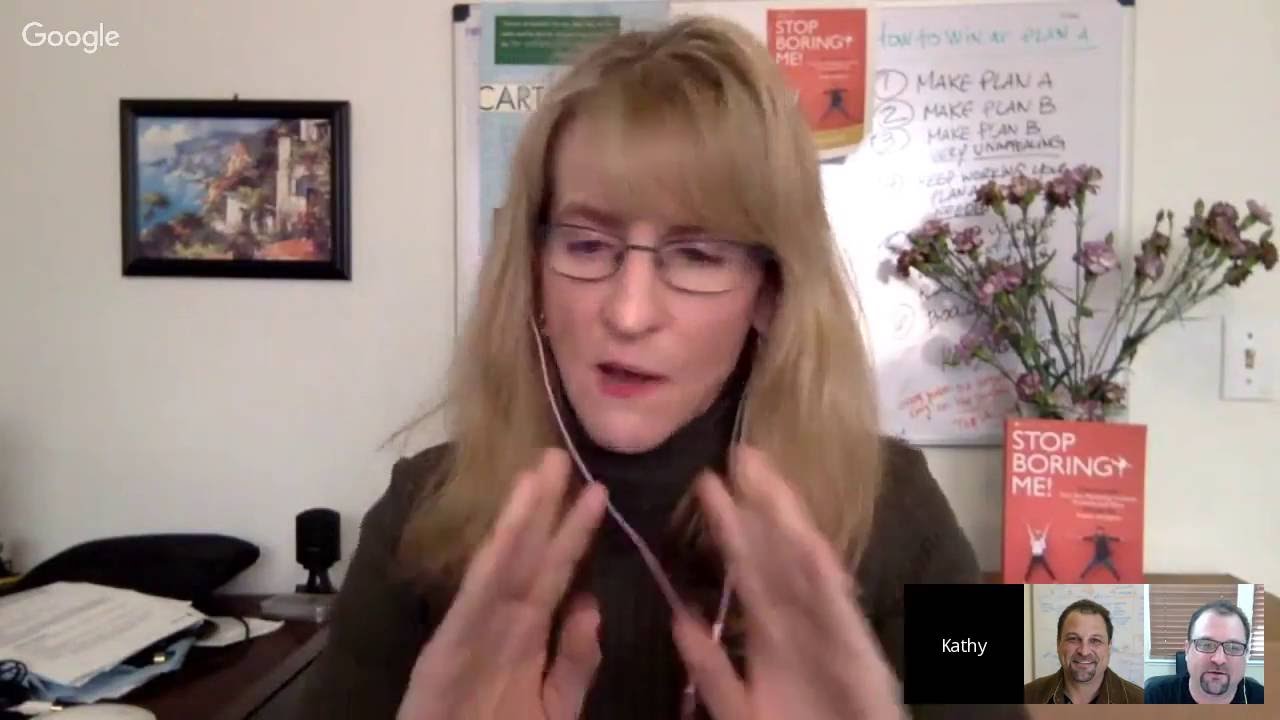
In this live H2H chat, host Bryan Kramer interviews author and improv expert Kathy Klotz‑Guest about her book Stop Boring Me. The conversation weaves together practical storytelling frameworks, improv techniques, and humor strategies for marketers. Kathy outlines her three‑step story formula—character, challenge, and change—emphasizing the need to surface a protagonist’s core desire, define high‑stakes obstacles, and end with personal impact rather than mere transactional results. She demonstrates improv’s “yes‑and” and “yes‑but” exercises, showing how spontaneous collaboration can generate fresh ideas and break creative ruts. The dialogue explores mash‑up thinking, self‑deprecating brand humor, testing jokes in real‑time, and tailoring humor to media formats (visual vs. print). Kathy shares concrete case studies, such as Umpqua Bank’s funny banking videos and a supply‑chain video that frames a vendor relationship as a dating scenario. The interview also covers handling hecklers, using audience feedback, and the importance of playfulness. The episode ends with a call‑to‑action to purchase the book and apply the exercises, while teasing the next guest.
Chapters
So the title of this is Stop Boring Me. Have we bored you yet? I think we're back again. That's the funny— the funny part is this is a show called Stop Boring Me. Actually, it's called the HA Chat, but the book Stop Boring Me is Is is not boring us. So this is great. I think the robots are laughing at us, Kathy.
They are. They're like,
wahahaha! So that's awesome. Um, I can't believe this is happening on a show called Stop Boring Me. I would love, Kathy, for you to just quickly start. I know, I know we're gonna have you repeat just a little bit, but give me your top three things. that makes a story interesting? And now you can't use technology going down because we've already done that one.
Woo-hoo! No worries. We are anything if not— we are not boring. We are all but not boring. So the 3 things I think it's most important is character. Really get to the heart of what that person is and what do they want? Who are they? Flesh out character. And I think you'll find that if you do that, your stories won't be boring. So if it's a CFO, for example, tell me, you know, what she cares most about in the world. If it's a founder of a company, why did he start the company? What does he care about more than anything? You know, was it to help kids? Was it to solve a problem? Find that heart. The second thing you need to do is challenge. What's the challenge that your character is facing? And make it a challenge that Like, make it very clear what the stakes are. If this person doesn't solve this challenge, what's at stake? Be really clear. And then finally, change. The biggest thing people skip over is they end their stories on a transactional note. The person made money or saved money, or we bought a product and product X, thanks to product X, we made $5 million. That's a very crappy story. Because it doesn't tell me how you made their personal lives better. Because they made $5 million, what did it do for their life? What kind of autonomy or freedom or whatever did it give them? So always end on a change to making the personal life better. I love it. Much more powerful. Yeah.
I love it. And for those of you who just rejoined us again, what looks like the numbers are going all the way back up. We really appreciate you hanging, hanging with us through our Improvisational technology, um, test. We were testing you all to see if we would stress out.
Life is improv! Life is improv!
That is awesome. We have some funny tweets coming out about that, and I love the fact that this just happened. It shows how imperfect— which you write about in your book, and we talk about as humans— how imperfect life is and how we need to embrace it. So I think we just actually maybe gave the perfect example of And so you're talking in your book, you're talking about storytelling, you're talking about improv. What are a couple other things that you're talking about that really shine through? What makes content shine through above the robots killing an HAH
fact? I think stories that excite people's imagination and stories that maybe are unexpected. And I think stories and content comes from all kinds of places, and it comes from places where you might not expect it. Before the robots took down our H2H chat, I was talking about the idea of just mashups. Take 2 things that you think, oh, they wouldn't belong together. You'd be surprised. Do a mashup of 2 things. I'll give you an example. You know, in one session I was leading, we had people who ran a recipe site and they ended up creating this mashup show that would feature a French motorcycle cooking gang. So they would go on the road with their motorcycle club and wherever they ended up, they ended up creating meals, French meals, and they would record this. And actually they did a bunch of shows, video shows based on this idea. You can do mashups of anything. Challenge your assumptions. The number one thing, Bryan, and everybody, I would say is challenge your own assumptions. If you're in a rut and you're doing the same types of topics over and over, get out of that rut. Start looking for dissimilar ideas that you can pull together. Starting point, really important. Start with the passions that your users care about. What do they care about personally?
Now, Kathy, you do— and I know this just because we know each other well— I know that you do workshops. Yeah. And you do those workshops around what we're talking about. And the thing I like is that you actually pull in, you know, your strengths into this, which is the comedy side. How do you teach someone to be funny?
Oh gosh. I think honestly, it's gonna sound a little oxymoronic, but I think the biggest source of people being funny Hmm. It's not trying so hard. I think people get hung up on humor because they're trying too hard. And I think our best ideas, our funniest— think about the things that happen when you're out drinking with your friends at the bar. You say the funniest stuff on the planet. Why? Because you're relaxed. You're just being playful. So I think it starts with an attitude of fun and just being playful. And, and not judging stuff. Um, I think the biggest impediment to people being funny is up here. It's that inner critic that's going, you can't say that, you can't do that, you can't— that's, you know, that's stupid, you shouldn't say it. So you're gonna have to either drink that voice away or do something to silence that voice. Because it really can get in the way of you fully expressing your playfulness. So number one thing, honestly, Bryan? Be playful.
I love that, the voice. And, um, and even better, I love that you said drink that voice away. Um, so, you know, it's, it's cool, by the way. I want to let everybody know, congratulations, we just somehow trended number 39 in the United States on Twitter. Um, that is fantastic. So congrats, Kathy, on bringing it. Um, everyone out there for tweeting, really appreciate you guys, um, doing that even with all our Improvisational tests.
Yes,
testing you with, um, or, or they were testing us with. Um, thank you guys so much, really appreciate it. Yeah, Kathy, we're talking about, um, we're talking about humor and how someone can become, uh, funny. Now I know that we're using humor as a slice of not being boring. There are a lot of different ways. Correct. I'm just focused in on that one because that's, that's an area I know I know you well through, and actually you talk about the power of improv on the COVID of your book.
Yes.
What I'm curious about now is how— improv is all about responding in the moment.
Yeah.
I think we tested that today, and I'm asking you, how do you respond in the moment without, I don't know, sounding badly or coming off, you know, and saying the wrong thing or You know, being the opposite of Gaylord Focker, being, being, you know, if you could be that.
Yeah, yeah. I think it really is about yes-anding the moment. So yes-and is really the cornerstone of improv, and I know anybody out there who's taken an improv class is with me on this, probably shaking their head. Yes-and is, I think, the right way to embrace the stuff that happens because it really is about, I can't predict what you will say, But if I build onto what you say and forget about what's in my head, but just accept what you've said to me and then add onto it, we're gonna have a great conversation because I'm no longer thinking, I'm not in my head going, well, I know Bryan's talking, but I'm thinking next about what I'm gonna say. And all I have to do is really embrace whatever happens in the moment, whether it's the H2H, the robots, we pissed off the robots, Bryan. And just laugh at it and yes-and it and say, okay, whatever card you're dealt. How am I going to make the most of whatever's offered to me? And if you want, Bryan, we can do an exercise if you're, if you're up for doing a live demonstration.
Sure, yeah, let's do it.
Okay, so we're going to do a yes and exercise.
Okay.
All right, and maybe the topic is, let's plan, let's pretend we're planning an H2H meetup, like an in-person meetup.
Okay.
And so I'll start, and the number one goal here, everybody, is to say yes and. To and it. Um, say yes and to it. Um, for the next meetup, oh my gosh, Bryan, you know what I want to do? I want to have clowns because clowns are awesome.
Yes, and rock star, because I can't last and try to be funny around clowns.
Yes, and, uh, I think that we should have a bunch of Minis and we should all try to cram inside those cars and then see who can set the record for the most clowns in a Mini.
Yes, and I believe a microphone is always needed around that.
Yes, and we could blare music and we could like mic up all the clowns and we could just see what kinds of sounds they make when we shove them inside the car and just record that on a, on a clown podcast.
Yes, and we'll need a car.
Yes, and it could be any car we want it to be. So maybe let's, let's have it be SpaceX. Now, now I'm going to stop it for a second, and you can see we're having a lot of fun. Oh,
I'm just getting started.
And you're just getting started. You've got tons of ideas. But we could keep going as long as we yes and each other, right? There's all these ideas. Now indulge me for just a second because this is really demonstrative. Now indulge me for a second for the audience. Now I want you to Yes, but me. Everything I say, just but the crap out of it.
Say that 10 times.
Say that 10 times. All right, um, so for the, for the next HH meetup, Bryan, you know what I want to do? I want to have jugglers.
But what if they drop the pin on your, on your foot?
Yes, but what if they didn't and we actually recorded and Everybody trying to juggle at once.
But what if it's on fire and it catches my clothes and I burn?
Yes, but what if we're able to put you out with a fire extinguisher right away? And we'll have— we'll start having clowns juggle fire extinguishers just as a precautionary measure.
Yes, but I'm not wearing underwear.
Yeah, yes, but that could be interesting. I think our ratings would go through the roof if we broadcast that. Now you see, we're getting silly. We're getting silly. But the point of the matter is just how but— when we but every moment because we're worried about saying the right thing and we judge ourselves.
Yeah,
but the other person, it just— the conversation is just— it's gonna go into these silly kind of loops. But when we yes and each other, you were getting started because you had all these other ideas you could have added.
Yes.
So just one little thing. But, and so one little thing, super, super, if I could just leave with everybody is—
Can I just say I'm wearing underwear? That was a joke. Randy.
No, you heard it here first, Bryan Kramer's wearing underwear. But if you could just reframe just one little thing, To be present in the moment from a yes, but mentality to a yes, and, I think will help tremendously.
Awesome. I love it. I love it. When you don't have people to do that with, how do you do— how do you come up with the material or the topics or the content alone?
Yeah. Well, it might sound kind of silly, but you can yes, and yourself. So one of the ways to do it— yeah, yes, and yourself. Well, how much— How much do we kind of yes, but our own ideas?
Right.
We do. We self-censor before we've even given an idea a chance because we've already judged it.
That's the voice you're talking about.
The voice, the voice that, you know, needs to go away. So I say if it's just you, that's okay. Just make sure you yes, and yourself. So start off with this exercise we did. Pick, pick a content topic and just yes, and yourself till it gets very silly and crazy. Now, you might not end up where you end up. You might not go build content around that idea, but you might get 2/3 of the way there and go, you know what, that's a viable idea. We actually talked about developing, you know, we did a mashup of ridesharing and pets, and we came up with the idea of doing a video for take your pet to work on a ridesharing service day. That's a viable campaign just by yes-anding each other.
That's great, I love it. Okay, so walk me through then the— you talk about kick-ass marketing content, products, and ideas. I love that. I love kick-ass. How— what separates— give me an example of one thing that is kick-ass content.
Oh gosh, something out there that I think is great. Gosh, you know, there's a— there is a bank called, I think it's Umpqua Bank. It's a credit union. And they are in the Pacific Northwest. And they have found a way to take banking and make it funny.
Hmm.
And they have done it because they have suspended all beliefs about what you think banking should be. And they do funny videos. Speaking of underwear, they do a whole banking thing where a guy is banking in his underwear. Yeah. To emphasize convenience. And they've done, I think, something which is remarkable, which is take a boring, really boring topic like banking and make it fun. And make— nobody wants to do banking. Banking is the most boring thing on the planet. Most of us would rather have root canals than go to a bank. And deal with the teller. And so they've taken all that stuff and they're very aware. They accept the premise that, that nobody wants to do it. And they heighten that and they play into that so beautifully that the truth is so great in all their videos. They're an example of, I think, upending the expectation of boring in an industry that is boring. Because you have a boring industry, everybody, boring is not a requirement. It's a choice. It's a choice and you don't have to be boring.
I love that. I love that. That's a great, great place to ask some questions. We've got some people that asked some questions before. I'm going to, I'm going to repose those to you now. If you've got more questions, keep them coming on #H2HChat and, and I'll get those over to Kathy for you. We're going to kick it off with J.S. Gilbert. He said, Isn't the great thing about the value of improv— let's see here, it's broken up a little bit. Isn't the great thing about value in improv is that it isn't by nature always funny?
Yeah, absolutely. Improv isn't always about being funny, and it really is about being human. Yeah! I
didn't read—
hey!
Wrong line!
And without getting super nerdy, because I am visibly nerdy from space when I talk about comedy, there is— to make it really simple, there's a couple types of improv. There's what we call long form and short form. And short form is like Whose Line Is It Anyway? And it's funny. But long form, longer form, is you're watching— you might watch a 30-minute play, Bryan. And in this 30-minute play that's fully improvised based on a suggestion, You're going to have moments that are funny, moments that are maybe poignant, moments that are like, oh, or moments that draw you in. But it's not boring. It's not consistently funny at the same arc here. It might dip a little bit, but it's never boring. So the beauty about improv is improv is really about creating something collaborative that's really cool, that's very human and dynamic. And it may be funny sometimes. And it may not be funny sometimes.
Awesome. So here's another question from Randy. He said, I'm curious, how appropriate would it be for brands to be self-deprecating with their humor?
I think it would be appropriate if you have a brand with a lot of credibility. If you have a lot of credibility, you can poke fun at yourself. Brands that are on the verge or in trouble, like Chipotle right now, I would not advise them because they're in a very precarious situation. And any kind of being humorous, I think, is going to suggest to customers that they're not taking their situation seriously. But if you've got great brand credibility and you've got a great reputation, being imperfect and being able to poke fun at yourself will endear your brand to fans. I promise. I promise.
Oh man. And I always use Gaylord Focker as the best example of self- self-deprecation. Um, so, uh, let's see, here's another one. I think it's from Randy as well. I'm gonna keep going. Um, could Kathy discuss the process of researching, writing? And, um, now he made it specific around the book, but I'd love to know, uh, also if you can add on researching and writing, um, humor. Um, how, how you could— we were talking before we even got on about how you had, you know, plane time and you were just coming up with ideas, but how do you research and write You know, content not only for your book but also for content that you're going to use, like when you do your stand-up comedy and everything else.
So what I do is I start with what's true in my life. So what's true for your brand? What's true for your business? What's true for the pain points your customers are, are having? Start with that. Maybe your customers are so sick of social media and maybe they're so sick of getting all these solicitations And, or maybe this, this bad marketing. Now, now take that and heighten it. Get crazy. So exaggerate, take that comically over the top. And there is something in comedy called the rule of 3. Can you give me 3 scenarios where somebody got this really bad marketing on the receiving end and they're ready to pull their hair out? And then just when they're ready to like pull their hair out, somebody Something comes into their inbox that makes them laugh and it's like, oh, the clouds part and they're like, oh my God, finally somebody gets me. So it's block, block, block. I'm blocked and frustrated 3 times and then there's a release. That's a standby comedy formula. That works. And the way that I always start with the truth. How can I take that pain point and make it funny, really over the top? And then how can I show that maybe your company is the antidote, the relief from that pain point? But start with that truth. And the way that I do anything is I start there. I just start there. Now, here's the other thing that I do is I test stuff. Like, I am notorious for like testing material and not telling people I test it. So I go out on Twitter and I'll just make a joke. And, or I'll throw something in casual conversation. And if you laugh, I go, okay, that's a keeper. I'm gonna keep that one. So the way that I test it is I never say, hey, Bryan, you know what? I'm gonna tell you something funny. 'Cause now Bryan's going, all right, giggles, make me laugh, say something funny. And I've set up this kind of, you know, weird dynamic because now you're thinking about it. And comedy is funny or it's not. It's visceral. It's not an intellectual exercise per se. So try little things and then start to test them. And if people laugh, build something more around that idea. Maybe do a very cheap storyboard, a cheap little video. And if it works, then invest more resources. That's how I approach things. And so then I know to spend more time if I get a basic laugh, then, oh, there's something to that. I'll spend more time on that. You
know. So, Kerri, Sorry, Carrie, if I get your name, last name wrong. I think it's Maslin. You really— she said you really need to know your customer. Like, what are they like? What do they not like? And how to exaggerate either point of view. Yeah. Can you kind of pontificate on that, on the exaggeration? Not only just understanding them, but the exaggeration point, the embellishment of a joke. It, it, I think it kind of tends to make it funnier, but embellishment is not necessarily true. And so that, that is direct opposite of what you were saying before, which I, I think I understand what you're saying, but, but could you talk about that?
Sure. Um, there's a really great— I'm good, I'm blanking on it right now, and I should know this because I've written about it many times, but there's a great, great company that did a very funny video back in 2010, 2011. And they are supply— it's on my website, I'm just blanking right now. They did a very funny video. They are a supply chain management tool, enterprise tool, and what they did is they took the pain point of dealing with you as the customer dealing with an enterprise service provider that doesn't get you, and what they did is they likened it to a relationship, a dating relationship. So in this video, the customer is trying to break up with the supply side, or supply chain tool, and they made that high-maintenance supply chain provider a girl that he was trying to break up with. He's like, look, it's just not working out. It's really just not working out. You're kind of high maintenance. She's like, I'm not high maintenance. And then the barista comes by and says, what do you want to order? And she's like, I'll have a no-caf, Soy, foam on the bottom, green, in a green glass, latte, blah, blah, blah, blah, 20 things later. And he's like, like I said, you're high maintenance. So here's our easy premise to think about. If you've got a relationship, a relationship between a customer and a vendor often can be a dating relationship. And somebody can get high maintenance and somebody wants to get out of that relationship. It's human. We all understand relationships. We all— that metaphor of a relationship is universal, and you're not getting into dangerous territory about the supply chain product itself. You're just simply likening it to a pain-in-the-ass relationship that you want to get out of. That's one way to do it.
Great, great. And then Monica Smith-Mullen said, what marketing content types work best for humor? Is subtle humor better in print, for example?
There's a lot of different ways to do it. I think if you're going to do print, you need to make sure that it is subtle and it's graphic and visual. And what I mean by that is, by looking at the picture, is it— do I get it? Because if you have to explain it, you might be into territory that gets a little funky. It should be very obvious by looking at the image. where the humor is at. So, for example, if you were watching comedy with the sound off, would you get, would you get the punchline? Think about it that way. It should, it should deliver graphically for you. So make sure that if you're doing it in print, that the graphics are funny or you get it right away. You're in dangerous territory whenever you have to explain a joke. The more you have to explain a joke, your joke doesn't work.
Ooh, that's a good one. That's a good one. Yeah. Well, good. I'm gonna have to stock that one away.
Yeah.
Darn it. Did I just explain myself?
No, it's true. It should be a tortured explanation.
Yeah. What I meant to say— so how do you move on from something that doesn't work?
Well, if you're trying something that doesn't work, you know, you have to understand why it didn't work. You might be in the general ballpark, and it may be that you just need to get, you know, tweak a few things. And that's why it's really important to— if you're not sure, like with respect to humor, if you're really not sure, ask your best couple customers, customers that you trust that will tell you the truth. That you know like your company and they'll give it to you straight. Ask them. It doesn't hurt. Don't get tons of people involved because everybody gets conservative and risk-averse and you'll go to the lowest common denominator. But ask your best customer and just, is it funny or not? And, and, and see what they have to say and test it. If you do make a mistake, own it and just, you know, poke fun at yourself. You know, I always blame autocorrect when I make a typo. I blame autocorrect and I will continue to blame autocorrect. I know how to spell, but my typing fingers don't. I'm sorry if I offended you. Blame autocorrect. There's a lot of ways to recover. And I think don't over-agonize over the small risks, the small stuff.
Oh, that's the hard part, right?
Yeah.
Is the small stuff. How do you walk away from— now obviously you've been on stage a number of times and you're used to doing that, but I'm curious how you walk away, you know, if an audience just isn't on and you can't break through to the audience. Maybe it's an off night, maybe it's a— Mm-hmm. Or do you beat yourself up or do you walk away and go, that's the audience, not my
So I'm a big believer that it's rare that it's the audience. I'm a big, big believer in owning the clarity of communications, and the burden of clear communications is, is ours as communicators to own. And I believe that. So, you know, when comics blame the audience, sometimes, but more often than not, it's like, you know, one of these things is not like the other. It's you. And it's owning it and owning it because you You— it's okay. So what I, what I do is, um, most of the time I can find something that an audience is going to laugh at, and it never fails. But if a joke, if a joke does kind of fall flat because I'm testing it, I'll just go, all right, well, some material is just for me. Clearly, that was, that was the test. All right. It's okay. So was— am I the only— am I the only one who got that? All right. And then I'll say, note to self, don't do that joke again, or something like that. And the audience will laugh. So as long as you own it and laugh at the fact that you're just testing, audiences understand that. They get that somebody's trying. And believe me, people are with you. They'd rather see somebody try, really try and fail, than somebody not try at all.
Oh, wow. And then, so just to close it out, let's talk about hecklers.
Yeah.
Because life is full of hecklers, especially this week. Um, yeah, uh, I, I've had my share in life and online and social, but, but, you know, it kind of bridges, um, it spans the idea of trolls, but it also, you know, it, it— there's this magic that happens when you're watching a comedian on stage and they're able to handle the heckler so well that you're like in awe of how beautiful the transition was and how much they just Shut up. And so I'm curious, how, how do they do that? How do they do that?
Well, I got to be real honest here because a comedy club is really different from sort of a business environment. But I, but I also think you're, you're onto something, Bryan. I think your, your question is a good one because I think a troll is like the worst heckler at a comedy club. You don't have to be nice. So there's a difference between a person who's challenging you but not a troll. And so, so in a comedy club, I think it's really just remembering that the audience came to see you and people want you to be successful. So if you do ever find yourself in a situation where there's a heckler, you know, you do have the right to kind of, you know, put the smackdown on them. And you can with trolls too. So I was, I was heckled many years ago when I was starting out in stand-up and by a drunk guy. And so nothing prepares you for life like getting heckled by a drunk guy. So this guy was just, said some inappropriate stuff to me, and he was saying it to other female comics, and nobody shut him up. And so I just stopped what I was doing, 'cause it was an open mic night. You get, everybody gets 5 minutes. And I just stopped the mic, and I just said, look, dude, you know, I got 5 minutes up here to make an ass of myself, and you clearly have the rest of your life. So why don't you shut it and let me finish? And so they always kinda laugh. But you have the right to just stick to your guns if it's a troll. Now, I wouldn't advise doing that in a business situation if somebody, you know, you have to, it's contextual. 'Cause you can come, the thing is comedy's a hammer and you have to know when to use a hammer and when not to use the hammer.
Right, yeah, really. Oh man, so much. I went to this great speaking, conference, Heroic Public Speaking, which I, I know you commented on. It was phenomenal. But there was one moment in there where somebody's phone rang and, and, and they didn't say anything. They just let it go. But then it happened again. And I was like, oh, this is going down. Yeah. Like, you just, you just messed with the, with It was Amy Port who put on the conference. She leaned over, she picked up the person's phone and answered it and said, hi, can I help you? And just answered this thing right in front of everyone. I was like, holy bold Batman. So how bold do you go in making someone else, the audience, almost worse for what just happened?
Yeah, it's a great question. So I would say the main thing is, is to shut down the distraction without making the person feel bad because the person— you don't want to use the hammer on the person because they're probably embarrassed they didn't ask somebody to call them. So the way that I've done that before is I've grabbed the phone and I'm like, hello, speakerphone, hi. And that way, the, you know, the person's like, okay, you got to stop calling me. I'm in the middle of a class here. Or we have fun. We just put them on speakerphone. Hey, how's it going? Well, this is, this is the workshop. You know, your person, the person you called is in a workshop and I'm leading the workshop and you're on speakerphone. And then they laugh. Everybody laughs. Nobody's insulted and everybody gets the message. Hmm. You have to deal with the elephant in the room. So if somebody's distracting it, find a way to poke fun at it. Maybe, you know, without making somebody feel stupid, shamed, or
Right.
So never go there, but find a way to have fun. Maybe, you know, just be playful. The best thing to do is be playful, if you can find a way to do that.
Right. Oh, playful is the key here. Is there anything here that I didn't ask you that I should have, specifically even around your book? Anything you'd like to leave off with?
You know, I would say this. I'd say honestly, Honestly, if your goal is to just really create great content, I know everybody wants to, be playful. I think that's really the big message of this book. The first half of it is storytelling, the latter half is exercises that you can do to come up with new ways of thinking. But A, be playful, and B, honestly think about what your users care about. What are their concerns, their passions? What are they like outside of work? Connect to them as people. Find those connection points as people.
Fantastic.
That's it.
Great. Well, Kathi, thank you so much. And where can everybody grab a good copy of this book and find you?
You can grab a copy of this book on Amazon.com. You can find me at keepingithuman.com. And, uh,
good.
Yeah, pick up the book. And, and, and one of the things I'm asking people to do is, um, let me know what resonated most for you and what worked for you and what you like and what you innovated in the world because of it. What story did you tell? I want to— I want you to report results back.
Awesome, awesome. You, you heard it here. Please report back to your, uh, nearest concierge. No, I'm kidding. Let, let Kathy know what you think. She'd love to hear from you. Go grab your book on Amazon. Thank you so much, Kathy. I really appreciate it. You're welcome. Great. Congrats on trending yet again on Twitter. And thank you, everybody out there. Next week, we are going to be having Rick Wian. He is the head of digital and social strategy for Kellogg's, just this tiny little company that actually has Tony the Tiger. So if we can get him to talk about Tony, I think that'll make my day. Anyway, thank you guys so much for being here again today on a— and especially through an improvisational approach to H2H chat. I loved it that we got— we had that happen. That actually proved the point.
Yeah, you
too cannot be boring. Thank you guys, and we'll see you again next week.
Bye.
More from Bryan


AI Didn't Make Leadership Harder. It Made Fake Leadership Impossible | CODA Keynote | H2H 2.0
Why AI Makes Connection More Valuable | BOLD Awards Keynote Trailer | Human-to-Human H2H 2.0