Replay: #H2HChat Using Sharing to Fuel Innovation with Erica Dhawan CEO @Cotential
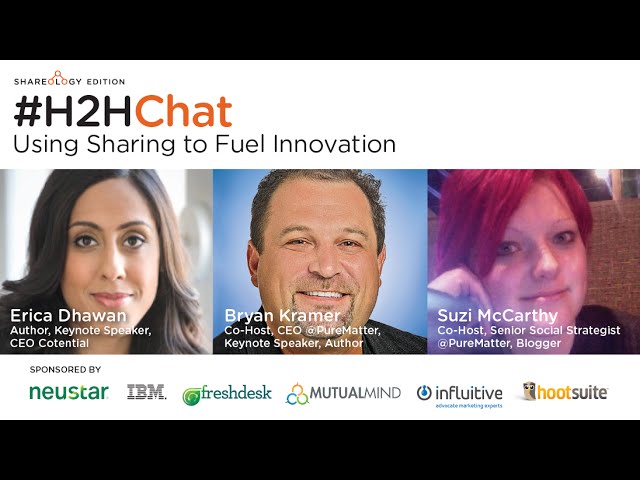
In this live #H2HChat, host Bryan Kramer and co‑host Susie McCarthy interview Erica Dhawan, author of Get Big Things Done: The Power of Connectional Intelligence. The conversation introduces the concept of connectional intelligence – a human skill akin to emotional intelligence that combines curiosity, combination, courage, community, and combustion to mobilize ideas and resources. Dhawan explains three connector roles – Thinkers (idea generators), Enablers (community builders) and Connection Executors (action‑oriented mobilizers) – and how individuals can identify their natural role via a quiz. Throughout the interview, they discuss real‑world case studies that illustrate these roles: The Guardian’s crowdsourced expense‑report game, Harvard Medical School’s diabetes crowdsourcing, Colgate’s physicist‑solved fluoride problem, Frito‑Lay’s employee‑network product innovations, Deloitte’s “covering” video campaign, Zappos’s holacracy experiment, and many more. They explore how to scale connectional intelligence in organizations, measure its impact (balancing quantitative metrics with qualitative cultural shifts), overcome resistance by reducing bureaucratic friction, and foster community through selective, trust‑based networks. The session also promotes the upcoming Shareology book and offers a free connectional intelligence quiz via text. Sponsors are acknowledged throughout.
Chapters
Hello everyone, how are you doing? This is Bryan Kramer. I am back with my co-host Susie McCarthy. So excited.
Howdy.
How are you doing?
Good.
This is the first time she's seen me in a week. I'm back from vacation and I am back Kicking and screaming, even though I am very happy to be here with Erica, don't get me wrong. But we are back on our second HDA Chat, now running every Monday at noon Pacific, and we're really excited. Erica is our second consistent guest that we've had, so, so excited to have her here today. And I'm gonna read you her bio because it's really impressive. Instead of just a short little intro, I'm going to do an actual real intro. But before we get started, I want to make sure that everyone realizes that this chat is also focused on something that we're really excited about, which is the upcoming book called Shareology. And you can go to shareologybook.com and sign up for something exciting that is going to be happening later this week. And that is a surprise, so I can't tell you what that is other than go sign up and you will be excited to see it. The other thing that I want to make sure that you are all aware of is that this is sponsored by some really great sponsors. And I'm going to read the sponsors off to you here because they made it possible for us to be doing this. Here are the sponsors. We've got Cisco, thank you. IBM, Influitive, Freshdesk, Hootsuite, Newstar, MasterCard, and Mutual Mind. So thank you to our sponsors. I'll read them again at the end, and I highly, highly recommend that you go check them out. Now it is time for the main event of the show. We're going to welcome Erica. Erica, I am going to introduce you here. Erica is the co-author of the new book, and I just am almost done reading it, so I'm really excited about asking you some questions throughout the book. But the book is called Get Big Things Done: The Power of Connectional Intelligence. She is a globally recognized leadership expert and keynote speaker who is driving innovation across cultures and generations, considered to be one of today's most provocative business thinkers on millennials, which is a hot topic. right now, I know, for everybody, and the future of work, which obviously ties into a lot of things that we're also doing with IBM, one of our sponsors. She is founder and CEO of Cattential— did I say that right? Yes. A company that has helped enterprises prepare for global workplace of tomorrow, and she's a speaker, A worldwide speaker, she helps organizations and enterprises that range from World Economic Forum to the US and global Fortune 500 companies. She's written for dozens of publications, including Fast Company, Forbes, Harvard Business Review, and she also serves as a member of the Aspen Institute Socrates Society, World Economic Forum Global Shapers, and the Young Entrepreneurial Council. So you can ask that. Erica, welcome.
Thank you so much. It's so great to be here. It's so fun to be with you, Bryan, and Suzy. It's good to have you.
Great to have you. And everyone out there, we also have a tweet chat running alongside this that is #H2HChat. Suzy is going to be fielding questions for the second half of this and also be posing the same questions we ask here on Twitter We'll be monitoring everything you say, so please take part. This is a very interactive interview.
Yeah.
So Erica, let's talk about your new book. I am totally enamored with it. I love it. I like the people that were— I read about that stood behind your book. It was a really impressive list, and I also am enjoying the book itself, but I'd love to hear from you as to what spawned you to write this book.
Yeah, absolutely. So, well, first I just want to say how great it is to be here on the chat and with both of you, 2 people that I think are very connectionally intelligent. So maybe I'll throw the question to you both later on in the conversation. The genesis of the book Get Big Things Done, it's really framed from my background. So I grew up in a family of immigrants, so you can imagine my childhood was about checking the boxes of success. I went to an Ivy League, I worked on Wall Street, and it was really during the 2008 recession when I was on Wall Street that I really witnessed a few things happening. First was my own burnout and frustration with a lot of the ways that corporate America was struggling in today's world to engage the next generation, but really tap into new ways of working. Secondly, the rise of connectivity tools that were changing not only how we use technology, but how we think and how we act. And that really led me on a research journey. I spent a series of years at Harvard where I looked at new models of working. And it was together with my co-author Saj Nicole Jonah that we uncovered that when we think about these topics, a lot of the ways that we talk about success and measure relationships is through quantity. So how many Facebook followers do you have? How many Twitter favorites did you get? How many YouTube subscribers do you have? But in our book Get Big Things Done, our mission is to shift that focus from quantity of connections to quality of connections. Because having a lot of networks doesn't necessarily lead to measurable change. The key is how you leverage your networks and connections to get big things done. And so our mission with the book and the genesis really came around shifting this notion from more networks to how to use the right networks to get big things done. And that was the birth of the concept and genesis of Connectional Intelligence.
I love it. I love taking it from the ego numbers, the stuff that, you know, a lot of management levels care about, unfortunately or fortunately, down to what matters most. Yeah. And I'm wondering if you can give a couple examples, some things that make you a connectional Absolutely.
So if you think about the idea of connections, so 10 years ago Malcolm Gladwell coined the concept of a connector as one of the 3 types of people that create the rise of social epidemics, the mavens, the salespeople, and the connectors. And while that concept was quite revolutionary 10 years ago, today in my view that concept is outdated because today we are all connectors. In fact, we're overconnected. So the question is not whether or not we are a connector, it's what type of connector we are and how we connect. And in our book, we decode that there are 3 types of connectors in today's world: the thinkers, the enablers, and the connection executors. So the thinkers are the people that love to combine ideas. These are the idea generators. They're the curious minds. They might be asking questions on our Twitter chat today, or they might be sharing ideas the research they're working on. The enablers are those that are really excellent at forging communities, sparking, bringing people together to care. And I can share some stories from the book about some great enablers. And in many ways, Bryan and Suzie, you're enablers here today to curate this community conversation. And the connection executors are those that really understand how to mobilize something and get it done quickly, right? So you're a get-it-done person. Oftentimes one of the best things you can do to be more connectionally intelligent is to spend more time with the thinkers in your organization. Or if you're an enabler, how are you bringing the thinkers and the executors together to get big things done. So in today's world, we don't need to just connect with more people. We have to figure out what are we naturally good at. Are we connectors of ideas, are we connectors of people, or are we connectors of resources? And how can we leverage our own skill set or the skill set that's needed for our job or our role and partner with others to get that big thing done we're trying to get done. So yeah, that's really the way that I think about connection and the idea of being connectionally intelligent today.
So one of the things that you talk about in your book that had me— I just love the term, first of all, is the power of play. And oftentimes we don't play enough, and probably I'm the worst person that— Suzy will tell you, the worst person at Pure Matter. She, as you can tell even by Her hair, she is the power of play. And so how do we build more of that into ourselves and our organization?
Yeah, so the whole concept around the chapter on the power of play is really that when we're trying to solve a challenge, one of the best things we can do is actually ask the question, how do we engage others outside our bounds to pitch in to help us solve it together with us? And how do we make it fun? So the question is more not just how do we solve this problem, but really how do we design it in a way that others will pitch in. And so I'll give you an example that we feature in the book. It's about The Guardian, the British newspaper. So a few years ago there was a release through something called the Freedom of Information Act that in Britain released British MPs' expense reports. So it was a big news story that these expense reports were being were being released to the public, and there was an online searchable database. And at that time, all of the big news magazines like The Guardian and The Telegraph were trying to write a big story. But one man, Simon Willinson, at The Guardian asked the question, how can I leverage the power of play? How can I engage our readership as we siphon through these boring expense reports? So what he did is he created a game on The Guardian website. Where it was almost like a hot or not, like this is an interesting receipt, this is not interesting, so people could swipe. They had pictures of each of the British MPs. They had a scoreboard showcasing the highest engaged readers that were going through these expense receipts, and then they had a scoreboard on top. And in just 4 days, they engaged 20,000 readers to review 170,000 documents, and the total cost of the operation was £50. By the way, The Guardian blew up with a great story about this. But even more importantly, what they did is they changed the notion of who is even part of the journalistic process. They allowed their readers to be part of it. So as you think about whatever challenge you are solving, think about how to engage those that you are serving to be active contributors in designing and questioning and coming up with the answer to the problem.
I love that. So it's taking a time when we're all— and I get that, you know, it's not always adding Slinkys and crayons to the table. It's more to it. But at the same time, it's rethinking the problem, you know, in a different way and maybe with a different surrounding and a different approach than you typically would by sitting in front of your computer and hopefully receiving the answer from the computer gods.
Yeah, and I mean, and it's changing, it's making massive moves in all types of industries. We also feature a story about at Harvard Medical School, they do best-in-class research around type 1 diabetes, but what they decided to do is ask the question to a larger crowd and do a crowdsourcing contest where they asked not just what should we study about type 1 diabetes, but what do we not know about type 1 diabetes. And they found they got about 772 submissions and 12 winners, and the best ideas that they noted came from people that were not in the diabetes field at all or had a medical background. They're just people that had a friend or relative that had diabetes. So as we think and use these different forms of connectional intelligence, Often we'll find that our greatest sources of help are where we least expect them, or where we haven't tapped. And that's really the power of all the different ways that we can use forums. And it's up to us to use our connectional intelligence to decide which types of forums and tools to use.
So how do— I'm trying to break this down into like bite-sized areas where we can apply this, and obviously You know, it's not as easy as getting online and just having a conversation with just one person because organizations need to scale this. How do you scale this?
So really embedding connection in your life and how you engage your people. So I'll talk about a few examples. So the first is—
I think we've got some connectional unintelligence. Challenges.
Well, you know, a Hangout wouldn't be complete without a little bit of the human element, right?
Oh yeah, oh yeah.
Okay, I think we're good again. Go ahead.
Yep,
we're good? Okay, and I'll have to charge my computer in a minute. So you know, I think there are a few key ideas on that lens. The first is around— I would just talk about it first from as you think about hiring talent and engaging in talent inside your organization. So the first example that I want to share with you lends itself through a case study that we shared in our book around Colgate. So a few years ago Colgate, the toothpaste company, had a very big science problem. They had developed a new best-in-class fluoride and they were trying to mesh it in their toothpaste. There was something wrong with the mechanical equipment, and the fluoride was getting stuck in the equipment, and it wasn't meshing well. And all the best chemists internally were trying to figure this out, and after months nobody could. So one Colgate executive decided to have the courage to ask, "Why don't we ask another crowd community to help us?" And they posted this question on Innocentive, which is a problem-solving site where anyone can go to help answer problems. And within a few days of posting this question, after months of not being able to figure it out internally, a physicist named Ed Milkerik. Who lives in Canada, looked at the problem and he said, this isn't a physics problem, it's a chemistry problem. It's about charged particles. You charge the fluoride one way, you charge the toothpaste the other, instantly the problem was solved. And now Ed engages with Colgate on many more challenges. But when I interviewed Ed, he said very specifically, I would have never been hired by Colgate. So what we can actually do now is we can actually access and engage networks beyond our talent pool to solve very specific one-off problems. And we can find experts in different areas and potentially bring them into our organizations, but even just live and breathe as part of our broader ecosystem to solve problems outside. And then more internally, I think there are a lot of new ways as you think about moving away from just one-off fancy training and development to creating more real-time, on-demand, gamified type learning that's really leveraging connectional intelligence One example of this that I brought into an organization is this idea of tagging people as informal subject matter experts in areas, the ways that Quora knows whose knowledge experts are in different areas. So as you think about this, it's almost about uncovering the informal map of where knowledge really lies, not just the typical org charts, and then it's finding ways to align that with tough challenges in the organization to get better results.
So let's dive a little bit into the CXQ role model. Yes. You know, you have the 3 categories. I think you talked about those before, but you break them down in the book. Yes. You've got the thinkers, the enablers, and the connection executors, which obviously you went over a little bit before. But how can we take those, and as you've divided that out into all these really cool— I mean, here's thinkers. you've got dreamers, adventurers, and seekers, and I identify with all 3 of those. And then you've got enablers, inspired leaders, advocates, creative company individuals. And then under connection executors, mixed masters, activists, empathetic entrepreneurs, and disruptors. So am I weird for saying I feel like I'm a piece of all of those?
You're just the ultimate connectional intelligence, right, Bryan?
I mean, I'm not 100% of all of it, but I like to like
I'll just jump in here to say make sure everyone is following the hashtag #H2Hchat. We're getting some great participation. Also, please tweet in your questions. There's so much information going. The last kind of— we try to do 20 to 30 minutes of the chat taken from your questions. Please share. It's all about sharing.
The Thinkers, the Enablers, and the Connection Executors that we describe in the book have a subset, as you said, Bryan, of all different types of role models. And the way— and the genesis of that is what we saw in the book is that people use their Connectional Intelligence in very different ways. So among the Thinkers section, there are Dreamers, those that are really the ideas people that are dreaming up the big ideas. And want to get big things done. There are adventurers, and these are the people that will go out and seek to the shore, right? They'll be courageous about spawning a new idea. And then there are seekers. Seekers are the people that are asking a very different type of question. So in the Harvard Medical School example, they were willing to ask, what do we not know about diabetes, which is a courageous thing for Harvard Medical School, who's known to be the expert on that space. And what you'll find in the book is that the genesis of those different role models came from what we call the 5 C's framework of connectional intelligence. So we decoded that there are 5 key attributes that make up a connectionally intelligent person, and they're curiosity, so the ability to broaden your perspective and ask questions in different ways. The second is combination, so the ability to combine ideas to come up with entirely new concepts. The third is courage. The ability to have difficult and diverse conversations despite forces to silence and control. The fourth is community, so the ability to spark and care together. And the fifth is something called combustion. So when you have courage, combination, community, and curiosity, you get combustion. You're able to mobilize resources to get your big thing done. And what we found is that certain people tend to be better at some of these 5 C's versus others. So there are those that are naturally more of the curious question askers rather than those that just love combustion. And so the most curious ones fit in the role models under the thinkers, the dreamers, the adventurers, the seekers. But the connection executors are those that are highest on the combustion category. These are the mobilizers, these are the disruptors, these are the empathic entrepreneurs. And if you think about the enabler category, those are highest around community. Those are the advocates, the activists that really understand how to forge and build community. What you'll find is that there's a quiz in the book so you can assess which role you naturally are. But also you can take it—
I just tweeted out the link. Yeah, so everyone check that out.
Awesome. You can also find— you can do a team exercise where you can have your whole team do the quiz and do a roll-up to figure out how many thinkers, how many enablers and executors do you have, and where do each of you naturally fit under that. And how can you leverage that better? Because oftentimes something that's a team dynamic issue is actually not. It's just people are more naturally— they're the executor types versus the thinker types. And so we have to leverage that and work together in a different way using our different role models.
So it sounds like the first part is identifying who you are, and the second part is figuring out how to make that work, the dynamic between everyone. How is it— is that where it's best to hire you to help people figure that out, or is there an ingredient mixture there to help people to combine those things once they figure that out?
Yeah, so I think the first is exactly to understand your own natural role and then really understand among your team where people are fitting in aggregate. But then You know, there's 2 more questions. The first is, who else do you need to tap and leverage? So if you're a team of executors, naturally, how are you surrounding yourself and enabling thinkers? Or who do you need to connect with in a different way? Who might you partner with? And oftentimes, if it's a client that's all executors, they'll hire me because I'm a thinker, or they'll hire you, Bryan, because you're— well, you're all 3. You know, whatever it might be. So I think that's one angle. And then I think the other question is really asking yourself, what role does your job require? Because there are things we're naturally good at, and then there's really the type that we're naturally— so you might be naturally an enabler, but at a certain point, this project is all about execution. It's about being an executor. So in that case, it might be, how do I surround myself with the right people to help me make sure I get it done? And so it's being mindful in a very different way of how we leverage our networks, not just as people but different types of ideas and resources that they bring.
So let's come back full circle to the name of the book, Getting Big Things Done. You ask some very poignant questions here, actually comes a little later in the book around page 208. What's the big thing you want to get done? Why does this matter? Who are the people and groups you can leverage to get this done? Yeah. My question to you is, how do you— this is all part of a wonderful plan. I love how you laid this out because it's thinking about how the dynamics of the group work first, and then it's how are we going to work together, and then now we're ready to start asking the questions. Because a lot of people really start asking the questions up front, but they haven't figured out how to work together. Is that kind of what— did I get that right?
Yeah, and we always have to start around aligning around the big thing that we're trying to get done. And I always say that in teams where you're leveraging lots of ideas, you can collaborate a lot and get nothing done because you're just sharing, but it's a mess. And so this is about being connectionally intelligent to get the big things. You can also get little things done. There's a book called Getting Things Done, but that's a book about productivity, and this is really a book about making big things happen. And by the way, a big thing could be revolutionizing industry, but it could also be a neighborhood program that you launch in your community or a school campaign, whatever that big thing means to you. But I would say it's almost like, if you think about— I always think about the difference between When you're trying to get something big done, it also requires a lot of difference in ideas on your team, and that creates more dissonance and more tension. So the job is actually to make tension productive, and that means you can't just rely on people agreeing on something. You have to create alignment, which I think is a very different thing. It's, it's when people might not necessarily agree, but they understand what they're aligning around and will partner with the right people to get that thing done, big thing done.
You know, it's interesting, I just read an article that the shoe company— why am I not— why can I not think of it— owned by Amazon.
Zappos.
Thank you. Obviously not shopping for shoes a lot. So the shoe company Zappos, Tony, the CEO, has sent a letter out mandating that they are going to be— is it called histocracy?
Holacracy.
Thank you. Holacracy, which means no middle management, no managers, everyone manages themselves. It sounds like you read the same article. What do you think about that?
So, you know, I know Zappos and the team there, and I was actually— it's funny, 2 years ago I was there the first time they unleashed a pilot of holacracy. I was out there, and I would say very candidly two things. I think that it's an exciting time to pilot this you know new form of operating, and like anything, I think it it hosts a set of. I think Zappos has always been known to pioneer, right? So there, when they modeled their recruiting programs where they they trained people and then paid them to leave if they weren't passionate about. The idea, so they've been a pioneer in thinking and aligning around their work structures. I would say that holacracy seems very exciting, but it's yet to be truly implemented in an organization besides Zappos that's roughly under 500 people— more than 500 people. And so I think, as we know, organizations truly change as they become global You know, in offices all over the world. And so I think that we're going to learn a lot through the pilot and through the initiative at Zappos. But I would say that, you know, you need power in an organization to make decisions and get things done. I do feel that. But I also feel that you can create— you can organize work to create more diverse inputs. So that those that are making the final decisions are actually are doing it in mindful and factoring in a lot of the input from you know those that are contributing to that that decision making. I struggle with the idea of absolutely you know I I think it sounds great, but I also struggle a bit with how it'll be put to practice.
Yeah.
Over time, and especially in large-scale organizations. Zappos has about 2,500 people, so it's a little bit different.
Yeah, it's going to be interesting to watch. I know it also said a couple of people left, and he said the chat— we can move on after this with some questions. We've got people posing questions online, but it was interesting also to see that he was offering for people to either accept it or leave.
Yeah.
And that is bold.
Yeah.
Within the next 30 days, we would like your resignation with a nice package to leave, or accept this and stay, but we are going to do this whether you like it or not. And so to your point of leadership, I think he expressed it right there in that one statement.
Yeah.
So David Pepper, @TheDavidPepper, he said that his question to you is, how do you manage dissidence that comes from the diversity of thought and experience that you want?
So the whole idea is that you can't manage dissonance, because dissonance is tension. Your job is to make tension productive, so you have to align that tension to the big thing you're trying to get done. So if you think about, I'm trying to think about a good case from the book, but oftentimes I'll give you one story. So you know one of the stories we feature in the book is about a woman named Pat Mitchell who started TED Women. And I know Bryan's a TEDster, but one of the things that Pat Mitchell realized when she went to the big-scale TED conference is that there weren't enough women speakers. And she talked to the team and they said they reached out, but it was just difficult for a variety of reasons, and it was creating a lot of dissonance in the organization. And for Pat, she had to figure out, how do I turn that dissonance— how do I not manage it but actually enable so that it can be productive. The genesis of TEDWomen was really, more than anything, to celebrate women and showcase women speakers. She launched it with the first event in DC. When she launched that event— remember, this was back in, I think it was 2010. It was right around the beginning of TEDxes. She made sure that TEDWomen had TEDxes around the world. So she wasn't just getting the one, you know, the top speakers. By the way, that was where Sheryl Sandberg launched and said for the first time ever, Lean In. Hillary Clinton spoke and beyond. But she asked women and men around the world to create their own TEDxes. And they had hundreds of TEDxes from Saudi Arabia to Iowa. And so what she had in that one year is not just a group of 20 amazing women speakers, but she had video talks. Thousands of women speakers from around the world to showcase to TED that they need more women. Here are the women that you should bring to the big TED. And so as you think about dissonance, I would just really think about how can you make it productive to showcase something that you're trying to achieve, because it's actually good. And when you're doing it again, that means that you're not just following, you know, following and getting into agreement, which doesn't necessarily create breakthrough results. But instead alignment, which means that you may not agree, but you might be coming up with a better solution.
So I have a question for you. I love the concept of moving from the quantitative to the qualitative, just to start off with. That's when I do social strategy, that's what I'm all about. The question though, right, is how do you measure success? If you are a leader, how do you know that this is really working?
Yeah, so I mean, there's no denying that the quantitative measures are really the drivers of the measurable outcomes, right, when you're launching a campaign, for example. Oftentimes when you think about measuring people's connectional intelligence, it's more, to be honest, like emotional intelligence. So you can build— connectional intelligence is a human skill just like emotional intelligence. So you can build it as people, you can build it into the culture of your organization. The breakthrough examples that I shared oftentimes they don't come from quick wins, they come from creating enabling structures that are more qualitative that you can't always measure entirely at the beginning, but that often lead to a bigger breakthrough. So to give you an example, a few years ago Frito-Lay, as we all know, makes Doritos chips, and all of their product ideas typically come from the R&D group. But a few years ago, the Latino Employee Resource Network, when combined together primarily for employee engagement, they asked the question, you know, why don't we have a Doritos chip for the Latino segment of the population targeted to them? And they came up with a guacamole chip that ended up being pitched to product innovation. It was a $100 million product. Then the Asian network said, hey, we want to do this too, and they came up with a curry chip that was a bestseller throughout Asia. And now the company systematically brings together every diversity network to come up with product ideas for their target segment. So what began as a very informal thing that you couldn't measure, it was a piloted group that was able to test and learn together, turned into a systematic effort that is now being measured to come up with product ideas internally and not relying on outside firms or research, whatever it might be, in the same way. And so now it's saving them a lot of money and there's a very high ROI, but You need the right container to be able to test and allow those ideas to come together. I think it is a balance, and a healthy balance.
Yeah, I completely agree. Thank you for that answer. It's always the balance, right? It's always how you figure that out. I like that a lot. I have a great question from Bryan Fanzo. Hey, Bryan! Shout out to Bryan! He's asking, how does someone who isn't working somewhere that they're passionate about dream big and make a difference?
Great question. This is really powerful because in the book we found that many of the people that were using their Connectional Intelligence oftentimes were using it outside of work. And it was really about opening themselves up to new people and ideas in a different way. So a few examples— so there's sort of 2 strands to that question. The first is, how do you leverage this outside of work if you don't like your day-to-day, and how do you actually leverage it inside to make it work better? So the first is oftentimes we can use connectional intelligence to get big things done outside our work bounds. One of my favorite stories of this is about a woman named Jeanne Pieper. Jeanne suffered from a very rare disease called FOV. There are only hundreds of people around the world that have it. For the last 20 years, she would go from doctor to doctor trying to diagnose this illness, but it was so rare that it was very difficult to diagnose. It was later on when she met one doctor who had met 18 patients in his lifetime that had this disease. She asked the question through her curiosity. She asked, what would happen if I connected all of our these patients together. She first did it more as an emotional support group. She created a Facebook group and an email newsletter to connect all of these patients from around the world. Then what happened is she started to realize it became the first-ever knowledge network for patients with FOB. They began to discover things like men under 45 tend to have cold sores. They started to teach doctors how to better diagnose the illness. And then from there, they ended up funding some of the most recent medical research at the University of Pennsylvania for this rare disease, because rare diseases typically don't get funded because they're so rare. So really, outside of her bounds of her day-to-day, Jeanne was able to start with a passion. She took a dream. She wanted to better diagnose this illness. She wanted to help others with it. And she added connection. She connected with scientists. She connected with patients. She connected with— Hospitals, and she connected with doctors. Through that, she was truly able to dream bigger and imagine more possibilities. It started as an emotional support group and to truly get big things done. I would urge you, one, to think about opening yourself up to people and ideas that you wouldn't normally connect with. I always say there's a 10-minute rule. Spend 10 minutes a day connecting with a new source of news. Outside your normal source. If you read the Wall Street Journal every day, maybe it's following 3 new Twitter hashtags or joining 2 LinkedIn conversations or Quora groups, whatever it might be for you. The second I would say is if you're struggling in your job, I would urge you to find 2 people that think very differently from you and ask them to help you think through that challenge. If you're more of an executor but you're in a job as a thinker, it might help you think about what role will really fit you inside the organization or outside. Or if you're an enabler and you're having a hard time, it might really involve thinking about the challenges that the thinkers and the executors have coming together. So I would encourage you to think about that. Introverts can use Connectional Intelligence just as much as extroverts. So what we find is that because of our connectivity Oftentimes, for example, Ed Melchorik, the physicist that worked with Colgate, he was an introvert. He talked about how he didn't want to work in the day-to-day grind of the corporation, and he didn't fit the mold as well given his resume background. More specifically, he loved the fact that he could scan and source the web and stay behind the scenes of his computer. It's thinking about all the different ways that you naturally like to work. And find the forms of connection that really fit best for you.
There was a good question that I wanted to read to you from Tamara McClary, our good friend Tamara, and she said, what are some great examples of individual and organizational connectors to model?
Great question. Individual and organizational connectors. I will start with one woman who was a great individual model that turned into an organizational strategy. And that is a woman named Christy Smith who works at Deloitte. She's a partner there. And it all starts— can you hear me okay? It all starts—
I can hear you fine.
Okay. It starts from an initiative that Christy began to realize. At the firm, she's very senior there, and she started to realize a very big challenge across the organization, and that was that the millennials inside Deloitte weren't as active to model and become partners the way that she and many other partners had done. And there was this major challenge that was going on where a lot of the younger talent that was coming in was struggling to connect, to feel like they wanted to follow the footsteps of the senior leaders in the organization. So what ended up happening is at the same time Christy connected with an author and scientist named Kenji Yoshino. And Kenji Yoshino was an academic who had studied the concept of covering. Covering is a concept which basically means that people cover themselves, whether advocacy-based, affiliation, appearance-based. And in an organization, oftentimes you think about diversity and leveraging diversity. But when Christy learned about this idea of covering, which was primarily discussed in the civil rights policy world, she asked the question. She brought this outside idea into Deloitte, and she asked the question: What's the corporate cost of covering? What's the corporate cost of people, especially our senior leadership, that are covering their true selves at work? And how is this? Causing a very big challenge in terms of the engagement of our younger talent. So what she did is she engaged a series of senior leaders to create videos showcasing not just what they do, but who they really were. So she had stories of a partner talking about her challenge of not being able to conceive and how she's faced that in the workplace. Another partner was talking about His challenge as a gay couple with a partner also at Deloitte. Another woman was talking about having diabetes and managing that on the road. Even the CEO of the firm did a video that spoke about the fact that he was the first person in his family to go to college, and so when he goes home, he can't talk about his successes at work. And what began to happen once they started posting these is the younger talent. Started to do it themselves. They started putting iPhones to each other saying, share your story. And so now what's been created is hundreds of videos where people across the company, 60,000 professionals, are sharing their stories truly to uncover themselves, and it's creating this infectious difference in the culture. So what Christy did is she was first an individual connector bringing in an entirely different concept, but then she made it part of the corporate culture. By creating a ripple-down effect so anyone could be part of these videos. And so, you know, for anyone out there that's trying to leverage these ideas, I would encourage you to think about how are you bringing outside ideas in, and then how are you enabling those inside to actually be part of it with you, to not only shift in enabling participants but make it part of your organizational culture.
Wow, I love it. I love the stories that are coming out of this. How many interviews did you do for— and how long did it take you to— I mean, just a matter of actually putting the book together.
Yeah.
What was the process like for you?
Yeah, so my co-author, Saj Nicole Joni, and I reviewed hundreds of case studies over 3 years. And, you know, it was— we would call it we practiced Connectional Intelligence. As we worked on this, so you know I found stories through Twitter, through informal networks, through LinkedIn groups, through online connections, through through conferences I went to, and you'll see in the book is oftentimes you know when there's books around these types of ideas, you tend to feature the most famous people in the world, and you'll see in our book there's pretty much no famous. Yeah. Or super rich people, I guess besides Pharrell, because we have a really interesting story about him. But it was really people that had a passion or purpose that weren't business people or were trying to get rich or successful, but had a passion and opened themselves up to new people and ideas. We have stories of pumpkin farmers, of plumbers, of surfers, of gamers, of scientists, of children. Grandmothers and beyond.
Wow, wow. So I highly recommend everyone out there read this. It's been a lot of fun to go through. Suzy, did you have anything that you wanted to jump in on? I think you—
Yeah, we have a great question from Carol. Thank you, Carol. She says, any suggestions how to encourage resistant team members To use connectional intelligence as a way to share and engage. I think in some ways this gets back to the Zappos example, right, where their pattern was do it or leave.
Yeah.
But when we're talking about an organization that needs to adapt, right, how do we figure that out?
Yeah, oftentimes the resistance comes because of bureaucracies, right, so there are processes or procedures and it takes so much time to take an idea and actually test it inside an organization. So oftentimes when you're trying to solve for resistance, I say start with thinking about how do you reduce bureaucracies. And you know, there's fun things to do. One of them is called the Kill a Stupid Rule game, where you think about all the rules and processes inside your organization that you want to kill, and you want to come up with a new process that will make it faster and better. And when I've seen this done, It comes up with all different innovative ways to get things done faster and move people in better ways. And so if you're thinking about— the idea of resistance often comes because there's an assumption under it that there, one, isn't a better way, and two, that better way will be harder for some reason. But oftentimes, through new tools and new ways of working, We can show people that it's actually much easier, and then they buy in. So I would start to think about what are the bureaucracies that are causing people to be resistant, and how can you create another outlet for them to see the value.
Yeah, I love that. So it sounds like a lot of what you're talking about is leadership. You need the right people at the top to really buy into this. Is that correct?
I would say 2 things. I would say yes, you need the right people to buy in at the top, but I actually don't think the greatest ideas come from the top. I think that they come from your people inside. They come from grassroots innovations like the Doritos guacamole chip. And it's actually the job of the leaders at the top to listen and be connectionally intelligent about the informal ideas that are coming from your people. That are coming from the learning that going outside and talking to a physicist could help Colgate on a more regular basis. You know, another story we feature in the book is about a law firm, and the law firm saw that their billing hours were going down of their associates, and this was quite confusing because they were giving them more work, not less work. And as we all know, law firms bill by the hour. But what they realized is the law associates were creating a Twitter-type network to help each other solve cases faster. So they were using these better ways of working, but it was an issue because it was affecting the bottom line, because this is an industry that's based on billing hours. So in that case, it's really the job of senior leaders and the top leadership to understand what are these new ways of working and how can we leverage them in better ways. And it might involve changing our performance structures, incentives, design, and beyond. So I think in some ways it's the reverse. It's leadership listening and letting their people be more of the contributors.
I love that. I love that.
Where does— I mean, we're also talking about taking a big idea and making it work. Is another name for this disruption, or is that something different? And I'm branching off of a question actually that I'm going to lead to, which came from David Pepper, but first I wanted to ask this one.
I think that connectional intelligence is a human skill. I'm not sure disruption is a human skill. You know, connectional intelligence is like emotional intelligence, it's something we can all develop. And when using connectional intelligence effectively, we can yes create disruption, but connectional intelligence is not like collective intelligence. which is like the wisdom of crowds and Wikipedia type books. This is more of the human ability to combine knowledge, ambition, human capital. So I think that we— I believe that when using connectional intelligence as people in teams and groups and companies, we can disrupt. So I would call it more of an enabler than anything else.
Okay, so the two kind of go, can go hand in hand, but I like the— obviously I'm a big fan of the human side, so I really like your definition. So David is full of questions here today, David Pepper. He said, do you have advice for someone who wants to disrupt journalism using apps like Periscope and Meerkat?
Yeah, well, I would ask Him back. What what are people doing already? I mean, I think that if you think about the example that I shared about the Guardian and how they engaged readers to be part of the journalistic process of even writing the story, so I think there are new tools to push out content like Meerkat. It's a great one. It was you know it's it's very interesting to watch, especially. From the South by Southwest week to now. But I would actually encourage you to think more of the question of how do you transform journalism so that— I mean, we see it with bloggers— but so that your readers are working with you to actually write your content, and they're contributing in a different way. So that's where I think some of the greatest insights can come. It could also be a way to find out who should really be writing the stories altogether, who knows the most. It shouldn't be threatening.
Are you saying don't use the tools first, ask the questions first?
Yes, understand what you are trying to get done and ask the questions of how might you get that done from the perspective of ideas, people, and resources. Notice that I don't even use the word technology. Or tool, or forum. Because this isn't about tools. This is about tapping into our greatest human skill of curiosity, of combining ideas. So in the Doritos Guacamole example, there was no technology at all. And oftentimes technology will be our enabler, but it's our ways of asking questions
I love that. I feel like that's— I tend to call it the shiny thing syndrome. We see something and go, oh, this is so cool. I'm going to try and fix it, put this in there. I deal with this a lot when I'm advising people on different social networks because there's this drive, I must be part of Tumblr. Your community isn't necessarily there. No. Right. That's not necessarily where you are. I think that's where I love that you're talking a lot about listening, community. Part of this is a special Shareology edition, so we're talking a lot about the study of sharing. How do you view building community in terms of social networks? In fact, let me put it as a personal question. What do you, with your specific Connectional Intelligence and building your brand, find to be the most effective networks for connecting with people and building that?
In terms of how I do it? Yeah. I would say a few things. I think that offline, I'm really conscious about not just going to the 20 conferences a year, but what are the 2 or 3? That will really allow me to deepen connections with people. That might not be the biggest conference of 4,000 people. It might be the 40-person event that PureMatter hosts with IBM— plug— or an event where I can actually build connections with 4 or 5 people that might expand my thinking, especially if I'm more of a thinker. And the room is more of executors. I think online I really focus on the trust-based communities. So Facebook groups that are private are my go-to home around content and knowledge and networks that I'm a part of, whether it's an alumni network or it's an entrepreneur's network or a community that I've gotten to know in a really intentional way. So I think that topical networks, LinkedIn groups, are often really great. And I encourage those out there, if you're trying to embed yourself in more communities, think of what are the 2 things that you really care about, and find maybe 2 communities that are actively engaged around these topics. So there's a lot of forums out there, and I say only choose 2. Don't choose 10. Good advice. And focus there first. I mean, I would say that those private Facebook groups brought me a lot of stories that are now featured in the book.
That's great advice.
Yeah.
It's certainly— what you're talking about here does take a lot of time and effort, and teaching connectional intelligence and really using it can can return on in spades. And I think you're right. I mean, HTH and being connectional is what it's all about. And I couldn't agree with you more on everything that you've written here. And if there's more things that we can point everybody to, we're coming to the top of the hour here. What can we do to help support you? Where can people go to buy your book? And where can they find you?
Yeah, absolutely. Well, Thanks so much again for this wonderful conversation. We'll continue it online using the hashtag. I would say, you know, you can check out the book on Amazon, Barnes& Noble, Get Big Things Done by myself, Erica Dhawan, and Saaj-Nicole Jonai. And you can learn more about me at ericadhawan.com or @edhawan on Twitter, E-D-H-A-W-A-N. And follow the hashtag #GetBigThingsDone. We built a movement of people all across the world that are leveraging connectional intelligence to create unprecedented Value and Meaning, and you'll find there I have a special giveaway where if you text the number 66866 with the word Erica, you'll get a free Connectional Intelligence quiz and manager guide into your inbox that you can do a little exercise with your team around the Thinkers, Enablers, and Executors.
I'm going to go do it right now.
Yeah, 66866. We'll post it on Twitter too with the word Erica.
Okay, great. Well, thank you so much. I really appreciate it.
Thank you. I'm so excited about continuing to follow the Shareology series.
Awesome. Awesome. We have some great questions coming up in the stream. Eric, if you have a few minutes afterwards— I'll be on. Yeah, absolutely. Please continue the conversation, guys.
Awesome.
All right. We'll see you guys soon. Thank you so much.
Thank you.
See you guys next week. Thank you, Erica.
Bye.
More from Bryan


AI Didn't Make Leadership Harder. It Made Fake Leadership Impossible | CODA Keynote | H2H 2.0
Why AI Makes Connection More Valuable | BOLD Awards Keynote Trailer | Human-to-Human H2H 2.0