Difference Maker Discussion with Mo Fathelbab and Bunny Young
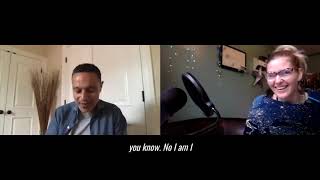
Bunny Young and Mo Fathelbab talk about how COVID shifted their work lives, weighing the trade-offs of travel and conferences against remote work. They discuss managing other people's energy, taking care of themselves, and why in-person connection still beats Zoom.
Chapters
Is just what this is gonna look like. So you don't actually need to have a discussion with me, Mo. You can. You can just talk to Blue. Right? Here's our foster failure, Blue. He needs lots of attention.
Adorable.
So he just turned one on Wednesday.
Oh, my God. Look at him snuggling up.
This is probably, like, you know, have you heard? I haven't seen it, but have you heard, like, the new show, like, Tiger King?
Yes.
Yeah. Okay. So I haven't watched it, but I imagine, like, I could probably get a sitcom that was like, Great Dane King or Great Dane Queen, I guess, depending on how I'm identifying.
I think you can. I think you can for sure. That's awesome.
I think they. I think they think that this is the best thing ever because it's just mom home all the time to just give them love, and it's amazing.
I love that. I love that. Oh, my God.
So I went ahead. I went ahead and just started the recording because I wasn't sure what my hands were gonna be tied up doing while, you know, I, like. I didn't want to hit the record button and have the whole laptop go out the window because I've got these gigantic beasts that are tackling me.
Sounds good. Sounds good.
Do you have a hot beverage, cold beverage to share?
You know what? I just finished my beverage. It was a very exciting collagen protein that I'm taking because I'm told it helps your joints, and we'll see what happens.
It was much less exciting than what I received a text message of yesterday that we're probably not going to share with the listeners.
But listen, hard times. Hard times. Hard liquor. What can I tell you?
Yes. Yeah. So, no.
It'S been a great time, actually. We've had lots of great time with the family and our neighborhood, which you've seen. I mean, people walk out at happy hour and have a drink, so there's been this wonderful community, and you know all about community. And so, yeah, one or two drinks a day is not so bad, but it's unusual for me. Usually it was just a weekend thing, but now it's a daily thing. But. But I think it's under control.
Well, I think that probably the most interesting thing that we. Well, not the most interesting thing that we share, Mo, but one of the most interesting things, our lives that we both share is that we're not getting on a plane. Like, this is the longest period, extended period that we've been home, like, with the exception of, like, holiday time.
I think since perhaps College. I've never gone this long without a flight. Yeah, Yeah. I mean, I used to do like 80 trips a year, and so this is definitely a change of pace for me.
How does that feel?
You know, I like it. I like it. I like it. I gotta say. You know, listen, I want to travel. I want to see the world, and, you know, it's been part of a great adventure, but staying put and kind of slowing down a bit has been nice as much as I'm managing to slow down.
So are you gonna go? Like, I know I'm asking the big question, but this is a question I'm asking Me too, Mo. So, like, you're my kindred spirit that I get to ask this with is, are we gonna get back on planes and go about it and do, like, first off, I'm not sure that our conferences are gonna look the same. And secondly, like, are we, you and I, going to elect to, like, go back to that road warrior kind of schedule?
I'm thinking about that very deeply. So, you know, this has forced a lot of us to think about how we reinvent our business. And for me, I'm doing a lot more virtual work. And literally, I never imagined three months ago that all my work would be virtual because back then it was all physical. So, you know, luckily I've got some work in that space and I'm making it work and I feel blessed. And I'm thinking about that very, very much. Like, will I get back on a plane? I mean, obviously I will, but are they going to take out the middle seats? Will I only fly first class to have as much space as possible? How's that going to work out? Will I wear a mask the whole time? Will I. Will I keep it to shorter flights so I could. I don't know. I don't know. Those are real questions. I have heard from my friends, though, that are flying in recent times. The planes are empty, so maybe this is the time to fly and flights are cheap.
Yeah. I had a friend that text me and he's single. He. I should just put like a dating ad out there for. For him because he's just an amazing guy. But he. He doesn't have a dog. He's kind of. He's a road warrior. And I'm like, what are you doing? He's like, I'm going down to the Caribbean for like two and a half weeks in an all inclusive vacation, like an all inclusive resort. I was like, how are you managing that? Like, everything shut down. And he's like, I don't know, it was like 300 bucks a week with airfare to go down there.
Oh, my God.
He's like, you know how. How much I work. Like, he. I mean, he's on a flight every single week. And so he said, the fact that nobody wants to see me right now and the fact that, like, we're on this mandatory stay at home order and there's really nothing that I can do because he does sales, there's like, nothing he can do because he's. Nobody wants to hear from him when they're thinking about shutting their companies down. He's like, this is probably the only time that I'm going to be able to get away, and it's super cheap to do so. So just like a totally different perspective. Totally different perspective.
Do you know what? Good for him. Because the people I feel most for are those that are single, living alone, cooped up in an apartment. I think that's a tough deal. I mean, for me and for you. You know, if you're. If you're anywhere close to being an extrovert, you know, on that side of the scale, that's a tough deal.
Yeah. One of the things that. So I think I identify as an introvert. I have learned how to cope. Like, you know, I tell you all the time I don't like people. And it's not the fact that I don't like people, but it's the fact that there's a lot of. Like when we go to a conference, that moment that we stop speaking and, like, everybody floods the stage. Not everybody. I'm not that popular. Everybody probably floods the stage for you. But there's like a line of 18 people, you know, that want to talk or want to hand me their business card or want to follow up after that, and I'm super, super, super blessed. Like, let me put that out there, that I'm super blessed that that happens. But, like, that a nightmarish moment for me. I don't like to be touched. And I got out of therapy because I had trouble, like, leaving that emotion, the negative emotions of others at my office. Like, I tended to bring it home. And so what's really interesting for me right now is not doing in person speaking. I couldn't tell you whether it's better or it's worse. Because if I'm doing a virtual conference, the subject matter is more therapeutic than it is business. Even though when I'm speaking, I'm speaking about business therapy and self awareness and team awareness in businesses, but I'm speaking to a Room full of people, and it's this big open space. And for the most part, everybody's kind of on this even keel. And the world really isn't in this state. State of pandemic or financial crisis or anything like that. But now I find if I'm in a zoom room with 25 participants, I can pick up the energy and the anxiety from everybody, and I can't. I don't have a flight home to, like, meditate or put on my, you know, those earphones that I talked to you about, like, the sound counseling earphones to, like, buffer drive home from the airport to my house. I'm here Mo, like, I'm 10ft away from those little energy sponges that are right outside the door. And so that's been really interesting as I'm thinking about this of, like, right now. I don't think that it's ever been more needed and more important to do the business therapy work that I do. But it's also one of the reasons that I left being a business therapist is because of how personal that it is. And, you know, it's like it's almost taking me three times as much self care time or three times as much self care, like, filling that bucket. A friend of mine was referring it to, like, arrows. Like, I have 10 arrows, and I'm giving them all to my company and my family right now. But now I need to find a way to get those 10 arrows back for tomorrow. And that's just. I don't have an answer on, like, which. They're two very different feelings. And I used to think, great, it would be wonderful to do virtual conferences because then I don't have to, you know, have it. Have Guinness to make sure that I'm not touched or that, you know, when we were over in China, it's a very. There's really no. The personal space is different than ours. And so people would come up and they would grab your arm and they would get really close when they were speaking. Not all people. I'm not making it generic, but I had a lot more of those encounters versus Americans. We, again, not being generic, but a handshake is kind of as close as most get in a professional setting. And so I was just making that observation that you and I are, I don't know how many miles apart right now. I feel good sharing our energy, even though it's through a camera, you know, but it's so weird. It's just an interesting. I know I just rambled and like 50 million people just stopped listening. Because of my rambling. But please, Mo, save the conversation.
Well, listen, first of all, the good news that I heard for you in all of this is you don't have to be touched anymore. And so you're good in that regard. But for me, I mean, listen, I think these zooms have been amazing, amazing, amazing as an alternative, but I need people. I need people. I need hugs, I need handshakes. I need all that stuff. And so, thankfully, I've got my family for the physical touch during this era of six feet away from strangers. Although sometimes my own family says, stay six feet away. Just kidding.
But no, you're not.
You know, the zoom. No, I am. I am. We are very touchy around here. And that's. That's wonderful. But if I sneeze, you know, then it's like six feet is not good enough. And, you know, right now it's allergy season, so we do get the sneezes here and there. So then you gotta. You gotta stand back. But, you know, for me, I really. I really do like the physical meetings. And I think Zoom has done. And whether it's Google Hangouts or Zoom, whatever platform you use, I think it's really illuminated how much we can get done without being in the same physical space. And I think it's pretty darn good. It's not the same for me. You know, it's just not the same for me. I like seeing people really feeling their energy and reaction. And it's hard when you have a bunch of people on a screen because how many can you see and notice in that way? It's kind of limited to the number of folks. We're going to do a call tomorrow with a group of facilitators. We're going to have 40 people in this thing. And I'm curious to see. With 40, I know with 6, 7, 8, 9, 10, I can really pick up the energy, and I feel like I'm still connected. 40, I don't know. So you're not replacing a keynote speech with 1,000 or 2,000 people in this manner. And as a speaker, feeling that connection. I've been in a bunch of educational webinars where I'm one of 2,000 people, and I. I'm really paying attention to how is the speaker feeding off the energy and to what extent are they feeling the energy when it's that larger scale? And I'm still questioning that.
Yeah, I, like, I've been really enjoying being a panelist virtually, because I feel like I can share. I can choose where to share. My energy, I'm sharing it with the panelists because it's like a discussion. I think that's one of the reasons we decided to do discussions instead of, like an interview type format. Or sometimes I get that feeling from, like, a question and answer session where they'll unmute somebody and then I get that more intimate reaction. Whereas sometimes in our conferences, in the question and answer session, you know, there's that like, tiny little crickets when they say, like, does anybody have a question? And like, no one wants to pick up the microphone until it gets rolling and. And then the person's asking the question and knowing that there's a thousand other people, to your point, staring at them while they're asking this question. So it doesn't feel as intimate. So that's just been interesting to notice. And, you know, it's. I don't have a crystal ball, so I know that we're going to get back on planes. I know that we're going to go back to conferences, but. But for you or I, it's great that you are sharing an awareness of how we're going to make intentional choices to get back involved and what that's gonna look like and what we're gonna bring to it. And then also from the stage, being able to just take a deep breath and share an awareness and say, can we just be thankful or acknowledge the fact that it is a true blessing that we can share this space together as humans? Because how many conferences have we been to where people are texting? Or it's like they spend more time instead of in the breakout sessions, like at the hotel bar, like, connecting with friends. And I'm not judging either way, but they're not getting the content because it's just the trip away to be able to interact. And it's such a gift to be able to share that space and share that message and be able to be interactive in that way.
So I think you've hit on so many amazing points. And one of the key things that I'm picking up on these zoom calls, including this one, is the interactivity is key. And so the one that I saw that I thought the speaker was not getting the energy from the group. There wasn't a conversation. The speaker was just speaking. But, you know, again, you got a couple hundred people or a thousand people on this call, and they're not getting the reaction from the audience. And I think that's where it falls flat. So I totally agree. Having a panel, you know, having a conversation, and that. That just really humanizes it and makes it so you're actually, you know, reacting to something versus just, you know, speaking to yourself.
So the last thing that I, anything you said that's. Wait, go ahead, go ahead.
I was gonna say the other thing that you talked about a little bit ago was that decompression time and putting the noise canceling headphones in or being in the car and just really being able to take that time off. And for me, as a self identified extrovert, I don't need that much alone time. But I still need some, right? I still need like maybe, maybe a half hour, maybe an hour. I need some, some amount of it. And so I'm just thinking about what you said and you know, walking out the door and having the energy sponges there and I'm thinking, oh my God, you're not even getting two minutes. And so that's, that's really, you know, I feel that. So thank you for sharing that.
Yeah, a friend of mine sent me. So, you know, well, you do national work and then we have a couple clients in Italy. And then a couple clients. Well, we just have a couple clients Europe and then I connect with a team that has a team in Australia. So when you and I were just on the phone, we were talking about this phenomenon of almost seeing this in waves kind of impacting where it's like a tsunami is coming and like half the world's like, yeah, we're not going to get wet. And the other half of the world is like underwater. And so, yeah, for being able to like have the conversations with like individuals in California that like are starting to experience this. A friend of mine who's out there, he's like, hey, I know how sensitive you are to energy. And he also, he's somebody that I've known since I've been a counselor or a therapist. And so he said, pick up this book and I'll tell everybody. It's called like the Empath Survival Guide. Whether you're introverted, whether you're extroverted, if you're sensitive to people's energy. And those of us in the speaking world normally are a little bit sensitive to people's energy because it's what makes us good speakers is because we can feel the energy of the room. And so I've read it and it's been really interesting. Not in an awareness of my, if we call it an empathic ability, but in my awareness of how to care for that ability and care for that sensitivity. And I've actually read parts of it to my oldest daughter because my oldest daughter who is not in school, not connecting with her friends and she has all of this energy that she really doesn't know what to do with. And she's a very sensitive human being. So I just share that because I think whether you're introverted or whether you're extroverted and if you are a sensitive human being in the aspect that you can sometimes feel what other people are feeling or like even you and I talked about the difference of if we like eat a bag of Cheetos versus like eat a home cooked meal with fresh produce and fresh items that were picked and sourced with love, like there's a difference how we feel afterwards. Which the book was calling that like a food empathy. So that's been interesting to just kind of look at how we decompress when there's really no space to decompress and just being aware of that kind of aspect. But one of the things, the last thing that I want to discuss with you, because I think it's pretty awesome, is you and I chatted. Time flies, right? Was it last week or the week? It doesn't matter for listeners, but I.
Think the week before.
Yeah, it doesn't matter. It's Tuesday, right? I don't know. We don't know.
It's not.
So it doesn't matter anymore. So it's kind of like Doc Brown. We've gone back to the future and we have no idea. I need the dashboard to tell me what date and year it is. You were FaceTiming me sitting in a rocking chair in your background. It was the first time that I had seen your son. And so you discussed the human aspect of this. That is something mo that I have enjoyed more than I can possibly ever really share is we've had amazing conversations, we've had amazing connections, We've talked about things that are important to us. But in a single FaceTime, I got a picture of you as a human, like as a dad, you know, as a significant other, as just like a leisurely human in your rocking chair in your backyard. The environment that brings this energy that then you hit the road with. Like, that's really something that I've enjoyed through, you know, zoom calls is. And now the listeners are 100% disappointed because you have two white walls behind you. And unless you have a really cool story about.
We can record this again. Yeah, you know, it's not sunny today. It's just 55 and cloudy and gosh, I wish it was sunny and 70 like that day because I'd go Right back out there. And we could do this with the beautiful background. So we'll have to re record.
Well, I'm sure we will record something else. Mo and I never like, cease to have stuff that's discussed about. We start with one topic and we end up on 15 other topics. So that's one of the things I appreciate about our relationship is it's like we. I think when I came up to GC the first time we had talked about like an hour and a half and I think it was like, it was definitely more than an hour and a half. And I'm like, okay, if I don't hit the road, I'm going to end up giving an apartment in D.C. because I'm never going to make it home. But yeah, I just appreciate. I don't know about. On your zoom calls, if people are like intentionally trying to make that professional background. You can see my kids bookcase behind, but this is our guest bedroom. And so from like this angle, I have like these, you know, shiny lights. And then I have the starfish that you can see right here. And then I put a encouraging testimonial type cards that I've been getting from people. And then right outside is that front. My front yard. I don't know if I turn the computer if you guys can see it.
But like, oh, lovely.
Yeah. And there's birds and there's all that kind of stuff. So it's. I think for me it's cool to be able to share that with you because that's a part of me, that. And for our listeners and for people that see me on stage and, you know, I'm a human. I'm a human with a yard that I've got to mow. Actually, I have a huge yard because we live on acreage. So it's a lot of mowing and you know, it's. But this is me sitting in my guest bedroom surrounded by things that make me human.
You know what? I love that and I think that's really a good point. I think one of the things that we take for granted when we do the zooms is the need to feel professional and to just have this clip of here to here. And what that misses, now that we're talking about it, is when you see someone in person, never are you seeing them just from here to here, you're seeing their whole environment and all that stuff. So here we go. Here's the rest of my office. And it's a tiny office, but now you got the whole picture. And voila.
I Love it. I love it.
Yeah. Was that baby, But I'd rather be in the backyard. That's baby Eli. Here, I'll show you again. Aw.
So, for listeners, that is Mo's contribution, greatest contribution to this planet. And the one of the individuals that will end up saving this planet is his amazing son. And he's also going to be an Olympic finger boarder, if I'm correct. So good memory. No, I know. The memory is getting better. Aren't you so proud of me?
I'm impressed. I'm impressed. No, he's quite talented on many levels, and I'm a proud dad. Absolutely.
Well, I appreciate you making time to first, make a difference. Second, make time for me and for the viewers that are going to be watching this. And third, for, I guess the time in the future that we're going to be able to share together from your rocking chair, since we're going to do another one of these as well as, you know, just the other incredible things that you're going to do for the viewers, there's going to be a link to find out about more about Mo and how to connect more with Mo and through Zoom or through many of his speaking opportunities. So look forward to that. Other than that, Mo, you have any final thoughts on making a difference and for our difference makers discussions?
Well, stay connected. Stay connected. Make sure that you are getting what you need. And we're all different. But, you know, I always say in person is best, video is second best. A phone call would be number three on that list. Followed by an email, followed by a text. Right. You know, the more you want to amp up the connection, the closer to physical it should be. And so stay in touch. And for me, I know that without a doubt, if ever I'm feeling a little bit on the down, I'm like, okay, who do I need to call? And it's just one phone call away, one friend away.
That's awesome. I don't think I can end any better than that. So thank you for making a difference and making the world a better place, and I'll talk to you soon.
More from Bunny
5 BEST Tips for How to Overcome Overwhelm used by Mel Robbins Tony Robbins and Tim Ferriss!
Need therapy or coaching? Life coaching vs Therapy explained by a therapist What you need to know!