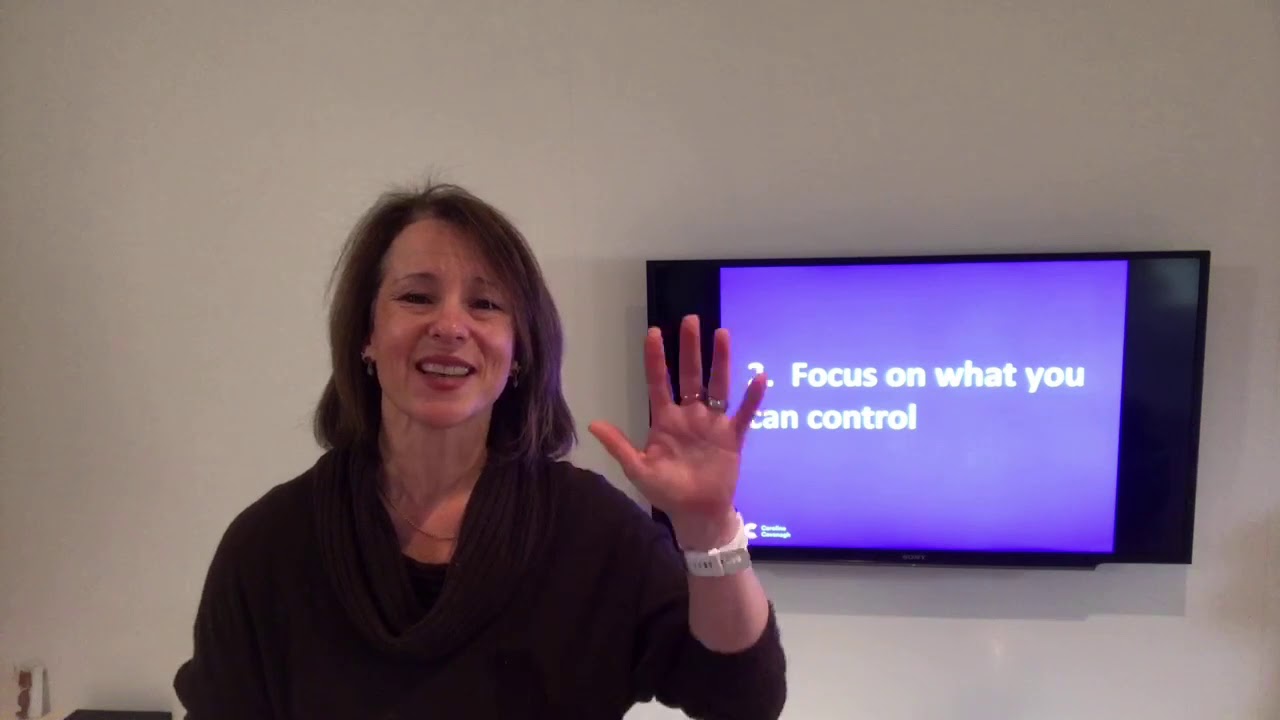
Caroline Cavanagh shares six practical techniques for managing high anxiety: shorten your planning horizon, focus on what you can control, cut back on news, practice gratitude, prioritize sleep and exercise, and notice unhelpful thought patterns. Resources are available on her website.
Chapters
Hi there, my name's Caroline Cavanagh and I'm an anxiety specialist, and today I'm here to share with you 6 tips to use in times of high anxiety. And now this is not about like immediate anxiety, like you're being chased down the road or something really scary has happened, that peak acute anxiety. This is the sort of anxiety that many of us are experiencing right now. It's where the environmental factors that you're in You can't control, but they're sustained. They're not going away anytime soon. And so I'm going to share with you 6 techniques. I don't expect anyone to adopt all 6. Just choose one. Listen through, find the one that you kind of think, you know, I think I might be able to do that. Use that one. It will start to reduce your anxiety because anxiety is purely A response to a perception of vulnerability. We're all feeling, or many of us I should say, are feeling very vulnerable at the moment. The lack of social contact, the lack of ability to do many of the things that we normally feel in control of. And so the more you start to feel in control, the more that vulnerability comes down, the more the anxiety comes down. And so it's changing it from going that way to now bringing it down that way. So in all honesty, none of these are short-term fixes, but you can make an awful lot of progress by taking small steps consistently than trying to take one giant leap, because often that leap ends up you falling down the chasm. So let's just get straight into it. 6 coping techniques to use in times of high anxiety. Number 1, stop Planning. And for some of you, this may feel a little bit ironic because planning often is a source of helping you feel more secure. But when the external environments are very vulnerable, if you've got high vulnerability, have low short-term planning. If you have low vulnerability— bring it that way— if the outside factors are just the same, Then you can invest in high-detailed planning because things don't change. Now, in all honesty, at the moment my planning horizon is about 2 hours because I found a lot over the last 6-9 months, if I plan too far ahead— let's even take her back to the recent Christmas, planned Christmas— how many times did those plans have to change in just a matter of a few days? So think about, for you, what planning horizon brings you back into a sphere that you feel more in control of. For me, it is about 2 hours. The risk of planning outside of that horizon is disappointment because those plans change, they don't deliver what you hope to, and secondly, it's using up time and resources of yours that at the moment could be better directed elsewhere. So whether your time, your planning horizon goes to a matter of hours, a day, maybe a few days, even a week, that's absolutely fine. Work out what's right for you, but keep your planning within a framework that is more controllable than the long-term planning, which is very, very difficult in a very volatile environment. Number 2, focus on what you can control. There are so many things at the moment that you can't control, but let's just think of a life outside of COVID if we fairly can. You may find that you're in a work environment that's very uncomfortable, but leaving that work environment isn't a short-term solution. Or perhaps you're in a relationship that's causing you a lot of dis-ease. But again, leaving that relationship isn't something that you can do at that time. But there will be things, even within that environment that's uncomfortable, that you can start to control. So one of the things I've chosen to do at the moment is I've set myself a challenge of doing 1 million steps in 90 days. It just so happens that my birthday falls at the end of March, so starting at the end of November— December even, I plan on doing a million steps in 90 days because I can control going out. Whether it's freezing cold, pouring with rain, I can still go outside doing the exercises within the government rulings, so I'm not putting anyone else at risk. And I'm doing something that is helping me. I've chosen to do the million steps because I know even if it is pouring with rain I'm going to feel better from having gone outside and spending time in nature. I also know that doing exercise is going to put endorphins— hi Fran, lovely to see you— putting endorphins in my, my system is also going to help my physical and mental state. So it may not be exercise for you, it may be something else. You may choose to finish a course that's been hanging around for ages, Or read some books on that book list that you've been longing to do. Pick one thing that you can control because it's your motivation and nothing else outside needs to change for you to have a success at that. The more you're in control, the less you feel vulnerable, the less you are anxious. Number 3. This is a real bugbear of mine. Cut down on your news intake. I don't know why it is, but for some reason, pretty much all of the news, even the high-quality BBC, etc., focuses on the negative. Excuse me. And when you're immersed in that negative energy, it drains you. So it's time to now pick up on the positive. Cut away the negative, stop that drain, just purely shut it off. Which brings us beautifully on to point number 4, focusing on the positive. Glad you agree with that, Fran, thank you. Choose to focus on things that you can be grateful for, because there will be things. So I choose, for example, to focus and be grateful for the fact that I live in the beautiful countryside, so it's easy for me to go out and do my walk. I'm grateful that I have teenage children, so I'm not having to be a primary school teacher to them and be sitting beside them doing something that I really am not skilled to do. But even on a day-to-day basis, my dog, for example, yesterday just made me laugh by being a bit of a nitwit. So when I went to bed last night and I did my gratitude exercise, I thought about that moment, and those feelings, those positive feelings, just welled up inside as if that thing with the dog had just happened already. When you focus on things that you are grateful for, it changes your internal body chemistry, and when your body chemistry is in a positive state, anxiety doesn't fit in, sit in there very comfortably at all. And if this is something that you think, you know, yeah, I can do that, on my website carolinecavanagh.co.uk, there's a lovely little exercise that you're very welcome to download and focus on doing. This is something I genuinely do every single night. Because it puts your body chemistry in that positive state, it helps your sleep, and it also means you wake up in a more positive state than the reverse. Go to sleep worrying about things, your sleep's disturbed, you wake up worried. It's something that you can control by controlling your thoughts, by choosing to focus on gratitude. Number 5, boost your immune system. This is a really, really simple, flipping obvious but not often done one. Good food, good diet, hydration, exercise— 3 things that will all boost your immunity. When your immunity is strong, you are less likely to fall ill, whether it's COVID or whether it's any other normal cold, flu, anything out there at the moment. Make your inside environment as strong as immune system as you can. That gives you again a basis of confidence. I am generally not worried about getting COVID. I haven't had a cold for 8, 9 years. My immune system's strong because I invest in it, because it's something I am in control of. And finally, number 6, notice your thoughts and change your language. It's one of the facts of your mind is it doesn't have a filter. It just accepts whatever you focus on. So if your focus is, I bet I'm going to get ill, I bet I'm going to get ill, I bet this is going to happen, your brain is hearing those thoughts as if they were real. It goes, you know, yeah, I can do ill for you. Brilliant, bring it on. A little story to share with you. My husband has struggled with his sleep for a very long time, and I noticed that he was climbing into bed going, oh, I bet I'm gonna wake up at 3 o'clock again. Brilliant, great thought. So his brain was going, yeah, I can do that, mate. You can wake up at 3. How about 10 past 3? And so I said to him, why don't you say to yourself— Gwen, lovely to see you too— why don't you say to yourself, I'm gonna sleep right the way through until my alarm wakes off. So he, rather taking the mickey out of me, laid down, sat down, going, oh, I'm gonna sleep through until my alarm wakes me up. I'm gonna sleep through until my alarm wakes me up. Fell asleep. He then woke up at 7 o'clock when his alarm wakes up— woke him up. He looked across at me and called me a witch, although there's another word in between there as well. And yeah, okay, I'm a witch, but I'm a witch who knows how your mind works. So become aware of the thoughts. What are the stories you're telling yourself? Because they are just stories, they're not real. If you're telling yourself you're going to wake up, if you're telling yourself you're going to get ill, It hasn't happened yet, it's just a story. Change the story, it changes your mind, and when you change your mind, everything follows through from it. So there's my 6. I know you possibly can't read all of them, but never mind. You've got all 6 on the summary anyway. Stop your planning, or take it down to a really, really narrow frame of time. Focus on what you can control. Mine's my million steps. Yours might be reading books, finishing a course, learning how to cook. Number 3, minimise your media intake because most of it's negative, it's gonna drain you. Number 4, be grateful because those grateful feelings will change your internal chemistry. Number 5, help yourself by helping your immune system. Good diet, good hydration, and some exercise. Those little things, 3 together, really combine to build a strength. And finally, become aware of your thoughts, and if they're rubbish ones, just change them. So as I mentioned, there's lots of resources on my website carolinecavanagh.co.uk. If you zip over there, if you're interested in the gratitude exercise, you'll find it very, very simply. It's a lovely exercise, but there's lots of other ones on there as well, and please download anything that you are interested in with my absolute pleasure. But for now, I will leave that with you. Thank you very much to those of you that have been watching it live. For those that you are watching it on replay, if there's anything, any questions that you have, please do get in touch with me. And what I would love for anyone is, having listened to those 6, just drop a message in the comments box below and let me know which one do you feel more drawn to do, because I'd love to know, of all these 6, Which one is the favourite one out there? Start with that one, then bring in the next one, then bring in the next one, because I genuinely do all these 6. Didn't start off that way, it's taken me a bit of time to get there, but it's very, very achievable. And so for now, I will leave those with you. Over and out. I'll be back soon.
More from Caroline


Diary of a Hypnotherapist, Episode 41 | @caroline-cavanagh | The Anxiety Alchemist

The Psychology of Comfort Food & Control | @caroline-cavanagh | The Anxiety Alchemist


Unlock Your Mind for Subconscious Healing | @caroline-cavanagh | The Anxiety Alchemist




Overcome Insecurity with Hypnosis | @caroline-cavanagh | The Anxiety Alchemist


Diary of a Hypnotherapist, Episode 40 | @caroline-cavanagh | The Anxiety Alchemist