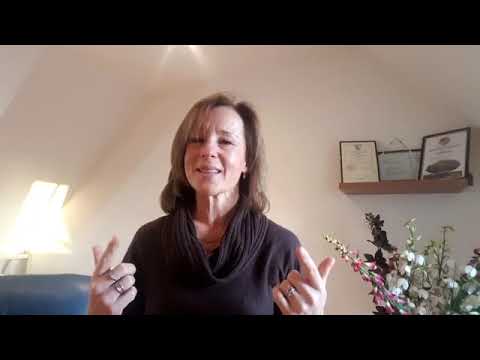
Caroline Cavanagh, an anxiety specialist, uses a rearview-mirror metaphor to show how dwelling on the past or distant future fuels anxiety. Shifting your attention to the present gives you a sense of control and reduces it.
Chapters
Hi there, my name's Caroline Cavanagh and I'm an anxiety specialist, and I love going out and doing public speaking and talking to people about the tips and techniques that I use to help people in the one-to-one sessions that I do with people who are struggling with anxiety. Can't get out and speak now to people face-to-face, so this is the best medium I have to share some of those tips, especially at a time where anxiety is is dominating so many areas of our life. And there's been one particular tool that I've spoken about a lot this week, and I kinda use the word tool because it is a bit like I have a toolbox. If my toolbox just had one tool in it, say, let's say a hammer, it would just mean that every situation I was in, you hit hard with a hammer. But in my toolbox over the years, I've developed a whole range of tools and techniques, and by sharing these What I aim to do is to help people have their own toolboxes so that whatever situation they're in, they can pick up the tool that is relevant to that particular situation or context that they're in. And this tool that I've ended up speaking about a lot this week was because I've been working with a number of people who, for a variety of reasons, have found themselves either stuck in the past or focused on the future. More commonly, I come across people who are stuck in the past, and that may be reflecting all the time on bad decisions that they've made or outcomes that didn't turn out in the way that they wanted to, and it really is preventing them from moving forward. And this is what the tool that I bring out and talk to them about in these situations Now, if you're a driver, I'm sure that you're going to be able to relate to this very easily. It's a tool that for me goes back to— I worked in a company where before you were allowed to take out a company car, you had to have a couple of advanced driving lessons. And I remember sitting in this car with this guy, and like most, I was a fairly newish driver at that time, would really be focusing on the car in front, at most 2 or 3 cars in front. And he was saying, Caroline, okay, yes, you need to know what the car in front are doing you, but what about the brake lights that have just come on in those cars 10 ahead? They're slowing down. If you're aware of that, you can start easing off the accelerator now so we don't have this sudden, oh, there's a big stop. And also, you need to know what's going on behind you so that if suddenly someone's coming up close behind you, you're able to accelerate, get yourself out of that situation. And it became very much a now, future, behind, now, future, behind. And that even now is something that when I'm driving, I still find myself remembering doing it, because it means that all the time I have an awareness of what's going on right in front of me. I'm having an awareness of what might be coming up in front, so I can kind of, you know, if there's anything coming up— Hi Fran, lovely to see you! Gosh, thank you for joining in, great to see I can't see you. Something that's coming up way up in the front, I can be aware of it and start planning for it, but also being aware of what's behind me so that you can learn from that. So bringing that into the context of how I use it therapeutically, someone that if they're constantly looking in the rearview mirror, just imagine sitting in your car purely focused on the rearview mirror. You wouldn't be able to drive, right? Or even if you tried to drive, it would be terrifying. And that's where anxiety comes from, because in reality you can't control what's already happened. Even if in your car you turned round, did that bit of journey again, it would already be different. You'd be behind a different car, it would be a different time. You can never go back into the past and it be as it was. It's Always moved on. Whereas when you focus your attention on the now, that's the time zone, that's the fear that you can have some control over, a large degree of control over. So if the car in front of you brakes, you can brake, you can respond. Similarly, if you spend too much time thinking about the future and looking way ahead, again, you might miss the taillights coming on in the car in front of you and And B, in a crisis situation, which is scary. So bringing this metaphor into how do you manage anxiety, anxiety is purely a response to a perceived vulnerability. Vulnerability is another word for not having control. Can you control the past? No. Can you control the future? No. You can influence it, maybe. You can prepare for it. You can't control it, but you can control the now. And so by— if this is something you can relate to, you just think, yeah, I do spend a lot of time thinking about the past. You're looking in your virtual rearview mirror. Have an awareness of that and think, okay, I can't control it. Maybe that's why I'm feeling anxious. So come into the now. Look at what's here, even if what you see is Isn't very nice. This is the sphere that you can be in control in, and when you're in control, anxiety cannot be in the same space. It's like there is just one car park space. If control's in there, anxiety has to wait. Just as similarly, if anxiety is in there, you need to reverse it out and get control parked up. You can only control the now. And so if you can relate to this, if you're aware of, yeah, I'm someone that looks in my rearview mirror, I'm someone that looks out in the future, think about this. Think about being in your car. What's the safest way to drive? Is to be focusing on the now, glance into the future, glance into the past, learn from it, but come back to the now because that's where you can be in control. And that's where you can reduce your anxiety by being in control. So I really hope that helps you. If you've got any questions, I would love to answer them for you. Please pop them in the comments box. If you can relate to that, great, share that with me in the comments box below. And if ever it's something that you just think, well, maybe I'd really like to talk to Caroline about this, please just pick up the phone, give me a call, or contact me through the website. It's a very easy one to remember. It's just carolinecavanagh.co.uk. Take a look at some of the case studies in there if you're interested in this. And if you think, yeah, this may be something that I'm aware of doing and I'd like to learn some new tools myself, let's have a chat. I'd love to talk to you. But for now, bye-bye, and I'll speak to you again soon. Bye-bye.