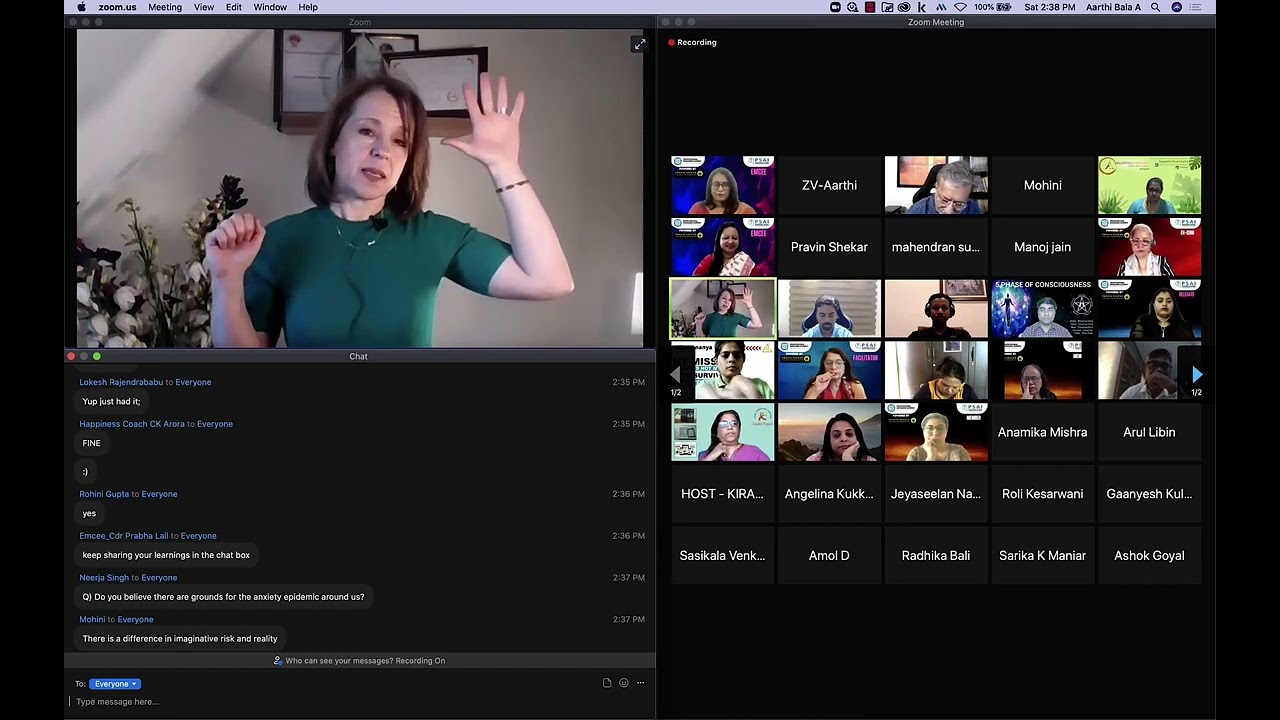
Caroline Cavanagh leads a workshop on anxiety and fear leadership, teaching three techniques: distinguishing real from imagined risk, expanding your comfort zone, and a reframing exercise called Flip It. The session includes live audience exercises and Q&A on fight-or-flight responses, camera anxiety, and accountability.
Chapters
Let us begin with one of our speakers. I suffer from anxiety. This is an expression that Caroline regularly hears. However, her view is that anxiety is not a bad thing. We just need to learn how to use it. In her talk, we're going to be encouraged to get involved and apply some of these techniques. She will actually help us experience how changing your relationship with anxiety— and you know what, learning how to give fear leadership— can be used to become a better speaker, grow a stronger business, and live a more exciting life.
So, recording in progress.
So without much delay, Caroline, the show is all yours.
I was laying there in a crumpled heap on the floor. The gym mats were cold underneath my forehead. I couldn't feel any pain, but I'd mucked up. And I couldn't move, because if I looked up, I might see the anger in my teammates' eyes. If I looked up, I might see the audience who'd be judging me as a complete failure. If I looked up, I might see the disappointment in my coach's eyes. So I stayed there. Paralyzed with fear. And then I felt 2 hands lifting me up, and as my head raised, it wasn't disappointment I saw in my coach's face, it was compassion. Come on, Caroline, it's okay, let's get you back to the bench. And as I walked back to the bench, it wasn't anger I I saw in my teammates' eyes. It was concern. Are you okay, Caroline?
Are you hurt?
And then I was brave enough to look across at the audience. Very few of them were even looking at me. The moment was over. They were just getting on with their lives. I was a 10-year-old gymnast, and my floor routine was the best in the squad, so they'd put me on last, and if I performed well, the gold medal was within our reach. But I'd mucked up. But I had a second chance. My coach had gone to the competition organizer And they'd said, let her go again. I was only 10! So I found myself standing there again on these cold gym mats. But what if I mucked up again? What if I let people down a second time? Would anxiety stop me from performing at my best? If I could go back and be that 10-year-old gymnast again, I would take with me all of the things that I've learned to help her perform at her best. It's quite a good thing I can't go back in time because I wouldn't want to put a leotard on again, not a good look. But I am pleased that now I can use those skills to make sure that I perform at my best at every opportunity in my professional world and in life, and I love sharing them with others too. Because we're all human, we all muck up, and I'm sure most of us here could share our own stories of when we've fallen, found it hard to get up, or perhaps haven't performed best in our businesses, in our lives because of anxiety. And today I'm going to share with you 3 really powerful techniques that I now use to help me perform at my best, and they're all underpinned by one very core principle: that anxiety is a good thing. It just needs leadership, leadership in the face of risk. As public speakers, we expose ourselves to risk a lot of the time. Audiences will judge us, and in that judgment, you risk negative judgment. Every time we do something new, you risk failure, and the degree of risk has a direct relationship to the degree of anxiety we tend to feel. That little 10-year-old felt a lot of risk as she went onto the floor with the gold medal resting on her shoulders. But what if the risk was life-threatening? I want to tell you Georgia's story. Georgia was a client of mine, and her risk was at the highest possible level. Georgia was on holiday with her mum. It was hot and she was struggling to sleep, and she knew by looking at that clock, the time 3:23 AM is a time she will never ever forget, because as she lay there, the hotel room door started opening. And there, his frame filling the doorway, was a huge man. There was a tiny bit of light in the room, and it struck something metal in his hand. He had a gun. And I'm wondering, how do you think you would have reacted if you were faced with a situation like that? Georgia's mum froze, but Georgia got out of bed and opened the safe and stepped back. The gunman reached in, took out the cash, acknowledged Georgia, turned and left. Georgia's behaviour that night probably saved both of their lives. So little 10-year-old me had a physical response to an imagined scenario, imagining what her teammates, her coach, the audience were thinking. But we can also have a physical response to real risk. And the first thing I would love you to take on board today is that fear is a good thing, because in each of those situations, fear's role is survival. The fear response is one of our most primitive survival techniques, the fight, flight, or fear— freeze, sorry. Georgia's mum froze, the most primitive of those 3, but Georgia's was to fight. to face the real risk. So what about that little 10-year-old? She also froze because her risks were also imagined and her mind wanted to protect her too. And herein lies one of the key problems. Your mind can't tell the difference between imagination And real risk. The fear response will be triggered in each situation. And so, one of the things I hear an awful lot is, I have anxiety, and my response is always, brilliant! And then I duck the evil look that normally comes following that. Because anxiety is a good thing. It keeps us alive. Without anxiety, we would cross the road without checking for cars, but the fear of getting run over keeps us safe. Without the fear of getting burned, we'd put our hand on hot things. Fear keeps us safe. Fear is a good thing. It just needs leadership. But I'd like to be really open and honest with you. Anxiety, worry, overwhelm, stress— they're all shades of one color: fear. But fear is a 4-lettered F word. And a bit like another four-lettered F word in the English language, it's not very polite to use in language. People avoid it. So we've substituted fear for anxiety. Anxiety is a good thing when you learn how to lead it. So let me take you back to Georgia's story. Georgia was able To face that gunman because she had gained leadership of her fear. But this may surprise you— Georgia was just 16, and 2 years before that, she had spent all of her school days cowering in a smelly, windowless art cupboard due to debilitating anxiety. In her art cupboard, she felt safe because everything outside that art cupboard was scary. And I wonder, as business people, as professionals, do you think that there are areas of your business, perhaps areas of your life, that you operate within an art cupboard size comfort zone because Things outside are scary. Georgia went from art cupboard to international traveller because of these 3 things I'm now going to introduce you to. The first thing we needed to do with Georgia was to help her understand risk. Most of Georgia's anxieties were triggered by her imagination. She worried about not being able to answer a teacher's question, but there weren't any teachers in her art cupboard. She feared having a panic attack, but she'd never even had a panic attack in the past. They were all scenarios bouncing around in her head. And let's go back to that little 10-year-old. The real risk wasn't what she was seeing. She was seeing all of those things in her mind and they were bouncing around keeping her paralyzed. And the first thing that Georgia learned is beautiful in its simplicity. It is purely to start understanding the difference between real risk and imagined risk. And we've already touched on the point that the mind can't tell the difference between reality and imagination, so we need to allow a pause to bring in another part of the mind, the conscious mind, that's much, much better at making good decisions. So what Georgia learned to do was when she felt those symptoms of anxiety rising up She'd take a pause and step back and ask herself, is this risk real or imagined? And the more she did that, the more she started to see that the imagined risks were vastly disproportionate to the real ones. And in that understanding, her perception of reality changed. had a much firmer foundation. And so I would like us now to take a brief pause. When I invited you into this room, I asked you to bring a pen and paper with you, so pick that up now. And I want you to just reflect for a minute or so. What are the thoughts that bounce around in your head That maybe keep you awake at night or stop you getting to sleep, or maybe distract you during the day. And just jot those thoughts down, big ones, little ones, work-related, family, relationship. What do you worry about? What thoughts bounce around in your mind? Okay, I can see some of you starting to look up. That's great. And now look back down at that list and just see how many of those thoughts are real risks in this moment. If that is the case, it's a real risk now, pop an R beside that item. However, if it's a thought, it's either happened, hasn't yet happened, may never happen, Pop an I beside those items. And then what I'd love you to do is to pop in the chat box, do you have more Rs or more Is? If you have lots of Rs, put an R in the chat box. If you have more Is imagined, put Is. Here we go, all I's. Arul got some R's. I's only, yep, so we've got a good mixture here. So I think the I's are starting. Ricks from Rohini, excellent. Good, keep them coming. Yeah, so we're definitely getting towards a mixture of I's. And please forgive me because I'm not as familiar with, with your names in India, so I'm finding it a little bit harder to tell gender differences. But certainly when I've done this within the UK, there's often a bias towards more of the ladies have imagined responses and more of the men tipping towards the Rs. But even then, I would challenge those of you who are writing the Rs, are these risks real in the now? Could you take action on them in this moment? Because if not, perhaps it's still something that hasn't happened yet, and that's something just to be aware of and think on. Perfect, so thank you very much for doing that. Let's move on. Because the reality is we can't change what's in the past, we can't control what's in the future, we can only change things in the now. Like Georgia's gunman in the hotel room. Georgia was able to face that situation because of the control of her fear allowed her to take that brief pause and bring in her conscious mind to decide that the best action given that situation was to give the gunman his money. And that choice, that decision, is the one that's likely to have kept them alive. Georgia's mum, however, was very different. Her mind had started entertaining all sorts of thoughts, none of which had happy endings, and that inhibited her response. So now we have an awareness of real risk and imagined risk, and that helps have a stronger foundation to respond to risks appropriately. So we're ready For tip number 2. And I'm guessing that most of us have an awareness of the concept of comfort zone.
Yeah?
So comfort zone is something that means we can do easily, don't really have to think about it. And by definition, anything outside of the comfort zone is uncomfortable. So I'd love for you now to play a little game with me and simply cross your arms. All doing that easily, fantastic. Yeah, comfortable, easy to do, yep. Now open your arms and fold them the other way. And I love watching this on screen because I can see people go, um, Ah! So comfortable, uncomfortable, and the more you practice doing it, the easier it becomes, until ultimately you have more ways of doing things, your skills grow. Brilliant, thank you for doing that, just relax your arms now. So Georgia's new awareness of reality allowed her to start stepping out of her comfort zone, but initially it was uncomfortable, but with practice it became easier. She went from art cupboard to classroom, from classroom to being able to go into an assembly hall. And from an assembly hall, she managed to do an international flight to go and see her grandparents, something she would have never been able to do before she started learning these skills. Time to pick up your pens again. What I would now like you to do is to write down the answer To this next question. What area of your business or your life would benefit from you growing your comfort zone? Pop that down, and when you're ready to, again, I'd really value and appreciate you typing that into the chat room as well. What area of your business or life would you benefit from if you increased the comfort zone? Okay, so a few people have put in none already. Self-esteem. Excellent, really good insights, Sangeeta.
Kathleen, did you mean increase your comfort zone or like step out of your comfort zone?
By stepping out, you will increase your comfort zone. Okay, okay, great.
Yeah.
So self-confidence, yeah. So overcoming fear, self-confidence, yeah, that's a common one that comes up. And by building self-confidence, that touches all areas of life— business, personally as well, self-worth, create— oh, creativity, I love that. Creativity is such a powerful thing. to then be able to come up with better solutions. Feel more out of life, wonderful. More visibility on social media, yeah, that's very, very specific, love that. More reach, learning, excellent. Keep those coming. And perhaps by seeing some of these comments from others, that may trigger some little thoughts in your mind to go, oh yeah, that would be good for me too. We can all learn From each other. Camera consciousness, yeah, that's a big one, isn't it? Excellent, especially when we're doing so much online as well. So perfect, we can come back to some of these a little bit later. So you now have an awareness of how imagination can hinder your performance, keep you in a small place, in a comfort zone. But you're also now aware of how stepping out of the comfort zone and taking small steps, and with practice, that comfort zone can grow. So we're ready now for skill number 3, and this is my favourite. Love it. It's a simple one called Flip It. When we go out of our comfort zone and into uncomfortable, our brains will often catastrophize. They will lead you down a path of what if— what if this goes wrong, what if that happens— and it's again part of that survival technique, helping us to preempt and prepare for things that may happen. However, often they don't, and it consumes a huge amount of energy. And Flip It is the most powerful technique I've ever come across that stops reducing this waste of your mental energy. Have you ever noticed that when you ask what-if questions, They're typically negative ones. What if the technology doesn't work when I go live? What if I don't get that contract I really need? What if I forget what I'm going to say when I'm talking to an audience of hundreds of people? They're all negative. And I'd love you to play another little game with me now. This is one that I often do when I go into schools, so unleash your inner child, it's Saturday, let's have fun. So what I would love you to do is in a second I'm going to count to 5 and I'd like you wherever you are to just look around your environment and see how many blue things you can see, okay? Here we go, 1, 2, 3, 3, 4, 5. Okay, you've all got a number, yeah? Excellent. How many green things did you see? And so when I do this in the schools, I invariably get kids that go, oh, Miss, you didn't tell us to look for green things! And then the penny starts to drop. If you look for blue things, you'll see them because they're all around. But you don't see the other things that are all around too. So let's now change blue and green to positive and negative. If the blue things are negative and you look for them, boy, you'll see them because there are plenty of negative things around us much of the time. You might not see The positive things. And this is where I love Flip It, because it trains you to start seeing the positives that are there. Our minds are very much like muscles, and when you exercise a muscle and flex it, it gets stronger. So when you flex the negative muscles and you see all the negative things around, it gets very strong. Meaning that you see even more. So Flip It is all around starting to flex the positive. And it's called Flip It because it does what it says on the tin. What if the technology doesn't work? What if it does?
Flip it.
What if I don't get that contract?
What if you do?
What if I forget my work?
What if you do?
Your mind will answer whatever question you give it. So give your mind leadership of the questions you want it to answer. Because the questions you give it will be answered. Those answers are thoughts. Those thoughts create feelings, and those feelings will support different behaviours. So flip it is another beautiful one in simplicity. When you recognise you're having those what-if negatives, flip it into a positive. And I'm not sure how many of you are parents, perhaps you have work colleagues, it's a wonderful one to also use with those people around you. Because the more we help each other build that positive mental muscle, the more we all start to see the positives too. So let's go back to Georgia. Georgia went from debilitating anxiety to the ability To control her fear in the face of life-threatening risk. She learned how to step back from those symptoms that we're all familiar with and ask herself, real or imagined risk? And as she changed her perception of reality, it allowed her to start growing her comfort zone, going from art cupboard to the classroom, making her world bigger. And she has built a very positive mindset. Georgia is now 23, running a business with a large team of staff working for her. And in her organization, that 4-lettered F-word is embraced because they all know that when they feel fear, it's an opportunity to grow. To be positive, to perform at their best. And that's what I would now love you to start learning to do too. So I said it in my intro, I'd love everyone to come away from this session with one task that they're prepared to action now. So where I'd love us to start is in a second I'm going to ask you to write down another number. This number is going to be between 1 and 10. If you can identify more with that little Caroline who was trying to get that gold medal for her team but was cowering on the floor unable to move, unable to look up and see what was really around her, give yourself one of the lower numbers. However, if you feel more aligned with 23-year-old Georgia and you feel you can face any risk with control and to make excellent decisions with the resources you have available to you at the time, give yourself One of the higher numbers. Write that number down now for you, and then I'd love it if you popped it in the chat room too. Of course, we've got some high numbers coming up here. That's great. Some nines, some sevens. No low numbers yet. That's wonderful.
Okay, perfect.
So we seem to be quite a few 9s, which is great, 7s, 6 and a 5. Oh, we've got a decimal point in there, 7.5, couldn't quite choose.
I love that.
Perfect. Okay, so that's given you a benchmark for where you are now. And what I love is that no one's given a 10 because it means all of us have still got room for growth. So the next thing I would like you to do is thinking on all of the stuff we've covered in the last half hour or so. What action could you take to move yourself up by one number? Perhaps it's using this technique of thinking real or imagined, so you stop wasting energy on imagined risks that are never actually going to happen. Maybe you want to go back to that second list you made and think, What area can you now grow your comfort zone in, and what step can you take to now grow your comfort zone? Or perhaps you want to use Flip It and start strengthening your positive mental muscle. So write down one step that you are prepared right now to start using to enhance your performance? And we've already got some coming up in the chat room. So we've got flip it, being more assertive, stop fretting. Excellent. So stop fretting, that's again relating to reality and imagination. To grow your comfort zone, that's great. A couple of people have said that. I'd love you to be quite specific. What area of your life are you going to grow your comfort Sorry, grow your comfort zone in. Is it going to be— someone said social media, are you going to grow that? The more specific we can be, the easier the steps become. Practice, practice, practice. Yay! Be more camera friendly. Excellent, that's a lovely specific one, it makes the step easier to take. Stop using certain words. Love that too, and perhaps identify on a couple of words that you want to start taking out of your language. So I'll pick up on that one because that's a great one. I've got 4 words that within my business practice as a therapist and within my family as well, I don't like anyone to use and I will challenge them on. So one of them is try. The word try, I'm going to steal this from Yoda. There is no try. Either do or don't do, because what try does is it sets us up for failure. It's an excuse. Don't use it. Make a decision. The next one is but. When you say but, you're setting yourself up again, because whatever follows but is rarely positive. I don't like make me. That makes me angry. No one can make you angry. You're doing it yourself. And the fourth one, gosh, I'm just forgetting what the fourth one is. It'll come back to me in a minute. That's quite weird. Oh, should, should. Should. I'm gonna go out for a run, or I should go out for a run tonight. Am I going to? Unlikely. So should and try are very similar, make a decision, I'm gonna go out for a run tonight, or I'm not gonna go out for a run tonight. Be accountable. So excellent, yay Yoda! Oh, great thing. I've turned my camera around, I've got a poster of him on my wall because I just love that so much. Do or do not do, there is no try. Star Wars, perfect. Okay, so you have now got an action that you can take. There's one more thing I would like to ask of you. By making that commitment to yourself, it's brilliant. By putting it in the chat room, you've also made it public, which heightens your desire to actually take that action. If there are other people in this room now that you know, ask them to hold you accountable. Or when this session is finished, Let someone that you know and trust, or even a family member, to say, I made this commitment today, hold me accountable to do it. Because we're quite good at letting ourselves off the hook. Whereas when we know someone's going to be saying tomorrow, next week, have you stepped out of your comfort zone and improved your camera confidence? You're going to want to say, Yes. So the last thing I ask of you is to find someone to now hold you accountable to what you would love to do in terms of improving your performance and really learning to use your fear, because fear is not a bad thing. By identifying the anxious thoughts are not real, your art cupboard stops being somewhere that feels safe and is somewhere that starts to feel really restrictive. By becoming uncomfortable and with practice, you gain more skills, you gain more confidence, and that allows you to go even further. And if those doom thoughts of what if creep in, Flip them. These 3 skills provide leadership to fear. They help you pick yourself up if you muck up, because we will, and stops you being like that little 10-year-old Caroline, unable to move forward. These skills allow you to make the best decisions when the risk is real. Like Georgia and her gunman, these skills allow you to grow and to build a very strong positive outlook. Fear is a good thing, and now you know how to give it leadership. And just in case you. wondering, I did win the gold medal. Thank you so much for taking part.
Thank you so much, Caroline. And Caroline, I'm still trying to get, get my arms folded the other way, but—
A little bit of practice, Bhavani, it comes.
I'll try, I'll try, I'll keep that trying, and I'll let you know if That actually works out for me. So ladies and gentlemen, we are supposed to have Chantal Simon to join us, but due to unforeseen circumstances, she could not be here with us. And on behalf of PSS 2022, our apologies for that. So you know the irony, we are having our theme, The Power of Uncertainty, and here we are with real uncertainty and chaos. So, and a big but, I'm going to say, but I know Caroline said no buts, but I'm going to say a big but. Even though Chantal is not here, but the show still goes on. So because we have additional time, we have Caroline with us and we don't want to waste this opportunity. It's not every day we get Caroline here with us and to chat with her. We're going to do question and answer session first. Do type in on the chat. I believe Praba has already collected some of the questions. We will do the question and answers and then we'll get into conversations after this. I hope that's all right with everyone. So we are going to continue the show and Praba, over to you with the questions.
Thank you, Bhavni. Thank you so much. Personally, Caroline, I must say lots of learning today. Fear is not a bad thing. That's my first learning, and I'm sure everyone in the room today will go away with this learning. Fear is not a bad thing. A new term I learned— fear leadership. Never heard of fear leadership.
Wow.
The 3 skills you shared, flip it, change the mindset also. know, you took us to that story, Georgia, and how you took— that was really wonderful. And now I have a lineup of questions in the chat box, and it is buzzing, I must tell. Thank you so much for the questions, everyone. So my first question to you is from Nirja. Do you believe there are grounds for the anxiety epidemic around us?
My personal perspective on this is that anxiety has heightened because of social media. I do an awful lot of work with, with teenagers, and if you have teenagers of your own, they spend their life on a phone, and a lot of the content that they're consuming isn't actually real. Pictures have been photoshopped, opinions not fact, and they're consuming. But for— say, it's the same for all of us, you know, we are bombarded now with national news, global news, and if we even— we went back 50 years in time, the awareness of the dreadful situation going on between Russia and Ukraine at the moment wouldn't be as much in our face as we are exposed to now. So we have risk in our radars, pinging it much more. Again, go back 50 years, most of what we were exposed to was real in that moment. As teenagers, if we were comparing ourselves, we were only comparing ourselves to the other kids in our classroom. it was real, as opposed to that Photoshop goddess or god that they're seeing in pictures on their, on their phones. So it's distorting our perception of real risk and imagined risk. So very long answer to what would be a short response: yes, I think that anxiety has escalated because of social media and the media in general.
That's—
Which makes it even more important to use this perception, real and imagined. So my personal response to the, to the Russian situation at the moment is, what can I actually do? Here in the UK, the only way it's really affecting us at the moment is the escalating costs of things such as fuel. So we are being practical in how can we turn the thermostat down a little bit, turn lights off, to actually, you know, save and conserve that energy. And we have made donations where I can actually practically help some of those Ukrainians. But beyond that, I am not spending a lot of my time worrying about things that I cannot change myself.
That's a nice perspective. We have to live with this social media. So, good. So the next question to Caroline is from our dear Bhavni— sorry, Mohini. Do you think anxiety is also developed when we are too competitive or too ambitious?
That's— I saw that question pop up, and I love the fact that you've picked up on it. It's a great question.
Is—
can you be too competitive? Ask that to an Olympic athlete and they'd probably say no. What competition does is we are then comparing ourselves to others. Comparison is absolutely—
Recording stopped.
So comparison is absolutely a good thing to do Because it helps us up our performance to be better. Where it becomes disabling or destructive is when you're comparing yourself to something that's not a fair comparison. So if I was to compare myself to, let's say, Usain Bolt, I'm never going to be able to run as fast as him. Firstly, because he's 6 foot 3 and I'm 5 foot 1. So his stride pattern is always going to be bigger. I will always fail. So compare yourself to something that is a fair comparison, and that may be your ability to do one thing. For example, to run 100 meters, or to, I don't know, Any of the other things that you may be doing, you know, cycling a race. Don't compare yourself to the whole person because that's not a fair comparison. And again, coming back to teenagers, a lot of the girls especially will say, oh, she's much prettier, she's got nicer hair, she's skinnier, she's more clever. But she's a different person. And the advice I give to those girls is that you can have a grape and a grapefruit. They're both fruit. But is that really a fair comparison? Because they're fundamentally different. So we as human beings are all fundamentally different. So don't make the comparison. The only really true and fair comparison is to compare yourself to the you of the past. So if you are improving, if you're running that 100 meters faster, then you are growing and that's a good thing. So competition isn't a bad thing, but to compete with yourself and keep pushing your own performance.
Thank you. The next question is from Bobby. He wants to know, do you have more realistic fear or imagined fear?
Me personally?
Yes.
Very much real fear. So I've worked on this technique of imagined and real, and it doesn't mean that the imagined ones don't flip into my head because it's actually quite hard to stop thoughts coming into your head. But what I don't do is then allow them to stay. So I actively use that. Okay, that fear is not real. I can't do anything with it now, so I allow that fear to just keep on going.
Oh, so there's one, uh, thing in the chat box— camera consciousness. Can you tell us how to overcome that?
Okay. Yeah, so with the camera consciousness, what I would ask you is, what is it that you are scared of? My guess would probably be the fear of what other people are thinking about you. That's normally when people are worried about standing up as a speaker or talking on social media. It's normally that fear of what's that— what's someone else going to think, what are they going to say. So my advice would be to help you overcome that, you will be judged. Because we as human beings are judging each other all the time, it's part of that survival technique. And sometimes that judgment will be unfair. Because that judgment is coming from within that person's own reference point. Let me share with you a little story that may help put this into context. My son is quite a good hockey player, and there were a number of other hockey players in the village. So every Friday on training night, one of us would tap into WhatsApp, I can do the lift tonight, and kids would all pile in one car, and everyone else could be enjoying their gin and tonic on a Friday evening. But this one particular Friday, I popped in the chat room, it's my turn to take all the kids tonight. And everyone came back and went, yeah, brilliant, thank you, Caroline. And I ended up with 5 children that wanted a lift, but my car will only seat 4. So a bit of a dilemma. What am I going to do? So I thought, well, maybe I could do 2 journeys. You think, well, that's ridiculous. So I decided to just go back to that person and say, last one in, I'm really sorry, the car's full. I'll see you there. That person went berserk and called me all sorts of not very nice things because she judged me. And that initially was very harsh, but the way I overcame that was to think, what was my intention? My intention was to car share so that other people could have a nice restful evening. If she wasn't happy to prepare to take her own child, that wasn't me being a bad person. So when you get up in front of the camera, focus on what's your intention. If your intention is to do the best job you know how, if your intention— for most of us I think will be true— is to share What you know to help others, then allow your intention to be your focus. Whatever anyone else judges is their business. Allow them to have their business. You be in control, have leadership of your intention, and that will help you stand up and share your passion, your knowledge to help other people too.
Wow, powerful word, intention. Our next question is from Dr. S. Ranjan. He wants to know how to choose accountability partner.
Ah, excellent question. It could be absolutely anyone. So I have accountability partners in different areas of my life. So within my speaking business, I have someone that we will talk normally once a week and we meet once a month where we discuss and set goals and then in those calls it's like, have you done it yet? Because I don't want to in that call say, I'm really sorry William, I haven't done it this week, and it keeps us moving forward. You may also have an accountability partner perhaps in another area of your life if you're a sportsman, or within your own personal development, it might be a friend. So it's really less important who that person is, more important to have someone. And where I find personally the relationships work best is when there's a reciprocity. So I'm going to do something, you're going to do something, and together we keep each other Moving forward.
That's really interesting. The next question is from Kalyani. She wants to know, without comparing to anyone, we get anxiety to underperform. Is that normal, and can we stop it or overcome it?
How?
Any example or tips?
Could you repeat that? I'm not sure I fully understood the question.
without comparing to anyone, we get anxiety to underperform. Is that normal, and can we stop it or overcome it? How? Any example?
Okay, okay.
So if we don't compare ourselves to other people, you are comparing yourself to your former self. And there is, I agree, a risk to then underperform. But who's making that judgment? You are. So if you know you're underperforming, there's a part of you that wants to grow. So focus on that feeling of underperforming and flip it. Turn it from underperformance Into, okay, that feels uncomfortable, I want to now move forward.
Ladies and gentlemen, another mantra: flip it. Remember this, flip it. Yes, so I can see the chat box. Now, next question is from Anamika Mishra. What are the factors that cause a difference between in the fight, flight, or freeze response? understanding completely that human beings are unique?
I love this question, Anamika, and I could talk about this for the next hour on its own. The fight, flight, or freeze response is our most primitive responses, and there is a gender difference which I think I touched on in the, in the talk. So, in many ways, our our minds, our psychology is still very similar to as we were millions of years ago as cavemen. Our physiology has changed because we now have walls, central heating, and stuff that means we don't need to be quite so hairy. But psychologically, the evolution hasn't changed that much. So that when we are triggered into that risk, We go into the fight, flight, or freeze mode. As cavemen, the men would typically be the ones that were out hunting, and so when their fight or flight response was triggered, they physically would be better to fight because that then would enable them to, to kill the tiger and feed the rest of the camp. Whereas women, because we're not physically as strong typically, would run away. So there is straight away an automatic gender difference based on the hormones that we have. Testosterone takes you more down an anger route when you're triggered. Estrogen takes you more down a fly away. Freeze is the most primitive response. And that takes us right the way back in our evolution to when we were actually animals. So I'm very lucky that I live in a wonderful area of countryside where there are lots of deer, and when I take my dog for a walk, if the deer sees us, what they do is freeze, because most animals have got really poor eyesight, and if you freeze, they can't detect movement. It makes us safe. So the response that we have as individuals will be related to our internal chemistry, it will be related to our confidence in fighting or in running away, and it will be also related to the resources that we have at the time. So individuals can typically have each of those 3 responses. In any one time. It's not that people always fight or always run away. We will have different responses based on a multiple of different variables at the time.
True, true.
And I always go by the saying, choose your battles wisely. Yeah, there's a time—
I think that's very great.
And there's a time of flight.
Yeah, absolutely. And sometimes the options are are restricted too. There may be times when actually you can't run away and you have to face it and you're pushed into that fight mode. But it still comes back to if you have leadership of your mind in those situations, you are going to make a better response. Yes.
So moving on to the next question, why is that some people have more fears as compared to others? This question is from Adil.
Again, a huge amount of variance as to why that may be. So, our fear response is one of only 2 emotions that we have when we're born. We are born with the emotions of fear and love. All of the ones in between grow as, as we develop, as we evolve as human beings. And the environment you're then brought up in will start to mean whether— how much confidence you have. So if you're brought up in an environment where taking risk is actually limited for you, then you won't develop the growth in comfort zone. So again, to give you a very practical example, I'm the mother of 2 teenage children. And I've come under quite a lot of criticism in the past because I allowed my children the opportunity to make a lot of mistakes. So at quite a young age, I would give them money because I wanted them to learn how to use money. And then you might find this story a little bit funny. So my son, he was 13, and we went from earning pocket money to giving him an allowance. And his allowance was there to buy his own sort of play clothes and to buy presents for his friends and just general play money. And the first month he got the money, he went, yeah, brilliant, and went out and bought £50 worth of absolute rubbish. We then were about to go on holiday, so I said to him, okay sweetheart, you know, you're going to need some more t-shirts and some more shorts. So you've got your £50 allowance, you need to go out and buy some clothes that you're happy with. And he was like, oh, I haven't got that money anymore. Oops. So I didn't give him more money because what I wanted him to learn was responsibility of managing his money. So I said to him, okay, you know, you've got a number of options. You can earn some more money, you can wash the car, you can walk the dog. Because that's, as adults, is what we do, isn't it? If you want more money, you have to go and earn it. Or you can, with the little bit of money you've got left, go to the charity shop and see if you can get some cheap things that you can buy to take on holiday. Or option 3 is you've got the one pair of shorts that do fit and the one or two t-shirts, and you're going to have to do an awful lot of washing every night when we're on holiday. So I exposed him to risk, a risk that made him feel quite uncomfortable, but he learned. And now as a 16-year-old, he's really, really good at managing his money. So as children, if we're exposed to risk and we learn to muck up and pick yourself up, then you will find yourself being more confident that you can keep doing that. But it still doesn't mean that no matter how old we are, we can still keep learning. So does that answer the question okay for you?
Yes, absolutely, absolutely. You know, though there were so many cobwebs in our mind which you took that off from our face, in fact. And I would love more audience interaction. So maybe by raise of hand, we would like the participants to come up one by one and ask questions. Raise your hand, I'll call out your name. All those who want to ask questions, I will definitely pick some from the chat box too. So all those who want to ask questions— yes, our very own Michael Lee, you can unmute.
Um, Just trying to get my camera on.
Yeah, I can't see you, Michael. At the moment, you're just a gray hand.
Well, now I'm— now I'm—
There we go.
So I have a theory that's adding a 4th F, and I use it a lot, which is freeze. And it's maybe in nature, like with a tiger or a lion or something, it doesn't really do anything. But in real life, it feels to me like the most common response people have. I'm just curious what your thoughts are on that because to me, to me, it's— we're not fighting, we're not running away, you know, but we're, we're just not doing anything. Most of the time that's what people do.
Yeah, so freezing is the same as staying within that art cupboard, not doing anything. And I learn an awful lot from, from nature. And a very basic fact in nature is one of two things are happening: you're either growing or you're dying. And I believe freezing is leading us down that latter path. And this comes back to a lot of the principles we've just been talking about. When you recognize that maybe you are frozen, you're operating within that art cupboard, just a bit like Georgia was, you can then recognize this is not a good place to be. And that then moves you on to being able to fight. And even flight is still movement.
Yeah.
Sure.
Can I ask a second?
Yes, please. Yes, please.
Because the other thing that I learned recently around this whole love versus fear thing is that there was a study done at Northwestern University quite a while ago, I think about 20 years ago, that oxytocin is the basis of both fear and love, not just love, which fascinated me because it made me realize that when we look at coaching somebody or guiding people, it's actually really a clear choice.
It's not—
You know, the physical basis of both of them is oxytocin. So it's actually a choice made along the path of this impulse whether to turn it into a negative or positive outcome. It's not the base— physical basis is the same, which I thought is just blows my mind.
Yeah, okay, I haven't actually read that study, so thank you, Michael. I will, um, take a look and see if I can find it more. My My response to that is it's more likely to be the the levels of oxytocin. If the oxytocin levels are high, then you will be moving more towards love. Whereas if the oxytocin levels are low, it's not.
Then like the study found that like it's not it's not that. That's what's interesting.
Okay.
Yeah, I can send you the name of the person. I can't think of her name right now. It's a Slavic name, but it's a— yeah, it's a very interesting study.
Yeah, that's lovely, and I'd appreciate you doing that. And that's one of the wonderful things about the world of neuroscience— it is moving on so quickly, and things that used to be a common level of understanding now are actually being blown out of the water. So it wasn't that long ago, probably only about 20 years ago, that there was a perception that if there was a brain injury part of the brain died, that whatever function that brain part did would no longer be accessible. But there is a whole new field now called neuroplasticity because there's an awareness that other parts of the brain can accommodate for lack. Another very personal story is my, my big brother. He had a massive stroke at age 37. Leaving him unable to talk and unable to walk. And the doctor said to him, he will never be able to do those things again because of where the bleed on his brain was. He's doing both. But the part of the brain that used to do that is dead. But what's happened is other parts of the brain are now compensating. They're not quite as good as the original part, but he's walking, he's talking. And that's a massive change in neuroscience in just 20 years. So it's something that constantly excites me because, a bit like Michael's understanding of oxytocin, it used to be it's only about love. Actually, no, it's not. We're now realizing it's different, and that's really exciting that we can continue to learn more and use more in our lives.
Just to, um, I would just take a quick, quick check on the On the— I'm not— I'm going to put a link somebody asked for. It's not the link to the study, it's just a link to an article about it, but it is from Northwestern, so it's like pretty close to the study. So I'll put that in.
That's lovely, appreciate that, Michael. Thank you.
But what it seems to have to do with more is not— is not the— the oxytocin doesn't produce love, it actually triggers an area of the brain that creates an alertness to the situation.
Yeah.
So, so it's basically a stressful stress of some kind, whether it's positive or negative stress, is what, is what releases the oxytocin in order to create a memory of the event so that you could use it to learn how to respond.
Yeah.
Yes.
So Radhika had a question for you, Caroline. She has been waiting long to ask. Oh, bless her. Radhika, can you unmute and ask?
Yeah, thank you so much, Bhavni. And, uh, sorry, that was not Bhavni, right? Uh, yeah, Caroline, I have a question for you. Uh, just as you, um, your son You said plays hockey. So my younger daughter, who happens to be a teenager, she's a football player. She plays soccer, and she has been— she's called a child with a lot of anxiety. She has anxiety issues, but her anxiety gets triggered with people not doing the right way, right things the right way. So if the child— if her co-player is not listening to the coach or is not standing the way the child should be standing attentively, she gets anxiety. If the students in the class are not attentive towards the teacher, she gets anxiety. If things are not kept properly— so she's more of a perfectionist. If there are things not lying in a proper manner, at home, she will get anxiety and that triggers her anger and I really, really do not know how to take care of that. Because— and she's not a social media kid. She's a voracious book reader. So she at the age of 10 would sit and read Constitution of India just because she's getting bored and she has to read something.
Bless her.
Her only way of Taking— letting out her energies is playing football or being with the dogs. I've got 12 dogs at home.
12, wow!
So she sees any dog on the street who is hurt, who is malnutrition, she picks it up and she says, mom, we're not giving it back to the road. We're keeping it at home. And I face a lot of issues with her anxiety. It's affecting her studies now. She's a child with an extra IQ, but when it comes to academics, she doesn't score. And I face the same criticism from people of letting my children do the wrong when to learn what the right is. I do not know how to tackle this.
Okay, so the thing that is triggering her anxiety is because she's trying to control things that are outside of her control.
Right.
And if we go right back to where we started, risk and anxiety are completely related. So the more you're in control, the less risk. The more you feel out of control, the higher the risk. So the first thing I would start working with your daughter on is helping her understand that she is not in control of how the goalie stands or people's performance in the classroom. She is only in control of herself, and her responsibility is to be the best version of her that she can be, because that very much puts her back in a place of control. And And then taking that up another gear is helping her understand that, again, I mentioned about make me being one of my little bugbears of things that you don't say. Those people are making me anxious. No, they're not. That goalkeeper is standing in the way that she wants to stand, and that's okay. It may not be the best way, but perhaps it's the best way that she knows how How to do. So helping her recognize that she is creating her own anxiety, because then again, that helps her put her back in a position of control. Because as soon as you're aware of that, you can make a different decision. So those are the 2 things that I would really start on working with her, is helping her understand, stop trying to control everything that's out there. And start controlling your response, how you feel, and be the best version of her that she can be.
Right. That's so— thank you for that. And as you mentioned about giving your teenage son allowance instead of pocket money, so there's something which I can really relate to with my daughters. Now my elder daughter is 22 and the younger one is 15. When my elder one was about 10 years old, I stopped giving her pocket money and I start— converted her pocket money into allowance. The way I did it was I would tell her that, Sindran, every right thing that you do, that you feel is right and it's not harming anyone else, give yourself 1 point for that, a plus 1. And any wrong that you do, give yourself a negative 1 for that. So end of the month, calculate all the plus and the minuses. Whatever the total amount you get is going to be over and above your pocket money as your allowance that you will use for take— buying gifts for your friends. Slowly she learned how to do that and how to manage her money. manage things and also learn to differentiate between the rights and the wrongs for herself, not for others, but for herself.
Yeah, and I think that's, you know, it's a lovely thing that you've done there because again it's recognizing for her frame of reference what is right and wrong. So that's putting her back in a place of control, this word that we keep coming back to. Control of what's good for her, what's good for others, and what's not. And it starts to make those boundaries, that comfort zone for her, very clear. So brilliant, well done.
Thank you, thank you so much.
My God, Caroline, with every answer of yours, it is seeming that we are like an onion. You are peeling layer by layer and answering all the questions. Love you, Caroline, love you.
Bless you.
It's lovely to have the opportunity to do this. Um, so I, I hope Chantal is, is okay, but, um, I'm very grateful to, to keep having this dialogue.
Yes, yes. So we have Krishnamurthy with us who wants to ask you a question. Please unmute yourself.
Yeah, thank you. Caroline, there are 2 things that I want to ask you. Actually, I missed the initial portion of your talk. I missed it, but then I later on caught on. After 10 minutes, I was with you. After 10 minutes of the initial part. One is this fear of being alone in the lift, you know, so something will happen and therefore the lift will not open, because that happened twice with me that I was actually caught up and I had to ask for help and all that. And so Now there is a fear of approaching the lift. I always take someone with me. It's not necessary that I should go alone, but I wait for people to come near the lift and then I ask them, which floor are you going to? They're going to the 10th floor and I have to go to the 5th floor, so I'll join. So that way I get this, you know, when I trace back in life as to why this is coming up, staying alone and all that, I can't stay alone. The question is that I got lost from From a group of my own family, we have gone to Italy for sightseeing and all that. And opposite the Colosseum, there is a complete big park, very huge park, and there are a lot of ruins and all that. So I went with the guide and I couldn't come back because I had lost the way. Then I suffered for about half an hour completely in panic. And then finally, I found my son coming and tracing me, and then we went back. But that moment, you know, is there that if I get alone, then what happens? Maybe these 2 incidents are linked in some way. So my question to you is that all that you said, all about the flipping, and then fear is imaginary, not real, all that doesn't work here for me. It's that fear is real.
Yeah.
Because I've gone through it. So how do I approach this? I would like to really get out of it. Very embarrassing, very embarrassing.
Yeah, so what, what you've had, Krishna, is what we call a phobic response. So if we come right back to where we started, the role of fear is survival. Another thing that the brain does which we haven't even touched on today is it stores all of your memories. So it's like there's an infinitely sized Google database going on in there. And the whole of the time, your mind is accessing that database to make judgments of what's safe and what's not. And so all of this data ends up being organized a little bit like an iceberg. So a bit like an iceberg, you get the bit that you can see, and you get all the stuff below the water that you can't see. The information that's above the waterline, or really accessible in your mind's conscious database, is anything that's linked to risk and anything that has a high emotion attached to it. So again, we touched on in the talk, we will all have files at the top of that database that says, don't walk out into the road without checking for cars, don't touch hot things, because having that information readily accessible helps us survive and stay safe. So Krishna, what's happened with you is, as that little boy in the woods, You get lost was a file, a piece of data that's got stuck at the top of that iceberg because it put you at risk. You were on your own, and it was very emotional. So the two things that push information up in that hierarchy of the database is whether it's survival related or whether it has a strong emotion. You've ticked both. both of those boxes. And that will then therefore continue to be triggered anytime the mind sees something that goes, I'm going to be on my own, or I might get stuck. And what does it find? That memory.
Hmm.
And so it triggers all of the emotions that are attached to that memory. And then there's another, we're coming back to another layer of the onion. When you keep triggering that response, it gets even more intense. It's like, I don't know, if you have a bit of water that's running down a windowpane, the more water runs down the pane, the more it creates a channel that other things go down.
Yeah.
And so the more you experience that, the more the brain's going, I'm doing a really good job because you're not lost, you're surviving, well done me, I'll do it even more. I work with a lot of people who have phobic responses such as yours in many different shapes or forms, and what I would advise you to do, Krishna, is— it is, it's not impossible, but it is challenging to overcome that by yourself. What I would encourage you to do is to go and find a hypnotherapist, because what hypnotherapy is very good at doing is getting this logical, rational bit outside, out of the way, way that's saying you're fine, whereas this bit's going, I'm really not. And hypnosis actually changes your brain function to allow you access to that bit where you can just simply go, okay, I am no longer that person. I can do— I can do being alone in the lift, because what's the worst-case scenario? The lift stops and I just press the emergency button and someone's going to come and get me out. So let me share with you another little story. Are we still okay on time? Because I'm just going on here because I love this. We okay with time, Bhavani?
Yeah?
We can start wrapping up very soon, maybe a minute.
All right, I'll tell one very, very little story which hopefully will, will give you hope, Krishna, and show you what's possible. I worked with a lady, she was in her mid-50s, who had a very acute fear of birds. They had a home in Spain, but when she went to her house in Spain over the summer, she couldn't actually sit outside to eat for the fear of a sparrow or a little bird flying down and pecking at crumbs on the table. So in a beautiful country, she was staying indoors all of the time. And I use hypnosis a lot in my practice, so we use hypnosis. We got her back into her database, and the file that popped popped up was a memory for her of being in a pram as a young child and a crow landed on the handlebars. So she was a little baby, great big black bird with a huge beak, and she wasn't able to move. So her brain had gone, birds are dangerous, don't let them anywhere near you, and that had stayed at the top of the database. There is then a therapeutic technique that allows you to recognize You're no longer in a pram, you're no longer 18 months old, and actually you're a heck of a lot bigger than that bird. And if you just go, the bird will fly away. And the next day she sent me a picture of being in a big shopping center surrounded by pigeons, because all we've done is just change the location of the file in the database. So my, my best advice for you, Krishna, is find a hypnotherapist, Because a good hypnotherapist will be able to solve your problem in about an hour. Okay, thank you.
More from Caroline


Diary of a Hypnotherapist, Episode 41 | @caroline-cavanagh | The Anxiety Alchemist

The Psychology of Comfort Food & Control | @caroline-cavanagh | The Anxiety Alchemist


Unlock Your Mind for Subconscious Healing | @caroline-cavanagh | The Anxiety Alchemist




Overcome Insecurity with Hypnosis | @caroline-cavanagh | The Anxiety Alchemist


Diary of a Hypnotherapist, Episode 40 | @caroline-cavanagh | The Anxiety Alchemist