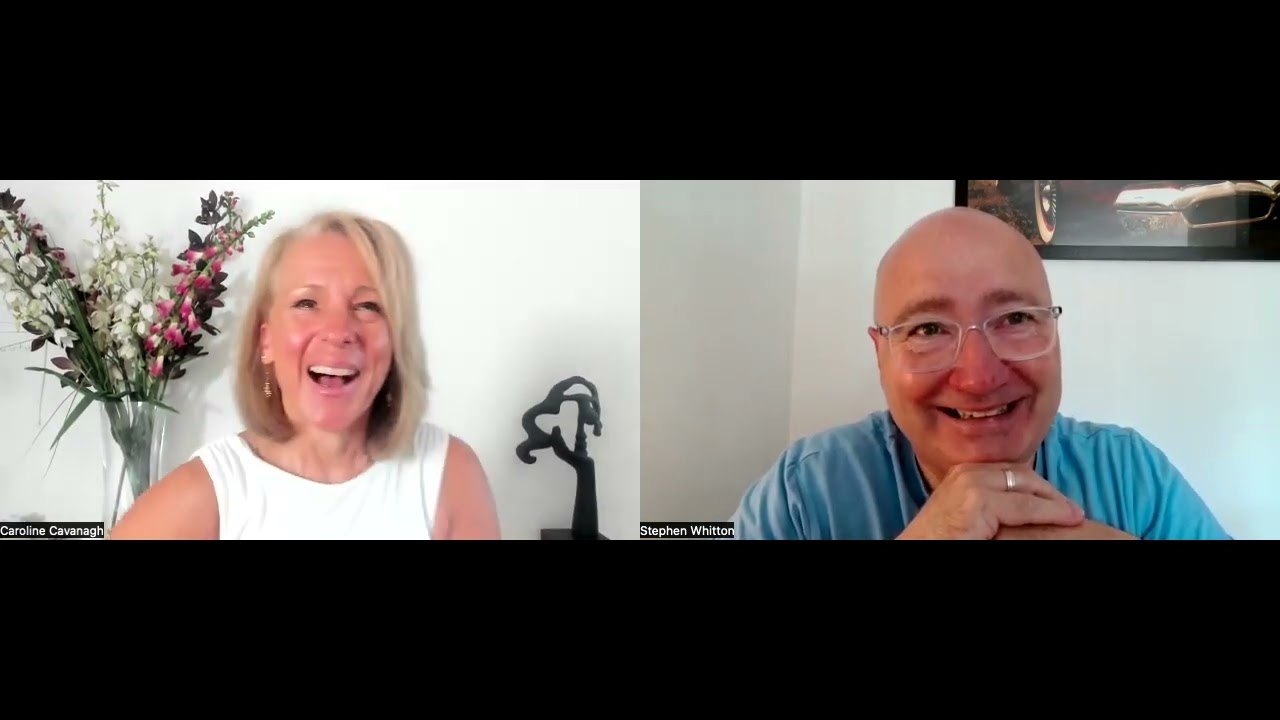
Hypnotherapist Caroline Cavanagh explains how hypnotherapy accesses the subconscious mind to treat issues at their root. She describes the mind as an iceberg with conscious logic on top and survival memories stored below, and uses gardening metaphors to show how the therapy removes problems from their source rather than applying surface solutions.
Chapters
Hi, I'm Steve.
And hi, I'm Caroline.
So what we're going to talk about today, Caroline, bit of mental health for men in particular, not just men, and hypnotherapy, I reckon. What about you?
Yeah, I think I always love about talking about hypnotherapy because there is such a misperception out there from a lot of people of what it actually is. So knowing that you've experienced it recently, to get it from the horse's mouth, so to speak. I'm not calling you an old man, my love, but—
Well, you've put me under. You've put me under a couple of times.
And brought you back.
And brought me back. And I'm here to tell the tale. And, uh, that's what we're gonna do. So, and that's what prompted this discussion really, wasn't it? Was at the end of that last session, I think we had a bit of a chat and said we should share this stuff because it's absolute gold, isn't it? It's just you know, gold dust material really in terms of what the outcomes are from doing hypnotherapy. So.
So I know, you know, we've got a great friendship. So I know that the trust was there before we even started. Yeah, back at you. So the trust was there before we started. And that's a really important element of any therapeutic relationship, let alone hypnotherapy. So let's kind of park that for a minute. The trust was there. But I would love to know from you, even though you know and trust me, how were you feeling before we started that first session together?
Yeah, I was, um, well, as you know, I was keen to do it. Um, so keen, in fact, that I drove all the way to your house to, you know, have a session in your little studio, uh, which was amazing, by the way. And, um, yeah, I was, I was really, really keen to do it. I'd had some hypnotherapy before, and I, I know what the the results can be. Like you say, the trust between you and I is immense because we're good friends as well. I mean, not saying you need to be good friends with your therapist, but having that trust there, knowing that somebody you can confide in is a massively huge, important step. If all those words worked out to make a sentence, then that would—
Rearrange these words in a new order. Rearrange those. It's important to have trust with your therapist.
was what I was trying to say, but you're so absolutely right. Tell us a bit, tell us from your point of view, because I, I know what I think hypnotherapy is and I know how I would explain it, but, you know, from your point of view as a therapist, how would you describe it?
So when I, when I talk to, um, a new potential client or someone that's interested, the way I explain it is if you think about your mind being in 2 parts, but the front part of the brain, sort of above, above our eyebrows, That area is what we call the conscious mind. It's the part of the brain that's rational, logical, deductive. It also has the ability to go out into the past or out into the future. So, for example, if you're thinking about something you're going to, going to do tomorrow, it is a conscious thought because you are actually engaging with it.
Mm-hmm.
But the rear part of the mind, sort of area where your, your spinal column comes up into your head, that area is what we collectively call the subconscious. Which is irrational, illogical, immature, typical age of a 4-year-old. And that's not just you, Stephen.
That's where I am most days.
All of us have a 4-year-old sitting back there. And the primary part of that role is survival. So it's what's keeping us alive. So anything we're not consciously engaged with is being run subconsciously. So we're not engaged with making a heartbeat. We're not engaged with breathing, although you probably are now because I've just brought it into conscious attention. So you've just become aware of how you're breathing. But in 2 minutes' time you won't be because it will have slipped back into the subconscious. So it's keeping our body alive, but it's also looking after our emotional survival as well. And so if ever we're put at risk, we flip back into that primitive fight or flight response, which cuts off the conscious and goes straight to the subconscious for a response in that moment.
Yeah.
Because if we go back to when we lived in caves, if a saber-toothed tiger came into the cave, And intelligent, rational, conscious mind went, what should I do today? Shall I kill it? Shall I run away? Too late, you're toast. It's a very instinctive runaway kill. And even though—
And saber-toothed tigers were well known for liking toast.
Yeah, absolutely. Yeah, a bit of butter on the top is cool. And so even though, you know, we don't live in caves, we're a little less hairy now because we've got central heating, we still have that primitive survival response. And that when it comes to anxiety, to a lot of the, what we term negative emotions, and that's a discussion for another time. My perception is there are no negative emotions. There's just emotions. It's how we choose to label them. But all of the emotions that we have are then being run by that 4-year-old.
Yeah.
What's the most appropriate emotion in that time? It may be anxiety. It may be anger. It may be jealousy. It may be guilt. It may be love. It may be joy. But all of those are instinctive in that moment.
Yeah.
And a lot of the reasons that people seek support, um, let's use the word therapy, even though again I would much rather say let's have mental coaching. We have physical coaching and that's deemed okay. Mental coaching suddenly, for whatever reason, is deemed negatively. But if we want to enhance how we're using our mind, it's understanding what's the trigger. And that's where hypnotherapy is really effective because it works at that subconscious level. It's not applying a logical, rational, deductive solution because that takes a lot of effort. It takes mental power. But when you're in that crisis mode, the conscious mind isn't accessible. It's shut off.
Hmm.
Therefore, you can have the best possible mental first aid kit. In crisis mode, it's not accessible to you.
Yeah. Yeah.
So why I love hypnotherapy is because it gets to the root cause and deals with the roots. So I use metaphors a lot with, with the clients that I work with. And I say, if you imagine that you have a garden full of weeds, you can bring in a gardener that scythes off the weeds at ground level. The garden looks lovely for a couple of days, but the weeds start growing again. So you have to keep getting the gardener back in. That's a bit like the talking therapies, and I don't want to be negative. Counseling, psychotherapy, they all work. They tend to take quite a long period of time.
Mm-hmm.
Um, one of my probably greatest strengths and greatest weaknesses, I'm a really impatient bitch. I want results really quickly. So my form of gardening is I come in with my toolbox and I give my clients a trowel and I teach them how to dig up the weed from the roots. So that then when the roots are gone, the weeds don't grow back. Also, that client has a trowel. They can dig up all the other weeds as well, which means they don't need me very long.
Yeah. Yeah.
And that was, is a very simplistic, but I think effective metaphor for how hypnotherapy is different to a lot of the other therapies. It's getting to the root cause so that you don't have to keep applying solutions.
Yeah. Am I allowed to call you my hoe from now on then?
It's better than some of the things you've called me.
There'll be certain parts of the audience that will like that and others that will just have switched off at that point. Now, all joking aside, you know what, I, I have twice now I've had hypnotherapy, obviously, but the major one with yourself. And on both occasions, what's come to my mind is that your mind is a bit like a filing cabinet, in that everything you've ever witnessed or done or experienced or had been a part of or whatever, it's, it's in there. It's like a, you know, the memory is like a picture. It's like a, like a file, you know, and it's all there. And what you did through hypnotherapy was help me to access those bits that were unhelpful, because what was clearly going on, and the reason I, I wanted to do it, was that there's something in the subconscious, so a file you know, in, in the drawer marked past, um, there's some— there was, there was something in there that was subconsciously meaning that I was attaching meaning to, you know, things that I was experiencing and think— thinking about and, and so on.
Yeah.
Um, and as I always say, and so tell me if you— what your thoughts are on this, what I talk about now. And as you know, I talk about mental wealth, um, because what I've kind of learned is that I can get depressed if I dwell too much on what happened in the past. And I can get anxious if I think too much about what might happen in the future. All of those are in this filing cabinet kind of image in my mind. So the only cure to not being depressed and not being anxious is to live 100% in the moment, in, you know, present in today. Problem with that is there are these things in your past that your mind is going to every time something happens. or someone says something or looks at you in the wrong way and your mind is making that make that have a meaning. Does that make sense?
Yeah, absolutely. And again, the way I kind of position it with, with clients is you've used filing cabinet. I use the word database. Everything—
I'm older than you though, Caroline.
But, um, everything that we experience goes into this database, right? So you've got this vast amount of data, but it starts to get allocated against 2 key criteria, one of them being survival, the other one being intensity of emotion. And so you end up with a database structure that looks a lot like an iceberg. So you've got references, you've got experiences that are easily accessible. That's like the bit of the iceberg above the water. Then you've got all this stuff below the water that's effectively archived.
Yeah.
And that radar that I mentioned earlier that's looking for risk is constantly looking at that iceberg to say, okay, what's going on out there? What do I know in my data database to help me make the decision as to what's the best behavior in this moment.
Yeah.
Which is why, you know, we will prevent, we will stop ourselves putting a hand on something hot because at some point in your childhood you burnt your hand. That reference went into the database. It was an intense emotion, pain. Also, it risked your survival. So it stayed above the waterline so that whenever your mind perceives something hot, It looks at that database, finds that reference, and goes, stay away from that because it bloody hurts. And that's what keeps us safe. So all of that, you know, that it's why we don't drive through red traffic lights. It's why we check before cars. None of that we were born with. It's all because we've had experiences that have created memories that now have the purpose of keeping us safe.
Yeah.
Which is perfect. There's an awful lot of stuff that goes on that also gets misfiled. So I do a lot of work with phobias, for example, which are very, very acute forms of anxiety.
Um, and they're all learned as well, right? Most phobias are learned.
Um, the majority are learned. Um, some are through trauma.
Right. Okay.
Yeah. So you can have a traumatic experience. Um, so something like a car accident would be a good example of that.
Sure. Yeah.
Um, but, you know, to, to give you a context, I worked with a lady who had a really acute fear of birds. So she couldn't sit outside in the summer with the risk of a bird, you know, hopping around and, and, or jumping on the table and picking up a crumb. And her database had a file that we accessed. We couldn't quite pinpoint it down, but we reckon somewhere between a year and 18 months old, where her mum had put her out in a, in a pram to have a sort of midday sleep, as you used to do when, when we were young. And a crow had landed on the handlebars. So there was her as a relatively young baby, all swaddled up with this massive great black thing with a huge beak that she couldn't respond to. So a natural instinct is fear, really intense emotion, and she was at risk. So that file, even though she was only a year old, was still at the top of her iceberg, top of that database.
So she never knew it.
Her conscious mind saw the bird, saw a bird, it went, what do I know about birds? Shit, they're scary.
Yeah, yeah.
So she would have that acute response, which when you know that context makes complete and utter sense.
Yeah, I agree.
What the subconscious mind can't reference is she wasn't a year anymore. She was 54.
Yeah, yeah.
And that's where hypnotherapy works. It comes in and it brings new information into that memory to say, you aren't that incapacitated baby anymore. And all you need to go is shoo. And the bird flies away because they're a darn sight more scared of you than you are of it. But she literally next day went out and walked through the equivalent of Trafalgar Square where she was surrounded by pigeons. That's the impact. It's so quick.
But she wouldn't have known that, would she, consciously? Because that was going on subconsciously. And I mean, when I did the session with you, I think one of the things that came up for me, and it's the second or third time now, was, was, um, a memory that I happened to know when I'd actually recounted that to my mum years ago when she was alive. I'd recounted this memory, and according to her, I was about 6 months old.
Yeah.
So, you know, this stuff is— these seeds, if you want to call them that, are sown from a very early age, aren't they?
It's, it's a fascinating debate. I've had 2 experiences with clients I've worked with where people have regressed in utero. Because neuroscience is now starting to suggest that that database starts to get populated 13 weeks after conception.
Wow.
So I have had a couple of people, as I said, that, that regressed in utero, and their particular anxiety that they were struggling with, that was the root cause, is when they were still inside their mum's tummy.
Yeah.
Then we get into the whole exciting area of past life regression. Can you go to past lives? Interesting debate. I don't know.
That seems like the subject of another podcast, Caroline.
Maybe, maybe we'll park that. But yeah, it's a fascinating one. I've got, I've got my own perspective on it. But as I say, maybe a conversation for another time. Yeah.
So just to wrap this part up, then why would somebody, you know, what, what would prompt them to want to go and have hypnotherapy? Because And I suppose it's a loaded question because for me, I think I was already in a reasonably good place when I decided to do it. And as you know, um, the purpose of it was because I was, I'm, I was about to make a big, fairly life-changing decision and I recognized that something was kind of stopping me, you know, emotionally or subconsciously. Um, but I've already done a bit of work prior to that. So at what, what point do you think someone should go, yeah, I'm up for a bit of hypnotherapy now?
But I love that you said that, Stephen, because there is such a perception again that you only get therapy when you're absolutely on your bottom, on your knees. Whereas, again, comparing it to physical, all of the Olympians that are training at the moment will be working with psychotherapists, with people that do the sort of work that I do. You don't have to be, you know, absolutely at your, at the deepest depths of despair to get help.
Yeah.
Anything that you, is holding you back, hypnotherapy can help you with. So whether you're, uh, you know, absolute, you know, in a deep dark hole, hypnotherapy can help you. If you're in 2nd gear, it can get you to 3rd gear. If you're in 5th gear, it can get you to 6th gear. If you're in 10th gear, it can get you to 11th gear.
Hmm.
We all have things that in whatever shape or form are holding us back. And typically that thing, which was a prime example of where you were, you didn't understand what was holding you back. Because it was at the subconscious level. So look at the subconscious level and you will find what that issue is. Yeah, that's what hypnosis gives you access to. Yeah.
Excellent. Now, in part 2, what we're going to talk about is the difference between how maybe men and women, uh, and any other genders that you choose to be, are defining, uh, or how they approach, uh, mental health or mental wealth. So, um, Join us in part 2.
I look forward to it. Great chat, Steve. Thank you.
More from Caroline


Diary of a Hypnotherapist, Episode 41 | @caroline-cavanagh | The Anxiety Alchemist

The Psychology of Comfort Food & Control | @caroline-cavanagh | The Anxiety Alchemist


Unlock Your Mind for Subconscious Healing | @caroline-cavanagh | The Anxiety Alchemist




Overcome Insecurity with Hypnosis | @caroline-cavanagh | The Anxiety Alchemist


Diary of a Hypnotherapist, Episode 40 | @caroline-cavanagh | The Anxiety Alchemist