AI Live - Land Shark Mastermind
Catherine Bell leads a real estate mastermind covering deal mechanics, underwriting metrics like cap rate and DSCR, and Missing Middle infill projects in Chicago's Opportunity Zones. The group walks through a car-wash acquisition, explores CDFI funding options, and assigns action items including contacting business broker Dr. Fernando Acosta.
Chapters
Okay, good morning everyone. It is a happy Monday morning, we'll call it that. Mondays are always my happiest days. Getting everybody logged in and we're gonna get started. Um, and, uh, I guess while we're waiting for Tommy, uh, I will share an epiphany that I had this past weekend with all of you. We've got all the people going live. All the accounts are up. So one of my favorite things to do is, funny enough, play pickleball. And it's become my obsession. And so we have— there's a— we have play at a club, but we have a group of us that play pickleball on Saturday mornings, which is a lot of fun. And playing that pickleball, here's what I've noticed, which is really interesting. So if you, if you haven't played pickleball, I'll— how it works is you have to— it's 11 points once you hit 11 points, but the points, you also have to have 2 more than the other team. So rather than focusing on 11 points, 11 points, 11 points, What I do is I focus on— so say I have 3 points. So I'll say to myself as I'm getting ready to serve, I'll say, I've got 3 and I've got 8 to go. And then I get a point and then I get— and I've got 4 and then I've got 7 to go. That's how I focus and stay really, really present to literally what the next one thing is for me to do. And then as a result, most of the time we end up actually, you know, winning the games, which is a ton of fun. And I played like, I was, um, I had a really, really, really great, um, set of games on Saturday. So it was amazing. But again, I assert that it's like, rather than being distracted with, you know, oh, I got all these other things to do, all these other people to talk to, like, I'm literally just focused on, I've got 4 and I've got 7 to go. And just one after the other, and we just keep getting point, point, point, point, where I just focus on that. So business is the same thing. I remember my very first business coach, she'd always say to me, like, to be mindful of your own business. Like, I'm sure you've all heard the term, mind your own business. So be mindful of your own business. Being mindful of your own business is like focusing on what is that next one right thing? What is that next one right thing that you need to focus on so that you can achieve whatever it is that you're— whatever the goal is? And typically it should be some sort of income-producing activity, whether it's a sales call or a call with an investor or a meeting. What is that next one thing that you're going to do to move forward, you know, to move the needle. So again, it's especially if I'm having a crappy week or whatever, like doing that mental reset and focusing on like, again, it's so funny how pickleball has like become this like thing that helps me reset. And the other piece is focusing on the ball. Like, that's the other piece I realized my game got so much better when I only focused on the ball. I didn't like pay attention to any of the other people or what was going on anywhere else. I literally just focused on where the ball was like going and where I wanted it to go. And when I did that, my game, like, it improved dramatically. So for you, like, what is that thing that you can do? And typically I found if you can gamify it or play games, that where you can reset whatever's going on with you, like in work or in business, but play the game. But see how we connect the dots. You know, SRA, same rules apply, that how it literally resets that internal thing inside of us so that we're like, oh yeah, that's right. This is the one thing I need to stay focused on to be able to achieve the goals. So if any of you have anything like that, I would love to hear what it is. So I've shared with you, I play cash flow and I do this. And of course now pickleball and do this. So what is it for you that you can have that? Sicily.
So I love that you're saying you're muted, sweetie.
Oh, wait a sec. Maybe you're not muted. Maybe I just don't have it turned up. Hold on, hold on. Try it again.
Okay. Can you hear me?
Yeah, now I can hear you.
Okay.
I love that you're saying focus where, like how you said for and then focus like Okay, I got 7 more to go. My coach— this is actually so aligned with what my coach has been teaching me for the last couple years. So acknowledging where you're at present, where you're present, and then seeing, um, instead of thinking of what's missing, the 7 missing, it's like 7 more to do, right? So it's kind of like a rewire of the brain rather than thinking of like scarcity. And so that, that right there is a golden nugget, 100%, like I love that you said that, because now my brain's thinking, because I, I feel like even myself, I do fall into scarcity sometimes, and I'm like, okay, I got— oh my gosh, I have 7 more to go, or 10 more to go. But I think if, if we think that way, then it's, it's abundant, it's, it's momentum, it keeps moving you forward. Um, and then focus on the ball. What I get from that is focus on the target, focus on— see the target hit the target. So that's what I get. That's what I get from that. So that was, that was golden, golden, golden, golden. Yay.
Thank you. Okay, good. I just felt the need I had to share it with you. So I'm glad it made a difference.
Thank you.
I love it. Blake, Laura, do you guys have anything like that?
Um, I would say probably something similar, just being a student, just kind of like breaking down the daily tasks where I feel I get into a system now where instead Instead of like looking at my load for the entire week, I kind of just systemize it and I break it down day by day ultimately where I know I need to get the job done, but I just have to kind of complete the task that I have at hand and then eventually I'll just kind of continue on to the other one. Once I find myself just focusing on that one task, the rest of 'em just go a lot smoother as well.
Yeah. I love that. So very cool.
Yeah. I like what you said about the gamify thing, right? We'll do that with the parking spot. I have this parking spot, I just ordered it in the front of the building, you know, and certainly cash flow, you and I for years have played the, you know, 3, 4, 5 or rolling of that. But I think also the focus, right? In business we're taught, you know, where, how, what is it? Where focus, where energy go, where focus goes, energy goes, right? And the world of that, even FOCUS has its acronym on, you know, Follow One Course Until Successful. And so I think that's— it's easy to get our focus pulled in lots of different areas. When we can narrow it in, it tends to have the desired result we're looking for. And then you just have fun with it. And it doesn't always, right? We don't always roll the thing. We don't always. But what we're focusing on tends to. So then you got to be responsible for what energy are you giving? What focus are you giving? Is it positive? Is it because it'll go down either way, whichever way you want to focus it. So, yeah, that's cool.
Okay. So Tommy is back.
Yeah. And to speak to this, I mean, in everyday life, that's possible to kind of step back and reset and realign. As a matter of fact, one of the, um, mentors that I had back about 5, 6 years ago, his name is John Lee, um, said that, that, uh, um, he, he had a set of, uh, criteria to, to get through a day, and that was to, to understand that nobody's dead and nobody's dying. I'm not gonna save anybody's life by doing what I'm doing today. And so kind of to bring reality into, into perspective. But I have a different perspective because I worked in the medical field and as an emergency room nurse, like focusing on one thing probably meant that I killed 3 other people. Because if a stubbed toe showed up and I was just like, okay, well I gotta accomplish this stubbed toe, that heart attack and that aneurysm and that, and that stroke over there gonna have to wait. Because I'm focused on next. And so in nursing, it became a matter of prioritization and delegation and understanding what you have as far as resources to accomplish all things, right? Um, and there was a, another mentor that I had by the name of Sohail Khan. Sohail Khan, um, was the king of joint ventures. And as the king of joint ventures, what he did was he would, um, he would take the opportunity to, uh, work with people in the situation they were in and, and kind of be a super connector in a way. Um, and, but, uh, I, I paid into his program and, uh, because he said he had secrets to the billionaire behaviors, and he gave out, gave out what was called billionaire behavior worksheets. And it was crazy, but that worksheet— and Catherine's got one right there, if she hands it to me, I'll be able to show you guys. Um, the Billionaire Behavior worksheet is literally just, uh, looks kind of like a, a kindergartner's, uh, a kindergarten teacher's, you know, daily planner, right? And what's crazy is, is as simple as it is, when I went to the guy, I was pretty mad because I paid 5 grand for this. I'm like, bro, like, what? This is— I've seen kindergartners teach You know, kindergarten teachers using this, right? I paid 5 grand for a daily planner for a teacher. He's like, well, if it doesn't work for you, give you your money back. He's like, that's what I use. I'm like, it was simple. All of a sudden it became very simple. He's like, that's what I use. Like, if it doesn't work, I'll give you all your money back. Just try it. And sure as shit, when we tried it, you know, it, it worked out. So Um, it's a— it's literally 3 things that must get done, right? Boom, boom, boom. And then there's 7 things over to the side right there that, that you want to get done that, that you might need to delegate it. And it'll even— it even says list the tasks that would be good to do today but are not essential, right? So you have 3 must-dos and 7, 7 should-dos. And, you know, and what he says is, do you have a written outline? Have you done your research? And have you eliminated to-dos that are not essential? So like, if you put something on there that's like Um, uh, you know, call my mom today. That's important, right? But only if she's in the hospital. It's a must-do if she's in the hospital or it's Mother's Day. But if I don't get to it by the end of the day, well, I'll— I know I'll do it tomorrow. I'm going to put it on something. I'm going to make it a priority tomorrow. It's prioritization, right? So my mom will understand if I don't call her, you know. But will somebody understand when I don't pay them, when I don't send them a check because I didn't put it on the list? No, probably not. So resolving issues like that prior to and, and, and ahead of— if you guys want more, uh, templates and tools like this, you can go to his Facebook group. It's called facebook.com/groups/jointventuregroup, and his name is Sohail Khan. He's pretty amazing guy. But what's his name?
What's his name?
His name is Sohail. S-O-H-A-I-L, Sohail. Mhm. Last name Khan, K-H-A-N. Joint Ventures. Yep. And then his Facebook group is facebook.com/groups/jointventuregroup.
In that form, does he have that form there, or is that— how does—
there's that form and many others. He's got a joint venturing platform, um, that's on there. So, okay, very— it's, it's, it's, uh, got templates of all kinds on there. Very useful. So very useful.
Bless you.
Thank you. Um, so Blake, we didn't get a chance to revisit the, um, property you had sent out an email on. Did you, uh, did you, uh, get a chance to, to reach back out to him and and do a little more digging on that?
I didn't reach back out to him. I was going to chat about that today because I just wanted to confirm that was a property that we wanted to pursue because I just don't want to just send a deal just to send it ultimately. So I just wanted to confirm that we still want to continue on with it.
Well, it's a cash-flowing deal, right? Correct. Right. And his cash flow numbers don't correlate with his asking price. And so that's all we're doing is pointing that out to him and saying we will buy it down here, right? And so yeah, I mean, if, if we can buy it and the numbers make sense— and the numbers, the numbers tell you what to do. If they don't, if they don't work, it don't work, you know? And it's, it's not going to work for them when they're being greedy, period. Yeah, you know, but we never know. We don't know somebody's situation. Maybe he wants to cash out and move out. You know, and so that's why we would offer the price of 2.1 is so that we wouldn't have to, you know, we can do what we need to do. Uh, I think it's unplugged over there, or no, you're good. I unplugged it on accident. Not on accident, but I didn't plug into it anyway. Um, that's Alex back there, he's getting the, getting the morning Joe going. So, um, anyway, the, um, yeah, the project, I think it was what a, um, what is it again? The car wash. Oh, okay. Yeah, the car wash. Yeah, yeah. Um, I've got, again, I've got a guy that, that can properly, uh, appraise it and get all the stuff figured out for it, uh, and he's with First Choice Realty. They, they're represented by a real estate company, right?
I believe so. Let me pull up the name of it.
Yeah, well, I know— I think they were with JLL or something like that. What we want to do is get, uh, Dr. Fernando Acosta involved. He's a business broker, and he can reach out to him and say, listen, this is where this needs to be, this is what we're willing to offer, and we can actually get Uh, Dr. Acosta involved. So I think that's our next move is to set up the appointment to call and talk to him. Okay. Um, you said you had another conversation with the guy. Did he, did he respond back or was that with your own AI that you had that conversation?
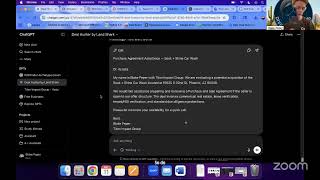
Uh, no, I'm just chatting with the AI right now, updating another LOI with the $2.1 million cash offer.
Got it. Okay, that's good, that's good. And all right, do you have anything else cooking? Sicily, you're showing me on your phone what you got cooking over there.
Not at the moment.
Is that him?
Uh, yeah. Okay, thank you. All right, let's see here. So I'm trying to get, um, uh, in to see that house we, we ran numbers on last week. The new— the, uh, uh, it was a— I want to say 6,000 square foot house, 5,000, something like that. And it was up toward the mountains area there. Um, when we were looking at that, we put, uh, we put the numbers together on it. They, they said we can come look at it, but we got to send them proof of funds. Anybody know what proof of funds are? Yeah, everybody know? Okay, so proof of funds getting sent over. We're gonna, uh, Catherine has her personal financial statement that covers Titan 23 that she's going to have to send over to him in order for us to get to walk the property and kind of go from there. So, um, that deal, uh, is, is a, a decent one because of what we're looking at doing with possibly, um working with, um, Club Scottsdale on how to, uh, on how to get that all set up and accomplished. So, um, and then on— let me see— Catherine, on Land Chart, on my, um, ChatGPT. I had a, um, conversation that I started, and, uh, I want to go over that because that's kind of goes along with, um, Amor and her. We, uh, we look— we were trying to look at Deals and Developments in Chicago, trying to find the, uh, chat for that.
Um, it was in Opportunity Zone, so So for everybody, uh, Blake posted the, um, links, all the social media links. So if you could, um, share those, that would be awesome.
Okay, so it's called If you scroll down, it's called deal, uh, deal source, deal sourcing. Right, it's all the way down at the bottom, right there. All right, so let's open it full screen so that everybody can see it, and we'll go all the way back up to the top. And so if you can click on that Missing Middle Program Guide, and this is what, uh, Amor had sent over, um, sometime last week. We were looking at these middle lots, basically. They, uh, and so, um, Diesel Get Infill Lots, and it's an interesting program. I'll go through it and just go through that a little bit and kind of see what's going on. So like they've got these infill lots or these lots in between houses in Chicago. You can literally have what's called a zero lot line, meaning that you can literally put your wall next to your neighbor's wall and done. So, um, but the, um, the houses there and the development and building of them There's like really no incentive for, for a builder because it literally has to kind of turn into a Section 8 house pretty fast. So, um, wait, hold on, can you— I was trying to see the maps, he flew past. So here you can see like this is a map of the 10th Ward in Chicago. And they've got all these different lots that you can go in and bid on and get the application to buy them and build on them. And then Um, these are the addresses, so we can, we can run the numbers here and put them through, um, Deal Hunter and Discovery on like what's it going to cost to build there, stuff like that. So this whole thing is very good for Deal Hunter to, to, um, to chew on. And I believe these are in Opportunity Zone spaces as well, so we could open up like an Opportunity Zone private an Opportunity Zone fund property management company, right? And by having that private— that property management company, we'd be able to operate the business of property management while, you know, building these houses to make a difference. So, uh, South Chicago is a rough area. My uncle was a police officer in that area, so I grew up hearing all the stories about South Chicago and Harvey, uh, Englewood, all that. So— oh really? Yeah, I grew up listening to all the nightmares, uh, that, you know, he dealt with. Like, he was a— he was a police officer and, and, and dealt with a lot of inner city crap. So, um, but, uh, again, that's why it's hard to find investments, uh, investors to come down there and do stuff. But when you properly incentivize it, it does make a significant difference. So that was the, that was the, the information that Amor provided. So let's go look at what Deal Hunter dissected on it real quick. Um, and we can get, uh, let's see here.
So we had time, I also have my LOI ready for the company if we want to just review it real quick. Not now, but a little bit later.
Yeah, we can do that. I'm going to actually have— what we'll end up doing is, why don't you go pull up Dr. Fernando Acosta, and when, when it's your turn to share screen, we'll review how to get a hold of him and pull him to the table. Okay. And we'll review the LOI as well. So, Missing Middle program guide, a strategic breakdown for deal hunting and development. So basically what it does is it sort, you know, the, um, for us what we can do is we can find discounted land, get, uh, public incentives. Uh, the public incentives, uh, like I think one of them says it's for a dollar. You can get, you can right there, it's a selling vacant lots for a dollar and they'll provide up to $150,000 per housing unit. So if you do a 2-flat or 3-flat on one property, you're getting $300,000, $600,000. $300,000 to $450,000 because you're doing a 2-flat or a 3-flat house, right? So, um, this is a public-private infill redevelopment strategy. Um, and so here's where the big opportunity is. Um, what we can do is we can source the, uh, development sites for a dollar per lot. And what this does is, um, it, it basically gives us the ability to, to leverage our position 'cause we own the land, we control the dirt. So, the other things that we can do is, as you can see here, the city offers $50,000 to $100,000 per unit in reimbursement grants, meaning you gotta put the money out to get the money back. And then there's Um, let's see, it says build a repeatable development machine, meaning once we figure out how to do it, then we can, uh, we can pump through this. It says, you know, that there's over 300 units already underway. So, um, first round of developers have already been selected. So like, this is already in progress. It's not a— and, and we can probably do some research behind it to see what else is going on. So here's— here, Deal Hunter is going to give us some strategies. So we've got all these things that we can look at and do. I'm going to send this over to you more after we get done. And then here's what some of the builder and contractor opportunities are. So we can get into being a GC up there again. I think I still have an active license in Illinois. What kind of builders should we target? So small to medium-sized urban infill builders. So that was basically what my dad was. We can go after some of the minority-owned builders and advertise for that. Um, or we can get into the modern, uh, modernized stuff like the modular panelized construction. So kind of like building, uh, there's a variety of products I can think of right now, but shipping containers, uh, the HercuWall system, these would all be great for Illinois. The real estate strategy angles, build strategies, best strategies would be build to sell. Um, and then what we do is we put that on an owner occupancy type situation, and then they sell the rest of the units or rent the rest of the units. We've got a house hack product, which I just described, and then the build to hold, uh, situation, or build to rent. Like, we can do a build to rent for sure. Merchant development is that we build, uh, entitlement development pipelines and sell shovel-ready projects to larger developers. Like, that's a, that's a different spin. We go in, we buy the land, we get it all set, we put the, we put all the things to it and sell it as a package to somebody. So, um, we can get the construction loan with the city subsidy, like, that'll back up the loan. We can do a private money and then do a reimbursement, or we can just go and try to get the JV equity structure set up. Um, by having somebody on, you know, involved doing that side of it. And then we come in and back them up with our knowledge and know-how. Keep going down. So just doing some quick underwriting, you know, the land cost is zero and then we get $50,000 to $100,000, $150,000 in public subsidies. Then what we end up with is understanding like how we can, how we can make money out of that. Um, and then here it shows the neighborhood, uh, target intelligence. Uh, South Chicago, South Chicago, West Englewood, and Englewood, um, are important because like they, they show you some of the things that have popped up there. We've got, uh, um, a variety of jobs coming in the area, and we've got, we've got hospitals in the area, we've got retail development going on. The lots are already zoned for a variety of uses that we can build on. We'd have to look up what those are— RT-4, RT-4A, B-2-3, stuff like that. We could build a, uh, deal hunting machine. So, uh, put together a builder network, get a funding division set up for this, set up the community relations arm to this. Like if we had somebody actually in Chicago, a boots on the ground. So hidden opportunities most people miss is that adjacent private parcel acquisition, meaning like the low-hanging fruit the neighbor whose property is about to go under because he has, like, he's, he's just not put any money to it for 30, 40, 50 years. We can probably buy the property next door and, and expand and do what's called cross-parcel building. We could buy 2, 3, 4 lots in a row and build multifamily and then get that incentive, $50,000 to $150,000, you know, uh, a unit, right? So some of the major risks are, um, you know, the environmental liabilities. The city, uh, transfers the land as is with all faults, and that includes any environmental indemnification, meaning if there's a dead body on the property, you're responsible for it, like legit. Oh goodness. Okay, it is, it's 100%. I— because what's crazy is in Chicago they used to bury people in people's backyards. And so like, yeah, and so you end up doing some digging, you find some bones, and you just found Jimmy Hoffa. Yeah, you're, you're stuck on that property for a minute. So you better sell your story to Netflix because that's all you're going to make your money back on. So, um, anyway This, uh, this project could be repeatable and definitely is something that would take a team. It's not something that one person can do. And that's the point to the Land Shark Mastermind is like, we can take on these types of projects, put together the team necessary to put all this together. And so some of the things that, uh, we can get into is discussing what that team looks like. It'd be great if somebody was up there, right? So, and I know Amor's from the area, I'm from the area, so we probably have some people Victoria lives in that area, right? So identifying funding partners are, you know, the local banks, CDFIs, construction lenders, and private capital groups. So gives a breakdown of what we should be working on if we want to head that way. I would like to identify the CDFIs. A lot of people might not know what that is, so I want to break that down, but keep going down and I'll show at the bottom here. I said, do they have this in Arizona? I want to know. And so they absolutely do. Phoenix has infill incentive areas. So they have places like South Phoenix, Maryvale, Sunnyslope, East Lake, Garfield, Oakland Historic, and near the light rail corridors. And so we could get these things for lower than land basis, rezoning upside, appreciation, and then infrastructure investment. Bless you. Bless you. So another place this works is in Tucson. Tucson's got a lot of stuff down there. It's, it's probably worse off than Phoenix, to be honest. And then what else does it have? Arizona Land Bank opportunities. So these are in where they're— it's not as massive as, as like Chicago does, but what we have is there's municipal surplus land programs, county tax liens, there's the ADOT program, there's redevelopment parcels. So, um, and, and finding all this stuff is pretty, um, pretty tricky, but with Deal Hunter by Land Shark, we can actually figure it out fast. So Opportunity Zones, uh, there's more Opportunity Zones per capita in Arizona than there is across the country. So What we're looking to do is kind of expand that. And if Illinois can do it, Arizona can do it. I'm boots on the ground here, so that's why I look. And so, let's see what it says here. So it's, you can see here how Arizona has the ability to get undervalued infill land before rezoning them. And appreciation is built in. So the best type of deals to find, uh, in Arizona are going to be the small multi-family infills where we can do duplexes, fourplexes, townhome clusters, cottage courts, etc. Um, the build-to-rent communities, they're actually getting outlawed. I don't know if you heard about that, but they're gonna, uh, they're actually requiring all build-to-rent communities to make their houses for sale within 10 years. So, it's going to be a piggy bank for somebody for about 10 years, and then they got to sell all the houses to individuals. So, adaptive reuse is to go and look for motel conversions, office to residential, church redevelopments, and retail conversions. So, Phoenix currently wants workforce housing, transit-oriented development, density in their infill and adaptive reuse. Tempe is aggressive on, on all those things. Mesa, Glendale, uh, and Tucson. So, um, the, uh, areas of Arizona that can, can follow that Chicago model, they give us the step-by-step breakdown of how to do that. Identify the infill corridors, build a land pipeline, partner with the cities, create repeatable products, and then move on. So, um, Arizona land is more expensive than Chicago city-owned inventory. That's a no-brainer. Plus the cost of everything is much, much higher. So to get the best overall strategic targets, going to Tucson is more important. You're going down Mesa's the next one, South Phoenix, then Glendale. So the smartest plays are going to be in those areas, what we could do next right there. So let's do a prompt real quick. Blake, you almost ready? I would like to explore what a CDFI is when it comes to development. And so this is what, uh, it's a community development financial institution, kind of like a credit union, and they will usually back up stuff that the other traditional banks won't do. And you can So what basically a CDFI does is they're again like a more, more so they're like a credit union or something to that extent. Um, and they go after stuff that, that has more neighborhood impact, lower ROI. Like, for example, they have an ROI cap in some CDFIs. They won't do an ROI greater than 15% because it defeats the purpose of neighborhood impact if the investors are getting all the credit, right? So this might be something good for Tina too, going to look at the CDFIs locally to her for for the property she's got in Boone there. So, um, they like ground-up construction, they like acquisition and rehab, they like— they love infill development. And then what they want from emerging developers is they want minority developers, first-time developers, local operators, and smaller builders. They don't want to work with the big guys, you know, the big guys typically. So, um, if we have mentorship structures, experience partnerships, and a public-private alignment, they really, really like that. And so it's because they can then identify with growing the community that way. So here's some of the cross-reference of traditional bank versus a CDFI. And to find a CDFI, we'll ask it here in just a minute. Keep going. Um, so here's some of the, the products that they provide. Um, and so a pre-development loan will cover all that. Acquisition loans cover all that. Construction loans, gap financing. So you can see right here on the gap financing, we'll, we'll show you something right there. Go back up, please. So gap financing, the bank will give you 70% LTV. Now, where do you get the other 30%? Developer has 10%, you can get a CDFI that fills that 20% gap. So, um, then there's mezzanine financing. So it's a higher level of capital, uh, raised behind senior debt. So you got like a first position, but then you'll have mezzanine financing, and they'll be able to set that up. And then there's also these things called the New Markets Tax Credit. And so a, an MTC— NMTC structure is for like bigger projects and commercial redevelopments and stuff. And the CDFIs will get behind that as well. So, uh, they, they like story more than they like bottom lines. Um, what CDFIs want to see— strong application elements are right here. So like workforce housing, affordable ownership, uh, blight removal, meaning like those vacant lots in between, local hiring, and neighborhood stabilization. Having realistic budgets is important, meaning like you're not paying contractors 40% returns or profits. Capable team to do this is right there. Exit strategy is right there. CDFIs are really good for this type of, type of thing because they like, they like the infill, the smaller multifamily and stuff like that. So here's, here's how CDFI examples could work. And so here in Arizona, Arizona CDFIs, we should know we've got Cruzstamos CDFI, very active in Arizona. We've got the Local Initiative Support Corporation. They're another one. We got Growth Partners of Arizona Clearinghouse CDFI. And so this is where the CDFI gets their money. This is really important to understand. This is why they have these programs set up to be more about, uh, improvement than about profit is because they receive their money from the Treasury Department, banks that need CRA credits, foundations, and institutional impact funds. So they are required to put those into targeted areas for, for, for community development. So, there's a lot more reporting requirements. There's slower process. There's mission alignments that matter. So in, in what you're doing, if you're really mission-focused, then a CDFI can work really well. So if you really want to understand CDFIs, you can deep dive it a lot. Deeper here, and that's about it. So any questions? Anybody got any questions about CDFIs or this program in Chicago? Amor, what do you have to say about any of this?
Um, I started looking at some lots and stuff, so I just need to look deeper at those, and then, um, some lots that were on the land bank to just run it through Land Shark to see if the lots even make sense or whatever.
Well, with them being free, I mean, they're a dollar, right? So what we got to come up with is how much are we going to spend to build there. If we build a 3,000 square foot house that had 1,000 square foot each, and it's a 3-story, 3,000 square foot house with 3 1,000 square foot deals like that, that could be anywhere between $150,000 and $450,000. $100,000 in subsidies. Yeah, right. Okay. But they're, they're reimbursement subsidies, so we'd have to build it first, then get reimbursed.
Got it.
Yep. And so that's, that's definitely something that a fractional situation could be, you know. Yeah, that is true. Yeah, that's true.
Okay.
But building a team behind that in Chicago could be a, a big possibility, very big. Um, and then having the ability to— because it, it mostly documentation more than anything. And so if we could come up with a way that we could blueprint it and permit it for a 3-story and then sell that off as a project, that would be the goal. I think that would be the ultimate goal. Okay, that makes sense. Builders Builders don't want to jump through all those hoops. So if we can solve that problem right there, that's the hoop to get through. Okay. Why are we kicking out all the note takers?
They're dropping off because the free ones drop off after 40 minutes.
The what?
Their free accounts, they drop off after 40 minutes. It's not us kicking them out.
Oh, I just checking. I again just trying to see why they disappear and I didn't know. Um, all right, anyway, Blake, um, you got, uh, you got this LOI. Mhm. I'm sure your screen will take a look at it and then we'll deep dive on how to get a hold of Dr. Acosta. Okay, yeah, it was with M&M going down. Okay, so we went 2.1, and it's based on the underwriting, uh, showing that Okay. Okay. You want a 90-day due diligence, not a 30. Okay, um, I like all that. As far as, uh, um, says buyer proposed closing, make that 30, and then, um, got to put in there it's contingent on the lease, verification of the lease with the car wash people because we're not buying the car wash business. We're buying the property it's sitting on. Yeah, correct. Okay. So, yeah, put that in there that we're going to need that.
Which section should I put that in?
It's going to be a separate section. So I would, I would take this back in the Deal Hunter and say, okay, we need to add in there that all leases, all, all income possibilities, everything, uh, has to stay in place and transfer. Ready? Remake the LOI. Everything there looks great, but what's missing is that the, uh, lease for the car wash and the owner for the car wash needs to, uh, have valid leases, and they have to be, uh, in place, uh, with no risk of losing the lease, um, and we need that verification and documentation prior to, uh, signing a PSA. And then did you, um, go ahead and send that. The— did you do the math on it to see like where he was at as far as cap rate and all that with the updated price. Yeah, it said 12%, but let's see what the math actually worked out to, right? But go back down, uh, right there. All right, so boom boom boom. All right, so we don't want to tell them that the cab rate's 12.1. We don't believe their NOI. That's what we're having an issue with. Okay. You know what I mean? Yeah.
Because essentially, if we lowered the cash offer by almost from 3.7 to 2.1, that increases the cap rate.
Keep going down. Let's look at the DSCR score, right? Because right here on DSCR, Um, well, the annual debt service wouldn't be zero, it'd be based on 2.1. Let's say we're borrowing the full 2.1, and would— what is our DSCR score on that, right? Okay, so keep going down. So risk adjustment is a 12% required yield. We can go do a little research on what the yield should be on a, on a car wash, right? Um, so, but yeah, we believe they're more around 150,000, which is why we think it's a 7.2 cap. Okay, see the difference now? I do. Okay, so, um, and so here's the other part. Um, the company was founded in 2021, so this is not a national credit triple net. So like, they don't— they— you're, you're risk— like, this guy could go and get a drug habit tomorrow and you're done, right? Your tenant's out. So keep going down. All right, keep going down. Okay. All right, so it probably rewrote the LOI. Let's, let's redo the economics on it real quick. We want to rewrite the economics. We understand that they're saying it's a 6, uh, 6 cap, um, and that's why they're justifying the $252,000 NOI at that price. Um, we need proof that the NOI is $252,000 a year. And then what we want to do is we, we want to know if we did a $2.1 million commercial note, what is our DSCR based on that NOI? And the $2.1 is going to be at, at 7.5% interest over 25 years commercial note. And it's a balloon. In it. So were they going through and, and, and, and hashing through that? We got an appointment that's going to start here at 10 o'clock. Um, So right here, the loan assumption showing it right there, annual debt service is at $186,000 with a $252,000 stated NOI. Keep going down, you're going to see that you've got a DSCR of 1.35. So that's That's at the 2 point— that's at the price of 2.1, right? So if we take that back up to 3-something, you're going to see that the DSCR score goes to shit. Keep going down, keep going down. Okay, so our price is justified based on the idea that we need to cover our, our our debt, right, to run it. And based on the number he's providing us, if we had full debt on that $3 million price, there's no way to cover that debt. We'd be paying for them to be there, right? We keep going down. It's probably why they're selling, most likely. Keep going down, keep going down. Okay, all right. And now ask it— ready for this? Go ahead. All right, so we want to know, um, what the, uh, what the cap rate is on a commercial property, uh, that is a car wash. What, what should a car wash cap rate at? Unverified NOI, weak lease proof, environmental and equipment risks. See where we're at now? Mhm.
Oh, I see that.
Young operator, limited financial disclosure, specialty use risk, cap rate's got to be at 9 minimum. So let's go see if we can find Dr. Um, um, uh, let's go see that one. Um, and again, like, the, the 2% annual increase is not That's not strong at all. No. What does it say? My cap rate opinion, what does it give us? Fair risk, 8.5 to 10, right? And so the value at a 10 is 2.5, right? And so with a 12, go down a little bit more, at a 12 cap it's 2.1. Yeah, right. So, um, we can tell them that's why. And, and so rewrite— ready? Do it one more time. Rewrite the LOI and point out that the reason why there's a 12%, uh, a 12% cap rate is because it's risk-adjusted cap rate for everything else. This— a 6 cap would be if it was a a, uh, national credit, uh, uh, AAA-rated credit rating, uh, car wash provider. And this is not— this is somebody who started in 2021. Uh, they've, uh, they— there's no proof of their NOI, there's no proof of it, uh, being able to scale or expand. And we know that the, the facility is outdated, and if current provider was to— or the current tenant was to vacate, we would have to reconstruct or repurpose the entire property. So make this why our offer is at $2.1 million and 12%. And so there, there's your LOI. Let's go ahead and prompt it again. I would also like to— I would also like to start looking for Dr. Fernando Acosta of First Choice Realty to assist us on putting together a purchase sales agreement for the guy. Uh, so, uh, please provide us with way to contact, uh, Dr. Acosta. So I think let's see what it's, uh, yeah.
I'm going to scroll back through the LOI while that kind of loads.
Yeah, you can do that. Well, it's just verifying. That's not the LOI, it's just verifying everything. I think your LOI was down there in the softbox.
I think it created, um, in the ChatGPT, and then also created downloadable piece of it. So it has both.
Yeah, go ahead and go down. Hold on. Right there it shows like this is the email you need to send them, right? That's what the email is that you would send them. Hey, how we doing? Good morning, partner. Good to see you. Good to see you. I'm just finishing up my podcast. I'll be right with you. Um, so yeah, you can do that LOI, and then I would not put all the— I, I mean, you could, you could put all those, those words in there and all those to, to give them an understanding of you're not, you're not a rookie. I mean, you are a rookie, but not really. So, um, Here's Dr. Fernando Acosta's info. Um, as a matter of fact, we have a meeting with him tomorrow, right? Or what day? At 8 AM?
Yeah, I got an email on it this morning, so So do you want me to hold off and send in that LOI until—
let's see if we can get a hold of Dr. Acosta. Okay, that's what I'm thinking. 8 AM, it's not— where did it go? 13:08 AM. Where is it on there or no?
Says it is, but when I look and it's not there, says it's right there. Oh, it's 8 PM.
No, who made that? It was me.
We were standing in the driveway.
Okay, I need to circle back. Yeah, we'll just change the time, right? Okay, so I think that's about it. Um, we got about a minute left, and so we're gonna, um, be in here tomorrow morning, 9 AM, um, to watch Amor and Trevor present on the Seven Streams Investor Club. and they're going to talk about what an investor club looks like, what it does, all that stuff. So be sure to come back tomorrow. Get, get on social media, send, send it to groups, send it to every group you can find and say, you know, webinar tomorrow at 9 AM. So, um, I appreciate everyone coming in today, and, and we look forward to you guys coming back and, uh, seeing us tomorrow for the webinar. So everyone, thank you. All right, thank you. I'll wrap it up with a prayer. Heavenly Father, thank you for the blessing of this day and the blessing of all the people in here doing this so that they may be able to do your son's will. In your name we pray, amen.










