AI Live - Land Shark Mastermind
In this live‑stream, host Catherine Bell, co‑host Tommy, and guest Holly discuss building virtual family offices and AI‑driven tools for real‑estate investors. Tommy showcases three client avatars (a blue‑collar contractor, a restaurateur, and a high‑net‑worth entrepreneur) and demonstrates how AI dashboards can map net‑worth, tax strategies, and capital‑deployment plans. They introduce "Deal Hunter by Landshark," a custom GPT that ingests property data, runs multi‑level underwriting, and generates negotiation levers, IRR, and financing scenarios in seconds. A live demo on the Phoenix property "Apex on Central" illustrates the tool’s ability to pull public records, rent rolls, and market comps, flag inconsistencies, and suggest offer pricing. The conversation expands to scaling the platform via a registered investment advisor (RIA) model, opportunity‑zone partnerships, and a tiered pricing structure for white‑label GPTs. Additional tools such as a free‑estimate GPT for construction costs are mentioned. Throughout, the team emphasizes automating data‑heavy tasks, reducing bottlenecks in sourcing and underwriting, and leveraging AI to accelerate deal execution for real‑estate professionals.
Chapters
And we are live streaming.
All right, all the note takers are gone.
Apparently, you're the— and I are the only 2 here. So let's talk about something fun. So we are Putting together virtual family offices, which I'd love to talk to you about, um, because I know that you've talked about it for your family.
Yeah.
And, uh, we've some really freaking cool stuff.
Before anybody comes on, let me show her real quick though.
Yeah, we're live streaming, just so you know.
That's fine. I mean, I'm not giving away trade secrets, but Claude's been amazing at building stuff out, so I had developed 3 client avatars. They were all different types of business owners.
Yeah.
Needing family offices. The first one was a blue-collar guy who just runs everything together under one, like, LLC.
Yeah.
You know, he, every, everything he owns under one, one company. Next one was a, like, restaurateur. She got a franchise.
Hey, really quick, Laura, did you remove a Holly from here and report her? She's saying she can't. It's saying she was reported and can't get back on.
That was a note taker.
Did I?
Oh, you removed an actual person.
Oh, damn it.
Sorry.
Okay, I don't know.
Oh, hold on.
Sorry, Tommy. Let me—
I didn't report any of the ones I removed though, so That's weird. I mean, I removed— I never report the ones I remove.
Yeah, but removing her would— doesn't let her get back in. Anyway, I'm fixing it. Go ahead, Tommy.
Sorry.
Um, so So anyway, in the, in the family office thing, it— yeah, Dave was a construction worker. Renee owns 22 restaurants under one LLC. Marcus got a huge exit. He got like $28 million exit from a business, but he owns a house and a boat now, or a house and a plane now. Doesn't know what to do with the rest of the money.
Oh yeah.
So those are the 3 avatars that it gave us. And then inside of that, I was able to build out the dashboards for each one of them to kind of help them understand where they're at right now and then how to get where they want to be. So, uh, through the interview process, what we've, you know, what we were able to discover, like their net worth, $12 million. Renee has 22 restaurants where she stands today. Is with, you know, a CPA that says just go buy the next unit. Where she wants to be is that, you know, she wants to be like diversified. She wants the restaurants— now that's— now that it's just buy the next place and turn it on, it makes money— she wants to start going other places and make money doing stuff outside of the restaurant business to kind of diversify. So structuring a dashboard for her We were able to interview her and get an understanding of where most of her money was, was, you know, 79% of it's tied up in the franchise units. And then less than 10% is in her personal real estate outside diversified asset holdings and cash liquidity. So, and then what we can do from here is understanding from here what we can do with, say, for example, depreciation of the different entities. But because she has One, she has all of her, you know, business in one entity. It just— it got to be spread out a little bit better for her to stretch that out.
Yeah.
The tax strategies that it suggests are listed out through here with like cost seg and bonus depreciation, entity structuring, concentration risk, personal residence, splitting that out, OZ investments, etc. And then inside of like a scenario, we can start building out a new model for her. One of the other things is, is that inside of that, we can do a prospecting plan where we understand her capital deployment by what she's making. We can put that number in here. And what we can do is we can help her find a way to move equity out to other, other resources and bring that concentration of capital out of the franchises over to other cash-flowing assets. helping her structure entities, for example, to do so. So it's just shifting her wealth over to smarter design.
So—
Nice. That's, that's one. Marcus, this is, this one's a little bit simpler because he's just the rich guy that has very little. So same situation, it breaks it down where he stands today, what he wants. How to open that conversation. He owns a private jet. All like $22 million of his money is wrapped up in a brokerage. Almost 80% of his money is uninvested in a brokerage, not making, not doing anything. So he needs a prospecting plan because like he has zero money deployed. And so we need to kind of help him do some deployment of capital in order to help him get things figured out. So if we wanted to move, say, $10 million into a, uh, into a fund, we would do that and then help him diversify his plan out. So, um, that's cool. Then the contractor which had the most complex, uh, Dave's dashboard, um, breaks down like all the things he's doing. He's $20 million net worth, uh, structuring his dashboard. He owns most of this stuff, is wrapped up in the business, 63%, but he's got an aircraft, he's got a boat, recreational products, personal real estate, rentals, non-rentals. Like, he's so messy, it's ridiculous.
Yes.
So, and this reminds me of what my life has always looked like right there. So I could, I could validate, yep, this is what it looks like when you're not organized and you're not done yet. So depreciation levers are over here on everything he owns. Tax strategies right here. Scenario assets like adding new models to it. Like what do I need to do? A new shop, new business, add that in there and it'll, you know, either it'll be a new model or prospective asset. I can go over to prospect planning if I want and do it from there. Put stuff in here. So I don't know why it's not giving me values. I gotta do some editing for the values, but because I just told it to build me shells right now, we're gonna— I can program these other numbers into it. But basically, that was all we came up with.
That's cool.
I don't wanna close that, but I damn it. I did. Anyway, inside of that, we were also looking this morning at a company that we're going to scale around a little bit. The name of the company— we met that guy right there, Brent Parker.
Yeah. Novogradac.
Novogradac.
Yeah.
So they're nationwide. They've got partners in every state or just about. They do private equity, they do opportunity zones. We don't have to do their grocery list of everything they do. But there's 3 little— there's 3 letters after everybody's name. That seems pretty common.
Yeah.
And so, and not that we're anti-CPA, we just think that we need to add to that. So I studied for my Series 65. I just need to go get it. And with the Series 65, Titan Impact Group then becomes what's known as a registered investment advisor company, an RIA company. And then what we do is we go get RIA partners to help and teach them out of the Opportunity Zone and then like get them to be advisors. We were talking to somebody yesterday, they got 90 clients. We did get another appointment with somebody else today. How many did that guy have? He has $33 million in AUM. That was the guy with 90, right?
Yeah.
So, and then Tim's company has somewhere probably around 1,200. Or something like that. So all these people, I mean, it comes down to what is the, um, you know, what is the strike point? And the strike point usually about 1 to 10%, 1 to 5%. So building out, um, working with these guys is possible, like, because we could always use the CPAs, but I think we need to be the, the company that holds all the RIAs.
Yeah.
On, on their LinkedIn. Um, and this is becoming— I'm going to build something that scores you on your social media presence. Um, because we talked to a guy yesterday and he's like, oh, I can make you so famous on social media. And it's triggered me to start another podcast because I went and looked at the guy's social media and I've got more social media than he's got, and he's going to build me out. So how do you do that? How do you, how do you scale somebody?
Wait, are you talking about the, the guy we interviewed yesterday?
No, no, no, no, not the guy you and I did. That guy seems legit.
Okay, because I was like, wait a sec, I thought— yeah.
No, that guy, that guy seems legit. We might break into that discussion later, but we got to call his references. But like, that one almost seems too good to be true. That's the hard part about that guy. He's like, oh yeah, we do everything and you don't pay until we, until we perform. And I'm like, I've never seen that inside of marketing.
I mean, that, that's some serious confidence in that he's gonna deliver.
I, I, I, it makes me smile. That's all I know. It makes me smile. I'm like, ooh.
So we have a, we have a guest here this morning.
Wonderful.
You've seen our guest.
Absolutely. Good morning.
So Holly, we met her at, um, Eddie Marin's event a few weeks ago. It's been a minute.
I remember Holly. She, her and her husband met at Sub2 or something like that, right?
We met at the Deal Maker Conference in Scottsdale.
Deal Maker Conference.
There you go.
That's right. How you doing, Holly? Good to see you this morning.
I'm doing all right. I got more blessings than I can count.
That's, that's good. That's how it's supposed to be. So, um, well, welcome to the, uh, Deal Hunter Podcast. Um, and, um, glad to have you come in this morning. Um, we sit around and talk till about 9:15 and kind of, uh, wait for people to show up. Uh, depends on who's coming in today. So, uh, did, did, uh, Holly book to come in and talk as a guest?
I invited her.
Oh, there you go.
Okay.
Yeah.
You want to run a little interview then?
So, yeah, it was just wanting to find out more about, you know, like Holly and her journey. And, you know, we like to interview everybody at all the different stages and, um, figure out where the, the bottleneck is or the roadblock, so to speak. And be able to help them go to the next level, whatever that is. So the first question we like to ask is, what is the asset class that you like to invest in?
So the asset class that I would like to invest in would be commercial multifamily. Okay, so anything 30 units or more, at least for right now. Um, but that's definitely the main one, at least for this next couple of years. And then, yeah, to switch over to business acquisitions.
Okay. And, um, what types of businesses?
Uh, home service businesses. Okay. Um, any, anything that I can get my hands on. Um, it's funny because I was, uh, Watching during my downtime a show with Gordon Ramsay. And it's like the secret undercover type of thing because everybody changes when he actually just comes into the restaurant. But he had a van and it literally said Holly's HVAC with a logo. And I had to take a picture of it. And I was just like, hey, future right there.
I love it. That's funny. So what has been your experience in the past? What has been your focus?
Well, it's changed a lot. So I'm a licensed realtor in Arizona and Utah. Been that way since 2019, although I'm gonna probably slowly drop the Utah one since I Don't really work up there anymore. And so I ended up meeting my husband. We got married and I helped him kind of build up his wholesale business.
Okay.
So I was doing a little bit of operations, a little bit of TC work, a little bit of integrator work. To help him build that up. We were doing very well on acquisition side, but we found our Achilles heel was disposition. So he decided to take a pause on his business and went to join a couple of different groups to see what their SOPs were, so to speak, for disposition. He ended up getting onto Eric Klein's team. He really enjoyed it, wasn't so sure if he was going to go back to his business. But that topic has kind of come back up now where that he's thinking of restarting his again. But I've kind of shifted. So the moment he took that pause, I shifted into learning about transactional lending, which deal— me and my partner, we deal with double closes and Morby methods. And so I ended up also getting onto Matt Starr's mastermind called Telos for learning the skills, learning the information I needed to know about commercial multifamily. So that's where I've been lately.
Okay, cool. So There's so many conversations to have there. So what would you say your bottleneck is right now in sourcing and finding deals?
I'd say, well, let's see.
I—
finding them, underwriting them, like, what's the bottleneck you're currently experiencing?
Originally, it was sourcing deals, but then I found different ways of kind of getting through to brokers' portals, I guess, where they will send you deals through there for me to be able to underwrite.
Yes.
And now it's— I'm trying to build this AI underwriter for myself because we have multiple levels of underwriting. You've got your first level, which is usually pretty quick, And it tells you whether this would be a go or it would be a pass. And then you have the second underwriting, which actually you break down into the meat and potatoes of the deal. And then the third level of underwriting is more for once you kind of have sent your LOI, it's been accepted, and you're doing a contract, you're filling this in because it literally will take you like 4 hours because it's gonna be the structure, the investment, like the model, like waterfall type of thing that you would present to potential LPs.
Yeah. So, so one of the— I think, did I give you the book to go read? Who Not How? Doesn't look like it.
You did.
Okay. Have you started reading it yet?
No, I have not. I literally, I have not even been able to read any of the books that I've been reading prior to. I haven't had time.
Have you, do you, have you heard of Audible?
I have Speechify, which will read it to me.
Yeah. Audible. If you go to Audible, it's a part of Amazon. And you can usually get the books for like less than $5. Um, and you can listen to it at— I listen to all my books at speed 1.5, 2, and then it gets through them faster. My brain just works super fast. Um, so that— and I usually play them in the background either when I'm driving or when I'm, you know, just doing stuff around the house. I'd always have it on when my kids, you know, which is now my kids are wicked smart. But anyway. That's a thing. But inside of what you're talking about, actually, I'm super excited to have Tommy actually take over and show you what he's built. He's the who that knows how and has actually built out the underwriting model that if I had had this back when I was doing the Flipping Females, I was partnering with women teaching them how to invest, and we flipped over 500 properties. If I had had this, we probably would have done 5,000 properties. So, Tommy, can you— so, Holly, do you have a current deal that you're currently looking at? Because I'd love to, like—
Well, she said her bottleneck was sourcing, right?
No, she said it was underwriting. She said it used to be sourcing, but now it's underwriting.
How about?
Because, okay, so sourcing originally, but now I'm able to get into those portals. For different, different groups. So now it's kind of like underwriting. And the reason why is because it can take so long to level 2.
So yeah. So if you have a— I'm sorry, because I heard sourcing and then I'm like, I got that covered. But even better than that, if you already have a source, that's even better because now you can— I can show you where you said you were trying to build something, right? AI.
Right. I'm trying to use AI Claude to help me build an underwriting portal that'll give me the pros, the cons. Are you familiar with the creative structure?
Are you familiar with use of API and MCPs?
No.
Okay. So who knows how, right?
Right.
Okay, I do. And I use APIs and MCPs to build the AI you're talking about here at Deal Hunter by Landshark. Deal Hunter by Landshark is actually a GPT that I built myself, and we white label it and build it for other people. We've got one that starts at $1,500, goes up to $10,000. But you can use ours still. You can still use ours for free because it's on GPT. It's written for me though, my investor, my, my buy box, my— the way I do real estate.
Mm-hmm.
It's written for me to do it right. And so when I— and it— I left it very general because I buy land, but Deal Hunter by Land Shark for GPT handles every kind of property, any kind of investment property. This is the machine that you can use to do that. You can find it. It's actually located on, on the GPT store. I don't know. Do you know how to find the GPT store?
Let's see, because I know through the phone we couldn't do it, but let's see if through my laptop we can.
Yeah, on a laptop, if you go to more GPTs, you'll go into what's known as the GPT store, GPT marketplace. Have you ever seen this before?
Okay. And then it's called, uh, Land Shark. Land Shark.
Deal Hunter by Land Shark. Looks like this. Just type in Deal Hunter by Land Shark, and you'll see it's got over 1,000 conversations. It's got a 4.9-star rating.
There you are.
And you're just gonna click Start Chat. Okay. Yeah. So when you start chat, go over to Deal Hunter by Landshark up at the top left corner up there. Are you able to see my screen?
Okay.
And you're gonna go to pin, pin GPT, and you're gonna pin it over on your left toolbar. And then you go to review. You can hit review and hit a 5-star. The guy that built it really likes that. So, but do you have a property that you've been looking at that an address you feel like you could disclose and we can show you what this thing does?
Let's see. I've been trying to underwrite quite a few of them, but I'll give you something that I have underwritten. Get in there.
Yeah, that way you can compare, compare notes.
I love comparisons. Let's see here. I was looking here in Arizona called Apex on Central.
All right.
What information did you need exactly?
Just an address.
An address. Okay, let's get in there. All right, it is 40 East Sunland Avenue, Phoenix, Arizona 85040.
That didn't come out well. Resay it. 4, uh, 40?
Yeah, 40 East Sunland Avenue.
For some reason my keyboard's not working. Stop. Try it again.
40 East Sunland Avenue.
S-U-N-L-A-N-D.
Correct.
Sunland. Yep.
Avenue. Phoenix, Arizona.
85040. So I've got the address in there. I'm going to put 3 little words because when I built this, I built it so that I could do— I could do this from my phone. I, I wanted to pull my phone out of my pocket and have answers in 3 minutes. So what I did was I said, I'm going to give you an address. I want to tell it to run this Deal. Those are the 3 little words. You have to be a prompt wizard to know how to, how to do this, um, or you can just use mine and say run this deal. And then what you get is you get 30 years of, of, of real estate development built into a GPT model that will search through every website that I would normally search, every resource that I would normally go to. It'll search public record, it'll search, uh, Um, listing websites, it'll search, uh, databases, um, it'll search whatever, whatever I told it to go search to bring me back the information I need for me to be able to use it to do intelligent, uh, investing, right? Because that's why we do due diligence, right, is to do intelligent investing, right?
Right.
So, um, inside of that, intelligent investing took me 3 days to 3 weeks I've been doing, I've been doing commercial real estate for over 30 years. I focus on land. Land is a lot harder than something with a building on it because there's very little record when it comes to land. So this is, this is why I built it, was for me to do land. But then the way that, the way that AI works, it learned how to also do every other real estate deal out there.
Mm-hmm.
And so it does a very good job of doing underwriting for any kind of real estate and business. that you would want to buy. And by the way, if you plan on buying blue-collar businesses in 2 years, um, you better be a billionaire to do it because they're all going to be gone by then. So, um, blue-collar businesses will not be for sale in 2 to 4 years. They'll all be gone.
Why, why do you say that?
Because I run 14 of them, um, and I got people— I got, I got private equity funds chasing us down. And so as soon as we make $10 million a year, They buy us for, for, for $100 million.
Gotcha.
So unless you're a billionaire, but in 2 to 4 years, you won't, you won't be able to buy one.
So unless you partner with companies that already know how.
And you got to bring the value to them, you know, like, uh, just buying blue-collar companies doesn't mean that they're going to stay valuable. If you don't know how to run them, they won't, they won't stay valuable.
Right.
Um, so inside of this, it's Apex on Central. It gave me an executive snapshot, and the initial verdict is a renegotiate because it already knows what I like to see, right? And so what it's saying is that the primary buy box right now, the asking price is $18 million. They've got an asking price per unit of $153,000. Um, which, by the way, does the information sound about right? 117-unit, 1988 vintage garden apartment community. On 3.4 acres listed by JLL on LoopNet for $18 million?
Yes.
Okay, so all from, all from the address and run this deal, we validated it and it brought me back a source. It said, here, this is where we found it, right? Does that look like the place there?
That looks about right.
Yeah. Okay. And so inside of that, it ran a preliminary on it saying primary strategy is a value-add. Multifamily hold to stabilization and a backup strategy of stabilize occupancy and remaining interiors, then refinance or sell to a stronger operating profile. Right? So, it says that it's holding at an 89% occupancy currently. So, right now, asking price, 153 per unit. Opening offer should from us be about 15. Target acquisition. No more than 16. Preliminary maximum safe basis, 15.5 to 16. Walk away above 16.5. The ceiling is preliminary because I do not have the seller's current rent roll, T-12, delinquency, concessions, payroll, utilities, repair history, and/or capital expenditure budget. Now let's go see. Sometimes these guys put these things over here on LoopNet. And they'll put them in here as, as a, um, uh, a, uh, file, right? They'll, they'll have a PDF file over here, but—
Yeah, JLL don't— they don't do that. They have their— which was one of the portals I had to end up stumbling upon.
Yeah. And then still, it takes a long time for JLL to produce those numbers because they typically, they typically are full of shit. Strategy-specific scorecard says this: if your current rental indications are between $1,000 for the 1-bedroom and $1,400 for the 2-bed, 1-bath, 2-bed, 1.5-bath, then what you're looking at underwriting-wise is that you have 34 units like that, 63 units like that, 20 units like that. What you need to get to is a gross scheduled residential rent of about $1.7 million a year. The market valuation support of this is that Phoenix rents are still down approximately 2.7% year over year in the July market update that just came out. Okay? And that— there's your sources. Like, this isn't— this isn't AI hallucinating about it. This is AI knowing where to find the info. Okay?
And that's what CoStar also stated, was that it was down about 2%.
So when I built this, I built this with a scientific brain because inside of AI, it hallucinates sometimes and it'll go pull data from like 5 years ago, 6 years ago and tell me it's today. So when I built this, I said, you got to go and get data like you're a research student at a scientific university. And when anything you state or say, you need to come back with cited source and it has to be current, cannot be biased, cannot be paid for advertising. Right. And so I gave it all the rules, and that's why when I built it, I spent 120 hours building this, and then I poured 30 years of interest into it. So it's got it's got a pretty extensive knowledge base. Verified current listing shows 89% occupancy. Underwriting the rest of this, looking at your debt service coverage ratio, stuff like that. Current multifamily financing options: Freddie's around 5.7. You can do a bridge debt all the way up to 10. So if you look at those, this is powerful calculations. You're going to do a 65% LTV at a 5.9, which means that you still got to come up with, um, uh, between $5 and $7 million to do the deal.
Right.
So outside of having your own equity of $5 to $7 million, I believe you said you're, you're a transaction lender. Um, do you have 5 or like 5 to 7 million laying around or know anybody that does?
No, I'd have to capital raise that.
Right. So inside of capital raising that, selling equity for that, you still got to take into consideration that's going to affect your total DSCR. It's coming up with what's called an IRR. Are you familiar with that?
Yep.
Okay, so it— this can also produce your IRR and build out your debt deck as well. Funding strategy: path 1, path 2, path 3. Stress testing, public record, major red flags. The 89% vacancy occupancy is, is a concern. The heavy concessions that giving away 1 month free suggests management prioritizes occupancy over headline rents. Property marketed as partially renovated, like what does that mean? Thin debt coverage, like 1.9 DSCR. When you're leveraging 65%, doesn't leave you much room for investors. So negotiation leverage brings it, brings it and breaks it down right here. Offer schedule or offer structure helps you break that down. Primary backup exits, lender investor view, like how do you, you know, how do you have conversations around that? And then the final deal verdict of a renegotiate. So inside of that, if this was a go, it'd tell you. If it was a no-go, it would tell you. This is telling you that it's just a go, a renegotiate. It's not going to steer me one way or the other. It's kind of neutral.
So, okay, right on.
I like it. And it took you a total of 49 seconds to get all that information. Right.
Yeah, I actually do have the OM, the T-12, the rent roll.
You do?
I do.
Go to— says, what do we need to do to go to next phase due diligence? And so it'll give me the— it'll give me the to-do list like you were talking about. And then if you have those files, are you able to, uh, send them to me in an email? Catherine, can you drop her my email address? And by the way, like, I, I have no interest in buying a deal like this, so we're, we're doing all of this for your benefit. And if you get this deal, congratulations. If it saves you from Like, we had somebody in here we ran a deal with, and it turned out that it needed $10 million worth of dirt work, uh, to even become viable from a bank. And so we saved that person $10 million.
So, um, let's see here. Let me get Catherine, did you? Yeah, because one of the, one of the things I'm, I'm coming in, I'm learning the skills that I need in underwriting. I'm trying to get in as much practice as I can. But one of the things I noticed was when I would do the underwriting in my spreadsheets, In order to get at least a minimum of about 15%, uh, AAR, I was seeing the offer price be super low, and I'm like, that just would not make sense at all for any, um, broker to even present it to their client.
Um, what, what experience do you have that tells you that?
Well, I'm just going based off of the spreadsheet.
So I like— what experience do you have making a multimillion-dollar offer?
Me? Probably zero.
Okay. So I'm just letting you know, when you, when you have somebody, you know, presenting you an offer at $20 million and you come back and tell them it's $9 million, like, if they get upset, that's no problem.
Move on.
Let's see.
This one is the—
So if you're looking to make, if you're looking to make an offer that makes somebody feel comfortable, You should reevaluate what you're doing.
Gotcha.
Right? I want to make people's butthole pucker. Prove to me why I got to pay top dollar. I want to pay 50% less or more. I want to buy it at 40% off. I want to buy it at 60% off. I want to buy it at 30% value. Like, I'm always about trying to get— because you don't make money on the, on the deal At the end, you make it at the beginning when you buy it.
Right?
Plus, people always evaluate their deals way higher than they're worth. Way over.
That's true. I call it Black Friday shopping.
Plus, if you find all the little hidden details they're not telling you, like, they're, they're over—
always evaluating. So—
oh, there it is. So let me grab your email. All right, I just sent it over. You should see it here momentarily.
So yeah, the— if you email me, um, email me the, uh, I don't know if it came through, um, email me the, the, um, docs you have. I'll show you how to load those in here.
Yep, I, I had emailed them to you. That should pop up in your email.
Let me take a look. Not yet.
Business.
What email did you send it from?
holly@hcinnovationsllc.com. It might have popped in your spam, potentially. Sometimes it does that, um, if it's a new email to you.
Let me send you one and then attach it to that one. Say it again, Holly?
I'll type it and put it into the chat here.
Okay, so you can see over here on the due diligence report as it went through, like, the number one thing is the T-12 NOI and, you know, understanding the unit-by-unit operational audit of like where they're at and remodeling what and why and Whatnot. So yeah, let's see. Copy. And and this is a good example too, Holly, with your email address. Like I have Tommy at Titan Impact Group, and I send emails to people and go straight to their junk mail and all that. I also still have a Gmail account, and guess what? That one never goes to junk mail. So I laugh at people who are like, oh, you don't even have a professional email address. I do. I do, but if I want you to read it, I'm gonna use my personal one. So, um, but here's how we have to do it from business to business. So I'm gonna send you a test test and shoot me back those, uh, shoot me back those deals right there. Um, inside of that, is there a reason why you choose Claude over, over ChatGPT?
Uh, well, I've I'm not sure. I've tried— I started trying Claude, and then I noticed a Cowork aspect. So I've been using Cowork to like run through my emails to, to help me with creating social media posts. Let's see, I did do quite a bit. I don't know, I just, I don't know, I feel like I understand Claude a little bit better than I do ChatGPT's GPTs.
Got it. Yeah. So inside of Claude, like, this is our— because we use, we use GPT, we use Claude, we use NotebookLM, we use Gemini, we use Groq, we use Um, I, I think we have a total of 14 different LLM and AI systems that we, we commingle and work within. Each one's got a different, different value to it. This one actually is our field ledger for our deal, like the, the podcast you're in. These are our numbers from that podcast. We, we separate out like all of our priority actions, like these are the projects we've looked at. Um, and, and we, we update them inside the, inside of our podcast, which ones are, you know, live, which ones are dead, what they need, etc. They're broke down by month, they're broke down by quarter, um, and so Claude is useful for us inside of the fact that it, it, it presents us, you know, provides us with stuff like this. Like, this is our roster of people that have come on the show just like you, um, this is our, our daily list that kind of grows, um, um And then are, are new in this period. And then people that have dropped off haven't been, been around in a while.
Mhmm.
So, but membership is based on, you know, 2 levels of, of joining. Some people work for it, some people buy it and get it done for them, stuff like that. But we keep track of all of our deals inside of here, who, whose deals they are and how the outcome went. So, um, and, and finding, you know, finding out that when you get into real estate, you got to write a lot of deals. You got to write a lot of offers to, to, to get stuff moved through and, and get it to actually close.
So, correct.
Um, inside of that, that's what we use Claude for. But then we have, um, GPT that— come on. Where'd you go? Oh, it's over there. I want the other one. Where'd it go? Nope, that ain't the one. I lost my window. There it is. Oh, that ain't it either. I have too many windows open. There we go, that's the one. So did you respond to the email there?
I did, I replied back to you.
Let me pop that open again. Where, where did my real estate deals go? And just like what you do inside of what you're doing, like this is my email list and I've got Claude pulling all these deals from email. See that real estate deals like I this is what I get on a daily six ten fifteen offers you know deals a day to sort through it runs Claude now runs those through my GPD oh wow right so they work together that's how they work together all right so let's see Holly test test there you go oh look Holly yours came in yeah so as soon as I send the test test it's like oh yeah yeah yeah and we know we know here you go. So, so I got 5 attachments. We're going to save all 5 real quick over to my— over my Drive. Apex on Central. I'm going to mark this with Holly's name. Holly, how did you discover what type of investor you were? Like, you just started doing it?
Oh, I actually, um, Went to your, uh, the one that Catherine had sent me. Oh, let's see if I can find it in here. Um, Land Shark Survey. And it told me, uh, my primary core archetype was conscious capitalist, and the secondary was systems architect. Um, so I was like, oh, okay, cool, that's good to know.
Yeah, at the bottom of that, when it gave you your results, it said that you can send me an email with your results, and then what we do is, um, I build out a 90-day blueprint and a 12-month business plan for you.
That's right, it does. Let me copy that.
So here we go. I've got the, uh, I've got the, uh, Apex Central Monsoon report. I've got all the, the products they sent over. Let's load these up in here. I'm gonna, I'm gonna look at what they sent you though. This looks like tax information. This Where's that one gonna pop up at? Oh, it's so slow.
Yeah, I I've noticed that with the internet and signal for anything.
Okay, yeah.
That it's been going really slow.
So this is their income statement. Yeah. We're looking at this. This is the rent roll itemized. Okay. And we've got Apex on Central. This is JLL's record. And Apex on Central, this is the offering memo. Okay.
Mm-hmm.
So showing all the property. And so they're showing all the, all the cool stuff they got in there. Here's what I'm looking for right here. What is my LIRR? Okay, now we're using LIRR. Gotcha. So proposed new loan of $700,000 debt service on a 12— look at— they got it at the loan amount of 12.25 based on what we were looking at. Inside of the, uh, inside of the first, uh, assumption of, of value, right? They've got it, they've got it where you're getting a loan for about 65%, again, off of their $18 million. So, uh, loan amount, you know, $12 million or whatever. They got it actually a little bit higher. They got you getting a loan at 70% of 18% of $18 million, right? So the DSCR doesn't even work that high. Like, basically, like, see, look, we're going to go prove that right quick. So all this is in here. One of the other ways— did you know there's 3 ways to talk to ChatGPT?
Uh, I'm not so sure what you mean by that.
I'll show you. You know the first way, which is to type your question in there.
Oh, okay. Yeah.
Right.
You can type it. You can use the mic.
Second way is to dictate. Okay, Charlie, I want you to go through and review all these documents and break them down for me one at a time before we analyze it against the offer. So, I want to know if there's any discrepancies. I want to know if there's any, um, uh, information that doesn't make sense. Like, poke holes in this, comb through it, tell me what's going on. And so it'll dictate— it'll— like, this is how you brain dump. You just brain dump into it and send it. Okay? And so inside of the brain dump, that's pretty good. The other one is where you're able to talk to it like a conversation. Have you done that yet?
Yes, yes, I have.
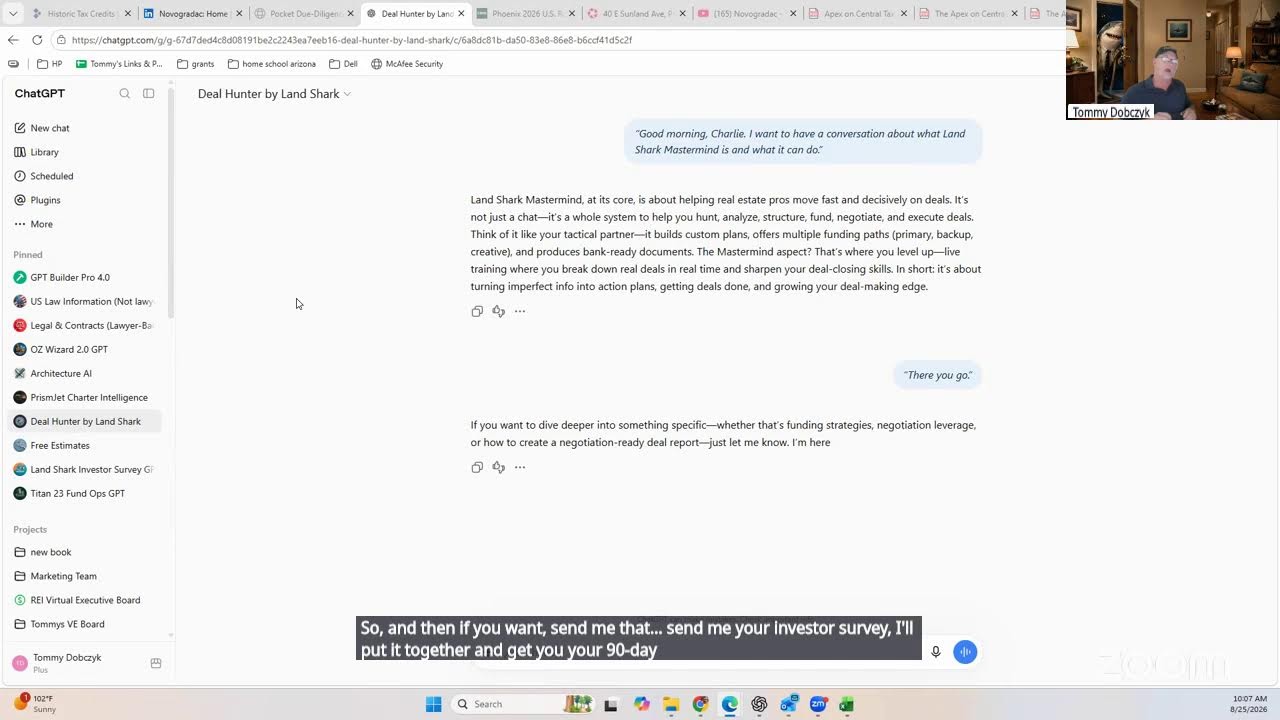
So, and that's the third way to do it is you, you, you have a conversation with it right here. Good morning, Charlie. I want to have a conversation about Um, um, what Land Shark Mastermind is and what it can do.
Land Shark Mastermind at its core is about helping real estate pros move fast and decisively on deals. It's not just a chat, it's a whole system to help you hunt, analyze, structure, fund, negotiate, and execute deals.
Think of it like your tactical partner.
It builds custom plans, offers multiple funding paths— primary, backup, creative, And produces bank-ready documents. The mastermind aspect, that's where you level up. Live training where you break down real deals in real time and sharpen your deal closing skills. In short, it's about turning imperfect info into action plans, getting deals done, and growing your deal-making edge.
There you go.
You want to dive deeper into something specific, whether that's funding strategies, negotiation leverage, or how to create a negotiation-ready deal report. Just let—
I don't know how I got a her voice today, but I'll get with it. So it's continuing to underwrite these, these documents. Inside of these documents, it's going to comb through them, probably take at least 4 or 5 minutes, easily 4 or 5 minutes. So, but the The, the great part about that is, is that you're going to be able to, to have answers sooner than you would if you were to go through and have this audited by a CPA or looked at by a lawyer or, or any of that stuff. You want to go to those people, but you don't want to go to them with basics. You want to go to them with conclusions. Here you go. It's what I think. This is what I'm— this is what I want your professional opinion on. And so that's, that's what Deal Hunter is able to provide. So another GPT that I built was called Free Estimates. Free Estimates is a model, GPT model, that you can take pictures and a zip code, put it in there, and it'll give you a breakdown of what it's going to cost to do the project. Again, I built it with my experience inside of being a contractor for 30 years. And what it's able to do and provide is amazing when it comes to the prices, the sources where it finds the products. It even makes recommendations for— makes recommendations for contractors based on their Better Business Bureau. their 5-star, like all their reviews. It goes through all of that and makes suggestions as far as who the contractors could be. So free estimates, let me see if I can find one. This was for a fountain that the people had. We've got some concrete products. And, and so I had AI help me build it. They're like, hey, can you build a fountain out of this stuff? I'm like, okay, let me take a look at it. And I went to my AI and I said, use all the pieces and make a fountain. And so it counted all the pieces and found all the pieces, and I, I can make it a fountain. So, um, I was like, okay, cool, let's, uh, let's use these pieces. I said, what is it gonna cost to build it? And so here it goes. Installation only is $3,350, and it could go as high as $3,500, but it doesn't include any of the electric, plumbing, or any of that. I'm just building the fountain.
Right.
So if they want more than that, then I can go get that and I can put it in here and add it to it. But they just wanted that. I wrote a contract for it. And now I can email it directly straight to them, all from inside of Free Estimates. So, um, with all that, let me see where that went. Our due diligence program, like, here's Deal Hunter again. You can get to it and run a deal. And use it for free. But if you want it to do like specific to what you're doing, um, we build it white label. We give it all the tools, all the info you want to have it to have. Um, the basic one, and that's for somebody that's just an investor, is $1,500. That's forever. Um, and it's $99, uh, $99 per, uh, update, and that's usually 3 times a year. The, uh, Deal Hunter with a Virtual Board— Ashley got this one. Um, Ashley is, um, a local realtor. She wants to find deals, but she also wants her deal hunter to help her strategize. And so we built her a virtual board that helps her strategize. And then the $10,000 Megalodon package— that's the one I operate out of And these are all built by Catherine. Um, the Titan Impact Group puts together a complete Rosetta Stone, the Deal Hunter white label GPT, and a, uh, uh, a 1-year membership to the Land Shark Mastermind. So, and that's my contribution. So, um, if you want information, more information on that, you can go request a build consultation. We go through it, but every day Monday through Friday, 9 AM to 10 AM, we're in the Land Shark deal room doing deals. And we— people that want to run deals, they bring the deals in after they ran them. And, uh, if it looks like we can raise capital for them, we will, you know. So, um, we've got experience in doing multi-million dollar deals, multifamily. Um, I've built several of them in my past. Um, and I can tell you that When you're doing commercial real estate, the number one thing is to understand what you're, you know, what you're bidding against or what you're buying versus what, what you can make of it and what you can do with it. So, I think this is the— no, it's this one. Clarify scrambled message. Here we go. So it ran through everything working for 2 minutes, 35 seconds, came back and said, this is a document forensic pass. So the first document, tax public record report, checks out all the information, shows that it's got multifamily zoning. And that it's an R-4 multifamily residence. So 4 units. On there, uh, on R-4 zoning, I mean. So, um, it shows that JLL's normal tax assumptions in the low to mid $44,000 range when an actual looks more like, uh, the, the raw line item. So, um, it shows that a negative— there's a negative of $8,171 property taxes from December 2025. So which means that there's likely an accrual reversal, credit reclassification, account adjustment, something like that. So that's the concern inside that document. The latest rent roll shows that as of July 2024— July 31st, 2026, that the totals match the operating memorandum. It's 91.5% occupied. And that's technically consistent with 107 units that are not currently labeled vacant. So, and it's comparing it off of that, that rent roll now. So physical occupancy as of today was about 107. So, but operationally, there are another 6, uh, 6 notice units and 3 eviction units, and evictions cost money, which now pushes you down to 83%. So. The headline saying 91% is only because of what it shows on the, on the lease roll, not the collection risk. So, uh, 3 current units show 0 base rent, meaning that they're not paying rent in 101, 150, and 257. So that does not make any sense without additional explanation. Evidence of eviction, like what that looks like, market rent versus contractual rent. Where we're at annualized, the latest rent roll has monthly market rent totaling about $153K a month, where annualized that's $1.8. So that actually matches what it says on the OM. However, what the actual base rent across rent roll totals look like is that it's more like $131,000 instead of $153K.
Okay.
Right. So economic occupancy, these are the actuals now. Do you know what economic occupancy means?
Yes.
Okay, perfect. So inside of that, you're able to see your values in your latest T12. That income statement shows that operating income is about $1.7 million, operating expenses are about $7. 41 reported NOI is a mil. So, but that is not yet a bankable NOI because you got to factor in bad debt concessions, etc. That's going to drop you down to a 1.5, but you still have the same amount of operating coming out of that. So that's going to bring your actual NOI down. And so, um, some of the other things they found in there was the $245,000 other income. So like utility recapture, uh, late fees, washer and dryer compliance, stuff like that. That accounts for about 14%. Delinquency accounting is a mess, uh, because it shows bad debt totals about $10,000, but it shows that for the full period it actually ends with a positive $13,000 18 net figure. So, uh, it, it, it's a, it's a Laura Miller thing at that point. So, um, and then the CapEx history shows that there's only about a $231,000 history of Capital One Pro Max, which basically shows that like air conditioners, plumbing, and stuff like that, uh, this is what it breaks down by. So Why is that important? Because if you have HVAC systems going out continuously, that's going to chew away at your T12 really fast. So what they want to see is a 5-year cap ledger, CapEx ledger, knowing what they've done for these, these things in the last 5 years. So anything that hasn't been— any of these that haven't been touched in the last 5 years, that's where you're going to spend most of your money when you take over the property. So inside of that, JLL's OM shows all the information, and here's the final verdict. OM pro forma assumes a much better operating property than what's, what's in the actuals. So the OM's pro forma NOI is dramatically above the actual NOI by about $160,000, which is roughly 15%. So that's where you can start negotiating from right there. Rent comparable methodology is weak enough to challenge as well. Because based on one competitor down the road versus Apex here, they're renting— they're going to rent that 970 for the same price as the 740, uh, you're— or 774. You're, you're stuck. So you got to do something different. Sales comps aren't especially tight geographically either. Mesa, uh, uh, the 5 sale comps that they use in Mesa are not South Phoenix. This unit is South Phoenix. That's not the same as Mesa, right? So you got to work from that. And now we have 4 different NOI figures across the sources, right? So which one do you choose, or do you just go with the lowest one? I always go with the lowest one. I'm not going to mess around. So JLL even has 2 pro formas. For themselves so that there's the OM sales pro forma and then the JLL debt underwriting part. So, you know, it's got— it's counting that it's got a 1 point, you know, 1.02 NOI there, and then it says here that it's got a 1.2 NOI there. So again, this is why I said JLL never— like, nothing JLL produces is ever the same. Ever, never. So insurance inconsistency, reserve inconsistency. One thing JLL did right—they did tax normalization right. Okay, so JLL is roughly underwriting about forty forty thousand, forty four thousand on on the on the tax normalization. So current whole poking scorecard shows. That at the end of the day, with everything laid out, why do 19 units fall into vacancy, notice, or eviction status? Why are units 101, 150, and 257 listed with zero base rents? What is the true AR? Explain the $231,000 in recent CapEx and reconcile the actual NOI. Normalize the NOI. Get rid of the JLL debt NOI and stabilize the NOI. Line by line and make them do that, not you. And then come in if they're like, oh well, we don't want to do that. Okay, so here's my offer. This is why my offer's at, you know, $12 million. Ready? Make an argument to offer— make an argument to offer $12 million. That's it. So, and then inside of that, like, if it came back that they actually took your offer, we have Titan 23 Impact, uh, Titan 23 Fund Ops. We actually build out, um, we build out, um, the 506 Reg D debt structures for those types of, uh, for those types of buildouts and buyouts. So, and we do that within GPT, and then we publish it on, on Titan 23. So impressed, Holly?
I am. Oh my gosh, I am impressed.
So moving forward, use Landshark by Mastermind and quit trying to reinvent the wheel. And then if you want one of your own, pay me to build it.
Okay.
So like, stop trying to reinvent the wheel. Bottleneck relieved. All gone, right? So, and then if you want, send me that. Send me your investor survey. I'll put it together and get you your 90-day business plan. I mean, your 90-day blueprint, your 12-month business plan. And get that back to you. And like, you'll have, you'll have a place to work from.
I'm super fast. I sent that to you several minutes ago.
Perfect. And I can have that done probably by— let me make sure that I got exactly what I need. I don't want to be lack. Okay, no, I got exactly what I need. So Uh, perfect. So I will go ahead and build out your— I'll put this in the system. I run it through a system, and then we'll have it for you again tomorrow. Just show up again tomorrow at 9:00 AM. We'll, we'll run through it real quick.
Okay.
Awesome. Thanks for coming in today, Holly. And I think a bunch of other people already dipped off, so, um, anybody else that I missed, uh, have a wonderful day. I'm gonna wrap it up with a prayer. Heavenly Father, we thank you for the blessing in this day, the blessing in this life. We ask that you continue to bless and guide us so that we can go out into the world and do your will. Lord, protect our enemies as the, the vengeance you set upon them, uh, will be of their own making. Thank you. Amen. Everybody, we'll see you in










