AI Live - Land Shark Mastermind
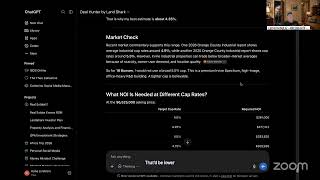
Tommy demonstrates Land Shark, a suite of custom ChatGPT agents that automate real-estate deal analysis. Deal Hunter and Free Estimates evaluate properties in minutes, targeting 40-60% gross profit. The platform can be white-labeled for retailers and adapted for cars, jets, and oil & gas.
Chapters
There we go.
There you are.
Yes, there I am.
Great to see you, sir.
Pleasure seeing you too.
Uh, is your daughter joining us?
I don't know where she's at, so probably just be me today. Okay, we'll have to come back again someday and, uh, have fun with her too. She really liked you.
Yeah, she was great. Um, did you and Tommy meet before? At the club, I think.
Tommy.
Yes.
I have no recollection of Mr. Tompkins. Sorry.
Yeah, I think I've seen him. I don't think I met with him.
How are you, Tom? Uh, a little under the weather today, but otherwise pretty good. How about yourself, sir?
Man, it's been a good day.
Yeah, it's beautiful here. Love it. Okay, so I shared a little bit about what your background and investing and all of that, and excited to have you see what Tommy has built out for, like, what I was talking about, the Land Shark Mastermind, and how, you know, he does deals and all of that. So Tommy, do you have a deal that you want to run this morning?
I mean, we should have deals every day to run. So I'm not prepared with anything because I'm in the middle of the septic tank job that, that's kind of got me focused, trying to get a $30,000 septic tank installed. So usually our team has deals that they bring and we run through them. And we use the AI to help us get things figured out. So appreciate you coming in and talking with us. Pardon me, because my throat's really, really sore. So talking today is probably not the best thing I could be doing, but I'll do whatever I have to do.
So I had the— you remember the guy Ryan Magoe that we had on not too long ago for Serenity Senior Living? We ran it through. And gave him a whole bunch of feedback. And then he actually went and says that he's got it all done. He sent me some new stuff. We can run that if you want.
Yeah, just for, just for understanding sake, that's the guy that, that during Las Vegas.
Oh, I don't remember actually. I haven't given it a whole lot of thought since we did it, but he's been sending me stuff.
Was he on the podcast when we did it or was he He just came to one of these.
I invited him to one of these.
Okay. Yeah, pull it up. Run it.
All right, hold on a sec. Let me get my act together.
What kind of real estate have you done in the past? Is your name Tompkins, or is that your last name?
That's my last name, but everybody calls me just Tompkins. It's great.
Okay, fine. What is your experience, Tompkins? What kind of real estate have you done?
Um, multifamily. Um, done some fix and flips. I've done, um, I've had personally up to 40 doors. I have a couple partnerships with more than 100. So, um, that's basically it for me.
Gotcha. Cool. And, and what's, uh, what's your bottleneck right now? What's the, what's the pain point you're experiencing?
I don't like real estate anymore. I'm going straight from where I'm at to like platform and I trade stocks. I've been doing that for 16 years. So I kind of like continuously do that.
Yeah.
Like as far as like pain points of real estate, I mean, it's just, I mean, I make 60 to 150% a year. So it's tough. Real estate doesn't make a lot of sense for me for best use of my time, money, and resources. But I, you know, if something comes across my desk or I have plenty of investors who love real estate who are part of our platform and founders. So I mean, I always look for opportunities for other people, including myself. I mean, if I can double my money on something, I always am excited to hear about that.
What is your platform?
What's that? What is your platform? Sorry, I didn't mean to interrupt you.
No, you're fine. Basically, like, I just like trading stocks, finding opportunities like with initial coin offerings and finding like I trade mostly the S&P 500. 100 futures for 16 years. So I've expanded on that a little bit, and our platform is going to be basically a trading platform/social media site for people who are investors.
Oh no.
I'm always excited to see how other people do investing because I, I love, um, you know, I don't know everything. I mean, I've been in the game over 20 years, but I don't know everything. So it's always fun to observe and find and discover what other people are using for, you know, DD and for due diligence and for discovery of finding deals or finding faster ways to process them to find out whether they belong on a table or in a garbage can.
Right. Yeah, I love it. Okay, I'm going to share my screen and I'm going to just run this deal through the Deal Hunter by Land Shark, which is one of the ChatGPTs.
Excited.
Yeah, so what you're about to see, Tommy created this with his 20-some-odd years of experience of investing and being a GC and all the investments. And so it's, it's been one of the most profound tools that we've ever come across and used.
I'm so excited. That's part of the reason I'm here today is I'm really excited. I'm always excited to see innovation. Like, and you sound like you guys really had something wonderfully put together.
Yeah.
Can you see my screen?
Yes, it's perfect.
Okay, so this is the custom ChatGPT over here called Deal Hunter by Land Shark. And all I did was I uploaded 3 documents that I just received about this deal, the executive summary and underwriting document.
And is it the same? Is it the same property or 3?
It's all the same. Well, you know what? It might. I don't know if it's all the same or not. It's a senior living development, and I don't know if this is going to be for one location or if it will be for a couple, but we're about to find out. I just uploaded these and I just put run this deal.
Fun GPT.
So it's pretty cool because it gives you a breakdown. So this says quick verdict, conditional go, heavy diligence required. This is a high upside senior living repositioning play, not a clean stabilized real estate buy. So it kind of breaks down everything for you. It'll bring out the positives and the negatives, the go, the no-go, um, red flags. It's, it's pretty awesome.
Where are the red flags on this one?
Let's see.
I'm scrolling down to it.
Yeah, it's still kind of going, so Back of napkin valuation check. I like that. That's pretty cool. 86-unit asset run in Florida.
So these two separate deals are all part of one?
Well, we're about to find out.
It looks like it's from one, one sponsor, one operator, and they're throwing— they're throwing spaghetti at the wall. So this is an example of what we experience. Probably a pain point you've had, Tompkinson. And that when, when you're doing real estate, people are just like, here's, here's all my deals, man. Tell me which one you want. You know?
So.
Oh, yeah.
Yeah. I found the red flags.
Okay.
So it says red flags, diligent killers. No property level financials provided. There's no rent rolls. It's probably because they haven't got it yet. This is the proposal, right? Senior living is an operating business. Yes. Not a multifamily. The biggest risks are Licensing approvals, staffing ratios, wage pressure, clinical compliance, insurance, resident acquisition costs, lease-up velocity, memory care build-out requirements, state-level regulatory constraints. The documents identify lease-up, staffing labor, and operational transition as primary risks. The $4.9 million stabilized NOI needs a hard bridge. At a 69% expense ratio, NOI is 31% of revenue. Said to produce 4.9 million NOI, implied stabilization revenue is going to be 4.9 divided by 31. So that's $15 million annual revenue, $51,000 per unit.
And so that basically with that $43,000— $4,300 a unit per month. That, that sounds about right. It actually kind of low in, in the, in the senior living department. Um, it's usually higher, around 5 to 7.
So yeah, depend on location too. The different states have different— which, which state was this, Florida?
Yeah, yeah, that's where—
that's low for Florida.
Yeah. Yep.
So very, very familiar with the Oh, so yeah, so it's 306, but it's, uh, it's 3 separate locations.
Yeah. Yeah. So you got Florida, Alabama, Alabama. So, and, and at this point, like, it's just given a— it's just given a bird's eye view. Like, it, it's, it's literally more of a 50,000, uh, 50,000-foot elevation view than a, than a microscopic view. But we can needle in on it. It just really helps us see Like if there's just too many red flags, burn it and go to the next deal.
Yeah, it's great because you can throw something in here and know instantly. It would have taken you a long time to figure out whether it's worth it.
Right, instead of spending 4 or 5 hours on this thing, you spend like 30 minutes.
Yeah, and it's trash. It's like, ah, why did I, you know, I underwrite so many deals and look at so many deals. It's like, this is a total lifesaver for the first, you know, just the first run through. But it's pretty cool because it gives you a funding strategy. There's pros, cons, approval needs, different paths. So it's got funding strategy number 1, number 2, number 3. So, you know, negotiation, leverage points, due diligence checklist, must-have before a real go, physical CapEx. Licensing, regulatory, title, legal, market. Current grade is a B- because it's incomplete. The basis is compelling, but the exit cap is not crazy. And the exit cap is not crazy. The reserve concept is good, but the uploaded materials are marketing level, not investment committee level. The deal needs a full property-level underwriting model, which, you know, maybe they have that. I don't know. This is just what they sent me. What would make it an A-? Verified rent rolls, of course. Third-party market study, confirmed licensing path, all, all the things that would mitigate the risk. Go, no-go, conditional go on Florida first, hold Alabama until proven. And it just gives all the reasons why it has selected the, the go and no-go in the past and the next action. So it's definitely helpful. Thank you.
It is. Thank you so much for that, Tracy. And while you were talking, I was getting a deal put together real quick myself because I just got a text message. I'm a bit of a dirt dog and I like doing real estate on dirt. So this is basically why I ended up building this was because oftentimes I don't have very much information available to me. Getting a hold of a realtor is a pain in the ass. Tracking down the owner is a joke. And so if I just need to, like, know if am I going to put gasoline to go down that track or not, it sometimes can take 2, 3 days, you know, 2 to 3 days, even 2 to 3 weeks. So what I did was when I learned how to operate inside ChatGPT, It was actually before it was called ChatGPT. It was just OpenAI, and I had a beta version of it, and I was learning how to build GPT models. So that's why I built the, the Deal Owner by Land Shark. So I'm— it, it just got— my deal just got done cooking. Let me go share my screen. Oh, where'd it go? Over here. So Uh, here we are. Um, have you seen the inside of the marketplace on GPT, ChatGPT? Oh yeah, yeah. So I mean, when Expedia, Canva, uh, uh, Trillio, stuff like that are using— making GPTs and using it, I feel like I was ahead of the game by getting started on doing it with mine. So, um, if you, if you know how to get in here and do this, you just type in Deal Hunter by Land Shark and let me spell it right, and it'll pull up the, uh, the chat. So, and you can have that conversation with it. You can do these prompts or whatever and put whatever you want in there. Um, so let me jump over to this deal. I'll show you the— like she showed you with some documents. Let me just show you how actually primitive this is. So this is the text message I got this morning from my partner. He's like, hey, we got a land deal coming in. Here's the details. You guys can see that, right?
Yes, we can see it.
Okay. All right, cool. So 38 acres, 3 miles away from I-10, paved frontage road, all the cool stuff. It's just vacant lot out in Tonopah, vacant dirt out in Tonopah., which is near Buckeye. It's a pretty popular growing area. So, uh, Tompkins is just a demonstration. Put— I put the screenshot. I didn't even type. I just put a screenshot, said run this deal, and it went through, scraped the data, figured out the information I want to know, which is like, what is the overall score of this? What energy should I put to it? Anything 7.0 and above, I'll put more info. Or put more, you know, details to it. But anything 7.0 and under, 6.9 and under, it's not worth dealing with. So, um, it goes through and points out the things that are green flags, points out the things that are red flags. I'm a contractor, I'm a general contractor, and so I, I understand how to mitigate some of the red flags. So red flags aren't always red flags for me. Okay. But I didn't teach it about me. I taught it in general what are going to be red flags for anybody, right?
Right, right.
So it pulls that out, it gives me multiple scenarios. I told it when I, when I built it, I said make multiple scenarios for me to, to choose from. So it gives me a Scenario A, Scenario B. And on vacant land, there's not much you can do outside of that. Um, and then it gives me some offer strategies. It helps me come up with options for funding, helps me come up with a due diligence checklist. And I'm going to ask everybody in here, all of our members, do we do the due diligence checklist? Do we do the due diligence checklist?
No, it's created for you.
No. All right, so I, I'm— I have no participation in here today. Sorry about that.
Sorry, I was muted.
Um, we, we do— we don't do the due diligence. We copy it, paste it, put it back in, and say you do the due And so we make the due diligence responsibility fall back on the GPT, even though it just lists it. This is the preliminary. So it gives us a go, no-go. So I can go ahead and—
Just copy and paste the due diligence.
Copy and paste this.
Do you have to copy and paste it or can you simply reply to it?
I like to copy and paste it as a way of teaching it, right? So I have to remember with every conversation I have in GPT model, start as if I'm talking to a kindergartner.
Yeah.
Then graduate to the point of the collegiate, you know, conversation over 4, 5, 6, 7, 10 prompts, right? So basic information first, slow, slow build of knowledge, and then we get into the big heavy stuff down the road. So putting all that in there, I'm gonna, copy paste and say, tell it to start with this list now. And I typed it because there's, I'm going to do another demonstration here in a minute. And again, I'm sure Tompkins understands it, but for the, for the fact that I want people at home to understand, like, there's so many ways to use AI. It's not just a standard. thing. Like, I put in a, I put in a screenshot and 3 little words, and look at the results that I got. I copied and pasted what it wanted me to do back to itself and typed and told it what to do. Right? And so it started to do diligence. I'm not even gonna really dive into this information yet, because what I wanna build out is a full report. I'm not gonna sit here and analyze this information yet because I had a 7.1. So I'm going to get it to work. I'm going to start making it work so that I'm not wasting time. I want to get through this in 10 minutes. So I'm just reviewing that it's hit every single one of those things. I'm seeing yellow and red flags going down, going down. Here's the other thing, Tompkins. I made it because I had— I have a degree in, in science. I made it reference things just like an APA format. In a research document like I used to write. I made this GPT write the information using the same rules as a scientist uses for research documentation. I need cited sources. So you can see right here, it's given me a cited source based on the information. It's not able— it's not allowed to just do assumptions. It has to come with real cited source information for this. So it comes up with this current risk metrics missing, unknown, unknown, partial, boom, boom, boom, all the way down. And so it leaves me knowing that there's a lot of work to do to do the due diligence here, because it just told me the due diligence checklist is mostly yellow and red. Right? So, eh, I'll probably pass on this. But before I do, because it had a 7.0, I'll, I'll, I'll, I'll put in here that I need a full feasibility. If I spell it right, I didn't. Studying. Actually, hold on. Watch this. This is the other thing I wanted to demonstrate. Because typing, you see how cumbersome that was? I gotta jump over to dictate. I'm way better at that. My throat hurts this morning. So that's why I'm trying to type. But let me do the dictate. Okay, looks like this has a lot of work in the due diligence department. So what I want you to do is I want you to give me a go/no-go. I want a SWOT analysis. I want a feasibility study, very preliminary, very minor feasibility study. We can do a bigger one later if it's possible, or if this is a good situation. But I need to know what the the likelihood of building 1-acre lots out there is going to be. I know there's 38 lots, so— or 38 acres. So go ahead and figure out what 25% of that 38 acres would be for infrastructure, 5% for green space, 10% for easements, and then tell me how many lots I can actually put on there. Ready? Go. And so did you just hear that massive amount of information I gave it, Tracy? Right? And so telling it to give me 5% for this, 10% for this, 25% for this, how long would it take us to calculate that and add that up? Take a minute. Right? So right now it says it's a conditional go. I've got a feasibility study seeing that I can do about 23 acres out there. The rest of it's going to be for the roads, infrastructure, green space, easements, and drainage. If I do 1-acre lots, I'm going to get 22 finished lots. If I do 22 finished lots, what does that look like? $97,000 per lot. What's the going rate out there?
$150,000.
I know that already. So I'd have to sell them for $125,000 apiece. That would give me my $2.75 million. That's going to be a loss. If I sell it at 150, it's still tight. If I sell it at 175, now I have a margin. 200, I got a strong deal. But since I already know the market out there, I know 150 is my, my cap. Probably a no-go. How long did that take us? I'll just give us the whole 22 minutes we've been in here.
Sure.
So I literally just did a master plan development. Due diligence plan that would have taken me a month over a year ago, I just did it in 22 minutes, 23 minutes now. And it was all Sarray's help.
That's pretty cool.
Tommy, will this work for any kind of a deal or is it mostly real estate? Does it matter if you change asset?
I mean, I built it only for real estate, but Catherine and I did, and Catherine, are you paying attention?
I am.
Yep.
You're talking about the cars?
Yeah.
How'd it go?
I think we've done it. Oh my God, it was insane. So we were, we went and visited a, it's a classic car dealership for lack of a better word. And we just tested it and literally took pictures of the car, uploaded it in there and gave it the prompt and because we were standing there with the owners at the time and it literally like analyzed the whole thing and all the numbers were like right on. It was crazy. I'm trying to think. I think we've done it with jets too. I'm trying to think of the other asset classes we've done this with because I know—
I'm trying to think what I did.
And when we did it with the antique car and for not lack of a better word, because it literally is a classic car dealership. They sell classic cars, and they're located here in Scottsdale, Arizona. And I don't know if anyone else in here is familiar— Takings, you're probably familiar— but yeah, you've heard of Barrett-Jackson, the auction?
Oh yeah, absolutely.
So every year they have this thing like it's a, like it's a prom or a homecoming event, you know. And so people in that industry, people in that world, they go out and try to find vehicles that need work to get it up to auction level status, clean it up, make it beautiful, and get it at the auction. Because if their car sells for a high dollar amount, then that car can lead to a branding program for them that gives them the opportunity to build up their brand. Right. Because they're, they're known for this beautiful classic T-bird that sold for $1.17 million or whatever. Yeah. So we were there at their, at their place looking at all their beautiful cars. And, you know, we went out back and we were talking to them about the 7 streams of income that they have there. They actually have 10. They didn't know. They only thought they had 2 streams of income selling cars and brokering cars. And I'm like, no, we went through it. They can get parts, they get— they can do deep— they already— things they already do. It wasn't like I told them they needed to start. They were already detailing cars. Fixing cars, buying old parts. And I'm like, if you guys focus on that, it'll, it'll definitely boost up your sales on the classic car side because you're doing what you're good at. You're good at sourcing materials nobody else can find. Like, great, you can sell a 1947 Rolls-Royce with a, with a, they called it a chauffeur, a chauffeur design where it was said that chauffeur sat on the right side of the car instead of left. Whatever. And, uh, the, uh, they're really good at finding that, but they're also good at finding the hand crank to roll the window down, right? And so anybody that has that car that doesn't want to sell it can become a customer of theirs too. So anyway, back around to the story, the, the T-bird that they bought was sitting in the back. I went and took a picture of the, the VIN number. We took a picture of the whole car, um, and actually it wasn't It was not Deal Hunter we did this with, Catherine. It was— Oh, it was Free Estimates. I made something called Free Estimates where I took a picture of the kitchen bathroom in a house, gave it the zip code, and it spit back to me not only a budget, but like, you know, cost for materials, cost for labor, and the list of materials and the, you know, and the image of it. I wonder if I have that. Conversation's still sitting over here somewhere. Um, but when we did it to the car, it did— it spit out an estimate to, to fix the car. So what I built for construction and, and real estate actually worked in the automotive industry as well. Same rules apply, I guess. Yeah.
So yeah, to answer your question, Tracy, yes, it works on like all the different things.
I'm trying to think.
We did run different, different asset classes, and my brain is—
I know. I feel like we— I feel like I ran a different asset class, but I can't remember what it is now. Yeah.
We ran the jets and we ran oil and gas through it.
I think I might have ran a, um, like a private jet cleaning business. I think I might have ran that through it.
It does do businesses. It does do businesses as well. Yes.
You have a different GPT or you just use the same logic from the Deal Hunter?
No, I've got a separate, another GPT. Uh, um, I'm trying to find that conversation right now.
I don't remember the logic because I've only used it a couple times. Like, I have an avatar GPT I built. Do you have it where you can do like multiple steps so you don't have to like go back and even input stuff? I mean, that's Oh yeah. Because then you can start, you know, the next step from there would be to like have an agent grab the information, chuck it in, and give you back results.
So you don't even have to— And again, I, I, I, I like getting people involved and then letting them evolve instead of being like, oh, here's the cookie cutter done for you. You know, because a lot of times people—
and yeah, I mean, I guess if Because I mean, what you could do too, like I talked to Andy Elliott, one of Andy Elliott's guys about like, so he has similar as like a lot of GPTs and he created an agent too. And a lot of times like with these deals, like you segregate like land from multifamily from whatever, and then you let the agent decide which GPT to use and gives you better results too.
Yeah, well, I mean, Deal Hunter by Land Shark handles all of the real estate. It just— we found it capable of doing the— like, kind of like doing the wide spectrum of other aspects. So, sure.
But I mean, like, to do— like, so, I mean, like, just to be, you know, not— that's, you know, not saying this doesn't work or it's not great, but like, the other idea or stuff that, you know, I was running by with, you know, a couple different other people were like, literally, if you separate them out, you get less noise and you get like less having to retarget it or retrain it or redirect it or reprompt it to get the result that you want also. Yeah, no, that's just having like a funnel right to the answer that you want to the final.
Yeah, no, that definitely falls into a waste of time. In that respect. But I oftentimes think that people really don't follow the rules of AI in that—
They don't. That's why, you know, that's why you make it so stupid that stupid people don't do stupid things with it.
Right. And so that's why, like, for example, I told it when I built it, I said, just run this deal. I gave it— I said, I needed you to do 3, you know, I need to get you to do a list of things based on 3 words. Because sometimes I'm driving down the road—
Oh no, I'm not, dude.
Like I said, this is absolutely stunningly amazing, but you know, you do have to stupefy it because people who use it like will do silly things with it. Like, I mean, even like, you know, who's going to have like that knowledge you have of different areas too, you know what I mean? So now you have to— how can I— the next step would be how could I plug in something to learn different areas values, or how could I find out? Because you know, there's a wide spectrum of information. There's information that's possible out there to get the values of the different properties in different areas.
True. And again, people can use— and that's why we have this podcast every single day, is because when I was taught AI 10 years ago in healthcare, I went into healthcare as a construction worker. And so I had to quit thinking like a construction worker and start thinking like a healthcare worker.
Right.
And so that's how I like an AI. You have to quit thinking like you know everything and pretend like you know nothing and then get into it, right? And so when it came to AI, I don't allow AI to tell me, like a lot of people would say, oh look, I got this due diligence list, let me go and start working on this due diligence list. When really what you need to do is figure out how to give AI the due diligence list and let it go back and do the work.
Yes.
So this is an example of the other AI that we built because when I built, and this is an example of what I'm saying, Deal Hunter, I did not build Deal Hunter with the ability to read pictures originally. I didn't see the button below to click to say, you know, use DALL-E. And so it didn't use DALL-E originally. And so when I gave it pictures, it was like, I don't know what you want me to do with this. And so I would look at a property like a fix and flip and I'd be like, I need a budget for this. And Deal Hunter was not giving me the right info. So I was like, okay, hold on. I went— since I already know how to build a GPT, I went and built— I went and built this thing called Free Estimates. And Free Estimates is for the fix and flipper and the rehabber. Who need answers right now. They can't wait for a contractor to get on the phone, right? They can't wait for a contractor to come out and do a measurement. So with free estimates, I made it to where we could install 20 pictures and give it a prompt with a zip code. And it is— when I built it, I told it to go out and scrape, uh, uh, data from not only big, big box stores, but also from the government websites where they post the numbers for getting permits and when they do what's called the RFPs. So when an RFP is responded to, it has numbers as to like, okay, they're doing all this office TI work for the city of Phoenix. This is the amount that was awarded. This is the square footage. I made free estimates figure out how to come up with a per square foot price for office TI based on that, you know, publicized data. So when I built it, I built it specifically to understand how to do free estimates for fix and flippers and rehabbers. But also as a— I didn't think about it as a Land Dude, but I did discover after I built it that now I can install blueprints to it and it will do— Sure. It will do a blueprint takeoff for me on top of it. It'll, it'll go off of, off of stuff I already have. So, but in this example, I showed some of these pictures to this High End Remodel. It was in a house that we went to and looked at as a possible Airbnb. And so it's got a nice big master bathroom and a nice big kitchen, but both of them are outdated. Yeah. It was built in 2001. So I said, I want an estimate for a high-end kitchen remodel, high-end master bathroom remodel. Here's the zip code, 85266. Put all that together and give me, you know, give me what that is. It went through and literally itemizes everything based on how I built it. It uses the instructions and the knowledge and Actions Explainer to do this. And at the end of my project, it totals it up for me and it says that it's $244,700. Now, if I don't know nothing about real estate or investing or fix and flip, I'm in a, I'm in a house that's about $4 million. And I know that $244,000 is a lot of money, but if I'm buying a $4 million house, I better expect to spend some money on fixing it up. So I said, you know, uh, it gives me all this info. I says, and so I don't know nothing. I says, hold on, go ahead and show me a conceptual picture of this kitchen and bathroom so I know what's $250,000. And here's the picture it created. And so all of this in 5 minutes, I've got an interior designer, a general contractor, an engineer, and an architect to put all this stuff together in 5 minutes using free estimates.
I know when I was flipping those 500 houses, like, that was— that was never gonna happen. The fact that we can even get pictures— I mean, to get a rendering from a contractor or an architect, I mean, that would have taken months and an obscene amount of money to get that done. Yeah.
Man, if you would've had this back then, Catherine, you would've done 10,000 flips.
Well, and again, I mean, we're— Yeah, and it's interesting 'cause we're doing the custom luxury build/flip in the Cactus Corridor. And again, with AI, because of all of this, like, it's made it so much better for us, for our investors, It's extraordinary.
That's awesome. Well, and then, you know, because I am a contractor, um, I programmed into it to go and find the Arizona Register of Contractors compliant, um, uh, contract format. And I said, using the compliant contract format for the Arizona LLC, put the contract together for me. And I gave it the information it needs— start date, start you know, end date, the name of my company, the price, etc. And it went ahead and put all that together in a, in a very easy to download, uh, format. So I can download it, send it, email it. I can actually program— I learned this weekend how to get it to let me email it, um, so I can literally just click the button from GPT and it'll send it. So, and then we, we went through and added some stuff as far as like remodeling. Oh, here's what I did. I was— did the last demo I did on it. I told someone to rewrite it in the tone of a pirate because they didn't quite understand the power of the GPT. I was like, well, okay, here. So let's just pretend that a pirate wrote it. And it said, The Imperium Construction is the shipwright, whereas the owner of the Fine Scottsdale Estate is the landlubber. Um, you know, and it puts the— it puts a little, uh, a little accent to it to make it sound like a pirate.
That's hilarious. I love the power of it.
Yeah, so that was a little fun trick right there. So, um, I told it to write— and then here's the— here's the moral ethical side of GPT. I said write it as, as if you were someone with Tourette's. I didn't say it Somebody else did. I just let it happen. And it said people with Tourette's have a motor tic and do not constantly blurt out, and most do not constantly blurt out profanity. So if you, it said, if you want the fictional version of this, as someone who experiences occasional interruptions of tics, I can do that, but wasn't going to do the part with the cussing.
So I have a child with Tourette's and he's never blurted out cussing. Just FYI.
No, yeah, no, again, it, it— I love that it dispelled the myth too, right?
Yeah.
So ticks are not always cuss words. So, um, but yeah, it, uh, it, it, it— GPT AI in and of itself to me is just absolutely amazing. I love all the things that it can do. Um, to kind of give it a little bit more of a breakdown, like this was a, a GPT we built specifically for a broker in the private jet industry so that they can do like very deep diving into their, into their stuff. I'll make sure I get that for later. This is an Opportunity Zone. I don't know if you're familiar with Opportunity Zones inside of the real estate space. But anybody with capital gains now can be eligible for tax-free capital gains if they invest in opportunity zones. So we built an Opportunity Zone GPT to be able to provide people with details about opportunity zones. They're very tricky. They're very dense. And so the, the issue for people sometimes is just not knowing what questions to ask. And so we coach people, go in there and tell it to interview you so that GPT can then build a knowledge base based on, on information you provide. So if you don't know what to tell it, I always say, ask it to interview you so that it'll then be able to start building a knowledge base from somewhere, you know. But yeah, that's about it. So Catherine, you got anything?
Yes. I've got— I didn't know if you wanted to run the 3 deals that we spoke with Michael about last week. He sent those over to us. So Michael. He, we met him. We met him at, um, the Westlake thing.
Uh, we can, what, uh, what was it that you wanted to, um, so he trying to, hello, because he put all the things into one.
I have to say he put 3 deals and I'm trying to separate them out so that it can. RP summary. Did it do this one?
No.
Property and then summary and stop. Okay, so every time I grab Land Shark, it disappears.
Well, while you're, while you're working on that, I want to just open up this other chat real quick.
Downloads.
Since I got Opportunity Zone GPT Wizard open, we've got an event tomorrow where we're going to— Catherine's actually a expert speaker tomorrow at an event. And so, um, they just sent over the, uh, the info on it, and I'm going to, uh, try and Try a little trick here.
Okay, so it finally pulled it up.
I don't know. Hold on 1 second. Let me prompt this real quick and get this cooking, then. Now let you reshare. This is information about an event tomorrow about Opportunity Zones. I need you to review it and prepare my Catherine for this event, giving her all of the information from this breakdown that would be useful in order for her to have a strong presentation tomorrow. We will also be handing out information about the OZ Wizard 2.0 book and how raising capital— Catherine's been raising capital for the last decade and a half and now is pivoting over to creating opportunities for people to invest in Opportunity Zones. Go ahead and put this together for her. All right, go ahead and share your screen while that cooks. Okay.
Okay.
So there were 4 documents, and then I missed the 4th. So I added in. Okay, so sponsor. So this is— they're calling it— go back to the beginning.
Did you run all 4 of them? Like, that's way beyond what— what— again, we got— every conversation has to start as a kindergartner and grow into a collegiate, you know, doctorate. So giving it 4 deals is just really unfair and not a good presentation of, of letting it do its job. So—
Sorry, I thought it was—
yeah, I thought it was— I mean, again, it's just not going to perform as well. So you really have to start one deal at a time and, and kind of do it that way. No disrespect, but I just, I think it works better if you go piecemeal. So I'm not quite sure who it was that got you this one. We got 15 minutes left. If you got a deal, we gotta get it on the table, kiddo.
Okay, sounds good. Let me share my screen right now.
Well, Catherine was running, uh, got that deal running. She can finish that one and you can jump yours as soon as you're ready. Catherine, where'd your screen go?
Okay, so this is the Camino Verde Fast-run deals. So it's 304 acres, 158-lot project in Santa Fe County, New Mexico. Total project's $31 million, projected value $51 million, 5 years, 31% IRR. 2.69 equity multiple. LP profits $10 million. So 59 lots targeted to national builder. So the core math. So profit— Target build.
50%. Profit on cost is 60%. So just so Tompkins understands, If that would have said anything less than 40%, we would have scrapped it because we have a— in order for any deals in Deal Hunter to work, they have to grow. They have to gross an ROI of greater than 40%. So we shoot for 60 and we won't take less than 40. So if it has a projected ROI of less than 40, it's a no-go and it automatically gets scrapped.
So like the profit, is that the overall profit or is that what you're paying your investors?
Gross overall profit has to be over 40%. We'll pay our investors then what out of, you know, something out of that, maybe like 20%, you know. So, you know, they'll take 20, we'll take 20, but we usually do a 50/50 split. So on this one, it's a 25/75. But again, that's as a fund manager. So if we're joint venturing with somebody, though, it has to be 50/50.
Sure. And like, you know, how, how, like, have you tested— what's the test that the Lithmus test you guys done with the numbers on this? I mean, it seems like you've been doing this for a while. Like, how close are these numbers? Are they pretty close, or—
They're not— they're, they're— again, they're, they're close enough, um, to where if there isn't— if we needed to, to really sharpen the pencil and get it down, we can do it without it taking, you know, 3 or 4 hours or 3 or 4 days.
We can do it. Okay, so this isn't really— this is just like, do I take a look at it or do I dive deeper into it and get what the real numbers are?
Based on these numbers, these numbers are coming straight out of that document.
Sure. I mean, the deals that you guys have completed though, what have you found? I mean, I'm a data scientist, so I mean, like, I'm always— this is, this is pretty cool stuff for me. I'm always wondering, like, what's the on the ground when it, like, lands? Is it like plus or minus 5 or 10? Plus or minus 15 or 20.
We're always plus or minus 5, 5 points or 5% because of the fact—
I mean, across the board, that's general, but I'm saying like in, in terms of like where this lands in the software so you can kind of get better data with it, like does it— do you ever check that against what it's produced initially or no? Yeah, I was curious, man. I'm sorry, I love this stuff.
Yeah, anything that we've done has, has 100% been, been on task, on target. We've We've never been like, oh, this is a 40% deal, and then turned around and was like, oops. Like Katya over here, she actually had a deal that, that it was on the table for 4 companies before we got to it. It was a property that is— what is it? Was it 5 acres or 9 acres?
Are you talking about the one in Tempe?
Yeah.
It was 5.35 or something like that.
5.35. But it had been on the negotiating table 4 times prior to ours. Are you still?
Yes.
And then when we picked it up and started running with it, by using Deal Hunter, it saved us $10 million in soil mitigation. So that's the other side of it. As much as I want to make sure that I get precise numbers, and it did work on the other side, I can tell you that it's about 100x the other way where it saved us money, time, and resources by not letting us go down the road with them. So the brokers both know—
Target.
Both know that the property needed to have soil cleanup because it was a dirty, wet, dirty site from being a junkyard for 20 years. And they also knew that it had a sinkhole under it because the building was sinking. But by using Deal Hunter, we were able to discover that without their input within an hour and a half of me, you know, like we had an hour and a half timeframe from the time we got the info to the time we made the discovery. We went and talked to the broker and we're like, hey, bro, like, what the heck's going on? Why didn't you tell us about this? He's like, oh, well, that's how you— that's on you guys to do due diligence. Right.
Yes.
Right. So the soil that just to find out the soil was dirty would have cost us $150 grand. And then if we did get into the contract and had to clean up the site, it was over $10 million.
Yes.
So, yeah, does it, does it like when I do the free estimates and I go to the store, as a matter of fact, we're trying to white label free estimates to, to Home Depot, Lowe's and True Value. So that you can— they can use free estimates in the store. And because I'm already scraping the data from there, if they go there and buy stuff, we get an affiliate off of every purchased item. And so I want to provide the software to Home Depot, Lowe's, and True Value at low to no cost. And then they have the— you know, we have the promise from them that anybody that does the shopping from home or contractors that use it when they come in the store, scan, and then they just pick up their product like Uber Eats. Because that's what, that's what's lacking in construction. People can walk into McDonald's and have just grab the food, walk out, take it to somebody's house and drop it off. We need to have that for construction. So that's why I create, you know, I want to white label this out is because Home Depot, Lowe's, True Value, they, I don't know, like they're multibillion-dollar companies a year. If I can take 1% of that billion just because I have the software in their store working and providing people with ease of access— I mean, as a contractor, I could spend 2 or 3 hours in that damn store collecting materials, or I can have an email to a representative in the store, go pick the stuff and have it ready for pickup when I get there and be there for 5 minutes.
Yeah, that's a great solution.
So, and it already exists, like it's called a Pro Rewards program. As a pro contractor, I can do that, but that, that system, software, and program is proprietary to them. If I give them free estimates and people are able to just be like, oh well, free estimate said that this material is here at Lowe's, can you guys have that ready for me? This material is ready at True Value, can you have that ready for me? And it communicates with it back and forth, I've just created Uber for contractors.
Yes.
Uber Eats for 2x4s, you know.
So, Katya, you got a deal ready?
Yes, I do. It's another Club Cali warehouse.
Let's go.
Don't laugh.
Get it up.
No, I love it.
Now, as a matter of fact, I told Catherine this weekend, everybody in this room just shops for stuff for us. Nobody's going off what's on their survey. They're trying to find deals that Tommy and Catherine like.
Well, this—
you're the exception to the rule, young lady. So, so don't even, don't even get sassy. I don't have the sass jar in here yet.
Okay.
Okay.
Okay.
Um, so this is the building and it's in Irvine and it has— let me show you the plans.
So real quick, before you go, before we go all, all the way down this rabbit hole, okay, one thing in the, in the, in the description under 18 Bunson that has me asking why.
Is it the fact that it's still 100% leased?
You are super smart.
So I sent an email and a text message to the brokers to find out more about it, but theoretically, are you able to purchase a building that's already 100% leased and they can finish out their lease? However long that is, paying you while you come up with the plans and concepts and validate everything in between? Like, is that a smart approach?
It is, absolutely.
Okay.
It's a delayed— it's a delayed opening to your program. Like, if you— if you're okay waiting, uh, till the end of the lease to start your, your car club, um, then yes, that makes absolute sense.
Right.
Okay.
So it has a lot— these are all like glass-separated offices, and this is the warehouse, and it goes to the second floor, which is open to below, and then this can be taken out to also be open to below, and here's more office space. So then when I went into Deal Hunter, I have a whole Club Kali Deal Hunter, um, said it was an 8 out of 10. The building size is 13,000 square feet, warehouse is 4,000. Um, mezzanine, is that—
That's the overhang, the second floor that can be removed.
Okay, so asking price is $6.5 million. Right now it's zoning as 5.4A general industrial design professional. So parking is really good. It's newer, so it's built in 2002. So I still needed to ask about the roof, HVAC, fire, parking, window, all that.
Yeah.
Um, it's Club Cali friendly, which is good. Strong location. It's weaker than the one that we checked out um, a few weeks back, and it says the reasons for that is because it's a smaller warehouse, so only 12 to 20 vehicles would be able to comfortably fit. But I think that's, that's not taking in consideration, like, the Club Scottsdale has those lifts, and so do they use those consistently?
Yeah, the lifts are always in use.
Okay, so then that saves you on space. Here it gives you the numbers. Back of napkin economics. And then revenue stack. So just about the memberships, the executive offices, the events, the card displays. The sponsors. So about $200,000 total monthly revenue. And then it just gives more information about the layout. So this is the one that I've been working on. And I sent an email and a text message to the brokers this past weekend to just grab more information. And then we'll continue on from there.
Okay, good. And then what does it say as far as the lease? Did you figure out like how much it's making, what the cap rate is and stuff like that?
No, I still need to get all that info.
Do it right now.
Right now?
Yeah. Based on the price. Okay, so let's ask it based on the price. What should it be a cap rate at? Based on what? Based on the location, I mean, what cap rate should it have?
Okay. Do you want me to ask or do you want me to dictate?
Go ahead, dictate. Based on the information, location, etc., give me a range of cap rate that could be applied to this, this building. And again, why do we negotiate cap rate instead of price?
It's complicated. I'm still learning.
Understood, but we got to go over until you figure it out.
So we—
I need to find my notes. Wait.
That's fine. You can— by the time you find it, I'll have it said. Cap rate is chose based on, on location and opportunity. So we, we negotiate on cap rate because if the location or opportunity go down, we can't change the price. But if we negotiate on cap rate, when they present their income, then the price can change regardless. Does that make sense? Yeah.
Yeah.
Okay, because cap rate or the value of the property is based on location, opportunity, and income. And so again, if we verify that the income is incorrect and we based it on the solid cap rate, then we'll have better opportunities for negotiation. So let's review what it says here real quick.
Oh, it's— it says— it just says, based on the information provided, give me a recommendation that should be applied to this building. Can you re-dictate, uh, maybe enunciate the cap rate a little more?
Yeah, we need to discover the cap rate for this building based on all the information you have about it. Give me the best and the worst level of cap rate and why.
Perfect.
And so again, teaching it like a kindergartner helps us build it out to be an amazing amount of information. And so it might even go back and find a cap rate So here you go. Best estimation cap rate, 4.35. Why? It's because the building size, parking ratios, the asking price is $6.5 million, which is roughly $500 a square foot. So the building needs strong market rents to support a mid-4 cap. Right. So we don't have any income status yet, right? We don't know the income from the property.
No, not yet.
Right. So now we know when we're talking to them what we're going to need to see as far as what the income should be. And right here it's saying that it should be renting for $1.46 a square foot to $1.58 a square foot based on the market. Okay. And so what that means is that's, that's based on, on, on monthly. Or as you can see here, $19 a square foot yearly, right?
Mm-hmm.
Okay. So your estimate, you know that based on these numbers, these are the numbers you need to see in order for you to know, is this a red flag or, you know, green flag? If they come back and say it's under that estimated NOI on any, on any of those levels from $235,000 and down, What do we do?
We say no.
And if it's above that?
We continue exploring.
And then we do that also with a grain of salt because we need to understand why is it above market? Why? It sounds kind of too good to be true, right?
Okay.
Got it. So in that area, um, It shows that this particular area has the ability to probably, I think, support what it's saying. It says that the industrial rate shows caps around 5.5. What happens to the price if we push it up to a 5.5? If I say that, if Remember what I said? Cap rates go up, price goes where? Tommy, right down. Cap rates are high, prices, prices low.
Okay.
Right. Cap rates are low, prices high.
Okay.
Right. It's an inverse. You got to remember teeter-totter. Just think of the teeter-totter when you think of cap rates. Low cap rate, high price. High price, you know, high cap rate, low price.
Right.
Okay. So if we— if they're saying that we—
But higher cap rate is also higher risk, right?
Yep.
Okay.
Okay. And so the area says that it should be a 5.5. Okay. Right. So it's giving you those target numbers based on the asking price. Right. Okay, cool. Keep going down. So aggressive cap rates right there. Conservative cap rates right there. Okay. Right. Yeah. And so the bottom line is to be in, in that area.
Okay.
Right. And so you want the broker to prove market rent above 2.2— uh, 2.1 square foot per month triple net. What does triple net mean again?
Triple net is when they have— the business has several different forms of income. Is that right? No. Oh my gosh, guys. I'm embarrassing.
I'm embarrassing all of you. Honey, honey, you're great. You're great.
Okay. Because Katia has only been doing this for a month, by the way, talking, and she's already shopping for million-dollar properties. So that goes to show you what kind of, what kind of confidence that she has. But triple net means that you get a base rent and then the occupant, the tenant, pays property taxes, pays insurance on the building, and pays maintenance, all maintenance. There's no out-of-pocket expenses to the property owner.
Yes, I found it. I have it all written down. I just—
I know you did. I know you did.
That's okay.
You are not a GPT. You are not a GPT. So I can't expect you to perform in 3.3 seconds. So, but there you go. Yeah, so I mean, you can explore it, find out the price on it, also find out like how long the lease is, and then kind of go from there. Because having a lease, having it 100% leased, will definitely help you get funding and financing.
Okay.
Right? And so if there's only a 2-year term on it with no extensions, you're golden, because that gets you into it, keeps you stabilized, and gives you an opportunity to build out your program.
Okay.
Right?
Yeah.
Awesome.
Okay. Good to know. I'll, I'll ask all those questions and continue.
Awesome.
And make a Quizlet about real estate terms.
Well, and again, you have to remember, you know, you have to hear something 21 times before you get it right. And so given that this is all new for you, like you get to grant yourself grace and you're doing great.
Thank you.
You know, Cecily's been doing this, you know, in real estate for several years now and she had some pretty big epiphanies last week about the, or the week before, whatever, about cap rates.
So it's all part of it. Yeah, I remember.
Yeah.
Okay, perfect.
So love that. So, oh crud, it's 10:07. Just realized I'm supposed to be on a call 7 minutes ago. So Tommy, do you want to wrap this up? And then I'd love to circle back and talk to Tompkins.
Yeah, for sure. So we appreciate everybody coming in today, and we're here again tomorrow. So come back tomorrow if you got more info, more questions, would be happy to hear about it. So wrap every day up with a prayer, and that's Heavenly Father, we thank everybody. For coming in today. And we ask that you take them out into the world to do your will. In your name we pray. Amen.
Amen. Beautiful prayer.
Thank you, everyone.










