AI Live - Land Shark Mastermind
Tommy and Catherine Bell explain how to buy manufactured homes for $125-130k, convert them into co-living units, and lease them to employers for their workers. The model generates over $10k monthly cash flow per property through employer-paid housing arrangements and short-term chattel loans.
Chapters
pouring into us, and we've had so many guests pouring into us in order to add commas to our bank account. So we're excited to hang out tonight, and we're actually going to talk about a really creative one, which I'm really excited about. And we have an expert on the phone, Tommy, who will be sharing just from his experience and the work that he's been doing in Arizona, and that's pet workforce housing, and it's through manufactured homes. So lots of people have heard of co-living, pad split, and if you've heard of pad split, put in the chat like, where do you live? What do you know about pad split? Like, what is it? It's a really big thing that's happening all across the country. Because we're really in an era right now where people need affordable housing, and it really provides a unique opportunity for people to stay in and have a home and a beautiful room while not paying all of this expensive rent that is out here right now. So, but this is a unique one, and Tommy, I'm excited for you to share more about it. Especially in the area of Arizona, but it's happening all over the country.
Yeah, and I appreciate that, Amor. Yeah, the experience that I've had here in Arizona is, you know, rinse and repeat in a variety of different workforce settings. And this is more something that happens inside of cities, like big cities, Atlanta, Chicago, Tampa, Orlando, the city itself has infrastructure already for workforce housing. They got, you know, they got 200-door, 300-door, 1,000-door apartment complexes inside these metropolitan areas. When you gotta do workforce housing in rural America where say for example, solar panel farm, or they're putting in the railroad, or they're expanding a highway, or the path of progress is out there, but it hasn't built the housing. These guys have a 300-mile commute or a 3-hour commute to get from their job to their home.. And so something that will give them immediate respite, they'll work 5 days a week, go back and forth, sleep, eat, work, sleep, eat, work, and then head home for the weekend on Friday. And so other things that happen is like, it's called FIFO, fly in, fly out. And these guys will literally fly into the area and they'll work for 3 weeks and then fly out and they'll be gone and home for 2 weeks. And they're guys that are like working for Caterpillar, they're working in the mine. With the tariffs we've gotten, a lot of manufacturing jobs are opening up and beginning to happen more here in this country. Our GDP is going to change dramatically based on the fact that all these domestic jobs are opening up now. So, but that being said, these people need a place to live. And so you're not gonna build a 60-door apartment complex, but it wouldn't be a bad idea to get like 60 mobile homes and put 3 bedrooms in each one of them.
Yeah. So Catherine has to keep us legal. She's our person to keep us legal. So we need to share a little bit about that. Before we dig into so much more information, right?
So I know that this isn't the most exciting slide, but it is one of the most important. Um, transparency matters to us, so everything we've shared— we're sharing today is intended for educational purposes. So some of the examples we'll discuss include historical operating information and illustrations designed to explain how the business works. Historical performance and projections are not guaranteed of future results, and all investment involves risk. Decisions should be based on your own due diligence and advice from qualified financial, legal, and tax professionals. So one of the things we want to build with Seven Streams is trust, and trust starts with being upfront. Alternative investments can be powerful additions to a portfolio. They can also involve risk. So today's goal is education. Our hope is that you leave with a better understanding of how alternative assets fit into a diversified strategy, not with the expectation that there is a risk-free investment waiting at the end of the presentation. So if today's conversation interests you, we will simply invite you to continue learning with us. That's it. So now let's talk about something way more exciting. Let's talk about multiple streams of passive income with this particular asset. And like Tommy said, how the GDP and everything is changing the landscape of this.
Yes, so the core opportunity here is not cheap mobile homes, it is controlled workforce housing supply. In rural markets. So instead of someone who's working renting a house, renting an apartment, they're able to rent a room. And usually that's in a manufactured home that's like 3 bedrooms, 1 bath, 4 bedrooms, 2 baths, usually under 1,500 square feet. A lot of the people who are doing this are minors, uh, contractors, people who are working in rural areas, but they may live somewhere else. They might have a family somewhere else, and in this place they're working and they need a safe place to stay. As an investor, it is also an opportunity for you to 2x or 4x the income that's coming in on a unit. Tommy, you want to tell us a little bit about just some of the areas and some of the needs for this?
So yeah, here in Arizona, Amor, we have the gold mining, we have the rare earth mineral mining going on, and these areas are areas where there's less than a total of 200 people for the entire town. And what's there is that there's over 70% of the houses in that area are vacant. And these vacant houses are 1980, uh, 1980 double-wide, uh, modular homes from, you know, from when the area was popular and it was a resort destination. Um, these houses have gone vacant and dormant, and so investors like myself, um, are going out in these areas and we're buying these houses cleaning them up, creating the opportunity for there to be 3 bedrooms, a common area, and a common kitchen for food, and maybe adding a secondary bathroom so that there's 2 toilets, 2 showers. And so split between the— you know, splitting it up so that these guys, all they need to do is go to sleep, wake up, eat, go to work. And so we provide them with a safe environment to do that. We provide them with a clean environment to do that. And we even put the beds and the furnishings in there so that all they have to do is bring their clothes in and out. That's it. They don't have to worry about their bed, their linens, their condiments. All they have to do is bring their food cooler, their clothes bag, and that's it. And they live there for 5 days. And typically, Um, the, the employee, the person there is actually paying me or, or the investor. It's the company that the guy works for, right?
That was the shocking thing to me, that they are providing— the company actually is paying for this housing. Um, that was surprising to me.
Well, the, the key component to that is that when these guys got to travel more than, more than 100 miles to get to work, they get paid for that. So they— it's not necessarily a law, but it's a customary thing that if, if I have to travel that far for work, you're going to pay for the travel expenses. So if it's just cheaper to keep them in the area, because I don't know if you notice what gas costs, but it's almost cheaper to pay $70 a day for travel.
Right, that's so true, that's so true. So let's dig in some— into some of the areas in which this is happening. One of them is Baghdad, and we're not talking about, you know, overseas, right? We're not talking about the Middle East, but in Arizona where this is happening.
So Tommy, maybe you want to turn off your video, your, your We're having a hard time hearing you.
Okay, is that better?
Yeah, we can hear you now.
I just had to scoop up the phone real quick. So the areas are again the mines in Arizona, um, there's mining in Florida, um, that this can be done in. There's, there's farming operations, um, in California where this is popular. Um, what you're going to do is maybe even go on to your using Deal Hunter by Land Shark, you could actually go and ask Deal Hunter by Land Shark to discover where the path of progress is and then start going and looking in those areas for the, for the investment opportunities and picking these houses up. So you want to be within, within 10 to 25 miles of these particular locations because you're going to be, you're going to be looking for an opportunity where you're going to— your mortgage is going to be like $600 or $800 a month, but your opportunity to rent it out is going to be closer to $1,500 to $1,800 a month.
That's all good. And I started actually this week because of this and what we talked about on Tuesday, I started using Deal Hunter, which we use in the Land Shark Mastermind, to say like, where are these areas at? Because I felt like I was never even aware that you know, where are these areas, where are they in Florida? Because I know, like you said, there are plenty of them, and I've gotten so many, so much like great information about that. Um, so thank you for this. This was just opens up a whole new world of investment and providing support in affordable housing for people in need.
Yeah, and it's a very, uh, it's a very low-cost way to get into real estate investing that has a very high risk mitigation, um, uh, uh, program because you, you're able to, um, you're able to then, um, get the, um, uh, get the property at a very low rate, um, which means that your resale, your resale value is not necessarily going to go up, but it's going to pay for itself while you have it. And so You may not be able to sell it for, for more than what you paid for it, but while you had it, it made you money. And that, you know, that's the key to this property, is that these types of properties are there to cash flow. Once they're done, sell them, sell them to somebody else. Or if you can get them paid off, this is the way you can become the bank, because instead of selling it, um, on the market, you sell it and hold the note What do you mean by hold the note, Tommy?
What does that mean?
So after the project's done, let's just say that I, I spent $100,000 on this, on this, uh, property, and I make $5,000 a month on it, and I own it for 2 years. How much money is that? That's, that's $120,000, right?
Right.
So if I made $120,000 in 2 years off of that property, it paid for itself. I bought it for $100,000, made $120K in 2 years, paid for itself. I own it outright now. It— I don't have a bank loan on it no more, right? So with no bank loan on it no more, which by the way, my mortgage payment was probably like, like maybe $700, $750, right?
Right.
These numbers so that you can understand When I pay it off, um, what I can do now is I can sell it to somebody because the mining operation can't attach it. Um, what I end up with is, is I, I have the ability to sell it, you know, on, on, on the MLS to somebody who wants to live out there. The population is going to go up.
Okay, okay, got it.
I write them a note, promissory note, and I say, you promise to pay me back? I'm going to sell it to them for $100,000. I say, you're going to promise to pay me back $100,000 and you're going to pay me a monthly mortgage? And they're like, yep, definitely, absolutely done. And that's what they did.
Got it. So that's holding the note. Okay, great.
So I become the bank. I'm, I'm, I'm the landlord of a, you know, a 3-unit mobile, you know, modular home for 2 years, and then after that 2-year period, I become the bank.
Okay, great, great, great, great. Okay, so now you mentioned this thing about the manufactured homes and like these different areas like Florence, Arizona, and all of that. What, like, what do you really need to be able to do this? Because I assume like it's not buying a brand new manufactured home. Right.
No. And again, a lot of these homes don't, don't come with the ability to get a traditional conventional loan. So we either have to get what's called a chattel loan. Okay. And that's, that's basically a bank loan that you would get for— it's kind of like a car loan, but for—
what did you say it was called? Say that again.
Chattel. C-H-A-T-T-E-L. Chattel.
Chattel loan.
Okay, a chattel loan. And then, or as part of the Seven Streams Income Investor Club, um, the Seven Streams Investor Club is set up to where like we could get, um, just 10 members from the club to agree that this is a good opportunity and they would be able to invest in it directly like that and go through, go through and vote it in and all that. So this could very easily be an asset that the fractional platform would work well for on each individual one of these. I currently have 5 myself that I'm off, you know, I've got offers on. And the interesting thing is, is that the chattel loans are already in place. So we're just assuming the loan at $600 to $1,000 a month. So, but basically, you know, this is exactly what these things need is that they all need to have adequate bedrooms, very well organized shared space. They have strict rules and the operations have to be very tight as well. And that's why I say we typically, we don't lease it or rent it directly to the workers. We lease it directly to the to the employer who then sends out the, the, the, you know, people that are going to be staying there. So it, it's typically the employer that we're using.
And so does that mean if they do something in the home, like, it is the business's responsibility? Like if they tear up something in the house or whatever?
Absolutely. It, it, it does two things. One, inside the home, what it protects the is what protects us is they're not there as a tenant, they're there as a guest, much like a hotel guest versus a, uh, a room tenant. Um, most of these are signed up by week by week or month by month. They are not always night by night, but sometimes you could do night by night. But the idea is that each room is independent of each other. The company might rent the whole house, Um, but you're leasing it to them room by room. Um, their, their employee becomes a guest in that, in that program, and if they do something, it goes back on the company. So you don't have to worry about that guest being the one that pays for it. You just go straight to the company and say, this guy messed up, and that'll be his paycheck. Like, they'll just take it straight out of this paycheck. They don't care. So But that's how we set up. Well, and again, a lot of the workforce housing that we've done, I would say out of the— I've done at least 15,000 tenants over a 6-year period. I started in 2020 with the 15— over 15,000 tenants that we've had. I can say that I've had a total of about a dozen jackasses that needed, you know, uh, needed reform, uh, and they ended up, you know, going somewhere else. We didn't lose any money either. Like, I, I can honestly say that, that in every situation where we had a jackass inside of our employee housing, the employer covered it 100%.
Oh, I think that's good. That's amazing. Great. Very good, great. So it's like protection for the investor too, you know.
Yeah, for sure. And again, like, right where I'm at right now, we've got holding costs on our, on our current offerings. We've got a total of 5 units that, that totals out to about a total of 15 rooms. We have about a total of 15 rooms across 5 units. Almost, almost, we, we could kick it up to 18, but right now each unit would make us $900 each, and our total across 5 units— so if we had 15 times 9, that's over— that's over $10,000 a month. Do you know what our holding costs are on these 5 units we're presented with right now? What the total cost for our monthly across 5 units is, is, uh under, uh, under $4,000.
Is this because they're already paid off, or that includes like your chattel loan?
Right, it's a high-interest short-term loan, and our monthly payments on them are between $600 and $1,000. So we've got 3 of them that are under $600 a month currently. We got one at $800, another one at just roughly over $1,000. So like $1,093 or something like that. So it's, it's right there. But adding it all up, we're just over $4,000 on our, our holding costs, and then our monthly income from them exceeds over $10,000.
That's nice. And on the next slide, I think we go into like, what does this revenue model look like if you're an investor and you're like, renting a whole home versus renting like per room, right?
So if you, if you, if you look in a lot of these areas and I don't know, I'm kind of freeballing it, but when I, when I buy a property, I buy it with the intention of renting it out. I don't live in it, etc. So I'm always looking at anything residential as an income-producing property. So if I rent out the whole house for a year, the average rents in some of these areas is only like $1,200 or $1,500 a month. And so then at that point, like a 3-bedroom, 2-bath mobile home can probably rent for about $1,500 a month, and, and that's all we would make off it as an investor right now. As a, as a pad split co-living model, if it's 3-bedroom, 2-bath. All I'm going to go to 70% of the local, um, and when you're out in rural America, the local hotel is 3 miles away. Okay, wow. So to find a place to sleep is just as tough as finding one that's cost-effective. So as soon as you find one, you go to that local hotel, it's $130 a night, you You know that you could literally charge $80 a night in your house per room, and they're going to get— right, they're going to get way better amenities than they're going to get at the, uh, at the Sleepy Hollow Motel on Route 66. Okay, right. Um, because our house comes with, um, our house comes with, with like a TV, uh, shared TV in living room, uh, kitchen. You can cook food. Um, and like, it's got a backyard. You can go out back and enjoy the backyard, a little privacy. But these are the things that these come with versus a hotel room where you're renting just the bed, the room in it, and, and maybe a burner. Like, some of them come with these efficiencies that you can cook coffee and you can cook hot dogs on the same thing, you know. Um, but that, that's the thing is you're still paying $120 or $130 a night for that room versus paying a hotel room per night for a hotel. Yeah, yeah. And so that's the thing, it's like, it's actually, it, it works out better for the company to pay for a month with us than it does for them to pay for 4 nights, uh, you know, because typically those guys drive into work the first day, they, they show up tired as hell Monday morning because they literally just drove 3 hours. They woke up at 2, 2 o'clock in the morning to drive into work, be, be at work at 5:00 AM. They're tired as hell. Mondays don't— you don't get nothing done. Tuesday, Wednesday, Thursday, they're working their butts off because Friday morning they're already packed up, their cars ready to roll. And when they get done at work at 2 o'clock, which they're supposed to work till 5, but, you know, they skipped lunch all week, so they're like, I'm leaving at 2 on Friday, and they get in their car and they're gone. They take a 3-hour drive back home. So that, that's typically how they, they live in that house when they rent it for the month. Then those guys typically, they'll stay through the weekend and just call their wife and be like, honey, I'm working overtime.
Right.
So, you know, but in the hotel, that's typically how it works for them in the hotel. Because again, they're not able to stay through the weekend at the hotel. That's because the hotel price goes up on the weekend.
Yeah. So can we go through an example? So say I'm an investor. I want to buy, rehab, and furnish. I think on the next slide we have like just a couple of examples of like what that might look like.
Yeah. And again, you know, when you're looking at, when you're looking at the financials on this, where you're able to see the benefits in what you're doing is when you start adding bedrooms. Okay. And so, and keeping that price under $200,000. When you get into these areas, like I said, there is a surplus of houses available, and so you get to pick the best of the best. Like, there's 50 houses, maybe 40 houses available. So go out there, find the one that's the best, and pay $125,000 for it. And then, and then put a fourth bedroom in it. Go, go buy 4 mattresses at the Salvation Army. They're brand new. They give you— they'll even upcharge you on the— they used to give you the freight. Now you got to pay extra for them, but you can go and furnish these things at a Salvation Army for under $1,000 a unit. And so you're into these, but you're into these units for, for all-in cost at $130,000. Your, your, you know, return on that, and you're looking at it at these numbers here, you're looking at about $1,000 net a month. That's, that's $12,000 a year passive income because you, you're, in my opinion, it's passive income because you're not doing any of the work. You make it mandatory that there's a check-in, check-out procedure for these guys, and you're just, you're just paying somebody to go out there and property manage it. You can do it yourself if you want to.
Yeah, or you can, like, some people just have one of the people who stays there, like, they do property management or whatever. Yeah.
Well, I actually pay, I pay a third-party property manager to go out and take care of it. But typically that person is exactly, they are in one of my other units and working, working from, from that unit as, as a property manager. And they typically manage 15 to 20 of my units.
Wow, that's nice. Okay, so I'm an investor. I'm trying to do this. I think on the next slide, we kind of break Now, like, you can source older manufactured homes. It can— you can look at estate sales, tax distress. You can come on the mastermind and you can use Deal Hunter to source some. And then you need to screen it for, like, what's the distance to the job site, road access, like making sure the utilities, there's septic, that there's electrical there. Parking as well, because you're going to have a couple of cars parking because you have 4 people, 3 to 4 people. And making sure the zoning— I know that's very important because there's certain land where, like, it has to have the right zoning and not just Residential 1 zoning or something like that. And then you have to rehab it. So you want, like, isn't it like Residential 3 or 4, or sometimes like rural and those type of things for manufactured home?
So, and the general answer to all this is, yeah, you're going to do that through due diligence, but in rural America, where they're beginning to put the rules, not much exists in the way of inhibiting anything that you're doing. Cool.
All right, then you were going to rehab it, clean it up first, make sure that it's also safe and durable.
Right?
Um, and like, this is not HGTV, right? You're not trying to do a TV show and do the big reveal, right? We want clean, safe, durable.
Yeah, we're not, we're not doing, you know, move that bus.
No, we're doing— I love that show.
Yeah, like, leave your boots outside. That's our big complaint right there. Leave your boots outside. But again, no, we'll build it. Uh, for employee housing, we're not— again, I— we don't have to have beautiful decor on the windows and stuff. It's nice to have a nice place, but there is a point to it has to be durable. Like you said, these are workers work living there. So these are the concerns that we have to keep in mind when we're building it out for these guys. We want strong, durable toilets. We want strong, durable plumbing and electric. We want strong, durable doors and windows. 'Cause things that guys touch typically turn to crap eventually faster. We're a little bit rough on stuff.
Yes, you guys don't know your own strength. So this is just some of the definitions, but I think the next one talks about like what's some of the risk controls that like protect the investor in the community.
So inside of occupancy, you gotta keep in mind that you're gonna wanna make sure that you're not only advertising to the workers, but you're also advertising to the sport of the workers. Maybe somebody needs to move to the area and live in a temporary housing situation for 2 to 3 months before they find something more permanent. And so then at that point, you know, you're able to take care of somebody who maybe works at the local gas station, not at the mining operation. You know, the other things that you're going to be taking into consideration is the utilities to septics and stuff like that. A lot of these things are concerning because it's so far out there. Like, you're praying to God you don't have a sewer issue because a septic tank is basically an onsite sewer, you know, onsite sewer wastewater treatment thing. And if that doesn't work properly, like, you don't have a city to come out and fix it. So, you know, the electricity—
I didn't think about that, right?
You got water problem, you're the water company, buddy, fix it, you know. So these are the risks that we take in being rural, but those risks can be highly mitigated by having the right operator in place that understands how to mitigate the risk of those things by making sure that they're either maintained properly or or replaced and you're dealing from a new level. Hmm.
Okay. Very interesting. Great. Okay. So how does this fit into Catherine Bell's Seven Streams Investor Club?
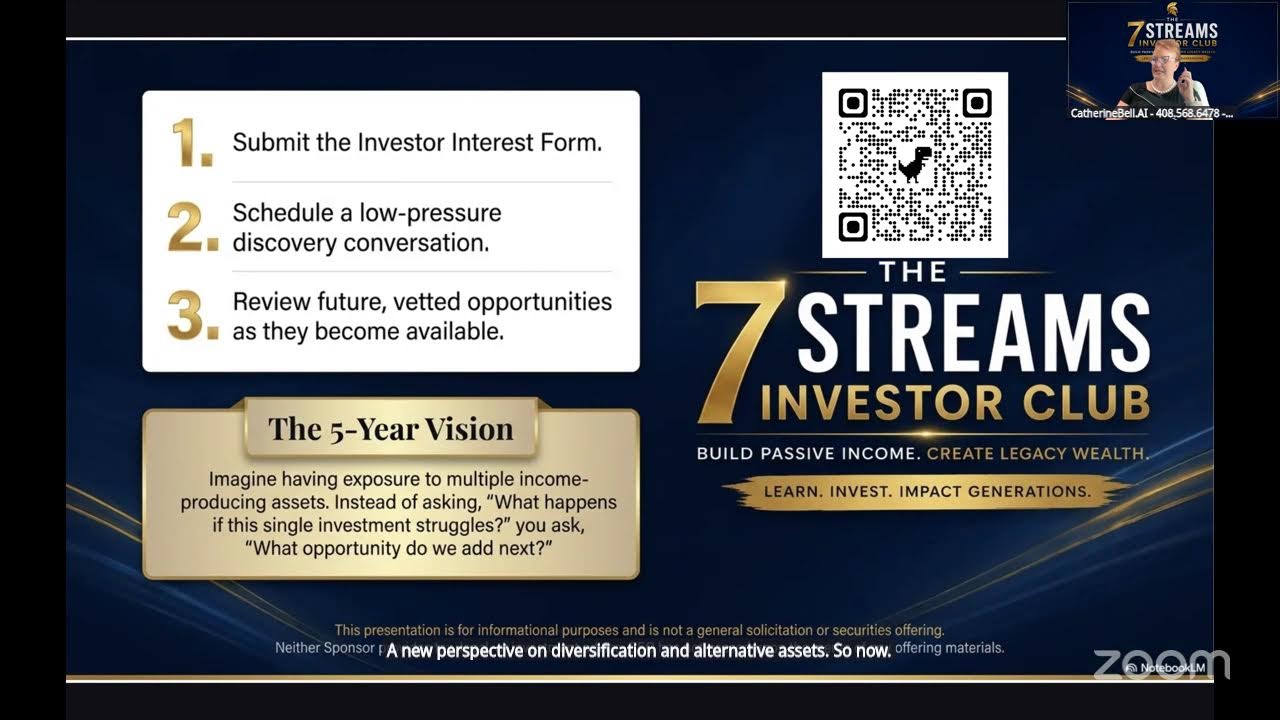
So I love this because again, what we talk about is the most important is with Seven Streams Investor Club is that it's a very low entry point in order to get in. We love cash flow. Um, we love equity too. So it's balancing that out. We're fulfilling on a need that is really, really important. I hope that you guys are all getting this, that all the changes that have happened politically and economically, um, that there is a need that needs to be fulfilled here and it's scalable, right? Because again, um, the low cost of entry inside of it. So, um, we're very excited about this, about educating on this particular asset class. And again, understanding what we're teaching in 7 Streams of Passive Income is the importance of having your portfolio be diversified. So this is another asset class that you can participate in, either in the 7 Streams Club or for yourself, you know, again, do your due diligence. And there's a way to make sure that if you're investing passively, you've got a really good operator, again, with some really great cash flow, which is super important. So the best PLAD split deals are not bought because they are cheap. They are bought because housing is needed. So again, like I said, the basis is low and the operators can turn a small home into reliable workforce cash flow. Again, these are hardworking people and I can give a very clear example. My adopted dad, living up in Northern Canada, worked— he drive— he drove one of those ginormous dump trucks that in the, um, the bed of the truck you could literally fit 6 Greyhound buses. Like, that's how ginormous this thing was. And it was in a mine that was up there, and there was no— the closest city to that mine was several hours away. And especially in the winter and stuff, these guys aren't going to drive back and forth, and they're working, you know, 12 to 15-hour days. So they did a pad split, and, uh, there were several, uh, other men that rotated through this place that they had. So because they worked— I, I don't know, I can't remember what this— it was like 4 on, 3 off or something like that. I don't remember what it was, but however they worked, and when, um, what, you know, when several guys would go back to their families, then other guys would come in, and it was just this rotation. And so, you know, they— again, it was just for sleeping, right? It wasn't like this luxury place, and they didn't care. They just wanted a good place to have a shower, eat, go to sleep. Like, that was the thing. So, you know, we've had it inside of our own family. Um, so this is again really important, right? Um, and usually the wives are involved too, making sure that the, you know, sheets get changed and that there's lots of food there and all of that. So Again, really cool fulfillment of a need that, that's definitely there. So the Seven Stream Investor Club, what is this? So everything we've shown you today leads you to this. So people often ask us, you know, are we just a real estate investing company? Like, what is this? We are all different types of investments because again, it's all about passive streams of income and having your portfolio be diversified. So we're creating a community, a community of investors who want to think differently about building wealth, people who, who enjoy learning, people who appreciate due diligence, people who understand that wealth is built over decades, not weekends. So our ideal member is somebody who is thinking long-term, somebody who values diversification, somebody who's comfortable exploring alternative asset classes, somebody who may have capital available to allocate over time depending on future opportunities with their own financial goals, but mostly somebody who's curious. So who this is not for— this is not for somebody who is looking for guaranteed returns because those don't exist. It's not for somebody looking to get rich next month. And it's probably not a right fit for somebody who needs immediate access to every dollar they've invested. We want members who understand that thoughtful investing requires patience and discipline and education. So one thing we've learned is that the quality of the community matters just as much as the quality of the investment. That's why we're intentionally building this club one relationship at a time. So I've had the opportunity to meet incredible investors over the years. And one of many of— so one thing that many of them have in common isn't necessarily that they're the smartest person in the room. It's that they're lifelong learners. So we ask thoughtful questions. They stay curious. They surround themselves with people who challenge them to think differently. That's exactly the kind of community we want Seven Streams to become. So if today's presentation sparked your curiosity, here's what's next. So let me first say thank you for watching this entire presentation with us and spending this time with us. And we know that your time is valuable, and we hope that we've walked you through at least what a new perspective on diversification and alternative assets. So now, if today's presentation resonated with you, we'd love to continue the conversation, not because we're asking you to invest today. We're not. Today's goal was simply to introduce you to how we think. So here's what's going to happen next. Step 1, complete the investor interest form. That simply tells us that you'd like to stay connected and learn more. Step 2, we schedule a relaxed, no-pressure discovery conversation. So we'll answer your questions, we'll learn more about your goals, we'll explain how the Investor Club works, and we'll determine together whether it's a good fit. And then step 3, as future opportunities become available, will have the opportunity to learn about them, review the information, and decide whether any, any of this aligns with your objectives. So this is absolutely no obligation, no pressure, no expectations, just education and conversation. So the 5-year vision is that I'd like to leave you with one final thought. Imagine it's 5 years from today. Imagine looking back on the decisions that you've made. Would you rather have spent those 5 years relying on one investment strategy, or would you rather have spent those 5 years learning, diversifying, and gradually building multiple streams of income? That's the question Seven Streams has created to help people explore, because we believe that wealth isn't built by chasing the next big thing. It's built by consistently making thoughtful decisions over time. So whether you ultimately invest with us, invest somewhere else, or simply leave today thinking differently about diversification, we hope that this conversation has been valuable. If it has, we invite you to take the next step, complete the investor interest form by scanning that QR code. And then let's schedule a conversation. Let's get to know each other and let's explore whether the Seven Streams Investor Club is the right fit for your goals. So thank you again for being here. Thank you, Tommy and Amor, for this whole conversation. This has been amazing and very educational. Again, another very cool asset class that I think gets overlooked by a lot of people because it's not sexy. But I find those are the best investments. So with that, thank you everyone. So appreciate you. And, uh, we will see you next time.
Bye everyone.










