AI Live - Land Shark Mastermind
Tommy leads a real-estate mastermind reviewing active projects: a septic replacement, a post-fire mobile-home community rebuild into luxury tiny homes, a 42-acre truck lot in Oklahoma, and a concrete-tank resale business. They demo the Deal Hunter GPT for automating deal sourcing and underwriting, and discuss financing through alternative lenders like Otro Financial using the five-C framework.
Chapters
to get here. So, uh, let me figure out how to get the background off on my screen, and then I will, uh—
hold on, I think I can take it off for you.
Hold on.
Go ahead, let me see if I can take it off. No, it won't let me.
Let me play around with it for a minute. Um, there's a couple deals in my, in my, uh Uh, in my chat.
Okay, let me jump in. Um, so Blake— okay, Katya, um, Cicely, do you guys have any deals you want to run? If you do, we want to get them teed up so that we can go through those.
I have some updates and questions and next steps for the Palisades property. Because I got a lot of responses over the weekend, which confirms Catherine's point that you control the outcome more than other people. You can't just sit and rely on a response. You have to go and find it elsewhere. So that was good advice and I followed it.
Yeah, that's been a whole— like, Katya has jumped into a major project Um, Tommy, did they send you a code?
Did what send me a code?
ChatGPT.
Oh no, let me see. Um. No, I didn't get a code.
It's coming to your 3AZ Buckeye email.
Yeah, temporary code, uh, 356634. Okay. 35, 66, 34. Yep, I'm in.
Yep.
So, um, Katya, for, um, again, jumping in both feet, she's jumped into a massive project in California and just seems to be her thing. And that came through doing her investor profile. And so we know what type of project she likes. And because that, she's literally jumping into the project she loves straight out of the gate. So it's, you know, again, very, very cool. If you're interested in getting your investor profile done, let us know. We'll give you the link. And it's an absolute game changer. It gives you a 90-day blueprint and then a 12-month blueprint of literally what type of investor you are, what your essentially your buy box is, what type of investments you like to do that are going to make your heart sing and where you're going to thrive. And then putting together a whole plan for that. Um, Tommy, we were able to see— we can see your, uh, your camera, so I'm gonna spotlight you for everybody. So now everybody is seeing— yep, you're giving us the tour. Here we go.
So the properties, um, this, this side of the street over here is what I call Old Mexico, and I'm not, I'm not saying that to be facetious. I'm being serious in that that road right there It's called Baseline Road. Baseline Road stands for where New Mexico started in, in 1961 and Old Mexico ended. This was literally the border of Old Mexico in 1861. Across the street over there, uh, would have been what was called New Mexico. Old Mexico—
your camera went off.
Oh, it's probably because it's hot.
There we go. Okay. All right, that's crazy.
How's that?
Yep, that's pretty awesome. All right, so the other part to that is, is that all the utilities are on that side for that subdivision over there. So the, the manholes to get the sewer over there, I'd have to shut down this traffic right here to run the sewer over there for that building, that building, the building next door, all of them over here on the south side in Old Mexico. So all the houses in Old Mexico, all the way to that mountain right there, that's called the South Mountain. There's a North Mountain and South Mountain there. There's an Estrella, there's a Camelback, there's all kinds of cool mountains out here. But this particular area here, from here to that mountain, is just all septic tanks. Every house, every building, every place that has a bathroom has to have a septic tank. Now the issue was when these guys bought this house, They had a— they had an inspection, and the inspector said, hey, wait a minute, the well for your water is over there by those tires, basically in that little shed right there. That little shed is where the well is. See that well? Or see the shed? Yeah, next to the white truck.
Yep.
There's the— there's a— there's the current septic tank. It's 82 feet from there to there. That is, that is, that is 18 feet too short because you got shit water going literally that far away from your house. So that's just a bad thing right there. I got a dog hanging out in my pit. He's a little bit hot. It's 114-something degrees right now. Anyway, I have to delete this box right here, delete it, demo it, get rid of it, and run run a new box 100 feet away from that, that well right there. And 100 feet is all the way this way, back in the front of the house, right about here. From here to back there is now 100 feet, and we have a new septic tank. So tying all that in all the way back, we've got to have a drop back there where those pipes were. Anybody ever heard the saying shit rolls downhill?
Yes.
So you would imagine that the steeper the pitch, like how fast it goes, the better. But if it goes too fast, what ends up happening is you leave the cacas up there by the house and all the water down inside the box. And that pipe will fill up with the caucus. So you have to do what's called a less than 2% grade. And how I figure that out is I— it's just a really simple math problem my illiterate father taught me, was that you just got to drop— you got to drop 1 inch for every 4 feet. So if I measure 4 feet from here that way, this needs to go down 1 inch to that point. And then if I've got from here to there, I just go 4, 8, 12, and I go 1, 2, 3. So every 4, 8, 12, 16, 20— when I get to 20 foot, I should be down 5 inches. So when I do the math from here to that box out there, I have to be down actually 7 inches because it's a, it's a total of almost 30 foot to the front. Now The tricky part is when I get out here, I have nowhere for the, uh, for the wastewater to go to. If nobody understands how a septic tank works, there's, there's a, uh, uh, this is a 1,000-gallon box. Actually, it's a 1,500-gallon box. It just— we, we only make it to go to 1,000. And anyway, there's a divider right here in the middle. If I took this lid off there, this chamber is going to be the solids, the— and, and, and those solids either float or they sink. And then there's like 6 foot of water in between. There's nothing in there right now. I don't know if you guys got to see anything in there, if you got to see the wall or not.
It just shows black.
Got it. Well, this side's 48 inches tall and this side over here lets out at 46. So this side has a— this side has a hole right there at the— at the— at the— on the side. The end comes in at 48, goes out at 46, and with that divider in the middle, there's a hole in the middle of that divider that the water comes out and comes over here. It keeps the solids over there, keeps the liquids over here. And what we want those solids to do, we want those solids to turn into, uh, wastewater. Basically, uh, we put yeast inside that toilet, we flush the yeast down in there. Our natural bacteria from our coccas, um, and the yeast mix together and it turns into basically like a, a shit beer. If you will. And as it breaks down the solids, the solids turn to liquid, the liquid transfers this way, and it's gonna come out of a pipe over here and travel into a pit. This is a giant pit right here underneath this plywood. I'll back this out.
So tell them how deep that pit is.
This pit's 30-foot deep. I've got— this is a 10-foot pipe. And I've got 3 of them glued together and they junction right here up at the top. That's where it's going to come from the pit over into this, what's called a sanitary tee. It's going to travel over and go in that hole and then drop down all the way down into that pit. The water, you can see the, the pit pipe going down has holes in it. In about 30 minutes or so, they're going to drop a about 2 big truckloads, 40 tons of gravel. It's called river rock. You've probably seen it as decoration around your plants and stuff, but it's rock between 1.5 inches to 3 inches big. They're pretty big. We're gonna fill this pit up with it all the way up to that, all the way up to that sanitary tee, or 30-foot. We'll fill that up because as that water spills over, and into it. It's going to fill this shaft up, this, this pit. It's 6-foot wide by 30-foot deep, and so that will hold a large amount of water. And then the dirt around it, kind of like when you water a plant, um, the water is going to go in, it's going to seep into the surrounding soil around it. This soil that we have here is very, uh, what they call permeable. It does, it does hold moisture. This stuff has been out of the ground now for over a week and there's, there's no moisture in it whatsoever. So if I add moisture to it, it'll suck up the water. If this was clay, like hard clay, it has no moisture capacity and it's not permeable. And so therefore I'd have to come up with a different way of getting rid of that wastewater. That goes down in there. But once that goes down in there, that water passes through all this soil, and this soil has chunks of what's called calcium in it. And that calcium cleans the urine. Basically, it's just urine water at that point because the poop's already been dissolved. But it gets cleaned out by the rock and by this dirt. And by the time it gets back down to the water, table that's back there by that well, it's totally drinkable again. Wow. So it's a, it's a natural filtration system. Um, there's a science to it. The, uh, the engineers that do this are few and far between now. Not many people know how the science of the septic tank work. Um, that's why they sabotage them and destroy them. Um, sometimes they like do, you know, crazy stuff like pour bleach in their septic tank once a week when they clean their bathrooms. Like, that bleach gets down in this tank and it kills all the good bacteria, and then at that point it ain't going to dissolve nothing, and you're going to end up with lots of nastiness inside this tank that you're going to have to get pumped out every couple years. Um, if it— if you're, you know, a heavy eater, it's probably going to be every couple months. So, um, But remember, we all have to eliminate. And what's crazy is that this, uh, this business doing septic tanks is my barometer for the housing market. The craziest thing in the world happens when people buy a piece of property, and when they are told that they don't have a septic tank or electric or water, the first thing they look for is a septic tank. They don't care. They know they can go to the store and buy water. They know they can get a generator to run their battery, but they have no idea where they're going to put their shit. And they go to Facebook and the first thing they do is septic tank and they hit me up and they're like, hey, how much is the septic tank? I'm like, okay, um, what size is the house? And they say, um, I don't know, I just, I just bought a piece of land and it doesn't have sewer. How much is the septic tank? And so I have to gently tell them, well, you have to go get me a— I need a permit and blueprints and, and a house drawn, and I need to know you have electric and I need to know you have water, because if you don't have that stuff you having a place to take a shit doesn't matter. And so then it turns into a, I'm building houses for people, or I'm referring them out to builders to get their houses built. And then I just sign up as a GC on the job. So, but it is, it's a strong indicator of the housing market. Because when they buy the lot, that's the first thing they call for. They don't call electric or water. They don't even call a builder. They're like, where's my poop gonna go? How much does that cost? So again, everybody says, you know, taxes and death. I call bullshit. Pain and poop. It's pain and poop, man. You can't get away from either one of those. Taxes, evade them. Death, no CPR, right? Marry a doctor, a cardiologist or ER doctor preferably. You know, you can skip death a couple times, but if you're hooked up with the right people, you know. But pain, nada. Poop, nada. You can't get out of life without any one of those. Are coming no matter what.
Should that be the quote of the day?
Yeah, that says death and taxes are bullshit, pain and poop are real. So, because you're not going to get away from pain and poop, period, ever.
So yeah, I find this fascinating. And here's what's really interesting is, so we're, um, uh, Tommy is— we're in the middle of, um, a value, like, wanting to acquire this septic tank company, and Um, you want to talk about that? I find that really interesting. Why?
Yeah, let me show them real quick what we're talking about. That concrete tank right there. Yeah, I, I, I sell these concrete tanks on Facebook Marketplace. I don't, I don't, I don't make them. I, I just sell them. And that tank right there, I buy it for about a— I buy it for about $2 a gallon and I sell it for $3. So I'm making 30%, maybe, maybe, uh, sometimes 40% markup. Just by selling the tank. So the reason why I got dragged into this one was because when they bought the tank, they said, you know, how do we, uh, how do we hook it up to the other one so that we can pass our permit? I'm like, wait a minute, what? And I dug into their story a little bit, and basically it's been like this where it's dumping raw sewage right there behind the house. You've seen the leak. Uh, it's installed improperly. The contractor that did it like got reported to the state, got fired from the job, got deported to Mexico, um, like abandoned the whole thing. So didn't do it right. Nothing's right here. So, um, I, I always take on the worst of the worst if I'm gonna do it because I can charge the best of the best. Um, so, um, this job here is $50,000 job. I've got— I got it down for these people down around $32,000. So, um, but this tank, I just basically sold it online, um, and, and I sell probably about 7 to 8 of them a month. They go for about $3,500 to $4,500 apiece, um, and I don't do anything except come out, make sure they dug the hole right, and, you know, guide the delivery driver to put it in the hole right. So that's the least I can do, is make sure that they go in the hole correctly. So I measure it up for them.
Yeah, I was gonna say the other piece that is that, you know, you're the who that knows how to make sure it gets done right the first time so that when they come back to approve the project or whatever, like, all your projects are approved.
Yeah, as a matter of fact, that's incorrect. I actually intentionally fail every one of my jobs because I want the inspector to tell me how she wants it. So there's specific things that I don't, I don't do. Like for example, I won't connect the pipes inside the tank because some of them like it, some of them don't. They want to see it, some of them want it separated, some of them don't. So connecting the pipes inside means that I got to put filters on it so that nothing gets in because you don't want anything solid going down into the pit. So there's a filter that has to go on on the other side. Some inspectors want the filter on both sides. Which doesn't make any sense. But when they leave, we just take off the one side. If I don't put it on there, then they say put it on, I put it on, they see it, okay, I pass. So again, you have to be— you have to understand, these people get paid. They don't get paid to do perfect inspections every time. They get paid to inspect property. So if you don't have anything for them to fail, they're really going to dig into your shit. And try to find every single thing that's wrong with it so that they can mark something wrong. So give them a couple obvious things that are wrong, uh, just do the job right. But at the end of the day, so that you don't have to have them all up in your business and fine-tooth combing you the whole time, leave the obvious, uh, open and say, I left that open for you, or I left that open for you. And they say, okay, well, red tag you for this, but send me pictures and I'll give you the green. And that's all I do. So it's an old trick. So, oh, it looks like I got tractor keys. Um, these sons of bitches, they want me to do the work anyway. Looks like I'm going to be doing some tractor work today. That's going to be my ride right there.
Um, hold on, don't you love driving tractors though?
No, I hate it. It's the most worst thing ever in the world, in the whole wide world, for a guy like me that, you know, grew up playing with Tonka trucks and tractors. I wonder if I get my pick.
You're being facetious, right?
I don't—
no, no, I never facetious anywhere. I'm a septic guy. I stay away from—
gosh, okay, he's excited to go play on toys.
Well, I get to charge him for it because like I said, I told him that if they did the work, I'd do the smart stuff, but this is dumb stuff. I don't like doing dumb stuff.
I want to do that. It looks so fun.
I want to do it too.
Let me do it.
Me and Amor are coming over.
3 new workers.
And it just goes to— it does it well. It goes right to the point of— right to the point of, um, that, that I, I think that a theme park with these things is important. And not just important because it'd be fun, but it's also teaching a skill and a trade. Like, you know, like that they don't cheat. There's no school for that anymore. They literally don't— they don't have a school for it. Hold on a minute.
So, um, there's actually on Facebook— this is actually kind of funny— there is, um, this guy that built, uh, a mini, um, sandbox, and he has these remote control dump trucks and like all this machine equipment. And all these men come and it's kind of like rather than video games, they're all playing these remote control and like getting to use these machines to dig and do all these fun stuff. It's a whole man adult theme park. Which is pretty funny.
They're living their childhood.
Say that again.
They're living their childhood.
Yep, absolutely. So while we're waiting for Tommy to come back, really quick, I would love for Carol and Boyd just to talk a little bit more about what you're—
who—
you're the who that knows how. For a really important part of projects. So I'd love to you to talk a little bit about that. And then what are some things that essentially lenders look for so that when we're analyzing and doing these deals that we can keep that in mind in order to have a higher success rate in getting the funding?
Sure. Carol, would you like to address that or should I?
Please do.
You're on mute, by the way. Yeah, you're off mute. Okay, thank you.
Sorry, I was interrupting here for a minute.
That's all right. Well, thank you, Catherine Bell. So Carol and I operate Otro Financial. Otro is a Spanish word that means alternate, alternative, or other. So if you speak Spanish, you get the joke. We're alternative lenders. We specialize in finding funding for people, especially when the bank has said no. And the bank says no a lot, about 85% of the time. The bank's going to say no. And they've, they've just tightened up again because they're expecting a recession. And so more and more deals are getting done. So Carol and I, we can help with any kind of— I mean, any kind of business funding. If there's a business purpose to it, we can help. We're doing a lot of real estate development work now, lots of motel acquisition, new construction. Anything that you need, we can do. We even have the capability to go internationally. We just had an agreement signed yesterday on a $20 million redevelopment of a fishing camp on the north shore of Lake Ontario up in Canada. So Catherine, you might be happy about that.
Yep.
Love those.
Yeah. So we're excited about that. So our unofficial motto is we can fund almost anything, almost anywhere. So if, if the bank's giving you a hassle or being too slow, you want some alternatives, we would be honored to assist.
I love that. So this is one of the connections you all want to make sure. So Carolyn Boyd, if you want to put your contact information, make sure you drop it. They're going to keep coming to here so that they can see the projects that we're doing and start getting out in front of helping us get some of these deals funded and stuff. So actually, it'd be cool to have Katina yeah, um, the Palisades project, for us to actually set up a call with them to, uh, get a preliminary conversation about that. Maybe, um, it looks like Tommy is back with, um, yeah, so, um, I was, I was catching the tail end of Boyd coming in.
I want to, uh, thank them for stopping by today and, and make sure they know that we want to have them come to the, uh, to the Scottsdale Summit.
Um, right.
I'd like to get you guys up as sponsors for that as soon as possible. So, um, and then, uh, um, I think also, uh, uh, if I'm not mistaken, you guys are also looking at doing the, uh, Rosetta Stone, uh, AI 2.0 program with Catherine. So I think as part of that, we can include your— we can include your sponsorship to the— to the, uh, December event. Oh great. And that way, you know, we can package it all together for you guys, um, because we— we really need those resources there. We're gonna, we're gonna have people coming in all from all over the country pitching us ideas and deals. Um, we're going to be vetting those programs and processes like Katya and Blake and more, Laura. Um, we're gonna kind of— I mean, you guys seen us at, uh, at the event we went to in Orlando. Um, but we got some deals right now that we're going to pull up and, and kind of, uh, pitch out. But, uh, some of them are real estate Uh, some of them are business, uh, some of them are a combination of it. So, um, uh, but, uh, yeah, we appreciate you guys coming in. And I'm just waiting for gravel to come in. I got cut off because the dump truck driver was calling. And, and if anybody needs to know what the lowest IQ you need in the world to get into blue collar is, a dump truck driver. So they average about 47.2% brain cell. And maybe 17 to 20, you know, IQ points. Like, literally no chewing gum and walking at the same time allowed. Um, but I've got one coming that I got to get them to dump it right here. And I'm telling you that now as evidence of— I will guide this individual here, and that pile is going to end up over here somehow. I don't know how, but we're aiming for there, probably going to be here. So I'm just making a note of that now so I got witnesses and all that stuff. Anyway, um, do we have some deals to run, uh, Blake or Katya? Um, I'm praying that this guy's coming to work. You coming to work? He don't look like a worker. His truck is way too pretty. To be a worker.
Anyway, I have any questions about the Palisades?
Let's knock that out. So a quick update for the Palisades. We've got a, a 19-acre spot. It's along, uh, Oceanside Boulevard. Used to be a, uh, how many? 170, 270, 170, 170-unit, um park had 170 mobile homes in it. The mobile homes pumped out at over $1 million. They were easily $2,000 to $2,500 a square foot prior to the fire. And that was me not trying to be a poet, but just putting it out there. But before the Big Palisades Fire, this particular spot, Uh, had all these houses on it that were literally like 1980, 1970 Cavco, uh, uh, Champion models, um, that, that were 2-1, 3-2, uh, 1,200 to 1,600 square foot double wides. Um, some of them added on to like what I would call, um, what I would call Beverly Hillbilly style. Like they had a mobile home and then they put a second floor on it and somehow like ran, ran the staircase through the rafters. I don't know. But, you know, a lot of these houses that they had out there were, were, you know, basically they would be, you know, shacks anywhere else in the country. But because they were literally right next to the Pacific Ocean and had that ocean view, they were going for $1 million to $1.2 million. So it all burnt down. Katya found the listing. Been in contact with the owner. The problem is, is they're, they're only allowed to put back what was there. And, and basically there's no way anywhere in the world you're going to get 170 1980 model, you know, mobile homes put back there. So something new has to go back there. So there's a lot of hoops to jump through to make this happen. And so for it to pencil properly, for it to actually make sense on paper developers know that if they build these skyrise, you know, 32-unit apartments or townhomes and they do 8 of them out there or whatever, they got, you know, they match the same amount of doors, but their units are now like $3 or $4 million apiece instead of $1 to $2 million. And they're a lot nicer, et cetera, et cetera. But the city and the state said absolutely not. Like, We're going to make you jump through massive hoops to do that. The current zoning doesn't even match that. So what matches it is like Luxury Lots, Luxury Estates. Um, but again, due to the fire, uh, rules, if they wanted to go back and split the lots and put in the houses, they got an 8 to 10 year process to make that happen. So it's like pointless to wait that long on that project. So the way we looked at it was by finding the right investors, we could make it into a real estate program that takes 10 years to get through. And the amortization scale of it, where on the other side of it, if we built out luxury tiny homes and Katja has got some great examples of it and we've got— we've gotten, you know, some models that we've done ourselves. These types of houses, we're getting some feedback that this could be permissible or allowable under that executive order by the governor. So if we are able to do that, the Palisades project would then turn into a 172-unit tiny home, you know, tiny house village, if you will, or community with upgraded specific concierge-level amenities that would total out to be about a $250 million value or fund that we would need to put together to make all that happen. Um, and, uh, it would eventually become, uh, in our mind, about a billion-dollar real estate project. So, um, Kathy has been hard at work talking to the city, talking to the planning and development. Um, so now that we're fully updated, what do you got, Kathy?
Awesome introduction. So there I got several responses from several different parties. There's the LA Housing Department and then the mobile home department and then the city planning and then the county planning. Like, there's so many moving parts to it. So the LA Housing Department mentioned that they, they're super— everyone's very supportive of the idea, but they did explain, um, that I need to dive deeper into the Rent Stabilization Ordinance. But also they pointed out that there is a right of first refusal.
So by the original people that live there, correct?
Correct. So what does that mean for us?
What, what I need to— what we would need to discover, and I think, I think it was discussed when we looked at it was where, where do these guys, uh, or what are these guys, um, position? And I think you asked the broker, but, um, I, I'm not quite sure if the broker was, was quite true with you on it. Um, to my knowledge or to my understanding, he, uh, he basically said that there's no, none of this, uh, first right of refusal. And what we learned through our due diligence on the, on the Deal Hunter was that there's not only a first right of refusal thing, but now also, I believe, a pending court case.
Yeah, and the broker said that, um, everything— the land is clear, so there's no lawsuits or obligations on our end.
Yeah, I'm sorry for cutting you off, but that, that key for the tractor worked. So I'm literally gonna have to get off of here as soon as we're done. I'm gonna have to work on a tractor today.
So fun for you.
Anyway, go ahead. Anyway, go ahead.
No, that's it.
So I will need to dive deeper and see the exact, um, components to it, and then they want me to create a concept package for the Rural Development District.
Yeah.
And then they asked us to request a preliminary development meeting with the Development Service Case Management. So is this something that we're interested in doing this week?
And that's, and that's possible. So here's what I would suggest. Where they told us to go do a deep dive, we think we should do, um, Should we try to go do that ourselves and go to the website and dig around and look and look and look?
I'm so sorry, you kind of cut out for me. Can you repeat the question?
I said, should we, should we, uh, take where they suggested we go learn more about the controlled rents? Should we go, should we go to the website and look for that ourselves, or, or what do you think we should do?
I was going to ask a deal hunter to go find it for me.
Exactly. So we're going to take those emails that they sent you. We're going to load it into the— into your conversation. And you're going to say, read this email. And, and, and do as much of it as you can. And then advise me what's left that you can't do because you're not a human being with two legs and two arms. Right. And so you're going to make it do everything you want it to do. And prompt it to do all the things you want it to do. So where they said to go and understand that rent roll, rule. Um, go, go tell Deal Hunter, go research this and tell me why it's a problem for our project. What do I have to worry about? What do I have to address? Okay, you know, and then also I would ask the broker, I would ask, you know, the deal hunter to create an email for the broker that says, listen, we're really concerned about the previous tenants. What is your position, understanding, or knowledge of the position of the previous tenants? What do you know, or what do we need to know from you? What can you disclose? Because we're going, you know, considering an offer, but we need to know the details of the tenant, you know, the previous tenants. Let him choose to either ignore it or respond to it. But at that point, if he's like, I don't know anything, that's when we can inform him and say, do you know this? Okay, you know what I mean? We don't want to lead in with, did you know blah blah blah, because then if he did know, then we didn't— you know, he's not representing, you know, anything properly, you know?
Okay, sounds good.
All right, cool. Um, and, and just for the record, um, um, I want to make sure that our guests understand how, how we got to this point. So do you mind breaking that down a little bit on how you use the Oh Hunter to do it?
Yes, definitely. So, um, are you guys familiar at all with this platform or not even a little bit?
So explain what the platform is.
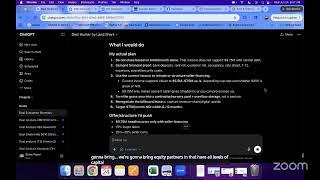
Okay, so we go into ChatGPT and then we click more, and Catherine and Tommy, and then we go to GPTs, and Catherine and Tommy created this awesome GPT that basically helps you with all real estate deals and all different types of investments. I think they've even done a car before. Like, it's very quick and versatile. So you click Deal Hunter by Land Shark, and then you— oops, sorry, the bar's in the way. Then you click Start Chat. And you can discuss really anything. Like, if you have a property that you're interested in, you can put the address. If you found something on a website like on LoopNet or CREXi, you can put the website link in there, and all you have to say is run this deal, and it'll give you so many different outcomes, numbers, statistics, go/no-go options. You can even prompt it to give you deals that they pull from on-market and off-market platforms. And you basically continue the conversation. And so with the Palisades deal, we found it, I put it in there, we evaluated it, and then it has helped me with all communication. So it gave me the broker's name, the contact information. The phone number, the email, and we discussed on what I should say, and it literally drafted an email that I just had to copy and paste, um, asking all the right questions. So it's almost like a top-notch real estate consultant. So anything that you need, you just go to and discuss, and it helps you go through things so much quicker and with a lot more confidence.
And that's the important part, is that, that with this platform, it was written, um, to, to like when we, we prompted to say run this deal, it was because when I'm, when I'm out and I, the way I understood GPT to work, I didn't know that it worked for everybody. I built this thing strictly for me, but then when I discovered that it helped other people, we brought that in and started this mastermind around that. So what it is, is that when I was out doing deals I would get text messages. I would, I would have stuff pop up on my, um, you know, on my Facebook Messenger. I would get, or I would get, you know, uh, be out driving around and I'd see a for sale sign on a property, for sale by owner. So, um, what I would do is I would, I would take a picture of that property with the sign, or it had a realtor's name on it. Like, how many times have we called a realtor and never got through? Zero. Like, I, I'm 100% zero out of, uh, of a million call on a realtor and getting directly on the line with them. There's maybe been one or two times, uh, in my entire life, but never ever consistently getting on the phone with a realtor with the first call. So if I need to know just some basic information, I wanted it to tell me what was in the area, give me a, a small comparative market analysis, tell me some numbers I need to know, tell me what would be a go, a no-go, tell me what a good asking offer would be, like what, what should I, you know, what should I do an offer at based on the market around it. That way when I call, if the guy's like, oh, I want $500,000 and my analysis came back at $250,000, I know the guy's smoking something from down the street on the corner. But if the guy comes back, he's like, I'll take $200,000 and my analysis said it was worth $300,000. Well, I know the guy's got a deal. I'm like, hey, you know, let's talk. And inside of that, anyway, the point is, is that it comes up with 6 or 7 hot topics or points based on an address and the words "run this deal." And by doing that, you're able to get 6 to 7 key points, what I call KPIs, key performance indicators, that this is going to be a good deal or a bad deal. And it gives you a grade. And we take anything from a 7.0 and up. Anything under 7.0, 6.9 and down is useless.
Throw it away.
Like you're going to work too hard to try and get it done. So with the— all the things that it evaluates, it comes up with a score that gives us the understanding if we're going to move forward or not with it. And then when we move forward with it, we move it to a whole nother level where we're now telling it to give us feasibility studies. We'll tell it to work up a DSCR score. Like, we'll tell it like, okay, well, let's reverse engineer the numbers. I want to have a 1.6 DSCR score. How much do I need to charge in rent on that property? Like, doing the math backwards on that as a human being is very hard. But with the ability of ChatGPT to compute so fast, it does the math for you really quick, and then it puts it in a way you can see it and understand it. So, um, but other than that, Blake, uh, is another one of our partners who's got deals going. Blake, uh, I know is working with one of our senior— um, and not like senior citizen, I got— if she's in here, I'm gonna feel bad, but um, uh, our more advanced, uh, members. She's a, a, an educator, part of, partner in our program, uh, um, Tracy Gore. And Tracy is in Oklahoma, um, and, and, and Blake found a property in Oklahoma, uh, that, that, um, Tracy's gonna go and verify and validate on. So Blake, what do you got on the property there in Oklahoma, brother?
Not too much just yet. I know we talked to the broker a little bit, so we're just kind of waiting for, uh, Tracy to actually walk the property because I know we're supposed to do that on Monday, but Tracy has some personal things going on, so we pushed it back until next Monday.
Yeah, we want to extend some prayers to Tracy and her family and her, her significant other as they work through some, uh, trying times through illness, and, and maybe God can put hands, uh, put power in the hands of healing, uh, people around them. So, uh, pray for their, uh, return to recovery. But yeah, I think she's going over there next Monday, uh, to peek at it. But, uh, give us a breakdown. What, what did, uh, what did you find? Why is it of value? And why are, why are we looking for money on it?
Yeah, essentially it was a 42-acre lot that was freeway, and I just found it on LoopNet And be next to a way, and especially Omaha, they have a lot of truckers come through. Pull up the listing of it real quick.
All right, let me go up here. So just to recap, you said it's 42 acres industrial, it's sandwiched between a rail line and a highway, it's got frontage access, frontage road access off of the highway, and it's used as primarily truck parking right now, or iOS, uh, um, industrial outdoor storage.
So you're basically just renting the lot out?
Yes. Yeah, we're renting the lot out. There's a company that does truck parking. It's kind of like an app like Turo or Uber Eats or whatever, and truckers can find a spot to park that isn't at a truck stop. And our lot, this lot, is guarded 24-hour guard shack so these guys can rest comfortably. There's a building there where they can have some, uh, office space, downtime, rec area, stuff like that. Um, and so the, the— what they're going to do is basically blow it up into a truck stop without pumps. And, and this is becoming a very popular way, uh, for truckers to have their 8-hour, 12-hour break.
Yeah, so this is the property right here. It lists, it's this entire 42-acre lot. So it's this entire property in yellow. You have the freeway to the left of it. You have the railway over here. All this is still vacant and not built out. There are 2 billboards on the property, so that creates additional revenue. And then this is the warehouse and the building that Tommy was talking about. So they have space for the trucks can come in, but then also has different stations inside of it. And we were thinking building it out and even maybe building little pods that the people can kind of hang out in, put some AC in there so they can sit around while they're driving. And then when they're resting the trucks here, they can just stay out. So this is the entire property. And then similar to Katya's deal, this is all the information that it gave to me. I had a pretty lengthy conversation, as you can tell. Just chatting with it and just trying to come up with the best ways to go about it. So I'm going to scroll down to the bottom once I have a little bit more of the meat and the bones of it.
And here's what's really great. So Blake is actually located in California. He's a college student. That's how I met him. And this property is over in Oklahoma. And he found this through all of the searching and has been able to do a significant amount of due diligence, literally using Deal Hunter. And then Tracy's there. Yeah, go ahead.
I'm sorry. And Blake and Katya both did their investor survey and, and they're both, you know, they're both working on things that fit their investor profile. Right. So Katya is working from a space that, you know, both of them brand new to real estate are doing stuff that 20 and 30-year veterans have never done before. And it's because there was some unwritten rule that they have to start at the wholesaler level and they can only wholesale and then they'll— it's like it's some sort of graduated curriculum of doing real estate that you somehow have to start out in a zero asset class and you work your way up into doing bigger things, right? So that's not necessarily the case with Deal Hunter. They don't have to start at wholesaling or fix and flipping or, or anything like that to get started. They took the survey, they know what they like, and they went and looked for it and found it. And now they're, they're able to process it. They have the passion for it. It fits their buy box, if you will.
Yep. And so this is where Carolyn Boyd, you know, like, you're the who's the know-how, bring in help, bring in rent money to the table. I bring investor money to the table. So when we build the team of all the pieces of the who's and know-how, we're able to all be a part of some really cool projects.
Exactly. And we teach, we work on and, and teach people how to do creative financing, not just by saying, oh, I have no money, give me all your equity. No, we're not doing that. We're doing stuff that's, that's a bit beyond that. We're doing capital stacking, right? We're going to bring, we're going to bring equity partners in that have all levels of capital. And we teach capital as, as 5 different things. Who here wants to get extra credit and a, uh, and a, and a big pat on the back from, uh, the Land Shark by knowing what the 5 capitals are?
The 5 C's, what are they? Shout it out.
You better have your notebook next to you. What are you doing, girl?
Tell me.
We got credit.
I know it's credit.
Yeah.
And then contacts. Yeah, I'm aggressively flipping.
Collateral.
Yeah, collateral.
Um, car crashes.
No, I'm just kidding.
That was a joke.
Um, that would be, that would be, that would be considered contracts.
Contracts. So that's 4.
And then the 5th one, you got contact credit.
Yes, contacts, credit collateral, um, cash, cash. And then the last one is—
oh, that's it, you got them all.
Yep, that's right. Cash, cash, credit collateral. All right, hey, I got a, I got a call coming in. You guys handle Catherine. If you want to pull up the one that, that Laura and I went and looked at yesterday on mine, we can update them on that.
Okay.
Let me share my screen and then— so share.
Catherine, I'm sorry to interrupt. Carol and I have a hard stop at the top of the hour.
No worries. We're happy you guys are here.
Thank you.
We'd love to have you come back as much as possible because as we see the projects progress, it's going to make a huge difference given what the piece that you guys bring to the table.
Yep.
So thank you for coming. Yeah.
Thank you. We'll see you again soon.
See you soon.
Thank you.
Bye-bye.
Okay, so the project that you guys saw yesterday, um, Laura, is it this one? Look at the address. Is it this one?
Oh, that's weird.
It might be me, I think.
I—
no, it's—
huh.
How about that? Can you see now?
No, but am I the only one that can't see it?
I was going to tell, um, Tommy about the the email I got back today from the city. Um, yeah, they gave me a— his name was Bradley, he works for the city. Basically, um, Tommy wanted me to just message him or email him and, uh, talk to him about seeing if we could build an apartment right there, like excavate and on the, on the mountainside right there. And so basically Bradley, he's— he, he basically made a whole, um, package for us to go ahead and send, um down to the next office, I guess.
Okay.
But I added him to the email, so he should have it.
Okay, perfect. Well, he'll be back in the office, I think, this afternoon after he's done having fun driving around on tractors. I know everything. So with that, I have a meeting I have to get to. Um, so again, I just want to thank all of you for coming. Again, if you haven't done your investor survey, let's get that done and keep looking for deals, um, inside of your buy box. And, um, yeah, let's get to add some more commas to bank accounts, and I'll keep you updated on the Cortez project that we closed yesterday. So it's gonna be fun. I love it. Okay, have an amazing day everyone. I'll see you in the morning. Bye.










