AI Live - Land Shark Mastermind
In this live mastermind session, Tommy leads a multi‑speaker discussion (Catherine Bell, Sicily, Blake, Mike, and others) on how to use a suite of AI tools—ChatGPT, Claude, Gemini, Deal Hunter, Free Estimates—to automate every stage of a real‑estate investment and construction project. They walk through a concrete example of a vacant lot in an HOA, using AI to generate a go/no‑go decision, detailed cost estimates, a 200‑line Schedule‑of‑Values (SOV) budget, construction schedule, and realistic architectural renderings. The team demonstrates how AI can ingest screenshots, PDFs, and daily site photos to keep a virtual executive board updated, produce “bankable” financial packages for lenders, and streamline investor communications via a live portal. They also discuss a broader brand‑building strategy for a family‑focused financial‑resilience company, referencing cult‑branding concepts and a diverse advisory board. The session ends with a brief group prayer, underscoring the team’s integration of faith and business.
Chapters
And so if you don't have one of these real estate investor virtual executive boards, we got to get on a call, and everybody needs to get one of these so that, that way when we get into these bigger projects, this is what you're using to knock that stuff out. Okay, so, um, over here I wanted to show you guys this. This was one where, um, I took a screenshot of a property and fed it to it, and it came back and it gave me a, a go/no-go deal right here. Okay, we can show people how to do this. It, it's, it's very helpful, you know, because then what you're able to do is you're able to see that, you know, this thing works at, at, at, at the drop of a hat. Yeah, this is a simple way of doing it, but when you go in and you, and you feed it, uh, an entire deal 34 documents are like this one here. I just did again the screenshot. That's not the one I want to show you. I'll come back to this one though, because it's got a pretty decent Shark Score on it. Um, so it's a vacant lot in a, in a, uh, in an HOA. And so that— this— so this is the significance to this. This is a vacant lot, um, and it's got an approximate acreage price of about $48, uh, $480,000, $488,000. It's an expensive place to live. The lots, you know, out there, uh, are, are minimum— they have a minimum home size of 6,500 square foot, right? So, um, this did a much more thorough and in-depth discovery for me on, on all the, uh, information, than the other one because of the fact that it had more detail to it. When you get into home construction cost estimate, I went over to Free Estimates and I put the same screenshot to it and said, okay, I want to build an 8,000 to 10,000 square foot house. This is what it provided me now. And so then I— what I did was I took this back over to my deal and said, okay, here's Here's— and right here, this was— this is what I said. It is that this is what— this is what Free Estimates said. And then they came back and said, okay, so based on that Free Estimates saying that it's going to cost you to build it, if your resale price is $9 million to $12 million, these are your profits. So you could have a loss all the way up to about a $3.5 million gain. So again, like, this, this information, if you knew how fast it took or how long it took to get this information, it would blow your mind. So, um, I did a document— here it is right here. So we did a document by document review inside of Free Estimates on that package that I just put into my real estate investor over there. And what it did was it went through and reviewed every single document, giving me the key points. You got 34 documents to look at, Blake. You want to look at those key points. So, um, and again, like, going through this, they want an estimate by Friday. Today's what, Wednesday, right? So if I got to get them an estimate by Friday, I have— I have to sit back and do a lot of work just to find out if I can get a job. And that, that's not going to work for me. Like, I'm not going to spend 40 hours putting something together for somebody for them to be like, okay, we'll call you later. No, that ain't happening. Now, if I put 40 minutes behind it, or 40 seconds like this one did, um, then yeah, I'm ready to go. Because again, the package is not good enough for me to actually even start beginning the work. All I need to do is get her a price, a proposed budget, you you know, and just kind of go from there. So, um, this is what it pulled together for me, is, is it went through every single document, pulled it all together, and, and explains that, you know, uh, like, here's some concerns. Roof live load does not match between architectural plans and truss engineering. So the architectural plans call for this, but the engineering says this is where they're at. So those are, those are massive issues. So, um, and so going through all that, I don't know, will free estimates give me a price on it? No, probably, probably not. It's going to be like, maybe there's too many issues. So that's, you know, uh, that's where I got to go through. Um, oh, that's funny. Look, it even, it picked out the project address misspelling. Most documents have two ends where, uh, on one of them it shows only one. So, like, it's, it's getting nitpicky. So this is important for builders because, again, I wanted to, I wanted to have that information now, right? And, and that way I don't have to spend a long time. So let's go ahead and do a full build budget with this, um, using all the documents I provided you and the zip code of the area. Let's go ahead and do a, a full, um, construction schedule. On this as well. So do the build budget and the construction schedule inside of an Excel spreadsheet. Make sure to include all 200 line items as normal. So, and we've got some examples of, of other projects. This is the budget that I'm looking for to provide. I'll pull this up real quick because, um, this is what we built it out to do. This is, this is how we, we told it we want you to work like this and build like this. So that's what it did. You got to go all the way up to the top. It's inside of my build package. All right, right there. Where is spreadsheets? Catherine, do you have those spreadsheets? Trying to find which conversation they were in, but do you have them open on yours?
Let me see if I can find them.
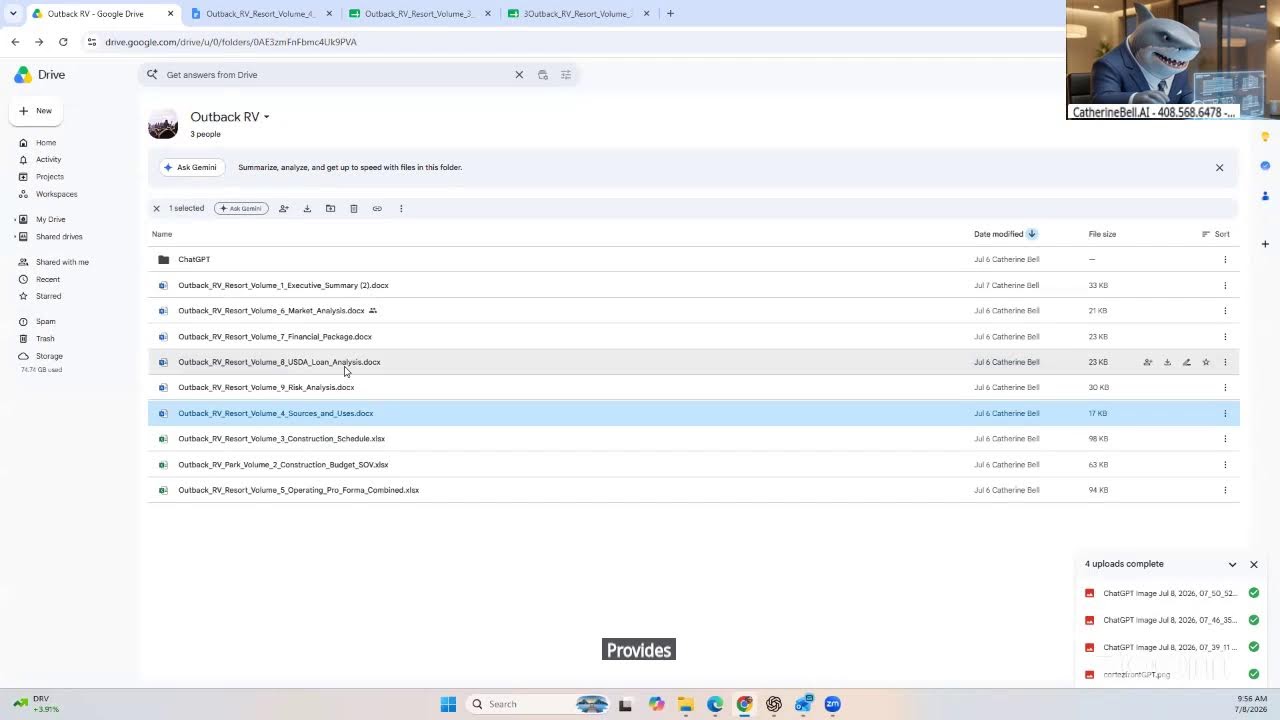
Um, or they're in my folder. I got them in my folder. Oh, okay. So what it, what it should be producing me, or get close to producing me, is this— is something like this here, where I'm able to have every single documented thing that we're doing done, like what it's going to cost for concrete, metal, electrical, communication, earthwork, external, internal, all the way down. So this is on a, a new construction ground build. So, but the SOV is, is, is what all contractors use to understand how to build stuff out So, and this, and GPT is providing us with the opportunity to do that. So, it's still thinking. I had some renderings. This is another thing that I was able to figure out how to do too. This, this was a rendering of, like, that looks computer, right? Um, and so I was like, I don't like the computer look, I want it more realistic.
Yeah, yeah, you took my Cortez and made them look way better for sure, right?
And so again, like, this is, this is what, this is what, and this was done inside of, you know, inside of GPT.
So, um, here, like The difference is the luxury fix and flip that I'm currently raising capital for.
This is a— this is not a luxury fix and flip. This is a luxury new build.
Yeah, new build. Sorry.
So this was architect—
yeah, the architect did images that were meh. And then these are the—
he gave us that and I'm like, we're, we're in Scottsdale. This is, this is the one that he gave us right here. This is Los I'm like, we're in Scottsdale, first of all, so the, the, the landscaping on here ain't working. But it just— it's computer generated. You can tell it's computer generated. So I'm like, no, I want something looks like, looks like Arizona, feels like Arizona. Tada! Brandon. Yeah, right. So, but it started there, went to there. Like, it was too much Arizona on this one. I'm like, can you cut back the landscaping about 60%? Okay, here we go. Much better, right?
Crazy.
So, and again, like, give it realistic. I said I like realistic, but our— we're in neighbors. I need neighbors. We're in a neighborhood. So when I told it we're in a neighborhood, boom, gave us neighborhood, right? It deleted the driveway, but I was like, well, yeah.
So here's the other thing.
Could we?
Yeah, because I was going to say there's houses on all sides of it. There's no—
well, again, these— we're trying to, we're trying to produce as realistic as possible, but at the same time, we also have to notify people that these are not real pictures. So I want it as real as possible, but then I also want to leave some error to it so that people understand what they're looking at. Here we go, 4 minutes 3 seconds. What I told you guys is going to take me at least 4 days to get it done. Let's see what this thing came up with. Boom. I love it. Picasso, right? So builder overhead and profit is at $116,000. That's not bad. You should be able to get done with this house. It's only 1,800 square foot. Um, so total planned coverage, improved build area It— with, with everything out there, it's 3,500 square foot. Um, it should only take us about 6 months to get that entire thing done, start to finish. So here's our budgeting, soft costs, everything all the way down through to finishes, category summaries, total cost, labor, everything. Total direct cost is going to be $700,000 to build it out. Everything all in, right? Material and labor. So, and if we do the math on that, just so people understand, if I pull the math on that, we go, um, is $700— let's do $707,000, and we said it was 3,500 square feet almost. Um, My calculator's stuck in, in crazy mode right now. Hold on, I don't need a whole screen calculator. So we're at $707,000 and divide that by the $3,600 just to get a ballpark. We're at $196 a square foot built. So that's, that's built, that's, that's good good materials, great, you know, great finishes, stuff like that. Like, they're getting a— they're not getting a luxury home, they're getting a custom home, you know. So, and based on the documentation that we have, you know, um, this would be worth $1 million when we're done building it. They'd be able to sell it for about $1 million, $1.1 million. So that makes the build cost 70% of the actual appraised value at the end. So for me, it's beautiful. Like, I'm not, I'm not going to be spending a lot of money or a lot of time on getting this, uh, on getting this, uh, budget put together. So, and based on what I have right here right now, um, I like, I like what I've seen. Um, I'm going to try and get it to open. There we go. And do one more thing here. Catherine, do you have any, uh, can you pull, pull up what you want on, uh, so you can have it ready to go next?
Um, I'm sorry, what I want? What was I ChatGPT I'm having issues with.
Yes, but don't you have a property to go and, and work for? No. Cortez. Yes. Like, we got to talk about Cortez every day, don't we?
Uh, I mean, I went there yesterday and took videos and they haven't done anything. So, but they have, uh, this actually be a good, uh, educational thing is that they sent me a, um, what's it called? Uh, project, uh, like a timeline. Okay, so I can sh— I can show that and we can talk through what the realistic expectations I should have for that. Does that make sense?
And then I just want to bring that up while this is cooking. Sure.
So this is what they sent me.
And that's for to start on Friday the 26th. It was supposed to start on Friday the 26th.
So pad set, what does that mean?
So setting the pad means they have to bring the dirt in and pour it in the— pour it in there and then pack it in.
So is that what they're doing right now? They just dirt?
I was over there the other day. Yeah, they had a bunch of dirt in there. Like I said, I It was— it, it, it's compactable dirt. It didn't look like clean fill. It looked like— looked like dirty fill. And what dirty fill is, is typically like somebody digs out a swimming pool. For a swimming pool, they got to get rid of that dirt because they're not putting it back in the ground. So they got to find a place to put it, and where they put it is under new houses.
Got it. Is that normal?
Yeah, but the problem with it is, is if it's— if it's dirty, meaning it's got a bunch of trash up in it, then it leaves voids. And so either you have to screen your dirt or get clean dirt.
So, and clean dirt comes from where?
Excavation projects, like where they're excavating roads, where they're excavating, um, like all the freeways that they're widening, anything. Yeah. Anything like that. So anywhere they got to take out dirt and put solid fill back in, that's where you're, where you're looking to get dirt. But, um, so yeah, based on this right here, you could actually take this document, put it into Free Estimates, uh, or into, um, uh, into Deal Hunter and tell it to provide you with a detailed scale, uh, a detailed, um, spreadsheet that you can then use to, uh, add notes to it and check off and do all the thing Okay, which is important because again— go ahead.
Yeah, yeah, keep saying that. This is good.
It just— it's important to actually be doing this on, on a project where you go ahead and do it in Deal Hunter.
Deal Hunter.
Okay. And what you're going to add to it here is you're going to add to it the Um, thing you just showed us. Okay, and then So this is the construction schedule for a project, and I want to go ahead and make an Excel spreadsheet that will, um, lay out this schedule so that I can add notes to it, uh, as they go along. Um, I want it to be a little bit more detailed-oriented than what I have present, but— and then also check it to see if there's anything that's missing that they should have in here, such as like landscaping and stuff like that.
By the way, today is Wednesday, July 8th. I'll turn the schedule into a working Excel tracker. Add My GPT talks to me a lot. So I literally, just while we're doing this, uh, this morning, it just woke up with a thousand thoughts in my mind and ended up taking my ginormous husky for a walk, uh, 45 minutes, and literally had the most extraordinary conversation of like working through, um, just all the things with the company and, um, The first part of this that I brought in was obviously my board and my— or no, no, no, no, no, no. I brought in, it was all the marketing, Gary Vaynerchuk, Brendan Burchard, Alex Hormozi. Who's the other guy? Brain is skipping me. Anyway, Donald Miller, all of those. And we had a whole conversation and then it rolled into my advisory board, which was or is Warren Buffett, Richard Branson, Ray Dalio, Tony Robbins, Sir Blakely, Jamie Kern Lima, and then brought in the culting of a brand, which is— there's a book called Culting of a Brand. It's a brilliant book, Blake. You might want to read it like part of your whole business thing. It's about how companies like Apple and Apple, Starbucks, Harley-Davidson, how they created a cult around their brand, so to speak. Disneyland— people actually identify as the brand, not just a product that they bought. And so it's really fascinating creating that following. So anyways, just— I'm fascinated with all of this and psychology behind this. So yeah, 45 minutes later. Had an absolutely extraordinary conversation. So I shared this with you because inside of all these tools that, that we've built, like, these are beautiful ways for you to brainstorm, mind map, get ideas out and expand what you're actually thinking about and building. And we talked about, you know, this project, like, again, Titan Impact Group is not a real estate investing company. What we landed on is that, um, um, crap, what did we land on? My brain. Sorry, I'll come back to this for a sec. Okay, here's the schedule. Okay, I freaking love spreadsheets.
Well, you were talking about how it's important that these, these virtual reality, virtual aspects, people doing it already when they, when they interact with what you're talking about, how important it is to understand that yes, they're feeding in into, um, what we're needing to understand about how to move forward. And in something that we have going on, like, you know, uh, Air Jordans made people feel like they could jump higher. That's why they bought them, right? Right. And like That was, that was the whole thing behind Jordans is that if you bought his shoes, you're going to fly like Michael Jordan, you know.
So we're a family financial resilience company. That's what we are. And again, create multiple streams of passive income, all the different asset classes. So it doesn't pigeonhole us into one asset class. It really is about financial resilience and it's based on my whole journey and experience. So anyways, we're We're gonna create a whole culting brand around that.
Okay.
So list dropdown menus. I freaking love this. So completion window. Okay. So let's download this for a sec.
Download it, but then expand it right there. See the expand button? It's right next to download. There you go.
Okay.
So So, okay, so every day that I go over there, I could in essence build in like, here's the update from what I see from the project. Are they on track, off track? And then from there be able to give, give investors updates and, you know, just the market updates on what's actually happening.
Right. The visuals.
I love this.
So, um, here's some— it's, it's suggesting some, some scope gaps and checklists, like, hey, you know, pay attention to this, etc., right?
Yeah.
So, um, and then, ready for this? You can actually, when, when you do this What I would do is I would start a project folder, put this in your Virtual Real Estate Investor Board. Your Real Estate Investor Board should, should take this and then you feed it. You go over there, you take pictures of the site, you feed it to your Real Estate Executive Board and you say, analyze these pictures and update my spreadsheet.
Okay.
Right.
Yeah.
And it should be doing that every single day. You're staying inside of that ChatGPT project folder. And as a project manager, that's what I would do. That's what I'm teaching people to do inside of Contract@ScaleUp is that they're able to take, take this job folder, right? Like we showed Blake where his project folders were. We take this, we take this schedule, we go put it in that project folder as part of its knowledge base. And then we say, we're going to update this every day using pictures. We're going to go to the job, we're going to take pictures, we're going to come back, put the pictures in, say, now update the, update the folder, update the folder, update the folder. Every single time we add pictures to it, it's going to update the folder. And it'll update this, it'll update this sheet as well.
And that, and, and then my master portal, I can have those updates ongoing there.
Well, not only that, but if this form is live, you know, dynamically live to your investor portal, then it even makes it even better doing that.
Right. You know, no, that's super exciting.
I think I'm gonna do it.
It's probably gonna irritate them, but whatever.
Not my problem.
They need to stay on time and on budget because time is money. Cool. This is awesome. Thank you. I'm gonna create this. So one thing that we did was we're working with Again, all projects are, you know, things move and change. And so we're working with another project and we ran, Tommy ran all the things through ChatGPT and all the things and then gave it to me and I turned around and I ended up building a whole thing and running it through Claude. And Claude, so just so you know, Claude does an absolutely extraordinary job building out financials and spreadsheets. ChatGPT does an adequate job, but Claude takes it to a whole new level. Being echoing. Anyway, so just so you know your tools. And then the other thing that was super cool is Gemini. So we've got everything in project folders in Google Drive. You can take Gemini and inside that project folder and it'll give you all the information inside of that as well. Again, just brilliant tools. So it's not one size fits all, it's understanding, you know, like a toolbox, you have different, um, tools that do different things. Just because you have a hammer doesn't mean you should use it as a screwdriver.
You can use a hammer as a screwdriver. Oh, absolutely. I can show you how. It's harder to use a screwdriver as a hammer. It's way harder to use a screwdriver as a hammer though, let me tell you that.
Right. That's, that's my point. I didn't say you couldn't.
Just not, it's just not a highest and better use for it.
You might get things done a little faster and more efficiently and effectively. Just saying.
Gemini and Claude are different, right? Those are 2 different chats.
Yeah. So let me here, let me share this with you because I think if you saw it, you might understand what I'm talking about. Tommy, do you mind if I share side by side what we did with Claude and chat?
Yeah, that 9 minutes. Yeah, I mean, that would be fine. I have no issue with that.
Okay, so let me Let me share this with you.
I can do— I can do it right now. Hold on.
Okay, do that one and then I'll pull up Gemini.
No, well, I mean, I've already got it all side by side right here. Okay, good. Give me— give me a second. Um, we're gonna put it right here. So inside of here, um, what we have is, uh, are you seeing my screen?
No, no, that— now we are. Yeah, pizza delivery.
All right, you seeing the screen now?
Yep.
Okay, so inside of GP, uh, inside of this one, what I had was Like, this is the construction budget that it created for us, uh, in Gemini. And so it's cleaner, it's got tables, it fit better on the page. It provided just— to me, it provided a cleaner presentation. Versus— I'll show you the exact what we fed it. We said in GPT, we created it in GPT. Here it is up here. We created this in GPT, 1, 2, 3, 4 tabs, and it's very basic, like just— it's just the nuts and bolts, you know. And I gotta, I gotta do this to see all the words up there, and then when I do that, it messes up the cost code down there. So it's like It just, Catherine would have to do a lot of work there. So we took this file as is, fed it to, uh, Gemini. No, Claude. Or Claude, and told Claude, clean it up, make it better. And so we get a cover sheet with it, table of contents, boom, boom, boom, right? And so this is why it's important not to be stuck on, because guess what? Claude cannot do the analysis like Deal Hunter. Right, or like free estimates. And so I did— Claude does not have my, my knowledge base in it. Claude does not have my brain, you know. So, and then that was, that was an example of like, um, here's like the, the schedule. I'll pull that up. And so inside the schedule Again, it's, it's got 1, 2, 3, 4, 5, 6, 7, 8, 9, 10, 11 total, right? And so looking at it, it's got— it's, it's, it's— this is how GPT looks. And then I back out of there and I go get it after Claude. Did stuff to it. Gorgeous. Again with the—
Look at that. Isn't that amazing?
Cover, table of contents, see, and then it just makes everything look better.
And the formulas, it does way better formulas.
Yeah.
Claude, Claude does the formulas.
Correct.
Claude does the formulas.
And creative tables and charts and graphs.
Okay, that helps.
Yeah, it really does. It makes the— and here's the other thing is it analyzes them and it picked out some things that got missed and where the numbers were off and how we had to go back. And it was asking us these things so that we could actually clarifying it. And, uh, we— Tommy programmed it to, um, or prompted it to be, uh, looking at it like, uh, a, a bank. Like, how is a bank going to scrutinize this?
Yeah. And, you know, again, this provided— provides us with the ability to, to, to showcase it in just a way better way. All of these files that Claude put together are, are certainly even like not just the spreadsheets but also like these Word docs, GPT is only able to give me an 8,000, you know, 8,000 characters, whereas this one provides up to 30,000. So like, here's the financial package. I think this was a pretty big document here. How many words would this one go? 8 pages. Pretty robust, way more than 8,000 words. So, and these are what we call bankable documents, right? So the bankable documents are what helps us get these loans, because you're going to need all this done like this, Blake, for that property out there. And we go to the bank and say, this is, this is our package. Yeah, that makes sense, you know. Yeah, Michael looks like he's out on an adventure today.
He went on a field trip.
You're on mute, Michael, you're on mute. Sorry, my wife just, uh, summoned me. I got to run home, so I'm walking out to my car. But very observant. Awesome. No, I was like, you, you— I was like You, you emulated looking like an angel going up to heaven. Your head was all white. I'm like, what? Wait a minute, what's— are we witnessing the levitation of Michael? Is he? I hope so. I hope I'm going in that direction. So, oh, that's awesome. Got 3 minutes left, and, uh, I want to just get a, a— can I get a word from each person about what they thought today about the things we got to show you guys?
Yeah, what are you taking away from today?
I mean, I think it's the great, the power that it provides. I mean, the amount of things that can be done. I mean, we've all been through that, how long it takes to underwrite everything. It's just amazing. Yeah, I like that. I like that. How about you, Blake? Very similar to Mike, but also just making sure you don't lose sight of a project, just kind of keeping track of everything and just make sure you keep it running. And just like you said, constant communication about everything. Got it. Absolutely. And Sicily?
Um, and really just utilizing the, um, the Deal Hunter. And I will tomorrow, I'll share a story. I know we don't have any time, but I'll share a story of how I think I'm saving, um, my developer from this really horrible deal that he's about to sign today. He's not signing it anymore because we went through it. I went through it through Deal Hunter to make sure, and it was—
No kidding.
And it— he, he was gonna sign— he was gonna get $750,000. I'll just— quick summary— $750,000 cash, but he was signing a note, um, to— he was signing a note to the church for the land, but he had no ownership rights to the land. So basically he was trading a $750,000 cash, liquid cash, for a $1 million, $1,050,000 note. I'm like, you're basically getting $300,000 in debt. So I found it, but I used Deal Hunter to find it and we were blown away. So I was like, do not sign that deal. Do not sign. I was like, no go, no go. And he was like, oh my God, look at you.
Yeah.
And I found a lot of other things that I learned through it. But and then Claude and Gemini, I'm working on taxes. I was manually doing it and I'm like, okay, I can— I try to put it through chat. Chat was spitting it back and not calculating anything for me. So I was like thinking like, okay, maybe I should go to one of these and work on getting it done faster because I'm doing it manually right now and it's taking a very long time.
Claude, thank you. Yep. Love it. So awesome. Okay, Tommy, we've got a call right now with Carolyn Boyd and Roman.
Absolutely.
You want to pray?
Yeah. Heavenly Father, we thank you for the blessing of this day and the blessing of this, this time that we've been able to meet together. We ask that you continue to take us out into the world to do your will in this, in the grace of your son's name. This morning's Bible verse was talked about where when Jesus went in and, and, uh, uh, uh, you know, flipped over tables and, and, and declared heresy against everyone that was, you know, working on on Sunday inside of the temple instead of allowing others to come in and pray. And we're grateful for your son's acts that, that he provided in that way. So it shows us the path that, that we need to take and understand the, the righteousness of tough fights. So we ask that you continue to bless us and protect our enemies. In your name we pray. Amen.
Amen.










