AI Live - Land Shark Mastermind
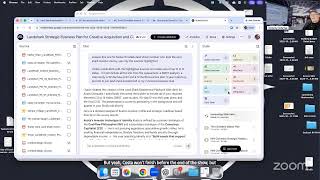
The livestream is a mastermind session hosted by Tommy D, featuring sponsor Catherine Bell, guest Tamari Story Harden (former pro‑athlete turned investor), and regular members Katya, Blake, Amor, Cicely and others. The group discusses the Land Shark Deal Hunter AI model—a ChatGPT‑based tool built on 30 years of experience that instantly generates due‑diligence reports when participants say “run this deal.” They review real‑estate opportunities ranging from Mississippi tax‑deed lots in an Opportunity Zone, to affordable housing, build‑to‑rent, mobile‑home parks, and sports‑tech ventures (FootSnap). The conversation repeatedly emphasizes the “5 C’s of capital” (credit, cash, collateral, contacts, contracts) as the framework for members’ contributions. Participants share personal research on cost‑segregation, bonus depreciation, and note investing, and demonstrate how the AI can produce feasibility studies, investor personality surveys, 90‑day blueprints, and business plans. The session ends with logistical notes about upcoming webinars, meetings, and a closing prayer.
Chapters
by Land Shark. And Deal Hunter by Land Shark is a ChatGPT AI model that was built with 30 years of experience between me and my two partners, Roman and Dr. Nguyen Tran. The glory of it is about a year ago, we started this two years ago, about a year ago, we had the pleasure of having Dr. Catherine Bell become our sponsor. And she's been sponsoring through Titan Impact Group, the Deal Hunter by Land Shark Mastermind, which has turned into a massive outcome of people, uh, from across the country, from California to Washington to Florida, uh, to, uh, to New York, and so, and all places in between. So, uh, members pop in on their, on their leisure, um, and we talk about real estate deals. We give everybody about a 5-minute, 10-minute opportunity to talk about the real estate deals they're trying to put out. And where they're getting these deals is they're either sourcing them from Deal Hunter by Land Shark itself, or they drive by it, seeing it on the side of the road, and they load that into Deal Hunter, and then they tell them the— what's the 3 little words we use, guys?
Run that deal.
Run this deal. Run this deal automatically triggers Deal Hunter by Land Shark to pull up a pretty concise, due diligence report, basically letting us know like what are the opportunities, what are the, the, you know, facts and figures that it discovered, and then also giving us a go/no-go opportunity. And if it's a no-go, we wrote— we just go, we go away from it, we leave it where it's at and move on to the next thing. There's no sense in trying to ride a dead horse. So, um, we, uh, we hurry up, get through these deals, and, and, uh, everybody, as you see popping in here These are all the members of the Land Shark Mastermind tomorrow, and they are hungry to go out and find some deals. We ran some deals yesterday. Katya, were you in here yesterday when we were doing those cap rate deals?
Yes, I was.
Okay, cool, cool. Did you, did you understand? Because you're a dirt dog like me. Did you understand all that hubbub about NOI and cap rate and value and all that? Because when it comes to dirt, we don't worry about that, do we?
No, but I went back and I was doing like a mini deep dive lesson on how the cap rates and the net operating income tie in together in addition, because I'm a beginner. But Deal Hunter walked me through everything.
Beautiful. Awesome. Well, so what I'd like to do is give Tamari about, about 2 or 3 minutes to introduce himself since he's our guest here this morning. He accepted the invitation to jump in the tank with us. So I'd like for you all to meet the glorious man that I met this weekend, who's actually 5 years older than me. He don't look like it, but that dude over there, he older than me, okay? He might not look like it, but he, he got, he got some days on him, more than me. So, Tamari, let's, let's talk about what you got, man. Tell me about, tell them all about how— well, first of all, tell them where you're from and then what you do.
Yeah, no, thank you, thank you, uh, Tommy. Thank you for the opportunity. Um, Yeah, this weekend was— or this week was amazing. And, you know, we got a chance to really connect and thank you for having me on. And this group is— I can already tell the energy is— it looks phenomenal. I mean, it sounds phenomenal what you guys are doing, and I think it's great. My name is Tamari Story Harden. I'm originally from the Bay Area, so El Cerrito, Berkeley. I went to El Cerrito High for high school and grew up single mom in Richmond. And I was lucky enough to have a couple of mentors that came in my life and they, they picked me up and dropped me off and sponsored me for baseball and like Little League and stuff. And, and, and then in high school, I was able to be lucky enough to go to this showcase where I got drafted by the Dodgers in the 8th round in '98. And so that like kind of getting drafted, getting out of Richmond and just getting exposed, you know, professional baseball. I played 6 years with the Dodgers. Was just right out of high school and then they paid for my school. So I went to University of San Francisco. I'm a Don, so I went there. I was a communication major there. So that was great to be able to, you know, go to school and, you know, have the Dodgers pay for it. And so half the year I played for the Dodgers, the other half I'd go and play. I mean, go to school in the fall. And so when I ended up playing 9 years of Pro Bowl and then when I retired, I got in the market In 2007, I got in the mortgage industry where, like, being in the mortgage industry at that time, I didn't know it was on the tail end. And so being able to just come in and at least get a taste, I fell in love with credit and how credit works. And so back then, I even started my own credit repair company that I have to this day. I was just talking to my wife, you know, how much has grown, because what we did is we went straight to— when the mortgage industry crashed, we went straight to mortgage lenders for their turndowns, the people that they can't help. And so just being in that space, um, and then also being able to like understand creative financing and how you can leverage credit for real estate, um, opportunities. I saw, um, you know, even us, um, being led to start buying houses like in the Austin market, the Florida market. That's why we're in, uh, we're in, um, I live in St. Augustine now and we're investing in the Jacksonville market. Because you can still buy houses for under $100 grand.
I know, they're great deals there.
Yes. Yeah, a lot of people don't know you can get houses for $90K, $100K, doesn't even really need any work, you know, on the $100K, you know. So, but yeah, so it, it just kind of got me, you know, with the, um, I just started seeking and, and looking at fun, how to, you know, create funds, and, and that's how, um I met my business partner, Ricardo Bey. We were in Bridger Pennington's Fund Launch group, and he was talking about how, you know, the whole basis of the group was how to, you know, through the SEC regulations and making sure that you stay in compliance. And so Ricardo actually put a post and it was, it was talking about professional baseball players that can have ownership in with professional teams, you know, ex-pros and being in the front office. And these are things that the owners back when I played never talked about. And so I was very interested in. And on the real estate side of things, he was talking about how, you know, they're building out sports and entertainment districts. And I just, I just, I was very— just wanted to know more. And so Ricardo and I connected and he was working with a firm, a private equity firm. And, you know, that basically You know, they were, you know, you know, buying percentages, minority and majority percentage of sports professional teams and things of that nature. And so Ricardo, like, basically, like, we had a mentor that was former NFL and then Ricardo and then just being in meetings. And I just learned for the last 3 years of, you know, we, we basically like when it comes to like sports tech and athletes and real estate, those are our focuses and where we're— we with the NIL, with the athletes, obviously it's Wah-Wah West, you know, and then when it comes to teaching them about financial literacy, credit, how to start their own companies and things like that, we have a mentorship program and we help the NIL guys. And, you know, like a lot— I focus a lot on baseball, but we've expanded to other sports like football, soccer, and golf. Right now we have a technology called FootSnap, which is based out of Switzerland, but we're in Jacksonville. We're like, we're working with the former mayor. He works for— I mean, he's with a lobbying firm that's like basically unlocked like $50 million for grants because we're going to have the first of its kind bespoke shoe manufacturing facility in Jacksonville. And it's already been approved. And, you know, we're excited about that because you take a phone and you scan someone's feet and you create custom bespoke shoes for that person.
Wow, that is amazing.
Yeah. So, so on the tech side, Benson, he's the founder of FootSnap, the company's called, and he, he like basically like was a sponsor at our event called Athlete Legacy Circle was at Fordham University in New York. And he told us about this technology. And, you know, I don't come from a tech background, but just, just the opportunity of him coming out all the way from Switzerland, you know, letting us know about this technology. And we just kept working with them and just helping them open up doors in the United States. And so Yeah, so like, I just wanted to kind of give you a little background as far as like, you know, kind of where I came from. And then like, just right now, it's just, you know, basically like just following, you know, like where you're feeling led to go, you know. And I just, I feel like, you know, where I am right now and the people that have come into my life, it's just amazing. And the mentors that have come into my life to get me and to help me along the way. I feel like we all meet each other for a reason, and I just feel blessed to be in this room and appreciate the opportunity.
Awesome. Thank you so much, Tamari. I want to say a couple of things to what you were talking about. The first thing is you and I both called this past week, the weekend, literally. I feel like that's a— I think Catherine's done it, a couple of people. And there's a reason for that, because we had so much fun that it did feel like the weekend. Like, today feels like Monday even though we started on Monday. It does, it does. It's crazy, it's crazy. We had that much fun that we're going to call this literally Tuesday, Wednesday, Thursday. We called it the weekend. So it was—
I didn't want to miss any part of it, so like everything else, I shut the whole world out. And I felt like I— what I love about the event, we— everybody was present. I feel like we were like literally It wasn't like— there's a lot of events I go to where it's like they're either trying to sell you on something or it's like, it's just like, you know, the ability to have the real people in the room that are like doing real deals and that are, you know, experts in what they do.
I was very impressed. Yeah. And that leads to the fact that, like you had mentioned, that you're working with NIL on helping people understand financial literacy and credit. And that's That's the basis of the Land Shark Mastermind right there. Like, if you look over to the, uh, to the, uh, up above there, we've got these 3 young faces up there. 4, 4, 4 young faces. Sorry, Mo.
Um, you know what, like, I was trying so hard today to not embarrass you in front of our guests, and still now Wow, round up, buddy.
Listen, hey, tomorrow you're gonna learn real quick. And here we got the sash jar. Blake, throw it up. Um, they get sassy and we're gonna catch a sash jar for that one right there. Somebody toss more of a sash jar if we please. But anyway, we, we do, we teach people in here how to be sassy, how to, how to speak your mind, tell people what you think, because in real estate you got to do that, right? But no, back to the credit part. We, we discovered— there you go, people, there we go. Look at the sash jar. Make him a highlight right there. Highlight my man Blake. Put him up. Um, Blake, Catherine Bell put you up. There we go. Oh my goodness. So, but no, to Tamari's point, like, we teach— there's 5, 5 C's to capital and in real estate and investing in business and all those things. There's 5 C's to capital, credit being one of them, cash being one of them. Those are kind of no-brainers. But you also have collateral, and a lot of people don't understand collateral. When you start buying assets, you can actually use those assets to then borrow more money or to get into more debt, right? And you had mentioned you like credit. Credit's great, you know, but collateral helps you grow as well. Um, we also use 2 more that people don't even understand, and we experienced one of them this weekend. That was the contacts. Like, we made so many contacts this weekend, it was ridiculous. As a matter of fact, Catherine and I have a meeting later on at 1:00. We're going to spend an hour and a half going through every single person that we met this weekend like you and curating an email saying, hey, we love being with you guys so much this weekend. We want to keep going, right? We want to keep connecting. And so— and then the last one is contracts, which you had mentioned with the NIL and Major League Baseball players and professional athletes. They need protection away from the, the, the, uh, what I call the rich mentality. Like, these guys get rich quick, and when they get rich quick, it goes away fast, right? And I'm speaking from experience, not, not that I, um, you know, that I'm pointing fingers at anybody. I'm coming on myself, that when I got rich fast, I had over $200 million in my, you know, in my early mid-20s, mid to late 20s. That went away faster than I made it. Like, it took me 20— it took me 24 years to get there and 2 years to get rid of it, right? So, you know, 24 at one end, 26 at the other. And, and again, it sucks that that happens, but it happens quite often in major leagues, not just baseball but soccer. One of the co-founders, Roman Rubio, is into soccer, and he sees that quite often in, you know, in his, uh, uh, clients that he works with. You know, so, um, but appreciate you coming in again, uh, this morning, Tamari. And, uh, so what we're gonna do, we're gonna jump into running some deals. We had—
can I add one more thing?
Absolutely.
So Tamari, here's what's really great about this for all of you. It's that the next— and Tommy and I had been talking about this last week and leading up to this week— is leaning into all of you for the 5 C's. And you know, what are they for you? So I would love to at some point do a deeper dive with Tomara and everybody so that he can help them get to the next level so that when we have a deal lined up, we're ready to go. We're not scrambling.
Yeah. Knowing where everybody— and again, I think that to Catherine's point, we talked about it yesterday a little bit. But yeah, I think maybe next week what we can do is, or even in a personal one-on-one with each one of our members.
Yeah.
Get back to identifying what is the capital you bring. And then again, maybe prioritizing it. Like, we know what each person brings. Blake, Katya, and Cicely, they actually bring sweat equity to the table. And what they're bringing with them on top of that is they're bringing the opportunity to develop contracts. And so to Tamari can understand what they do. Katya, Blake, and Cicely are basically our bird dogs. They go out and they hustle deals and bring them back. And their, their collab— their, their capital to these deals is the contracts they're able to foster and provide. So, uh, and so we end up with a deal flow of, uh, we're on track to get to 100 deals a month, uh, and we filter those through the Deal Hunter by Land Shark. So yeah, uh, but yeah, as far as like our, our group moving forward, yeah, we've got some people that Um, you know, we'll be able to identify who you are in our group based on the capital that you provide. So if you're providing contacts, we— you're going to get a badge that says your capital is contacts. If you provide collateral, you're, you know, because there's people that can do that. Maybe tomorrow you can speak to this or, or not, but like I've had some, uh, joint venture partners who put up their, their, their Rolls-Royce as collateral because it ain't going nowhere. It's in a garage and it's got a title and it's worth $1 million. And when they put that title up as collateral, we were able to achieve a $500,000 loan. It didn't cost nobody nothing. Like, it's just collateral, right?
Or you collateral too. Like, you know, you know, when you— when it comes to bringing debt or equity on some of the larger deals, and you can leverage collateral that could just be sitting there, you know. And so I love reverse engineering, like, opportunities because the more data that you get— and it sounds like that the software that you guys have is amazing software where you can like pull data from all these places and then, then reverse engineer whether you bring the, the credit, the debt, you know what I mean, whatever, whatever it needs, and then kind of just build it up, build the—
absolutely, absolutely. So we, we made it to the part in the show— we're about 5 minutes past actually— and so what I'd like to do is get everybody geared, uh, uh, get your, your deals up. Um, I think you had something cooking already, and if it's not, I want to see the, the, the thing about the Palisades. I know Cicely's maybe got a, a point where she can check in because she's been, uh, sourcing stuff, uh, pretty, uh, pretty strongly. Blake always has something. And then Miss Amor, did we, did we want to wrap up or talk more on, on the, um, on the, uh, the thing we've got out there in Quartzsite, or do we want to send them an email?
Let me just check where we are with that.
All right, jump into that. I'm gonna have Catherine open up Deal Hunter. We're going to go over one of the deals I opened up this morning. And so get everybody else, get your, your screens ready to share. After I get done pulling this, we're going to run those. So go down in the conversation if you don't mind, or, or full screen that thing. It's going to be the document review summary, or I'm sorry, no, the feasibility study, OZ fund. Right there. And we'll go up all the way to the top. This here is a, um, the— and Tamari might remember this— remember seeing the guy by the name of Al who was there? He was a, a dark-haired gentleman, um, and, um, he was from Florida, but he had property in, in, in Florida and Mississippi where he's doing tax deed auctions. You remember that guy?
Oh, you know what, I don't, I don't think I met that guy, um, but I'm familiar with Cash Dealer, you know, or Tax Dealer.
So one of the gentlemen there, he's got this free and clear, so that's why I'm running this deal. And so what I did was we downloaded, uh, his list, and you can open the list up right there and see that, uh, just do the expanded, expanded out. You can see he's got over, over 200 or 300 properties here. There's 300 lots in Mississippi. And so each one of these, let's, let's take a look. He's got square foot pricing as far as like how many square foot the lot is and what the price of it was, right? And so what they're selling it for. And then there's a map. You might be able to click on the map, I don't know, or we might have to, uh, download, copy, paste or something like that. I'm certain. Um, but the, uh, the idea here was, and I'll show you here in a minute, see if you can click on it right there. Go back up. You can click on it right there. You may have to copy, copy paste.
Forcing me to download it to pull it.
If you left click copy paste.
Yeah, it's not letting me do that.
Double click it. When you click it there, see that right there? Hit that enter button right there. Will it let you do that? Or hit the enter button? No.
No, it's not.
All right, let me see.
Not letting me copy nothing. Yeah, to download it.
Okay, there was a few of them that were live this morning. There we go. Go back to the chat now. If you minimize, minimize right there. Yep. So what I did was, if you scroll up, you can see the, the earlier discussion while it's cooking. So I took that list and I dumped it in here, and I said that I wanted to see if it— because it's in an opportunity zone And I need to understand, like, is it feasible? Is this part of the country that needs housing or not? So I said, give me a feasibility study on the Bayside Park, Bay St. Louis, Hancock County, Mississippi area, 300+ affordable housing units and Opportunity Zone fund structure. And so the Shark Tank— the Shark take on it was that it's a conditional go, but not as simple as a 300-home-for-sale build-out yet. So scroll down, let's see what it's talking about. And what it's talking about is in the Opportunity Zone world, we have to have some sort of a build-to-rent or lease-to-own affordable workforce housing thing for it to be, uh, not a fee-simple home sale. Okay, and what that means is like we build them and sell them, then it no longer qualifies Opportunity Zone. So we have to do something different. We can do a 10-year, because in the Opportunity Zone you got to hold your asset for 10 years. So what we could do is do a 10-year asset hold, sale after 10 years, and it'll probably pull that up in here. But I'm just going to show you that this thing thinks like me, right? So Sheet 1 goes through, Sheet 2 goes through, explains everything, lot size profiles, gives me a breakdown. It says parcel, uh, numbered lots, and it only went based on the parcel number lots. The median average size is about 5,700 square foot. So the smallest lot being 3,300 square— uh, 5,600 square foot and 3,300 square foot. It's saying that like the, the concern is that at a 3,300 square foot lot you're not building a very big house. So that's a concern. All 299 parcel numbered lots are buildable. Uh, so we want to make sure that, you know, that this is a clean deal based on these things right here. So it'll help us break that down. The feasibility study says demand signal is favorable, that the base— Bay St. Louis, Hancock County area has a strong affordability spread, meaning that the current market data shows that Hancock County median list price in— is in the $300s. Okay, and so that, like, Fred and Realtor.com report seeing $363,000, $370,000 homes in Hancock County. And so if the median sale price is around $256,000 or the median list price is above $320,000, it's meaning that the opportunity to do something there is pretty good, especially when you've seen the list price on those lots at $6,000 to $12,000. Scroll up, you can see that. Scroll up, scroll up. You know, you're going the wrong direction. It shows right there that the median, uh, the median, um, price lots right there, it says lot profile $6,000 to $12,000. So we use a rule in here that, that, um, raw land, vacant land needs to be at least, at least less than 15% ARV. After repair value or after construction value. So, if we did this at 15% or even 10%, these lots need to be priced at less than 15%. So, we can discover that in a little bit. Scroll on down to where we were before. So, it shows here that with an average household income of about $67,000, the household can support a $1,600 a month payment, which is about 30% housing cost ratio. That's what they base it on. So at that point, um, we could possibly pull in like these workforce buyers with a sale price of $225,000 to $275,000. And we would do that by giving them a sale purchase option of 10 years. They're paying rent on this property for the next 10 years. Okay, so go down. Feasibility shows that there's some red flags. So, uh, scattered lot execution shows lots are spread across many streets, the largest concentration being 11 lots on Ridley Street. 11. So you see, like, at least then at that point, we're able to stay in one spot for a little bit, and we can do these in phases. That's what this tells me. Scattered lot execution is not a red flag to me. It is to an investor. Ready for this? Why is this not a red flag for Tommy D? Who can tell me why this— having spread out lots like that is not a red flag for Tommy D? Come on, Catherine Bell, do you know?
Because we have Deal Hunter.
Not only because we have Deal Hunter, but what am I? What is my expertise? What is my background?
Land. What are we going to do with land?
Not just land, but what else am I? I'm a contractor. I've been a home builder for, for 35, 40 years. I build custom homes. I don't have— I'm not necessarily going to build custom homes here, right? These are Cracker Jack boxes. Go ahead and keep that share screen up real quick. So when it says— when it says— holy crap, where'd it go? Uh, when it says there's 11 houses on Madison Street I'm gonna go buy 11. I'm gonna plan out 11 houses. They're going to all be the same, and they're— so that they have the same lumber account, they have the same material list, they have the same blueprints, all that. Why? Because it's— it makes it butter, right? Turn and burn. So I can put a crew out there on Madison Street and have 11 houses built in 3 months. My cost of construction comes down because I'm a contractor. This doesn't— this is not a red flag for me. But for an investor, why is that a red flag? Can anybody tell me why that's a red flag where they're spread out like that?
They don't have the who that knows how.
If they don't have the who that knows how, they're going to pay for somebody like me to drive around and make sure all those things get done right. And you're going to phase it. You'll end up having to do it and build it in phases. And by the time you get to the one, you know, to the end of the project, or the end of the list, those houses are going to be more in value because you did, you did what's called set the HUD. Okay. And in the HUD, that means that the square footage price of the house on lots 1 through 30 were at, at one number, say it was at $110,000. By the time you get to lots 290 to 300, the square foot price is going to be about $210,000. Right. So if you're at 110 at the beginning, you're going to be at least at 210 by the end. Does that make sense? Let me get a thumbs up. All right. So scrolling on through here, it says that there might be some flood elevation risks that we're concerned with because this is Mississippi. You know, those things can be a big concern as well. So underwriting these things, if we have to do elevated construction or flood venting, pilons, uh, stem walls, blah blah blah, it's going to increase the cost or the value, the price tag on the house. So zoning and buildability, uh, buildability risk, you know, so we would have to run some, find some information about that, uh, tomorrow. So you understand, it's just identifying what needs to be done. And then, and a lot of cases, people like, you know, not in Land Shark Mastermind go, oh, this is a lot of work I got to do. What do we do here in Land Shark, people? We take this list and do what?
We ask it to do it.
Tell it to get to work, baby. We don't do the work. Come on, man. Like, that's the wrong— that's how you let AI rule your life. When AI tells you to do something, you go, guess what, sucker, here's the list that you got to get done. And you give it right back to it and tell it, get this done, do this work. And Katya, how well has that worked for you?
It's worked out extremely well, like when it comes to contacting people, writing emails, bringing contact information, getting the details finished.
Nice, that is awesome.
Yeah, yeah, yeah. So here's the feasibility reports showing right here. So low case, uh, standard, like an $8,000, $7,000 lot, you know, $8,000 or $9,000 lot ends up being the total cost unit $274,000, which then means that the ability for me to sell it may or may not be there. Let's go down. Um, it's showing that our product's going to be maybe like a 900 to 1,100 square foot cottage, or maybe even a 1,200 to 1,400, 3/2. Um, doing manufactured homes are risky because of the flood and, and, and code restrictions. Modular homes may be a possibility. Duplexes, best density upside, right? Uh, requires zoning confirmation, but we could do a build-to-rent like that. The best OZ fit is actually the build-to-rent, so like duplex cottages, quads, stuff like that. But then doing straight flat for-sale homes, uh, it makes it a weaker OZ fit. Uh, and in the opportunity zone, we've got a wizard for the opportunity zone to kind of help us game plan that. But for now, Deal Hunter is just like, be careful, right? So in order for me to get deeper dive on, um, OZ status, I would want to take this deal in the Opportunity Zone Wizard and say, help me figure out how to do this. And it would do that. We'll do that probably another day. But let's finish this out, uh, and then somebody else can go, um, keep going. It's identifying the opportunity. I love that it's identifying the opportunity zones. Since we've added that little bit of information about it, it does have some expertise to it, right? So here we got fund stacking, uh, opportunities, the 3 viable paths for that, doing OG fund with construction debt and workforce rentals. Um, uh, it shows how to possibly set that up. We can deep dive that more later. Public-private affordability ownership program, I kind of talked about that right in the beginning, didn't I? I said, we're going to come up with a way that this is a buyer financing that we hold them for 10 years and then give them away, right? Master development, lot banking, vertical JV builders. So we go out there and we set up 5 construction companies that could build houses that will literally drive economic demand for that area, and they'll come and live there. So phase 0, phase 1, phase 2, phase 3, phase 4. Nope, just 3. Go and no-go shows here that at least 275 lots need to be buildable. 90% of the target parcels need to be in the soon-to-be designated OZ, which this is that overlap I talked about, right? I always— some of you people might know that I talk about the overlap. Opportunity Zone land in 1.0 goes away in 2028. But Opportunity Zone 2.0 land starts up in 2027, so we're going to have a whole year overlap, which to me, that's just like two layers of gold, right? Gold here and gold here. Get the money on it. The go-no— the no-go is, is that if there's a lot of— if there's a lot of paperwork that has to go into this, entitlements, rezonings, and all that stuff, if a lot of it lands outside the Opportunity Zone tracks, not worth it. So, um, confirming all these things, it says that on a land basis it's an A-, affordable housing demand it's a B+. So, uh, OZ fit is a B if it's rentals and C if it's a pure sale. Execution complexity is a little high, that's okay. And overall it's got a conditional go for phased diligence but no full commitment yet. It's not going to give us the green light, we got some work to do. So, and then what I did was I selected this one right here. I said, um, in that, in that form, we selected this lot and it went through and gave us a strong breakdown of it. So go down a little bit right there, put in run this deal. I'll show what happens when we do that.
Run this deal.
No, you're good. It's noise-canceling microphones, brother. Tear it up. I'm, I'm jealous. I want to be over there doing that. They're putting together, right? Let it go. Uh, Club Scottsdale actually purchased, um, some of these pods that— they're privacy pods for office space. So it's, it's going to be really cool now to You can be in an office and be quiet and have a meeting. But anyway, all right, so who's got documents to share? Amor, why don't you pull up your screen or what you got on the RV park?
Wait, I don't have mine up yet. Someone else can go first.
All right, somebody else go. Blake, are you driving? I see Tina's here today. Welcome in, Tina. Glad you're here. She's Yes, I'm on my way to the car right now, so I won't be able to pull it up. Of course you are.
I know. Doctor's appointment. She'll be back in 15 minutes.
Who is? Everybody's offline. What is going on? Sicily. Sicily.
I don't have a deal right now, but I've been obsessed with cost segregation and I've been obsessed with bonus depreciation and cap rates. So I've been digging, listening. I've learned So after the meeting with you—
Do you feel like sharing your screen? Do you feel like sharing your screen to kind of talk about a little bit what you've been learning? Okay.
Can I first say to Tamari, say hey from the Bay. I heard it in your voice. I was like, oh, he's from Richmond.
Okay.
Yeah, I'm from the Bay. I'm here.
Hey from the Bay.
It's really, it's really, eh, it's really eh from the Bay.
You already know.
What was that?
What city are you?
Canadians like, hey, hey, we know.
It's the— it's like we just know, you know.
Um, absolutely.
I heard his Bay Area accent come out for a second. I'm, I'm in Vacaville. I grew up in Fairfield and I work in Vallejo.
So, oh yeah, very familiar.
I've transitioned myself out of that life, you know, that kind of stuff too. And I've made my way to Catherine, so she's my mentor.
Oh wow, that is a pleasure and honor.
Thank you, thank you. All right, so share my screen. So you want to see what I've been looking at, what I've been researching?
Okay, yeah, what did you research? Because I, I've been doing some research on the Cossack thing too, and one of the things I discovered was that, um, it said that like the number one skill for being a cost segregation engineer is to have a construction history background. And so, and then aligning with a very strong CPA. So having a good CPA and a good construction background, you can make good money doing cost segregation studies. So, um, definitely share with us what you discovered because we might, we might start a business here doing this. Okay.
Mine, mine is the mobile home background. So I, I've been researching a lot on Mobile Home University. He teaches like how to buy parks. And, and so I have been researching his podcasts. And just so happened after our meeting the next day, I stumbled across a podcast that was about cost segregation. And he broke it down into different buckets. And I was able to understand you because Tommy, you broke it down for me like you went I mean, I was not cap— I mean, I was not getting— I did get it at the end of the call, but he broke it down in different buckets, but I was able to put, put, put it all together. So, um, let me— I'll just share my screen, but I don't know, I'm just going to show you the videos I've been watching. Um, let's see, let's see, my screen is—
show us what— show us what Deal Hunter taught you about it.
Okay, if you got I didn't, I didn't dig back into it. I use Deal Hunter, but I didn't dig back into that with the cost segregation. I've just been, I've just been watching the videos and— but you guys led me down that, that rabbit hole.
So. Okay. Okay.
I think this is it. Okay. Sorry. It's— I have lots of stuff going on right now.
So we— and this is, this is the other prerequisite to being in our club. You have to have 75,000 windows open every time. You share your screen. It's— we know how busy you are based on all the crap at the top. You know, when they cut the icons in half and just put a letter, uh, that's what we try to strive for around here.
Yeah, I'm trying to hide the back. I got mobile home stuff. Okay, so I found— so Mobile Home University, um, it's about like mobile home investment, but he has like podcasts down here. And so I've just been listening like as I'm driving or cleaning the house or whatever. Um, but this one, there's a podcast right here that, uh, where is it at? I sent it to the group because I was like mind blown. It was everything you guys were saying but like with the illustration. And, um, where is it at? Uh, those recent videos. Right here. Mobile home park owners, the new kings of bonus depreciation. He was basically saying that mobile home— mobile home parks were made for cost segregation. He was like, this is the perfect investment. There's like nothing better for cost segregation. He was explaining it, comparing it to like storage facilities and laundromats and all the other stuff. And it was— this was a really great video. Of the breakdown, and then they kind of show how they put it in the buckets like you were showing us, right? Illustrate it. Um, and I guess with what's happening with, um, I guess the, the big beautiful bill or whatever, it's set up— he was— they were talking about how it's set up for real estate investors, how it's very real estate investor friendly, and it's, it's in our benefit to be investing right now in in real estate. Um, I'm trying to think of what else. So yeah, I've just been— I've been going down that rabbit hole. And my, my, my love, as you guys know, is mobile homes, mobile home parks, and mobile homes. The other thing I've been digging on, and I've also learned this from Catherine, was note investing. So I've been watching Lonnie, Lonnie Deals, and he teaches about how to, how to create the note. And I've done a couple of these myself, so Um, he's— this is like a 15-hour thing, and I just play it.
Is this a program that you pay for, or is this free?
I paid for this. Um, I paid for this. I already kind of know what he does, but I wanted to see if I can catch any kind of little things I didn't—
that I don't—
I'm worried about the fact that we're live streaming. I don't want to get in any kind of copyright issues. Okay, so let's, let's just minimize. Yeah, let's minimize how much we're I, again, I love, I love that, you know, you have that. It's part of what you do and, and all of that. And again, I— we're always making sure people are using just more networks, uh, than what we have because, you know, the, uh, the, um, uh, the, the niche markets need those networks or they don't survive, right? So, um, it's important to, to get into like Uh, Cicely's thing is the mobile home park stuff. It's important to be in those other networks outside of this one because what you're able to do is you're cross-segregating knowledge, information, and, and, uh, and, and contacts. Another part of capital, right? Contacts are a big part of capital. So you can bring, bring information back and forth. So thank you for sharing that with us. And again, like, um, 100%, uh, uh, you know, continue to, to maybe even take that transcript instead of just watching the video. Grab the transcript and bring it in a Deal Hunter and say, hey, break this transcript down, give me some points, ask me some questions, test me on this so that I can increase my knowledge, right? As an, you know, as, as a nurse, um, we used to have books as big, right, for doing for doing our homework, but then turn around and, and like, it didn't matter if I read the whole book, I couldn't pass the test unless I took a bunch of practice tests beforehand. Right? So tests for me are useful. So maybe even bring it over to NotebookLM, put the transcripts in there, tell it to make you a PowerPoint for you to study from, and then tell it to make you a 10, 10 or 15 question quiz. To, you know, to help make sure you understand it.
So I love that. I love that because then I could kind of what I'm researching, I can put it all together. And I love it's really what I'm learning, I think, too, is to ask it more questions because I kind of get stuck with the questions that I would already think. But now I'm seeing, like, if we can kind of change the question or or add to the question, we get different answers and we can expand on it.
So that's great. Ms. Catherine, do you mind? Um, I'm more stepped away, so since she's away, why don't we, um, why don't we go ahead and do a demonstration of, uh, uh, let's do a demonstration of the, the, the Land Shark Investor Survey. Can you mind doing that real quick?
Yeah. Yeah, I think this would be awesome for Tamari.
Tamari, I would like to introduce this to Tamari for sure.
Oh yeah, that'd be great.
Thank you. I think I did Tina's, didn't I? That's okay. We got one from Costa. Let's do Costa's while we're here. So what I did, Tamari, is I have, um, um, ChatGPT create a survey that we then come up with a personality type. I don't know if you've ever heard of like the Briggs Myers personality exam. Yes, I have. Um, or survey. So we created something similar to that for real estate investors, and it's called the Land Shark Investor Survey. Catherine's showing here on the screen that, uh, um, it's called the Land Shark Investor Survey GPT. I don't know why it's not showing the picture. That's weird.
Yeah, it's being— it wants me to 8 right now is the time.
Are you in the— are you in the— the— all right, so maybe just go over to the other thing. I want it to work right during the show. So I know, you know, you're not— we're not updating it like we're supposed to, but at least for the podcast we need it. It looks like you're in—
this is the app. If I go into— I can go into the, um, go where it works.
So we can do it. And then as soon as the show's over, let's get everything updated so we don't hit the walls. There you go. So the Land Shark Investor Survey, um, you begin just by hitting one of the prompts up there and it starts you off on a 125-question survey that at the end provides you with a detailed breakdown of your personality type. And so in my email, we have one that was just finished up by, by a future member. And we can pull that one up and run it real quick as a demo to show how that all worked out. You said Costa sent it to me? I think his name starts with a K. No, is the, the one that was above that. Yeah, maybe not. Okay, maybe he didn't send it. Um, nope, that ain't it. Oh, what is that? View entire message. Right there, see where it says view entire message? Um, scroll all the way down to the bottom of that, right there. All right, so here it is. Go up a little bit. So it's right in here. See this right in here? End of results. End of results. Yeah, so we can go all the way up to the top here. Grab that, copy it. Did you— did it copy? Yeah. All right, so go back to the GPT and go into the projects folders. And in projects folders, we've got, um, we're not in mine. We'll get this done before we run out of time, I promise.
Oh no, you're good.
So what I did was I built into my GPT, I built a program called the Real Estate Investor Virtual Executive Board. And the Virtual Executive Board, the virtual— I have a hard time finding my board. It's under projects. Yep. The real estate— click on one of the things. We did this last time. Then go up to the top and start a new conversation. So my Real Estate, uh, Real Estate Investor Virtual Executive Board, um, is where I, I have— hold on a minute— um, is where I have, uh, uh, basically a source file of information such as the test, the results. And what it does is it processes the results and provides a 90-day blueprint and a 12-month business plan. So we're going to go on right there where it says the Land Shark Investor profile right there. And we'll go down and, and continue the conversation. You gotta drag it all the way down. Keep going. And so we can paste the conversation, and then we're going to Give them space underneath just to talk. We're going, we're going to, uh, need you to put together a presentation, uh, for Costa Caracas. Is that his, the main thing? Okay, there it is. Yep, go back. Just go back. Can you go— all right, do that. Yeah, just stop it, stop it, stop. No, yeah, just delete all that. Let's start over. Just paste his name now. And then give me the dictate. Okay, go ahead and create a presentation on these results from the investor survey, uh, and create the presentation to also include a 90-day blueprint, 12-month business plan. Make sure to incorporate, uh, the SWOT analysis of this investor survey profile. And break it down into the standard, uh, presentation that you make, and it'll take off from there. If you go back to the GPT window— the— not right there, the app— and then go back to the conversation we were having, I can see the results real quick while that's cooking. And so, put Cecily on mute and go up and you'll see here. I wanted to just kind of verify. I told this, oh yeah, I got pretty deep. Go up, up, up. So when I told it to run this deal, it went through and it, it did a very detailed breakdown. So we'll have to share this out later. I thought it would just be a little, a little bit about that one lot. It went through and did all the lots. It gave us a deal thesis, what the key problems are, what the key problems are, uh, highest concentration streets, affordability test. The base development. This is awesome. For sale exit test. Rent to lease. Lease to own. OZ fund structure. Fund stacking. This is cool. We'll send this over to Al. What I would offer. It's great. Go, no go. My recommendations. Great. I'm gonna prompt it so it's cooking. We actually are gonna joint venture with the landowner on this. So go ahead and put this report back together with the landowner contributing all the land to the deal and how we can do it in an opportunity zone as either an HOA, as a buy and rent, or as a lease-to-own opportunity for the 10-year hold to match the Opportunity Zone requirements. Send it, and then let's jump, jump back over to the other conversation. So in here, it breaks it down, gives us the executive summary. Go ahead and go through each one of these real quick. Okay, cool. Just like, we're just, we're, we're not reading each slide. We're just showing how it breaks it down. I, I'd still like to read the, the line. Just copy it and then take it over to NotebookLM. Never mind, put a NotebookLM. It won't finish it today, but we got a couple over there that we can show. It is going to be that one right there, Landshark Strategic Business Plan. And so you'll add it as a source. Insert. Yeah. And so it's put it in there. So do the, uh, deselect, reselect, and just grab the, um, 100, the The 10,000 JPEG. Go down and find where Costas went, right there. Go down more and select the Untitled Designs for our, our, our things right there. There you go. Great. Go back up in this, uh, chat area. Go up in chat. Go up in the chat right there where it has that for Kelly's. Select all that, put it back down there and, and paste it in there. So, and then just change it from Kelly to, to Costa and hit that send button. And then let's just go look at, at, at Kelly's. It's right there. Yep. And so Kelly is Costa's wife. Full screen it. And so basically what it does, it comes up with this, this, uh, playbook for them. And you can just like tap through each one showing that it lays it out as to the type of, uh, assessment they are. And when you mix those two together, what it looks like, what it creates, where it's headed, giving them path, showing them the, you know, the inner to the outer, giving them a, a understanding of what they need to, to be able to grow. The next one, it ties into how it ties into our mission as far as like Titan Impact Group. Keep going. I think that's it. That's it. Yeah. So this one wasn't exactly, um, X, just hit the X. Yeah. The, uh, the Chris Starkus, the one that says master plan. Yeah. That one had more in it. Go down. I think it has more than 8. Go down. Just scroll all the way down. Yeah, it has the 15. Okay. So this is the one that it did right. The other one did not come out properly. So it shows how to combine the two archetypes, what that creates. Go down to the next one. Shows the, um, the personalities of what that looks like, how, how the SWOT analysis breaks down, what the, you know, uh, blind spots are for the person, what are the good things, but what are the bad things to that, you know, like the, the superhero superpower versus the kryptonite type of thing. What are the ideal assets, you know, that, that would help people getting, uh, getting into this? The, um, the Mastermind ecosystem that we have, how that, how that ties into the individual. The hypothetical case study of kind of like how we could build out a plan for them, the, uh, steps to doing it and then repeating it. Here's the 90-day blueprint, the 12-month business plan, 5-year vision, and then how that ties into us as a group. So this is the, the investor survey that, that I think Catherine and I were talking about, uh, to everybody there the most was like how important it is to know what you want to get into because of the expense of the experience. Catherine's done multiple deals for the last 20 years, and it took her better part of 15 to understand she likes to rent dirt and be the bank, you know. So, but yeah, Costas won't finish before the end of the show, but Katya, you're back.
Sorry about that. I had to take a medical call.
I understood. No problem.
I'm allergic. I'm allergic to 20+ things that I use in my daily life. So bad news.
Oh, hopefully everything's okay and we don't need to stick you with a needle in the heart and bring you back to life.
So I think we're good for now, but sorry that I missed it.
10 o'clock and I've got a meeting.
Yeah, we've got to jump off and get busy to the rest of the world, but, um, come back Monday. We're going to be back on Monday. Actually, Sunday we're going to be doing a, a webinar. So Sunday is going to be a webinar about the, um, um, the event coming up in December. So we'll be talking more about that later. But Katya, you and I, I believe, have a meeting later today as well, right, with Blake?
We have a meeting at 1 PM with the LA Housing Department, and then also I think just you and Blake.
You're not in that one? No.
Do you want me to be?
Yeah.
Okay, then I'll take a look.
Okay. Because, yeah, we're going to be talking to the sales team over at Ember Sales about how we're going to, you know, turn this, you know, keep turning these products into, business meetings.
So, okay, sounds good.
You guys will probably be getting the calls to, to line the people up with us. So, because Amber, Amber's just there to get the meetings, you guys might be there to sit through the, the BS markets, right? So, all right, let's wrap it up with a prayer. Heavenly Father, we thank you for the blessing of this day and the blessing of this life. We ask that you continue to bless and guide us, protect our enemies from the damage that they've done to us, and be merciful on them as we would want them to to just be right to us. We ask this through your son's name, in Jesus' name. Amen.
Amen. Amen.
Amen. Everyone have a great day. Be back Monday. Love y'all.










