AI Live - Land Shark Mastermind
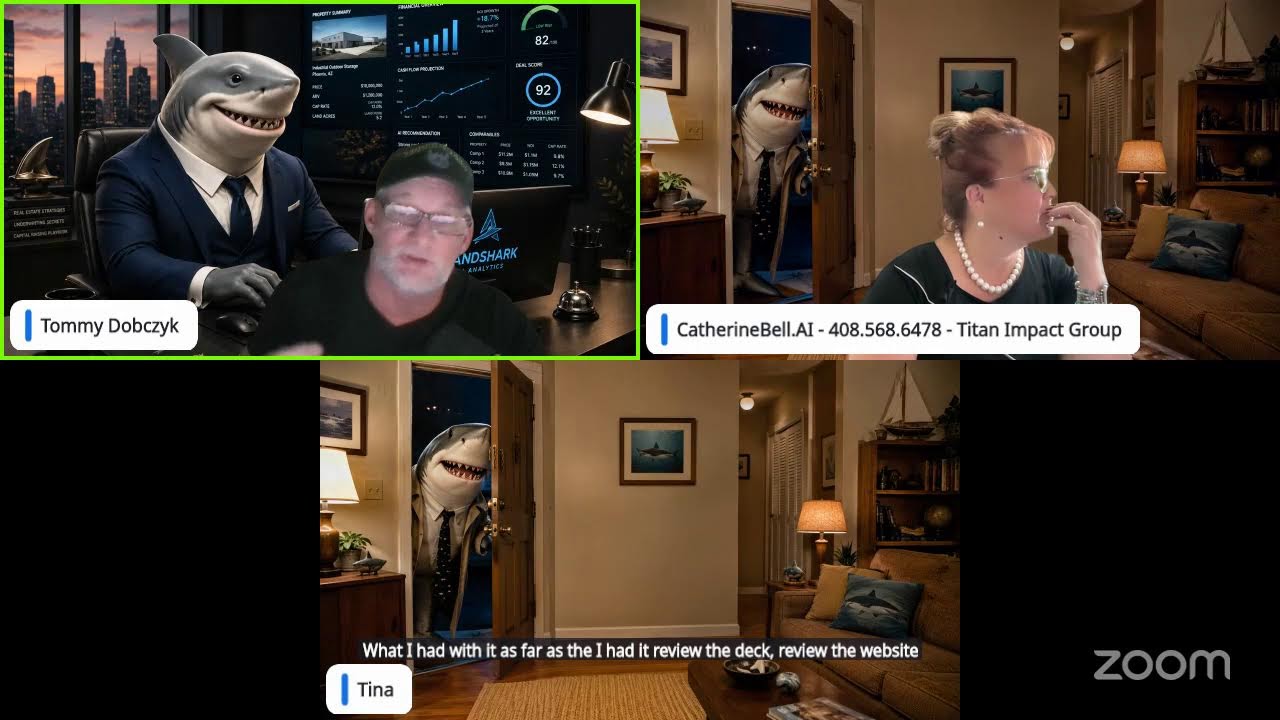
Catherine Bell and Tommy review a 122-unit Memphis property worth $7.5M using Land Shark's AI due-diligence tool. The Deal Hunter flags major red flags: occupancy at 38.5% versus the seller's claimed 61-68%, and $6M in renovations with no receipts. They also warn against illegal capital-raising schemes like fractional ownership and sub-2 methods.
Chapters
Okay, we are now live on all social media.
That's freaking awesome. Um, well, yesterday, uh, was an exciting day. Um, we were— we had the ability of, of, uh, getting through a couple of deals literally on the call yesterday. We, we were talking about getting turned down by a realtor, and by the end of the— by the end of the show, they called and said, hey, let's renegotiate. So like, this is the point to doing deal— like doing these rooms, like showing people you can get— how to do it is one thing, but how to do it mentally, like taking the no with a happy heart, Catherine says, right?
Right.
So take the no with a happy heart.
And we do this inside of Land Shark Mastermind.
This is a group of people that get together Uh, we are an AI-powered real estate community. As a matter of fact, we are in a crisis right now. Discovered this morning— yesterday— that, uh, OpenAI is getting rid of GPTs.
Like, ChatGPT is no longer going to be a ChatGPT, it's going to be a chat plugin.
So OpenAI has been making some massive changes, and we've built our entire platform on the GPT situation. So we have literally spent the last 24 hours trying to understand what we need to do to maintain Deal Hunter by LandShark and making sure everybody gets access to it and it still works appropriately. And so we, we actually have figured out a plan. We've got a plan figured out. And it's not that bad. As a matter of fact, it's actually a good thing. Um, inside of your GPT now, you're going to be able to get the Deal Hunter by Land Shark plugin that you don't have to go to GPT to use it anymore. It'll operate straight from your phone, like just like an app almost. Um, and so, um, you know, it's super exciting about, um, The— what do we got here? Somebody dropped something in that shitty chat. Uh, it's super exciting to, to know that, that we're going to be upgraded from GPTs to a plugin though. Everybody's becoming a plugin though. Um, and, and that's what's super cool is the plugins are, are really coming along. What do we got here? Okay, it looks like, uh, looks like somebody's dropping a pitch deck to us. This is cool. So, uh, Rachel, um, appreciate you throwing a pitch deck at us. Um, if you want us to run this, um, in the, uh—
We'd love to have her actually come on and talk.
Well, hold on a minute. I'm just trying to, trying to see what it is because I believe it's more of a pitch for For their community, which is— I'm not interested in it.
It's actually— I'm working on raising capital for this.
Right. But this is, this is like a community, right? This is like—
No, it's actually— we are actually hoping to close in a couple of weeks.
Okay.
So it looks like it's a multifamily.
Yeah, it's a multifamily. It's like 122 units in Memphis, Tennessee, for $7.5 mil. It's an REO. It's been almost completely renovated. And we're trying to— we still have about $3 million to raise. It's like basically 0.52 52 cents on the dollar.
So we— yeah, yeah, there's, there's a different path for this. So Titan 23, we do fund-to-funds. So we happily raise capital for deals like this with all our investors. And we're totally happy to have conversations about that. Deal Hunter specifically is about helping investors actually find underwriters.
Yeah, we would underwrite this deal with you.
And so if you don't mind, what we can do is we can run it through Deal Hunter to like validate and verify the information.
Yeah.
And make sure that like, you know, from an investor standpoint, like that it's a valid and worthy deal. So do you have like, do you have the, do you have the T-12s or all the— is this all?
Yeah, all the financials. Yeah, all the financials and stuff are in there. In that. Yeah, this is the first multifamily deal that I'm capital raising on. So capital raising is not my superpower.
Do you have—
not normally what I bring to the team.
So is this, is this a 506? No. Or 506?
No, this is a, this is a fractional.
Yeah, it's a lease option. Yeah. Deal with the bank has this.
Hold on, hold on. We need to understand the structure because we have to be really, really, really careful. If this isn't a 506, we can't be talking about this on all the social media platforms like we are right now. We're gonna have to take this offline.
I just—
for regulation.
Yeah, like I said, it's a pitch. It's a pitch to raise capital. It's not a pitch to, to run a deal. So, but what we can do is we can get the, uh, Um, we can get the—
it shows a business plan here.
Okay. This is my— oh, this is my second time, like, on your guys's podcast. So yeah, I'm really excited and I'm still just, you know—
No, no, no. And we appreciate you coming and bringing us the opportunity because again, we use, we use, uh, we use SEC because I know the point of fractional is that you don't have to deal with SEC.
Totally appreciate that.
Um, inside of the— inside of that though, we do register with the SEC.
And this is what Catherine's kind of getting to, is that inside of the SEC that we register with.
If we're, if we're advertising something that's not SEC approved, we get in trouble, not you guys. And so, and that's something that, that's something that a lot of people don't know or don't understand, right? So, and then getting into this on the flip side is that because of the fact that there's— we, we only can solicit. Do you understand what the term solicit means?
Yeah.
Yeah. Okay. We can only solicit funds that are registered with the SEC.
Okay.
So that's why I would suggest that all we— if you, if you're willing to let us do it, we'd love to, to run the numbers on this property and, and compare them to, um, um, whatever it is that you may have.
So it says that the, the current occupancy is about 38.5%.
Yeah, it's a lease-up. The bank has had it. It's a deal where the original investor bought it, put like over $6 million CapEx into it. It's almost completely, totally renovated throughout. There's only about $600K left to renovate. And so he couldn't basically pay the note or make it back in COVID.
Got it. Right.
People were just buying like crazy. So then another— so then the bank took it back. Another investor had it, couldn't fund the deal, had like $9.5 mil or something like that. So then the bank reached back out to Matthew, which he is the GP on this, and said, well, we'll still take your $7.75 mil offer. And he said, well, no, that's no longer any good. So he goes, I'll give you $7.5 mil for this. And the bank was like, okay. So the bank is also offering some seller finance terms or seller finance with this as well. So, and the minimum—
Hold on a second. Let me just make something clear. A bank doesn't do seller financing. What they do is they do a—
they just They finance because a bank that owns the property is just going to make you a mortgage on it. And so you're going to have to do a down payment.
Do you, do you under— do you know what the terms of the deal with the bank is? Because we do the same thing. We acquire property from a bank. All they do is issue us a new loan. It's not a seller finance.
They own the note, not the property.
Yeah, it's all in there. They're doing something because it's a lease-up, because there's not— since the vacancy is so low, Yeah, there's still some things that need to be done to some of the units before those can be leased. But everything is, yeah, in that. And Matthew would be a great person to answer a lot of questions too, since he's a JP or GP.
I mean, he's a— yeah, he's a—
well, yeah, like I said, this capital raising, this is my first big deal of doing capital raising.
When you reference a GP, you're calling him a general partner, correct?
Do what?
When you call him, when you reference GP, you're calling him a general partner?
Yeah, the general partner.
Yeah.
Okay.
He's the, he's the main, the main person, the main guy. He's the one that, yeah, has the center contract. Yeah.
I want to protect you from making a mistake. Call him owner. Call him owner. General partner, again, is a term for SEC regulations.
Okay.
So when you, when you call him a general partner, you're giving the assumption this is SEC-regulated company or SEC-regulated Fund, okay, and by calling him a general partner, and and it's strictly a it's it's only a fractional.
Then at that point, you're creating an issue for yourself.
Okay, what is the? Yeah, just again, we'll help you along. Yeah, and as a matter of fact, I think we met. Didn't we meet you at a at Eddie Marin's event over in Scottsdale?
No, I'm actually in the Friday Night Live. Lights group.
Oh, okay.
So I was there with you guys for like the last 3 weeks.
Good.
Okay, cool. Yeah, I was reaching out to Jason. Yeah, I was reading out— I reached out to Jason to see if he could send me the links from the last one last Friday because I was listening to you guys, but I was driving, so I couldn't, you know, save those links and so forth. But I was listening to you. It's very Um, overwhelming but exciting. Like, AI and technology is like a foreign language to me, like trying to teach me how to speak French or something. So it's very overwhelming but very exciting too.
So here's what I like to help people understand. I am full-blooded redneck.
Um, oh, I am too. I'm country all the way.
Part hillbilly.
I've got a lot of—
I've got a little bit of yellowhammer in me.
Yeah, yeah.
Okay, like I'm every level of low DNA gene pool brilliance that should exist. But for the sake of argument, for some reason, I have more brain cells than all of my ancestors. And I went to college and got a degree. And so inside of doing that, how I figured it out was I have this cool learning pattern called— I'm a kinetic visual auditory remedial learner, a KVAR. Okay, and so if you can go take the VARC test, V-A-R-C.
Yes, I did start on that. Yes, I did. Yeah.
Don't start on it. Take it.
Like yes.
Like it's only fifteen questions. If you say you started on fifty questions, that tells me your attention span's too short.
So that oh, and I'm very busy. I have another business I run, and I also have a farm. So block.
Do you know what time blocking is? Have you ever heard of time blocking?
Yeah.
Block out 15 minutes. That's 1 minute per question.
Yeah.
It really will help you understand the direction to learn in.
So we'll start there.
We'll end that there. Learn your VARK and then it won't feel like a fire hose. It won't feel like French when you understand how to consume the information. Because when I went to college, it was all about how can I consume the information? To make it make sense so that I can do the work. Catherine's the same way. Catherine had a difficult— I'm not going to tell your story, Catherine. Catherine, Catherine, you tell people how, how you made it through school. You figured it out, right?
Yeah. Yeah. I'm a very visual, hands-on person.
There you go.
Yeah. Because I was in dentistry and nursing for over 30 years. So.
Got it.
Got it.
Well, again, with, with Matt, what Matt's doing, it's, it's, it's not just you. There's several other people. That's why I asked if you were in the Friday Night Lights Eddie Marin group, is because there's a lot of people in there pushing this thing. And it's dangerous because of the fact that the way they're talking about it could lead to them in, in some— again, it only becomes a bad thing if it's a bad thing, right? If the deal goes sideways, then the people that were talking about it are the ones that are going to get in trouble.
Okay.
So be careful.
Yeah, this is great information.
Yeah. And how you're pitching this thing. Okay. Yeah, it's very important because again, I don't even know what you're getting from it. I just know that if you do get anything from it, it's illegal.
Okay.
Unfortunately, I mean, unless you're a realtor and you're on the contract as the realtor.
So, well, and here's— yeah, and here's the thing, Rachel, I want you to hear from this. It's that, um, that, uh, it's like playing any of the— any board games. If you've ever played board games, it's like you don't have to like the rules, have opinions about the rules. You just Learn what the rules are. You play and you win. And so when it comes to raising capital, um, there's just rules you need to play by. So you play and win and that's it. Right, right, right.
And I'm— yeah, and I need to learn those.
That's okay. Yeah. And we'll show you good places to get that information.
Um, real quickly, what I'm gonna do is I would like to get the address. Do you have the address of the, uh, Of the place?
Oh, I do. I have to go back and look in my emails.
I'm going through. I'm going through the the the website, trying to find it, and so that's where I'm starting right now. It's called Idlewild Forty Five.
Mm-hmm. Let me see. Let me use my phone to do this because I'm just working from my laptop here. What then?
Explore the property.
I thought I went through this already. Can't download files, so I, I'm trying to see the, the, the It's not letting me actually access any of the financials. Um, market overview. Wait, maybe I can get the address from here. Go back.
It's, uh, 45 South Idlewild— or wait, let's see, I gotta do smaller. 45 South Idlewild Street, Memphis, Tennessee 38104.
And so this is, this is something that I've, I've basically, um, designed.
I don't know if you're familiar with Deal Hunter by Land Shark, but this is a pocket due diligence program that we built after 30 years of doing real estate.
Yeah, you guys were talking about that last Friday.
And so inside of that, we, uh, we programmed it so that it can be— it can provide us with a good, uh, aspect and understanding of everything. So, okay, um, 45 South Idlewild, uh, run this deal is a simple prompt that we provide to it to just, uh, begin the process of pulling 27 different levels of information from different sources, from, from online listing websites to, to the local municipality websites. Anything that's on the internet about this property will be pulled and put in here, and then it deep searches inside of some of those websites to get me more information, such as like the last time it sold, what it sold for, what You know, how did it end up REO? Uh, the story you told us, you know, is great, but I could— if it was publicized inside of public data like a foreclosure typically is, I'll be able to get all the information from that.
Okay.
So, um, inside of, inside of that, what I did was I also pulled like the information off of and from, um, the pitch deck you guys had about the current condition inside of what What's going on there? So, what I would do aside from just reading all this information is for me, and this is how this is how we do due diligence around here.
Okay.
Is that I'm gonna come back to the actual website here, and I'm gonna try to get it to give me the the. the, uh, uh, rundown of this website, uh, of this web page, right? Because I want, I want to make sure, but I'm, I'm only wanting, or I'm only needing the information about the, like, the business plan. This is, this is actually the one I need the most. So I don't know if it's going to give me the opportunity to do it. We'll see. Probably not.
No.
So basically what I'm gonna have to do is just Screens, screen captures, which is okay too.
I think all the financials are like in the data room.
Yeah, well, and again, I showed you that I can't get into the data. Oh yes, it's locked down. So, um, you know, that's, that's okay. I can, I can— the, the goal is to, to minimize the amount of time spent Yes, having to observe deals. And then the other thing is, is to prepare me to come in to a conversation with, with excellent authority, like having, having reviewed the data on a, on a, on a micro level using AI is something that is kind of Uh, is, is kind of underused if you ask me.
Yeah.
Like this morning, this morning I ran 4 reports and then fed it to my AI and then said, tell me that, tell me what these reports say. I no longer even review the reports. I don't care. The only time I care is when there's an abnormality. The only time I care is when there's a, when there's a, a glitch that I, I caught. I'm like, wait a minute, that's not right.
So as long as it's running right, I don't I don't jump into a lot of that.
Well, what's going on here? Everything. It's like changing.
That's—
I don't know if I like that. Anyway, so inside of what I do with AI now is I just feed it a bunch of information slowly.
And let it digest it so that it can come back and tell me based on all the training I've given it.
Like it's going to come back and tell me exactly what I need to know and what I want to know because it's using a brain that I created, you know? Yeah. An example of this, the example I like to give, I told Catherine about it this morning is like inside of one of the companies that we're buying, it's a It's a septic tank company, and they make septic tanks out of concrete. And what makes this company basically better than all the rest of the concrete companies in the state is there is that they have a consistent recipe for making concrete that makes those that makes those tanks. And so they they they can make tanks that. Are— stand the test of time because they use a specific recipe to make those concrete tanks.
Yeah.
And so that's what AI and GPT and all that is for us, is we've put the recipe into it that we say, this is our idea of success, this is what we've done to find success. Now follow all these steps on every single thing we feed you, and that consistency then provides us with the results that are, are replicable and duplicable and, and adjustable according to market as well. So, um, now that I've worked through all of those, I'm not even going to really read this yet because I want to start cooking on the next thing. And so to me, that's going to be dropping these, um, these screenshots in there. So does anybody else have a deal to run?
Catherine, you got a deal to run?
Uh, I have a deal. Ashley, I know you're here. Do you have a deal? And Tina's here. I don't know if Luke has a deal. Do any of you have deals before I jump in?
Luke is, Luke is not at deal-ready status.
He's, he's in his first month of, of internship doing amazing. Um, and, um, Luke is going to be doing some work with us. This week on some other things, but he might have a deal. He might.
I was gonna say, I'm gonna speak life into Luke.
He is, he is literally like, he's, he is literally like the, the Nikola Tesla of, of this, right? Like, he is brilliant but doesn't even know it yet.
That's awesome. I can't wait till I can get a grip and learn all of this because I'm just like, just amazed and I— this will save me like so much time.
Yeah, yeah, yeah. So I loaded all those screenshots. I'm gonna have a conversation with it. This is the— come on, hit the button. This is the—
these are screenshots from— come on.
That's not awake yet, apparently.
It's not wanting to— it's not wanting to participate. Yeah, it's not letting me click on nothing. Darn it. I think— I think I overwhelmed it. Try again.
I like too much information.
These are screenshots of the business plan for the address above.
Review this business plan and get back to me as to letting me know what the. Business plan says regarding this property and compare and contrast to the Deal Hunter report. And so now what it's going to do is it'll, it'll take the opportunity to review those images, review the, the, the pitch deck, if you will, business plan, and come back and let us know. But inside of this, the executive deal snapshot shows it's 122 multifamily. 122-unit multifamily, a 10-story.
It's got 81,000 square foot, built in 1966, renovated—
started renovation started in 2022, and we're in 2026 now. So it's in Midtown Memphis. Average rent per unit is $1,143. The broker reported a 68% occupancy. LoopNet occupancy indicated 61%. You're the—
the— I know, I remember from looking at it, it said 38.5.
That's why I was like, what the hell? So broker stabilized NOI is about, uh, $991,000.
Prior sale in 2025 was for $8.3 mil.
So about a year ago somebody bought it and then didn't like do anything with it.
Now it doesn't necessarily mean that there could be a prior sale.
It could be also that that was the original note and that's what it foreclosed at was $8.33.
Mm-hmm.
So the listing status says it's unpriced, subject to offers. Seller situation is that it's lender owned. foreclosure. Now, when you say—
when we talk about lender-owned, it doesn't always mean a bank. If it's lender-owned and it's somebody that's not a bank, then it could be seller financing. If it is a bank, it is just going to be regular financing.
So, um, it says that the financing angle shows that it's got below-market debt availability. So below-market debt means that they're going to sell it to me at a low, low, low cost. So, and you saying that it was at like 7.5, then let's see where that falls off at. What jumps off the page is that it's a 122-unit, all that covered, all that. It's got a 68% occupancy, uh, which means that there's 83, uh, occupied units, meaning that there's a total of 34, uh, uh, additional occupied units between broker-reported current and stabilization. So the difference between the two, basically.
Mm-hmm.
The rent supports for the current rent Uh, approximations. Like, this is from, uh, realtor.com. This is, this is coming off of a listing on realtor.com about this property. And so the property is being advertised right now for this amount right here on Realtor. Okay. So getting all that information, we understand that the Memphis market backdrop shows that, um, Like, this is a, a, a report from the, uh, real estate advisor group in town saying that this is where the average rents are and the occupants— occupancy expected is 86%, with absorption improving. Absorption is improving as the construction pipeline contracts, meaning like there's construction going on out there and that's driving the need for housing. Okay.
Mm-hmm.
So stabilization valuation shows that the broker projected a $991,000. What we're looking at inside of the indicated values, if we're buying it between, uh, $15 million to $11 million— and your number is not even on here because again it's based on cap rate, it should be about an 11 cap if, if anything, uh, the, the price per units is over here— so calculated broker stabilization NOI. Has not been verified. So inside of this, it's saying that the opening offer of 9.5 is based on 77,000 per unit. When we go up and and as we stabilize, the value of the property is going to go up as well. Like when you fill it up, the the value is going to go up significantly. So again, this is why he's raising capital is because the value of it if he's got value add to it, it makes sense. So inside of this, taxes and public record shows, um, let me get over here and grab this because my scroller's not working, uh, that the current appraisal, uh, total would be around $9.6 million. So total assessments, uh, and county taxes show that you're over $500,000 a year, right? Uh, zoning on the parcels shows that it's an RU-4. Um, and that, uh, it's got an RMH zoning. And so what that, what that covers is basically like the, the density of, of people can— that can live there. So multi-million dollar resident renovation started in 2022 according to CREXi.
Mm-hmm.
Um, what we would want to know is that all of these things were taken care of, CapEx, meaning like All this was replaced prior to buying the building, because doing it after is going to be ridiculous.
So, yeah, the only thing that, um, I believe my understanding was that there's just about a little over $600K that needs to be done, and they've had, um, general contractors and, um, everybody has already, you know, walked through it.
And, and so inside of, inside of, inside of any kind of investment, Proof, not word.
Proof.
Yes.
You need to have elevator certification, HVAC. Like, you need to show a receipt of the full system being replaced within the last 5 years, roof being replaced in the last 5 years. These are the— when you say that there's a multimillion-dollar renovation done, this is what it's after.
So inside of that, if you needed to learn more about the, the, the CapEx on this, there's a link right here to free estimates.
If you click this link right here, it actually takes you over to one of our other, one of our other tools called Free Estimates. And Free Estimates allows us to provide, you know, detailed, you know, detailed budgets for these types of projects. And so you'll be able to know, well, is it really $600,000 or is it $600,000 to get started?
Okay.
Those are the things that, that we try to teach people to be cautious about. Yeah. Right. And so inside of that, uh, free estimates is pretty, you know, pretty powerful. Uh, does, does some amazing things. So back over to the deal, let me bring that back in. Um, come on, my scroller on my mouse is not working, so I have to literally grab stuff and move it around. All right, so inside of Deal Hunter, it, it basically breaks down how, you know, how to average out the value and figure out the value not just based on, on potential but actual right now. So it's going to mention some red flags, um, that, you know, there could be a, a tax burden involved.
Mm-hmm.
Um, so, um, there's, uh, again, it's showing like there's a conflict inside of some of this. This is stuff that's not inside of always, you know, involved in realtors. So that's why it pulls public record.
Mm-hmm.
Here's some funding strategies saying to leverage 70 to 75% to do, to do maybe a bridge with a private multifamily or even a JV conservative senior debt. Here's the stress tests. You know, if the NOI misses by 10%, the CapEx value goes down Significantly. If it's 20%, your value drops by $2 million. So breakpoint analysis is included, some major red flags, occupancy discrepancy, uh, between the two things right there. We haven't given it the, uh, the, the full summary yet, but the SWOT analysis is in here, negotiation leverage, offer structure. And again, it's saying offered at $9.5 million, right? You guys coming in at $7.5 million, that's a good deal. So lender view, documents needed, and final verdict. It's a go with conditions. What are the conditions? And here's the actions. So we fed it the pitch deck or the business plan, and then we told it to review. It said, bottom line, the business plan is materially more aggressive about operating turnaround than the Deal Hunter report. And so materially conservative on the acquisition basis. So the biggest difference is that the business plan currently says there's an occupation of, uh, 38.5, and that only 47, 47 units are occupied. Deal Hunter's preliminary report was told 61 to 68. The business plan acquisition, uh, says $7.5 million, and Deal Hunter preliminary says $10 to $10.5. So these are where there's differences already. What is— what the business plan is saying is that the physical asset has already received substantial interior investment, but the property operation never stabilized. So the opportunity is to buy it at a deeply reset basis, finish the physical work and rebuild demand, improve leasing and collections, and then monetize stabilization NOI rather than rely on speculative appreciation. The property is operationally distressed, not primarily an interior renovation play. So it's missing tenants.
Mm-hmm.
And so inside of that, it's going to, the capital raisers are going to need to explain how to remedy that. You know, we already know like how to do a fix and flip. You go in and change everything and make it brand new. But if you can't rent it back out because nobody's interested and there's newer places around the corner for the same price or less, then there's a significant, you know, concern about what— how are you going to fill it up and make, you know, and pay the investors back?
Right.
So the plan claims physical diligence is already well advanced. That's great. So getting to understand, like I said, it says that there's a review, but it doesn't show that there's an actual replacement. Right, and so the other thing is is that the rebuild the demand engine. How how do you capture more people to come in and rent? You know, are they going to be advertising to this this workforce that's coming in to stay there and live there? What is the what is the trends in the area showing? Is the leasing treated as a measurable funnel? Do you guys have KPIs for that? How long it's going to take to to stabilize. Um, and the physical occupancy is not the finish line. Like, getting it filled up and all that is one thing, but getting them to pay is another. And since in the area the current rate is only 86%, like, that's the average occupancy of any, any, any one place, you have to put an operating budget together for that in the fact that you're going to have only, as you know, an 86% vacancy. So what that means numerically is that, like it reads here, that 91% stabilization is above the average. And so that's a concern. The other units getting leased up will improve the gross rental income. So to get it up to that $930, but again, if you're at 91% at $930, going with what the average is, is what investors look at. They're going to say, no, no, no, no, no, you got to back up your numbers. with what the averages are. And so expecting to hit 91% is not, is not feasible because the local area says 86% is feasible.
Okay.
So the return thesis here says that the acquisition basis is 7.5. Um, basically to get that, to get that return for your investors, the holding period appears to be about 7 years. Um, and Um, here, and, and here's where the, the, uh, agree-disagree comes in from Deal Hunter. So the core strategy to the business plan is operational turnaround and stabilization. That's great. Uh, Deal Hunter says to do the lease-up and stabilization. This is where the fundamental strategies are different. Um, so the operational turnaround though, per the business plan, has to happen for sure. Deal Hunter is not the expert on this. Physical interior says significant work already completed. Uh, Dale Hunter says that it recognized the 2022 renovation. So where's the proof? Bring the proof. Main value creation, occupancy plus NOI recovery. We agree there, right? Um, it says where— oh, these are all agree on. Okay, I see what happened here. I was reading, reading down. I'm like, they're agreeing with each other.
Yeah, now I know Matt has all the, um, right, right. Documents and all that stuff.
Where there's a difference is inside of the business plan. Business plan says there's $38.5 million, which I'm going to believe that more than I believe the $61 million, right? Um, and then the business plan says that, you know, it's being acquired for $7.5 million, and our recommendation was a $10.5 million. So, um, there's value inside of that. That's built-in equity. The physical diligence— Deal Hunter says, you know, physical condition remained on an open risk. The business plan claims that they already have a PCR, that they have full inspection, a mechanical walkthrough, and design review. That's great. But like I said, if I'm going to invest in it, I want it brand new.
Mm-hmm.
It says it was a multimillion-dollar renovation.
Where?
Show me the receipts to $1 million or more in renovation. Yeah.
Like, now you have to show me 2 because it says multimillion.
$6 million.
Right. So if they did $6 million worth of work, show me the receipts.
Mm-hmm.
Put— make those public record.
Yeah.
So, um, the rent assumptions is a, a bit of a difference. Stabilized occupancy, like, they're giving it the 91, but Deal Hunter, you know, the Deal Hunter analysis showed that the, the local area was at 86. Where I think the business plan is strong is in the operating logic.
That's great.
The physical occupancy, uh, and the economic occupancy, that's where we need a little bit more work. How are you going to collect the rent? How are you going to guarantee that you get 91% occupancy and 91% and 100% payment? Right. Because there's, there's usually a percentage of those people that are there that won't pay.
Mm-hmm.
And so how do you set that up to make sure you get paid? It's called asset recovery or collections. So where the business plan still needs more proof, I like what it suggests here inside of the current operations, the physical budgets, like I said, the receipts, the lease-up budgets, like what, what are they going to do inside of marketing and advertising to get people to live there? And then what is the debt actually going to cost? And so getting all that down, again, it's, it's a go with conditions. If we can get it for the $7.5 million and all of that, that's, that's Pretty good, um, because again, it's a, it's a $2.5 to $3 million savings, right?
Yeah.
So he's getting it, getting it on a hell of a deal.
So, yeah, we got it. He got it at the $7.5. Um, we've already started, like, like capital raising. Like I said, there's only $3 million left, right?
Again, the, the biggest concern is right in here where— why are 75 units vacant?
That's the question.
Yeah, why did 75 people move out? Or why did, why did 34 people move out? Because technically the difference was 34. Now we're down to 75. So when it was first advertised, it was 34 people missing.
Now it's 75 people missing. You only have 34 people left.
So my concern is if they all move out, well then what?
Yeah, and that's a, you know, a property management issue too.
You know, yeah, and it comes down to the experience.
Yeah, we just need to make sure that you have a good solid property manager, property management coming in to be able to lease that back up.
So, well, if property management was the only issue there, then that would be great. But my other concern is that maybe there's newer buildings down the road that are prettier, better, and cheaper.
And I don't know that without diving into it, but Um, again, I think the deal itself is strong.
I think that if you only have $2 million more to raise, um, that's, uh, that's pretty cool. Yeah, be careful on how you do it because, uh, again, if you're in an investor club and you're a member of the investor club, um, you can only advertise about the investor club, not the deal.
Okay, that— this is all great knowledge because I said this is the Really the first deal that of someone that I've, you know, helping raise capital. So this is not usually, you know.
So are you, are you a partner in this actual deal?
Yes.
Or are you just an investor?
No, I'm, well, I'm an investor. So, and it depends, that may change, you know, depending on how much capital I do raise or bring in. So that could change.
Oh honey, you're gonna get yourself into deep trouble.
Oh no, help me. This is my first time.
Can I give— can I give a mini class right now? Like, I feel like—
yes, please. I'm learning so much. I appreciate all this knowledge.
No, no, no, no, because again, we're broadcasting live, um, and I, I think in order to really help Rachel better and more efficiently would be to have a conversation offline.
I do have an appointment scheduled with you, Tommy. I think it's on Friday.
Perfect.
So it's on my calendar.
So definitely explore a little bit more of that as well, because again, there's, there's specific rules set up around advertising to raise capital for a reason.
And yeah, and nobody really, nobody really tells you those things.
Well, it depends on if it— how they're going about it, if they're looking for accredited investors or not.
No, it doesn't actually. Yeah, if you, if you understand it, it's okay.
But technically, to raise capital, you have to be registered with the Securities and Exchange Commission of the United States. Raising capital for any other reason outside of that, um, if you're doing it in a way that you're basically creating a paycheck for somebody to get a paycheck— like, all we're doing is— if all, all I got to do is invest into this and I'm going to get my return, this is a security.
Mm-hmm.
I don't know. So there's no, there's no accredited investor, non-accredited, anything like that, unless this is a GoFundMe that says you're not getting your money back, you're just giving it to me. Then there, then, then it has to be registered as an SEC, and that could be as a Reg D. And if you want to go after non-accredited investors, it's called a Reg A or Reg A+. And you can do a Reg A or Reg A+, and this is all highlighted and outlined inside of the The JOBS Act of 2012. And so go look up the JOBS Act of 2012 and it'll explain explicitly how you can go about raising capital and how you can solicit to raise funds to raise that capital. So unless it's— yeah, go ahead.
If you're raising, if you're like advertising publicly and you're not an actual partner inside of the operating agreement and inside of the actual company, and somehow you're going to get compensated based on how much money you raise. That is a securities violation, and you can actually go to prison for that.
Yeah, no, I'm not doing that. I've only, I've only sent this to, uh, my own, um, investors in, um, things that I, that I know and that I work with. So those are the only people that I have sent it to.
Again, I'm not a lawyer. I'm not a, I'm not a, I'm not a tax provider, a, a tax lawyer or a, or Securities Exchange Commission lawyer, but I do pay one a lot of money every month to tell me what what I can and can't do, and I cannot talk about raising capital unless I'm registered with the SEC.
Yeah.
And so fractional is breaking the law. Fraction— if you're doing fractional, you're going to go to jail. If you're doing sub-2, the Pace-Morby method, you're going to go to jail. They're changing the rules. It's not that it was illegal when you started, but by doing it the way they're moving toward it, like literally every mortgage company out there now is using AI to discover if people are are doing sub-to method, and the mortgage companies are spending billions of dollars on getting AI to bust people doing the Morby method.
Wow.
Do you want to keep doing it? Like, go learn a new way.
Oh yeah. No, no. Yeah.
Go learn a new way. I'm tired of people like putting this guy on a pedestal when he needs to be put in prison.
Yeah.
This is great.
This is great information. It's great logic that, you know, knowledge that I didn't—
So again, I have no— and, and this is why I asked Catherine to let this go offline, because you get me talking about Pace Morby And I really, really believe that him and Grant Cardone need to share a cell. That's what I think. And it's because of the fact that they've done people dirty so many times. I got more dirty stories than I got good stories. And the fact is, is that they told them themselves. Like the last stupid, stupid Morby story I heard was that they literally had 15 wholesalers in one transaction. He brags about this.
Oh my God.
He brags about having a 15-person daisy chain on a piece of property.
That's crazy. That is absolutely insane.
No, that's ethically ill. That's ethically wrong. You need to be beat up. You need to be taken out back of a woodshed and beaten with a, with an oak board upside the head.
Yeah.
And I know that we're going to get kicked off of all of our live streaming right now because I'm threatening people, but I pray to God somebody goes and tells Pace Morby this. I'll do it. I'll do a $100,000 boxing match with him and give it to the highest charity. Charity of choice, whoever wins, because he deserves an ass whooping.
Well, I, you know, I'm not, I'm trying, I never try to do anything that's illegal or anything else like that.
Well, I'm letting you know right now, I promise you right now, I'm going to use this tape and we're going to audit it. And I'm going to send you the audit because we have a legal auditor. We're going to audit it. And if I find any red flags in what you and I discussed, I want to bring that to your attention, but in a way that helps you learn, not points out anything you did bad. And it's because you're being guided and led. By assholes and morons that have no ethical or moral guidance or compass.
Yeah, yeah, I don't go by them.
Yeah, I literally had a face-to-face conversation with the the the the founder and creator of of fractional, and I said, "I need to talk to your SEC attorney that said this is legal," and she refused to do so.
And then we hired our SEC attorney to go through it, and our SEC attorney is like. Stay away.
Run.
Yeah.
Yeah.
Run. Yeah.
And then he had— he not only told me to run, he said, here, here's why that's dumb. Let's do it. Let's do what's called a Reg A. Yeah. And so he not only, not only pointed out all the illegal act— all, all the illegal, illegal activities of a fractional setup, but he was able to show me why it doesn't— why they're not doing it is because they don't want to use a Reg A and file.
Mm-hmm.
And they're trying to cut a corner. And this is what typically happens is when you cut a corner, you end up somehow infringing the law. And Pace Morby is a pro at this. He's been able to cut corners around, around, because he'll brag about it. He's like, I legally have $200 million in, in debt. Like, you don't have to announce you legally did anything if If it wasn't illegal to begin with. I don't ever say I legally drove to the store and got milk, or I legally built a house in Buckeye.
Right.
I just say I built a fucking house.
True. It's true.
You know what I mean?
Yeah, absolutely.
That dumbass is up there saying, oh, I don't use banks, I don't use credit, I don't know cash, and I got $200 million. Well, you, you, you finagled the system enough to figure out how to piss off every mortgage company in this country. You taught people who don't have good moral ethics Some people do.
Yeah.
But really, the only people I've learned that do really, really good inside of Pace Morby's method is the people that have zero moral compass.
Mm-hmm.
Yeah.
The people that suck at the Morby method is because they have a moral compass and a good heart, and they don't understand how to take advantage of people.
Yeah. They always, they're always reaching out to me, you know, wanting me to join their community and so forth.
And I'm like, well, if you're selling stuff from Matt, Matt's attached to Morby.
So Matt's a great guy.
Well, until I have a conversation with him and find out why he's trying to do things illegal, I think he's a scumbag.
He's not doing things illegal.
If he's— if he's— if it— based on the deck I just looked at, Ashley, this is illegal. I'm going to send it to my SEC attorney and have him cut it, cut through it. And if he finds that it is illegal, I'm going to make a formal complaint to the SEC about Matt Telos.
Why would you do that?
Because I don't like scumbags breaking the law and tricking people into breaking the law.
Matt's the opposite of a scumbag.
Yeah, Matt is the opposite. Matt is the opposite of that.
Scumbags trick people into breaking the law.
If someone's using fractional and they trust fractional and fractional's cutting a corner, that's not necessarily Matt intentionally being a scumbag.
This is new information.
He's calling himself a GP, Ashley. He's breaking the law.
He didn't call himself that.
She accidentally did, or yeah, as a matter of fact, she well again, she this is her first deal. Rachel's first deal. Rachel was taught to call him something, and so at some point someone introduced him as a DP.
No, he didn't. He didn't. You know, he didn't refer to himself as that.
Okay.
Well, we've got we've got we've got his podcast.
Yeah. So I apologize. That's my error. That's my mistake. But I have not. It's not your mistake. This is a Exactly.
This is exactly what I'm worried about, Rachel, is you're going to take ownership and responsibility to something like— again, you came into this as a novice.
It's not like you're looking to invest, and I just thought it was a great deal.
Well, everything I heard came from somewhere. It's not like you created these words based on no knowledge. No, right? You've sat and drank the Kool-Aid long enough to say what you've had to say. And during this podcast, I've pointed out 7 times that there's an issue. Inside of what you're saying and what you've called things. And it's not because you created it yourself. It came from somewhere and it came from the people that fed you this information. And so again, like, Ashley, you're welcome to not come back on the show if you're concerned about how I review people. But until Matt shows up and tells me that he's not breaking the law and he has an SEC attorney that I can talk to and explain it to me, he's a thief and he's teaching people the incorrect way on raising capital. Which is exactly one of the issues inside of the financial world and the industry we're in, is that there's just too many immoral crooks doing business.
That was not my intention by this at all.
No, and that wasn't mine either, but it got to that point because now we're defending somebody who I've pointed out has massive mistakes inside of the way they're doing it. And so I can't be told that, oh, he's okay doing it based on the knowledge and information that I have through the fact that I've been, I've been registered as an SEC-certified provider of raising capital. I followed the rules. I followed, I followed the rules and I paid the price to go and do what I'm doing. And Matt hasn't done that. And so therefore, I call that a scab.
That you're saying is still hearsay. No one's been arrested.
Going based on what I— Ashley, I'm going based on what people are telling me about him and the deals they're putting in front of me and the webinar that I watched. And so again, I provide— I'm going to take not only this presentation that I have, but the webinar now, and I'm going to put that in front of my SEC attorney and say, is there, is there anything wrong with this? Because if there is, I want to pursue it.
Okay, well, I mean, if there's something wrong with that, I would like to—
There is. He's illegally trying to raise capital using people. Rachel, correct me if I'm wrong, but he said if you bring more investors, you get more of the shares inside of, inside of this deal, right?
No, he didn't. No, he didn't say it like that. So we didn't have an exact, um, you know, uh, plan or anything like that. There has not been anything concrete as far as that goes. So I am just planning on coming in and investing and helping to try to raise capital on this. Um, because it's non-accredited and accredited. Um, and so I'll— that's all I'm doing. And this is the first time I've ever raised capital on somebody else's deal.
And I understand. And again, and this is, this is that, that's—
I didn't know any of this or I would not have even brought it up.
Rachel, that statement alone, saying that you're helping raise capital for someone else's deal is 100% where my concern is.
It's illegal.
Yeah.
It's illegal.
Okay.
I'm trying to, I'm trying to have a conversation with 2 people who have never picked up an SEC book. And and and and try to explain to two people who are relying on somebody else's ad hominem argument.
Tommy, we lost you.
I've read no, I'm just trying to understand five manual on how to be an s how to be a securities and exchange commission capital raiser. I I all I have to do is go take the damn test and I'll have my Series Sixty Five. This is my issue with Matt and and anyone using fractional is they skip the entire fifty seven. Weak process that I went through and are calling themselves capital raisers.
So you have to do that to order to be— to raise capital?
Raise capital for other people's deals. And I raise capital— I raise capital for Catherine, Catherine Bell's deals, and I have to have a Series 65 to do it.
I, I was not aware of that, and that, that's my mistake. No, it's not your mistake.
The mistake is with Mac and being a thief and a crook and a liar and a cheat, and I'm going to bury him if I find out it's, it's It's true. Like if he is doing this illegally, I'm going to report it and make it a big case. Just like I did Grant Cardone. Like I'm doing the same thing to anybody who's doing people dirty and wrong. I'm starting a podcast called I Call Bullshit, and those are the first three people I'm gonna have are these bullshit artists that convince people that they can do something that they're not allowed to do, and who ends up benefiting is them. You know, Pace Morby shook my hand and said he was going to buy our RV park and then turned around and did and ghosted me for 6 months and pretended I didn't exist. That's a— that's, that's not the moral or ethical path that, that we teach here in the Land Shark Mastermind.
Yeah.
So anybody who's okay with that, please don't come back to my— don't come back on this podcast if you're going to support immoral and unethical people. See your way back over to their channel, because I'm not going to have it. I'm not going to tolerate it in here.
I understand that. I respect that.
But it's not your fault, Rachel. Please don't apologize because you are a novice. You are a beginner, and this is what happens inside of real estate. And this is why I started the Land Shark Mastermind—is because too many people are being taught the wrong information, and it's creating and causing havoc and terror. For us that know the right, know the rules and play by them.
Right. So what, what is the path? What's the direction that you would need to go? And I know you just mentioned a little bit ago, but there's been so much information as far as to be able to be a capital raiser or raise capital.
If you want to raise capital, first of all, it has to be your own deal. Okay. Like if you want to raise capital and not go through a Series 65, you have to go and find the deal. You have to be the general partner.
And raise the capital.
And raise the capital. It has to be your deal. And it has to be your deal.
You can't do that. Okay.
Okay. Or you have to be in the deal as a co-GP.
Okay.
And I have a— I'm a general contractor, so I can co-GP up to $2 million because I have a $2 million limit as a KB2 contractor. So as long as the deal is under two million, I can be a co-GP. Mm-hmm. Right? And so these rules and this information all available on Deal Hunter. It's all available on Deal Hunter because Deal Hunter will go scrape the internet and bring you back the sources that'll tell you what it whether or not this is a good situation or not. And you can go have a conversation with our other our tax our. Our tax GP, GPT called Opportunity Zone Wizard. It knows about it knows about raising capital. Titan in Titan 23. I don't know. Is that one? That one's an internal leak, is it not? It's internal.
It's not. Yeah, it's not public.
Okay. So again, there's there's multiple ways to raise capital. You can do syndications, and maybe we have to have a webinar about this because again, I'm tired of people saying oh fractional is okay. No, it's not. Uh, they're breaking every rule out there.
And yeah, because I've been to multifamily, like, workshops and conventions and all of that stuff, and I've never— I was not aware. This is new, new knowledge.
Yeah, but when you say you've been to these conventions, who— like, is it one source or is it multiple sources across multifamily levels? Like, have you been to the ones that, that they do with Lucrum or, or CaliberCo or any of those multifamilies? No. Okay, call Caliber Co. and call, call Lucrum. Call Thomas McPherson over at Lucrum. Call, call Chris Loeffler over at Caliber Co. These are legitimate multifamily companies. Okay. They, they are multifamily fund managers and they raise capital and they have, they have millions and millions of dollars under asset, uh, assets under management doing it the right way. Call them. And tell them the deal you have going with Matt and see if they like how they would respond. Because that's that's really going to give you a bigger perspective in the sense of like the first thing they're going to do is ask you where you got your certifications or license from. Because that's again like they want they want deals too. I want to invest in this deal. I'm not going to touch this deal. Catherine and I can raise this two million in about four hours on a podcast.
Mm-hmm.
Right? But I'm not going to touch it because of the fact that Matt's been running it as an, as an unsanctioned SEC operation. And if the SEC finds and violates, finds him for that and it goes into violation, have you ever heard of federally owned property and stuff like that?
Mm-hmm. Yeah.
They love when you mess up in the SEC because they get to own your asset.
Now, does— what, what makes you believe that he's not compliant?
I've, I've watched his webinar. I've read his documentation, and you just sent me his pitch deck, and I went through that entire pitch deck, and looking at it, it's advertising. It's, it's not a— it's an advertisement for an investment, like a solicitation. And so I ran it through, I ran it through my preliminary legal checker. And it came back with about 14 red flags, right?
So you're aware of— so you're aware of Matt prior to even this, me presenting this to you? Say again? You're— so you are aware of Matt prior to me presenting this?
I'm aware he's got people trying to raise capital for him illegally, right? And that's why I said I don't want to show that presentation on my screen. I did it anyway.
Yeah, like I said, I apologize.
I was, and I did it only because I was, I was like, to me, I'm like, I, I need to make sure that inside of our community, we're not, we're, I don't mind running anybody's deals, but I'm certainly not going to illegally raise capital.
You know, and so, you know, and I think Ashley left and that's fine.
She can stay gone as far as I'm concerned because You're not going to sit here and tell me that fractional is legal when I pointed out point blank that they are hiding their SEC attorney and not allowing anyone to validate their, their, their claims that it's a safe way to raise capital.
Yeah. And we've run it through our SEC attorney and our SEC attorney has confirmed that what they're doing, it's, it's ill— it's illegal and they're going to get into a lot of trouble.
And, and, and there's already proof that like the Morby method of sub-2 is coming back to bite people in the ass because now The due-on-sale clause is being caught by AI, and and they're forcing like even if you just did it, even if you just do a a notice on something, you're not even filing a deed or anything. AI is picking up any activity on these things and and call it doing a due-on-sale clause, and they're literally right now, and I've done the research, there's over 14,000 Morby Method. Uh, sub-2s inside of the entire United States, there's 14,000 of them in foreclosure.
Wow. See, I have not done any, um, seller financing, you know, Pace Morby structured deals at all. So yeah, Morby—
and again, I have an issue with Morby because he lied to my face and he broke a verbal agreement that we had. Matt, I've never even met the man, and I'm tired of hearing his name because of how many people are coming and saying And he's raising capital. And I'm going, well, what— like, what do you get out of it? Because again, if you get anything, you're going— that's illegal. So why are you telling him— why are you telling me you're raising capital for somebody and you have no SEC credential to do so? And so the only way you can do that legally is to be, uh, uh, an actual, like, SEC-certified capital raiser. Or a partner, a physical GP, co-GP.
Again, this is—
Those are the only 2 ways.
Yeah. And I think that, um, the part of the, um, the disservice that these gurus are doing is telling part of the story, not the whole story, getting people all hyped up so that they buy their course. Do their things. But at the end of the day, you know, it is up to you to fully understand the legality of what you're doing. Again, it's—
And here's the example, Rachel, because we've only got a minute or two left and I want to be clear that you're not doing anything wrong. But when I bought my first gas station, I bought it with 10 guys. It was me and 10 guys. So it's called a syndication. We raised capital outside of that syndication because one of the members of our group was actually an SEC-certified RIA. It's called an RIA, registered investment advisor.
Mm-hmm.
So he raised another $4 million for the gas station that we put $10,000 into. We only needed to put $10,000 in to raise the $100,000 we needed to go raise the $4 million in capital. Now, if you did that, That's okay, but you can't tell nobody about it. Only the RIA can.
Okay.
Right. And so unless you have a previous relationship that's verifiable prior to any raising of the capital, meaning that if you and I didn't meet before you started raising capital, you are legally not allowed to solicit to me. Okay, and it's like I said, it's not so much that it—it's—it's that the soliciting. If this deal goes good and people raise capital and people got paid illegally, like no one's going to come and knock on your door and be like, "We caught you." Like the cops don't come and knock on your door if you blow a stop sign or a stoplight and you didn't get caught, right? Mm-hmm. So again, like you can break the law and not get caught. And and as my grandpa used to say. It's not illegal unless you get caught, right? And so I'm just cautious about letting people do that inside of the fact that what I've been through, it's kind of like, you know, Catherine went through the legal channels of becoming a United States citizen and people that just jumped the fence and crossed the border piss off the people that did it legally.
True.
Right. And so inside of capital raising, I'm the same way. It's not that I'm being jealous or that I'm being irrational. I'm 100% being protective of my time and energy behind learning how to raise capital the right way.
Well, let me, let me also do too. Yeah, let me also share this. There's a really, really good friend of mine that actually went to prison because of what he should have known that another person was doing inside of another company. And because they couldn't get to that person, he was the he was the scapegoat that went to prison. Him and his business partner. Yeah. Wow. Because they didn't follow the rules that they should have known. Yeah. So this is a part of like what everybody these are the rules to the game, right? And it's I I hope that we're not coming across as like you know we probably did.
No, I came across harsh, and I apologize, Rachel. And I pissed off probably everybody in the room when I started cussing and getting mad.
But again, I can't.
I didn't. I didn't. You know, I didn't want to start all of this.
And I and I appreciate you coming in. I appreciate we got to run the deal. I want to. I just want to apologize. Yes, I got hot because I'm not going to let people tell me that some what somebody else is doing when I know 100% what they're doing is not right. I'm not going to let somebody try to convince me that. Just with their experience. Like, if you haven't read a book about it, don't tell me what you think.
Right.
You know, because I really don't— I've read the book, and as a matter of fact, I wrote a book about it. So again, I, I get to beat my own chest and say I know that when people are breaking the rules. Um, but again, like, I'm not— I, I guess I, I just want to apologize if you feel like it was aggressive. Because I did, I did, I did get excited about it.
And I could have, you know, like I said, I'm— this is new for me as far as approaching, you know, raising capital. And so I just look at this as, you know, this was a really good deal. You know, the numbers, you know, everything are good. Like you said, Tommy, it was a really great deal. And I thought, you know, this is going to give the opportunity for people that, that I know of personally investing, looking to invest in their first. multifamily deal and not have to be accredited and could be not accredited, you know, and the minimum was like $20K. I looked at it like this would be a great opportunity for new investors to be able to, you know, do it, you know, get in a deal or do a deal finally. Was just my thoughts and my approach with things. I wasn't— I didn't intend anything else other than that.
And again, this is, this is, this is where the education comes in, that there is a way way to do it. It's just not through fractional. Like, set up the Reg A or, or start a syndication, and then, and then, you know, just follow the rules and play and win is what we're after.
Right.
So, um, we, we've had bad— we've had a, uh, negative experience with fractional. And I— and again, like, I am going to push hard on anybody who, who feels like fractional is, is is worthy of attention because I don't want people tricked into stuff that I've been through myself. And so inside of what I've been through, I know to avoid things. And one of the things to avoid is, again, this promise of greatness inside of saying, this is the only way I can do something. Well, when you tell me this is the only way I can get into multifamily investment, and then I find out there's like 5 other ways, and those are actually more stable and less risky, why didn't you tell me about those? And it's mostly because cutting corners is how people make money.
Mm-hmm.
Right? And so by not paying an SEC attorney $50,000 to go through everything and make sure it's legit, You paid $5,000 to fractional, and they they told you their attorney, who you can't talk to, said it's okay. Yeah. Now I'm worried about the investor who gave the money because what happens if they lose that $20,000 in that deal? Are they ever going to be able to get it back? Mm-hmm. No, because that was if they if they used their $20,000 by by rule and regulation. Um, they're, they're— and this is ready, this is where it's tricky. To be an accredited investor, do you know what that costs?
Yeah, it's a lot.
No, it's not.
Costs you nothing.
It doesn't cost you anything.
Well, you have to have— there's, you know, requirements that they— that's required to be accredited, or at least that's what I've been told, right?
Well, again, see, you've been told, you've been told that it's difficult to do something. Ready for this? Yeah, you only have to have an income of $250,000 a year, right? Right.
Or a net worth of a million dollars.
But let's just focus on that. Yeah, let's just focus on the requirement of $250,000 a year. Ready? That's $250,000 a year for a single person, $300,000 a year for a married couple. So each person's making $150K a year, right? Okay, in order to invest into a Reg A or as a non-accredited investor, in order to be able to invest as a non-accredited investor, the SEC says that you're only allowed to invest 10% of your current gross income.
Okay.
So if, if the minimum to get into fractional is $20,000, what is your annual gross income?
Yeah, well, more than that.
Your annual gross income is $200,000 because you're only allowed to invest 10% of your annual gross income. And if the minimum to get into this is $20K, yeah, then legally, legally you have to be making a minimum of $200K a year to be able to meet the minimum On the on the investment.
Gotcha.
And so technically, and that's per person. So technically, if a husband and wife wanted to do that, they would have to make two hundred k each a year, which makes them worth four hundred k a year collectively, which is a hundred k over becoming an accredited investor. And they don't know it because they were listening to somebody who's only interested in getting money and moving down the road and not teaching people. They're already accredited. Let's get you into a different investment.
Yeah, that makes sense.
So just based on his structure, he's a thief. Okay. Because if he actually was— and this is where, is he actually ignorant to the law or is he actually not trying to, not trying to break the law? Because that's why he's got this minimum of $20,000. Technically, accredited investors, if he's going to follow a Reg A, they can invest up to that $20,000, not minimum of. So again, this person putting in $20,000, they can't put any more than that in until next year because it's, it's $10K per— or 10% per year. And so this is why, like, it's important to understand why accredited investors are important. People are trying to subvert accredited investor Because they're like, oh, it's a hard it's a hard feat to beat. No, it ain't. Yeah, it's not. No, it's not. It just minimizes the amount of paperwork that's involved because when we do the paperwork on an accredited investor, costs us fifteen thousand dollars. Mm-hmm. So fifteen thousand dollars of the investment is chewed up in just getting the accreditation handled. Yeah. You know, and so that's why people skip it. It's not to help people get into their first real estate deal. That's bullshit. You can do that with a syndication, right? And you can do that— you can get up to 100 people, 99 people in a syndication and not ever file one SEC, will not start any investor club, nothing like that. But you can't advertise it. It's literally by invitation only for a syndication.
Yeah, and I wasn't trying to, you know, come across as I was advertising.
You did every— you did everything you've been taught to do, and that's why we're trying to help you learn to undo it. Yeah, I'm not going to tell you what you should and shouldn't do because I don't should on people. Yeah. Um, but what I do— what I will do is this: I will advise you because, um, because advising people comes from experience. I can't be an advisor if I've never done it before. Okay. And so I've done this before, and I advise you to go and research the SEC rules around what, what What they're doing with this, so okay.
Yeah, that's great to know, Tommy. I appreciate that, and you too, Catherine.
So I didn't mean to take everybody's time or take no listen, and and here's the thing: we can learn from it. Like, and that's the thing that you know I learned about raising capital and how to legally raise capital literally like probably twenty years ago in a room that I. Totally did not feel qualified to be sitting in, um, and was deeply grateful for what I learned. Scared the crap out of me because of what I learned.
Yes.
And, um, because of what I learned, that's when I learned how to go down the legal route and do it legally. Was it an enormous amount of work? Absolutely. Has it made a huge difference for my investors? Absolutely. And knowing like that I've played the game, so to speak, by the rules, like has me be able to sleep at night. And, and I can tell you a whole other piece of, you know, being involved. Just so you know, again, um, I learned probably it was well over 10 years ago now, um, that we were— my partner and I were involved in um, we had a partnership inside of it, and we learned that one of the partners was doing something illegal on another deal. But because we were all linked, we very well could have been held accountable for what he was doing illegally. So we contacted our attorney, um, ended up being able to sever and protect ourselves and protect our investors and stuff. But again, It was up to us to know, like, what what was actually happening to protect us and our investors. So again, already, like Tommy said, multiple red flags inside of this, inside of what you've been told or not told, educated in or not educated in. You came here for a reason, and we're like, hold on. Like, here's the rules to the monopoly game. Let's open it up and start reading it. Because clearly they didn't hand you those rules and say, okay, Rachel, here's the rules to the whole thing. They like took bits and pieces of it and, you know, let you run with it. Again, inside of like, you very well could be in a whole world of trouble if you continue down this path because you didn't know all the rules.
Right.
Right. So it's not your fault. You don't have to apologize. I'm happy you're here.
The other thing too, Rachel and Catherine, I'm sorry to interrupt. I'm going through it on ChatGPT. Um, I'm going to send her the, the, uh, conversation that I've ran. Yeah. So that she can bring it into her AI. If you— Rachel, are you good at using AI and ChatGPT?
No, not really, but I'm trying.
Are you using ChatGPT at all?
Yes. Yeah. And I'm using Gemini. Okay. I've not ever— Claude I've looked at, but I have not used. I've only used Chat. I did sign up. I do have the business ChatGPT from the first week that you guys did the AI thing and Gemini. Yeah. And this became not with you guys, but I've been aware of Gemini for a little while, you know, so I've been using that as well.
So I'm sending you over the conversation inside of What I had with, uh, what I had with it as far as the, the— I had it review the deck, review the website, um, and then come back and, and, and have an intelligent conversation with it. But I'm going to also send you another email inside of the use of fractional. And so when you read these, read the first one inside of it, just read the deck and it's got concerns, and read those concerns. And then go to the second email and see the conversation I had inside of raising capital as a as a co-investor. Okay. And what's missing, and you know where what you know what the concerns are because you can sell this or or you can pitch this inside of being inside of the fractional club, but you have to do it in a way that doesn't. Raise the red flags because again, this is a strong enough deal. I don't think it's going to fail and cause people to lose money, which means it'll never get caught. Yeah, right. Like Grandpa said, if it if it's only illegal if you get caught.
Right. And I think right. I agree that it's a great deal.
I just with this deal being so good, the risk is mitigated inside of getting caught because you got a really good deal. And so but if investors get burned. The people they go after are not the people who ran it, but the people who sold it.
Okay. So prior to this right here, like, I was only presenting this to my other investors and so forth like that.
So, but again, any of your— any of your— when you call them your investors, have they invested with you in a property prior to this?
Um, some yes, some no.
So only the ones that have invested with you prior to are eligible?
Okay. All right.
Right. Because they're, they're in—
and though— and the deals they invested with you in, those were GP deals that you owned, right?
Yes.
Okay. Because again, this is why we raise capital with Titan 23.
I'm going to get a Series 65 license because when we talk about raising capital for Catherine's deals, I'm, I'm in a lot of liability if I'm not attached to the deal as a co-GP. And I don't need to be. I don't want to be in every damn deal. Yeah, right. And so, but I still want to do the work. But the issue I have in being in every deal is that now I got to manage the work that I do inside of that deal up to a certain amount. And if it doesn't apply to a general contractor, I'm going to do a lot more work for less money than I would normally get if I was a capital raiser. Because as a capital raiser, I'm entitled to 1% And that's the other part they're leaving out. Do you know that if you're a capital raiser, you're entitled to 1% of whatever you raise as an RIA? And that's for life, forever. So every year you get 1%. Yeah.
So if you raise— so many people out there that, um, in this industry, in the real estate space, especially with multifamily, um, that made capital raising seem like it's It's easier than what it sounds, you know, to go out there and just rate every corner.
Yeah. When you cut every corner out of the book, it does become easier to do it.
Yeah, it does.
And there was— I think it was last Monday, there was something on Instagram, and it was somebody that I actually— they pitched me on raising capital for their restaurant in Scottsdale. Long story short, here he is a year and a half later, and he's gone to prison.
Oh well, because that was an example of somebody, and he didn't he didn't raise capital illegally. He was raising it legally. He just lived on all the capital he raised, and he didn't do any work. Yeah. And so again, if anybody was trying to sell sell for him, they're they're going to get in trouble too. Like he he definitely got busted.
But well, his yeah, his partner and him both went to prison so far.
Well, it was a high-profile case because again, they promised to build a restaurant and the city's like, uh, when are you gonna do this? So, and they never, they never got around to doing it and it's because they spent all the money.
Yeah.
So, um, but no, this deal is a strong deal. I sent you, like I said, I sent you the, the email, uh, with the conversation.
Read it inside of ChatGPT, copy it and read it inside of ChatGPT, tell it to continue the conversation. And teach you what you can say and to who. Okay, yeah, it should be able to guide you a little bit on that.
Okay, all right, well, thank you.
I've got another meeting, uh, 3 minutes ago, so I'm gonna jump off. I'm gonna pray everybody has a wonderful day. Thank you for everyone for showing up today.
And so, Heavenly Father, we thank you for the blessing of this day and the blessing of this life. We ask that you continue to bless and guide us and show us that you can— that we can do your will. In your name we pray, amen.
Amen. Thank you.
Everyone have a wonderful day.
Thank you for all the wonderful knowledge. I appreciate it.
Rachel, keep coming back. Yeah.
Yeah. I love you guys. So, yeah, definitely will. Thank you so much.
Okay. Bye, guys. Bye-bye. Bye.










