In this live YouTube session hosted by Tommy and featuring Catherine Bell, Rachel, Brad (a Florida realtor), and other participants, the group introduces and demos the Land Shark Mastermind ecosystem—a suite of AI‑powered tools for real‑estate investors, developers, and contractors. The conversation begins with informal introductions and personal background sharing, then shifts to a discussion about AI’s impact on the workforce, referencing a Palantir CEO statement that only hands‑on workers will thrive in the AI era. The core of the session showcases the Deal Hunter AI (branded as "run this deal"), which ingests an address or property data and executes a 27‑step underwriting process in seconds, pulling comps, ROI calculations, financing options, SWOT analysis, and documentation checks. Tommy explains how the system scrapes 240 daily deal emails, applies a custom "buy box" criteria, and can surface deals across asset classes, citing examples such as a 540‑unit and an 865‑unit development in Florida, a 80‑acre parcel in Jacksonville priced at $35,000 per acre, raw land in Okeechobee, and the high‑end Camelback One condo building. The team discusses financing strategies (USDA loans, seller financing, joint ventures) and the role of Opportunity Zones. They also explore modular and container housing as affordable solutions, and recount past experiences with brownfield gas‑station remediation. Catherine promotes her freeestimates.io tool, an AI‑driven contractor estimating platform, and announces upcoming webinars (Oct 25, Nov 1 cohort launch). Throughout, the participants emphasize how AI reduces due‑diligence time from weeks to minutes, improves data reliability, and enables rapid deal sharing via a Shark‑Tank‑style live podcast. The session concludes with logistical reminders, sponsor acknowledgments (Titan Impact Group), and a closing prayer.
Chapters
Um, Tommy coming on, or is he on here?
Uh, not yet.
Okay. Um, Brad is, um, my realtor partner in Florida, and he is also from Canada.
Yay, Canadian!
Yes, and he is the one that lives in Florida and is being— is doing the buyer, um, buyer's agent For the Sarasota deal for Tommy. So I wanted him to come on here so that I can introduce the 2. Brad is absolutely amazing. He is awesome. And—
He's Canadian. Of course he's awesome.
I know, right? And then Jerome, he is my general contractor that I use here. He is absolutely amazing. We've been friends and working together for quite a while. And so I was excited for him to see the free estimates and the contractor thing that you guys just built, because I think this will be like over the top amazing for him.
I love it. Well, super happy to have you both here. Thank you for coming, Rachel. Thank you. You're extraordinary. And I love you guys. Excited to have you here. If it wasn't for contractors, we would all be living in mud huts, I'm sure.
You're not— you are, are not wrong at all about that, Catherine.
Well, in Canada we'd be living in igloos, right, Brad?
Right.
Wow. Okay, we're not, we're not that far north.
Like, where are you from in Canada?
Um, well, originally Nova Scotia.
Oh wow.
Um, yeah, I grew up, I grew up in Bridgewater, Nova Scotia, but lived in Ontario, Toronto, Ontario for about 20, 22 years. And then, uh, I've also lived in Alberta for 5 years. So
where in Alberta?
Edmonton.
Okay. Yeah, I grew up in British Columbia, so, uh, grew up in Prince George and lived in Vancouver for the last 10 years that I was in Canada. So
yeah, when I, when I was out west, I, I worked oil fields, so I traveled all over BC, Alberta, and Saskatchewan. For oil fields. So I know, I know those roads very intimately.
I bet. Well, listen, shoveling sunshine is so much better than shoveling snow. So,
oh man, it's so beautiful here now. It's amazing.
I love it. Well, very cool. So you see Tommy on the screen. Brad, we can't see you. I don't know if there's—
Is there a way that I can actually come in and as a And show my face. I don't know. I can't see how I can do that. So join it.
Bring them up as a panelist, right?
Yeah. Yeah.
Promote all these guys as panelists.
You should be able to share now.
Don't pay attention to how I look. It's Friday, and I don't care.
So I,
I'm pressing nobody.
Start video. Okay, there we go.
Anybody familiar with Palantir? Hmm. How are we doing, Brad? Good to see you.
I'm, I'm good. You too. Anybody familiar with what did you say?
All right. So who's that? Someone's talking. Who's talking?
I don't know. I was just asking a question. Anybody familiar with what did you say?
Okay, we got way too many voices going on. My ADD is bouncing off the wall.
Rachel. She just muted herself. Sorry. Okay, go ahead, Brad.
I was just asking, like, you— Tommy had started to talk, anybody familiar with something, and I was just asking for him to repeat that.
So yeah, we were going— I was actually going to go back and reference something that was mentioned by somebody. I think it might have been you, uh, about the, um, about Catherine said we'd be living in mud huts, then we ran off to igloos. Again, like, all I'm looking on my phone while I'm hearing this stuff in the background, and so the way You know, the way my brain works, the ADHD, DDAD, BCD, OCD brain works is that it just trickles off and everything else. And so one of my brothers, Eddie Marin, says if you're talking across the room while he's trying to talk, he can smell your breath. So, and again, I don't know. So, but anyway, when y'all mentioned the mud huts and stuff, the CEO of Planeteer or Palantir, If you don't know who that is, it's a software company. And so that's what I asked was, anybody familiar with Palantir? Because this morning I read an article or a statement by the CEO who said that there's going to only be 2 types of people that survive the AI era. And these 2 people are going to be hands-on workers, electricians, plumbers, mechanics, and people that have a physical dependence on physical presence. So also edge case judgment and real complex real-world conditions that AI will always struggle to handle. And we've had a 3-day cohort the last 3 days. Do we not know how AI can struggle, Rachel? Yes. Right.
So it's interesting you're discussing the AI stuff because, you know, especially with Palantir. So Palantir, you know, if anyone doesn't know, they're a huge tech company that has actually moved to Florida. Um, so their operations are here, and one of the biggest issues with, you know, housing in Florida now is all these tech people and their executives can afford the ultra luxury.
Yep.
But there's not an— there's not enough affordable condos or things for the people that work for them.
Yep.
So, you know, you know, I'll just throw this out there, but like my brokerage is actually— has control of 2 development projects that we're looking to sell. Um, one of them is a 540 4-unit development, um, and the other one is an 865-unit development. But if someone— if a developer were to come in and actually make those regular developments and not branded uber luxury, there would be that— they would fill some of that void for, for those, you know, housings. Because obviously they're still going to be able to afford certain amount within the, um, the tech space, but they just can't afford the, the branded ultra luxury. So if you got anybody that's like that, hey, let me know.
Yeah, we've been working on it for a little bit. Yeah, I've got a buyer looking at them right now, so we'll see. He just got back in town.
Perfect. Yeah, I mean, and there's, you know, there's lots of other opportunities in Florida. Just, it depends on what people are looking for and, you know, how deep their pockets are. Is— I have, I have some big projects available.
Yeah.
Well, and I mean, it's, it's, I, it, um, so inside of, uh, inside of that, um, I wanted to also add that, uh, that the, uh, CEO said that the other one would be nonlinear thinkers, people with ADHD, autism, and dyslexia. So, winner for me, right? So I'm in both, I'm in both categories. And so therefore I will definitely survive. I've actually got the immunity. I got, I got the immunity to AI. Because at the end of the day, what you just described is something that as you're talking, I'm like, yeah, we know this inside of the fact that how many— I don't know where you guys are doing your projects, but your competition is now vacant offices due to COVID. And you're like, what do you mean? If you don't understand what I'm talking about, you're not in one of these 2 categories that I live in. And the reason why I say that is because here, like, for example, in Phoenix, they took the old offices from, from— what does BMO stand for? Bank of Montreal.
Yeah.
And Ontario is a BMO.
BMO Harris Bank.
All right.
Yeah.
Their headquarters was at the corner of Camelback Road and Central Avenue in Phoenix for over 25 years. They had a 14-story building down there, and in 2020 it became absolutely vacant.
Yep.
Today it stands as Camelback One, and it is a high-end luxury, uh, luxury development. Um, all— we went and toured it, right, Catherine? Like, we went to the penthouse. It's what, $14,000, $16,000 a month for the penthouse?
Yeah.
Uh, the cheapest unit there was a 600-square-foot loft No bedroom, just a wall, uh, between your kitchen and where your twin bed would fit. Um,
and that one was not even a queen-size
bed. Not even a queen, baby. You could put queen— you could put twin bunks in there. Um, but, uh, point being, it was $1,600 a month just for that. It was like next to the janitor closet. So that building is going to be fully maxed out, 94% occupancy. Before, before the end of 2027. So, um, and, and it's because of that out-of-the-box thinking. Nobody knew what to do with the building. Do we tear it down? Build it? Like, what would we build if we tore it down? Right? Mm-hmm. And so this is something that a lot of people are struggling with. And, and you can see this also inside of like the affordable housing market where the big boom in the 1970s was mobile homes. They, they, they no longer made mobile homes after 1978. Most people don't know this. The actual mobile home was never made again after 1978. They became modular homes after that, but that categorization and calculation never transferred to all the rest of the categories inside of that housing. And so it stayed mobile. They still called it a mobile home, even though technically it was nothing like the 1974 mobile homes. That existed, right? The 1978s were built in a factory on a frame. Yes, they came out on wheels, but they were technically modular. And so therefore the double wides, triple wides came out and all that stuff. And it was supposed to take over in affordable housing. Now we have somebody in Phoenix, Catherine and I just went and visited them, did a tour. They make modular homes out of the shipping containers. And now the idea is that you can move anywhere in the country, just move your house. And you're going to take it to—
You need to send me that information, Tommy.
You're going to take it to these, you're going to take it to these container house communities and plant them in. And you can live in this container house community over here by Laura out in Washington. And oh, I'm going to, I'm going to move and, and, and, you know, cause I work, I can work from anywhere. I'm going to move down to Florida by, uh, uh, uh, by Brad. And then we'll jump up to Indiana by Rachel for, for the summer. And like, again, you can move your, you can move your 320 Square foot container around now today way easier than ever before in history, and those are the ways that people are now focused on solving the housing crisis.
Yeah, that's my idea. That's that's what I do. Right? Not stealing my idea.
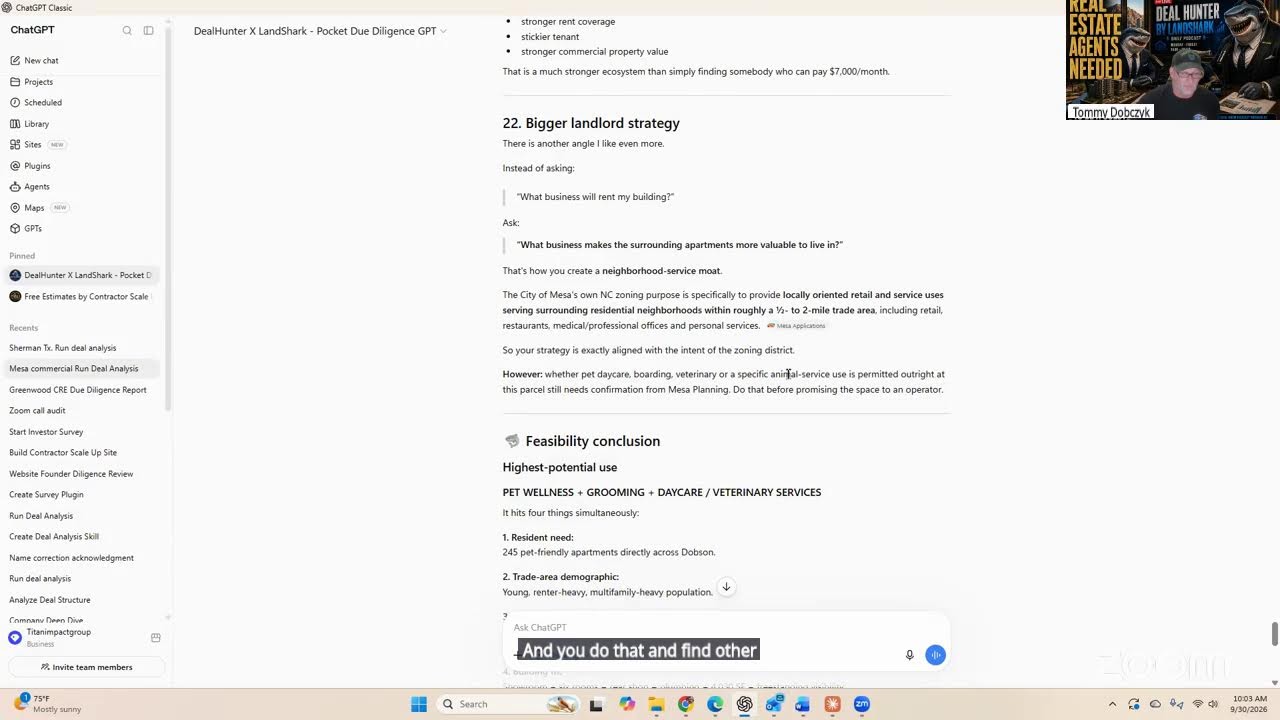
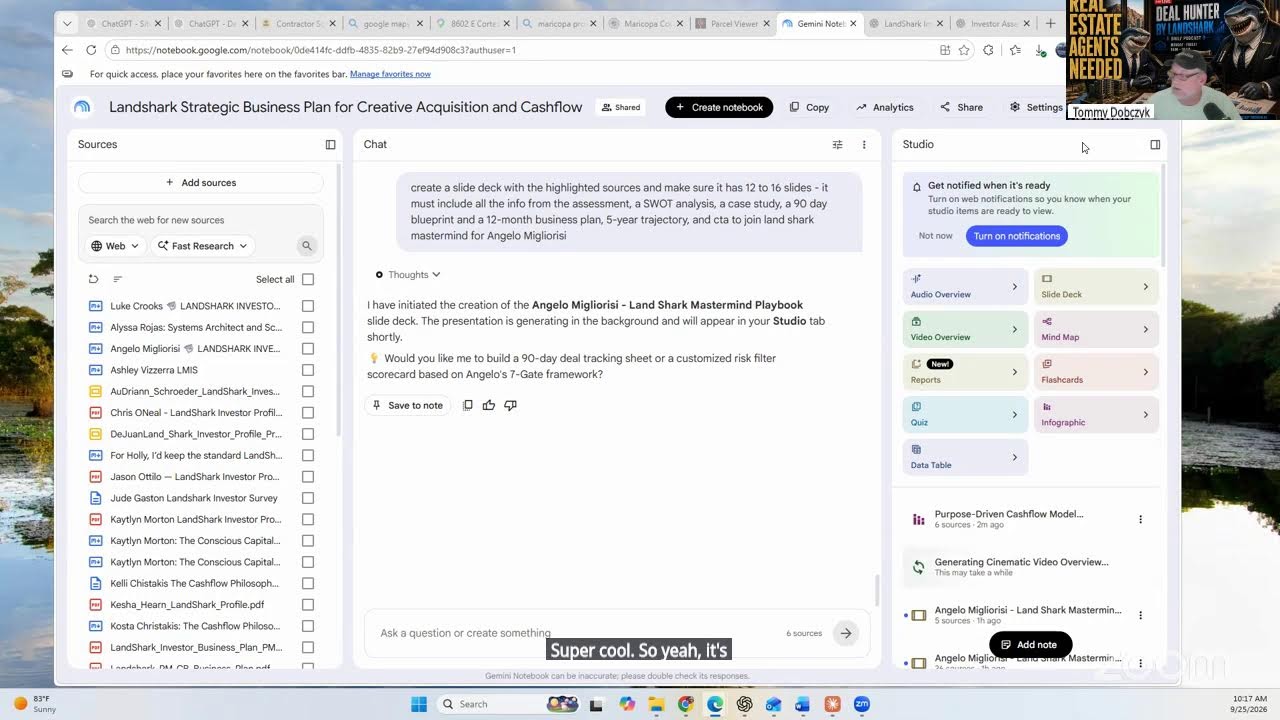
So inside of that, what we came up with was we came up with the Land Shark Mastermind inside of the fact we got people like like Rachel, Laura, Catherine. yourself, myself. I do. I'm a general contractor, real estate developer. And so I built an AI tool that we use to do all of this amazing stuff. And so it's called Deal Hunter by Land Shark. And what we do is we go into AI. I've built into it the knowledge, the tone, the understanding of all this around investing in real estate. And so you can literally just now take an address And plant it into— we'll do a demonstration here, but basically you can take an address, a screenshot, a listing. You can take any form of information about real estate that it can do a little bit of digging on, and it turns into what we call the Land Shark, and it just deep dives it. You have to use a really tricky 3-word prompt called run this deal. And if you just put the address or the real estate information in and say run this deal, It goes through a 27-step process and application of, of all the things that I would use in underwriting a deal, all the experience I've had and my team's had over 30 years of doing it. It does it in 3 seconds to 3 minutes instead of 3 days to 3 weeks.
And it also helps you find like vacant land anywhere in the US.
So I'm going to go ahead and share my screen real quick. We'll pull this up and get this started. Screen number 1. And so this morning, every day what we do is we have— we host a Shark Tank style— that's not the one. We host a Shark Tank style podcast like you're in right now, where we, we will pull up properties and just run these deals. We try to run at least 2 to 3 deals a day. And it's not just properties that we source, but deals people source to us. I get 240 deals a day sent to me in an email. And so I have my Claude actually scrape those emails and say, these are good, these are bad. And it goes off of my criteria, my buy box. It goes off of my buy box that in a deeper hole, I'll tell you about it. But we designed an investor survey that basically designs your buy box so you don't have to spend years trying to figure out what you want to be when you grow up. And so my AI knows my buy box. And then I say, here, go find my properties for me. And this is what it does on a daily basis, sifts through all my emails and says, these are the ones that you want. And it gets rid of the ones that I don't. So this morning, I, as, because we are gonna be starting a new format in the next couple of weeks, starting in November, we're going to actually be having this whole cohort start up again in November where we'll have 10 to 15 people in here. And what we're going to do is we're going to actually just crank up the Shark Tank style thing. We're getting more precise about it. And during this podcast, what we're going to do is we're going to just let people run deals that we, you know, if they don't have one, we're going to get it for them. And so I put in my criteria that I wanted 10 properties, 5 different asset classes, and its hurdle is an ROI of 40%. And so how does it discover that? It uses all the calculations, understandings, and rules that I've applied to it inside of the brain that we built into it. It's not just a regular GPT. So, um, this morning when I ran this, I said I need to see a couple residential deals. I don't care where they're at. So it pulled 2 of them out of Cleveland, Ohio. Um, it shows this is a cash-only opportunity here, substantial renovation, short sale approved, uh, for $89,000. It's a 5-bedroom, 2-bath for— and 2,200 square feet distressed duplex. Like, that's a cream deal because I could probably just go buy it and wholesale it for $10K, right? Yeah. I could probably do the same for this one down here. Dirty titles. I got a guy that covers that stuff, but it's looking for 40% ROIs, right? And so this is where it says it figured it out. Asking price, assumed rehabs, other assumed costs, total basis. And then the exit to get the 40% ROI is right there. So it basically went off of the fact that it's looking at— I could probably, looking at the sources, I could probably see if the local area has an ARV that's going to be up there. If not, is it getting its information off of a— off of doing like a DSCR and doing a BRRRR method on it? And so if it's doing the BRRRR, it says right there, it's a BRRRR method. So it showed me. I didn't even have to— didn't even have to ask. I just needed to read better. Catherine, did you see this? Now you can actually surf the internet straight from GPT.
Yeah, this is insane. Mine's actually— so I'd run a deal and it pulled up an actual picture of the actual property.
Yeah, it's getting better. It's getting better. So we'll, we'll do the demonstration here in a minute. But here we got some raw land for development out in Okeechobee, Florida. This is something that we could probably look at for, um, because we bird dog for several industrial buyers. If it's big enough and cheap enough and, and, and the industrial, uh, position is great enough, we can actually get, uh, IOS yards in here. So, and we, we shop for IOS yards. It's under an acre though, so they like to have at least 5.
So that's sweet. Yeah, commercial. Barbary Dale in Florida, 54 acres. So I
actually had like, if you guys are looking for raw land, there's actually 80 acres in Jacksonville, Florida. They're only asking $35,000 an acre. So that's $2.8 million for 80 acres. Mm-hmm.
And again, I would, I would, yeah, I mean, if you have the address, we'll run that as the demo. So
you know what, let me just, uh, let me find that here.
Yeah, so, um, but this shopping list here basically, uh, will go out to our, our Land Shark members and people that want to try and sponsor deals. Because a lot of times people just, they want partners to do deals, so they're either looking for deals or they got a deal they need partners on, right? And so Land Shark Mastermind is, is here to do both. And our Deal Hunter by Land Shark is here to actually provide, you know, the opportunities too. Like we can not only show you where to get it, but we can, you know, we can also run it and make sure it's worth getting. And then after that, we've got places to go and put them. Like people like Rachel has handfuls of buyers out there. We've also got partnerships with a company called Dispo Buddy. If you get it under contract and then decide, you know what, this isn't something I'm going to do, but you still got really good terms. You got a good contract. We got a place where you can wholesale that contract on the internet to a group of buyers who always love to move on stuff like that. So going through Dispo Buddy and getting it on termsforsale.com, that's part of our, you know, that's part of what we do as well. So let's do, uh, yeah, let's look at what you got, Brad. Let me pop this.
Yeah, hold on. I'm trying to open my screen up bigger here. It kind of closed me down to a little box.
Yeah, hold on. That's because I'm sharing my screen. So Let's see.
I'm trying to get to the. Actually, I can just tell you the address.
I was gonna put it in there too.
So it's one five four two two Southwest.
Hold on one second. Pull that back up.
I already typed it in. Yeah, go ahead.
So, yeah, so 15422,
15422
SW
Southwest
50th Avenue, Archer, Florida. A-R-C-H-E-R. It's 150-acre parcel or 80-acre parcel.
A C A. I'm sorry.
A A C A R C H E R.
A R C H E R. Florida.
Florida. Yeah.
Right. Okay.
So that must be right outside.
This is the demo. This is a this is a demonstration for you of how how this AI is different than standard AI. If you put this address in a standard AI, I do not believe that your standard AI would work this way. But If it is, it's stealing it from me. Run this deal is the prompt that we put in there. Yeah. So that it goes back. When I programmed it, I said, I don't want people to have to be a prompt wizard to figure out how to get information for themselves. And when you get information, I want you to supply strong sources to back up the information and the data. And so the The way that I built this was so that it not only did more than a standard GPT, but then it also, you know, wouldn't hallucinate and come up with stuff and make assumptions and bullshit generalities in order to satisfy you as a user. So I needed it to be an actual tool, and I had to build it and tell it to be that way. So inside of that, that address, and it says run this deal, it shows an executive snapshot. It goes through 27 steps, shows that there's a current advertised price of $2.8 million on 80 acres, which is $35,000 an acre, like you said. This is an advertised price increase since 2025 of almost 50%. Interesting. So property details goes into the fact that it's got a 40— a 4-bedroom home on it. This is probably a ranch, right? Old ranch down in that area.
Like an older one. Yeah,
yeah,
yeah. So it's a legacy estate, equestrian ranchette, luxury home, luxury country, minutes to everything, accessory dwelling, zoned A agriculture currently, high and dry, FEMA Zone X, uh, 55 acres planted pines, 25 acres mature oaks. Well and septic, buried electric, existing, yeah, 4/2 home,
right?
Uh, fully usable land, no wetlands, but complete redevelopment is available,
right? And so when that says that, what does that actually mean, Brad? When it says redevelopment available, what does that actually mean?
You can redevelop it into whatever you want, and the city is open to you.
The city's what?
The, the city is open to, uh, projects for either student housing, um, low-income housing, you know, multi-family, whatever you want. They're, they're open to working with you for it.
Do you have that documentation?
Um, I have what he presented to me. I don't have all that actual from the city, but— Right.
And so that's— and so as it— and, and I'm only saying this, Brad, because I've been developing for 30 years. And this is why I built this, is because the pretty sales letter that everybody sends out can't be used as actual and factual until there's documentation to back that up.
Right. And I heard that Florida—
Because there's been so many times that there's property been— and this is one of the reasons. In Florida in 2007, I bought 3 gas stations in a portfolio. 2008, Obama became president. 2009, he— or in 2008, he actually did his first— one of his first 100-day executive orders was to change, make every gas station across the country switch over to a 2-wall tank. It was something he promised all the tree huggers and stuff. Right. And so that mandate forced me as a brand new gas station owner to have to switch out my tanks. Right. And so when I did that, all 3 of them had broken tanks, and I ended up going into 78 years of soil remediation.
Wow,
that's pricey. Oh, right.
Yeah.
And so in a matter of 24 months, I went from owning 3 gas stations to owning 3 brownfields that I couldn't do anything with.
Yeah,
until I met a guy who was willing to say that they were 3 gas stations up for sale. And he's like, I don't know nothing.
Yeah.
And so we actually sold them and the new owners became, they ended up buying them as gas stations that became tax liability or tax write-offs. And he sold them in that fashion. And so I was like, wow, that seemed pretty shaky, right? But I was out of my debt and I was out of my situation, but he got them off to somebody else. And so I was like, eh. So when I built pre-estimates, I put into it situations like that where It don't— I don't want it to tell me the value of what it could be because I'm not going to pay that. As a developer, I'm going to position and work myself into terms for that. So if the current owner wants it to have— because it says it's got a 50% increase in a year. What, what work has been done to this property to substantiate a 50% increase in asking price? Yeah. To go from $1.4 to $2.8, there needs to be some sort of entitlements that are recorded. The city needs to have had stamped meetings, meeting minutes that says it's going to become something, because in order for it to have entitlement value, it has to have actual entitlement paperwork.
So what work got done to justify 50% price increase?
Because right now in that area, it's only actually worth about $17,000 an acre. Not 35.
Okay,
Brad, do you have any of that information, or can you get that? I'm sure you can.
I can get it.
Yeah. So, and then on the flip side of it, I'm okay with doing a, doing a, a closer to, uh, future value because the city or the county— and this is, this is why I mentioned this— we're, we're experts inside of what's called opportunity zones. And if this is in an area that's an opportunity zone, great. But based on the prices I'm seeing, it's probably not. Um, and if this area doesn't fit that criteria, that's okay. But there's a way to get it through by saying, okay, listen, if you think we're going to do 4 to 6 years of development, what we'd like to do is pay your full asking price because we know what it'll be worth after we get past this section of entitlement. So what we would end up doing is like right here inside of, inside of our program, it gives 3 funding strategies. And one of them is to do the land acquisition loan through maybe USDA. We could do that. But the other 2 are going to be equity-heavy joint ventures or seller financing and saying, okay, so we'll pay what you're asking for, but we want it to be like with 30% down and you're going to carry 70% financing. Or on the flip of that, we're going to do like, I'm going to work with Catherine Bell because she's Titan Impact Group. She's the sponsor of the Land Shark Mastermind. Um, uh, she's an equity, uh, fund manager. And so I'll say, Catherine, do you think we can raise and do a capital raise of like $1.5 million and get this, you know, get this thing off the ground, or maybe raise $3 million to do, to do the acquisition and, and, and the first phase of, uh, phase 1, phase 2 of development? And I might do that with her so that once I get into phase 2 development, now I can go get a commercial bank loan. For the $15 million or $30 million, I need to build it out. So, um, inside of that, it gives me some more things to be concerned with— development rights, um, uh, the limited liquidity in the asking price is kind of rough. And so, and then the insurance, taxes, uh, and access, uh, could be underestimated. It wants me to take a look at that. And then, um, it also provides a SWOT Uh, analysis, you know, like we can see where there's good idea, bad idea. Um, but again, it, it wants us to start the negotiations, uh, way closer to a, a comparable price until we have that documentation and validation for the current, current asking. Um, primary and backup exits, lender investor views, etc. Um, you know, these are things that we can kind of spill over into a little bit. But from that standpoint, like, it's, it's definitely saying like you need to renegotiate. Now here's the other thing. It's going to ask me some suggestions and it's going to say, well, what are you planning to do so that maybe we can re-strategize? And it'll say evaluate the $2.8 million asking price. I'm going to say I want it to do that, but based on what I'm looking to do, I don't— I'm not going to wholesale or flip it. But I want to, I want to buy it, split it, and resell the land to builders. Okay, because again, we do need, we do need affordable housing in those areas. So, um, I wanted to update it based on that information. Now, while it's doing that— go ahead.
Can I ask you, can I ask you a question? Yeah. Oh, you know, in, in Florida, I'm like, I'm sure you're familiar with the Live Local Act. Is— will— can you ask this to kind of evaluate a development project based on the Live Local Act and the extended leniencies that they give for that?
Absolutely. And it'll— I can, I, I can put that into it. Um, but the way I built Deal Hunter was to not rely on, uh, subsidies or, or other sides— sides— uh, sidesaddle programs. Um, the deal has to stand on— for me, this is for me. You can use Deal Hunter to do that. Like, if you and I are sitting here, because my criteria is 40%. This won't meet that. So I am automatically, just because time is money, I automatically chuck this to the weeds. I have no interest in doing anything with this because it's not even worth my time to talk about when they do a 50% increase. My system automatically junks it. Somebody else though, who's like, hey, I like tricky deals, right? I call them red flag chasers. They'll take this and try to do something with it. And they'll do what you're saying and they'll apply multiple subsidies to it to make it work. The issue for me with that is, is when I'm representing investors, they, they won't accept that as an opportunity. And so I'm basically wasting money holding webinars about a property that has, has no face value that they can see. Right. I have to convince them by showing them, look, here's subsidy 1, subsidy 2, subsidy 3. They'll go, no, absolutely not. So, and so here we go. Interactive maximum offer calculator. If I split it all up, I'm looking at a $1.6 million loss at the asking price.
Wow.
Gotcha.
Based on comps.
So again, if the reason I love this— again, I've been investing for decades now. I mean, for us to figure this out prior to AI, how many days would it
have taken?
It would have taken at least 3 weeks to figure all this out.
Oh yeah.
And now I could, like, this is where the collapsing timelines and adding commas, like now our time has been saved and we can actually move on to deals that actually make sense.
Yeah. Cause I'm, I'm, I'm kicking, I'm kicking tires with this deal right here. So unless they can become very creative, it's not worth the salt. And then on top of it. Like I gotta again jump through many, many hoops to get where I would probably want to go with it. So inside of that, though, if this was to become something that I could be like, yeah, check this out, it's a great deal. What we do inside of inside of that? Let me see. I lost my darn windows today. Where'd it go? Where'd it go?
So as for realtors, like why this matters is because when you have your conditions of satisfaction or buying criteria for your clients, you literally could use this and say, okay, this client, this is their buying criteria, and have it now go through your whatever listings or whatever that you have access to and literally go and scrape and find all the deals that meet those criteria and then present it to them inside of like, not only here is the deal, but here's the analysis we've run on it for you.
Right. And then, and then not only that, but when you do find a piece of property that you want to present to your, your, your buyer, you can do things like this. I'm trying to see if I can get it to come up. Come on. All right, we did it. Expand it all the way. How do you— I hate when it does it.
Which I like that too. I think that's great because A lot of times with brokers, you don't even get very much information.
Right. So here's, here's a deal that we did. And this is— let's just pretend, Brad, that your deal made it through our criteria. This is a deal where it's, it's a custom home on 6.5 acres that backs up to 12 million— or I'm sorry, yeah, 12,000 acres of, of equestrian property. So this is like for like, equestrian property for equestrian property, even though this is only 6.25 acres. Price-wise, it's about the same ballpark because she wants $1.9 million for 6 acres, right? But this is super fancy. And so our plan is on this property to go out there and do a redevelopment. We're going to split the 6 acres into 3 lots, 1 that has a house and 2 that'll be vacant and for building. And the square footage of those new lots is going to be over an acre. Um, but we'll be able to— the buildable area is about 12,000 square feet. It's a great area. It's got lots of great views. And, and the current comps in the area have the house being sold. Here it is, parcel development. So here's the original house, and then we would split it up and build 2 new ones out here. So reselling this one to pay for these 2, and then we basically cash profit off of both of those.
Yeah.
Um, and so when we do that, we're selling them for probably about $4 million. We're looking at about a, about a net, I think it was a 70% ROI on this deal. This is what we look for, right? And so then when I get this, I can create this entire— this is a website, and I can literally just now send this over to my bank. I can send it to my investors. And I can say, here you go, there's— here's the deal, here's the underwriting, here's all the stuff. Super easy to see.
Yeah,
real easy to explain. And they can— they have an interactive calculator to play with if they really want to.
I like that layout. Yeah,
right. So, and what it would cost and all that stuff, it's all built in. So now I'm able to, to handle, you know, handle stuff with people, um, in a, in a rapid fashion. I'm not messing around with, well, how can I What other government programs out there that I can use? Even— I'm not saying that I don't like government. As a matter of fact, here, let me show you something on the government programs that we actually—
Yeah, our OZ Wizard is literally the whole—
So we're in the process of actually— this might be a little corny, but I, I learned— I mean, I, I took a mentor class recently that said you have to entertain to educate, and you have to, uh, in order to enroll. So if you want to enroll people in what you're doing, you have to entertain them first, get, get their attention. And then educate them about why you're important, and then you can go ahead and enroll them and get them signed up. So, um, inside of that, it's like, oh, okay, I get it. Um, and so come on.
I got a couple land developments.
When our journey began, Penny Taxwell was convinced she already had a strategy for almost everything— capital gains, Got one. Deferral? Got one. Estate planning? Got one. Charitable planning? Got one. Penny was not inexperienced. She had spent years building a tax planning toolbox that worked. Then I asked one more question. What about Opportunity Zones? Penny gave me the look successful CPAs reserve for ideas that sound like extra paperwork. I already have strategies that work. Then her phone started buzzing. One client had heard about a qualified opportunity fund. Another wanted opportunity zones explained. A third asked if they should be looking at it. Suddenly, this was not theory. It was already in the client conversation. Still think you do not need to know? Penny paused. Maybe I am missing a piece. That was when we found it. One empty glowing drawer in a very full toolbox. Penny asked the right question. Why use this instead of something I already know? So we worked through the framework: capital gain, QOF, timing, fund structure, long-term investment, community development, not as a replacement, but as another strategy to evaluate. So this does not replace my toolbox? Exactly. It expands it. The missing knowledge started to fill in. I know taxes. Penny said, I just do not know this framework yet. That was the breakthrough. Penny did not lack expertise. She needed enough Opportunity Zone knowledge to recognize when it fit. Then the next client called. Yes, Penny said, let's look at your gain horizon, plan risks, existing strategies, and whether an Opportunity Zone strategy belongs in the conversation. Brock smiled. Looks like someone found a new tool for the toolbox. Penny sighed. Fine. Opportunity Zones might belong in the toolbox. That sounded painful. Do not ruin the moment. Penny found the knowledge she was missing.
So inside of that, that Opportunity Zone program started in 2018. I've been in, uh, in the program since 2022, um, and Catherine's getting introduced to it. So we designed this entire thing on AI around educating CPAs, lawyers, and people that have capital gains inside of learning about how to invest in their Opportunity Zone areas. And it's basically getting the 1031 program out of the way so that people can take advantage of their profits immediately and in this lifetime, right? So, uh, really excellent program, but it has to be taught to people, and we've developed a lot of AI behind that. Um, so again, we, we love government subsidy programs, um, but And, and all that, but only if it's an add-on to the great deal, not the reason the deal exists.
Now, Georgia, right now I have a couple land deals in Georgia, and Georgia, the government's providing a bunch of grants.
Yeah.
If you want to come in there and develop and build.
So, yeah, and there's places, as a matter of fact, you can use Deal Hunter to look that up. Here, I'll show you one of them.
Yeah, I have a couple that are off market right now with, um, my amazing, like, broker that's in Georgia.
Well, load them up, run them up. I think we've looked at them. So let me see here. Uh, provide me with a list of all the government, federal government programs available right now, and then list— give me a list of states where I can actually get land for free, buildings for free, in order to help in economic development. And I'm very familiar about these programs because I got a partner in Yuma that he's our Roman Rubio. He's probably coming on here pretty soon, or he might be in here already. He is the Economic Development Council liaison for the city of San Luis. It's going to be the 2nd largest border port in the country shortly. They're building it out pretty large. But He's got, uh, he's got access to a lot of, a lot of deals just because of the fact he understands where to go ask for the questions right
now. I'm telling Mike, uh, general contractor's on here too. So I wanted him to see that your free estimates in that new contractor.
Well, we've got that webinar coming up on Sunday, so I definitely love to have them register for that. I'll show them how to get in there and register for that. Let's see.
I sent him the email and stuff, so I talked to him this morning about it. He was also at my cookout, my networking event too. He's a good friend of mine.
Very cool. So what do you think so far, Brad? Like, what's your take?
It's looking very interesting. And I like how it does take a lot of the guesswork out of, or the manual labor out of what you're doing. So I'm pretty impressed.
Yeah, like, I know, I— again,
like, now you know why I've been so excited about this.
Yeah, 3 weeks to 3 days is too long to wait for stuff for me, so I want to know now, you know. Um, and so yeah, I'll show the free estimates thing real quick, but the other thing is like, I get— I get— like I said, I get 200 deals a day. So if something smells kind of nice, I like to actually just screenshot it, put it in the machine, and hit run this deal and let it go.
So If you were to take a full pro forma and upload it into this system and say, run this deal, like with the actual asking price and everything like that, it would spit you out a full yay or nay, right?
Yeah.
100%.
Interesting. Yeah. Okay.
It'll, it'll actually go through. And as I had a deal where they sent us over the entire package on this property they were trying to do multifamily on, and one of our— she was only in here for about a week, right, Katya? Yeah, she's a she's a college student. She she was part of one of our our cohorts for a short time, but she found a deal. Seven acre property said it was going to be multifamily blah blah blah blah blah. Okay, cool. We we actually signed an LOI, sent over PFS, sent over proof of funds. Did the buyer get the the due diligence package? And she's like, "I don't know what to do with it." I'm a contractor. I'm like, "I don't have the time to sit here and comb through every one of these documents." Put the whole thing in here and run it and say pull out all the red flags.
Yeah,
it pull and said we told it you know for a multifamily deal. It came back that the history said that it was a junkyard. It needed ten. It needed soil remediation, and that there was a possibility that ten years ago it had a sinkhole. Saved us ten million dollars in soil remediation and and everything. And so we actually were able to go back to the agent and be like, bro, it was actually in your documentation you sent us. He's like, well, good thing you found it.
Yeah, I'm telling you, that's because—
I'm like, bro, you couldn't have told me before? He's like, I don't know how much it's going to cost. I'm like, you're, you're literally sitting here selling me multifamily property that needs soil remediation because of the sinkhole and because of a, because of a junkyard that used to be here.
No, they just didn't want to include that and tell you about that.
It's just right. I mean, the part— the parking structure is all like— the, the hole for the parking is already dug.
Unfortunately, this is next to the empty and dry Salt River, and I guarantee if there's a sinkhole, it's because that water is eaten away somewhere down underneath. So let me share this real quick. Uh, this is our free estimates deal. Um, and so here it goes. Uh, no.
Yeah, this is awesome for builders, contractors, flippers.
I got too many windows open. I thought I had the right one. Let me try it again.
Oh, nice. Sounds like—
share screen 1, move camera 2. Like, I feel like I run a production studio here some days. So, uh, here we go.
Are you a contractor trying to scale up? Would AI be able to improve your work life and buy your time back? I'm Catherine Bell, and we created freeestimates.io, an AI-powered web app built to help contractors create professional estimates faster. Simply upload project photos, add a few details, and Free Estimates can help identify potential scope, estimate quantities, and use current regional market data to help you discover pricing faster than traditional estimating methods. But it's more than an estimating tool. Think of it like a pocket contractor your homeowners and clients can use before they ever call you. Contractor Scale-Up is hosting a webinar October 25th with sessions at 3 PM and 5 PM, Right between the football games. Before the webinar, go explore freeestimates.io, use it while it's free, and see what AI could do for your business. Then register for the Contractor Scale Up webinar and learn how to put it to work.
Okay, cool. So Contractor Scale Up, we use it in GPT.
What if contractors and clients could get reliable project cost estimates
Okay, cool video. We go, you can go register for the webinar there, but basically by December 11th, this is going to be an app inside of that website, freeestimates.io. We're no longer going to go through GPT to get to it. It's just going to be part of the website. So inside of this freeestimates.io, we're able to do estimates on any kind of deal you want to do from literally just pictures. Okay, so like I could, I could just do like pictures of the backyard, okay? And, and I want to do some hardscape landscape, okay? Um, and on this one right here, I'm just gonna, just gonna feed it some pictures that I got from, from the listing, right? I was on the listing and I'm like, here's the backyard. That is a freaking ugly backyard. Am I wrong?
Mm-hmm.
Exactly. It's super ugly. I don't even know why they have the lights. Like, the lights make me want to rip them down. So they didn't even fill in the buckets. Like, it, it's absolutely horrific.
At least it's not trash.
Don't even know how you plan on buying— like, selling this house like this is absolutely ridiculous. So we get rid of it, and I said, no, I want a better layout, more plans with a pergola. Like, what does this look like? And so boom, oh my God, reshapes the whole place. Perfect. I love it. How much? How much is it going to cost? Like, if you could get Pinterest to give you prices on stuff, right, you wouldn't do half the dumb stuff off of Pinterest. So I need a cost estimate. Who do I hire? 85354. All right, boom. Budget, $25,000 to $40,000. What are they doing? They're putting in a 12 by 16 pergola. They're putting in new trees, shrubs, and flowering plants, drip irrigation, additional pavers, landscape lighting, fire pit, electric, grading, finishing. Boom, done. Subtotals. Allow. Now it's telling me as a contractor or as a client that I need to allow for at least 10 to 15% in contingency. Right? So then after that, here I go down. Here's who I need to call. Desert Point, Phoenix Outdoor, or I&M Landscaping. Why? Because they have 4 and 5-star ratings. How do I know? Because when I wrote this, I said, don't use Angie's List because she's a dumb see you next Tuesday. She wants you to pay to be at the top of her list, whether you're a good guy or not. So no, I don't want that. What I want is I want to know that you have good listings on Google, you got good reviews on Google, that Facebook and Instagram and all your social medias think you're cool. I want to know that you're on the Better Business Bureau and that you have an ROC license. That's what it brings back to me is now I have contractors that meet that criteria and I'm not relying on some dumb chick that doesn't even run the business anymore.
Yeah.
Then after that, I as a customer am going to ask the contractor, I'm going to say, hey, I'm looking for a licensed landscaper. Here's what I want. And I want to stay in this budget, right? But if I don't, let me remodel it. So I say, oh yeah, let's knock it down a little bit. What's that look like? Gives me an idea of what it looks like. Tells me a budget, tells me how to get to it. Says, how would I change the existing backyard? Should I worry about the pergola, get rid of that, shrink it down, plants, perimeters? Like it helps you think like a, you know, the client think like a contractor. Now watch me flip the switch. Okay, I've, I've been talking with the client. I'm the contractor, so they're gonna go with the $22,000 bid and we'll be able to go up to about $25,000. Definitely want the fire pit and the pergola, but cut down on the plants a little bit. It is Arizona and they are concerned about being water conservationists a little bit. They're from California, so they think everything's going to get you know run out of water. But go ahead and put this together. I need this in a bid, and I want you to use my I want you to use my ROC information for Imperium Construction, and I want you to use my logo. If you don't have my logo, ask for it. But it should be in our library. Imperium Construction. Go ahead and put it on an Arizona contractor. Legal contract as it's prescribed by the ROC of Arizona. Create that now. And so now that I've turned it from being the client-facing now to the contractor-facing, it's going to produce for me, as if it's my secretary or office manager, a document I can immediately send to my client. Who's standing and waiting in the living room. And I'm, I'm like, boom, here you go, ready? So, because this is where most money is lost in the blue-collar world, is like customers that collect, you know, they like to think they collect estimates. This is why contractors don't go out and do estimates. Like, how many estimates did you get? 6? Okay, have a good day. Yeah, I'll be there Friday. Right?
My experience, half the time they don't show up.
Well, and I won't either, because I, again, I don't like to feel like Walmart or Target. I'm a contractor. I'm not a freaking like retail store. Don't shop me, baby. I'm gonna come do the work.
I wasn't talking about shopping. I was talking about just showing up.
No, I know. But again, most contractors don't show up. And the reason most contractors don't show up is because they don't want to have that, that shopping experience. They don't want to be shopped by the customer. Right.
So how are they gonna make money? I mean, that doesn't look good on them.
I will again have to say, 80% of your contractors, if they feel like you're going to compare prices with other contractors, they will not show up.
That's crazy.
Period. It's— and it's only because contractors are not retail stores. You go to the store and you go, okay, I want a gallon of milk, but I have I have, uh, I have, um, Funyun Dairy, I have Xavier Dairy, and I have Low Brand Dairy. And I can either buy the glass bottle, the plastic bottle, or the, or the, the paper milk carton. Again, when it comes to contractors, we don't function that way. We don't operate that way. We don't like it when our clients treat us that way. So at that point, it's really simple. You want to hire somebody to do the work, go with the guy that shows up first and pay him. If you want to shop price, this is what this tool is for. And then therefore the guy that answers the phone shows up, it's probably the guy you want to hire.
Yeah. But—
Right. So, because again, getting 2 or 3 contractors to show up, I would literally show up on a roofing estimate with my one, one, there was one competitor who would write a contract that said lifetime warranty for the owner. And he would only do this if your birthday was after 1947 or before 1947. So, and again, basically just writing a contract so that like it only, you know, he's like lifetime guarantee, but only if you're over 73. Like, how am I going to compete with that guy? I'm not.
Yeah.
Literally, I'd show up, he's at the job. I'd be like, hire him. I give you a $500 bonus to hire him. After 3 weeks of doing that, I never had to worry about that guy again because he had so many freaking roofs to do, it was ridiculous. And I raised my price by 40% because I no longer had to compete with, with, with, with, uh, uh, uh, the, um, uh, Junior Bernie Madoff.
Yeah,
right. Like, he was trying to screw people out of whatever, and it just went sideways.
This is like with shopping around. It's just like, okay, say you wreck your car or whatnot. I mean, you're going to get a couple of different estimates, you know, prior to deciding who's going to—
I'm just letting you know how blue-collar guys look at that. And you can continue to do it, but you're going to continue to get the service you get. So blue-collar guys do not like to be shopped, whether it's an auto shop or a body shop or a contractor. If you're shopping them, you're going to end up getting rid of the best one based on that.
Yeah.
I
don't have to do that anymore because I have this.
Say again?
I don't have to do that anymore because now I have this.
You got this, right? But I'm just letting you know, like, when the best contractor or the really good contractors find out you're comparing prices on them, they walk away. They, they don't even try to participate. So,
but what if they don't know? You don't say anything to them and they still just—
they don't shop. We know each other. We shop at the same stores.
Oh gosh.
Yeah, we all know each other, you know. Like, hey, do you think girls are the only one that have apps where Yo, check. Yo, check my dating from last night. Like, is this? Is anybody else dating this guy? Come on. Like girls came up with that. Contractors do that too. Oh, you went and bid on that project? Oh, okay, cool. All right, I'm not gonna write a contract then. Like I've gone out, measured a job, found out somebody else bid on it. Done. I won't even write a contract. No, but call me back. I don't think. I, I, I just— how it works, because again, I can write 10 contracts. If I get more than 4 contracts signed, I end up raising my price because I, I like— I need to only sign about 30 to 40% of my jobs. If I'm signing more than 40% of my jobs that I'm writing for, I'm, I'm charging too— I'm not charging
enough. Yeah,
right. I'm getting too much work, right? Yeah. So That used to be the measurement. That used to be the scale. So now that I pulled this up, it didn't put my— it didn't put my logos in it, but it did, it did provide me with a, a reasonable, uh, ROC contract. It left some parts out. And so that, um, when we build these things, I built it generically, but when I build— when I use mine, because I have a separate one that I call CSU and it's— it sits in my private. And so free estimates is for everybody. And what you would do is you would just load the, load the template or the logo or anything right here and let it, and then let it get it from here and, and it'll, it'll build it. So if I really needed to, um, I can get it, I can get it to pull from my library. I can get it to pull from, pull from whatever I tell it to pull from. Uh, to make sure it has all the right, you know, information in it. But as far as the free one goes, it's the, it's the white label that everybody can use. So you can add to it as you need to. But we do build them to be your tool that you don't have to— we like, we pre-program it. So imagine if, if you had a saw that you could program to just cut stairs every single time, right? Yeah. And so you'd be a stair builder all day long because your saw cuts stairs perfectly every single time. We can build a white label free estimates to do that.
So can we, like, my contractor Jay's in here, can we see about possibly running a deal or property that he has?
I've got an— Catherine's got a hard stop at 10 o'clock. I got one as well. Unfortunately I don't, but what I will do is if he wants and he's got a project, I would love it if he could show up to either the 3 o'clock or 5 o'clock, tell me it's Jason, um, and we'll use his deal as the demo live on the webinar.
Okay, yeah, I sent him the email and stuff. I said— actually, I sent it out to probably 100 people.
Awesome.
Yes, yes, I'll be there. I'll be there for the webinar, for the 3 and 5, because—
yeah, no, I encourage people to show up for both because we're, we're going to be teaching something differently in both of them, not doing I'm not doing a recorded— this is live, so we're going to be doing something different in each one.
Yeah, because we want to see how that will run for here, like in our market too.
Yeah, yeah, absolutely, absolutely. So, um, but bring an address, bring a
deal, Jay.
Absolutely. There you go. Uh, one of the other things, let me see if I can show you guys this one here real quick. Um, this is a, uh, an example We went in and this is a kitchen. I heard someone this morning say they did a $150,000 kitchen remodel. I was like, what? But anyway, this is an example. Kind of ugly kitchen. Not, not super impressed with it. But it again is just images off of the internet, images off of the, the listing site. And I said, I need to do a full remodel in 85354. And I can tell it if I want to do like a low end, high end, middle, you know, do a mids, whatever. But it went through. It does off of the pictures. I don't have to even give it like measurements because it's using the idea and understanding that those kitchen cabinets are a certain size. And so it knows and it can make those calculations, estimations, and assumptions without me having to tell it. Right. And so the total estimated cost of remodeling this kitchen Is going to be about $120 grand, right? And so what it's going to go from and into, I can print this out, hand it right to my homeowner and be like, this is what you're going from and over to, right? And show them how we open the room up, blow the walls out, blah, blah, blah, blah, blah. And they get super excited by that. And so this, this is what sells it right at the door. And again, you want to shop, go shopping. I like that analogy. Like, go let you and I go shopping. Hire me and I will go through and make sure we're not going to pay that much on material. I'll make sure we're going to work on the cost of labor, stuff like that, right?
There you go. That sounds like Jay.
And so, but that's the key. That's how a contractor should be used, not who's cheaper than who or who's charging what. If you're going to hire a contractor, hire him on whether or not you can talk to him, whether or not you can work together, and whether or not you trust him. Period. Who cares about the price? Because if you're going after the lowest price, but it's a dude you can't trust, he's going to be in your closet doing things you shouldn't or wouldn't want anybody to be doing.
Yeah. Or he's going to take off with your money and not do the work.
He might not, but he might, he might damage more than—
That's what happens a lot here.
Again, like there's all kinds of bad things out there in the world. So inside of that, again, we encourage people. Come to the, come to the, the, the podcast. It's how you get to the podcast. You go to Land Shark or use the Deal Hunter, uh, GPT. You go to landshark-dealhunter.com and that one will run the deals. Go to free, free estimates to run the, run the free estimates. And then to come in here every day, just go to landsharkmastermind.com and go to the deal room and watch deal room every day at 9 o'clock. Go to Titan Impact Group. Uh, to, to, uh, meet up with Catherine, which you already went off, uh, because she had another meeting. Um, but Titan Impact Group is our amazing sponsor, and we, uh, we can't do much without our sponsors. So, uh, if you want to check into how to be a sponsor, um, we can book a call for that offline. But I'm going to wrap this up today with a prayer and thank everybody for coming in. Uh, we'll see a lot of, uh, you guys on Sunday. Um, and then if not, we'll see everybody on Monday. Bring deals, Because our new format starts November first, and it's going to be Shark Tank style deal hunting. And and so if you don't have a deal, you'll be given one, and you're going to run it, share it, and and and see if it's something worth calling because we do live calls here too. So all right, everybody have a wonderful weekend. Heavenly Father, thank you for the blessing of this day, the blessing of this life. We ask that you continue to bless guide us, take us out into the world to do your Son's will and your In your name we pray. Amen. Everyone, thank you so much.
Everybody have a great weekend.
All right, thank you.