AI Live - Land Shark Mastermind
Catherine Bell and her team present a three-month investor program building seven passive income streams. It includes a personalized dashboard tracking income-to-asset conversion, foreclosure property sourcing through Arizona trustee sales, and tax modeling for IRAs and non-recourse debt. They compare AI tools like ChatGPT and Claude, and showcase a shark-character branding system for real estate investor archetypes.
Chapters
investor program. And so, um, I'm actually excited to put this together and put together— and so I had a long conversation with a couple friends this weekend, and I think we're going to do it. We're going to do it in 3-month modules. And, um, kind of similar, uh, to Laura— remember when we did the Financial Peace University? Um, we did that, and I'm trying to— I think it was a 12-week program. So I think that it works to do it in 3-month modules, so to speak. And then really people can come in at different levels, but be— have their hand be held and accountable for actually creating the 7 streams of passive income. So there's gonna be a lot of homework in it. And I was thinking more about like, I think people who have their own businesses, we could look at, uh, because there's a whole way of going through and making sure that they've got multiple streams of income in their business. But more importantly, whether it's their business or their job, that they're setting money aside. Um, again, your earned income is meant to buy assets that provide passive income, and then your passive income. Pays for your lifestyle. So if your earned income is paying for your lifestyle, you missed the most important step. So, yeah, which is—
It's really good. Uh, I was on mute and I go, wait, what? You're leading it and there's lots of homework?
I know, right? But that's the, that's the thing. It's like, you know, the— how did I learn? From doing an obscene amount of homework, right? So I— there's no fast way of learning this.
Yeah, right.
And it's, it's just one step in front of the other. And so, because I'm thinking like I can put together a dashboard, uh, so each person will get their own dashboard and be able to see literally where they're at and then creating that income snowball and the investment snowball and continue to see it going forward. And so funny enough, I'm literally doing a Bible study. So every morning, um, there's a Bible study that I started doing, and it's all about what type of leader God created me to be and then leaning into that. And this whole module is on finances, funny enough. And it talked about, um, the 2 different types of, you know, getting rid of debt. And then I can also see like the multiple types of getting into passive streams of income. And the more I was thinking about it, because people like to ask me when, like, when Christopher passed, what were the 13 streams of passive income? It doesn't matter what they were because some of them you won't be able to duplicate. But I'm clear that there's passive income streams that I won't be able to duplicate. So, I don't want people to get hung up on that it has to be this. Mm-hmm. This thing or this asset class. Like I want open people's brains to like really starting to look outside of the box and look around them and go, "Wait a sec! That could actually be a passive stream of income," right? And more and more and more, which I'm really excited about, is an affiliate program. So multiple streams of passive income for me. I talk about this a lot. Have been affiliate programs.
I've got.
Some, like, I think the oldest is over 20 years old, and I still get paid off of it today. So, um, inside of the 7 Streams, uh, I'm gonna be creating an affiliate program for that. So anybody that wants to be a part of that, um, they can let me know, and that would be another revenue stream for them moving forward. So I think it'll I don't know. The people that I've talked to are absolutely like, heck yeah, like, let me in. Uh, so it'd be interesting to see, you know, does this really resonate with more people who would really want to go through this? Um, so yeah, those are, those are the things I was noodling on over the weekend.
Nice.
Those are my noodles.
Noodles.
Yeah.
No, it's good. It's good. All of what you said, Catherine, I was, you know, that, and I know, I know from, you know, our years together, the, the piece of the, you know, have your passive, have your earned income buy assets that generate passive income that, you know, is your lifestyle. And we You know, Darryl and I went to Costco, whatever, last week when I got back from traveling for 3 weeks and had a rather hefty Costco bill. I had a $600 Costco bill that, you know, included $110 worth of sushi and dirt and, you know, some stock-up items. But, you know, we drove out. I, I was predicting it. I was playing the game of like, let's predict it while we're like scanning everything, you know, I was like, right, $400 or $500, you know, like $650 or something. I was like, oof, we're driving out, you know, and then I got gas and that, so that was another $100. So I was like, we're driving out of the Costco parking lot going, well, there's like $750 like gone. And I said, but at least I didn't have to work for it.
Right.
Most of that, you know, yes, I have some earned income and You know, but most of that, our lifestyle income is from our real estate investments. So, you know, it's like, that would have been at $25 an hour. That would have been a lot of earned income. But right, you know, that—
How many hours of your life?
Yeah, but that really was like what I said as I was driving out. I go, well, at least I didn't have to work for, you know, work for it. That was passive income.
I have people doing Trade time for my dollars.
Doing the things for me for it. So yeah, it was just really, it just hit me as you were sharing that this morning.
Very cool. All right. Well, let's look at Deal Hunter real quick.
You got Carol and Luke, and Luke is in as well. I don't know if you saw him come in, Catherine.
Yeah. Morning, Luke. Morning, Carol.
Is my, is my microphone working? You guys hear me okay? Yep.
Good morning.
We hear you.
Yep. You'll absolutely get to do that, Luke. No hope involved. Action, action, action.
So Laura reminded me today it's Happy Adoption Day for me. It's the day I was adopted. I was 16.
That's awesome.
Alright, I'm off the phone.
I love it. Okay.
So, um, so yeah, I'm sharing a list here. Um, we're going, you know, to what you were talking about inside of the 7 streams. So we built a dashboard and set it up so that we can start finding auction property. These are properties, um, that are being auctioned, uh, for the purposes of, of recapturing money that was borrowed. And so these are what, what would be considered foreclosure auctions right here. So inside of the foreclosure auctions, we've got like, for example, this one says this is $75,000 from a loan 10 years ago. How much of that loan do you think is left? That's a real question for people.
Need to put on my bigger screen.
So, do we have participants in here today or just watchers?
Yeah, no, I'm— you flipped off the screen. I was trying to see the numbers.
I said 70— if the money's— if it's $75,000 10 years ago was the loan amount, $75,000 10 years ago, how much do you think they currently owe on that property currently? Less than the $75,000.
Yeah, like maybe what, $40,000?
Maybe it could be if it's, if it's a 30-year loan, at least, at least a third of it. Right?
Right.
Because it's 10 years ago. So looks like a pretty Pretty large property too. See it?
A lot. Yeah.
That's so— that's about a— I would say that's a half acre. So an acre would have probably been like this whole thing right here, but I'm pretty sure that that would be a half acre, I'm guessing. Right. So did you see the, the, the, the price on it?
I didn't, uh, know you flipped out of it too fast.
So that was this one right here, $75,000.
Okay.
Yeah.
This is in Glendale right here. This one, pretty sure that's the one I picked.
For closure sale date is September 10th.
Yep.
You got to get to the— you got to get to the courthouse on the 10th and be there ready to buy it. You got to have $10,000 to bid. And you got to have all the money the next day.
So, Tina just asked, what foreclosure website are we looking at to get all those information? So here's the exciting part, Tina. Are you ready?
I'm ready.
Tommy made it.
This is our website. So this database is pulling from the actual AZ Trustee Sale Auction website. So inside of those—
So you can do one for each. I can come on video, I guess. I'm not in Nicaragua anymore.
Oh, you're back.
I just came back. Yeah. Saturday morning around 1 AM, and I made it back.
I made you something. I made you something, Tina. Oh, yeah. Where is it? Where is it? Dang it. Certification. Did I make it on?
Yeah. Oh, Tommy, I thought I, I had a— oh, you know what? Um, that investor, I think I'm gonna have to get like a 1-month ChatGPT again. I don't have the ChatGPT Pro anymore.
The $20 one?
Yeah, I canceled it and we went to Claude, and now we're thinking about going to Gemini.
You should, you should have a budget for both of them because the way they work together is Amazing.
Yeah.
So here's, here's a dashboard. So I created this dashboard based on like, um, variety of avatars. This is a working, um, uh, this avatar is of a working man that turned a, a 2-man crew into a $40 million commercial electrical company. And what he's done is he's like muddied his entire portfolio. It's all— he doesn't know what's business, what's personal. Nothing's, nothing's set up. No entities, no nothing. So—
Oh.
I built out his structuring dashboard showing where most of his assets are sitting inside of like business operating assets, like 63% are tied up there. He's got 8% in real estate. He's bought himself an airplane. So that's got 7%. He's got about 12% in liquidity, but about 9% in personal real estate and 1% in recreational. And so we built it out so that all of that information is available to him.
Oh, that's—
And then he has a prospecting plan where he can actually go in and say, okay, I want to buy something now. Like I've got, say I've got over here in his structure dashboard, he's got depreciation scales that he can use to see where he can invest, you know, and where he should. Inside of that, he's got his tax strategies. He's got a variety of tax strategies that he can explore. And this is where you go back.
Oh, that is so cool.
Put it back into ChatGPT. And then if we need to add assets as like scenario building, we can do that here. And then inside of the prospecting, again, the prospecting is like putting it actually in there and moving it to the portfolio or just having it in there. What does it look like if we had to sell or reduce, liquidate something, et cetera, all that built into this. So that was Dave.
That's really cool.
Renee got one. Renee's a business owner, has 22 fast casual restaurant franchise.
Wow, somebody's doing well in the restaurant business.
All into them. Well, like one of our clients is a guy by the name of— his family owns Filiberto's restaurants. So the Filiberto's brand in Arizona, New Mexico, and California. 240, like they've got 240 units across 3 states.
Awesome.
So I built this kind of in his, in, in his honor type of thing, but it's, it's a different dash. It's got a lot of the same components, but a different dashboard in the sense that this is all business-oriented and it ties a little bit back into it. And inside of this, her story is that she wants to, you know, start taking her income from this because she's almost worth $12 million. She wants to take the income from this and put it into other things so that, yeah, if the industry ever Crashes, she's not going to be destroyed.
Sure, yeah. Not have all your eggs in one basket, right?
Right. And so inside of this, we can do prospect planning where we can add franchises. We can build out entity structure, and so we can help her understand what entities she needs, how to create them, where to put them. Da da da da da. So and we can really play around with these these numbers inside of the dashboard. That's Renee. And then the last one was somebody else that we're. you know, kind of talking to about stuff. So I built this avatar for him. He may or may not be real, but he basically sold a company and made $28 million. No previous knowledge, got a bunch of people telling him exactly how to spend his money, and they have never had any money in their life. So they're probably—
Good for them.
Right. So he's got, he's got 3 very unqualified, highly opinionated partners telling him what to do. So we built him an awesome dashboard so that he understands, like, he went and spent 9% of his earnings on an aircraft, on a jet, 13% on a house, personal house, and 80% of his money is literally just sitting in a brokerage account making like 1.5% annual. So $22 million just sitting there cooking against inflation.
Right.
So he's got all of his scales here. We can put stuff through. He's got his tax strategy explained. What he needs to do. He can go into scenario, start modeling new assets to do, like spending that $22 million in the right direction. Buying what, Catherine? What does he need to start buying?
Assets that do— oh, the passive income.
Thank you.
Right.
The 7 streams of passive income.
Anyway, Catherine, there's a delay on the microphone, I think.
That, that's really cool. You know, I've seen, I've seen a couple, they, they're called, you know, there's, um, another group that I've been in from the trading side of things, and they have this Wealth GPS that they've built out, you know. Uh, it's, but this is nice because, you know, the thing is with that, It kind of gives you a visual of where are you.
Right.
But the idea of having the tax strategy options there, really looking at it from an alternative investment, because again, this is more of trading. So it's like, okay, where could we reallocate your money? So if we want to go buy an option here, you know, when the fear or something like that, right? This is, this is really nice because I think that mine's all in a spreadsheet. Right. And, uh, I love this dashboard. This is really cool.
Well, yeah, and it's a holistic dashboard. That's what I like about it.
Yes.
And the planning out, like, for the, the taxes, the— and, um, Tommy was showing me, like, it runs scenarios. Like, if I do this, then this is the outcome. If I do this, then this is the outcome. Like, that's the other piece.
That is awesome. Now, how accurate do you think it is from, from a tax perspective, though, Tommy? Like, it gives you tax options, but yeah.
It gets better as I teach it. But from the standpoint of where I'm going with it is, is if it's incorrect, it's faster to catch it, faster to fix it, and then run it back through.
Sure.
So those are really the, the, the key components to this is inside of that. So I'm looking for what I—
Well, and here's the other piece, is that being able to run the what-if scenarios and then take it to your tax professional and say, hey, this is what I'm thinking, like, verify that this is actually on track with what our— how the taxes are being done.
Yeah, yeah.
Right. Because then it takes the brain damage out of it for them in having to figure it out because you've already essentially figured it out. And if there's some minor tweaks, like Now it's like you're getting to the answer actually faster.
Yeah. And, and to be honest, I, I feel like, you know, your CPA really just does the taxes.
Uh, well, yes.
And, you know, and it's like you then you have to actually get a tax strategist and they're not inexpensive. And, you know, so this is nice because honestly, all of the tax strategies They're available to us. Yeah, it's just knowing, like this, if it can kind of help you identify which would maybe be the best strategies to put in place based off of your current situation, because that's always the key, right? What is your current situation? It's not like a one-trick pony, right? Everybody should do the Augusta rule, you know.
Right.
And inside of that, what we're also understanding is the reason why, like, Many family offices don't start up until they have like $50 million of net worth is because there's no, there's no value to it for the family office to be set up until then. Because everybody in that office needs to be paid. The traditional family office has 3 to 7 board members, and typically they're not part of the family.
Right.
You know, so, um, I'm trying to find the dashboard I built for you that had There was the thing you were talking about inside of the IRA, the questions you had about that. I built something out for you for that.
Oh, inside my IRA. I think the questions that I had specifically for the new, new entity structure that I had to build out for the 72. And so with that, You know, as Catherine knows, the— there are certain types of investments that I, that I can do that are— I'm not too concerned about disqualified. You know, I think we all understand who, who can do what with the money inside of those. But, uh, it's more around the non-recourse debt that's being used, the, the fact that there is debt at all, and how that impacts my investment from a tax perspective. So I can lend, but if I go in as an equity partner and there's debt, then I want to be able to calculate what is the tax impact to me on that. Because sometimes maybe it's not that bad, you know.
Right.
Depending on, yeah, whether or not— and I think the fuzziness of that is, can, can you, or if, however it was designed, are they, they, are they capitalizing expenses or are they expensing their expenses, you know?
Yeah.
And that makes a difference. And being able to kind of run those calculations to say, okay, yeah, I'm still profitable if I go in as an equity partner here, even if I do have to take a tax. Or, you know, maybe as I go in, that's the checklist I think we were talking about, Tommy. I want to have a checklist to say, okay, these are my rules. This is what works for me.
You know?
understanding, no questions asked, this is the type of investment that I can go into. Otherwise, it just gets too complicated.
Yeah. And I mean, inside of that, the— to build a checklist like that, to have something that does what you're describing is more of a custom GPT versus a dashboard. A dashboard is where you can kind of um, do, do, uh, hypotheticals and stuff like that, um, and do more structured, um, experimentation. And so I, I like Claude for the experiment, you know, being experimenters. And I call it being a lab. For me, yeah, it's more about being the lab. It does a really good job of, of breaking that into fragments that— and stuff like that that I can understand. So. I'm super excited when I use, when I use that one for that. So I'm trying to, I don't know how to search on here. Here we go. Hold on. I found it. And then so for inside of the, inside of the other one, which is the ChatGPT, that's the one for the repetitive work type thing that It has to have a memory base and work from that memory base, just like Deal Hunter, kind of, you know.
Yeah.
So let me double check because I did build something for you, but I don't know. I can't seem to find it. Email audit donor funds for adoption.
Yeah, it's super cool.
I'm excited.
This is for—
you've inspired us, Tina.
I've been using this Prime Meridian tax, tax app that I actually really do like. I like it better than any— it's, it's a really cool version of like, they've taken TurboTax and put it on steroids basically for entrepreneurs. And I mean, you can do it all the way down to just a regular 1040, but it's very interactive, kind of like what you're doing here.
Right.
I upload all my documents and, and then it starts, it goes through everything and then it like goes through it and then it'll prompt me and ask me a question about it. I really like it. I'm curious to see how it's going to work, you know, for my tax situation. But they, the guys that developed it are all Silicon Valley, you know, they've made and sold businesses and made millions. And their whole point of it was to say, why do we have to pay so much to file our taxes? And they want to be able to do—
Right.
The complex scenarios. And very simple. Right. This is, this is really cool, guys.
Especially if they live in California.
Yes, exactly.
Why do we have to pay so much? Right. Yeah.
And for me, I like the holistic view of this because it's not just the tax piece now. It's the hold on, my— here's my goals and my strategy and how does it fit in? Because One of the things that I learned forever ago is that with my CPA is there's multiple ways to actually do taxes. Do you want your taxes done so you're paying zero taxes? Do you want your taxes done so that it's done in a way that now these are bankable documents in the sense of like it's going to get you bigger loans, which means you are going to have to pay taxes? Is it— are you paying— are your taxes done so that you can maximize your Social Security benefit at the, you know—
Mm-hmm.
After you've retired. So there's multiple ways to actually do your taxes.
Yes.
Depending on what your goals are, and we all don't have the same goals. So being able to have a dashboard that is literally like, these are your goals, here's how you want your taxes. So if you want to do that, here's the things to do now. Here's the things to do in a year, 5 years, 10 years, and really be building out the whole bigger picture to the whole thing.
Yeah, it creates that map, which is that, that vision of, uh, it removes the, um, unknown, which is the scary part, right? So I— that's, that's awesome. Yeah, if you— and, and the thing is too, I think you have to plan to be successful and accomplish what you want.
Well, it's the— what is that famous thing? It's like People don't plan to fail. They fail to plan.
Right? Yes, very true.
Yeah, right.
I'm gonna grab my battery pack real quick.
Catherine, I think what happened was somehow I made that thing, and basically you made something else that wrote over it and got rid of it.
I don't know how.
I can't find it anywhere. Well, like, you can prompt it, like, because if you make something— let's see if I can find it here.
Well, and maybe it'd be more helpful after I get my investor profile. And I think I was going to give you my— I had that P&L statement that I put together. Just the or the financial profile.
So I've got the self-directed checklist. You can see it here. Yes, this is what I came up with in ChatGPT. So you can go through all of that and. Kind of, it'll break down, give you some rules. Oh, here we go. Um, all right, let me blow this up. Oh, is this not— why is it not expanding? That's crazy. I don't know why it's not, uh, expanding out to be larger, but basically it I have inside of this conversation all of the, the self-directed checklist.
Yeah.
And then this is the dashboard I was talking about. You can type in your scenario right here.
Oh, perfect.
Okay.
You know, or load an example and then it'll give you like what your debt, you know, on this one, it's my Roth IRA buys a $500,000 rental with $200,000 in cash. And then I got a $300,000 non-recourse mortgage at 7.5% for 20 years. The rent's $4,500 a month. Operating expenses are $16,000 a year. I want to assume a 28% UBIT tax rate and a sale in 5 years for $650,000, and it'll build it out.
Oh, very cool.
Boom. Everything.
Do you— are you using like a ChatGPT code, or is it just— this is just classic ChatGPT here?
No, this is built inside of Deal Hunter.
Oh, oh, okay.
So Deal Hunter— so in order to build like a GPT, it's just a GPT. Like, it has, it has the knowledge base of anyone between an 80 and 120 IQ, just knowledge base. But until you put tools into it, until you put directions into it— like, I, you know, I built Deal Hunter in 200 hours. It took me 200 hours to take everything that I needed to, to put this into Deal Hunter. In order to do this project that I had, you know, to build this out, I had about a 7 or 8 hour conversation on how to build this.
Right.
And then I, I went and got information that I put into it for it to be able to understand. And then inside of making it look this way, this is just an example to get it from here into another dashboard that actually works on You know, your computer is probably another 30, 40-hour project. Because I can build it in about 10 hours, just like I built it here. But then I've got about 20 hours of testing and recycling and then 10 hours of, you know, onboarding it, making sure it works.
Yeah. Yeah.
So that's— this is what I came up with based on the conversation you and I had the week before. Yes.
That's really cool. So what did it come up for the conclusion on this?
As far as what?
As far as where it— what it came up with is the taxable impact.
So again, you're going to build into it like you're— you can build into it. Yeah, inside of your scenario, you can build into it. You're like, your exit assumptions are all right here. So did you have a manual sale, calculate from growth? Did you force sale of UDFI off, like, or did you do a debt? So again, it all depends on what you want to do. And then this is the live underwriting that it comes up with. So it'll show you your effective gross income, your NOI, adjusted basis, adjusted UBITs, cap rates, DICRs, all of it. And then your, you know, UDF paydown scale.
Yeah, that's kind of cool because I tried going into Claude and doing something where it built out kind of a table showing me, um, in the scenario for Cortez, in fact, you know, I was running through, okay, here's the scenario, uh, based off of the amount of, uh, debt that was involved and the hold period. And, you know, the loan terms make a difference too.
Right. And so all that can be put into this as scenario.
Yeah.
So inside of this ask scenario, it'll, it'll generate that.
Yeah.
So, but yeah, that's, that's inside of GPT. That's not inside of Claude.
Okay.
I was looking for it all over in Claude because I've been playing in Claude. As a matter of fact, I'm going to show you all what I've been playing in Claude doing. So we're designing this comic book series thing. You know, on the weekends, I like to play a little bit. I don't like to work all the damn time. And so let me see if I can find it real quick. Go over here. So I play in— I, for whatever reason, my GPT is super artistic. It is so freaking artistic, it's ridiculous. And if you don't, if you don't use, um, um, let me see, if you don't use, um, GPT to do do images and stuff. Like, you got to give it practice. But I, I, I was, um, over the— you know, I don't know who made me the— Blake made us the, the avatar that you see here with the— yeah, um, with the land shark that everybody's got a background for.
Uh-huh.
And so just playing around, we— I made an ad because I want to get more— I want to get more Guests on, but we're looking for real estate agents. And so, this is a pretty cool logo that I came— a little podcast ad that I came up with. And I started naming characters like the Land Shark's over here, but then there's the Mega Lodon. Like, he's the big dog, right? $10 million, $20 million deals. And then, you got the Wholesale Hammerhead who's just like— and there's a significance to this character because he looks out the right side and left side of his head. He doesn't see anything in front of him.
Right.
them, right? And so like a typical wholesaler, it's like, how do I make money over here, over here, over here, over here, over here, over here? And they never really focus in on anything, right? So then that started to expand into, I want to, I want to use these characters to teach, because inside of a course I'm taking right now, in order to teach, you have to be entertaining inside of the, inside of, you know, social media, right?
Yeah.
So social media, I was like, okay, I'll use these guys to teach in kind of like a comic book strip situation. And so here they're teaching about the 5 C's of capital, which we already do, right?
Yeah.
And so they're going to go through and have conversation and they're going to teach Hammerhead all about it. And so Hammerhead gets to learn about capital and we're always teaching Hammerhead, you know, to not be a complete hammerhead. And, and right. And so we're teaching it. So then that expands into like giving these guys, you know, like avatars and building it out.
Yeah.
So I'm like, okay, so Megalodon, he's the biggest shark in the investor tank. And then you've got Land Shark, you know, he does million-dollar deals. And so I was like, okay, well, I'm gonna name them after me. And then we got the, uh, Hammerhead Wholesaler. And, and like, so like some of the— and so what I did was I started putting in here like characteristics based on who they, you know, not only like their habit inside of real estate, but the habit inside of an actual shark, right?
Oh, sure. Yeah.
And so inside of this, like typically the Hammerhead is the one messing up deals because he finds it, locks it, tries to flip it and move on. He steals equity. He undervalues everything. He overpromises everything. He creates disruption. He flips the contract. And it just— it's, you know, he's not really powerful inside of being a real estate investor, you know? So Catherine's like, well, what about me? Like, you got all these 3 boys. Where am I at? And I'm like, oh, okay. So she is the tiger shark.
Nice.
Right. Lady Tiger Shark, capital raiser. And so, and it picked up right away what I was doing. And so, it started, you know, relationship hunter, capital, you know, capital omnivore, like opportunity migrator. So, I was like, okay, cool. So then I was like, well, what about the— you got to have a contractor, right? So, we got— who do we got? We got Bull Shark Bob. Builder Shark, right?
Bob the Builder.
Bob the Builder. And then I was like, well, what about—
Did you come up with these names or did AI come up with these names?
These are me. So I, I actually, I have a, I'm a big fan of sharks because I don't go in the ocean. And so, um, I can be a big fan of sharks. And so what I was doing was I'm taking my natural knowledge of what sharks do and connecting it to the natural traits of a shark. You know, and so inside of this, I start— I was like, okay, now I'm, now I'm just getting crazy with it. I'm building a whole team.
You're not gonna have some dog wear pants in here, right?
Right.
Oh yeah, we're thinking about it. So inside of it, I started making— I just started going through and making avatars and letting it make avatars. So this is the Joint Venture Bonnethead. He's similar to the, to the Hammerhead, right? But the Bonnethead has both eyes in front of it facing this way, but it can see almost 360 all the way around.
Hmm.
And what it does is it makes it like, because again, the hammerhead gets into the deal with nothing and creates his own position and then he steals equity. Whereas a bonnethead has a 360 view. He doesn't steal equity. He builds equity for himself by bringing relationships together and launching out big deals. Right. And so this is where we're teaching now, be a bonnethead, not a hammerhead, if you're going to do wholesaling.
Right.
So, and it goes into how, how that works here. So this was my first, like, dichotomy between good and evil or whatever. And so as I'm doing this here in ChatGPT, I'm also talking to it in Claude about building out, like, what I'm trying to do. So I was like, okay, a nurse shark is an idea. Like, as an idea, a nurse shark is a new investor, brand new investor. So built out a brand new investor profile. Right? And so inside of that, I then, you know, what's the next investor? Well, the next investor is a is a fix and flipper, rehabber, thresher shark, right? So we got the thresher shark, burr, and she's into the burr, right? She's into the burr. And then we've got a whale shark. Whale shark is a tax strategist. Like he does. And it was giving me like, this is, this is how AI hallucinates. It's like, you like this one or that one? I'm like, bro, just stick to a style. Like, quit messing around. So Whale Shark, he's a tax strategist and that's how he learns to do real estate is through 1031s and opportunity zones and stuff like that. And then we've got— and so again, going back to the counterparts, you've got Tyler and Sadie who are fix and flippers, but you got Lemon Shark Dolly, who's the fringe investor. And so she's waiting for her 401 or IRA retirement goals. She wants to do real estate, but she's just too fringe about it. And so— She overanalyzes is what it says. Right. She's overanalyzing. She's the fringe investor. She's a teacher property manager. She manages property for people for free so she can get the experience.
Sure.
She does all the wrong things. Nice lady, but wrong things. And she's the opposite of the, of the nurse shark. Nurse shark is kind of the same thing, but the nurse shark, much more goal-oriented. So this is developer shark. This is a dusky developer, or no, yeah, dusky, the developer shark, Brian. So he's out doing deals. You got the private money, uh, lender. This is a leopard shark. Private money lender comes in, does, you know, private hard money lending. Um, we've got, uh, the Wobbegong. You know what a Wobbegong is?
Never heard of it.
Shark. They, they hang around the bottom and they just feed off everything that comes down to the bottom, right?
So what role does he play?
Section 8 Ocean View, right? He's at Section 8 Ocean View and it says, too broke to ball. And so cash today, houses, cars, guns, dreams, like hustle or starve, baby. And then you can see he's like, decked out in his Louis Vuittons and his Coach, and he's like, look how cool I am, my Adidas Ludi. Like, he even went and had an Adidas Louis Vuitton jacket polo made or whatever, you know. He's like total trash. He only invests in shit under $100K, right? So he's a total Wobegon. And so, and on this one, I started naming them after people I know.
Yeah.
And so there's literally a Wobegon dude out there. He's an investor, but he's a Wobegon. He's a master of bottom feeding. His name's Alondra. I'm like, that's who I'm— and so I named him Ace. I gave him a nickname, Ace, because Ace, um, is, is because he's like, just call me Ace because we all know I'm number one. And so that's, you know, that's his, that's his attitude, right?
Wow.
So we're going to move out of that and go over to like our more, um, our more, um, affluent, uh, investors. And these are, uh, Cat Shark Cat Shark Carl and Dog Shark Donna. Okay, these 2 right here, they've been married 4 times, uh, 3 times between the 2 of them. They have, you know, 6-figure careers, 4 homes, and 1 plan. Like, how do we retire? You know, so inside of that, the, the— that's who they are. Then we— I added like Hannah. Um, I went back and changed Hannah to be the business broker, Mako Shark. And so then I started building like actual scenes with these guys.
Everybody's swimming alone.
And so I started building scenes. This is talking about like Land Shark Mastermind, how to, how to get going inside the Land Shark Mastermind. And so how all these avatars work together, play together, do stuff together. And so I mean, and then I was making more avatars. The Basking Shark, he's the auction hunter. He goes to the auctions and like Ducks up all the auction stuff. And so here he is just chilling out there waiting for auctions to come in. So, and then there's the next one. Um, so I made Red Shark Real— Red Suit Realtor Guy. Like, it's a— it's an actual guy on Instagram.
Oh.
So I made it a blacktip shark. Um, and this is how he dresses. Like, he dresses just like this, you know, Red Sea realtor. So—
I'd make him a little more frumpy, but yeah.
And then I, I was like, okay, I need the counterpart. And I was like, all right, I need to flash your luxury, but I'm like, I need a lady. I want a lady in there. So I got— I made Alexis the Gray Reef luxury real estate specialist. Yeah, right. So she, she's out doing luxury. And now, and then, so like, that's, that's the cast. That's what I came up with so far. And so inside of that, I went and said, okay, we're going to make this into a reality show. And, and here's what I know. There's, there's software out there now that I can take these and I can make them talk.
Oh yeah.
Everything. And so inside of that, we want to— and, and this is what I want to kind of continue into with inside of what Titan Impact's doing. Like, we're raising capital for other people to do, to do movie and, and stuff like that and, and be inside of like production, like film production and, and TV production. This will make money as well. This type of, uh, this type of program programming that we could put together here, um, is something that could, could create an income because of the fact that like this would be a severe source of passive income. Once you build it, it just repeats itself like Hanna-Barbera. Like I was joking around with somebody the other day, I I put I put the soundtrack or the the the music of um uh what is the movie um The Jungle Book and then what was the other movie um that was similar like people people don't know it but it's literally the same movie they just recolored it and the, the characters move the same. What was the Jungle Book and the other one? What was the one? Um, Winnie the Pooh or something like that. And Winnie the Pooh and Jungle Book literally have the same movements in it all the way through, right?
Yeah, yeah.
Oh, oh, Robin Hood. Robin Hood and Little John. That's what it was. I had the song Robin Hood and Little John over the top of like a Jungle Book thing, and it made sense because literally it was the same scene from Robin Hood, but drawn as you know Jungle Book, and people is twisting their mind, and they were like, what going on? I'm like, so anyway, point being, we can. I made this. I made this as the learning board of like how to see who all the characters are. That's awesome. Um, it's got you know positive counterparts, negative counterparts, complementary partnerships, family bloodlines. Etc. And so inside of it, like, um, it, it shows who's, you know, who's who, who's where. Um, and, and like, you can choose from capital lending, deal ethics, learning arcs, and it explains like what this one's doing versus what that one's doing. Indiscriminate versus discerning, right?
Yeah.
So, uh, building development, you know, what the differences between this guy and that guy. What does the advisory situation look like? And then what I found that it did really cool was it went and found me new personas to create. I can create like title escrow, insurance, appraiser, etc. So this is the example I'm giving you inside of how Claude and GPT work together. Yeah, this is in Claude and I'm taking this information and feeding back to GPT and letting GPT do what it's good at.
Yeah.
And then doing what— and allowing what Claude does and letting it do what it's good at.
So now, Tommy, are you using like the advanced versions of these tools then, or the $20?
What I'm doing?
Yeah.
No, they're just the $20 version.
Hmm. Because I just noticed, I noticed with Claude, I had the $20 version and I have like, just maybe depends on what I'm asking it. If I'm busy kind of chatting with it, going back and forth, it's like, oh, you used up all your tokens. You can't come back for another 5 hours.
Right, right, right. Well, and that inside of that, that's why I use both of them, is because if I use Claude to do every single thing, I would have— I would say I only use Claude for about 20% of what I do. Okay, right. Because ChatGPT doesn't eat up my tokens, and ChatGPT is better at a lot of stuff than Claude.
Okay.
I mean, at the end of the day, Claude, Claude is literally, like I said, it's If you treat it like— so ChatGPT is where I have a relationship. I have Charlie there and I talk to Charlie and Charlie and I do stuff all the time.
Yeah.
There's certain things he's not good at, but most of everything I need, he does. Claude is set up as a science lab for me. It's where I go to perform whatever I learned in GPT. So if I get it in GPT, I bring it to Claude and I say, Claude, make this better.
Yeah, so you've already narrowed it down. I think with Claude, if you spend a lot of time doing the, the research work, and I've noticed too, don't ask it to go back in and review a conversation because that eats up your tokens and then it spends all of your tokens going back in. That's actually eating up your token usage.
Correct.
So this is interesting. I was listening to an article about Visa now Because the whole tokenization of the AI is where they're going to be making their money, you know, the token usage. So Visa came out, they, they went out and coded their own tool that kind of is doing what you're doing, right? It goes out and does all the grunt work, puts everything together, builds the roadmap, and then it goes in and uses AI in specific use cases. So that it saves over 50% of its token usage. So kind of what you have going on here, like balancing the two, if you can get ChatGPT to do all of the upfront and obviously a lot of image generation too, it's very robust. And then take what you just what you need over to Claude, have it narrowed down and yeah.
Well, yeah. So the other fact that If you ask, if you ask GPT, I can, I can tell ChatGPT, hey, I want to do this in Claude. Tell me the way to do it so I can save all— like, it'll create all my MD files over. And this is, this is the, the real valuable part, Tina, is that I know how to write code.
Yeah.
I've been writing code since 2001.
Okay.
So I know how to write HTML, ALS, CMP, MCP, API. I understand how to write code.
Yeah.
And so that's why all my stuff works really well is because I'll make all my MD files and then bring them over to Claude and say, here's all the information you need to make what I want. And it'll take 200 tokens instead of making it do all the work, then create what I want, which costs 20,000 tokens.
Yes.
Yep.
Makes sense.
Yep.
So, yeah. So inside of this is a business that we're buying equity into. It's called the Dona Adela Legendary Salsa Brand. Dona Adela was made by my buddy's grandmother. She was what was called the Adelitas. The Adelitas were women that fought alongside and nourished the troops during the Mexican Revolution.
Oh.
So his grandmother was born in 1933. She learned how to create a salsa that was delicious and people would eat it. And so we're putting together marketing. We're going to be looking for investors for this. We're raising $2.5 million so that we can make like garden-fresh salsa from Mexico in Arizona and then sell it across the country.
Oh.
So, um, there's a program— there's a machine we need to buy. We've got the kitchen already, but there's a machine we need to call, called an HPP machine. Basically, after we put the stuff in containers, we put it in the high-pressure machine. It's a water pressurizer, and so there's no heat involved. And what it does is we use, we use water to pressurize pressurize, kill all the bacteria inside of the container, giving it 30 to 60-day shelf lives and stuff like that. So, because as it stands right now, from creation to your table, you have to eat it within 8 to 9 days.
Yeah. Yeah.
Right? So, to keep that freshness like that, we have to do this thing where we're putting it in there. Part of what we're also doing is that we are setting up what are called the Salsa King Experience. And we're creating a franchise experience inside of that where we go to office parties and network parties and set up like salsa table and we have chips and all the salsa. It comes with, it comes with like 2.5 gallons of salsa. We give away salsa, plus people can stand there and eat it and stuff. It's about a 2-hour party.
Yeah.
Me and my buddy, the guy that brought this to me, he's actually a comedian. So we came up with what was called the comedian package for kind of like Like bachelorette parties, birthday parties, stuff like that, right? You get 2 and a half hours of salsa, 5 gallons of salsa to eat and give away, and 1 to 2 funny Mexicans talking about, you know, salsa and being comedians.
So 5 gallons for $15, that's to give away?
The 5 gallons would be for 30 people or more.
Okay.
Yeah. Hold on one second.
Just for them to consume in 2 hours? Oh, sorry.
Good morning.
That's a lot of chips and salsa.
I think so.
We're good.
As long as there's margaritas to go with it, it's all good.
There we go.
Sorry, that was, um, that was, uh, Krusic Media, Catherine, for 2 o'clock.
So, oh, got it.
Send him a note saying that we need 3 fund managers or there's no point in talking, please. So, um, but anyway, inside of it, like, Claude built all this out for me because again I was adding to it and telling it what we needed. Um, And it, you know, it built out something. Now I feel like I can take this to investors. I can take this to, to the bank and, and get what we need for, you know, for our, for our client, what he's going to need to, to be able to, to launch this out.
So, you know, we had a local, a local woman here that created a salsa. And, and it's just exploded now over the years. They, and, and yeah, now they're on every shelf in grocery stores and yeah, farmers markets.
Yeah.
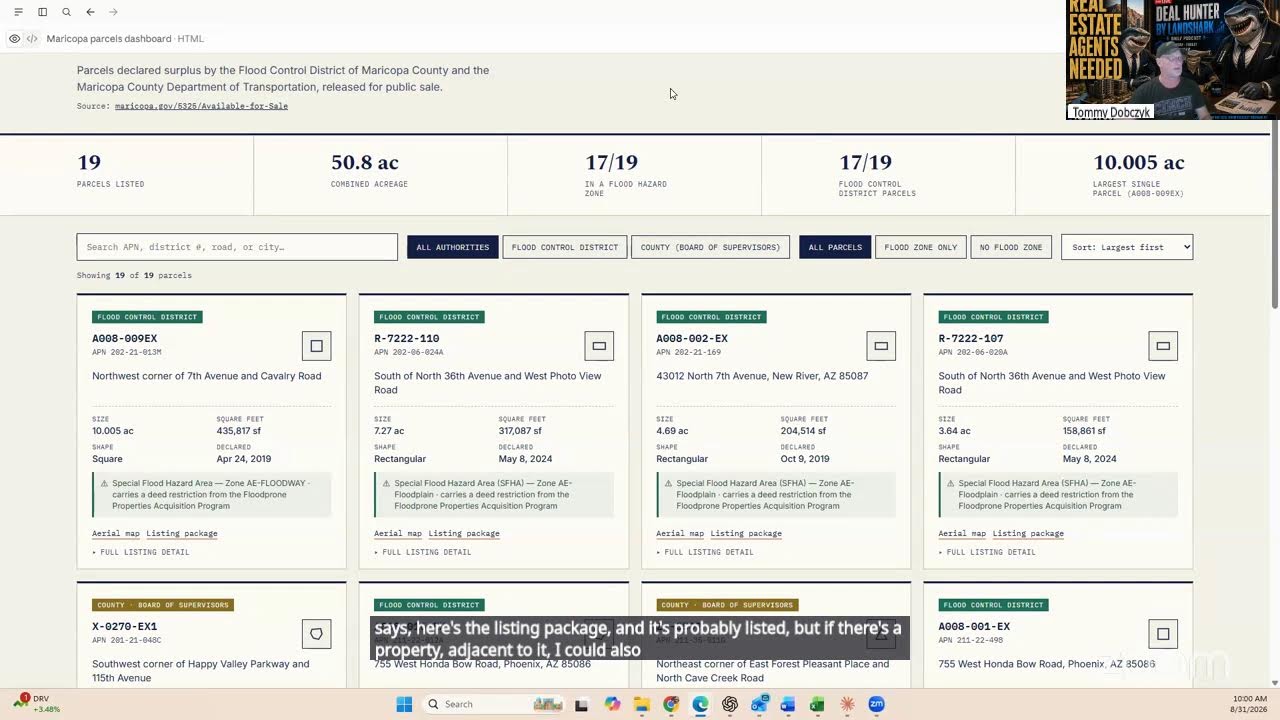
So, I also built out, this was, this was off of a dashboard for excess land available in Arizona. And I'm going to do it for all the states, but this will be something I put out for people monthly. Through the Land Shark Mastermind, I'm going to start putting out these lists because lists are ways for people to, you know, to know who you are and to make money from. So yeah, but this dashboard actually shows like property that was set up for flood control or was used to store equipment. Now they don't need it anymore. So it ends up here on this auction list. Huh.
And it's like a government auction list then?
Yeah, there's a government auction list for, for what's called excessive land.
Huh.
And so, and it, it's not for sale. It's available to, to request for, uh, for, for bid, request for purchase. You do an RFP. And so like, if I want this property right here, I'm going to do an RFP. It says here's the listing package, and it's probably listed. But if there's a property, um, adjacent to it, I could also ask, do an RFP. And this is the map This is the piece of property. It shows it's right in the middle of a floodway. There's houses here and here.
Oh, sure.
Like, it's just a dead piece of dirt, basically. But if, if there's a way that this could be, you can see houses down here are in that floodway. You get what is known as a permit to build in the floodway. You can do that as well. It doesn't look like there's a way to access that dirt.
Yeah.
You know, so based on where it's sitting and there's like—
So are they using it for like CRP or what is, what's the plan with it?
Yeah, you can use it. You can do anything with it. Like, at this point it's available for sale because they just want somebody to buy it and pay taxes on it. So what you choose to do with it comes to that level, right?
I mean, Walt Disney did Amazing things with a marshy flood area.
Yeah, he did. He did. And again, that's, that's kind of the idea. But on this one here, it like tells you like it's odd shaped or what's like, I just like the fact that it gives you all the details.
Uh-huh.
You know, and then if I get interested on it, I'm like, oh, let me go see where, you know, where does that, I want to, I want to pop it up on my map and go see where it's at. Uh, I think there was one that Catherine and I were looking at a couple of weeks ago where Um, we needed like that easement to come through. Remember that one, Catherine?
Yeah, yeah.
So, you know, that's, that's the other part. But it is 10 o'clock. My, my call got— 9 o'clock, 9 o'clock call got pushed to 10, so I'm gonna go jump on that.
Okay, guys, well, I'll go ahead and, and re— reignite my ChatGPT Pro again and I'll get my investor profile done. And that dashboard, the dashboard concept is really super cool.
Well, I can build one out for you too. Let's just, let's get on a call and after you get your, after you get your $20 ChatGPT up, let's get on a call. That way we can build out something for you on your end.
Yeah.
Big house and stuff like that. Because right now, Like, um, ChatGPT just did an update. Um, Deal Hunter, the ChatGPT, um, would go— is— would have gone away if, uh, if I didn't have my developer program on ChatGPT, because they just got away from all people, like personal accounts, being able to create GPTs.
Yeah, you can't create GPTs now.
You can't— you can't create your own personal GPT anymore.
It has to come through somebody like me with an I'll tell you, you know, they had a, they had a plan in place when they started.
Oh yeah. Well, again, everyone knows the Yahoo email, right? Yahoo email. Like, I don't know if you remember, at one point they wanted you to buy it. And basically they figured out instead of charging for the people like AOL was doing, what they said was, we give you, we give you a limited amount of space. And if you want more space, you got to buy that.
Yep, and that's still them. That's still the way they do it now, right? Yeah, Google's the same. Yeah, so that's how it works. Cool, guys. Well, awesome. Yeah, I'll go ahead and get that done. I'm gonna— I have some things I need to take care of, get my taxes done today. But, uh, this has been good.
Well, love it. I'll wrap it up with a prayer. Heavenly Father, we thank you for the blessing of this day and the blessing of this life. We ask that you continue to bless and guide us so that we may always do your will. In your name we pray. Uh, we'll see everybody










