AI Live - Land Shark Mastermind
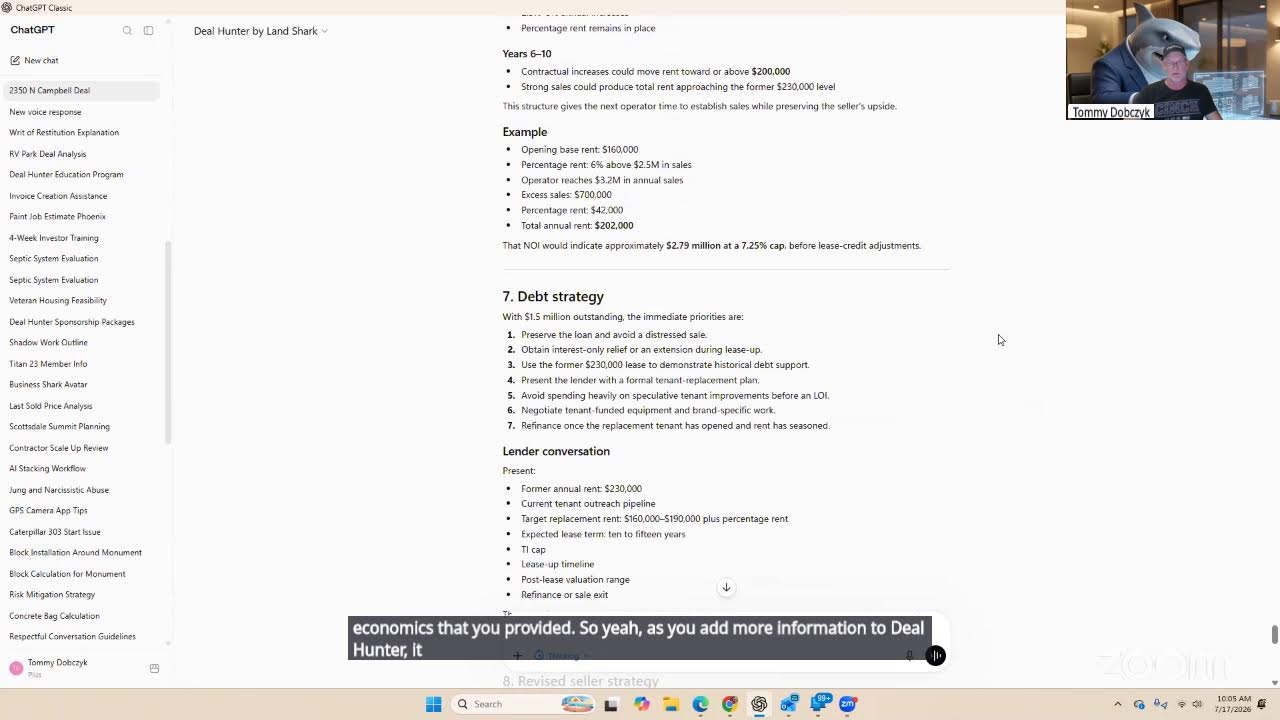
Tommy, Steve Lowe from Surmount, and Catherine Bell demonstrate AI tools for real-estate deals. Land Shark's Deal Hunter analyzes properties like a former Tucson Starbucks, pulling permits and comps to estimate pricing and NOI. Catherine's Virtual Executive Board lets investors consult AI versions of Warren Buffett and Ray Dalio for strategy.
Chapters
I work with a number of investors. Our, our headquarter office, the company I work for is called Surmount. Our headquarter office is in Manhattan. We are known for doing a couple of things. We're known as one of the firms that originated the sale-leaseback in real estate. This is going back to the late '90s when our CEO started this. Our CEO is a guy named Glenn Konofsky. Who, if you're familiar with Marcus Millichap, which is where Glenn and I both started, Glenn was the number one agent at Marcus Millichap for many years running. At one point he was 20% of their revenue by himself, which is pretty impressive. But he broke off and started his company, which he originally called TripleNet Pro, and then started a few sister companies and then decided to bring everything under one brand. Last year and we call it Surmount, which is why when we call people and I say, hey, it's Steve Lowe with Surmount, they're like, who? I've never heard of Surmount. That's because it's new branding. But my buy box and my area, if you will, is going to be single tenant net lease retail, you know, and I like convenience stores and I like dollar stores and I like, I like car washes because they have bonus depreciation. I like gas stations because they have bonus depreciation. So that's kind of me in a nutshell. You know, I, I like to go out and meet people and I'm not shy to say hello or anything like that. And if I can help in any way I can, I'm always willing to do that because I had a lot of help learning this business myself. I try to pay it back.
That's, that's awesome. I very much appreciate that, Steve. And so anybody got any questions real quick before we dive into Steve's deal? I want to do a little demonstration for me. He presented me with this opportunity to demonstrate Deal Hunter, uh, standing there, and it kind of, it kind of impressed him enough for him to show up here today. So, uh, I know it's kind of impromptu, but do we have anybody that has anything pressing right now?
I mean, I'm excited to dig further into having the conversation with Steve about all the things.
And sure, yeah, I see that. So normally we have a couple other members that are here, like Blake, Katya, Tracy, Amor, um, Cicely, Tina, whatever. They'll, they'll come in and they'll have deals that they want to run. And, and, um, um, and what we'll do is we'll end up either, you know, finding out whether or not we want to do it, or we'll discover that it's time to, to, to start putting pen to paper and make an offer. Yeah, you know, in real estate you got to make offers if you want to get closings. So yeah, um, we use Deal Hunter by Land Shark, the thing I demonstrated for you last night.
Yeah, that was pretty impressive, Tommy. Uh, you know, and, and you guys, I'm telling you, I— he right off the cuff— I put him on the spot too. I said, all right, here's an address. And, uh, you know, and the stuff that it came back with was really impressive considering that all I gave him was an address. That was it.
Yeah, these guys know that, and, and that's what they're— that's why they're still here is because they love the fact that when I— when they just put in the address and then tell them, like I showed you last night, I said run this deal and that was it. And it supplied all the information off of that. By the way, uh, what Steve positioned in front of us was a property that's listed. And I didn't get the opportunity to show Steve this last night, but when we built Deal Hunter by Land Shark, we built it in the way that it does research on property like a scientist does research on on a realistic disease process. And so inside of that, it shows that it found multiple sources to pull information from, such as permits, permits that were issued, Instagram Q1 market reports from— wow, that's in the area— Realtor.com reports, Homes.com, Kitter.com, like they're, they're going to add to this to kind of like, again, pull the comps and pull the market data. So when, when you asked, is it GPT's answer or is it, what is it? It's scrapping data from across, you know, across many, many sources for just this one answer off of one prompt. It, it pulls all this information. So And one of the things that I think you were surprised by was that when it pulled it, it said that— it asked the question, why did Starbucks leave?
I was blown away by that. Yeah. I mean, that's a really good question that, you know, people occasionally ask me. To give you guys a little bit of background on this particular opportunity, this was a build-to-suit for Starbucks. And the deal was completed in 2024. And then in 2025, and they had a 10-year lease with Starbucks in place. In 2025, the new CEO of Starbucks decided that they apparently they overexpanded too quickly. They're going to shrink their footprint. So they closed 7 stores in Tucson. This was one of them. And they'd only been in the property for 9 months. And it took a while. But, you know, we're in a position now where we negotiated a buyout with Starbucks that's over and done with. The owner of the property got his check from Starbucks and we're just trying to find the right investor partner for it. I have a few offers on it. I have one offer with a developer that I think is going to make— I hope it does— knock on table. Hopefully this goes through. I should find out here in the next few days. But yeah, I was, I was really surprised. At some of the questions it asked, because this is stuff that a human would ask, not necessarily AI would, would think to ask this. So I was very impressed by this.
So what I'm going to do here is I went, I went over to the, the LoopNet listing and I, let me pull it up real quick so that we can see what it is that I grabbed over here on LoopNet. It just had this and I just All I did was just said, print this document. We're going to use this as a case study only to the fact that, that I want to— because you're the expert on the property, it, it goes, it shows to the validity of the, of the, of the app.
Right, right, right, right.
So I'm not trying to— so I've showed people and I'm only saying this because I— we really need to come up with a disclosure document where you can sign it that You'll have no hurtphilioma and you will suffer from no hopium if the report comes back incorrect. So because many times we'll give people this report and it'll say your deal sucks, you need to work on it. And they get what we call— they get hurtphilioma. And then we have to build into it some hopium so that they go away happy. And we don't like to do that too much. Gotcha. In this sense, I went and just copied that we had gone over. I got a preliminary off of it last night and It provides us with some basic strategies and basic information, which we, we look for. One of the things is the major red flags. It says, why stay Starbucks vacated? I love the answer you provided. As far as everything else, we can kind of go through that stuff if we needed to or wanted to, but it gave us a conditional go based on, based on some information. Now we want to write the information. We're going to, we're going to use the sources it gave them, tell it review the document and compare to the current report. And so it's— I love ChatGPT for the fact that it will, it will contradict itself and then tell you it contradicted itself. Or any AI does that, actually. If you produce a document and then you have information and you say, find the discrepancies, I love that it does that and it does it so fast. Right? So, uh, according to the uploaded document and prior report, uh, everything seems to come back checkmarked, confirmed, all the way down. So obviously what all I did now is validated that the information that produced the first time matches what is on your report. And without you sitting here, I— this is how I would do it to verify and justify it, right? So, um, it says here former Starbucks, and, and it's trying to answer the questions that it had before. So one of the things we'll do is we'll go back in here and we'll grab what it said about the major red flags. And we'll, we'll create— this is where you got to be kind of become a prompt wizard. I'm going to paste it in here and then I'm going to tell it to try to answer these questions with the current data. So, and sending that up, um, and, and so we'll sit here and, and we'll analyze deals until we get a solid go. And when we get a solid go, we go over to what's called the VERT REI Virtual Executive Board, um, and this is, uh, this is something you may or may not know, uh, a lot of people use, uh, AI, uh, don't know all the cool tools and tricks inside of it, like It's like owning a Tesla. I don't know if you know, but with a Tesla you can make it make fart noises while you're driving, right? And so these are little hacks that, that people don't really know about unless they, they own the vehicle and they play with it and stuff like that. So with as long as I've been on ChatGPT, Catherine Bell had identified something I never knew about. Catherine creates what's called the virtual Virtual executive board. I don't know why my computer's being so slow. And inside of a virtual executive board, I'm going to stop it from thinking right now and restart it. Hold on. Catherine, do you, you do a better job of explaining your reasons for the virtual executive board.
Um, so it's a virtual advisory board and it comes from, um, Napoleon Hill. And, uh, when he talks about when you surround yourself with, um, you know, people smarter than you. And so, uh, I was— one of my companies, I was working on a project for several years. And anyway, uh, long story short, I needed to have a conversation with somebody who was way farther along in the path than I was, but could see the bigger picture and everything that we were creating. And so, you know, I just literally thought to myself, who could I— if I could sit down on a table with anybody, who would it be? And so then I thought, with AI, I was like, wait a second. So long story short, I built my virtual advisory board. It's Warren Buffett, uh, Richard Branson, Ray Dalio, Tony Robbins, Sarah Blakely, and Jamie Kern Lima, all because they're billionaires and they think very differently. And I just wanted them to, you know, when— 3 things I know about, you know, human beings is that, um, when— where things go south is when we believe our own BS, we're impressed by our past accolades, and we take our own advice. And so I uploaded everything and had a whole conversation with them about, you know, where it was at, where I was going, all my thoughts, and told them, you know, like poke holes in all the places. And they literally for 20 minutes ripped the whole thing apart and told me everywhere where it was going to blow up. And then they came back and they had a whole conversation with each other, and I was able to like be a part of the whole conversation. And they said, now you, you do this and you structure it this, this, and this way. And it was things that my team and I had never even thought of. And they said, you do this, we are all a hell yes, we're in. And that was like, it changed everything forever. So that's how I got to surround myself with billionaires and think very differently about my companies.
And to that point, what Catherine built for me was my real estate— I call it the Real Estate Investor Virtual Executive Board. And this is just an example or demo of what I did, was I took all of the, the project plans to a, um, a new home built. There's going to be a new home built. And I said it to my executive board, I said review the documents, uh, uh, and then put together, you know, the opinion of everyone so we know if we're going to move forward with it. Find— and again, this is where I said find discrepancies. And so what it does is it goes through document by document, identifies discrepancies, identifies concerns, gives me red flags. But then what it also does is when I get down to my executive board My executive board are, are real estate investors. Grant Cardone, Robert Kiyosaki, Pace Morby, Cody Sanchez, Steve Train, Catherine Bell, Gary Keller. And so I use all of those personalities to then have their brain tell me where there might be issues that I'm not going to see because I'm just a developer. And so, like, for example, getting, getting the perspective of Pace Morby, Cody Sanchez, Catherine Bell, it's coming from their own interpretation or their own, uh, belief system or their own, uh, strategy inside of real estate. And so now I've got, instead of one concept, I've got multiple. And then they also give me a board consensus and stuff like that. So what I would end up doing is taking, you know, taking, uh, if, if your deal came across our desk and we ran it and we were like, okay, we can definitely do something with this The first thing we would do is tell it, go ahead and conduct a feasibility study. We'd like to see what the opportunity is to come back into this building with either a different brand of coffee shop or go into it with something else that would work here. Give me 5 options of what that would look like for us. I'll start to get it thinking on that, but this will turn into a report that I then take back and feed into the REI Virtual Executive Board. And so then I'll be able to get a different level of report. I'll be able to talk to it. It'll tell me, for example, once it's got its own idea or understanding and I've built that knowledge base on it inside of that conversation, then I'll ask it to create an ideal client avatar and give me the ideal client avatar. Who do I talk to and how do I build rapport with those people? Who do I advertise to? And so, um, inside of this system right here, for me, it's okay when I apply the team to it. Like right now, we have, we have Blake, who is, who used this system to find a property in, uh, Oklahoma, where we have another member who is a broker who was able to actually go out and walk the property. And we're looking at turning this 42-acre industrial lot into 6 industrial lots that we then sell off to basically double our $12 million acquisition fee. And by splitting it and selling it off piece by piece, we're basically looking at a, you know, a 2x on that. So, and we're doing it through what we, you know, how we, how we handled it inside of here. So the tool itself really does go deeper and further inside of, like I showed you, the free estimates where I did a TI package and built out something that would resemble an estimate. Wanted to make sure you got to see that while this is cooking. Inside of Free Estimates when I just gave it the simple address and told it that I needed a commercial build-out. What it comes back with and what it's able to tell us is like every single aspect that would be necessary and what the dollar amount of that could be. And then the nice thing is, is you can recalculate it and change its mind multiple times without suffering the change orders of an architect and a designer. You can sit here and continue to to have the conversation back and forth with it to get it down to the price you want it to be. So for example, if I wanted it to get down further than $136 a square foot, I just simply tell it, you know, I want a budget that fits $89 a square foot. Rework the numbers and tell me where we're going to have to cut. Tell me what we're going to have to remove and rework all the numbers, please. Wow. So, and, and this again is hours. Like, I've been doing— you were a general contractor, uh, you understand this. Um, I would, I would have to sit with a project with blueprints on my desk and budget and budget and budget for hours. I'd be in that office until 11, 12, 1 o'clock in the morning burning, and I would, I would drink Mississippi Mud just to keep myself awake long enough to keep getting that budget done so I could hand off the next day to the estimators, you know, and get them busy shopping, you know, so they could go find everything. So because it all came down to me, like I was the one building it, I need to make sure that those takeoff reports were full and then nothing missing. So if I turned it over to, to, to an estimator or a jobber and they were like, oh well, you didn't order enough 2x4s I knew for sure I ordered 450 2x4s. If you only bought, you know, 350, that's not my fault. Like, now we got, we got to figure that problem out. And, and inside of AI, it's really been amazing in how it's able to do that. So, um, you know, here's the example. Like, we took it from the $136 and dropped it, you know, dropped it down to, to $89 a square foot. Now it's going to show us where we're going to have to cut our costs and, you know, may have to, you know, eat some labor, you know, sending in the family to take care of it instead of hiring somebody, you know, whatever it is. So, wow, this is an add-on to it. And that's kind of how we try to operate within this. Once we get a deal, once we get something sourced, Catherine is, Catherine's in the private equity world. She's got a fund called Titan 23 and it operates in many verticals, everything from data centers down to, you know, iOS parking lots. So we are basically buying up anything in those spaces. We're not typically asset, we're really asset agnostic because We're buying it and positioning it for other investors to purchase, and we're getting it stabilized and/or repositioned for other investors to buy into. So when it comes to your buy box, we'd love to know how we can go out and continue to expand what it is that, that you're doing at Surmount and see if there's a way that Titan Impact Group can contribute to that.
Cool. Yeah, I mean, this is like you're miles ahead of where we are with implementing our AI plans with our company. You know, we're like the stuff that I'm doing. I could show you some of this another time. I'll show you some of the stuff that I've done for my brokerage practice. But yeah, this is miles ahead of what we're doing and using ChatGPT, not Claude. Interesting.
Well, and as I told you, the reason why we were doing it this way was because of its ability to front face for our clients. And what I mean by that is Claude, I can't send you to use my Claude conversation for your own purposes and then get a response back like this. I'm trying to find where I had a response back. Where basically I'm able to install a call to action every fourth response. So when I go, you know, when I'm building, when I build out this thing like this, it'll, it'll come back with a response that'll say, you know, click over to the Land Shark, you know, the link I sent you this morning. It'll drop that as a call to action inside of our conversation. So if somebody outside of, outside of our ecosystem is using this because That's to me, it's kind of the point. That's kind of what I want to do. Then that's what we're able to do is, is get that call to action where they're showing up outside of this. So for us, ChatGPT is a B2C, a B2B component, kind of like a business card. And so we use, we use the AI tools inside of there. The AI, they're called AI models. We use those as a calling card. So And, and one of the things that's kind of like a, a proof of concept for us on that is when you go to the GPT marketplace, you've already got big name companies like Expedia and Canva inside of here who have also understood the benefit to this and are putting their own business cards on here. Right? And so all these different— these are agents, basically. They call— GPT calls them models. Claude calls them agents., and, and so Kleenex, you know, tissue, same thing. So, but every one of these agents, every one of these models in here produces something specific. And when I build it, I can build into it, other things like this one down here inside of the education, for example, I use this legal and contracts one to actually ask smarter questions to my lawyer. And so this is actually ran by a lawyer. I know the lawyer that built that with this group. AIresearchplus.com is a great resource. They do amazing GPTs, but they weren't able to— they weren't able to really get, get too deep with me online, but they're building some really cool ones for sure. So we build GPTs custom. So like when you said you're— we're— you're miles behind us, we can speed you up really fast. Like we can we can turn on the 1.21 gigawatts and get, get you, you know, like Michael J. Fox, Back to the Future. Because the, the way Catherine has been able to design these things, like we built— this is a client that we had come in. She's a broker inside of the, inside of the, the jet world, private jet industry, works over at Scottsdale. And so this is her personal private jet charter intelligence GPT. And so she's able to go on here and, and find, you know, find holes to fill dead legs, um, put, you know, recommend best aircrafts for clients because she has clients that buy jets, not just fly jets. Um, and then putting together like evaluations for trip requests, priority, uh, quote. Like, she, she uses this thing for all sorts of things. So inside of her program We have one that we built that does for the Opportunity Zone program. I don't know if you're familiar with that, but that's the new One Big Beautiful Bill Act where you can now take your capital gains and instead of doing 1031 exchanges, you're going to be doing the, doing the Opportunity Zone investing. And by doing that, you're eliminating future capital gains taxes.
And so I'm familiar with OZ investing. Yeah.
Are you? Okay. Yeah, well, we built an OZ Wizard GPT. Myself and my partner Roman are both certified Opportunity Zone advisors. And so we partnered with Catherine and Dr. Ning-Yong Chan on writing what's called OZ Wizard 2.0. The Playbook. So, it's a 600-page manual on how to break down, establish, understand, function, and develop Opportunity Zone funds and projects. And then, we also have, as a great going-away present, we have OZ Wizard. Ai, which is a clone that you can— it's a clone of myself that has all of the OZ regulations, rules, laws inside of it. Like, I've got a little bit in my brain, but the way that AI and ChatGPT work and all that, we use Claude to build out the knowledge base for this. And so if you actually hit the call button, You have to register so that it'll use it, and what it'll do— oh my goodness, I did not know I made it this difficult to play. Hurry up, hurry up, flip back and forth. I got a couple email boxes, as you can see. Come on, Catherine, does yours do that too?
Everything's being slow this morning. I think we have to reset the internet. I think the weather is definitely impacting everything we're doing.
Probably. Here we go, log in to Delphi. 899-375. 899-375. It's good to have eidetic memory sometimes. Oh my goodness. Good morning. I'd like to— Tommy's Digital Mind. How can I help? Yes, good morning. I want to have a conversation about Opportunity Zones. Can you give me a brief summary about how you might be able to help me do that? I can help you think through Opportunity Zones from a few angles. I've been working in OZ development for a while now, and I can walk you through the tax strategy, how to structure a deal, how to find projects in your area, or how community benefits fit into the whole picture. Most people come in asking one of three things. They've got capital gains sitting around and want to know if an OZ investment makes sense for them. They spotted a property or project and want to know if it qualifies, or they're thinking about raising capital for development in the zone. Where do you land? We're looking to deploy some capital gains and we're going to need some guidance on how to do that. Do you have any suggestions? Yeah, I've got plenty. First thing is figuring out what you're working with. You've got capital gains sitting around, which means you likely sold something or cashed out an investment. The clock starts the day you recognize that gain for tax purposes, and you've got 180 days to get the money into an Opportunity Zone fund. That's your window. Here's what I'd want to know. Are these gains from business sale, real estate, or stocks? And do you have a sense of how much we're talking about? It's— and so you can see there, Steve, that like now I don't have to have endless conversations with people about Opportunity Zones. It has all the information right there for them. And then once these people have built up a level of trust in what information they're getting, then they're going to be prompted by my AI to then book and schedule a call. Catherine has one. It's called CatherineBell.ai. And how many conversations have you programmed?
How many conversations? So mine, under over 118,000.
Wow.
And, and that's only been since November of '24, right?
Correct. Yeah.
It—
and I— yeah, and I've raised the first— anyway, you can tell the story about that, but yeah, within the first 3 weeks of releasing it with my first 3 international bestselling author books, I raised over $11 million completely by accident.
Like, wow.
Accident. I love the completely by accident part.
Well, because that wasn't like— it wasn't like we're going to do this and this is the result. It was—
no. Yeah, it wasn't intentional for sure. So but basically inside of that, we host this mastermind every day. I seen Blake peek in. Where are you at, Blake? Balaka. I'm here.
I came a little bit late.
I see that. Are you driving or you got updates on— do you have updates on Oklahoma? Um, I don't have any updates so far. I was gonna work on it. My high school volleyball team kind of had like a reunion, so I just got back from that. We were playing on the beach courts this morning, um, so we were doing that. But I'm gonna upload the Facebook ads right after this, and that's kind of all I have so far. Not much of an update from yesterday. Sweet. Well, I appreciate you checking in, and, um, we'll, uh, we'll round back afterwards, uh, if you want to review those Facebook ads after your celebration with your high school buddies and stuff and enjoy that, dude, because as you get older, the buddies reduce and the time you get to spend doing that disappears. So Blake's like, what? What are you, 21, 22 now? Blake, 24? How old are you?
I'm 22.
22. So enjoy it, brother. Don't, don't, don't get bogged down by old people trying to work and make money. You know, go out, have fun, and then when you got time, hit that stuff and see what you got. Oh, Cicely's here too. Hello, Cicely. I want to make sure I do as well. I'll balance it all out, but I fully agree. Those moments, they definitely don't come often. Absolutely, dude. Enjoy them. So we'll catch up on that deal later. Cicely, good morning. I want to make sure that we give you a chance to say anything if you got anything you want to throw in.
Good morning. Yeah, no, I don't, I don't have anything. I'm just watching. I love the, the AI, like, what did you call it? The board of—
Board of Advisors.
Board of Advisors. And yeah, well, we can, we can show you. You're, you're, we've got to set up a webinar for, for new, newer members to get that virtual executive board downloaded because it's, it's really simple. There's just a couple of things that you have to copy and paste into your projects folder. And then you're, you're giving it just the instructions on how to operate. And then once, like I said, once you have a deal, uh, ran through Deal Hunter, you're able to actually grab that deal and inside of that conversation and go and share it inside of the folder, uh, inside of the project folder. So you would basically, you're basically able to send that into your virtual executive board where it's able to then dissect it and do stuff with it. So. Um, it's, it's very helpful, very useful, because again, I'm only as good as what I know. And then if I don't know it, how do I find out about it, right? And I— and including other people is important. But I think Catherine hit like gold when she came up with this idea, concept, or whatever, to go and find experts out in the world, bring them into the virtual space, and get them to work for her. Yeah, right.
And maybe give clarity, like where, like, things are kind of cloudy, like give help, give insight. I think that that's— it kind of helps with being unstuck in certain situations. I do that with Tony Robbins and Allison Armstrong, but that's more on an emotional level. So understanding how to do it more like, um, as an investor and financial, like, with financial advice would definitely, I think, help excel me or help me excel. So I like that.
Well, the same rules apply. Whatever you're using for your personal life will be helpful and beneficial to you in your, in your professional as well. So you can always—
mine's different. I just say, please help me, um, understand this from this perspective, from Tony Robbins' perspective or Alison Armstrong perspective. And actually, it's like a coach, kind of like if I find myself in a situation Boom, I get— I hear one thing and I'm like, okay, I'm good, I'm good. This is what I got to do. So that's—
that's—
I'd love to do that.
And when it comes to doing creative finance deals, that's what we do inside of using it with— with like, I've got to do a creative finance deal. I know that the— the knowledge that's free to the world that Pace Morby has created and made free to the world so he can increase his brand and visibility. I'm able to capitalize on that. I mean, it's right there on the hat, right? Capitalize. I'm going to capitalize on his social media presence to benefit my understanding of how I can get different deals accomplished. So he's put out so much information that why would I want to go and rewrite the wheel myself? I can just say, hey, you know, Virtual Board, what would, what would the virtual Pace Morby do to get a creative financing on this? What would, what would the virtual Pace Morby say? And it's funny because I have multiple virtual boards now. I don't have just one. I have one for real estate. I have one for marketing and sales. I have one for myself, like my own LLC has its own virtual board and it's a completely different board than the other ones. So, but on my sales board I have like, I have a couple of sales gurus that are on there where if I need a good sales pitch or copy, I'm able to get it. Like, Tai Lopez is the master at being able to say something on the fly. And so that's what makes him good, is that not only does he say something impactful, but he says it on the fly. It's like he does— it's unrehearsed. Boom, he just spits it out. And the best way to do that for me is to go and use the— my virtual board for sales and say, give me a Tai Lopez sales pitch. Boom. So it's pretty amazing that stuff happens too.
I love it.
Hopefully I didn't lose Steve. Um, uh, I'm here.
I, I was just getting, uh, peppered by somebody in regards to this deal in Texas I've been working on, so I just had to shoot him a quick text message. But I'm here, I'm listening.
Oh, no worries. Um, I wanted to make sure that we invite you to come back and and share deals with us and let us know what kind of details and deals we can get into with you, as well as maybe set up a one-on-one because I'd like to see what you guys are using and then maybe have Catherine do some analysis on that because she could— I mean, she builds out stuff for family offices all the time. She's got references to other family offices that she's built in AI 2.0 integration to that is mind-blowing.
So, yeah, you can go to my LinkedIn profile and read all the things that people say about what happened after working with me.
I love it. You know, just to clarify, so there's really two entities that I work with. You know, we have a family office based in Tucson. Our family office is as old school and archaic as it gets, short of, you know, the fact that the head of our family office, who's my aunt, she uses email. That's about it. But our company, Surmount, we're just kind of taking baby steps into AI. We have several systems that are not really friendly with one another. You know, we don't have a good system. Like, for example, we've got over 100 agents and everybody uses their own CRM, even though our marketing team uses Salesforce. And if we're going to put a listing together, we have to use Salesforce. So we don't use Salesforce really as our primary CRM. Like, I use HubSpot, for example. So, uh, but so it'd really be more of like a Surmount discussion than it would be, uh, the, the Steve Lowe family office discussion, because there, there's no modernizing that. That's just not going to happen. That's like, uh, you know, take— that's like taking an old, uh, like 1968 Mustang and, and trying to put a new engine in it.
It's just not not going to happen without a lot of modification, hammers and sawzalls, right?
Yeah, exactly. But the other one, Surmount, they're very willing to listen to ideas. You know, and I think I mentioned this to you yesterday, Tommy. I have a friend who's an anthropic scientist. He's using a version of Claude that's several levels above what you or I could get access to. He works for— he's the lead developer on a project for this company called Qualia. And if you look up Qualia, they're basically like an AI mortgage company. They do title and escrow and mortgage. So, you know, he's one of the lead devs on that project. And so he's been very helpful to me just in terms of the direction that I've kind of taken my AI setup with my brokerage business. The stuff I'm doing now is like, like nobody at Surmount is doing what I'm doing. And I'm now getting the attention of the higher-ups, the C-level people at Surmount. They're saying, how come everybody isn't doing what you're doing? And, you know, and that's just because the brokerage business in general is very behind in terms of technology. You know, there we have all these different systems, these different giant swaths of data that we just don't have a way to update, uh, other than manually. And, uh, we don't have a— we don't have really a good system to sort of bind everything together. And that's definitely something I've been solving with my own personal setup, which is just Claude right now, just me, like just a $20 a month Claude plan. And I've been able to do some pretty incredible stuff, I think, compared to— certainly compared to what I was doing before AI.
Yeah, that's, that's amazing. Catherine actually has an AI integration program where she builds out a Rosetta Stone, provides the AI voice and does a, does a, the virtual board. But she can also build out a team of agents or multiple GPTs like this that, that work inside the background of, you know, large teams in development. So I would love to have an opportunity to schedule a call and meet up to do more discussing of that because, you know, if you guys are doing these types of things, just a little background, 2020, I'm sorry, 2001, 2001. Geez, it's so hard to be like 2021 and 2001. It's hard to imagine that 20 years is already gone. But in 2001, I was a roofing contractor in the state of Florida and had been doing developments and building projects, and I was investing into pad developments. And so I was building out shells for 7-Eleven and worked my way up to eventually— oops, somebody got in a car accident.
No, they backfired.
Okay, that was loud. I felt it in my feet. Very loud. Anyway, the, the pads that we were building out and buildings that we were building, gray shell, we were building out for like everything from 7-Eleven to Goodwill. And we could turn a Goodwill into a Lowe's like that. So if Lowe's showed interest, they were a much higher credit client than Goodwill. And we could literally just pass Goodwill down the street to another, another shell. And, and build, you know, build in Lowe's right behind it. So, um, we were doing a lot of that in Central Florida back in, in '98 to 2005. So, um, and that was where my background was, was doing that kind of stuff and development in my early 20s. So, um, enjoyed a lot of it. But, uh, it— so I— it speaks to me when you're like, you know, you like these retail things in, in, in these, uh types of areas. So the report that it did provide back to me, uh, real quickly is that, um, on that feasibility study of the location there down in Tucson, um, it provided back to me, uh, a variety of ways that we could, you know, come into the building. Everything from a regional coffee breakfast drive-through concept on down through bagel, the, the health food market, the Tucson breakfast, like you get a Filiberto's in there possibly, you know, just a breakfast Filiberto's, medical retail pharmacy. These are the, you know, things in my head that pop out already. And what I enjoy is that Deal Hunter does that because like it goes back to what I learned a long time ago and then brings it forward and says, if I'm asking, if somebody asks for the 5 best opportunities there, at least it's going to supply it or try to, right? And then also providing me with— I've always, when I built this, I built into it, don't provide me with a problem, provide me with a solution. Show the problem but provide the solution to it. And so funding paths, getting SBA funding, getting bank acquisition, seller carry, uh, with, uh, tenant, uh, plus tenant equity, like there's quite a bit that, that it'll put, you know, put forward. But the larger the language I use with it— right now I'm just using basic prompts— but the deeper the conversation I get with it, the bigger the deal becomes. And so, for example, I'll just give you a quick— I want to create a pro forma for the possibility of having a health food store give me a pro forma spreadsheet built out for 5 years and so that it is SBA ready. I want it to be able to pass an SBA loan package. So prepare it at that level. And so what it'll do from here and not sure that it can do it in the amount of time we have left to do it. I believe I have some examples of what it's done already that I can show you.
And while it's doing its thing, you know, I was curious, did it have a pricing recommendation? And if it did, what was it?
The pricing recommendation for the, for your property?
Yes.
Um, yeah, well, it's going to give it to me as an investor, right, and tell me, and like, I, the, the, the strongest offer to— it's going to be a lowball offer, it's going to be a tank offer because I'm an investor and that's what it's trying to get me down to. But it said here that, um, indicated as-is range was $900,000 to $1.1 million. And so that's what it's telling me to offer based on current conditions, etc., etc. I can immediately turn this around into saying I'm the, I'm the owner of the building and I need a, I need a better valuation of this. And so give me the value based on that. So here it gives the value sensitivity. On stabilized NOI and cap rates. So it ranges from 1.2 to 1.5. So I don't remember what I— do you have a price listed on the LoopNet one?
No. What— why is the— and I know like, like I'm looking at this like these are good talking points, right? This is good information to kind of get a discussion going as far as the actual opportunity itself. Put it this way, Starbucks, when they were a tenant, they were paying $230,000 a year in rent.
Right.
So, you know, when I see things like the NOI is $78,000 or $123,000, to me, that's too low. That's very— that's way too low, unfortunately. But, you know, I also understand this isn't a person coming up with this. This is AI. AI is scarily good at some of these things. I can also tell you that the seller has— One important consideration for how you guys are coming up with pricing is debt. The seller has debt on the opportunity. He's got $1.5 million in debt. So, you know, the idea that he would like, and we're getting specific here, the idea that he would sell it for say $900,000 to $1.2 million when he has $1.5 million of debt, it just, it wouldn't pencil for him as a seller. So, but again, you know, I think the overarching point here is this is really good at sort of provoking a conversation internally, especially if you're an investor and you're looking at some of the things like I was really surprised by some of the things that came up with like why did Starbucks leave? I think we mentioned that one. So I think that there's some really good points in here. I will say that the way it's calculating the stabilized NOI, the stabilized NOI of this property when Starbucks vacated was $230,000 annually.
So who else in the market is paying $230,000 for that size building except Starbucks?
Yeah. So I mean, other Starbucks locations are getting close to that rent. Dutch Bros is getting close to that rent.
Right. You know, I imagine if we did get a Dutch Bros in there, that then, then it does equate. But if you get a, if you get a Filiberto's in there, I know Filiberto's personally, they wouldn't pay anything over $130,000 a year in rent. So that's, that's why they'll go.
We're, we're very close. We're. Yeah. And, and we're very close with a developer who has a national restaurant tenant. Who would be paying Starbucks-level rent. And so—
and this is the beautiful thing about this, is you can actually go into this. Yeah. As it's, as it's continuing to do what it's doing, you can tell it, listen, like, the numbers aren't making sense and here's why. And then tell it how to go and get that. For example, when I— I love dirt. I only, I only play in dirt. I only like to do dirt. So when I do dirt, I tell it, I want it to be over an acre or over a million. It can be one or the other, but it has to be one or the other, right? And I want it to be only 40% return or higher possibility. So it'll eliminate, it'll eliminate, you know, 90% of anything under 40%. So I might get 100 leads and then I'm left with 10 because of that 40% thing. So right here I would say The, the previous tenant, Starbucks, was paying $230,000 on this property. So we need to readjust the value based on that. And we need to understand who the next viable operator is for this property. We currently have $1.5 million in debt on the property. So adjust the numbers and look at this from the seller side.
Be interesting to— so now that you have that information, it'll be interesting to see how it changes.
It will. It'll, it'll, it'll, it'll completely rewrite it because again, when it's built for me, Deal Hunter is built for Tommy D. Yep. So Tommy D is not going to pay top dollar for anything. I'm not Starbucks, you know. And so it's going to shop, it's going to deal hunt for me, if you wanted this to deal hunt for Steve, we could literally build it out to be the Surmont model so that you guys have exactly what, what it is that you're looking for, how to find it, and you can set it up to do this deal hunting for you on a daily basis where you're only coming in analyzing stuff and actually instead of actually having to fish for it, you know. So and then when you do find something or you do have something that's problematic, You're like, I see how the world sees it, but I want to see it how I can do something different. That's the beauty inside of Deal Hunter is that if it's telling you your deal is a shade of green you don't like, you can tell it how to, you know, ask it, how do I get it to a different shade of green? Or how do I make it get greener? Because it's a dark green and I want it to be a really bright green. With lots of money coming out of it, you know. So, um, the, uh, uh, NOI and stuff like that readjusted shows that these values then change closer to probably something you're more, uh, inclined to, to, to accept with the 1.5. And now it'll build into it the 1.5 debt so that you know what your estimated proceeds are going to be. Then you've got your replacement rent sensitivities that show up, and it should say who you're looking to bring back. And there you go. BlackRock, Dutch Bros, Seven Brew, uh, Scooter's Coffee. And so all of these should be the, the credit A-rated tenants that you're looking for. So, uh, breakfast bakeries might do well there. So, um, so again, what it's built to do is shop for me. What we can tell it to do is then act, act in your position.
You know, yeah, this is where good market intel really helps with the input into this model, because if you knew, if you had that information when you did your calculating, so, uh, like if you knew Starbucks is paying $230,000, or you knew, like, uh, you know, uh, had an idea of that anyway, uh, that would have really helped, I think, or the amount of data.
What it does is it allows— I tell people to use Claude. Claude's like talking to— to me, a $20 version of Claude is like talking to a graduate student. So I have a small science degree, and so I've had those conversations with graduate students, and they're very— it can be very insightful, but it's almost like reading from a garden hose. Or reading from a, a book, right? And so ChatGPT is kind of the opposite. It's like teaching— it's like teaching a, a toddler all the way to a high schooler in the matter of a 30-minute conversation. I'm going to be very basic and then kind of build up on it at like building blocks and build into it a knowledge base that makes sense. Because in the first assessment, it provided me with a, a basic level of this is the going rate in Tucson. Tucson is only $18 a square foot. So that's the data that it found when it went out looking was that it's only $18 a square foot. But when you tell it, okay, well, we have a AAA-rated tenant called Starbucks. With Starbucks leaving, that does Essentially, let's just pretend they were there for 10 years and finally went out of business instead of 9 months. That story isn't even understood by human beings until it's disclosed. So, right, AI is the same way. Unless it was disclosed it was only open for 9 months and that it was just kind of a spoof, then it's going to look at it and say Starbucks left. This is bad news. No different than anybody else until you say, oh, well, it was only because it was there for 9 months. And there was no choice. So now value goes up. It's no longer a distressed property. It's a, it's a unique opportunity property. So, but that, that is the recommended updated version. Now, updated recommendation is that, you know, approximate value, $3 million to $3.4 million. Does that sound different? Does that sound along the lines of what, what it should be?
Yeah, I think we can do a little better than that on pricing. We're probably in the mid-2s. Realistically, like mid-2 to 3. And that would be—
I think that would be acceptable for the 7, 8, or 9 cap right there based on the rents, you know, the economics that you provided. So yeah, as you add more information to Deal Hunter, it's going to— it's going to do a good job of that, of getting it figured out. The example it provides at a 7.25 cap, you're at a $2.8 million price tag. And that's before the lease credit adjustments, right? So it knows the vocabulary, it knows the, it knows the, uh, it knows the, uh, the algebra, it knows how to do the word problems, and it does it really, really fast, which is very, very beneficial when you have a lot of work to do. Um, I like to do quick work, but when you have a lot of work to do, this thing does a great job of putting that all together. Uh, on a final note, I'll wrap up. Is, is that this is that call to action I was telling you about. After a certain amount of, of, of prompts, it eventually it'll say, become a deal hunter, go join the live stream every day, 9:00 AM, blah, blah, blah. And then it points you straight to the webinar that we're on right now. And so it begins my top of funnel from here. Uh, we're able to pull people in, they come to join the live stream, and we talk about their deals.
Yeah, I saw that you have different product types for different days. I think today is your, your OZ day. You have a commercial day, you have a residential day. Are you still doing that or is it—
No, as a matter of fact, we've kind of changed the format up to be like whoever comes in and has deals because we, we thought Deal Hunter was like asset specific. And the more we used it, now we're at, I don't know, several thousand conversations. It's actually able to run deals on, on Barrett-Jackson automobiles that are going to go up on the auction block. I actually used Deal Hunter to discover what the value of a 1963 Thunderbird was, and it went through it, used the VIN number, and it went through it, looked at the the condition of the car, because I fed it some pictures, and I said run this deal, and it came back telling me that the car, you know, at— as his condition was around $14,000, but if they did all the work to it, cleaned it up, and had it roll across the stage at Barrett-Jackson, probably achieve, you know, $40,000 or $50,000. And then we went back and discovered that that's exactly what happened. So, uh, it's pretty amazing that it did that. But, um, it is 10 o'clock. I don't want to keep it— I want to be respectful of everyone's time. So We wrap up every day with a prayer to the Heavenly Father. So, uh, God, we ask that you continue to bless and guide us, give us the tools and equipment necessary to go out and do your will and bring all people to your Son's glory. In your name we pray, amen. And so we ask that everybody come back tomorrow— or on Monday. Monday we've got, uh, uh, new deals coming in. So, um, and we like to have more of, uh, more of our friends, uh, show up to do, uh, to do deals with us. So Have a deal, have it ready, and we'll be running those when you all come back Monday.
Okay. Well, thank you for putting this together and for inviting me.
Absolutely. We'll see everybody next week and we'll send Steve— make sure I've got your number, Steve. I'll make sure we send you a calendar link so we can get on a one-on-one call.
Cool.
Awesome.
Take care, everybody. Have a good weekend. See you next week.
All right, guys.
See you guys.
Bye.










