AI Live - Land Shark Mastermind
This content was created by Catherine Bell. This content was uploaded by Catherine Bell. This is a YouTube live session titled "AI Live - Land Shark Mastermind" (created 2026-08-07). The recording is an English conversational workshop led by Tommy (host) with Michael and several participants (references to Carol, Boyd, Ashley, Luke, Roman, Carrie Sparks, Laura, etc.). Tommy demos and discusses Deal Hunter (an AI/ChatGPT-backed real estate underwriting tool), runs a case study on a multifamily listing (cap rates, NOI, T12 vs T4, CREXi listing discrepancies), financing options (LTV, mezzanine/bridge loans, raising capital, refinance strategies), and a separate fix-and-flip buy-and-hold workflow for Phoenix-area single-family projects. The session also covers operational topics — investor surveys, capital stacks, PR/media strategy, episode/production plans, team/intern structures, and next actions for launching the product and projects.
Chapters
Anyway. Miss Carol, how are you? Good.
How are you?
Good afternoon here in Florida. How are you? I was thinking about you this morning. Awesome. We did too. I was talking with Boyd last night after our webinar that he had a great Uh, video call yesterday. Yeah, it was a good call yesterday for sure.
I'm glad.
Morning everybody. Good morning. Usually you're, uh, you're talking about all the stuff, so I'm gonna, I'm gonna go ahead and start jumping into a deal. Um, share my screen. So good morning, it's the Land Shark Mastermind podcast. I'm running this thing myself today. The ship is sailing by, by myself. Um, what we do is we have a program called Deal Hunter by Land Shark. It's on ChatGPT. We're going to launch the beta version of this here pretty soon on the App Store. And, um, the, uh, the idea is that, um, we're going to be able to, um download it from, from Apple or, or Android and use it outside of ChatGPT, but it's still going to use Deal Hunter internally, uh, to run the deals and do the things. So it'll actually be a little bit easier to use. Um, the, the— I'm still working on some bugs about like how to store the conversations and, and organize the deals, because that was one of the other things that I noticed is like realtors need some way to organize their you know, organize their properties when they get listings. And, and they're trying, just like they're going to sort their buyer— because you used to have a buyer's agent and a seller's agent or a listing agent. And so the buyer's agent just knows a lot of people that need stuff, and they're always going to network meetings and stuff like that. Whereas a listing agent doesn't really need to go out to a lot of networking events and stuff like that because they can build— they can, uh, do, do mailers and cold calls and stuff and get clients that way. And so that's how kind of like the real estate world has been split up. Deal Hunter brings that stuff together, you know. So inside of that, the, the, the way that I envision working with the realtors is that the, that they're able to store their list of listings, and then they're able to store like their, their contacts and the people they know that are probably looking for stuff, etc. So, uh, what I did was I ran a case study on this. Um, there's, uh, uh, we're— I'm looking at, um, doing a fix and flip, uh, where we're going to be in it for, for about a period of 9 months start to finish, and, and that means buying it to selling it. You know, entrance to exit. And we want to document this. And so we've been talking about this, um, and, um, I don't— Catherine, do you want to talk about this in here, or do you want to keep this offline for now? Um, yeah, I'm sorry, I'm, I'm not feeling well. I need to, um, Yeah, go ahead and talk about it. I'm gonna jump over here, so let's just skip over that anyway. Um, so yeah, I'm looking at investment properties this morning. Michael, this is something up your alley a little bit. Um, multifamily down here in Phoenix. And so, um, I'm, I'm, I was just fishing around for some, some, uh, cool ways to, to showcase Deal Hunter. And so I found this ad this morning on Facebook, just doing my normal Facebook Marketplace sweep every morning, and it came up with a 40-bed and stuff like that. It's called the Signature 18, a gated community, blah blah blah. I don't have to read a bunch of the stuff to you, but just taking those two screenshots right there and then supplying the address because I went looked it up online, found the address, and I said, here it is, run this deal. And so this is the demo of Deal Hunter inside of this, is that with the two screenshots and that small three-letter prompt, three-word prompt, um, it, uh, it shows that, uh, um, Wow. Um, the, uh, I got another deal going on right now I'm going to go into in a minute at Horse Property out in Tonopah. The guy's giving me some really good terms. I'm not, I'm not sure I'm going to want to pass it up. Anyway, um, this deal, Signature, uh, 18 deal quick deal underwrite. The area that it's in, um, this, this, this, uh, the location is really close to downtown. And, and so I want to pull this back up. You can't see it from this angle, but if I go from the other angle, like, this is facing, uh, I believe this is like facing northeast. If I flip around and face southeast, you can see the downtown and all the big buildings. So that's how close we are. So they're asking the 4.45, 4.5, or for 4 million. It shows that it was listed at 4.5 million. It's claiming a 7.2 cap rate on a T4 cap rate, meaning the last year's tax, the last quarter of taxes. Or incomes. So showing that basically it's giving me a shell and out of $222,000 per unit price implied annual NOI based on just assumptions, back of the napkin style stuff going with this. If I'm using the claimed cap rate and putting a claimed value to it of that, the income better be that basically. Is that— that's what it's saying, right, Michael? Correct. Yeah. So base assumptions, what we can do in a debt scenario, and this is where Carol comes in, if we got a, if we got a 70% LTV with 6.75% amortized over 25 years, our, our debt service is going to be about $232,000. Right. So with the NOI where it is, debt service where it's at, our DSCR comes in at 1.35, but that's, that's assuming and considering that we're coming up with the 1.1 or 1.2 cash out of our pocket. If we have to go borrow that, like what's called a bridge loan or a gap loan or something like that.
Yeah, mezzanine or bridge loan, right?
Mezzanine or bridge loan. Yeah. Is that's where, that's where we're going to have a little bit of a hangup. Correct. Other way to do that is to go raise capital. This is where Catherine comes in. You got a 30% gap that you have to cover, mezzanine. And so what you're going to do is you're going to go raise that capital and have that with the debt service together because you can typically stave off your investors for 3 years while the property amortizes and grows in value. And as it grows in value, What you're going to be able to do is possibly either refi that acquisition loan out to a lower amount so your debt service changes and goes lower and you still got the same base rent. If you're stabilized and your NOI goes up higher, that'd be great. You can start paying dividends to your investors. But the idea would be that at about year 3, you're able to refinance everything, cash out your investors handsomely, restructure the debt, and get the debt service, uh, without investors back down around that original annual debt service rate, right? And so that's how you're recapturing equity inside of your business, inside of this, this model. And then you're going to do it again at year 6 or 7. When you go again at year 6 or 7, get it reappraised. Your rents should have gone up your, your, your debt service stays the same every year. So as your rents go up, the value of your property goes up. And that's why you see people hold things for 5 to 7 years, right, is because that's what they're doing. They're coming in, raising a little bit of debt, applying their own equity, and then leveraging it 2 and a half, 3 years out, leveraging again 2 and a half, 3 years out, and then either exiting it or continuing to leverage again and take, take the capital out. So, uh, value range by verified NOI. So if, if it looks like the, the value, um, uh, needs to be adjusted, we might push it out to an 8.5 cap. The, um, offer guidance that Deal Hunter provides is it says that this is only a reasonable price if the full-year normalized NOI is at that $310,000 to $320,000. So the initial offer we should come in at is about 3.6. With that NOI, it makes it an 8.5, 8.45 cap, making the base unit price about $200,000, which is a reasonable price for that area. With that built-in cushion of approximately, you know, $300K, we should walk away if they won't take less than, you know, less than 3.9, 3.8. So the major due diligence thing is we want to obtain the full T12, not just the last 4 months, right? And that way we can get a better, better understanding. Um, the, uh, rent roll collections to bank deposits, like, we need to see that and make sure that matches up. We want to make sure they've got it structured properly. These are all considerations taking into effect. Why is that important, Michael? Why is Why is having a T12— why is having a matched bank account with the matching the bank account with the spreadsheets— look, why is that important?
Well, one, you want to make sure that the income actually matches what the rent roll is projecting and also what's on their financials. So the income is critical. To your point, Tommy, the income is critical here. The question becomes the story is behind the T4 and not the T12. Did they just buy it a year ago? Did they just get it leased up? Did they do a complete renovation? So that's specific to the property. But you're correct, you want at least a full T-12 to see what the performance is if this property has been existing for more than a year. So that's the point.
So here's, here's where something comes into play. I just clicked on that link for CREXi, right? And so if I move CREXi into frame, you can see here that it says the NOI is a pro forma, right? It's a Class C. So let's do this. Let's take this, this link right here. Oh, not that one, because it's going to just link back to the— I want to— I'm going to— I'm going to screenshot it is what I'm going to do.
And it looks fairly updated. It was probably— I was curious when they last— when that last traded, this property.
Yeah, this Uh, this CREDSY listing, um, may, may or may not be, uh, be up to date. Year renovated 2023, right? It said it was year renovated 2023, but as far as like when, when they, when they, uh, listed this, I don't have, I don't have the— it says July, so I'm assuming July was when they did it. I'll blast through some of these pictures. Fairly decent, cleaned up.
So they probably just leased it up. They may— it may have taken them a year or two to get to this point, right?
Fairly cleaned up. The grounds don't look horrible. There's— it looks like sand. It doesn't look like it's, it's got any real landscaping there. So it would need, it would need like a little bit more on that landscaping side of things. The roof is not brand new. Um, but it looks like it might have been seal coated. If you know what seal coating is, it's not the greatest. Um, lot of room out here for parking that's used up for— um, it's kind of used up for, for stuff. Here's that angle I was telling you about. See, there's a 6-story there, 5-story there, parking garage there. We're real close to a, a major intersection right there. Um, part of me wants to just demo the damn thing and go up 6 stories, but that's— I mean, like, I can, I can add— I can go from the 40 doors to 120 doors real fast, right? Right. So, and change the dynamics of this place completely. Um, but staged, looks beautiful. And again, like dog walk area, whatever. I mean, it's, it's again, it's, it's what the buyer wants to get, right? So to keep underwriting this through Deal Hunter, though, it'd be important to have all these details. So I screenshotted it because I'm going to keep pretending like I'm on my phone and when I get in here, I can just skip if I want. I can just skip past all this. What it's going to do is it's going to give me funding paths and give me a preliminary verdict which says it's a conditional go. But now I'm going to add to it the facts, like what it, what it literally says was that, you know, it's, it's making less than that $276,000. So we assumed, we assumed the 3-something So let's give it the facts. Come on, screenshots, catch up. I got so many screenshots, it just gets overloaded. Throwing that in there.
And so they dump some money into it.
Yeah, they put some money in it, I'm sure. Um, but I, I, I— again, I'm gonna go see if I can find out um, when it last sold and how much for. And so I'm going to give it the chance to do this, this underwriting part of it here where it shows that the NOI is, you know, readjusted, right? So, um, the financial analysis on it shows your cash on cash based on the LTV you're applying to it. So And from the value analysis side of it, like, because, you know, the cap rate of a C-class property doesn't usually go below 8%. Yeah, but— oh gosh, excuse me. So they're claiming it's a 7-something, and, and no, it's not.
So, well, that NOI, typically what they'll do, most, you know, they'll, they'll, they'll get the NOI on a basis on a T3 or T4 income, 12, uh, uh, T12 expenses. Uh, cuz it kind of, that kind of automatically juices up the NOI a little bit.
Oh yeah, it juices it up, but they don't even mathematically, they don't even mathematically correct themselves in the inside of the fact that they advertised They advertise it as a 7.82, right? And these are things that ChatGPT catches, and then my brain goes, oh, oh, look, look, look, look. So it says that it's got a 7.82 cap, and at the 7.82, did that come out to the, the, the, the $3.999995?
Uh, it's pretty close. Yeah, while you were talking, I checked it, man. Okay, so 78 cap.
So it shows here. So is this math incorrect, the $312,008?
Yeah, I put in, uh, I put in— I just rounded it up, so I put 312, $312,000 divided by $4 million comes out at, uh, 78 cap.
Let's see, I might— we might have found a broken spot.
Me put the exact numbers in.
Yeah.
312. What is it? 312,800.
Okay.
Yeah.
So if the NOI, if the NOI is actually this, the $273,000, right?
That's a game changer there, right?
So that's what happened was so, so no deal hunter actually caught it. Yeah, so it shows here that, that it shows in his, in his listing here it's at this, and then the cap rate's here now, right? But in their ad on Facebook, it shows the cap rate adjusted because they, they, they boosted it up, the NOI up above 300. So deal owners on top of that saying, no, no, no, hold on a minute, like at a 7. You know, the NOI at this, that changes the price.
Yeah, it changed. That's all wrong.
So if I have— if I actually have the NOI at— here, watch this. Come on.
At that NOI at $273,652 out of $3.99 million, I come in at $6.8K.
6.84 cap rate. But if I, if I apply a cap rate of 7.82 to the NOI of $273,652, what does it make the price? One second, because I like to, I like to use, I like to use their own, their own paperwork in negotiating and say, so you advertise this and then you show me this, I'm going to combine these two numbers and tell you to go with this. And so let's see what this person comes back at, because this is where I would probably begin the conversation with the guy, you know. Um, it's thinking about it. My computer's kind of, uh, bogging today. Had a lot of, um Let's see, I had so many tabs open yesterday. I was in the middle. I had to go to— while this is thinking, I'm going to go off on a, on a little, little rant. Yesterday I had a court hearing where the state of Arizona represented the Register of Contractors, uh, and a, and a ex-client against me to figure out how much, um, I needed to pay them for a job that I walked off of. And so I'm going to just be straightforward. I walked off the job left it because it was unsafe for me and my other contractors because the homeowners decided to continue to flood irrigate their property while we were digging a hole 14 feet in the ground. Wow. Like, I wasn't digging a swimming pool, I was digging a septic tank pit. And so every time they would flood irrigate, that water would collapse the sidewall of that tank. Very unsafe. Very, very, um, think somebody's grave, right? Very scary. Yeah. Told them we're walking off the job if you're going to continue to do it. They continued to do it, so we walked off the job. They called the, they called the Register of Contractors to come out and do, do a, um, an investigation. But before they did that, the Arizona Department of Environmental Quality, which is the, the, uh, governing body behind septic tanks came out and said this is taking too long to add this.
It's $4 million, Tommy.
Got it. It's a— it's $4 million. Yeah. So the cap rate was 6.8. I mean, if the— if we made the cap rate 7.82 and the NOI is $273,000.
No, that cap rate, it was— I thought you said was 0.6.84.
Yeah, that's the, that's the cap rate advertised with that NOI. But if they, if they advertised on the, on the Facebook listing, oh, got 7.82.
Yeah.
So why is this? What is the value?
$3.508 million.
That's what I would come and say. There it goes.
Yeah.
Like, holy crap. So yeah, 3.4, 3.498, blah, blah, blah. Anyway. Long story short, the, the, uh, septic tank inspector went out and inspected my tank, the tank and the site and everything, wrote the report and gave it to the homeowner, me, and, and, and put it on the file, um, 2 days after I walked off the job. Because the homeowner was like, the job's almost done, I could probably get them to finish it myself. And so the inspector came out, told her, no, don't finish it yourself, let somebody else come out and do it. She then waited almost 2 weeks. The investigator from the state came out from the Register of Contractors, never looked at the inspection from Arizona Department of Environmental Quality. They flooded the site 3 more times. There's literally footprints of their dogs and their kids playing in the mud pits that it created and everything. They pumped, they started using their septic tank. They put, they sent their porta-johns back and started using their septic tank. And then the county came out and they're like, you got to clean that out, put clean water in it. And so instead of having it pumped out, they pumped it down their canal. Yeah, my God. So all this stuff happened, all documented. However, the State of Arizona's Register of Contractors never looked at that file at all at any point. And so I'm a little perturbed because I had all— that's why I had all these windows open. I was literally having to go and teach the Register of Contractors how, um, they tried to bill me for cleaning out the septic tank. I'm like, I didn't tell them they could use it. We were still in the middle of working on it, so they, they, they chose to use it. I shouldn't have to pay for that. And so what I ended up agreeing to was just paying for the work that I left behind because I did abandon the job. So no problem paying that. And so I left that on the table, and believe it or not, it's the difference of, of, of about, uh, They, they— and it was crazy. The, the investigator added up one of the charges, was added— she added the bid to the invoice because the bid and the invoice were two different prices. So she just added them together and tried to charge me for that. Now it's the state investigator who's been doing it for 20 years. She's a paralegal. And I'm like, how do you mathematically mess that up? But anyway, after all the math and stuff came out, like, it literally came out to the last amount they paid me And that money is still sitting in the bank account. So I literally just have to refund them and I'm done. So a big blessing there, but tons of windows open, my computer suffering from it today. Anyway, this deal out there, that, that, uh, that multifamily, it just goes down in price. And this is what I was kind of trying to, to, to validate for folks. I already knew the answer, but if we take the, the, if we take the 7.82 that they advertised inside of the, the— and I, I call this mixing, mixing the message. Inside of this message it says $7.82, but it doesn't have a verified NOI. If I go back and I look at the NOI that they put on CREXi right there, it says right there NOI, it's an exact number. So by combining those two numbers right there, I get to automatically come back and say your price needs to be fixed. You're actually advertising it should be at 3.5, right? And so I kind of take advantage and I'm taking position right now in the negotiations like you did your math wrong. And that's what got me to win the court case yesterday. Not win it, but get through it was like I literally did the math and I'm like, where did you come up with your numbers for this lady? And so when they were called to the carpet on how to figure out the math, they're like, oops, yeah, we made a mistake. Oops, yeah, we made a mistake. And I'm like, okay, well, like, here we go. And so it helps and leverages you in negotiations when you know your numbers and your metrics are on point, right? So know that. And then again, it's a T4. We get the T12, it's going to go down again, probably, right, Mike? Yeah.
You just got to get the story. I mean, it's worth— I mean, if you're— if your plan is to buy and hold for long term, then it's worth it because it's up running, it's all updated. It might be worth it. Depends on your business plan going in. But, you know, say, hey, call him out on it. Look, what's your what here?
Yeah, yeah. The what on this one again would probably be a 7-year hold where, where we're going to raise the acquisition, we're going to refi at 2 to 3 years of stabilization and then exit at 2 to 3 years after stabilization. Right, right. And so do a 5 to 7 year hold, pin it down to where we get some cash every year. It's got cash flow, but we're able to refi into, you know, into better terms and continue to continue to scrape the equity, I guess I call it, right? Yeah.
So it's a long-term play. This is not a fix and flip.
So not at all. Not at all. Now over to the fix and flip. Let's talk a little fix and flip.
Good segue.
Good segue. This is on single family. And so we got Ashley up in here. Ashley is a, is a, is a, an opportunity fix and flipper. Like she's, she's got her, she got her investor survey and we figured out her investor survey and it says inside of there that she's got, she's got this about it. So What I did was I said, I want a live— I want a market scan from October 20— or August 2026. And I said, I want to see if there's any 30 days, you know, closed within 30 days on market. And so it's saying that the average right now is 54 to 65 days on market, with Phoenix, you know, itself falling around 51 to 65 days, right? So, um, the best target areas, uh, as identified on, on in the valley is going to be like East Valley and West Valley, and they're going to mix in a couple other areas too. But what I noticed was like it focused on best target areas, like it gives a good breakdown to it. So it's saying, and I'm just going to go through the first one to kind of give an understanding, and then I'll just skip through what the other areas are. But it says Downtown Chandler and North Chandler, uh, North Central Chandler have a high priority to need a high priority of attention. 8.7% year-over-year price growth in Chandler. Okay. So and with Chandler overall recording about 907 sales, which is up from last year, 799. Okay. So the citywide days on market looks to be about 49 days. But the downtown pocket is showing the best appreciation than the, you know, better appreciation than the broader city. Okay, and so let's just pull up where they— what the sources are here. It's saying, um, that Redfin— how Red— it was a Redfin article. Um, what was the other one? Um, so we got a May 31st Redfin article, and in scientific research, that's important because it's a relevant date. Relevant topic. And if I can get it to skip to the next one, shows another one written. It actually— this one is, is just graphs, it looks like. So again, the sources are important, right? So that you know this is valid information, valid data. So it gives the, the target zones, best acquisition for this, like a 3 to 4 bed, 1,500, 2,300 square foot. See what I can do with this? Ready for this? Is how I use the professionals. AI does not replace people, it replaces slow people. And so what I can do is I can take this right here and send this over to, um, my title lady, uh, Carrie Sparks over at Rock Title, and say, Carrie, this is my parameter. Do a, do a search in these, in these target zones with— I want to— I want only the 3 to 4 beds. I only want the 1,500 to 2,300 square footers. I only want things built before 1970, you know, after 1970, before 2000, and boom, boom, boom, right? And, and it then tells me why this fits and the main risks that I have to be concerned with. One of them being do not over-improve above the neighborhood ceiling. Don't go in there and build Taj Mahal and expect to get $900,000, uh, $900,000 or, or whatever for that property when No one in the market is even selling above $600, right? It's that— that's, that's not going to work. So keep that in mind. So what it does is it follows this format for me now and outlines Downtown Mesa, Central Mesa. It, uh, got Gilbert in there and central older established neighborhoods, like trying to tap into that, into that historical district. Um, you've got Downtown Phoenix, Arcadia, light fringes, and, Central East Phoenix. So, uh, here you can see how the, the number of sales in the area are about 4,800, and that means that the, the, the percentage is, is significantly lower, right? Where we were talking about 800 sales before, now we're at 4,800, add 4,000, right? And so this is a completely different market, and you can see that inside of what the best market acquisition is. They want us between 1950, 1970. Like nothing newer than 1970, something architecturally interesting. Okay, so here we go. Glendale, Peoria North, Scottsdale. And it says here only as a high margin specialized play. And the reason is, is because Scottsdale's had an increase in pricing, uh, over, over the year over year at a rate of 10%. So literally investing in Scottsdale, you get a 10% return year on year after year. Or 9%, better than any bank, right? Like, do you have any other banks out there offering, offering 9% returns AUM, uh, or, uh, at, uh, at the— what is that, APR? So no, Scottsdale is like that. Scottsdale, Scottsdale, uh, retail, uh, uh, real estate is, is pretty ridiculous that way. So, um, inside of that, this is the hunting order, right? And it says follow this hunting order to be successful, and it gives me acquisition opportunities, right? Like where, where the acquisition opportunities are going to be and, and what my exit liquidity is going to look like, right? So be, be mindful, like Michael was talking about, your exit strategy. So the property buy box gives me, gives me a very detailed spot the under 30-day standard, right? Renovate 3/2 and 4/2 sales. So it says right here to, to before purchasing, pull all this information that's going to give me the best strategy and help me understand how to get this done. Once it's done, I want it sold in 30 days, right? So the furnished exit strategy is By furnishing it, I'm allowing people to just come move in and I'm calling it the Carvana of real estate, right? People are going to just want to move in, live there. They're not going to want to furnish it and all that, depending on the area. So that's, that's why it's looking for that specifically. So owner-occupied conventional renovation strategy says if we live there, if I live there while I renovate it, what I can do is get the, get the conventional renovation strategy going. Like I said, a 70/30 or maybe even a 70/40. I get into that a little bit down here, but it gives me backup exit strategies and backup funding plans as well. And then my go and no-go thresholds on properties, right? And then it gives me an option. Do I want to launch a, launch a search in these areas filter 60+ days on market properties, require each candidate to have a conservative unfurnished ARV. Like, I can ask it, I can— it's asking me if I want to build the next thing that I need to do. And so what I did was I said no. I said I want to look at this as a proposed capital stack. I want to get a hard money lender for 60% of the secured debt. I want to raise 30% of the capital. And then my partner and I are going to put in 10% of our own equity. Right? And how I'm going to contribute that is through the in-kind sponsor equity or deferred compensation to my construction company. So when we put all this together, we'll be doing the recommended deal structures kind of showed and laid out here. But I said, you know, hold on. I said, I want to, I want to make sure that we're covering our bases. It actually talks about, you know, how important it is to follow PPM laws and SEC stuff. I said, I said, now I said, factor in we're going to actually have a camera crew following us around doing this because we want to prove this to people. We want to show this is actually how it works. Right. And so now it's like, okay, let's factor in what it looks like for that. You got the Property LLC, you got the construction company doing the work, and then you're going to have the media and education company following you around. Right? And so now it starts laying that out, what the 8-episode framework looks like, doing phase 1 for the hunt, uh, couple weeks of underwriting, doing the funding, doing the building, doing the live-in the project for a minute, and then getting it finished up and sold, right? And so it's laying out a— it's laying out a schedule for that. Um, it's got like disclosures. We need to make sure that investors and lenders know what we're doing. They're not paying for this to be on TV. They're paying for it to be built. Right, so that we have to structure this so that it has the right, like, layout to it properly, right? So because we can't, we can't have entities paying for other entities. We know what that looks like on paper. We got that going on right now. We're looking to launch a website called Save UTH, but we'll get into that later. So we got brand integration. We're going to be pulling forward Deal Hunter. We're going to use Deal Hunter to show people how this stuff works. We're going to use free estimates to show how that works. And inside of doing a buy and hold or buy, buy and fix and flip, right? And then Imperium Construction, we are very AI integrated. My partner Roman does a great job running that company. And then Catherine, Catherine and I provide the human story to this, you know, and my partner's sick today and off on, on, on some, uh, spiritual journey. And so I'm here to take the lead on it and do what we got to do. Yesterday was her day. She covered me while I was in court, so I appreciate that. So, but anyway, that's what partners do, and that getting caught, like, you know, the, the, the drama of real life has always been popular for, for real-time TV and entertainment. So inside of that, um, the project scorecard shows like how all this comes together, what, how to handle lender objections, and what the next actions might be.. And so I, I had a conversation. I said, listen, this is getting above my pay grade. And my— when I say my pay grade, I mean like I'm not smart enough to know how to do that and get paid for it. So, um, and that was what— that was the excuse I used in the hospital. Like if they asked me to do something crazy in the hospital, I'd be like, that's above my pay grade, meaning I don't have the brain cells to do that at this point. So however, I can let AI help me with that, and ChatGPT helped me with that through Deal Hunter by Land Shark, because I said I just need to hire a PR firm. Like, how do I get a PR firm to do this? And so we start talking about PR firm, and of course it's giving me all the details about a PR firm and how they, how they get compensated, how do they structure, um, building a public audience, building investor qualifications, what the PR firm would do, how that looks on weeks 1, weeks 4, week 6, week 8. And then the deliverables PR firms need to help us out with is really just getting our brand out there and recognizing what we're doing, right? And so putting all that together, it created a scorecard for us that when we're looking for a candidate, they have to meet these criteria. Like they have to have a real estate media relationship or capital markets or fintech experience. We want this PR firm to understand what it's like to do a national podcast broadcast, have Phoenix media relationships with the local media groups, and then founder brand development, not just, you know, not just the brand product. So I said inside of that, I says, of course, we're not going to make them raise capital for us. But the other thing is we want to bring on interns. Now, who wouldn't like an intern? Interns are basically students, eager working for you, for— and using knowledge as compensation. And so we could end up with an intern program. This is what I love about Deal Hunter. Now it's telling me how to get interns. Now it's telling me how to get— build my team. Um, it's showing right here like an intern, uh, reporting structure system so that we can, we can really start to fine-tune this machine and get it down to a, a a comprehensible, consumable, digestible way of doing things. And, and that would then transfer through the results that we're able to show. That's going to transfer into this changing lives of, of families and, and, and, and people across the country, hopefully. So, uh, next actions goes through all the things that we should probably look at into doing. And then inside of that, uh, I love this part at the end. It says, become a deal owner. This is, this is why we use ChatGPT. It allows us to actually put a call to action to people come in and participate, uh, inside of this chat that we're all in right now. And so more people could see that, this room would be filled up, and we'd have to take breakout rooms and have like groups of people spin off into breakout rooms and start talking about real estate. Michael, I know, would be like— Mike Butler would be over there in the Mafia Family teaching people how to get that legacy built. Catherine doing rent to dirt. Laura doing, you know, start your child in middle school and make them a real estate mogul before they're in high school. Like, everybody could have their own, their own their own breakout room and, and specialty. So I gotta go get something to drink. I can't talk for an hour straight, uh, caught from a brain dump. Today is a dead room. Nobody talking. Anyway, that's about all I got on that one. Uh, Luke, I see Luke's in here. Luke, you do get the, um, investor survey I sent over to you? Um, I got the survey done that Catherine had sent me. I didn't see a follow-up from that. Oh, okay. I thought I had attached it to you. Let me, uh, let me pull it up real quick. Here we go. All right, I'll share that.
Hold on.
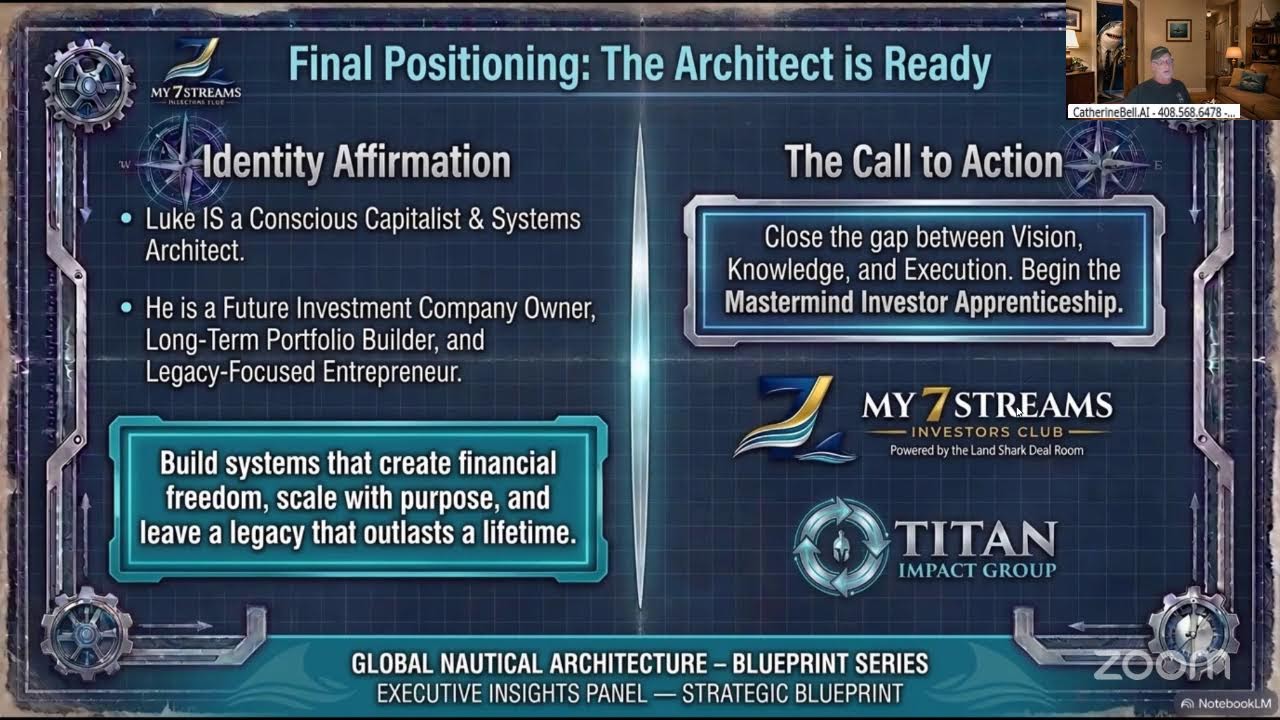
There we go. So this is the Architect's Blueprint for Purposeful Wealth, Luke Crooks. You mind if we go through this real quick? It takes about, uh, takes about 10 minutes. I don't mind. Cool. So, uh, inside of this, Luke took the, uh, investor survey, Land Shark investor survey, And inside of doing that, ended up with, uh, with a foundation of a conscious capitalist with a systems architect. And so institutional foundation starts with the dynamic emergence of, of, of a, of a bigger plan. The foundation has to be built first, um, and that gets done by understanding your why. So Luke revealed that, you know, um, uh, he's looking into building an investment business, right, and being an investor. Why? Because that creates freedom. It's to fund purpose and serve for future generations. The, uh, the engine behind this is what— when Luke filled out all the questions and answered the questions, um, it took his answers and, and aligned him with, with, uh, real estate professionals in the industry who are highly successful. And so inside of the Conscious Capitalist, the guiding principle is that money is the multiplier, not the mission. Wealth represents freedom, freedom, opportunity, responsibility, significance, and service. And then the, uh, dual archetype, or the, the secondary archetype, is the, the systems architect. Which means that the guiding principle on that one is to— that, um, you, you're beginning to think like a, a future business owner and you value operational excellence and accountability. The bigger picture is that the, the dual DNA provides a significant long-term advantage in building organizations rather than a disjointed portfolio, right? So, um, Inside of that, the mindset matrix is that, um, uh, that the primary question, uh, that you should have— your focus, your operations, and your scale— should, uh, you know, these are, these are what the, the novice would look at, right? Versus what Luke needs to, um, strive toward and strive for. Like, don't ask, how do I buy my first rental? You need to be asking, how do I build an organization that eventually runs without me? You know, and on the scaling side, individual— Novus thinks that there has to be an individual ownership model, and there doesn't. There can be capital partners, investment companies involved, right? And that's the, that's the mindset of the architect. The survey diagnostic analysis gives us what you have in as far as strengths, weaknesses, opportunities and threats. And so your structural strengths and weaknesses kind of offset inside that. You know, you have a, a desire to have a mentor, have high accountability, coachability, etc., etc. Um, but that does no good if your tendency is to be stuck in analysis paralysis. Okay, um, with the limited investing experience you have, it's important to be coachable, but it's also important to know that you have to You have to kind of trust what you're being told, right, and move forward from that standpoint. Um, so inside of that, the blueprint, uh, for recommended investment vehicles. So your long-term vision is not simply owning properties but also, um, owning an investment platform. Something's going on with my Zoom. Somebody done something with it. I don't know. Um, I keep getting notifications. Things are changing on the counter. I don't know what's going on. Catherine, are you doing something? I'm doing— hey, Catherine, leave. No, I'm not touching anything right now. Got it. Okay. Um, so anyway, Um, the— to get to the scalable investment company that, that Luke is looking at, um, it, it kind of gives you a platform to build from looking at long-term family multifamily investing like that, that deal we just looked at, doing buy, buy and hold rental property portfolios like, and building that through syndication, getting creative financing, adding investment partnerships to that, and business acquisitions like building up from that that way up, build the pyramid. Phase 1, it should be focused on learning. Phase 2, focused on growth. And then Phase 3, becoming a leader. Um, structural cases, uh, case study inside of this is like how to engineer the investment company from the ground floor up, you know. Um, and, and it kind of lays out how you got to, you know, be, you know, be the student before you be the teacher. Um, inside of that, um, a good idea to start building from on this 90-day blueprint is to, uh, spend month 1 coming to every deal room that you can come to, analyze at least 25 investment opportunities, and start learning how to underwrite using Deal Hunter by, uh, starting to build your own personal buy box and meet with 5 experienced investors. Catherine is one. Mike Butler's too. Like, you probably spend some time with Mike to learn more about investing, but go find some more. Month 2, build confidence. Confidence comes with competence. So when you're running and analyzing at least 50 deals a month, not like lifetime, some people like 50 deals. Yeah, bro, I look at 125 deals a week. So I don't know how anybody's like 50 deals a month. I'm like, how do you get any work done? That's literally like not even 2 deals a day if you got to take weekends off. I don't know. I can— I literally look at 100, 125 deals a week, 20 deals a day at minimum.
So anyway, that's the beauty of Deal Hunter. It really helps you increase that volume.
Yeah, well, and again, like what it did was I was doing that before, doing 20 deals a day, but not with Deal Hunter. And I had 6 guys working for me, and I had people stealing deals from me. Like, you find a really good deal, you find a really good— here's what I know: when you're working with a team of acquisition people, when you find a really good deal, your team cuts in half pretty fast. They will scoot out the door in a minute on you, and, and it's because they hold the paper, and you're just praying that there's loyalty. So it sucked, but I went, I went through about 60 different, like, acquisition managers before I decided, screw it, I'm building a deal owner. Um, so inside of that, month 2, 50 deals. Shadow somebody, hire somebody, pay somebody to follow them around. Like, that's the part that I— like, I don't want to pay to go to a conference for $20,000 and sit in a seat. I want to pay $25,000 to the guy to follow them around for 5 hours. There's the difference. And hopefully he's doing really cool stuff for 5 months. That's what I want to do, right? Um, inside of that month 3, build momentum. And the reason you want to do this over that period of time is because you've got to get people— here's what I know. I'm gonna, I'm gonna pull my screen over real quick. Claude has helped me do this. Look at this. Inside of my real estate bucket, I get deals sent to me this many times a day, right? From, from— and these are my vetted sources. These are guys I trust and will only do work with. Trana, Logan, Lucas, uh, RJ. Like, these are my dedicated. These are the ones I don't— I, I know they're not going to send me some BS, and they're not going to get butthurt when I say no, I'm not interested. That's something else that happens a lot in this industry. Oh, you don't like my billion-dollar deal? You're a jerk. Whatever, I'm not interested. So inside of here, here's your 12-month business plan, brother. You got a 12-month business plan: education, underwriting, first acquisition, document your system, and do it again, right? By the year end, you should have done 150 deals, tended 40 rooms in here, and And again, you can go sit on YouTube for 2 hour, uh, uh, 2 or 3 hours watching in 2x and catch up on a whole week of, of episodes. Like, we got all the videos on YouTube. Um, building a professional advisory team is huge. Complete your first acquisition or partnership and then create a personal investment operating manual, SOP, standard operating procedure. Luke, you're right here in the middle, brother, and this is the, the ecosystem you need to build around yourself. Mentors, insurance advisors, general contractors, property managers, commercial lenders, real estate attorneys, CPA, uh, and again, commercial realtor, right? And so outside of that, you're going to need to hire acquisition manager, investment relations manager, uh, um, operations manager, and assets managers. This should be a disposition manager, by the way. So, but if you're holding you should have 2 acquisition managers, right? So, and inside this meeting we've got 1, 2, 3, 4 of those people already in here for you. Actually 5.
I can add, I double dip.
So, uh, yeah, we can help.
We, we can help with the asset management side as well.
There we go. Yeah. So like you got 2, 2 or 3 there. So to, uh, to, to connect the, the span between the two, the execution gap connecting vision to reality is that, you know, the assessment revealed one defining characteristic, and that is that your vision is already operating several years ahead of your current experience. So this is an opportunity to provide, uh, uh, yourself with, with the chance to, to build the right bridges, right? The Land Shark Mastermind Investor Apprenticeship means that by being in the apprenticeship, you're going to have, uh, access to the weekly deal rooms, live underwriting, property analysis, offer writing skills, negotiating and coaching, due diligence and capital raising. I don't know if Ashley's still in here or not, but I had a great talk yesterday with Ashley, like so coachable on, on what we're doing inside of this land deal. Like, she's like, so where's your, you know, where's your goal? And she's talking to me like she's a realtor instead of an investor. And I'm like, Ashley, pump the brakes. I don't want you to be my realtor. I want you to be my investment partner. And so we got to go after these guys with teeth. We can't just come at this, you know, blah blah. So Ashley picked up on it, was like, I like it, I like it, let's do it. Caso, right? So you're 1 to year 5, brother. I'm going to send you this and, uh, send you this in an email. I want you to go through it, but understand this, that we'll, we'll leave every person, property, and community better than we found them here in Titan Impact Group. And Being part of our, our ecosystem is to, you know, help you do all these things, but doing it in a way that aligns with wealth, wealth with purpose. And so if you're down with that, the last thing is to, um, you know, make sure you understand that this is, this is just the information that we were provided. So, and, and we provided you with information back, analysis. It's You know, you can look at it like it's entertainment, like it's a fortune cookie, whatever you want. But at the end of the day, we have a call to action to everybody that takes these things, and that is to begin by becoming part of the Mastermind Apprenticeship. Get involved as a mentor, you know, and we can do big things and great things. So that concludes your assessment right there, brother. Thanks for putting that together. Say again? Um, thanks for putting that together for me. I hadn't seen it in the email till now. Well, I'll be, I'll be emailing it to you right now. I got, I got your email in front of me, and I'm going to be, uh, uh, sending that over to you. And then again, like, the rest is up to you, man. Uh, get us over the, uh, if you send over to us the Um, uh, I think I asked you for a resume and a, and a, uh, uh, skill for work, like what you, you know, what your best skills are and what job you could perform and stuff like that. So, all right, all right, all right. Thank you. Awesome. Well, I'm gonna— it's 10 o'clock and I'm gonna wrap it up because I've got another meeting to jump to, so I appreciate everybody coming in today. Um, and I'm going to pray that Catherine feels better. Heavenly Father, we thank you for everything that you brought us today, and we ask that you continue to bless and guide us so that we may always go out and do your will. In your name we pray. Amen.
Amen.
Awesome. Feel better, Catherine. Thank you. Feel better, Catherine. Yeah.
All right, thanks, John. Great call.
Thank you. Have a great day. We'll catch everybody










