Building a Family Financial Mastermind: Teaching Financial Literacy, Relationships, & Legacy
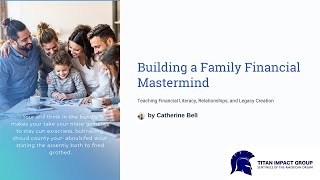
Catherine Bell (three-time international bestselling author) presents a recorded webinar on building a "family financial mastermind" to teach children financial literacy, communication, relationship skills, goal-setting, and legacy values after her husband’s 2018 death. She describes a structured, multi-year program she ran with her then-15-year-old twins that combined personal-development books (Success Principles, Awaken the Giant Within, Science of Getting Rich), investing education (Rich Dad Poor Dad concepts), and experiential learning (playing Cash Flow, family game nights, volunteer projects, dream boards). She emphasizes practical routines (biweekly sessions, homework), celebrating wins, and purposeful philanthropy; reports measurable outcomes for participants and family (collective earnings/investments and individual investing success), and invites attendees to a live Q&A (Thursday, 2pm Arizona/mountain time).
Questions this video answers
2018
14 years old
Over $100,000
Over 200 families ("over a thousand lives saved" reported)
Seven streams of passive income
Chapters
It. Hello everyone. Happy Tuesday. Good afternoon. I guess it's not good morning wherever you're at, but it's probably afternoon. I am super excited to be here to actually share with you something that people have been asking me for years to actually share and it's actually inspired me inside of finishing up writing three international best selling author books. And I just actually wrote my fourth one on Friday or Saturday and I'm getting ready to write my fifth one which is actually going to be on this subject. So I'm super excited to be sharing all this with you. And if you have questions, go ahead and ask your questions in the Q and A. I'm happy to do that and make sure that you have it in your calendar to come to our call on Thursday because it's going to be a live Q and A session and I'll be sending emails out about that. So without further ado, let's go ahead and get started. I'm super excited to be sharing all of this with you. Okay, so hopefully you can all see my screen. Any of you who are here, if you could do me a favor and just put it in the Q and A that you can see my screen, that would be super helpful because I need to obviously make sure that you can see that. How do I see q and a? Okay. Beautiful. Awesome. Thank you, Karina. I appreciate that. Okay, so again, my name is Katherine Bell and I am a three time international best selling author. And so I invite you to go and get those books as they really dive into the world of investing and you know, my own story inside of how I did it and created it, you know, for and with my family. So let's talk about why family financial masterminds a little bit about my story. What happened was for those of you who don't know me, My husband of 18 years passed away very tragically and unexpectedly in 2018. And overnight I was left a widow and a single mom. My twins were 14 years old at the time. And what ended up happening was I realized there was about a year later they were 15 years old and I realized that one day they were going to leave home, which, you know, is the healthy thing for them to do. And they needed financial literacy skills, communication skills and relationship skills. And my husband wasn't here to help, you know, essentially co teach it and the school wasn't going to teach it. So clearly it was up to me and I had to figure it out. Now I didn't come from a background of having any financial literacy at all. In fact, I Was born to a teenage mother and went in and out of more homes than you can count. Went to 13 different schools and didn't learn to read till I was in eighth grade. But I got straight A's because I learned very quickly. They didn't want you to get the right answer. They just, I'm sorry, they didn't want you to think, they just wanted to get the right answer. And I knew how to do that. And so having that skill set of figuring things out and getting myself educated really I feel like is a huge skill set and a muscle that I developed for creating everything that I've created. So all this is completely self taught. But more importantly, I really understood that it was something that needed to happen, you know, for my children. And so I was really interested in making sure that the legacy of our family really was felt by my children. So obviously for sure it was about creating wealth. But more importantly, like as the wealth that my husband and I created and I continue to create, passing that on to my children that they knew how to manage it moving forward. So that's really, really important. And I don't know about you, but growing up in and out of more homes then you can count. There are a couple of things, couple of messages that I got throughout my life that it was, it was unacceptable and impolite. You know, born and raised in Canada, it was impolite and improper to talk about money, to talk about religion and to talk about politics. And which is interesting because those are some really, really important things to actually get educated about. And if you can't talk about it and you can't get educated on it, then what are you going to do about it? And so I flipped that all on its head and we talk about all those things so that we actually can be educated rather than ignorant throughout, you know, the entire, for any of those really important subjects. So wealth was clearly a really important one for me. And then of course, wisdom. I remember growing up that I always. And I remember I was like, I want to say I was like 7, 8 years old. I remember thinking to myself, I didn't want to get older because I observed the people who were who I perceived as adults. Now looking back, they were simply teenagers. My perception was that the older you got, the more stupid you got. And so I didn't want to get older. And when I realized that it was simply they were, you know, really immature beings at the time. But I was a child and that was my only reference point that I could actually learn from other people's mistakes and make better choices. And so that's a huge part of what I actually did, is taking those mistakes that I watched those adults make and make better choices and then took it from there to a whole new level of I have a lot of friends who are multimillionaires, sent to millionaires, a couple billionaires. And so I really leaned in and asked them the really vulnerable questions about what it is that grew their wealth and what wisdom that they would pass on. And I'm actually going to pass on a lot of that wisdom to you. And so my thought was, is that if I do the same, if not like, similar things to what they did, then I should get the same, if not similar results. And that's pretty much exactly what's happened. And so creating that, those lessons and then passing them, them on to my children. I'll share with you more what how they took it and they took it to a new level. And then, of course, there's my values. And passing on those values was really, really important to me. And of course, my husband and his legacy. And then, of course, the most important thing of all is that my husband and I always had a vision that we would make so much wealth, that we would actually be able to give away 90% of our wealth and live on 10% very comfortably. And that's always been our goal and still is, because I believe that money is like oxygen. The more you have, the easier it is to breathe. And the more you have, the easier you can breathe, the bigger the difference in the world you can make. And if you can add commas, you must, because you never know when you're going to be called to actually make that difference. And just to make the point really clear about that, it was back in October, November, when the hurricane hit Asheville, North Carolina. And what ended up happening was that one of my business partners actually lives there. And we, you know, I'd been texting, texting, calling. No messages we're getting through. Just. I just wanted to make sure he was okay and that his team was okay. And finally a message came through. And so the hurricane hit on Saturday and I had been messaging the whole time. So now fast forward, it's now Thursday morning at 7:30 in the morning. And I was on a webinar for my other nonprofit, Wealth Wise Women. And all the women were there and were, you know, going through all the motions and all the things. And his message came through. And so they had really crappy service. And so when his message finally came through, I was sitting there and he, you know, he said he was okay, everybody was alive. And I said, you know, I know I'm living in Arizona, but if there's anything, anything, anything I can do, please let me know. And so he had texted back because messages were getting in and out. He texted back to me that he needed, they needed food, water, fuel and body bags. So here it was, 7:30 in the morning and I'm on a call with women from all over the country talking about creating multiple streams of passive income and all that. And I just said, ladies, stop. Here's what we need to do. It's very clear this community is in extreme distress. And so what ended up happening was we immediately reached out to our entire networks and started, you know, coordinating and making, making this happen at the end of the day, because FEMA wasn't happening, the government wasn't stepping in. You know, it takes them forever to get anything done, but as individuals, we can actually get things done way faster. And so unapologetically, within 48 hours, we had raised over $100,000 and coordinated with the United Cajun Naval Service and had the helicopters deployed with food, water, fuel and body bags within 40 hours. What FEMA hadn't done an entire week. So that had happened. And I didn't hear anything. That Monday, he sends a text message through and he says, because of what we did, we saved over 200 families. That was over a thousand lives that had been saved because of what we did. Because going back to, we had added enough commas to all of our bank accounts and so many others that everybody was able to give a little and contribute and literally save over a thousand people's lives that we will never know, that we'll never know them. So teaching my children about adding commas to bank accounts so that you can make that impact really is, it literally is a life saving experience. And then of course, I have another nonprofit that focuses on getting the adoptable children out of the foster care system adopted. So the point being is that I believe that all, all of you are called to make a difference in the world. And when you have the financial resources to do that, then when you get that call or that text, you literally can mobilize immediately. So that's why I implore all of you to not only add commas to your bank account, but teach your children to as well and to certainly be setting aside an amount for those times when, you know, they, they, they want to be able to give and can actually give at that time. So the tools that I used to build the Mastermind was a couple of things and here's the thing, you guys, I didn't like. Yes, there were some things that I absolutely taught my kids and you know, we did a lot and my children ended up having an enormous love of reading, you know, because of me and, you know, just my insatiable curiosity for knowledge and stuff. And so there's lots of tools out there. These are the tools I'm going to show you that we used and I'm sure there's so many more. So when the kids were little younger, Christopher and I were actually volunteering and we led the Dave Ramsey's Financial Peace University for several years. So we had those fundamentals and I had my kids go through that because I think it's fundamentally the foundation is really important now. I don't believe that's where you need to stop. I believe that's a good foundation. Now he doesn't teach investing and all that. And that's where, you know, we stepped in for all the things. So remember, my family Financial Mastermind was about communication skills, relationship skills, financial literacy skills. So the tools that we used was this right here. These are some of them. So this is Jack Can Canfield's the Success Principles. And it actually comes with a workbook. And here's what was really cool with the workbook. So there's actually, I believe it's like 12 chapters because this took an entire year for us to actually go through. Well, it's 17 chapters. But what happened was when I started this family Financial Mastermind, my twins were 15. Like they had no desire to spend any time with me, to listen to me, anything they. So I told them, listen, this roof over your head, I paid for this. So this is a dictatorship. This isn't a democracy. Like, you need to show up and you're going to show up every second Friday at the dining room table and you're going to have your homework done and you can bring your Darth Vader breathing the. Or the eye rolling, like, bring it all. Just make sure you roll your eyes the opposite way so you don't end up all weird and lopsided. Bring it all because we're going to do this. So for two years I did this. And so we wove in doing this workbook. And so we did. We had it every second week. And then in, in between all of that, we also played the game Cash Flow for all of those of you who know. So if you could just put it in the Q and A like does anybody, has anybody heard of the book Rich dad, poor dad, or is it just me? So I hope that some of you, if you haven't heard of. Looks like none of you have heard of it, go get the book. Rich dad, Poor Dad, Robert Kiyosaki. And he does a brilliant job going weaving through this entire story. Of course, it's, you know, it's not a true story, but you get the lessons in it anyways with that book. He also talks about a game that he created called Cash Flow. And basically, it's like Monopoly on steroids. And we played that game. And so here's the interesting thing about that game, is that how I made it fun, because you kind of make it fun for kids is. And even adults. I made it fun for adults because we host games here and playing this with adults as well. And what we did was the. The game. So you have the board game, but it also has an app on your phone called Cash Flow. So the Cash Flow app, it's a purple square with a C and an F. And what that does is it actually basically calculates your balance sheet. Because in the Cash Flow game, there's a balance sheet, and it's the enormous amount of math, and if it's the first time you're playing it, it drags on forever, and it isn't that much fun. So when you use the app to actually do the calculations of your balance sheet, what happens is it becomes an enormous amount of fun playing the actual game itself. And so that's how I did it, because I had to speak in their language, right? Kids speak in text and they speak in apps and all that. So it brought all of it to life. And in the game, it teaches you that in order for you to get out of the actual rat race, your passive income is needs to exceed your total expenses. And that's how you get out of the rat race and into the game of life. And so what I taught my kids is that the average millionaire has seven streams of passive income. And so the seven streams of passive income is what, you know, they need to reach so that they truly can have true passive income. And it just gives, you know, like a gauge. And so the whole purpose is that when you consistently do this, then obviously you play it with the app, you start playing with the real sheets, so you understand, you put the real numbers in. So you see how a balance sheet actually works, which is what most people have no idea how to read. But the game does a brilliant job teaching you how to read these balance sheets. So then from there, what you're to do is when you get out of the rat race consistently in under an hour, you're to put your real numbers into that actual balance sheet. And that's what Christopher and I did decades ago. So we put our real numbers into it, and we turned our lives and business into an actual game board. And that's how we created our 13 streams of passive income when he had passed away, which gave me the breathing room to be able to take a year off and grieve with my twins. Not that that's what the purpose was, but it really was a big, big deal when it all unfolded. So for all of you, I encourage you to read the book Rich Dad, Poor dad and play the game and, you know, put those in. So another tool that. That I had used is there's a book, it's called the science of getting Rich. I have it here somewhere. So the Science of Getting Rich. And here's why I'm saying this is because every millionaire sent a millionaire billionaire that I know we've all talked about this, and they've all done this and consistently do this. So what it is, is it's a teeny, tiny little book. You can. You read through the whole book. And so this is the whole purpose. You read through the whole book once, it takes maybe two hours. And then you read every day for 90 days. 90 days. You read chapters 4, 7, 11, and 14. So 4, 7, 11, and14. And if you miss a day, you start all over again. And what happens is, by the end of the 90 days, I promise you, what's going on here is no longer the same. And. And that changes everything. So there was a lot of homework over the two years that I did this, but it was really extraordinary. And I'll share some wins of what happened. So talking about that. So we did the game nights in there, making sure we had critical thinking. We celebrated milestones. Oh, my goodness. So we actually had other family members join the family financial mastermind. The first year, we ended up so there was just the three of us. By the time we had the celebration at the end of the year, there was 47 people there. It was crazy. And what ended up happening was we calculated what had happened as a result of what we learned and what I was teaching. And collectively, they had earned over $100,000 more that year. And collectively, they had invested over $50,000 as well. So it was a pretty big deal for the entire family. So there were some huge wins. And that's a really important part. Of course, we took time to celebrate birthdays and anniversaries. So it's just a beautiful way to bring the family together to celebrate all the things. And that's a really important part because they've actually done studies on this, and this is really interesting. So they've done studies that when relationships. When it's not about ne. Yes, it's about being there for, you know, the hard times and all that. But what they have discovered is that people, family relationships that are there for each other, intimate relationships that are there for each other when you're celebrating, have a far bigger impact. And a far. The criteria of relationship actually lasting and moving forward comes from celebrating each other's wins rather than just being like, ah, you know, whatever. The psychological and emotional impact on that is huge. So you really want to take on celebrating each other's wins and all the things that you're doing. So I thought that was a really interesting study. So again, going back to giving back. Oh, this is another thing we did. So we also wove in doing community service projects. So there's a nonprofit here called OCJ Kids, and it focuses on children in foster care. And so we went, we did a bunch of volunteering with them. We volunteered at homeless shelters, soup kitchens. There's lots of different places that we volunteered. But the whole point being is that when by teaching kids, my kids, potentially your kids, that the world is so much bigger than their wants and needs, and there's people out there who have way far less than we do, there's this sense of gratitude that now comes home in realizing what they have and the importance of what they have. So those are some things that we wove in there that were really important to me anyway, that really had it be amazing. And then, of course, building strong family relationships, you know, we had some really hard conversations. And then of course, goal setting, that was really important. So Harvard did a study on. They took part of a class that didn't write goals at all, and part of a class that did write goals, but didn't even review their goals. And the part of the class that did review did write their goals. They went back decades later and. And those people accelerated and had achieved all those. And the people who didn't write goals at all pretty much stayed about the same level. So just simply writing goals is a whole exercise in itself. And we went above and beyond. And we created dream boards and all of that. So we took our goals, wrote them all out, and then created dream Boards. And the dream board is a whole other course that I've taught everybody. And what it was. Is. I started doing it, you know, 30 years ago when I was single. And then when Christopher and I got married, we did ours together, and we actually put kids on there. We ended up, you know, adopting our twins. It looked exactly like us. I mean, it's just. It's magic, all the things that happened. And then when, you know, Sarah and Jordan came along, we incorporated them into our family dream board. It was. Ended up being like 3ft by 4ft. It was framed. It was on our wall. It was beautiful. It was like the centerpiece of our home. But it was cool because we all came together and created those dreams together and those goals. And then as the kids got. Well, Christopher passed away, and it was just the kids and I. And then as they got older, they had their own bathroom. And so I let them take their entire bathroom wall and turn that into a dream board. So it was pretty cool to me that their goals went from these small goals into literally an entire wall of their dreams. Like, that's pretty magical. So encouraging them to have goals and timelines and what are the steps we need to take to make that happen was really magical. So the bond between us, you know, it just got strengthened all the way through the loss of Christopher, you know, all the things that we were building. So some simple steps that you can take today is just pick one book. You know, I'm sure you can Google lots of different books. Again, the one that I. We happen to do was the Success Principles. One of the other books we also went through was Awaken the Giant within by Tony Robbins. Another one is the Holy Grail of Investing by Tony Robbins. This one I highly recommend. Whether you do a family mastermind or not, he does a brilliant job talking about all the. What all the really wealthy people. He interviews them, and they literally tell you exactly what they invest in and why and why you should, too, which, funny enough, is alternative investments. What. Which is exactly what we do with Titan Impact Group. So it was. It was very cool. It was very affirming that everything that we were doing with our company and personally, we're on track with. So those are just some of the books that we use. I've got so many more, but these are the. The few that we really focused in on. And then, of course, involving the entire family, no matter how young or old we. I host cash flow games here in the Valley, and I have, you know, kids to adults, everybody coming and playing. And I think the youngest participant that we have, he was like 8 years old. And him and his brother, his brother is 1112 years old and they absolutely crushed it when they came to playing cash flow. And I think that kids get it faster than adults because I feel like adults have learned some bad habits that they have to unlearn before they relearn their habits. So that's why kids tended to be way better at this than adults. Just again, because they don't have all the gunk and roadblocks in the way bad habits in the way that adults tend to. So that's why involving the whole family and then of course, focusing on giving and having us all come together and say this is how we want to contribute together as a family, be it monetarily, but more importantly, with their time and talents, that was really important because there's something very powerful when they go on site and they actually see and experience other people who just don't have it, as wonderful as they have it. And having that sense of gratitude, that's absolutely everything. And then of course, celebrating the wins, these are really important to do and be intentional about it, right? So whether it be Sunday dinners or whatever it is, making sure that, that it gets those big rocks get scheduled on your calendar and that you make it really clear everybody needs to come and celebrate all the things. Because at the end of the day, let's face it, tomorrow isn't guaranteed. And if I could have another day to celebrate with my husband before he passed, I absolutely would take it. So anytime there's an opportunity to celebrate, no matter how big or small, make it a big deal because it's totally worth it. And so the just sharing a little bit more about Sarah and Jordan. What happened? So again, Sarah and Jordan come to the family financial mastermind. They're rolling their eyes, they're doing the Darth Vader breathing. They don't want to be there. They're smarter than me, you know, I'm stupid. It's. They're at that age and what ended up happening. So fast forward, they're now 20 years old, and my son is a US Marine serving over in Japan. He's been there for several years. My daughter is here figuring out life out and living her best little life right now. But here's what happened last June. So my son was 19, my twins were 19. Then he called me and he said, hey, mom, I got myself into a lot of trouble. And I'm like, what did you do? And he said, I got a really big tax bill. And I was like, buddy, you're a US Marine. You're making three bucks an hour. How big can this tax bill really be. And he said, no, Mom, I listened to you and I did what you told me to do and I invested and I made a quarter of a million dollars. Yep, $250,000. Because we played cash flow again and again and again. Because I had them read the investing book, because I had them do the personal development work, because we worked on what was going on in between their ears and making sure all the success principles were built in that he actually did. He took it and he took it to the next level. 19 years old, as a US Marine in another country, made a quarter of a million dollars investing. So that was pretty magical to me. And that's why I feel called to share all of this with as many families as possible. And obviously no results are guaranteed because we never know what our kids are going to take with it, do with it, whatever. But the point being is that, you know, just do it. Just start. Just start somewhere and start to celebrate. And there's no right or wrong way to do it. I think the only wrong way is to just not do it. And the right way is to just start doing it. Just start. And so that's what I have for you today. I hope this was helpful. We are going to have a Q and A session on this Thursday at 2pm so I'd love for you to noodle on what I shared with you. I'll also send this recording out so you guys can have this as well and watch it again. Share this with as many people as you want. I want, I would love to have all families have financial literacy and more importantly, have it be fun and then they turn into philanthropic families that are like making a difference and having fun. Because the reality is, is that financial literacy doesn't come through the school system. It doesn't come from the college, education or university system. So it's up to us. It's up to us to take it on and to figure it out and then to pass it on to our future generations so that they can do better, you know, for them and their families. So I'd love to hear what your questions are, what your ideas are. I am going to have. Actually, let me put the registration link in the, the chat for you. Two seconds. Let me do that. In the meantime, do any of you have, if you have any questions, put it in the Q A right now. I, I'm here. I totally love talking about this. If you haven't figured this out and happy to answer, however, whatever, resources, tools, anything that I can give you insights that's what I'm here for. So I hope that this was valuable for you. If it was, just let me know in the Q and A. And if there's other subjects you'd like me to talk about as well, that's what I'm happy. Happy to do and happy to talk about. So I want to make sure that, you know, you guys have all that. Chat is disabled. Yeah, that's why you got to do it through the Q and A. I don't know how to enable the chat. I gotta. I gotta figure that out. I'll figure that out for next time. But in the meantime, thanks, Joy. If you could, if you have any questions, you know, put it in the. The Q A. Or I think you can even raise your hand possibly, and I could bring you on if you wanted to do that. Here is the link for the registration for Thursday. Yes, Tina, it's at 2:00pm and. And here is the registration link. So It's Thursday at 2pm Arizona time, which is mountain time right now. Arizona changes time zones, not times. So I'd love to have you all there to answer whatever questions you may have. And yeah, anything you guys need, that's what I'm here for. So I hope this was helpful for all of you and, you know, made a difference somewhere. Again, it's obviously really important to me, given what happened with my kids, and I continue to do it with other families because again, we host the cash flow game here in the Valley and just have a lot of fun because when you can make finances and investing fun, it's awesome. You can't see the registration link because chat's disabled. Okay, so let me. Here you go, Joy. Did you see that? I put it in the chat. Hopefully you can see that there. Okay, you're welcome. Awesome. Thanks for letting me know. And I'll. I gotta figure out this whole chat thing anyways. If any of you have any other questions, I'll give you a minute or so left. Yeah. So, again, I hope this was helpful for you. And yeah, I'll be writing actually a whole book on this and expanding on the whole thing and everything that we did. I love it. Wonderful. Thank you, Tina, for letting me know. And any other subjects you guys want to learn about. I'll be talking about all the things I did. I did some really unconventional parenting things with finances and stuff that I'll be sharing with all of you. So I hope that it inspires you to go do it with your families. So with that, thank you, everyone, for coming. I hope you have an extraordinary day. And I'll see you either Thursday or next Tuesday. We're doing another webinar. I'll be doing these every Tuesday, so have an absolutely extraordinary week. Bye, everyone.










