Catherine Bell | Titan Impact Group Empowering Change: My Journey to Impact Investing & Philanthropy
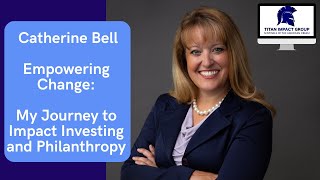
Catherine Bell recounts her journey from a difficult childhood in northern Canada (13 schools, learned to read in eighth grade, adopted at 16) to becoming an entrepreneur and philanthropist in the U.S. She and her husband built a multimillion-dollar company, adopted twins from foster care, and later pursued extensive real estate investing to create passive income (13 streams). After becoming widowed in 2018, Bell focused her efforts on scalable real estate strategies (mobile home & RV parks, being "the bank") and on her nonprofit, Bell Community Empowerment Foundation, which encourages adoption from foster care and partners with churches and agencies to fund and place children.
Chapters
So my name is Catherine Bell, and I am here to tell you about why I am a sentinel of the American dream. My journey actually began in northern Canada. I was born to a teenage mother, and I was in and out of more homes than you can possibly count and ended up going to 13 different schools and didn't actually learn to read until I was in the eighth grade. But I did get straight A's. And how did I do that? That it's because I learned very quickly that they didn't want you to actually think. They just wanted you to get the right answer. So if you could figure out how to get the right answer, you got straight A's. And that's what I did. So through that entire journey, I had younger siblings. They ended up getting adopted. I knew that I was headed down a really horrible trajectory and something needed to happen. So by the time I was 16 years old, I actually did get myself adopted by a family that absolutely changed the course of my life forever. And that allowed me to go on and graduate and eventually go off to college. I ended up traveling the world, and from there got to explore and discover that there were so many different ways that a person could actually live versus the childhood that I was born into. And went on to do a bunch of volunteering, which is where I ended up actually meeting my late husband. And we got married in 2001. He was an American, and he actually had a dream. So it was choosing, you know, Canada, United States. We chose the United States because he's American. And so we took his dream and we turned it into a multimillion dollar company and turned around later and sold it. And so what was extraordinary about that experience is I came to this country at 26 with nothing, and by the time I was 30, we were millionaires. Hence the American dream, which is extraordinary. And in that time of that journey, discovered that we couldn't actually have children. And one of the things that I like to really talk about is that when we hold onto a vision, but we let go of the picture, then magic shows up in all different ways. So we ended up adopting our twins out of the foster care system. We got them when they were four months old, a boy and a girl. That's what I wanted. That was my vision. And so we had our. We got our twins and ended up living truly. It was the American dream at the time, at least for our little family. And fast forward, my twins were about kindergarten, first grade. And up till that point, my husband had been a really great provider for our family. And he ended up actually getting really, really sick. And when he got sick, that actually forced me to actually go back to work and provide for our family. And so here I was, a mom, a wife now back working in the family, so taking care of my very sick husband, taking care of my twins, everything there was to make that happen. But the beautiful thing about being that is women, you know, we just make it all work. And so I ended up working with several companies and adding a lot of commas to their bank accounts and through that entire time understood a couple of concepts, is that the average millionaire had seven streams of passive income. So the question I kept asking myself is how many did I have and how many did I want? So while I was working my jobs, I was also involved in real estate investing and to create those passive streams of income. So through that time I had done, we had done buy and hold, discovered I don't really like tenants and toilets, done some wholesaling, which, you know, that's good money initially, but it doesn't create the actual passive streams of income. Ended up going on and starting my own hedge fund, and it was a vacation rental hedge fund. So discovered that through vacation rentals. Turns out I don't like gas and toilets either, but gave myself permission to try lots of different avenues of real estate investing. And each one springboarded on the other, meaning that I would take and glean what I learned, what worked, what didn't work, what I loved, what I didn't love, and then use that for the next adventure of real estate investing until I ultimately really figured out what I loved. So through that we had done residential developments, commercial developments. I was running a program called the Flipping Females here in the Phoenix Valley and really partnering with other women, other people and teaching them how to actually invest. We flipped about 500 properties here in the valley, which was a lot of fun. Then in 2018, my husband died unexpectedly and it was very tragic. I ended up being a widow and single mom with 14 year old twins. It was hard, But because of the passive streams of income I created for our family, that's what got us through. I created 13 streams of passive income, which is another part of the American dream, because what we know is that money is like oxygen. The more you have, the easier it is to breathe. And the more you have, the easier you can breathe, the bigger the difference in the world you can make. So those streams of income gave my twins and I the breathing room to do what we needed to do to figure out what we were going to do. And I Got really clear in that next year, what actually mattered to me, shut down the hedge fund, shut down everything that I was doing, and got clear on two things through real estate investing. Because I had really intentionally gleaned what I loved and who I was and what mattered to me. I learned two things about myself that I love renting dirt, and I love being the bank. Being the bank. If you understand real estate investing, that there's multiple roles you can have in any real estate investment transaction. You can be the buyer, the seller, the contractor, subcontractor, realtor, title company, bank, all of it. But being the bank ultimately is the safest, most secure position you can be in any real estate investing transaction. And because if anything happens to the deal, you ultimately get the property and then can turn around and sell it and at least get your initial investment back if it's done right. The second thing that I love is renting dirt. And what I mean by that is that we invest in mobile home and RV parks and we just rent the dirt, so we're not responsible for the structures. But what I love about it is that it provides an opportunity for affordable housing. And it's scalable because the difference between buy and holds or everything else we were doing, it just wasn't scalable. And so this is scalable, and that's what I love. So creating the multiple streams of passive income is a big part of that. And so continuing to create passive streams of income not only for my family, but for other families has become a huge passion of mine. And helping people understand why they're here and why this matters. So again, back to being the sentinels of the American dream. So my company's vision and mission is that my own personal vision and mission is that we're the sentinels of the American dream and that we leave every person, property, and community better than we found them. And so what I'm clear, what I'm here for is all of this. These passive streams of income lead into my why, which is my nonprofit, and that's Bell Community Empowerment Foundation. And how this all ties together is that there's over 500,000 children in the US foster care system. 350,000 are available for adoption today, and it costs less than $1,000 to adopt a child. And so when you work with the right adoption agency that specializes in this type of adoption, the impact is huge. So if you understand that these children in the foster care system, when they stay in the foster care system, it's literally costing taxpayers billions of dollars at the their 18th birthday. If. If they haven't been adopted and they age out of the foster care system, what happens is they experience black trash bag day, meaning on their 18th birthday, they are handed a black trash bag, told to put all their belongings in it, and then they're out. So if you understand that 80% of the people who are actually homeless came out of the foster care system. And so what does that mean now? Drugs, prostitution, trafficked, which is a huge epidemic, and incarcerated, costing taxpayers billions more. So my nonprofit focuses on partnering with churches and these specialized adoption agencies to be able to get the word out and get them fully funded, to be able to help families find. Get connected to these right children so that they can create their own families with these children again. I was adopted when I was 16, and it changed the course of my life. I did get my babies from the foster care system, and they were four months old. So think about this. These 350,000 children, there's more than 350,000 congregations in this country. If each church takes on finding one family to adopt one child, we can get this done in our lifetime. But bigger than that, what if 1% of those 350,000 children was so inspired from being loved and having a family just like me, just like I was, that'd be 3,500 kids that grow up to be 3,500 adults that decide to go make a difference in the world. So that is me. That is what I'm passionate about. I am clear every single one of you out there wants to make a difference. And you have a calling that you're called here, and you have a purpose to support. Either it's a nonprofit or create your own, whatever it is. But that is why, if you can add commas to your bank account, you must, and you must be unapologetic about it, because in this country, compassionate capitalism, that is what this country is all about. So that is what I'm passionate about, is we find the deals, we have the investors, we create turnkey solutions for families to have passive streams of income and ultimately make the difference that they're here to make while they're here. So that is me. I am Catherine Bell. Thank you for your time.










