❓ Got questions about staying focused AND building wealth? We’ve got answers | Titan Impact Group
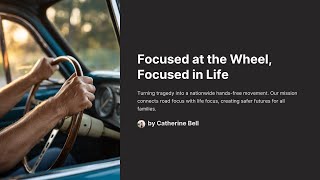
Molly Welch survived a car crash caused by distracted driving and turned it into a mission. She founded a nonprofit, gave a TEDx talk, and helped pass a hands-free driving law. The conversation also covers financial preparedness and practical ways to stay focused on the road.
Chapters
So welcome everyone. Super excited that you're here. It's a happy Thursday. I don't know how it is in the rest of the country. Here in Arizona, we're in the triple digits. So we're a little bit warm here and having an amazing conversation from Tuesday. We had started the conversation with you, Molly, and so super happy to have you back. Thank you for coming and talking to us about seriously something that is like, it's such a critical conversation for you to have. And I love talking about the hard things. Everybody knows that. You know, why I do these is because we're going to talk about things that actually matter. And, you know, I talk about the hard things. The, the five Ds that, you know, most families will deal with at least three of them in their lifet, whether it's death, divorce, diagnosis, downsized, being dumped, any of those. And if we don't have our multiple streams of passive income in place to be able to handle any of those, then we're literally going to be devastated. And so one of the things that we're talking about, Molly, is a tragedy that happened to you inside of essentially it's like a diagnosis downsize, like all of that that came out of what happened. And yes, it was devastating and how you've turned it into something amazing in this movement across the country. That is a really important message that parents and everybody else need to really pay attention to. I mean, quite frankly, I think more adults are bad at this than kids. So let's talk about this because this is a really, really important topic. So on Tuesday, we talked about your story. So people who didn't get a chance to see your story on Tuesday or why don't you share a bit about your story and then we'll talk more about the campaign and, you know, everything that you're doing with this.
Well, I was a student at Auburn University, majoring in journalism, and I had just gotten a job on the school newspaper. So I had taken some interviews on a recorder. It was way before the iPhone or any of that awesome technology that we have today. But one weekend, my good friend called from campus and said she was on her way home. Well, she was at school in Europe at the time. She used to really home, so I just had to go see her. So I went home, spent the weekend with her, had lunch with my family, and started the trip back north to campus. And I believe I was messing with that recording device, dropped it, reached back down to pick it up as I went clear across the median and handled with the pickup Truck. Now, the only reason why I think I was distracted on the recorder was because it was all recorded on tape. I mean from the country song I was listening to, to the soundless gentleman saying, up is on the way, breathe easy. And then it just cuts off.
So again, a split second of being distracted changed your life forever. So obviously help showed up and then you end up in the hospital. So then share what happened after that?
Well, I was rushed to East Alabama Medical center and then I was there in a coma and got transferred to shepherd center and I was there for about a month when the doctors told my family, you know, she's really not making the progress. We want her coming out of her coma so we're going to send home with y'. All. My family was like, my family was in shock. They're like, she doesn't know who we are. But I went home with the hospital bed and a feeding tube and one day my sister came in my room and started playing bible songs and I started mouthing the words. And then another day my father came to a car and the pain was so intense that I had no way to verbalize it. So I just bit the heck out of him. And he was like, look Molly, next time just tell me to stop. So that's what all started the progress. And I had a couple more criteria to do besides mouthing the words to be it readmitted back to shepherd for more intense therapy.
So your so your parents so they take you home and fast forward so now so share like from then till now and then the things that you're doing to move this forward.
Oh gosh. Well, I came out of my coma and I was. I did all that extra therapy and I was eventually discharged for good. So I thought what do I do now? And so I went back and graduated from Auburn. It took me an extra three years but. And then I got. It took three more years to find a part time job. It was in social media which is kind of like my major journalism. The only problem was it was behind a cubicle all day so I had no social interaction. So I started to get an idea. I started to think why not use my experiences to help motivate others not to make the same mistake I did and drive distracted. So long story short, I got help creating a non profit and a public service announcement. The motivational speaking company was a nonprofit and I've talked on TEDx to the legislation of Georgia do many church groups and Rotary clubs and Gowanus clubs. But my absolute favorite strong do is high school and college students, because I was in college at the time and high school is all new drivers.
Then this is a really big. Obviously, you know, not just college. This applies to absolutely everybody being distracted and driving. So it's incredible how you've taken, you know, a tragedy in your life and turned it into something pretty amazing and making a huge difference, you know, at the level of legislation to change this. Do you want to talk about the. The laws that you've already had impact in changing? With this.
I was able to talk about my story to legislators and adopt, help adopt HB673, which is a hands free law. And basically you can't hold your phone when you drive or you get a tick. But I was one of the many who helped bring about that law, which is really extraordinary.
So what I love about this is like this is part of your legacy moving forward. Again, we can't control what happens to us, but we can control what we choose to do with it, which is really amazing. Obviously, making sure that previous this, which is why you go and speak to college and high school students, is talking of, about protecting their health and their well being by not driving while distracted. Making sure that for me, the reason I talk about this and all the things is making sure that you've created seven streams of passive income for your family. So if tragedy does happen, at least that piece is taking care of the financial aspects so that we can make the impact that we're here to make. So this is really extraordinary. So some of the questions is the. Let's talk about it, about, you know, the things that they can do on their phones to help automate distracted driving.
Right. Well, I'm not that familiar with all the new technology on phones, but what you can do, I think is get a tracking device so parents can track their children when they're growing places.
Yeah. So there's apps that can be on the phone that can set it up so that it will do the hands free calling, which is a really big deal. And when, when my twins were going to driving school and going through that whole process, there was an app that tracked not only their driving time, but it attract, it attract how many times they actually interacted on their phone, which is a really big deal. And we had created a driving contract for them that needed to be followed in order for me to agree to even sign over and, you know, be able to help them get their actual license and stuff. So again, it was about creating healthy habits from the beginning. But I think the more healthy habits that are really important is making sure that we ourselves are doing. Like, it's. What is it that we're doing? Right. Like, it's. I don't care what you say, I care what you do. And it's what's caught, not what's taught. So what are our kids and everybody catching from us and our habits? Do we have good habits or bad habits around distracted driving? So I think that that's a really important topic for, you know, people to look at.
So, yeah, I think what's really important is the phone mount, so you're not having to touch it.
That's really good. Yeah, A phone mount, for sure. Because. Yes. Because what if it does slip out of your hands and it's on the floor and then you're, you know, like, you. You were reaching down to grab it, and then that's how the whole thing happened. So, yeah, that's really good. So, again, this is. I know it's a hard topic to talk about, and the thing that I want people to take away from this is obviously, you know, distracted driving is a real thing, and we want to be able to prevent that. And if any of you have relationships or contacts or ways that Molly can come and speak to high school and college students, like, that's what she does. So she's got a TED Talk, which I'm really excited about. Molly, do you want to tell them where they can find your TED Talk?
Sure. You just go to YouTube and type in TED Talk Molly Welch, and it'll pull it up.
Yeah. So I think this is a really, really important message. I think that having your message even be played at driving schools and stuff, that would probably be good. So that would be another good place for people to connect you to, to be able to speak to those students as well. So it's a really big deal. And it's even a talk that you could do via zoom just like this. You could zoom into classrooms and have conversations with kids like this right here. So it's, again, really, really important, you know, topic for us to talk about and pay attention to. And. Yeah, really amazing. So again, coming back to seven streams of passive income, why I want everybody to dig in, lean in, and create those seven streams of passive income. Because sometimes tragedy does start, hit our families and we don't have our financial house in order. Obviously, it's even more devastating than the tragedy itself. So anything else you'd like to share with everybody, Molly?
Well, it only takes a second. You like, sometimes you're not prepared for it.
So we need to pay attention. So so, so important. So for everybody, again, the next, next actions for you to take that's not on here is really go and watch Molly's ted talk on YouTube. I think it's very powerful, and the message is really impactful. So, yeah. With that, I just want to thank you, Molly, for, you know, taking something so horrible and turning it into something truly magnificent inside of the impact that you've already made at the level of legislation and continuing to share this message with high school and college students and, you know, be the difference that you're here to make. So thank you. I think you're extraordinary.
Thanks.
I love it.
Have a good day, everyone.
Okay. Thanks, honey. Bye for now.
Bye.










