How to Create Legacy Income Without Burnout | Wealth Workshop | Titan Impact Group
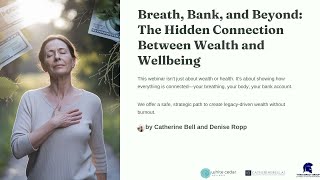
Live workshop episode (Catherine Bell hosting, guest Denise Roth) linking breathwork and emotional regulation to financial resilience. Denise (35 years in health, trauma integration, systems optimization) explains how shallow breathing triggers fight/flight and narrows cognition, teaches a box-breathing exercise (count 4 in, hold 4, out 4, hold 4) to engage the parasympathetic system, and describes working with mostly 50+ clients using biometrics (wearables, EEG-like devices) to track shifts. Catherine frames the topic toward creating passive income and preserving health through stressful financial events (the "five Ds").
Questions this video answers
35 years in health, trauma integration and systems optimization.
Count to four: inhale 4, hold 4, exhale 4, hold 4 (repeat ~4 times).
Typically 50 and above.
Death, Divorce, Diagnosis, Downsize, Being dumped.
Chapters
Sa. Okay, so we are live. So I am excited to go ahead and we're going to talk about something that's really, really important, which is interesting because I was having a conversation and we were talking about the fact that people can live something like, I don't know, two weeks without food, three days without water, but only like three minutes without breath, which I thought that was really interesting and that I feel like that's the last thing that we tend to focus on. And maybe, maybe it's just, I don't know, but I know for me, there's a lot of places where I literally forget to breathe. And why this is so important to me is again, talking about, you know, one of the most important things, which is breathing and breathing into. Breathing life into all the things, you know, especially creating multiple streams of passive income and all the things that come up from, you know, just. Just all the things. So again, I'm Katherine Bell with Titan Impact Group, and I've got Denise Roth here, which I'm really excited to have all of you meet her and to talk about, just learn more about just another deeper layer of health and taking care of ourself. So she's got 35 years in health, trauma integration and systems optimization. And of course, everybody who knows me knows that I'm all about creating multiple streams of passive income because when most families hit or experience three of the five Ds, what's death, divorce, diagnosis, downsize, being dumped. That when you have that financial breathing room that is taken care of so you can deal with the actual emotional piece of this. And this is the piece that Denise is coming on to talk to us about is those emotional pieces. So excited to have you here, Denise, and to share about all the things because this is such an important piece. So do you want to start diving into your genius, which is all about this?
I totally thank you. Thank you again very much, Catherine. This is, this is a real passion for me and, and I, like you see it all the time, but I also see it in people with regards to pretty much every other area of their life and if they are not breathing. So first thing, I would like to say that anyone listening to this, H, kudos to you and congratulations for being able to recognize that this is an important step that is kind of the first step, knowing that you, you are, you, you are important. And this is part of your self love. This is part of the self responsibility that you have for yourself in loving yourself. And the first thing right after it, you were right on. So four minutes.
Yeah.
Some People can strut it a little longer, but four minutes, pretty good average. That's about how long you can last without that breath. And if you don't have it, and I see it all the time, when people are presented with something that's stressing them out, the first thing they do is and they, they close off the upper part of their body and just start to breathe from a very shallow area. And when you're doing that, your body is automatically just thrown right into a flight or fight response. And yet, you know what? This is really the, the beautiful thing here is that we have conscious control over this. We do have that automatic thing that'll flip us into it, but we do have the ability to have that conscious control and go, wait a minute, I, I'm recognizing that I'm only breathing in this part of my chest here, in this part of my body. And if I can just deepen it. There are so many things that happen though, on a very physiological level, nervous system level, chemical level, just things happen and get that reduction in stress levels in amazing ways. And we have total control over it. It's just a lot of times about how do we, how do we recognize it? How do we, how do we stop and go, wait just a minute, I'm, I'm not breathing right. And, and noticing that and taking that first step to going, I, I, I just noticed it because I can feel myself do a sigh. There's lots of us too, that will work away. And then all of a sudden go, oh, I just needed to take a deep breath. Well, that's probably because you were breathing this, this depth. Maybe you should sit back and take a couple minutes and just do some deep breathing. Do a box breathing. Do, do some sort of breath hold. So like deep breath and breath hold so that you're really pressing down on that diaphragm. So, yeah, big area.
Yeah. So let's talk about. You just, you started talking about this, the whole recognize your state. So that's really interesting.
It, and again, it's one of those things that is, it's, we often confuse our, our ability to sense things versus our, our ability to feel things. Those are two very different things. Sensing is being able to see and hear and feel and, and touch and smell. Those, so those are the senses. And our senses are, are often, well, they're automatic, number one, but number two, they also get triggered by past patterns that we've had. Good, bad, and ugly. They're all, they're all there. And then that will flip us into a feeling state. So if we can actually get, understand that emotions, they are a great indicator. There's something that says, hello, something's going on. Just recognize your state, your emotional state and then being able to shift it over so that you can change your physical feeling status because that will help a lot in just getting, getting to be able to recognize, okay, if I take that deep breath, what does that feel like? And you can feel that part. So there's a real difference. We often confuse those, those two things I feel and think it's a physical thing. It's not necessarily, it's often and more likely to be a physic, like a feeling of an emotion that's attached to it.
Right. Yeah. This is fascinating. So in order to, I know you've had a lot of clients and stuff, but so obviously, Sarah, we're changing the names to protect your clients and everything. But let's talk about, you know, some of the stories of, you know, again, moving from panic to peaceful prosperity.
Well, we do, you know, like I said, I've seen this happen a lot. And if we were to look at, well, what is at the root cause. And I'm going to use finances and that scarcity model as a, because it's a real good one. If we are triggered by our finances and it throws us directly into a state of, of fight or flight, we are no longer able to collect other information. When we go into that fight or flight area, it shuts down our ability to see more broadly. So it narrows our focus down, it narrows our ability to hear properly. So, you know, we'll, we'll often get into a situation and, and where people will respond to something that somebody said to them, but it's not, but they're listening for something else and they hear something else versus what somebody said to them.
Right.
They're not looking at their bank account and seeing, see like seeing exactly what it says in. Because there could be things that are, they're, they're expecting certain things and they will often see them the wrong way. But this goes back to, this is really about an energy exchange kind of thing. So are you allowing all of the energy, all of the positive energy to come in and be received by you while you are looking at something? And again, this is really. How do we check, check our estate so that we can see, hear, feel and respond appropriately right. When we are challenged by our finances? So how are we actually doing that? And then are we able to go, you know what, hey, I, I, I can put this extra 50 bucks into my savings, into my Rainy day stuff or into my investment or whatever and not feel charged by that, knowing that that is in fact a good thing to be doing and not, Not a bad one. I, I see this not only in the finances, but I do see it holistically as well. I will see it on a, on a weight level, on a, On a, on a stress level scale, period. I will see it in their ability to move physically, pain levels, all those kinds of things. So it is, first, recognize what's going on and are you getting enough sleep? Because that'll throw your, you know, your, your stress level off just because you're not getting the right sleep or the right kind of sleep. And that's key. And I often work with people on that.
Yes, that's really important. So starting with one breath. So this is really interesting. Let's talk about that.
I love this. Yeah, you betcha. I love this slide and I love how you're doing this. So if we were to look at one breath and, and I'm going to use a box breathing exercise and as, as an example, many people might have heard of this particular exercise. There's lots of others, but it's really how to slow your breathing down and tra. Take you out of a state of anxiety and, and move you into that parasympathetic nervous system. Box breathing is really counting to four. So you take a breath in to four, hold for four, out to four, and again hold for four. Okay, so before you take that in breath. But what's important also in this is, I love how this picture is sitting here. You can have your hands right on your chest, resting over your heart, and you're going to breathe into your heart. So don't focus on your lungs, just focus on how can I breathe into my heart? So if we were to do that, that be in 2, 3, 4, hold 2, 3, 4. Exhale, 2, 3, 4. Don't breathe in 2, 3, 4, into 3, 4. And if you do that in around about four times, just focusing on that breath coming into your heart, holding it there, then letting it out for four, and then leaving that space for four, it will ultimately provide you with a decreasing. Like it slows your breathing down, it deepens your breath, because on the first time you're probably, yeah, yeah, I can do this. 1, 2, 3, 4. 1, 2, 3, four. Slow it down and it'll force you to take a deeper breath. So if you do a box breathing four, and then do that for four times, at the end of that, you're not even a minute in and you will notice your state will start to become much more peaceful, much more relaxed, and you're able to take in more information, you're able to process with more clarity. You're able to react and respond with more options, which is the big part.
Right? Yeah. This is powerful. I know for me, the, you know, again, that box, breathing, again, it's the, you know, taking myself out of my head and into my body and being more present to actually what's going on versus like just all the seemingly emotional chaos. It's so profound. I love that.
So people can try that too, but they can do it before they're, before they're, they're opening their bank statement or before they're going to do something with money and then try it after they've opened it and see if there's, you know, like, if you're able to recognize that, that breath state.
Right.
I'm gonna, I'm gonna take a baseline. When I'm not stressed out looking at my finances, I'm going to do that exercise and then I'm going to open up my, my accounts and go, okay, now we're going to do it again and again. That just not will pull you back to the anchor of the one where you weren't looking at the stressful points. Right, that's, that'll be really helpful because you, then you'll go, oh, yeah, okay. I do get stressed out when I open up my bank account. I do, you know, when I see those numbers.
So this is really interesting. So I, I, I would love for you to, you know, talk about, like, when, like, who are your typical type of people that come and work with you and what are they generally looking for and working.
A lot of the people that come to work with me, so they typically are 50 and above, and they come because they've had some sort of challenge in their life. Whether it's one of those, typically it's one of those Ds, you know, whether it's a death or a divorce or dumped or whatever. And they're realizing that they're going, I'm kind of running out of time and I need to get myself in order. And so they're, they're really checking in and figuring out what is it that I need to do for me. And they're, they're getting close. Maybe it's their empty nesting. Maybe it's, you know, maybe they want to climb the, the, the corporate ladder. So then how do you take the next left, next step? Well, it means developing different skills and most of them are around inside you. Those of us who are older have had the opportunity to experience a lot of life and we now need to be able to step forward with strength and confidence in those areas and just move through. And it's not because any of those experiences were pleasant or rewarding. It's because you've had those experiences and now you have that opportunity to apply that knowledge corporately, familially, relationships, whatever. And so I do get a lot of senior supervisor managers, CEO types and entrepreneurs who are really trying to shift, shift themselves so that they can make a difference in one or many areas of their life. So we do use biometrics. So and because I find that those numbers, those little numbers on a page and whether it's a lab report, I actually use wearable devices. So things like an Apollo Neural or a Muse, which is an EEG tool and we will look at the numbers underneath it and we'll often see changes in inside 72 hours for somebody's lifestyle, which I find really helpful because we got so much noise and so much distraction that you can get really depressed and lost if you don't have that positive reinforcement, which is what the devices will help you do because you'll be able to look at them. And I, I help people look at them and examine them and really take a deep dive on them to see what might be the thing they need to do here. Sleeping, change their eating, change their mobility, change their emotional resilience or emotional responses to things. And that's where we start to see the shifts biometrically so that they can actually see it on and lock into it on a much more. You know, this is my day to day, this is how I'm going to get up and this is how I'm going to own it.
So I love that because I'm heavy, like I'm a nerd straight up into AI and all the fun things. And this is like a way that I think is brilliant that we can use, you know, that intelligent technology to be able to help us, you know, with our longevity, with our vitality, like really helping us go to the next level. I know for me, I use AI in my workouts every morning. Like I'm tracking everything and helping, you know, it's helping me take it to the next level, but in a very healthy, logical, methodical way. So I really love that you have those devices. That's amazing. So what's really interesting is, let's talk about, you know, when you align wealth and health. Like I feel like they're like, right there, very connected. And I've heard so many times, like, what's the statement? It says people will, people will spend their health getting wealth, only to turn around and spend their wealth to now have to deal with their health, you know, and that to me is like, oh, how many times have we seen that, heard that, you know, where. What if we actually were healthy while creating that wealth and then during our wealth, we could really make that impact that we're here to make. Right? So let's talk about that. Like, I think that's a really important piece.
You know, I was having a conversation with a potential client a week and a half ago, and she was waiting on a diagnosis. And I said to her, I said, well.
What.
Given the diagnosis that you're expecting? And she, she had an idea of what that might be. It was a cardiac issue. And I said, so what, what would change? What, what is going to change once you get that diagnosis?
Right?
And she said, you know, I need to control my stress better. I need to eat better, I need to exercise differently. I need to do all these things. What are you waiting for?
Right?
What, what difference does the diagnosis make?
Right?
And she went, right. So now she is this, this week she's scheduled for some tests. So I'm giving her this week. But the, the ultimately it comes back to, you don't have to wait. You don't have you. We know these things. We know we need to control our, our stress better. We know we need to things, but we're often locked into. How do I say this? We've often had our boundaries crossed. We've often been that mom who is doing it for everybody. She's in charge of all the, all of the appointments for everybody. She understands what everybody's doing. She, she's. She's a super mom. She's been, you know, the soccer mom. And now she's figuring out all the appointments of her mom and dad. Partners. Mom and dad. And, and this is sometimes where we need to, okay, we need to change our boundaries a little bit. And how do we do that and how do we reinforce that? And that's where I'm often stepping in, because I look at the patterns too, of what's happening in those relationships that are derailing people. So, number one, we don't have to wait for diagnosis if we have a, if. If we know we should be able to make that shift. And yeah, it's hard. It's not easy. And that's, you know, my own personal experience. It's not easy to make those shifts, those changes. People often have challenges around that. That's okay. That's totally normal. I. The way we look at things is on a day by day basis, let's just keep small steps forward, just keep moving forward, keep going in the right direction towards where we want to, and we'll get there.
Yeah. Again, baby steps all the way. But mindful, like, that's the other piece, you know, something that you said that I always talk to my kids about. It's like, you know, we know, you know, but I always tell them, I don't care what you know, I only care what you do. Right. The knowing isn't enough. It's all inside of, like the mindful doing, which is really important, implementing, which I'm really excited about. So we are just like we do every week. Denise, we're going to have you come back on Thursday and do Q and A. And I'm excited about having, you know, women and men, everybody come on and have this conversation with you again about the mindfulness, the breathing, the dealing with the hard things. Right. Again, I talk about the five Ds, death, divorce, diagnosis, downsize, being dumped, and any of those. Like your client, you know, again, she was dealing with a diagnosis, one of the five Ds, which now impacts the other Ds. And so there's a place of, you know, if people have already unfortunately dealt with, you know, some of the Ds, which a lot of people already have. Like, now there's the emotional impact of making sure that you're taking care of your health and managing the. The impact that it comes from, from any of those five Ds. And like, what can you do to actually use it for you? Right? Like, there are ways to take any of those and use it for our benefit that I feel like, you know, we can really lean into on Thursday. So, Denise, thank you. This is critical. Again, going back to the beginning. You know, human beings can live like a couple weeks without food, a couple days without water, but literally minutes without breath, the most important thing ever. And so focusing on breath is like a critical piece of. So thank you for coming here. I'm super excited to have you come back on Thursday and to be answering questions for people on this really critical subject of, you know, dealing with trauma and all the things, and literally being able to use breath to deal with those things. You know, something God gave us. That's so simple. Anyways, you're amazing. Thank you for being here. And we will see you on Thursday.
Thank you. See ya.
Okay.
You rock too.
Bye, love.
Bye.










