Keys to Cash Flow: The Airbnb Luxury Play in the Florida Keys 1
The webinar, hosted by Catherine Bell, introduces the Seven Streams Investor Club—a community aimed at helping over 10,000 families build seven diversified streams of passive income. Catherine shares her personal story of building and losing wealth, then rebuilding through multiple income streams, and positions the club as a vehicle for education and partnership across asset classes. The guest presenter, George, a self‑described institutional‑grade short‑term‑rental (STR) expert, walks the audience through his entrepreneurial journey from a Peruvian immigrant to managing $25 million in assets and $2.3 million in annual STR revenue. He outlines the “Emperor’s Methodology,” a data‑driven framework that includes strict market regulation screening, supply‑demand analysis, a 20 % revenue‑to‑purchase‑price rule, and three‑tier underwriting (worst‑case, realistic, target). He then details the “Sweet Spot Formula” that defines the buy‑box by combining revenue potential, guest appeal, proximity to demand drivers, and value‑add opportunities. George emphasizes experiential design—high‑impact interior and exterior amenities—as a direct revenue multiplier, illustrating the approach with a Cypress, Texas case study that exceeded projected revenue despite a hurricane. He describes a “flywheel” process that moves from market selection to micro‑market identification, acquisition rules, design implementation, and cash‑flow generation, positioning the Seven Streams Club as a passive‑investment conduit that offers institutional‑level returns without operational headaches. The session concludes with a call to action for attendees to register for upcoming webinars and join the club.
Chapters
Hey, Cecily, glad you're here. Hey, Eric, glad you're here. We're going to be having more people join us and this is being recorded so we can, we're going to be sharing this in our whole Seven Streams series. Perfect. Okay.
So I'm here. Let me know if you guys see the presentation.
Yes, we see it. Perfect. Beautiful. So let me go ahead and introduce you to everybody. So for those of you who are here, my name is Catherine Bell. I am the president and founder of Titan Impact Group and the co-founder of Seven Streams, my Seven Streams Investor Club. And what this is, it is a club that we are creating to help over 10,000 families create 7 streams of passive income. And it comes from my story of what I did and what I went through from becoming a multimillionaire to losing it all, to having my husband pass away unexpectedly in 2018. And because of that, I was able to take a year off and grieve because I had created 13 streams of passive income for my family. And so the more I talk to people, the more I realize that people are not set up with multiple streams of passive income. So we created this club to create 7 streams of passive income because that's what the average millionaire has. So one of the things that we do is make sure that you're diversified into all the different asset classes. And so this is a whole educational seminar that we have here. George and I have known each other for several years now, and I would say he is the foremost expert when it comes to short-term rentals and that whole asset class. He's very passionate about it and very good at what he does. So he's here to teach all of you more about that and what it looks like to actually be a passive investor inside of it versus an active investor. So with that, George, take it away.
Thank you, Catherine. It's always a pleasure being around you because your energy, it's so exuberant. It just gives me more energy and I typically feed off people's energy. So thank you for having me. And super excited to be here. I love being part of a great cause, so always great to see you. So thanks for the invite and we're ready to go here, everybody. So excited that you're here to learn about short-term rentals, and I'm gonna be talking about building a predictable portfolio, or at least start with one property, right? Building wealth through institutional-grade short-term rentals. Okay. So this is gonna be an educational masterclass and partnership opportunity, and I'm gonna show you our company's methodology, Empress. So super excited to be here. We'll go into the next slide. Next slide here. Quick disclaimer, if you guys want to give it a read, this is all for informational purposes. We're not offering an investment or an offering here today. So, all right, uh, so just a little bit about what we've done. So we are currently generating about $2.3+ million in annual revenue, and I've built this from absolutely nothing. I had $5,000 in my pocket in 2018, and now we've built it to $25 million in assets under management under our platform. And over the last 8 and a half years, I have personally invested over $1 million of my own cash, and I still am investing today into our portfolio improvements, new properties. So, and we have a track record of 6+ years of investor distributions across our portfolio. So just a little bit about us and a quick story in maybe just a journey about what I went through from day one here that took us, took me to where we're at today. So I am from Peru and I emigrated here at 15, so landed here in 2000. From there, I used to actually live in an adobe house and half of my house had collapsed. So just being here today, it's, for me, it's living the dream, right? Being in a room full of entrepreneurs ready and willing to go to the next level and really just better themselves through investing in real estate, right? So I migrated at 15 here and I was in hospitality for quite a while, so 2007 to 2017, ran a marketing company and I was a promoter, was an event producer. So I put up to 3,000-person events. And then in 2015, I ended up investing without any knowledge into a nightclub slash event venue, and I lost all of that money. It was actually $310,000 out of my own pocket, and I took out also personal loans on it. So that doesn't include the loan, so it was almost $400 grand. But when you fall hard, you also have to get up harder, right? You have to wake up up and realize that was just the education piece. So that's what happened to me. And my rebound started in 2018. I was working 18 hours a day, and then I locked in our first deal in 2018. And by the end of that year, I had done over 10 short-term rentals in our portfolio, had done over 20 deals that included the short-term rentals and some fix and flips and also some wholesale deals. So by COVID, I had 40 short-term rental doors amongst 4 or 5 that I personally own, and then 35 that I used to rent as a rental arbitrage play, which I would rent and sublease to other tenants in Airbnb. So COVID was a reset again, right? The entrepreneur journey, you go up and down. So COVID was a reset, and I had 55 units at the time, and my reset was really just the entire country shutting down and me figuring out what was my next 10x level, right? Where would I grow to? So I pivoted into experiential short-term rentals, and over the last 4 years, 5 years since COVID we now have 28 properties, quality versus quantity, right? Doing the revenue there. And then I have a personal portfolio of $8.5 million assets.
Okay.
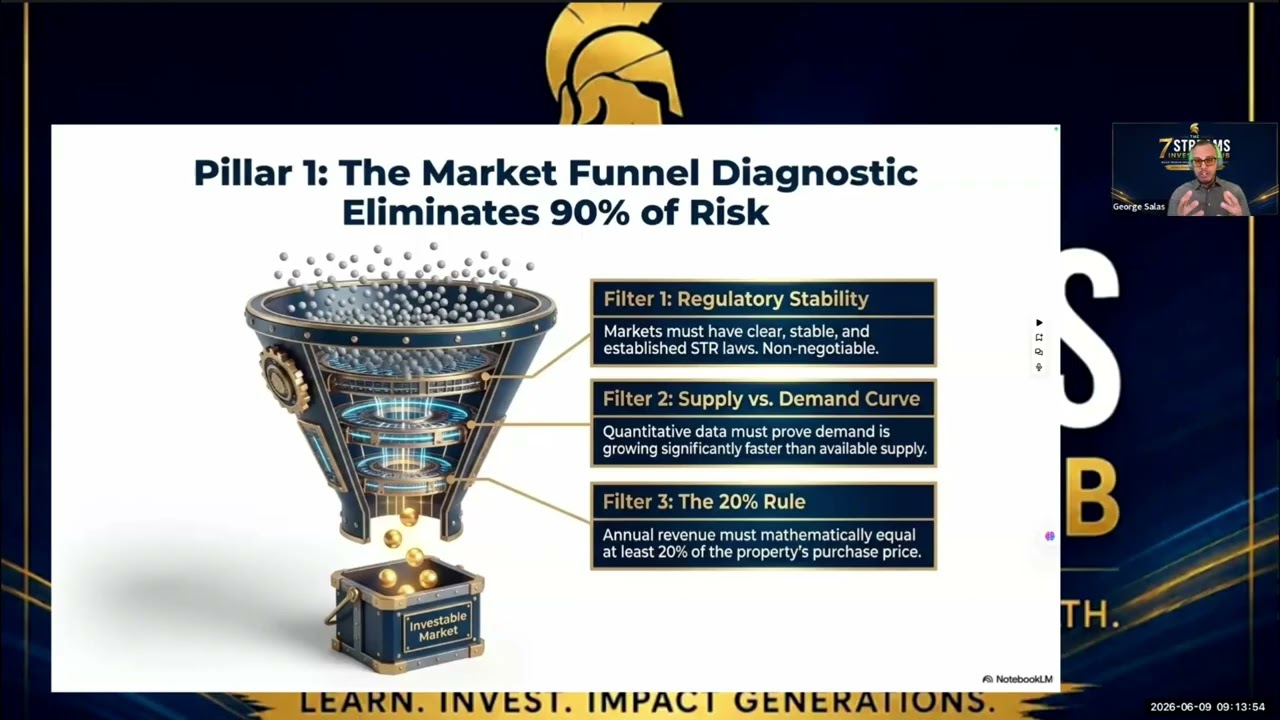
So that's quite a bit of the journey there. And here I want to talk a little bit about the, the vision or the divide between the amateur gambles and institutional certainty. Somebody that is a retail amateur, right? Comes in and makes decisions when they invest into short-term rentals by emotion, right? The essentially want the proximity. They find what's available on Zillow. They're hoping for the best case scenario, and then they're literally just making bets without the numbers, right? Numbers are everything, right? So, and they set up properties that are very basic, which is what I also did from day one, right? And that has changed to what I call the Emperor's Methodology, right? Where you're learning about your one of seven streams method here. So now today we apply a very strict methodology with data filters. We look at regulations. We look at the market demand versus supply. We always want to make sure there's, there is a stability there on how the demand is growing along supply in that particular market. So we look at the market first, and then we benchmark the properties that we're looking at against the top 10% of existing listings. So that also creates a stability long term. So When you guys go do a short-term rental, invest in a short-term rental operator, make sure that he is always thinking about the long term as well. Okay. The next thing we do is to stress test the market and stress test the properties against worst case, worst case underwriting. So we have 3 levels of underwriting: worst case, realistic, and target, right? So always shoot for the stars, and sometimes you just come in right in the middle, right? So, but for us, if a property doesn't least cash flow, or worst case scenario, even a little bit, we just don't execute it, right? So we focus on revenue-driving and experiential amenities such as pools, hot tubs, outdoor kitchens, pickleball courts, just playgrounds, things that could create memories for the family. So next, what I like to do is jump in to pillar number 1 of our 3-step methodology that we're going to go to today. So the first thing we do, we look at is the market, and we diagnose eliminate 90% of the risk just by filtering the market. The first thing is regulatory stability, right? We make sure that we look at regulations. We need to understand there's an HOA there. We don't go for HOA properties. If the market allows short-term rentals, and they do, great. We like to go for that middle, strict regulation, not too loose, not too strict, right? So then we simply filter the supply versus demand. We look at quantitative data and qualitative data at the same time. Quantitative data are the numbers. So does this market sustain? Does the growth of this market in terms of money coming into the market, is it equal or less or more than the listings being posted or listed in that market? We want very steady growth or we want more demand in that market, right? And next, we filter out all of our properties through the 20% rule. So it's what I call the revenue to purchase price ratio. So if the property that we purchase is worth $500,000 and it does make 20% of its purchase price in revenue, then we just simply don't do it. It's got to make at least $100,000 a year in order for us to execute that project, right? So that's what we call the 20% rule. And mathematically, this allows us to be on the safe side. Now we average 25 to 30%, okay, purchase price to revenue ratio. So let's talk a little bit about the 20% rule a bit more. So this is the baseline, right? So in this case, it's a quick case study here that we did in Cypress, Texas acquisition. We purchased the property for $455,000, and our gross rent estimate, right, was 29% of that $455,000. And we have actually hit over $100,000, between $150,000 to $155,000 for 2 years in a row in this property. Okay, so that's the baseline. We like to stay a little bit above 25%. If we hit 30%, that's great. That allows us to cash flow. On this property, the cash flow is $1,000. Summary there. So the next pillar for us is what we call the Sweet Spot Formula. So the Sweet Spot Formula essentially dictates what our buy box is, right? We look at revenue potential— so how much money, how much revenue will this property bring in year per year? We'll look at guest appeal— what do these guests in this particular market love? Like, what are the amenities that they love? What are the size of properties? How many bedrooms and bathrooms are they coming in? What are they booking all year long, or is this a seasonal market? Is it on a strategic location that has demand drivers around, right? We want to make sure that if we're going for a property, we are in proximity to locations with demand drivers. So what I call demand driver, for example, is it could be an entertainment center, or it could be a boardwalk, or it could be a shopping center of some sort, or the beach, or a lake, something like that, right? And then the next for us is the value-add potential, right? So can we add value to the property in the interior and exterior? So can we add amenities? Is there enough room to do that, right? Can we make this pool that's already there super cool? Can we build an outdoor kitchen, put some cabanas around it? Sometimes these properties don't have any room, right? So currently we're doing a project in— or large portfolio in St. Louis, and one of the properties we recently launched essentially was gutted, completely gutted. So we added a pool in the backyard, and it is— was an above-the-ground shipping container pool. We added a carport, we added the outside, the outdoor kitchen, and then we added a basement as well. And that basement was a movie theater, right? And so these things add what is not just a guest appeal, but it also adds value to the entire project, entire property, and it creates longevity in terms of How long is this property going to cash flow at that consistent rate or revenue at that consistent rate? We love that piece as well. Okay, next pillar number 3 is the design aspect. So we focus on experiential design, and for us is an ROI machine. Design is our secret sauce. Interior design is a direct revenue multiplier, okay? And interior design and exterior design comes with a bit more than just the word design, right? Inside the sign, there are amenities, as I mentioned, right? So how do you dress up these amenities? Are you just going to throw some furniture out there, or are you going to put colorful things? Are you going to put— are you going to make this exterior or interior look beautiful, right? So for us, it's about the— these common spaces will at least create those memories for you, right? They essentially make the people live there. So, and for us, we think about sales 101, right? And when people come in and book a listing, are they looking at the property itself or are they looking at how they're going to feel when they get to the property, right? So this experiential design creates higher average daily rates and higher occupancy for us. It creates better reviews and repeat guests as well. So quick case study continuation here on this Cypress property. What we did was we came in with our 2024 projections here. Our projections were $100,000. If you look at the left column here, we projected to do $100,500. Our actual revenue in year 1, in just 8.5 months, was $150,000 because of the things that we did in that property, right? Now, the reality of real estate is that sometimes even when you go above the projected, there are always issues, there are always things that are going to get in the way, right? In this case, that year we had a hurricane hit Houston, so— one of the buildings, which we had 3 units in this property, flooded. So we had to come in and spend additional CapEx. And our actual net cash flow for that year, despite of that additional CapEx, was still $35,000, where it could have been $45,000, $50,000, right? Maybe even more. So for that 2025 look, we actually hit $46,000 in cash flow, and then the revenue was around $155,000. Okay, so again, we come in conservatively. Underwrite at the lowest possible worst-case scenario. And then we want over— under-promise and over-deliver. And that's always the goal. So continuing here, part of the flywheel is what we call, right? When we build our STR Wealth Engine, we want to create a flywheel, right? So the first thing is always looking at the market. So you take the market, you understand it, and then you narrow it down to a smaller submarket, per se. And then within each submarket, there are what I call micro-markets. Markets. So let me give you an example with a proper city. So if I'm in the Houston area, a submarket of Houston area would be The Woodlands, okay? The Woodlands, Texas, one of the fastest growing communities or cities in America. And then a submarket would be— a micro market would be maybe the Waterway in The Woodlands, right? Where all the shopping and all the restaurants and the mall where everybody loves— likes to be right there, where there's tons of things. There's a lot of people are follow there. People love going to that area. So then the next thing for us is plugging in our acquisition rules, being super strict about those rules and those points that we mentioned in the prior slides, making sure that the purchase price to— purchase price to revenue ratio is right, making sure our signage strategy is there, our amenities are set up the right way, and then setting up our listing there, right? And then next is putting that to life through a revenue-based design strategy where we come in and we actually implement the finishes, we put in the amenities in there in the interior piece, and then as well as we create that environment and that theme that people love to be part of. Okay. So the insight here is that this flightwheel generates exceptional generational wealth, right? But building, managing, and maintaining it requires full-time institutional infrastructure. Well, now let's talk about the Emperor's Advantage, institutional expertise delivered passively, right? So we built an engine so you don't have to. So we invite select partners to bypass the operational headaches and access institutional-level returns. So we focus on full-cycle optimization. We own, manage, and optimize high-end short-term rental assets completely in-house. This goes from acquisitions, renovation, interior and exterior design, and property management. We go in and perform expert due diligence, so we acquire strictly within our defined buy boxes to maximize downside protection. As I went through in the prior slide, you always want to make sure that you're going for the lowest, the lowest target, but it's essentially shooting for the stars, right? So your lowest number, your lowest revenue, that way you can overperform those numbers and create better cash flow, better returns for investors as well. And the next focus for us is dual threat returns. Investors benefit from immediate strong cash flow coupled with long-term equity appreciation. So now, supported by the Seven Streams Investor Club leadership Ecosystem, myself, Catherine Bell, Amore Porter, Trevor Hicks, and Tracy Gore. I love this family, by the way. So I'm super excited to be here. So I appreciate you guys listening to this. Just giving a quick outro here. So if you wanted to take over this, Catherine here, we're super excited to be here. So thank you very much for having me.
Absolutely. So here's the thing I hope everybody got from this. And George, you said at the very beginning, like, this is 7 streams of passive income. And finding an operator who really like not only knows and understands how to take whatever the asset class is and have it be extraordinary, but really is passionate about it. Like, I don't know about anybody else, but George, it's absolutely abundantly clear you absolutely love this and this is your whole background. It's having that heart to serve and to have everybody have an amazing experience. So I know I had some vacation rentals. I do not have that same gift or skill. Having somebody people like you that we can partner with to literally have our investors create extraordinary returns, as well as know that they're a part of indirectly having other people have amazing experiences, is incredible. So this leads into— we are actually creating a club, the Seven Streams Investor Club, and these are the webinars that are leading up to it, teaching about all the different asset classes that get to be a part of everything that we're creating. So if you are interested in learning more about this, please reach out to us. You can put your comment here. Laura also put in the Zoom chat link so that you can get registered for the upcoming webinars and learn more and more and more about all these other asset classes. And then more importantly, how to join our club and the community. So again, George, thank you for being here. I'm super excited to have you be a part of our community and all of this. Again, this is a really important asset class to have as part of everybody's passive income stream portfolios. So really excited about that. So get yourself registered. The link is there. Super excited to have you here. And George, again, just thank you. Thank you for being you, and thank you for having that heart to just serve and make a difference for people. Thank you. Beautiful. Okay, well, with that, we are at the bottom of the hour, so we promise to honor and respect everybody's time. And again, thank you everyone. We're looking forward to having you. Uh, anybody who missed it, George will be back on Thursday to be able to do this again, and we'll be able to have some time for questions and stuff on Thursday as well. So awesome, George. Thank you, you're amazing.
Thank you, thank you.
Love it. Okay, bye for now, everyone.
Bye.
Make sure to check out my7streams.org for details about the club.










