Live April 20
Catherine Bell and Tracy teach the Seven Streams framework for building passive income through assets. Catherine built 13 income streams after losing her husband to secure her family's future. Participants get homework: play Cashflow, take an investor survey that generates a 90-day plan, and use vision boards to clarify goals.
Chapters
Can you hear me now?
Yeah. You hear me now?
Yeah, we can hear you.
Okay. I think the link that was in the—
Yes, the link that was in the email you sent out is not this link.
So we have to figure that out.
I like it. Yeah, again. Yeah.
No, it's good.
We're learning this.
We're learning this. Yes.
Yay. Woo-hoo.
Yes.
A whole lot of woosa. Okay. Super excited about getting started here and having all you ladies here to do this.
I—
oh, good. Everybody's names are popping up.
I'm doing that. I figured out how to do it.
Okay, thank you. Awesome. Um, I'll let Victoria in. Okay, so, um, we're gonna go ahead and get started. I'm really excited about this and about what we're doing and what we're sharing. Um, I had it all up and now I can't find I can't find it. Awesome sauce.
What happens? Nothing worked when I sat down. It's all good. You know what that means? That means that we're fixing to drop some pho.
There we go. I love it. Thanks for the context. Good morning, Victoria.
Oh, her background is not changing.
Oh, I was having such a hard time getting in.
Sorry, we're all having some fun technical difficulties.
I love you guys' background. I don't know how you got that.
I'm trying to put it on yours and it's not taking for some reason.
Oh no.
Do you have another background on right now?
Um, no, this is actually where I'm at.
That's actually where you're at.
It's hard to tell these days with virtual background. No, yeah, I don't know why it won't take on yours. That's interesting.
So I have all these people texting me that it's not working and emailing and calling. I love that everybody wants to be here.
Oh my gosh, now my computer doesn't want to work. Come on, baby, you can do it. Gotta talk nice to her. Come on.
Okay, so let me share my screen and we are going to get started. Where did it go? I'm so proud of myself, was ready like 45 minutes early.
Yep, that always feels good.
And now I can't find it. Okay, found it. Okay, here we go, Tracy. Super excited. Okay.
I don't know why the background doesn't want to attach to you, Victoria.
Who's this?
It's okay, I'm sorry.
Rejected.
At least we got your name though.
I'll take my name.
Okay, are you guys seeing, uh, where it's talking about turning income into freedom?
No, we only see you still.
Oh, all—
not that we don't want to see you, but Hey, Greg is coming.
That's exciting. Okay, here we go. Now, do you see it?
Yes.
Okay. So we see—
yeah, but we see it with your tabs and everything too. We don't see it like as a presentation.
Hey, Greg is here. Somebody gonna let him in?
I did.
He declined.
I'll let him in again. Okay, maybe he doesn't want to be pink today.
Sometimes if you don't respond fast enough, it disappears and you think they rejected it, but they didn't.
Oh, and it says that you have to find—
yeah, super excited you're here. Thanks, it's great to be here.
I'm gonna have to be off camera, but, uh, it's good to be here and I'm excited to hear what you have to say.
I love this. Okay, so Having technical difficulties. We're getting there. Come on. Okay. Can everybody see my screen?
Yay. Yes.
Yay. Okay. Awesome. Here we go. So I'm really excited to be here with all of you. My name is Catherine Bell, for those of you who don't know, and Tracy and I are going to be presenting for you today and sharing a little bit about our stories and our journey and more importantly, our mission. Which is all about multiple streams of passive income. So we're gonna go ahead and, um, dive in.
So, oh, so I was gonna say, up until now we've talked about systems and funds and deals, but today is gonna be different. Today is about you, because none of that matters if you don't know how to take the income that you're earning and turn it into something that will work for you instead of something that you constantly are striving to work for. Um, when I first started investing in myself, I would take my active income and I would start investing in certain, um, equity positions that I could afford that would turn around and then produce passive income for me. So it's not about really replacing your active income, it's how do you use that active income to then fund all of your passive income and then eventually be able to sit back and enjoy the streams of money flowing in.
I love it. So most people are trapped in a cycle where their income is tied directly to their time. So they work, they earn, they spend, and they repeat. Even when income increases, the lifestyle often expands with it. So leaving very little room for true wealth creation. This is not a lack of effort. It truly is a lack of structure. So I just want to share a little bit of a story last— from last night. Last night we had guests in town and long story short, they came and played Cashflow with us, which anybody knows, my favorite game on the whole planet. And that would be my homework for all of you. Go buy the game and play it, but play it the way we play it, which is super fun. And so we're going through and literally teaching them, and I want everybody to write this down. This is really important. Your earned income is meant to buy assets that provide passive income, and then that passive income pays for your lifestyle. This was the number one lesson that we kept going over again and again and again yesterday. And this is the piece that is missed because of what were indoctrinated into through school, through society, through media, like all the things, is that your earned income needs to go buy all the things and pay for the lifestyle. Well, then that's backwards because then you have nothing left to actually invest. And when you understand how the wealthy are actually doing it, you literally can do this too. So again, write this down: your earned income is meant to buy assets that provide passive income, and then your passive income pays for your lifestyle. This is a really, really important piece that people need to understand because again, if you don't do that, then you get stuck in the time equals the money trap. So again, like it said, like if you, when your income increases, you go buy more stuff. That income increase literally should go into— yes, I'm shutting— into buying these assets that now you have the freedom to buy as many, you know, fun doodad things that you actually want to buy, which gives you the breathing room. So I really want you to take away— we're going to be giving you lots of nuggets and homework pieces from this entire webinar, so make sure that you're writing down all of these notes.
So the true currency is peace of mind. So money is— it's not just numbers, it's stress, it's freedom, it's options, and it's security. For many people, especially women managing households, uh, careers and families, money represents stability and peace of mind, but it can also represent stress, and it can represent, um, money myths that you've believed growing up. So sometimes you have to straighten out our, our our mind around money and understand that money is a tool. Money is not evil. Money is the tool so that you can make more money, so that you can fund your lifestyle and cause massive impact in the world. So the goal is not to just make more money. The goal is to create a life where the money can support you and your mission and all of the things that you want to do in your life. We can't do it without money. We can't help people if we don't have money. So Wanting more money is not greedy, is actually biblical. And, um, I believe we're supposed to steward money well, and to be able to do that, we have to make it multiply so that we can help, um, support people that, that need our help and our loved ones.
Absolutely. So, uh, the Wealth Wise Women community, um, it was actually created to make wealth building accessible, understandable, and achievable. And so it focuses on helping individuals take control of their financial future by creating multiple streams of passive income rather than relying on a single income source. This is about empowerment through clarity and action. So last night we were having this conversation while we were playing the game and I said to them, you know, exactly what I say to my twins who are now 21, like, I don't care what you know. I only care what you do. So it's only in the doing that it actually matters. And why was this created? This was actually created out of some experiences that both myself and Tracy have had and so many other women and families. So this isn't just about women, it's about families. So the husband, the wife, the kids, I want everybody to actually lean in and participate in creating these multiple streams of passive income. This is a really important piece because the more families that I speak to or stages that I speak from, I literally have everybody hold up their hands. So everybody do me a favor, hold up your hands, put up so I can see your fingers. And what you're going to do is I'm going to give you the 5 D's. However many D's your family has literally dealt with, I want you to hold up that many fingers. We're going to do a test. So it's death, divorce, diagnosis, downsized from the economy, or being dumped from your jobs? Most people, yeah, 3, 4, 5. That's what people are dealing with. All of these are emotionally devastating, let alone financially devastating. And you couple that together and literally it will break a person. And so this was created after my husband had passed away in 2018 very tragically. And I, through a whole series of events, had actually created 13 streams of passive income for my family. So I was emotionally devastated, but had I not created those 13 streams, like, that gave me the freedom to take a year off and grieve with my 14-year-old twins at the time and figure out what we were going to do next. Again, we didn't plan for my husband to die. We didn't plan for the economy to crash. We didn't plan for, you know, any of these other 5 Ds to happen, but they happened. And so having those multiple streams of passive income in place to be able to take care of our family during those very devastating times makes a huge difference. And then we go on and we create multiple streams of like income 8, 9 through 40, and those can actually go make an impact in the world, which is what Tracy had alluded to a few minutes ago.
The concept of the 7 streams of income is built on the idea that true financial stability comes from diversification. Instead of depending on one paycheck, you build multiple sources of income that work together to create consistency and growth. Um, each stream plays a role, and together they form a resilient financial foundation. There's different, different streams. So you've got your earned income, which is your active income that you're, you know, maybe it's your W-2 job. And then there's residual income. That's the ongoing royalties properties and systems that you've built using your earned income. You've got capital gains, which is your asset appreciation. You have rental. So maybe you are able to invest in a short-term rental or even in a multifamily, and then you'll have, you know, rental income coming in. They call that mailbox money and profit from selling products or services, interest lending capital. So I've been a private money lender now for many years. I have a hard money lending company and in those We've learned how to use money to make more of it, and that's the whole idea. And then you have dividend, which is like owning equities. So there's all these different streams, and inside those streams there's a gazillion strategies, and we can teach you lots of those strategies. But you've got to get your mindset right. You got to get it all lined out, just like Catherine said, where your earned income is, is supporting the asset. Acquisitions, and then that supports your lifestyle. When people do it backwards, all you see them have all these things, but they're stressed to the max because all of the money that they're earning is, is being used and they can't even invest even though they have plenty of money. So you got to, you got to be able to prioritize and just change your mindset. Like she said, earned income pays for your assets. The assets will then pay for your lifestyle.
Yeah, this is a really important piece for everybody. I hope you're understanding this. So the structural integrity through diversity. So active income requires your time and your energy. So your active income is like your job, right? That's a very active income piece. Or for instance, when we were doing the Flipping Females, it was, that was essentially active income because we actually had to be doing all the work for that. Passive income is a whole other story. So passive income is designed to continue generating returns even when you are not actively working. This is where the true freedom comes from. So the goal is not to eliminate active income. In fact, it is used as a tool to build passive income over time. So here's what I love about this inside of a family, right? Generally in a family, there's one spouse that's earning a significant amount of the money, and then the other spouse is free to, has a little more freedom of time and energy to be able to do this. And so generally how it works, like with my husband and I, you know, one of us earning all the income, the other one focused on building out the passive streams of income. And when you do this together and then, get this, include your kids in it, Oh my gosh, then everything changes. That is a game changer. Because when, when kids understand essentially what doodads are— play the game Cashflow, you'll understand what I'm talking about— when they understand the difference between assets and doodads, all of a sudden they start thinking very differently about the things that they want. So this is really important. So again, you have to understand these passive streams of income are meant to reduce expenses. Exposure, right? Right. So a single source of income is a single point of failure. And when we lost everything in 2009, that was the biggest thing I wanted people to understand is that we were 100% owners in one company. Yes, at the time it was a multi-million dollar company. We sold it. But then of course my husband got sick, the economy crashed, like all the things happened because we had one income source. We were 100% owners of one company. And that's when I realized and like clued into, it was better for us to be a small percentage owner in hundreds of companies rather than 100% owner in one. That was really important. So it creates flexibility. So it gives you options to expand when survival isn't tied to one paycheck. That gives you some breathing room. Like I can tell you, all of us here are going through some hard things. And you never know when people are going through hard things, but most of us are going through hard things when we don't even realize. And having this breathing room, like there's a friend of ours, something happened to her son and she literally was able to drop everything and go just literally be in the hospital with her son for weeks. Same when Christopher, when he got sick and literally like in the hospital every single day for 4 weeks, like I was able to drop everything and just go be there with him without having worry about the money. Again, we don't plan for these tragedies. However, having it set up so you have the passive income, it makes it be okay. So this enables strategy. So the shift from a defensive survival stance to an offensive wealth planning stance, this is a very different conversation. Like last night, again, playing the game and showing them like exact— having them understand because they had this, this active income and then were growing the passive income, even the passive income turned into opportunities to be able to buy more assets that provided more passive income, which gave them more freedom to protect their families, but now go make a difference in the world as well.
So active income is not the enemy, is the seed capital. So the objective isn't just to reduce your active income or eliminate it. It is to use the income. I think we're, we're getting this through to you. Use your active income to purchase your assets to build the passive income, right? Um, the objective isn't to consistently harvest active, uh, time-based energy and plant it into passive systems that yield continuous returns. That is the objective. It is not to just replace your active income. Right.
Yeah.
I think, I think you already went over this pretty well.
Yeah. You still want to have active income no matter what, right? Yeah.
Yeah.
Just the now passive income. That's what gives you the freedom to literally—
Yeah. I mean, I've been dealing with it. I've been dealing with it in my life as well. So, you know, if I didn't have passive income, I wouldn't have been able to take off 2 weeks not that long ago. And stay with my loved one. And so, you know, all these different streams of income, and they're not always going to be flowing with giant wads of cash, but if you will be diversified, when one is not doing great, the other one will pick up. And so it's— that's why it's important to have multiple streams, because one stream might be dripping and the other stream can be flowing, if that makes sense.
Yeah, absolutely. So despite Spelling the capital myth. So one of the biggest misconceptions about investing and passive income is that it requires massive capital to get started. It's actually not true. So in reality, what is required is structure, consistency, and access to the right opportunities. So the Seven Streams framework is designed to meet you where you are and help you build a step-by-step plan. And here's the other piece I'm gonna give you some more homework, so everybody write this down. So one of the things I want you to understand, again, when we ask better questions, we get better answers. When people are like, well, how, how, how, how, how, that's the wrong question. The right question is, who knows how? So there's a brilliant book by Dan Sullivan called Who, Not How. That book, I know all of us have read it, changed our course of our businesses and lives and nonprofits, forever because we ask better questions. And when you can plug into who already knows how and get the benefit from it, then that's when your life absolutely changes. And that's what you really want to focus on. So little side note, we are the who that knows how. So you can write that little note down.
So this is not about theory, it's about real individuals who started with active income and gradually built additional streams over time. Um, some start small, some started with partnerships, some started with education, but the common thread is that they follow a system. And I know I started out with nothing, and so I started out partnering with people who had money, and I had to be the active boots on the ground, so to, so to speak. And now I've built enough, um leverage there to be able to be on the other side. Now I invest passively and get equity pieces while other people are doing, um, all of the day-to-day activities. So engineering the shift— the common denominator is adherence to the system, not a windfall of cash. So your active income is your starting point, and that leads to your current streams. Um, leverage education into profit and dividend streams. So educate yourself. Um, the starting point for current streams is start small through strategic partnerships, just like I did. Um, and it will activate different streams of income for you. If you want, um, well, if you have purely earned income, then it will lead to transitioning into a balanced portfolio. So you have to adhere to the system and don't just start thinking about, um, the windfall of cash that's going to be coming. Stick to the plan. Make a plan and stick to it. Know what you're doing, why you're doing it, and how you want to get there. If you will take your life now and you'll say, okay, in 5 years I want this, whatever it is, it doesn't matter. Reverse engineer that and come up with a plan that you can do today. One small step in the right direction will change the trajectory of your life, but you've gotta know what you wanna do. So you gotta plan it out in 5 years, this is what I want, and break it down, reverse engineer that sucker, and then start implementing things that you can do today to start, um, figuring out how you're gonna end up with 7 streams of income.
So I love this, Tracy, and it reminds me like as moms, right? We, our kids watch movies or we read them books or whatever, and two of the stories that keep coming to my head is the one Alice in Wonderland when she comes to the Cheshire Cat and she comes to the fork in the road. She says, you know, which direction do I go? And he's like, where do I want, where do you want to go? And she's like, well, it doesn't matter. Then he's like, then it doesn't matter. You need to be able to be really crystal clear where you're going so you know what path to go down. That's number one. That's really important, and we're going to give you a gift at the end, so stay to the end because we have a gift that will actually give you the roadmap. So that's the whole other thing, so stay. The second thing is the Tortoise and the Hare, right? The Tortoise and the Hare story, again, I love these stories because they teach such brilliant lessons, but I think as adults we forget about it. So the tortoise, people want the whole, I hear a lot of people wanting to like get rich quick, There's no such thing. Don't do that. It's all about the tortoise. In the end, the tortoise won. Little teeny tiny baby steps. If you've ever watched a tortoise walk, literally they have little teeny tiny baby steps. And as they're walking, literally he won the race. And that's exactly it. People are like, Catherine, how did you build your empire? Tracy, how did you build? Laura, like And how did you all build your empires? Well, it was one little tiny step at a time. Literally, there were no leaps and bounds. There was no jumping jackrabbits. It was literally a bazillion tiny baby steps. So I want you to keep that in mind as you're thinking about this. And again, stay to the end because we're actually going to give you your own personal blueprint.
Yeah, and don't make, don't make emotional decisions on investing because you think it looks fancy or like, you know, make sure that you're making educated decisions on what you want to do.
Yep. So building wealth is not something that you have to do alone. So within the WealthWise Women community, again, this is for families. I want people to understand this. This is so— there is support, shared knowledge, and the best part, collaboration. I love it. So this creates an environment where people can learn faster, avoid common mistakes, and stay consistent. Community accelerates progress. So I want you to write that down. Community accelerates progress. This is really important. Again, going back to who, not how, right? So when we're building wealth in isolation, it's exhausting and it's prone to error. This is a really important thing because you only know what you, know, and there's a whole lot you don't know, you don't know. And there may be a whole lot you know, you don't know. But inside the community, collectively, we all come together, and all of a sudden you have this collective knowledge and can make way better investing decisions. So the WealthWise Network provides shared knowledge, vital accountability, which is really important, and collaborative momentum. So for instance, we do this every morning at 9 AM Arizona time. We all get on a live webinar. Everybody's invited to come and actually participate in the actual accountability and the collaboration and the momentum that's actually happening from that. And we're doing some amazing deals. We've got some young adults here in their 20s and just crushing it. Again, zero experience. Experience, but doing an amazing job just being coachable and following along with the steps that the community has given them and how everybody's coming around them and being able to do multimillion dollar deals. Like, who wouldn't have loved that in their 20s? So community drastically accelerates the timeline from education to execution. You guys, I said this at the beginning, I don't care what you know, I only care what you do.
Right?
Knowing isn't enough. It's the actual execution of the thing happening that matters more than anything. So this is really, really important. I want you to lean into this community only if you're interested in multiple streams of passive income. If you're not, that's okay. We understand.
We're just better together. We're better in community, you know, because we can share our losses, share our wins, share all of the secrets that can Like you talk about collapsing timelines, you know, when you can learn from people who have done it, you're collapsing timelines on being able to, um, you know, implement those strategies that they've already done. You don't have to reinvent the wheel. Amen. So the Titan Wealth Engine, uh, Wealth Wise Women is a key part of the larger Titan ecosystem, connects directly to the Land Chart Mastermind for deal flow, Titan 23 for investment opportunities, and the Seven Streams Investment Club for participation. It acts as a bridge between earning and in between earning income and deploying it strategically. It bridges between income and investing. So you get educated through the Wealth Wise Women, then you can find the deals in the Land Shark Mastermind, and then you can create yield through the fund. Or if you want to learn and earn, you can do the Seven Streams Investment Club. It will be more hands-on where you actually get in there with your own money that you invest. And walk through everything and vote together. And it's, it's great for beginners. So there's something for everybody in here. It doesn't matter what stage you are in. We are there to help you. You know, somebody was there to help me and I want to reach back and help the next person. And yes, it's WealthWise Women, but that's because women are the glue that hold the families together. And we want everybody to be able to understand this and implement it for their own, for their own, you know, life so that they can create the wealth that they want, leave the legacy that they want, and have the life that God you know, designed for us.
Yeah, that's super important. I love that. So the real transformation happens when you stop thinking of income as something you earn and start thinking of it as something that you allocate. So every dollar has a purpose. Every decision has a direction. This is how wealth is built intentionally. So again, when you get out in front of your money and you tell it exactly where it's designated to go, again, you guys, this is what the wealthy do, right? This isn't rocket science. We just weren't taught it in school, but we're teaching you here. So when you take that again, and you tell your money exactly where it's going to go, and you have a plan for it, all of a sudden, now it starts to multiply. Again and again and again. Again, it's baby steps. This is the most important thing that you guys need to understand is like, again, it's about being intentional. So intentional allocation, write that down, strategic decisions, and that gives you purpose-driven money. Again, money is just a resource that gives you the freedom to literally go make the difference in the world that you want to make. So this is really important. I hope you guys are taking notes.
It's important to understand where every bit of your dollar goes. And for people just starting, they need to really budget and understand this is exactly where my money is going. And then you plug those money leaks, which are the things that you don't really need, and you start, you know, developing wealth on purpose. So the architecture of freedom— by now you should understand that wealth is not about luck, it's not about timing, it is about structure and consistency. The Seven Streams framework provides a roadmap for turning active income into long-term financial stability and growth. Uh, wealth needs to be structured. It's intentional by design, not a byproduct of luck. Luck is not gonna, gonna make it. Consistency wins. Compounding small actions outpaces the erratic leaps. And clarity equals execution. The Seven Stream framework gives you the exact blueprint to deploy active income into that lasting legacy that you are longing create.
I love this so much. So, um, the, the next session that we're going to be doing— again, we're doing 7, 7 webinars which are leading to our actual virtual event. It's a 3-day virtual event. But the next session, we're going to explore something deeper, the concept of legacy and purpose through nonprofits. So my— one of my nonprofits is Wealth Wise Women. The other one is Chosen Forever. Because wealth is not just about what you build. It is about what you leave behind. So this is really important. Again, now it gives your money a whole new meaning and purpose to it. So it's not just about buying all the fun toys, but now leaving that legacy and leaving it as a family. Again, husband, wife, kids, like everybody gets involved. When you bring that heart together and family is serve together in this way, everything changes. This is a really, really big deal. So structuring wealth is only the mechanism. The ultimate goal is that wealth, what wealth actually leaves behind. So again, another book, here we go, Catherine's like list of library of books. So Simon Sinek wrote a book called Starting with Why. I invite the whole family to read the book. Because again, when you read the book and you discuss it as a family and you all really discover what your true why is, all of a sudden what you're creating and these multiple streams of passive income now take on a whole other life, meaning, and purpose of their own. So this is really important for, you know, you as a family to be able to take this and change the legacy of your family forever. You literally can. We all can. This country is extraordinary. So let's take advantage of all the benefits here.
I think the beauty also of doing it as a family is that now you've got the whole buy-in. Like if everybody understands their why and everybody is going for a common goal, now everybody's bought in. Like they, they are, they're pressed into it. And it's not just, you know, like a list of things they got to check off. It's like now it, like you said, it has purpose and it has meaning and then it can just come alive. That's beautiful.
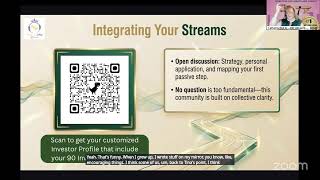
So I promised you we're going to have a gift at the end. And again, it took me 20 years and all the different types of investments to figure out what type of investor I am. I like to be the bank and rent dirt. Literally, we've collapsed 20 years of knowledge and experience right here for you. So if you scan this QR code, it's going to take you to a 125-question survey. And literally, it's a, it's a personality profile of who you are personally. As an investor, and it literally is going to lay out a 90-day blueprint for you, which leads into a 12-month blueprint, and literally all the teeny tiny baby steps to be able to get you to the next step, and next, and next, and next to get you to your 7 streams of passive income. Again, this takes years, don't get me wrong, but you need to start somewhere, right? And so this is our gift to you. Please come back for the webinar that we have on Thursday. At 3 PM Pacific, and we can get you the links for that. In the meantime though, does anybody have any questions before we move on? Was any of this not clear? Any comments? Or what are you choosing to take away? Anybody?
Hey Catherine, I just dropped in a chat like First of all, straight gems you guys been dropping, Tracy. You guys amazing. Um, but in the chat I put like, do this totally debunk the trend of using active income to buy assets is what the world teaches everyone. Um, and getting a hold of that earlier in life actually, you know, will move you forward. Instead, just knowing that the real flex is to use the assets to buy freedom and that That's the part where we miss, right? Right. Um, when you're purchasing and just buying the things that you think you should get, right, you're— you just put yourself in a hole instead of purchasing the assets that will help you get there.
Yeah, it's like, uh, once you've bought something that you tend to consume, the money's gone, it's done. But if you will use that money to go into the streams that are going to be creating more of it then you'll have more money left over to buy the things that you can consume, you know? But once you've consumed it, it's gone. So you have to really be intentional with, okay, is this dollar gonna, is that it? Or am I gonna be able to take this dollar and create lots and lots of dollar babies?
So one of the things we talked about last night is we talked about like the son wanted to buy these custom golf clubs, you know, and they love playing golf, which I think is amazing. Now, what if rather than him taking the $1,500 and going and buying those golf clubs, went and took that, bought an asset that threw off $1,500 a month, bought the golf clubs, but now the next month he has another $1,500 and another and another and another, right? That changes the whole dynamic of what having your passive income pay for your lifestyle. Because if you design it and have enough discipline to go, wait a sec, I'm going to go buy an asset that's going to pay for this, but then understand it's going to continue to give you cash flow so that you can keep going and buying more toys or making a difference, whatever it is. You designed it for this one thing, but now it keeps— it's the gift that keeps on giving. Yeah, how great is that? Yeah, right. It just has you— I hope this is having you think a little bit differently about this.
Yeah, it's good.
I was gonna add something.
Oops, sorry, go ahead, Tracy.
I was just gonna say, it's just like, um, like when you build an offer that's like an evergreen offer that just keeps on going. Like, you know, Catherine and I both wrote several books. Well, those books are going to pay us for the, for the rest of our lives. We had to do it one time though. So you just have to really start thinking, okay, what do I want for my life and how am I going to get there? Yeah. What were you gonna say, Tina?
Oh, I was just saying, uh, you know, I, I have been working actively in a W-2 for multiple years and now I'm at I'm ready to— I've had some wonderful investments, but now it's— I need to learn how to just keep finding where I can reinvest, where I can trust, you know, who's putting the deal together. Also, I wanted to throw something kind of funny in. I'm trying to teach my boys this as well, so this is awesome. They're almost 21 and just turned 19, so 19 My 19-year-old and I were talking yesterday about thinking about kind of his future, where he's at right now with what he's doing, maybe starting into his new business after schooling. And he said, well, Mom, I only have about 5 years before I start to decay.
I'm like, I must be a walking corpse. I don't know where he gets that.
So he only has 5 years to get him where he needs to go.
So I need to start working.
And that's hilarious. Hey, well, at least he has some urgency to get things going, right?
Right. So funny. Okay, so no, this is great.
I love bringing the kids into it. Absolutely love it.
Yeah. So Tina, again, like, this is the homework for everybody, is to go buy the game Cash Flow. And here's how you get them addicted to it. Buy the game, but then what you do, you can play with the written paper. Don't do that. That's too much brain damage the first time around. There is an app on your phone if you have an Apple, and you can actually get the Cash Flow game. And as you're playing the game, it'll actually calculate out the balance sheet. And there's a whole like green line that moves across, like as they start making progress, they get closer and closer and closer. To getting out of the rat race. And let me tell you, the joy that they experience is off the hook, and literally they become addicted. All of a sudden now it's like, wait, it's a whole different game changer. It isn't about mom and dad being mean and saying no to all the things. It's about them being responsible and looking at money in a very, very different way.
What, what is the name of the game?
Cash Flow.
I mean, I mean the app.
Cash Flow.
Oh, is it?
Yeah, it's a little—
it's, is it the little mouse?
No, no, it's, uh, it's a, it's a purple square with a white C and a white F. CF, Cash Flow.
Okay, now—
oh, you got it.
Cash Flow Balance Sheet.
So it's, uh, yep, Cash Flow Balance Sheet.
That's what it says on mine.
There you go.
CF. Yeah, okay, because there were several ones. I just wanted to make sure everybody got the right one.
Yeah, so it's that, that purple one right there. So if you can see—
well, then that's— I still don't see it.
Hold on. So see how it's—
I see it on your screen.
See if I can drop the link. I'll try to drop the link in the chat. Give me a sec.
Okay, cool. Yeah, cool.
That's awesome.
A lot of super smart people. This is awesome. So yes, that's your homework. And again, the younger you can start them, the better. Because again, usually here's what I have found is that kids actually usually kick the parents' butts because they don't have all the stuff around money the way that adults do. So usually adults have to unlearn all the bad things and then relearn the good things where kids just get to learn the good things.
Yeah, it's awesome.
Yeah.
Sisley, what's going on?
So I definitely agree with this, and I've had the privilege to play Cashflow with my son. We came out and stayed at the Catherine Bell Hotel, and my son, his whole entire mindset has changed just by putting him in the space with other kids, with Catherine. Like, Catherine left such a big imprint in my son's mind. Like, we go places and my son's speaking doodads. He's speaking cash flow, profit, interest. I mean, he's 13, and, um, so it's, it's definitely 13 years old. Yeah. And, um, the other thing too is since I've known Catherine, and I, I forgot about this until you brought it up, I have a note that I bought after working with you, and it comes in every single month. I get reminded every month, and I'm like, oh yeah, there's extra money that I completely forget about. And it usually covers something. It's not a lot of money, but it's, it just, it's consistent. And also, after knowing you too, like just the whole trajectory of my life, just the proximity is so powerful because I was able to flip a home. I mean, I can't even believe the amount of profit we made. And so now I see the Reticular Activator allows me to see the opportunities that I didn't see before. And that game, playing that game with you. And yeah, so I see it. I see opportunities all the time. So I just wanted to—
That's awesome. Here's what I love about Sicily.
I love it.
Right? Like, here's what I love about Sicily. Like, I put it out there that I'm playing Cashflow, and I put it out there again, did some videos. Any of you that want to come play Cashflow, you can come stay at the Bell Hotel and play Cashflow. I promise you, your molecules will be rearranged, and you will never be the same again. I promise you. Like at the end of the game last night playing with this family, like they were like, "Oh my God, you've like changed our lives forever in literally a matter of 2 hours." And again, it's not me. Like let's just get clear. It's not me, right? It's the game board. I just happen to make it super fun because I'm the fun one and so we make it fun and we gamify it and then all of a sudden like when your brain can latch on to something so typically not fun like finances and turn it into something fun, all of a sudden it's like, oh my gosh, I want more of this. It's so awesome. So I see Trevor's gonna book at the Belle Hotel. Victoria's gonna come to the Belle Hotel. Everybody come to the Belle Hotel. Let's have game night.
Tracy, have a big giant Cash Flow Party.
Right? I can't even tell you how fun it is. It's so ridiculous, the amount of fun. And yes, we're really loud. So it is a super fun, active game. Okay, any other questions, comments, takeaways? Okay.
Can I just add one more thing, Catherine? I'm sorry. Yeah, um, I think that the one slide that you show when, when you guys projected what the 7, um, streams of income are is very powerful because a lot of people don't know exactly what they are. And if like that can be reiterated, like put on a sticker, um, somewhere or a pin for everyone to have, it's like an eye opener to like, man, when I saw this, I'm like, okay, where am I lacking at? Like, what, which Which one am I missing? And I think it's very important. And the other thing you said about, like, um, Tracy, I think you talked about this in regards to, like, every mom should be in the room of this, with this, with this, um, slide in particular. Because, um, a lot of time if you're just W-2ing, you know, like, a lot of people like, well, you just need to buy some property to help. And that's kind of like, oh yeah, I have the property, I have the home, I'm good, but I'm still sinking. And they don't realize a lot of the spaces that they actually, you know, have opportunities in. It made me even think about it one time. I didn't even realize, like, I was investing like $50 or something, and then I wanted to see this like specialized doctor, and I'm like, well, I don't want to pay for this out of my, my paycheck. What am I— and I, I was able to like pull money right out of that and pay for it and had this. It was really amazing, and it just— it's an eye-opener. I think this slide is so powerful I think every mom, like Tracy said, like could recognize where freedom is actually within reach if they can see the bigger picture of this.
Oh, that is awesome.
I love that.
We should all have a sticker, a magnet for our refrigerator with the different streams.
So, okay. So again, for all of you writing this down, I want you to like honestly write down how many streams of passive income you currently have. And then how many do you want? Right? Like, for real?
Yeah.
And then let's build your blueprint based on that.
Well, and what about the power behind vision boards? And I know Catherine is a firm believer of that. So, you know, if you will, like Victoria said, you know, if there's a certain, um, image or something that really will put your, your, your frame of mind, your money hat on that makes you think, okay, wait a minute. It reminds you to think, um, outside of the box so that you can rewire your brain. If you look at it all the time, you're gonna, you're gonna— your brain will start doing things that will start projecting ways to get to the thing that you're looking at all the time. It's just part of it. Like, it's the more you get it on the inside of you, the more you will start doing things that will lead you in that direction. It's so crazy. And I know Catherine probably has a couple of victories about around vision boards because she's a firm believer too of putting up the things that you want. Like I had, um, there's a— this is, this is kind of silly, but I had like this— there's this beautiful house and the only reason why I wanted it is because I thought that would be the perfect location to have women's retreats. I was like, I got it, I want to get— so I— and my daughter Zoe thought she was like, are you— why are you putting that picture of that house up on the whiteboard? I'm like, because I want to have that, because I want to remember that the importance is pouring into women. And buying a beautiful place to do that is part of my goal, right? So I'm speaking that into fruition now, I should say.
Okay, Tracy, I love this. So I'll bring this up again. So last night we were playing Cash Flow. One of the things that when you come to play Cash Flow with me is you're going to learn about intentionality. There isn't a roll that I don't do without knowing exactly where I want to land on the board. I count it out. And then I close my eyes and I see it on the dice. I feel it in the dice. And when I'm ready, I'll roll the dice and it lands on it every single time. And they were like, what? But what you're talking about, right? Again, it's the having the blueprint, writing it out, saying it to yourself every day, having it created on a vision board, like having all the modalities of how we learn. Having it surrounding us because then all of a sudden our reticular activation system sees something and goes, "Wait a sec. I could do this, this, this, and this." All of a sudden, it happens. But again, if you don't know where— if you don't care where you're going, then don't do any of this. Like, that's fine. But if you actually like know where you want to go, then let's build it out together. So again, Going back to the last slide, if you haven't had a chance, like please give yourself this gift and do the blueprint. I promise you it's a game changer. It's 125 questions. If you do the, um, the speaking to it, it takes like 20 minutes to do. If you type it, it'll take you about 2 hours.
And it doesn't take 2 hours.
You, well, it took me 2 hours, but it's, but it's worth it.
It's, it's part of investing in yourself. Because it will kind of open up, open your eyes to the different, uh, areas that you're like, makes sense, that doesn't look like me, you know what, you know, and it will just help you, uh, see where you've been, maybe you missed some opportunities that you kind of felt drawn towards, but you didn't take them because you didn't know if it was the right fit. And you can look at your investor profile and go, you know what, all of these things I'm drawn to is because that's where I'm, I'm, I'm gonna be great in, that's where my gifting is. And it'll pull out your investor genius, I think.
Yep.
It's worth doing. So sit down when you have a few minutes to get it done.
And I think it'll affirm you as well.
Yeah.
You'll be like, oh my goodness. Like, you know, so it's a feel-good thing for sure. But a strategy thing. So coming up to the end of the hour, does anybody have any more questions or anything that they want to share? Any takeaways? I hope this was valuable for everybody and I hope you took notes. I gave you lots of homework. This is awesome.
Not a good webinar until we have homework from Catherine.
Yeah, I just kind of adding on to the, the blueprint and thinking through there for a lot of people, and I know I've been trying to really work on that with myself and with my, my boys, and there's some discomfort in that. I don't know why people aren't It's almost like they're afraid to allow themselves to dream and plan. And I don't know if it's— or they just are not intentional enough, like you're saying, and not— they don't want to make the time. And then you just end up going nowhere, right? Because, right, yeah.
And if we think about it, Tina, like, think about where else in our lives we're actually taught to do this. Are we taught to do this in school? No. Are we taught to do this in college? No. Are we taught to do this through social media or like, no, right? Again, it's the whole like what the poor middle class teach their families and what the wealthy teach their families. Yeah, right. So we're just pulling back the curtain to show everybody, look, you can do this too.
Right.
And I think it's like, how many times have we been told, you know, don't share your dreams with somebody else because then you'll jinx it or it might not come true or la la la la la. Or even worse, if you have shared your goals and dreams with people, they've literally like poo-pooed on them and crushed them, which now crushes your heart, right? And it leaves you in this vulnerable place where you don't ever want to share it with somebody again. Again, it's super important. Proximity is power, right? And having that proximity around people who are like, yes, Let's totally get your vision and let's lean in and help you take the baby steps. So yes, be very, very careful who you share your dreams with because there are those people out there. We all know them. We can list off them in our families and not. And we're here. This is the Wealth Wise Women community. So we want all of you to lean in. Again, this isn't just about women. This is whole families, husbands, wives, kids, like everybody gets involved. To be able to create this. So when we first created— when I first started doing dream boards decades ago, it was just me and my cat. We had a dream board. And when Christopher and I got married, it was Christopher's and my dream board. And these dream boards are like 3 feet by 4 feet. They're huge. And they're framed. And they're right in our living room in our house so that we see it every day, right? Like you don't want to make it and then hide it. You want to make it, frame it, and then display it. Be proud of your dreams. And it creates amazing conversations when people come into your house. And then when we, when Sarah and Jordan came along, then we created the family dream board. So it was all 4 of us and all of our dreams. And then, you know, they became teenagers. And I literally let them turn the entire bathroom wall in their bathroom into a dream board. I love it.
That's awesome. I'm gonna see if Zoe wants to do that.
Like, let them create, because my thought was it was, it was a wall right behind where the mirror was. So the mirror was here and the wall was here. So my thought was if they do it there and they're getting ready, unconsciously they're looking in the mirror but looking back and seeing their dreams all surrounding them.
You know, When I grew up, I wrote stuff on my mirror, you know, like encouraging things. I think some of us, um, back to Tina's point, I think a lot of times I didn't realize in my life I was afraid of success. I was scared to succeed. I had, I had always been taught to kind of shrink back. I mean, somebody didn't tell me, oh, you know, don't outperform me, but you were, you were kind of trained certain ways by the environment you grew up in. And I just taught to shrink back and I didn't, I didn't give myself permission to, to succeed for a long time. So sometimes you gotta do a little bit of inner work and be like, you know what? I can succeed and I'm worthy and I can do it. I'm a good steward of money.
Like, re—
get rid of that, the lies that are in your head that tell you you're no good with money. Get rid of those things.
Right.
Start speaking life. Start speaking life to yourself. Your, your world will change for sure.
I love it. Okay, ladies, it's the top of the hour. Thank you for being a part of this amazing conversation. Again, our next webinar is coming up on Thursday at 3:00 PM Pacific. So if you don't have the link, then please let us know. It's all over my social media. It's, yeah, it's on all the things. So yeah, we would totally love to share this with you and look forward to having you come back. Trevor, super happy to see you here. You and Greg and Blake all Came in as the man. I love it. I know we got the pink background. That's our book. But again, so yes, I'll share that one more thing. All my books. So the Wealth Wise Women Playbook is on Amazon. And what is it? It is a compilation of a whole bunch of women's stories, including mine, of where we came from, how we built out, and all the different asset classes. Again, you want to be diversified. So it's just It's meant to inspire you and have you think a little bit differently and go, oh, wait a second, I can do this too. That's my whole point. So I hope you have an extraordinary day, everybody. And I do look forward to seeing you hopefully tomorrow morning, 9:00 AM on our webinar, landsharkmastermind.com/webinar. Join us, join the community, and let's start strategically creating those multiple streams of passive income for you and your family. So with that, thank you everyone and have an extraordinary day. We appreciate you.
Thank you.
Bye-bye.
Bye.










