Ready to build wealth without sacrificing your sanity or your weekends? | Titan Impact Group
Catherine Bell talks with father-daughter investors Ashley and Michael about managing rental properties without burning out. They cover vendor relationships, tenant communication, documentation, and budgeting basics like reserving 5-10% of annual rental income for maintenance.
Chapters
Okay. So we are here today to continue the conversation from Tuesday, which was all about maintenance with buy and hold real estate investment. And what I loved is that you wove it into your own personal home ownership, which was super, super cool, and putting it into proactive steps that you can actually take so that the maintenance doesn't become overwhelming. It's that whole an ounce of. What is it? An ounce of prevention.
Yeah.
And then just like play Monopoly. Like, we learn all the rules. We may not like them, but just learn them. Play and win. So for everybody that may have missed Tuesdays webinar, let's go ahead and just go over that with them really quick, like a quick summary and then dive into the next part of this because you unpacked a ton of stuff on Tuesday, which was amazing, and I have no doubt you're going to unpack more. So again, Katherine Bell with Titan Impact Group and Ashley and Michael, father and daughter team, doing extraordinary things and for extraordinary reasons for amazing people. So really excited to have everybody here learning from the both of you. So go ahead, let's dive in.
Thank you so much, Katherine, for having us. Really appreciate it. And just real quick to before we give a quick recap on last week, again, for those of you that missed it and don't know who we are, again, father daughter team. And just a real quick summary of how we got into real estate in the first place. As Katherine always talks about, there's one of the major Ds that can happen in your life and which is why you need all the different streams of income to make sure that you and your family are protected. So the thing that started it out for me was D as in divorce. And so I got divorced in February. And in March, one of my buddies said, hey, there's a rich dad, poor dad, Robert Kiyosaki seminar in town. Would you like to go? Well, I said yes. And I primarily said yes because I had a small. Well, at that time it was small software development company that had just started only two years prior. And so it was in its growing stages when I went through the divorce. Both Ashley and her brother Brandon moved in with me. They took all the debt, took all the responsibility for the kiddos still had to pay maintenance. And to be quite honest, I was freaking out. And so I wanted multiple streams of revenue, as Katherine always talks about. And real estate is always something that I wanted to get into and learn. And so there you go. You get thrust in and you make it happen. So I learned about all the different streams of revenue Started doing all the different ones, figured out which ones were working for me, which ones weren't. And as the portfolio started to grow, I was having a lot of success with it. And I was doing a lot of the things myself, of course, which you're not supposed to do, especially as you scale. And as we started doing things, realized we wanted to join forces and do this together. So we. We started making that happen. The other D that came into our lives, which is a bigger D in this case, is one that you never, never, never want to have happen. It's the knock on the door and there's Marines in dress blues at your door telling you that your son was killed in action in Afghanistan. And that was very real. That was very impactful. When something like that happens, you change everything about your priorities. What used to be important is no longer important. You change things to where all of a sudden you realize how precious certain things are. And so you try to incorporate that into your daily life and what you do with that. And so one of the things we wanted to do was make this where we can pay it forward. We also created a foundation, Dark Horse Angels foundation, to help military when they return. But also we wanted, in the real estate endeavors that we're doing, to be able to pay it forward in ways to provide knowledge, information that we didn't have when we got started. And so we want to make sure that we can help people and give them a leg up so they can also have yet another stream of revenue for their families and. And for their legacy moving forward. So that's a little bit about why we got into it.
Yeah, it's amazing. And now, as two times international bestsellers, we're helping others be able to create their legacies through their own buy and hold projects and really just pay it forward there. That's kind of our mission moving forward. We manage a $65 million portfolio consisting of single family, multifamily, and industrial properties in both Colorado and Florida.
So that's about us now. Just a real quick recap. You want to give a recap of what happened on Tuesday?
Yes. So Tuesday, if you haven't seen it, go back and check it out. There is a lot of meat in there to dive into, but this is just a really brief overview on how to build out systems that work for you. We walked out how to build a vendor ecosystem. We actually gave a handout for that as well on what it needs to include templates, screens, scripts, all of that good stuff. Tenant communication. You want to build trust there. What we mean by that is you want to be able to be proactive, you want to communicate with that tenant right away, you want to let them know what's going on because you're building a long term relationship with that tenant as well. So turning tenants into allies with maintenance instead of creating anxiety on either side with that is important legal timing timelines that you can't ignore. All of those wonderful little gems. We went through what's kind of required by state law, what to pay attention to for time frames for maintenance in terms of when you need to start work, when work needs to be completed, by the difference between emergency and urgent or routine repairs, which is important to be able to classify and document. And that way you're staying compliant and your assets being protected. It and then we went through vendor relationships, how you can cultivate those, what to look for, what to when you're hiring, how to actually test that out and really making sure that the people that are working on your properties, they're certified, they're trusted and that you're building the relationships with them as well. The vendors that we work with personally, we have relationships for no less than five to six years and it truly just is amazing now what we can provide to our landlords. And so that's something that's really important when you're talking about maintenance. And then we went into our workflows really kind of your must haves top to bottom, what it looks like for intake triage. We went into detail on how you can continuously improve your maintenance as well and how to make sure, like I said, stay documented, stay compliant, but make it easy, make it run for you, right like this. If this is your game of buy and hold or your game of Monopoly, right, play to win, make it work for you. You don't want this to be a burnout for you. So went through your workflows and what that process should look like and then your must dos for first time landlords. So this was a big one in of what to have with reserve funds, what's recommended and truly the entire laid out list of start to finish, what your maintenance process should include in order to be successful and really systematize that process. So that way it continues to work for you.
And the idea is not to have yet another 40 hour plus job for you to do. The whole idea is to have a team in place, to have systems in place, processes in place such that much of it is automated or can be automated and that you're more of a puppet master instead of the person actually doing all of these pieces and taking a ton of your time. So.
Yeah, and we went through how to do that without a property management software too. Like there was.
Which. We're going to go through detailed questions.
Yes.
Of each of those.
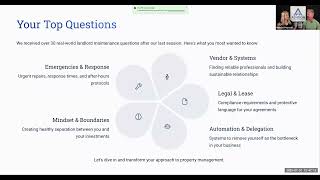
So that was all Tuesday. That was the briefest overview I could give for Tuesday. And this is kind of how we broke down today. So these are 30 of the. I mean, honestly the most asked questions we've received that have been cultivated from you guys to say these are the categories that they span across that we're going to go into. It's everything from emergencies and response vendors and systems legals and lease requirements. That's a big one. Automation and delegation and mindset and boundaries. So these ones we're going to be talking into a lot more deeply to really make sure that you're transforming your approach when it comes to managing your own rentals. Or this is going to be really awesome information if you are outsourcing that to a management company to make sure they're doing right because you want to make sure that that trust and that they're doing every piece of this. So that way your. Your assets protected.
Yes, absolutely. And we'll go through. We literally. I'm going to put the questions up here. We're going to walk through each of these independently, provide a little color, hopefully around them real life experiences and but for each of these types of things, the. This is important that Ashley just pointed out that this is whether you're doing it. Your. These are the practices procedures to give you the most success. But also likewise, if you have someone else doing it for you, make sure they are doing these things. Make sure all of these items are covered so that your asset and your legacy are covered as well.
And this is huge when you're starting out like if you already have at least even just this, that already gives you such a leg up with just managing the maintenance piece of your asset and what happens with that rental property. It's huge. So I'm super excited. We're gonna. We're gonna dive in.
All right, here we go. So how fast do I need legally need to respond to maintenance issues in my state? And I'm gonna start it out and I'll let Ashley answer the main piece of it. But if any of you have ever worked with a attorney, their favorite answer is it depends. So it depends.
Yes.
So this is where you're going to hear us reiterate. Every state is different. And I mean that when it comes to buy and hold and in state legislations, everybody's got a little bit different of a formula. So you're going to want to pre talk to a property attorney and make sure that you're abiding by your state's municipal, city and state legislation. When it comes to maintenance, it's super important. So that's number one. But we're going to give you an overview of what we typically see with Colorado. I mean you're. So when it comes to maintenance issues, when you're talking about emergency maintenance issues, those are things that in Colorado you wanna, you have to be on within 24 to 48 hours. Like it's, it's just regulated. You have to respond in writing that you actually received everything. And there has to be already action steps that are happening to resolve that emergency and emergency. When I say emergency, I mean things like health and safety hazards. So large pest infestations, gas leaks, no heat.
That's actually question number two. We'll get that.
Yes, I know exactly all the things. Right.
There'll be more.
There's more. I'm, I'm going to, I'm going to verbal bomb at all of this. But yeah, and so you're going to want to respond very promptly because not only does this help your tenant because they feel like, oh my gosh, they're on top of it, I'm safe, I've got a property that's going to get resolved here. This is good, right? They're not wanting to go, oh my gosh, how do I get out of this lease in a bad situation? So you're responsive, you're communicating, everything's documented and you're handling those emergencies very quickly. Likewise, if it's a routine maintenance issue, you're going to want to jump on those within 72 hours and then completion within seven to 30 days. So double check your state. There might have different city or state guidelines for that. That's kind of a general. And a qualified attorney is going to be able to identify your exact state's mandatory regulations there.
One of the things I always like to say here, not to belabor this, but this is true across many of the things related to real estate investing and specifically all of these requirements with regard to maintenance is a lot of it is common sense. And you know, I've spoken about that before. They have the pizza boxes that say please remove from box before putting in oven. The reason why they did that is somebody did that and started a fire and caused a problem. Likewise, they put these rules in place because there are slumlords out there or people out There who do not take care of properties, who do not treat their tenants with respect that they deserve. And so if you truly look at it from the perspective of what if I were the tenant? What if I were the tenant and this thing happened? What would I want to see happen? Yeah, that's truly how we approach many of the things we do. It just so happens, yes, they comply with the requirements that are for the states above and beyond what is required. And again, if you just follow that philosophy, I think in general you'll be better off. Just like the next question, what qualifies as an emergency repair versus a routine one? So I'm not kidding about this one. This example, there's water running out of the front door. That's not a normal situation. And that actually happened. That is actually a pipe getting broken and filling things up. People were gone anyway. It. It's a real situation. The roof just blew off. Happens in Florida. So the light bulb burned out, not so much.
Yes, big difference, right? Same thing. This is where it really, when it comes to health and safety items, those are the big ones for emergencies. So you're going to want to have protocols on how you're handling those, how they're being documented. Same with your routine maintenance issues. But yeah, like changing batteries in a thermostat, A. Who's actually responsible for that? Is that on you or the tenants? Hopefully it's the tenant. And how quickly you're responding to those is going to be huge. But big difference between emergency and routine. You still want to handle things promptly. You still want to have the communication. I think no matter what type of maintenance, emergency or routine repair it is, communication goes a really long way with building those relationships.
Absolutely.
Well, you keep going over document, document, document. I don't know if anybody's caught that.
Always document work.
That's another D. That's another D. That.
Will say, there you go, it's another D. I like that. That's a good one. That's how you counter the other Ds. And that includes documentation. The date, the time, the mechanism that was used for the communication, whether it was text, email, voice, whatever it was, smoke signals, whatever you used for that communication, make sure that is also part of the documentation. The next question has to do with how to select vendors and how to go about creating that stack. And we're going to talk about a vendor ecosystem next, which was that stack that I'm referring to. But when you're first getting started, really, the local websites, the word of mouth websites, the thumbtack by the way is one that I've had quite a bit of success with as well. There are other sites like that that provide you the ability to get multiple bids quickly to get an early selection, if you will, of types of vendors that you want to work with in the future.
Yeah, yep. Better Business Bureau, most of those contractors are already pre vetted, which is pretty great because insurance, things like that, to be on that platform, you have to be already doing jobs constructively and maintaining those and really being a qualified vendor and presence. So those are going to be great resources to go to. Referrals are great. The bonus here, and I've done this a ton because I'm like, okay, if they can do work in my house and they can do it well, then I will absolutely, you know, integrate into the vendor ecosystem. But I'm not going to touch anybody until I see them work on my own house and see what quality it is, see their time frame to see their response. And I don't initially include what I do or that there's other, you know, work to be had unless they really perform. And then I'm like, okay, by the way, now we need to have this conversation. So that's one of those, those tips that I always like to say is like, use them in your own home. See how they do. The communication they do with you is going to be huge to see how they're going to communicate with other people. And the other thing that I hear a lot is like, you know, how can I. This kind of goes into the trust, right? Like what are they going to say something and do something different? Are they gonna, maybe they don't have proper documentation. Like all of those things are things to look out for. But if there's something in your own house that needs to get repaired, what better than to get an estimate and to see how that rolls and then do it on your property.
And as Ashley pointed out, when you have that conversation, when they realize as a vendor that, well, there's more opportunity here for business, for their business with not just your individual home, but also these rental properties as well, then again, you can negotiate better rates, you start to create that rapport where you make that phone call, it gets picked up. It absolutely gets picked up. And if we have time at the end, I'll share a couple stories with that about how we truly created, started creating some of these relationships early on and what, how that's really paid off.
Yeah.
As far as the vendor ecosystem, what this is, is critical. I also call it the vendor stack. And these are Your. The. The top five are electrician, plumber, H. Vac, handyman, and pest control.
And landscaping.
And. Oh, sorry, landscaping. Yes. You want to make sure that you have at least three deep. We actually say three to five deep in each of those areas. That's absolutely critical. Yeah.
And the main reason why is because I use this example all the time. Because it. It truly, like, it happens. Florida, same thing. Hurricane season, Trees are down. Do you know how many vendors are booked for months dealing with trees? Fallen trees. Colorado, it's a blizzard. Your furnace goes out and half the cities does as well. Like, you've. You have to have vendors, multiple vendors that are already vetted that you've worked with. So you already know pricing, you already know their quality of work, you already know their licensing. So that way if an emergency happens, you've got somebody that you can pull from and go, yes, on it, and they have that relationship with you that they're going to go, yes, yes, I'll make sure and add your property to the list tonight. So your tenants, not without heat, all that stuff.
And from the story that you shared on Tuesday, like that vendor that literally, like, turned around and went and handled it and then continued on his way, I mean, that literally is like, not only on the list, but like, top priority.
Absolutely. So I want to share that story again really quick because it's so impactful and it really shows how that relationship can. Can happen. And so this is literally back in 2008, 2009, a long time ago, when I was getting started in this, and I had had this plumber come and do some work for me on a few properties, we started having this relationship where, you know, I pay on time, by the way. That's a huge thing. Pay on time. They love that. That way they're responsive to you because you're responsive to them. And so I'm literally. This is when I'm divorced. I'm dating. I'm actually going out with my now wife at the time. It's a Saturday night, and I get a call from one of the tenants that their shower, their sewer is backed up into their shower. And obviously not an ideal situation, something that needs to be resolved very quickly. So I jumped on the phone, called him up, and I said, hey, I've got the situation. I was wondering if you'd be able to take care of it. He said, oh, yeah, Mike, no problem at all. I will take care of it tonight. As a matter of fact, I'm like, wow, that's awesome. Well, lo and behold. So meanwhile, I go about my life, I go on my date, it's great. And I didn't worry about it. And lo and behold, I find out he was actually on his way to Colorado Springs to go see his parents, to see his mom. And he literally turned around, came back, dealt with the situation and then went and saw his mom. And so that kind of commitment is huge. I didn't even find that out until later. Well, that was, you know, quite a few years ago and I am still working with he and his company now. His company's grown quite a bit. My portfolio has obviously grown quite a bit since then. And so again, that relationship is amazing. And it continues to grow and continues to be something that's, that's cherished on both sides.
And we used to see this even in the fix and flip days where, you know, contractors, you buy everybody pizza and, and pizza and beer or pizza, you know, for lunch or whatever on the, on the job. And it just shows.
No beer on the job.
Yeah, no, no beer on the job. Pizza for sure though. And it just shows that, you know, you're. You care and it keeps everybody. That relationship just kind of, kind of gross. But you see a lot of fix and flippers use that.
Yeah. As far as how much to budget on a monthly basis, we always say 5 to 10%. Just literally just plan on it, put it aside for capex and repairs and.
That annual rental income. Yeah, 5 to 10% of that annual rental income. Right. This is a pass through, this is a business. So you know, if you're starting out and you don't have that rental income yet. Reserve account. You want to have a reserve account for your what ifs because we talk about this all the time, like a property, even the brand new properties. Okay, awesome. Your timeline on when you're having to replace or repair things may be a lot farther out. So that conversation may look a little different. But if you've got a property built in the 60s or the 80s and you know that the sewer lines, cast iron, it's not if it will fail, it's when. And so being prepared and having things in place ahead of time will help you in the long run for sure. And it'll help you save costs, honestly.
Yep. Yeah. So can these maintenance costs be passed on to the tenant?
Yes.
So in writing.
If it's in writing and if there is a documentation of the cost. Right.
So there's that D document.
There it is. I'm going to start saying that the D. The documentation guys. So yeah, absolutely. It can be a Passer. I mean, if language supporting it, where it puts tenants on the hook of them being able to tell you and notify, they have to notify you of a situation, otherwise they could be on the hook for the cost of the repair. I mean, that puts a little skin in the game. Right. And all of a sudden it takes a renter from, ah, it's not my problem. I'm not paying for it. To somebody that goes, wait a minute, how much is a plumber these days?
Yeah.
Like if I don't tell them about the running toilet. Yeah, okay.
But it's a little bit of skin in the game, A little bit of, you know, where they actually care.
Yes. And so prevents major issues. You know, you should be doing walkthroughs of your properties, but it prevents major issues from happening for a long period of time and then just, you know, having to have a major remediation because of it.
So we've already kind of bled into the next question, which is the big D, the documentation that is in your lease. And so Ashton's already spoken a little bit about some of the requirements that you should have.
And this is where an attorney is going to make sure you have the proper language. They're going to make sure it's enforceable, they're going to make sure that it matches with what your state legislation has. But you're going to want to make sure it has landlord and tenant responsibilities in their requirements. Right. Like what is a tenant required to do during the term of this lease? Are they required to maintain rooms at a certain level? Is it, what is the maintenance requirement? How do they submit a maintenance request? The landscaping, who takes care of that? Like, all of this should be documented heavily in your lease, because the lease is how you're going to be able to enforce it.
Those things. Yes.
So you want that not written.
It doesn't exist.
Yeah. And leases change. Well, your lease should be reviewed by an attorney every year, at minimum. At minimum, guys. Because legislation changes constantly. Colorado has changed dramatically over the last five years. So make sure you're using an appropriate lease. Don't. I think I went into this on one of our, one of our webinars, Catherine, is don't chatgpt it and print it.
Right, well, and more importantly, an attorney that specializes in this type of law.
Exactly, right, exactly.
Part of your team we talked about earlier on about having the right kind of team, the right kind of systems in place, and an attorney with that background, with that specialty is a key part of your team.
Yeah. So you're going to want to have all the notices in there. How you can also enter the unit if the tenant's not around, what kind of notice you need to give all that good stuff.
Absolutely. As far as the vendors that you try to reach out to and then they ghost you. And I mean we've all had that on their personal homes, right. You're trying to get something done and how you call a whole bunch of different vendors and you're lucky just to get a call back, let alone a bid for the job. And so it's with everything else that I've figured out with real estate, it's all about relationships and establishing those relationships and providing value on both sides and find providing something where one, you're working with good people that have good intentions, that have, you know, just, just great ethics with the way that they do things. But weed out the ones that don't. Weed out the ones that don't. Don't worry about those. Keep there's, there's others out there that are good. Go through all the different places that we recommended earlier in terms of finding the vendors. Establish those relationships and be a good person. Pay on time, pay quickly on time. That is a great way. They will never ghost you. If you pay on time and you give them reviews. That's another great idea.
That's a great one. Yeah, reviews are wonderful. And I always like to bring this up because I had a landlord asked me this and they're like, well, you know, I've reached out to him like four times. I don't understand, I'm not really getting a response. And I said that should be your indicator that this is probably not a good relationship. Right. If they're non responsive to you, how do you think they're going to be to your tenant?
Right.
They're non responsive. That's probably not a relationship you want. That's a good indicator from the get go. So you want somebody that's responsive, that has integrity with their company as well and they're going to follow through and if there's warranty items they'll come back and take care of it. You know, all of those things you, you really want to look for. So communication is just an easy one from the get grow that you can kind of see how they're going to, how that relationship is going to go and if that's something you want to be a part of.
Yeah, absolutely. The next one ghosted. So maintenance expectations with tenants. So this is again referring back to the big D documentation in the lease. Yes, so, so I don't know if we need that.
The other piece you can do here. I'll say this so because there's. It's great that you. Let's say you have a pre vetted attorney lease and it's wonderful. They sign it, they're going on, maybe it's right before they're moving. If you haven't gone through that lease with them, it's more than likely. I've seen like it's crazy how many times I hear this happening. They're probably not going to know where to go for maintenance unless you really communicate it to them over and over and over again. Rarely are you going to have a tenant go to the lease and pull out that information. So it's helpful to have another separate tenant welcome letter even if you have a move in welcome email, anything like that. That just gives a one sentence snapshot of this is how to submit a maintenance request. This is what to do in an emergency. This is what constitutes an emergency.
Yes.
So there's clarity, no light bulb calls. It's just a quick snapshot and they have it and it's a great resource. And I mean you can even if, if that changes too if like you're maybe you're self managing and then it changes later, there should be notification to that tenant of where to go. That's you know, what's changed in that process. But just having a quick snapshot that they can go to. Super helpful.
Yeah, even one that they can put up on the wall. Just even a little handout thing that says in case of emergency, this having the different categories, phone number, whatever mechanism you use. The next question talks about should I accept maintenance requests via text or via mail? Email. And so the answer again is it depends. Yeah, I mean be consistent. The answer is yes you can, but. Yeah, but of course. But in order to keep the communication as streamlined as possible, have a consistent way to do that.
And the only weary thing I would say to watch out for with texts is especially if this is like you self managing and you're doing a tech stream trying to go back and find a text stream of like what happened when? Could be. I mean it gives me anxiety thinking about it. Yeah. So think about something that if an insurance person called you and said okay, what time? I mean it gives me anxiety thinking about it. Yeah. So think about something that if an insurance person called you and said okay, what time a date, what happened? Who was involved? If they were to ask you those five questions, you could literally pull something up within two minutes and say this is everything. And hand it to them. If you have that type of documentation, you're probably golden. But making sure that you're consistent across the board so you're not hunting and trying to find the information too.
And so we talked about the thing that's up on the. On the board. So what part of that, what that really is. It's an SOP for your tenants. We have SOPs internally as well when we receive the calls. But then it's important to have an SOP for common issues.
People who may not know what an SOP is.
Sorry, Standard operating procedure. And so that way the tenants know exactly what to do, what phone number to call, whether it's text, whether it's email or phone number. Maybe you have different options for that, but that way there is no question what procedure to follow.
Yep. And that kind of takes it back to Tuesday's intake process, right?
Yes.
Where you get a maintenance request in. And we walked through, okay, this is how you identify what it is. Then it goes down into here of your triaging what it actually is, what's happening, and it just goes through that flow. So that's essentially kind of what this is. Just to break it down a little bit further, I think.
So this is the one everybody loves. What do you do if you're on vacation or you're asleep and there's maintenance calls that come in. What are the different ways to handle that?
Yeah, so we can do a couple things. Right, so if you're self managing it and you're. You don't have anyone else, that person would be you. So you would be required to be answering those calls. You would need to have that on your as being able to check those even if you're on vacation. If likewise, if you're like, oh my gosh, I might experience a big D of divorce if that happens. I am not going to go that route. I need a better solution. You can do a 247 maintenance line. I've seen that with Handyman before. You can do VAs, virtual assistants. You can do call center. There's a bunch of different ways that you can do that. So those are kind of some of the outsourcing. Most 247 property management companies will already have that integrated into their management system. So if you do have somebody else managing it, that's something that's already taken care of. You're not taking those phone calls. But you do have options, whether it's you, whether it's, you know, a select few people that you're having manage those for you or whether you're outsourcing it to a full time management.
The next one is what? Maintenance items must legally be working at all times. We've touched on this earlier. Obviously if it's wintertime and the furnace is out, the heat is not working, you must fix the furnace. So there are some key ones. Obviously, yes, there are rules and regulations for this as well. Because again, somebody didn't take the pizza out of the box box before they put it in the oven. That same analogy happening here.
So heat, plumbing, water, electrical, structural, those are all the safety items that usually encompass that additional states may have additional items. So those are something to review, but those are the big, big main ones.
So how do I automate maintenance workflow without software? I'm an engineer. So my favorite thing is, of course is a spreadsheet. And when I first started, I did everything via spreadsheets and I had some pretty whiz bang spreadsheets. But you can definitely do things that way. The key part is to integrate your spreadsheets with your calendars as well. And reminders for all of the maintenance activities, routine maintenance activities, or the ongoing activities that are happening for a given maintenance effort. But it can be done. Whoops.
Yeah, it can definitely be done. So like I said, spreadsheets is like spreadsheet mastery here. Do you know how many times I heard, let's just put it in a spreadsheet?
Growing up, you know, spreadsheets are my love language.
An engineer. So my favorite thing of course is a spreadsheet. And when I first started, I did everything via spreadsheets and I had some pretty whiz bang spreadsheets. But you can definitely do things that way. The key part is to integrate your spreadsheets with your calendars as well and reminders for all of the maintenance activities, routine maintenance activities, or the ongoing activities that are happening for a given.
So many times. So many times, Michael, if you could.
Put teenagers into a spreadsheet, just think how much everything would be easier.
I know, right?
It's a real thing.
Spreadsheets work.
They do, they work. Google forms, that's another one. It works. It's on the cloud. Those are always going to be around. You know, the other piece that I've seen is, I have seen where landlords.
Try to do emails and maintenance effort. But it can be done.
Yeah, it can definitely be done. So like I said, spreadsheets, it's like spreadsheet master right here. Do you know how many times I heard, let's just put it in a Spreadsheet growing up.
You know, spreadsheets are my love language so many times.
So the only tricky part is you have to really be consistent with checking your email. So if you are one of those people that's like, you know, neurotic about checking it, great. You can always create filters within that and then is it Zapier? Zapier.
Zapier.
I'm going to butcher the name. Zaps.
It's always a Zap.
Zapier. There you go. That one is great for, you know, making sure that communication gets to the right person. From there you can then have an automation stream created. But, but, but yeah, it's pretty cool.
A pro tip along with that, if you are going to use emails in your header, create something very specific like maintenance, all in capital.
You know something Michael, if you could put teenagers into a spreadsheet, just think how much everything would be easier.
I know, right?
It's a real thing. Spreadsheets, they do, they work. Google Forms, that's another one. It works, it's on the cloud. Those are always going to be around. You know the other piece that I've seen is.
You can create email rules on and that you can then integrate Zapier with and other tools with to be able to automate as much as you. As you can.
Yeah, that way if it pops in with that heading, it'll automatically trigger it to go to something else and do something. But yeah, just be aware the email one. Otherwise, yeah, Google Forms, spreadsheets and then.
Which kind of bleeds into the next one is what system can I use to track tickets, vendors, response times, all that sort of thing. So spreadsheets can be used for this? Yeah, for sure. You have to be a little bit more diligent in making sure that things are truly tracked and you're staying on top of that. Again, automate as much as possible through that.
Yeah, exactly. And this is really, if you're self managing, these are some tools and resources to use. You're not going to have to worry about this if you're outsourcing this. Like this is already going to be something that a property management company is going to do. But if you're wanting to take it on and do it, there is, there's Tenant Turner, there's Buildium, there's even team management platforms that you can use this with. So like Microsoft Teams, Asana, there's some other ones that you can use and some of those are even free. So I mean there's some tools out there. You just. Same thing. You have to be diligently making sure it's going start to finish.
Absolutely. The next one has to do with what if a tenant refuses access for repairs. And this really is a combination of the logic part of it, that something's broken, it needs to be repaired, and it's in their best interest, it's in everybody's best interest to get it fixed. And also the empathy side of it where you understand their, their desire for privacy and, and all of that. So it's that balance.
Yeah, this is big. You're gonna want a big D. Document, document, document, document. I mean, you need T shirts. We do, we need Catherine. So document everything. If somebody denies you access, you are not going to get in trouble. If you offer alternative times, time frames, you give them multiple options to make this happen. You're being reasonable. It shows the other person's being unreasonable in terms of letting you fix this repair, which hopefully they're not doing. That would be crazy.
It's in their best interest.
Yeah, it's in their best interest to do. But you know, you can also issue notice with your state, according to your state law. So an attorney, a property attorney would be able to help you with that as well. But yeah, documentation is going to be crucial there.
So we talked about different support as part of your overall team in terms of supporting your effort managing the properties. How do I train a VA or assistant to handle maintenance calls? Yeah, it's the SOP word coming up. Standard operating procedure.
Yes, standard operating procedures. Scripts. You know what happens if a person calls in with an emergency? Where do they go? What happens to them? What happens if they call in for a light bulb? The thermal that batteries. We talked on Tuesday that 30% of the work orders that come in were able to completely literally resolve in five minutes or less.
Oftentimes using video.
Yeah, yeah, exactly.
And so triaging those calls when they come in is really important because it's going to save you a lot of costs. Most vendors these days have their own costs that they're having to, that have gone up or whatnot, whether it's been economy wise. And so they're having trip charges now. And those trip charges can really add up, especially if you're getting estimates. So you're going to want to make sure that you're having that intake triage process to see if that's really even a maintenance concern.
Yes. So the next one has to do with what I call ostrich syndrome, where you put your head in the sand, you pretend it doesn't exist. There's a Maintenance issue out there and you don't do it. I mean, this goes back to the common sense part, but again, you have to ask the question. Partly because there's requirements and rules that are out there.
Yeah.
But then there's also the common sense piece.
This one makes me squirm, like, how could we do nothing? I don't understand it. So if you do nothing, you're risking rent withholdings, legal, I mean, claims against you, lease termination, like, it's just ugly. And you're an awesome landlord. You don't want to do that. So you're going to take care of your place and your tenant and they're going to be long term tenants and you're going to play to win. You're going to play to win the game. But yeah, that's just kind of in a nutshell, what would happen if you.
Yeah, so what about tenants? We all, we've all seen people, just not, not tenants, but people in general who. Something happens and all of a sudden it is the most important and it is an absolute emergency. Anybody who has kids, oh, my goodness, kids when they're little especially, everything is so dramatic and such a big emergency.
He's getting flashbacks.
Yeah, yeah, I got a little PTSD with that. I really do. Because I've got young kids now again, by the way, I'm doing this all again, which is pretty awesome. And my kids play with my grandkids. It's. It's amazing. Anyway, another conversation for that one. But the phone calls where a tenant says it's an emergency, I can't see. And their light bulb burned out. Okay.
Yeah, you see, these are real.
Yeah, these are actually real. I'm not making this up.
The leak one was my favorite. There's like, oh, my gosh, the ceiling's gonna cave in. And like when I hear those words, like, the ceiling is actually going to cave in. Like, that's what's going through. And then triaging that phone call within three minutes for maintenance, it's like, oh, no, it was pinhole leak. Very different, Very different, very different.
The water running out the front door, that's a different situation. Pinhole leak. Yeah, not so much.
Yeah.
Yep. All right, next one. Can tenants repair and deduct from rent? This is a very real thing.
Okay.
And red flag.
We're going to get into it. So, yes, some states do allow this. It really comes down to. And you can go all day with a property attorney and ask them that question. You're relying on their quality of work. And if they even Know what they're doing or if their dad's dad, grandpa, you don't even know. And so I highly suggest that you get reputable vendors to do the work. DIYs are risky and, and you know, everyone, everyone will, will play the game the way they want to play the game. But you know, just be aware of, of what could happen if something goes awry because you're not using a pre qualified vendor.
Yeah, we definitely recommend against having them do that for sure. It's just there's, there's a lot of stories that we've heard about where things did not go well and so it's definitely not recommended and sometimes you're actually.
Having to pay double to get it done. Right.
Again, yes.
So you're part of the documentation too, Right.
In your lease you actually spell it out. You have to spell it out that it's not allowed.
Yes, that's what we do. Yep. Yep. So technically you can. Is it frowned upon? Yes.
So do I need. This is actually a. I guess especially in Florida or some states like that. Do I legally need to provide AC or just heat?
This one's fun. I kind of like this one. So. So it depends on where you are. Heat's almost required everywhere. Right? Heat's. Heat's pretty mandatory. But when it comes to ac, it depends. If you live in Arizona, chances are it's required because you're having to already put ice cubes in your pool to prevent it from boiling. Different situation. Right. Like think about it. Florida is the same way. AC's probably required. I think there was a thing that came out that said if AC is off in Florida, in a property that mold starts like germinating within a week.
Yeah. It's probably maintenance thing. It's actually in your best interest to.
In your best interest. So certain states are going to have that regulated that you have to have acs because it just makes sense. Right. Other places, not so much. Colorado, they've got swamp coolers, they've got ACs. Some of them don't. Some have the window unit. So you know, make sure you double check with your state. Obviously if you're in a state where it makes sense, like Arizona with the boiling pool. Yeah, it probably makes sense not to.
That whole drama thing. Remember when I was talking about kids being dramatic? Sometimes that doesn't change when they get older.
Okay. My sister in law told me that one. I'll be honest. So I'll have to chat with her. The pool's drama. Okay, well there you go. So funny that's awesome.
The next one in terms of handling repeat complaints for the same issue. This is something that one, it's frustrating for the tenant if they're seeing it. It's frustrating for the owner. And oftentimes again being an engineer, I always look at everything from a what's the root cause of the situation? And so oftentimes maybe because of the symptoms, because of what was initially identified as, as the quote problem, maybe it was just a symptom that was fixed, but the underlying problem still exists. So it came back again. So different approaches for handling those situations.
Yeah. So I mean walking it is always wonderful, right? To find out really what's going on. Walking your property, especially if you're getting conflicting information from vendors. You need to get eyes on it and you need to get eyes on it. That, that makes sense with somebody that isn't, you know, I think it's this. I think it's this. You get too many cooks in the kitchen and all of a sudden you don't really know what the issue is. Get eyes on it, walk it. Truly get all the information you can document. And if you do find where a vendor didn't really properly address the issue, you can have a follow up conversation with them. But then it also might be time to get an additional vendor in that knows truly how to resolve that if the first vendor did not so and.
Do it quickly again. That's part of that whole relationship that you're creating with your tenant. Making sure that again that they understand that you have their best interest at heart and not just you know, the landlord owner interest at heart, but providing a good situation for them. And so that is key and the communication for that is key. Yep. Next one, should you pay vendors up front or after the service? And I technically the answer is you could do both but never pay up front. I'm just gonna say never pay up front.
Yeah. And likewise. Right There's, I mean most vendors have contracts for large jobs they they've got. Even if it's a sewer line repair, if it's something like that, it's in writing. It's in writing. The big D. It's documented, it's in writing. And it also having split payments. Whether it's half down up front or if it's a super larger repair, maybe you're doing a rehab. You know, it's in incremental payments and just making sure that you're protecting yourself. I've heard some of those happening during, after those major storms hit where scammers specifically target people that Pay upfront, want and then they never show up again. So yeah, you definitely don't want that to happen to you. And so just making sure that you're. You've got something in writing on what's going to be completed, when it should be completed by what the payment arrangement is and.
And what complete means.
Yeah.
Even a definition of what done means. Yeah. And so it's critical because oftentimes your definition of done is different than their definition of done. And so it's critical.
Yeah, the interpretation can be different. Right. So making sure it's in writing and making sure it's clear and having those split payments is. Is going to be super helpful.
Yep. Let's see the biggest legal traps in maintenance and. And what are those? I think we've talked about some of them. Timeline is obviously the big one.
Yeah. Habitability that goes into your. The tenant has to have a habitable unit. Right. You're saying from the get go on that lease is providing he maybe ac, it's providing other appliances. Those should be working for the full term of the lease. If anything does fail with one of those items, part of the landlord responsibilities is they will make sure it stays running. So habitability is going to be a big one there. And yeah, just making sure everything's good for the term.
Yeah. There's the next question has to do with seasonal and preventative maintenance, obviously. How often do you use seasonal? Seasonally. I know that was anyway kind of obvious. But the other question is, you know the other preventative maintenance parts of maintenance. What should you schedule their. How often should you do that?
Yeah. So we, I mean we typically do furnace filters quarterly. Right. You see those very regularly switched out. We've got vendors that switch those out. So we're not relying on tenants to do those. There's a story there that I had a landlord that he was self managing and he was like yeah, I've got this, I've got a system where it auto ships air filter, furnace filters to the tenant. They're the right size. Well, we went and walked his unit together and there was eight of them sitting outside of. Literally outside of the furnace. They had never been switched. So making sure you know who's doing those that they're actually getting done. But H vac filters, AC tune up. Those could be regular, like depending on where you are we get some crazy debris that can get into those. And so just making sure those are cleaned regularly. Gutters is a big one. Pest control can be another one.
Smoke detectors, always smoke detectors. But the others definitely Depend on where geographically the property is and you know, the very specific seasonality types of things or, you know, obviously pest control is a bigger deal in Florida and areas like that. So just making sure that for your particular area you are on top of things, proactive, just like you would for your own home. Again, a lot of these things that we talk about apply not just to a rental property, investment property you may have, but also to your own home as well.
So sprinklers can fall into that for Florida and here even.
Absolutely.
But those are going to be regular inspections. Same thing with roofs.
Yep.
A lot of people don't think to do the roof ones. And I mean, if you get a hail storm.
Yeah.
Or you know, you just want to make sure that they're being checked pretty regularly too. They might have a different, you know, it might not be seasonally. Maybe it is depending on where you're located, but that'd be a good one.
So the next one, we're getting close. I know we're tight on time, so we'll try to push through these fairly quickly. But vendor types on speed dial. We talked about these before already. Again, I'm going to hit them again. H Vac, electrician, plumber, handyman, landscaper are my top. And then I add pest control in there as well for a sixth. Yeah. So how do you limit liability during vendor visits? This is actually a great question.
Don't let them go in by themselves. Don't give them unauthorized access or. Well, for sure, unauthorized access. Right. But make sure that you're coordinating with the tenant. If the tenant is not going to be home, you know, having somebody either from your team or you physically there with them limits your liability because you're seeing what's happening, making sure that it's documented what happened. The big D again, there's photos, there's before and after pictures and making sure that the vendors are pre vetted, insured and trusted.
So the next is when we've already talked about. It's a different form of the same question that we've received before. But what's fair response time for tenant issues? We've talked about the different categories, the urgent versus the routine, etc. Versus non urgent. So moving to the next one then. Handyman or licensed contractor. So that's actually a pretty good question. And depends. Wait, that attorney favorite answer to every question is it depends.
Yes. Handyman can be great for minor fixes. Right. Contractors may be better for plumbing, electrical, anything that requires a license. Where you need to have some intricate knowledge of what that system is doing, and you're not just kind of going, oh, looks about right. You know, we don't want to do that. So handyman, great for light bulb switches, batteries switch outs with thermostats, furnace filter changes. They can do that. They can't service the furnace. Right. There's the difference. They can do the furnace filter swap, but not the servicing and the cleaning, things like that. Those are going to be great differentiators for handyman versus contractor.
Exactly. And it's in your best interest to make sure you get the right one for each, obviously. So the last question that we've got to go through, and of course we're going to finish with another big D. This is for documentation again. And so scripts and templates that help with maintenance, communication. And Ashley's already talked about some of this, like the welcome letter, et cetera.
Yeah, the welcome letter. Having scripts with those escalation processes. What happens there, what vendors to call. That's kind of. Kind of go into your vendor ecosystem, really. I mean, that encompasses everything in there as a whole, is what's happening, when, who's doing it, who do they call, and the. Where is it being stored, where is it being documented?
Absolutely. So we talked about. Everything's a relationship, everything is important, whether it's with the vendor, whether it's with the tenants. You know, it's. It's all about relationships and making sure that you are establishing that in a way that they interpret. Because again, interpretation is reality, whether that is your reality or not. So making sure that they interpret that as a good situation, as a situation that's mutually respectful, that's. That's critical. That's also important on the side with the vendors as well.
Yeah, yeah, it matters. Like my interpretation of Arizona and the boiling pools, like, we. We gotta be clear. Right. Granted, I don't. I don't manage around anything in Arizona. And I've. I think I traveled there once, but I never actually got to see anything.
Arizona is actually really nice. So.
Yeah, so there you go. My interpretation was boiling cools. Unless I learned something new today.
Yeah. Wow.
There you go.
I'm in their lukewarm, but they're not boiling.
Yeah, lukewarm. That's nice, though. Lukewarm is nice.
Really funny.
I love it.
So that. Those are the top 30 questions that we've received from various means. And again, just something that tries to fill in the questions people may have. If you have other questions, please reach out. We do have support beyond this. We've got a variety of materials A lot of them are free. We also have a course, a Landlord Blueprint Success Blueprint course that's available as.
Well that goes through everything of how we do what we do and we can teach you how to do it yourself. These are really like the briefest overviews I think of. And, but I mean, you're going to get the sheet from today. But yeah, the, the blueprint course goes heavy dive into how to do it and how to do it well. And then there's definitely daily support you can always reach out to. Likewise, as Catherine's mentioned, you can always hit the easy button and have somebody do it for you.
Just make sure you're having, you're asking these questions to make sure they are doing the things that you need done.
That's great knowledge.
Hit the easy button. That's brilliant. And again, it goes back to who, not how. So a couple of things I like to give. Homework is if you haven't read the book who not how, read that book. Because again, when you understand, you plug into who already knows how and then you get the benefit from it. Just like you guys have been talking about. Like all your contractors are. Who's that know how? You guys are. Who's that know how for, you know, buy and hold and all of that. And then the other one that kept coming as I was listening to you is there's a brilliant book I love called Profit first by Mike Michalowicz. And he goes through, because you guys had talked about having the different accounts for making sure that you have money set aside for maintenance, money set aside for all these things.
So he actually talks about that, how.
To actually do that inside of any business but real estate as well. So I think that those are some other tools.
Yeah.
That anybody in real estate investing could use and benefit from.
Yeah, those are huge.
Again, more systems, teams, everything to make it successful. And don't. Yeah, we can go on forever in terms of how to structure your business in a way that's successful. That those are just a few of the, the, the ways to make sure that you, you are staying safe legally and compliant wise, but also just sanity wise, especially from tax time.
Right.
So you guys have like definitely gone above and beyond. So thank you. This is absolutely extraordinary and I know that we're going to be doing more of these together, which I'm really excited about. Again, this education is invaluable. So again, I thank you for who you are. I thank you for what you do and why you do what you do. Like, you really are a beautiful example of how you leave every person, property and community better than you found them and help people set up their portfolios to have passive income so that you know when any of the five Ds hit, at least the finances are taken care of. So thank you both. You're extraordinary. And I'm looking forward to our future.
Calls that we're going to do with this.
Bye. Thank you, Catherine. Thank you for having us.
Absolutely. Have an amazing weekend. And we're going to get some more schedule.
This is amazing. Absolutely.
I love it.
Thank you, guys.
Take care, everybody. Bye.
Bye.










