Real Questions. Real Answers. Building Wealth with Integrity | Titan Impact Group
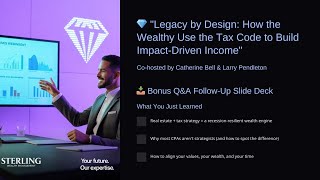
A recorded conversation (YouTube) between Catherine Bell and Larry Pendleton about using tax planning and real-estate investing to build passive income and impact. They contrast a tax preparer (historian) with a tax planner (future-focused), discuss real-estate tax incentives (depreciation, rental income treatment), approaches for people with losses or late starts, and practical mindset/advisor selection advice.
Chapters
Hey, how's it going, Larry? How are you?
Good, how you doing?
I'm good. I apologize for being a minute late. I was speaking with one of my partners about one of our investments. This is very exciting to be doing this with you. Let me. I am needing to live stream this, so two seconds.
I.
So much exciting stuff's happening. Actually, I want to talk to you about one of the things afterwards too. Super, super excited. Okay, I've stream this. Continue. Here we go. Go live. Okay. Sense. So exciting. Sorry. Oh my goodness. Technical difficulties. Okay, while we're figuring this out, let's go ahead and get started while we're here. So we actually had this amazing conversation on what are we on Thursday? So Tuesday. And we were. So let's talk a little bit about what, what we talked about on Tuesday. I'd love for everybody to just again, for those that miss Tuesday, who you are and more importantly, your heart. Because you and I have the same, you know, money is like oxygen. The more you have, the easier it is to breathe. And the more you have and you can breathe, the bigger the difference in the world you can make. And so you do. One of my most important things and favorite things as a cpa, but not only a cpa, as a historian, what happened in the past, but a fortune teller into the future. So let's talk about that for a sec. And investors and business owners and anybody needs to have the whole tax planning piece of this. So let's talk about that for just a sec because that's super important.
Oh yeah, thanks. Thanks for having me back. For those who don't know, I'm Larry Pendleton, the investor cpa. My mission is to help people build passive income and save on taxes. We find that real estate is a good vehicle of doing that, but also with various businesses as well. So I take pride in kind of taking someone's individual situation and just trying to find different tax saving opportunities so they can put more into their business, into their investments as well into themselves.
So awesome. And then from there, like again going back to the impact is now they have the ability because if they're saving money on taxes, they now have that extra income to, to go and you know, make a difference on whatever it is that speaks to their heart, which I really love. So, okay. So I wanted to dive in deeper inside of like we touched a little bit on questions that people may ask around using the tax code to build wealth and impact driven income and things like that. And so I wanted to again just dive deeper into that to give people More better understanding of how it is that they could be working better with their CPA or tax planner, not preparer. Again, for those of you who missed Tuesday's webinar, a tax preparer is a historian. Like, everything's in the past. You can't do anything about the past. Right. But a tax planner plans for the future. And what that means is like, for me, at least, and Larry, like, I'd like to have, like, if I was your client, you know, to have, like, how would we actually have that conversation? Right? Meaning, like, for me, it's like knowing what my goals are in 1, 3, 5, 10 years financially and you know, even in the other areas of my life, because we had talked about. There's multiple ways to get your taxes done. There's a way to prepare the taxes so you pay the least amount of taxes. There's a way to prepare taxes so that you can get different, better loan terms, bigger loans, things like that. There's a way to pay taxes so that when you go into retirement you're getting, I don't know, possibly a bigger Social Security check. Like, there's things like that. So it's like, what are the things that people need to be thinking about and having those conversations with their tax. Like the, the tax planner.
Yeah. So really, it's just understanding. And your, your advisor should also understand is like, what. How the tax code is really built is really to incentivize the private sector to do certain things. So that's why real estate, for example, they, they need more homes built in a lot, especially a lot more rental properties built. So there's always incentives in real estate that can be align. If you're not in real estate yourself. It was like, okay, you make your money in the area that you make it in, but knowing that, hey, the government incentivizes housing being built. Okay. If I invest properly in that arena, I can see some tax benefits, whereas, okay, I'm not having to pay a whole bunch of stuff for my business that I don't need now I can use the deductions over here to help offset my income and still be able to qualify for loans for my business because it's two separate, two separate ventures there. So just kind of understand how the real estate can be aligned with your tax strategy as well as your, your business strategy as well. Definitely goes a long way.
Yeah. Super important and really quick a piece about real estate. Like, there's huge advantages to investing in real estate for tax advantages, right?
Yes.
Okay, yeah, let's talk about that for A second because I think that's brilliant.
Yeah. So in the sense of we're talking about investing in real estate, we're not really talking about flipping properties and stuff like that is really more solely are you holding properties long term? The government definitely understands that most people are going to be renters even though there's a, the American dream to own a home. But the aspect of providing more rental properties out there as people are starting off where they're, where they're going to live at. You hear this thing about depreciation which is really more so like a paper loss per se, you're able to recoup the cost. Like it would be nice if you buy a property, you just write it off, the whole thing thing. But it doesn't work out that, that simple. So you can, you can claim depreciation able to reduce your, reduce your taxable income without having to. That's not money that you actually like taking out your pocket per se there. So that's the incentive really, really in real estate that the government allows. Plus the, the income that you make from rental real estate isn't subject to self employment taxes as if you were flipping properties or running a business or, or with your W2. If you have a W2 employment tax is basically the same as FICA taxes. Your Social Security, Medicare, your rental income isn't subject to that. So for one is tax advantageous and then it has this additional non cash tax deduction and depreciation.
So here's what I love about that and people who may not have like actively really dug into investing. You know, obviously there's the benefits of investing for you know, long term inside of like helping your money grow your money. But again I want you to understand it's like the double benefit which is your money not only grows money but you also have the tax advantages of it as well. So it's like if you're not investing, you're missing out on multiple fronts. Like that's the thing that I don't think people see because there's a short term benefit and definitely a long term benefit. So I really want people to like lean in and start understanding that. So some of the questions that we got is like what if I've lost money before? Right. So one of the things is like, so say some of the what if you lost money before or what if your investment isn't currently making money? Like there are tax benefits to that, right?
Yeah. So like I said, if you have an investment that you're still operating, is operating a loss Depending on your facts and circumstances, you can still use those losses to, to offset other income. Even if even aspect of like, like Ponzi schemes, stuff like that. If you invest in something that ends up being a Ponzi scheme, like you have a possibility to be able to deduct that as well over, over several years. So it's just kind of knowing your facts and circumstances and that's really the responsibility your advisors. Okay, here's what you have going on now or what's currently happening. Okay, here's how we can actually use the tax code to fit you into where you can benefit from it. Even so you can take a negative and turn some positive into it.
So and that's amazing. And that's the other piece. Like if you have a job, that's awesome and we want you to have that job but you're paying the highest amount of taxes by investing or you know, starting like a small company or whatever. There's so many things that they can be doing with the benefits of the tax code legally to be able to offset the, the that W2 income tax that they're paying. Right?
Yep.
So let's talk about a few of those ideas because again I talk about that your every family needs to have a minimum of seven streams of passive income. Right. It's what the average millionaire has. It's why, you know, it's why I talk about seven and it helps mitigate the risk of the five D's death, divorce, diagnosis, downsizing, being dumped. So by having those seven streams of passive income, you're helping give you the breathing room. But also when you set those up, the tax benefits of how you structure that also gives you that benefit as well. So there's just, there's so many layers to this.
Yeah.
So when people have these smaller companies or like you know, home based businesses or whatever and investing like what are some of the like top of the mind advantages that you see tax wise for those.
I see a lot of people looking into the, the short term rentals aspect of it because there's, if you have a, a full time job or you're 100 invested into your, into your, into your home business, you may not have enough qualifying hours to put toward hours to put towards qualifying to being a real estate professional. So the aspect of going into the short term rentals provides a like I said people call a loophole. It's just kind of like what's allowed within the code itself to still be able to invest in real estate, build that passive income somewhat actively involved without Being spending thousands of hours involved with it, but still be able to use the losses off of it there. So. So there's one thing on top of mind as people who don't have enough time to qualify as a real estate professional in order to benefit from real estate as well.
Yeah. So, and here's the thing. The next question is, do I need to know tax strategy already? Again, like, here's the deal, go back to who, not how. Right. Larry is the who that knows how to make all that happen. Right. And again, it's not about being the smartest person in the room. It's about having the smartest people in the room like you, Larry. And so for that it's like, I mean, when let's talk about a person that really leans into your knowledge and understanding or versus somebody that like thinks they know it all and then comes to you and you know, you really can't help them because they just aren't coachable.
Yeah. So it's the aspect, and we deal with clients like that all the time was like, okay, here's the advice that we're giving. And from the aspect of you shouldn't do that investment because it's not going to be worth your time and effort. That's what's like, we want to look at the investment as a whole not just from a tax perspective, because I've seen too many times with people like, hey, I'm gonna go get this property, I need these tax savings or I'm gonna buy this G wagon and write it off. It was like, you can do that. But I highly recommend not based on how I see how that investment is going to turn out and then ends up being a headache and end up hating life for that.
Right.
For that one year tax savings, like, yes, great, but you gotta do that headache way, way longer than that. So even from the aspect of us telling you like it's, it's not even worth it. You may want to look at a different type of strategy to help benefit from you from, from that perspective. But not just jump into anything because anyone can just kind of tell you whatever strategy to go out there. But the aspect, aspect of bringing the advisors like, hey, are they comfortable? Can they comfortably tell you or make you feel comfortable that the advice that they're giving is going to work for you instead of, instead of just talking over your head and you understand and you may not even take action on what someone's trying to advise you on.
Yeah. So important. So then the next one is, is it too late for me?
It was never too late. There's opportunities always there, always a deal or investment opportunity. So as you, as we're always trying to like, find that additional streams of income coming in you, you always gotta be actively alert with stuff like that because sometimes you may, you may not reach that financial freedom number. So until you have reached that for yourself, it's never going to be too late. And long as you have the right people around you and the right mindset, you can still get after it.
Yeah, so here's the other thing that I want to say. I want to answer that question as well. So there was a friend of mine that back after, after my husband had passed away, that she had come to me, multiple people had come to me and asked how I created those 13 streams of passive income that allowed for me to take a year off and grieve with my twins and figure out we were going to do that. So I put together like a little mini course and like showed family and friends, you know, what I did. And she was one of the people. So she was 74 years old at the time and she had, um, she was just shy of $50,000 in tax debt and back taxes or whatever owed and then no passive streams of income. And so her and her husband did not know what they were going to do. So I walked him through, you know, the whole thing and didn't think anything of it. Well, a few months ago, she actually calls me and she shared with me, which I didn't realize at the time. I was just doing this showing, you know, family and friends what I had done. And they had literally gone through my process. And the process is the debt snowball and, and which leads into the income snowball and the investing snowball. Anyways, fast forward. She had shared with me three years, they were completely out of debt, and then they were making just over $12,000 a month in passive income. Again, if she can do it at 74. Yeah, it's not too late, right? It's too late. If you don't start ever. Like, you just wherever you are, starting, right? It's one, one step at a time. What do they say? How do you eat an elephant? One bite at a time. This is like another version of that, right? And it's the compound effect. Like, you know, I've been investing over 30 years. Like, I'm like, oh my God. And somebody said to me yesterday, 30 years, like, where did I start? Like, I just started. And then it was just one day after the other after the other. And you know, 30 years later, like here I am doing the things. So it's again, the whole like, know where you want to go, know where you're at and then start and then have the people in your court that can help you with the knowledge and the pieces and you know, all of that to move forward. So having a tax planner is definitely a critical piece to making sure that your path, like the treasure map, you're like the treasure map. You create the dots on the treasure map to say you're here, the X is here to help him actually get there. So you want to make sure that, you know, we have that. But before we go, I want you to say again the whole king and queen thing, because I really love that.
You talking about my shirt?
Yeah, yeah, yeah.
Oh yeah. So I'm really big on saying and wearing like saying cash flow is king and assets are queen. So when you think about the game of chess, the purpose of chess is to protect your king. And in the way of life, your king is actually your cash flow. If your cash flow stops, if you just stop losing streams of passive income or cash flow coming in, then you're kind of stuck and you're in, in a worse off situation. So the goal is to protect your king. And what actually produces the king in the cash flow is the queen. Because your pawns are actually just cash, right? Roll your pawns as your pawns advance or as your, as your, as your cash advances. You then use that cash to, to buy assets similar to your, your pawns promote to, to, to queens and, and queens, they give birth to kings. So that's, that's, that's having to figure out the bishops and the rooks and all that stuff.
Yeah, I love that. Well, I think there's some CPAs and some attorneys and like they're all in there and we like played it all out.
Exactly.
I love it. So again, Larry, thank you for who you are and for being on here. If people want to get ahold of you, they can scan your QR code, which I'm going to stop sharing for just a second, so that they can scan that code there, right? Yes, they got bats. They can scan that. Obviously, you know, reach out to me. They can find you on LinkedIn, is that right?
LinkedIn, Facebook, Instagram, or they can reach out at the investor cpa.com as well.
I love that. Investor CPA. So awesome. I love it. Okay, so thank you for this and thank you for, you know, just what you do for your community and all the investors and their families. Like, they don't even know who you are, but it's because of you that gives their families the freedom that they have. So on behalf of all those families and communities that are touched through them, just thank you. Thank you for who you are. It's extraordinary.
Thank you. Thank you for what you do.
I love it. Okay. So have an extraordinary week, and I know that we'll be connecting and doing some other fun projects together.
Looking forward to it. Love it.
Okay. Thank you. Have a great day. Bye, everyone.










