Seth Kaller: Gatekeeper Of the Legacy Of Jackie Robinson
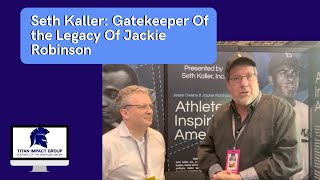
This YouTube interview (April 1, 2022 upload) features Seth Kaller speaking with host Steve about Kaller’s work preserving and selling historical artifacts, using Jackie Robinson as a focal case. Kaller shows and describes physical items (a 1956 jacket given to a neighbor’s child, a baseball signed by the 1955 Brooklyn Dodgers, Robinson’s glove, a padded Brooklyn Dodgers cap) and discusses documentary evidence (a 1946 minor-league form, a 1949 contract and Branch Rickey’s earlier $14,000 offer and later $21,000 offer). The conversation interleaves artifacts, Robinson’s personal history (military service, experiences of racial discrimination, role in opening organized baseball to Black players) and broader themes linking civil rights, economics, museums, and philanthropy.
Questions this video answers
March 28, 1946 (arrival to training noted March 4).
72 times (stated as 'he was hit by pitchers 72 times').
An initial offer of $14,000 (Library of Congress copy not signed by Jackie) and a subsequent $21,000 offer about a week later.
31 months.
A jacket Jackie Robinson owned and wore (given in 1956 to neighbor Russell Strauss); a baseball signed by the 1955 Brooklyn Dodgers; a Brooklyn Dodgers cap with special padding; a 1949 contract (statistically his best year).
Chapters
My fellow compassionate capitalists. Hey, Steve here. And I will introduce the guest of honor here in a second. But I got to tell you, I am excited. You won't believe. Look, I realize that I, you know what, I'm for scuttle. I constantly find myself falling ass backwards into gold mines and right smack in the middle of historical events. In fact, this is where I met today's guest, Seth Keller, at was that last time we were together, I found myself bidding on the Constitution of the United States and Sotheby's back in November. Now I was going up for 20, I was going up 20 million, okay? But then, man, Ken Griffin came out of nowhere within 14 seconds and he shot, he shot over the bow with 30 million, silenced, everybody. There was only one giant slayer man enough to go toe to toe with Ken for the next seven and a half min. This guy. Look, it's the whole thing that I wanted to show today was the fact that, you know, and again, I'm excited. I don't get awestruck very much. But this, this, this is awestruck. Okay, the thing is, is that, yeah, it's cool to the whole little flash and cash and to have declarations that, you know, the museum and the Constitution and all that going on and hey, I love it, I enjoy it. I en a patriotic philanthropist myself. But the people behind the scenes, you see, I may be Forrest Gump cool, but it's a whole different level to be Seth Keller cool. This is the guy who handles the documents. This is the guy who goes and authenticates everything while just last night we're at this club and you've got some rappers standing on the table and doing their whole little thing, whatever the deal is. Seth is pulling out Jesse Owens gold medal from the Olympics and just putting it on a case. Because, you know, why else? Why, why not just people should see it, you know, but just so nonchalant. I mean, that's when you know that you're cool. So you know what? You don't want to, you don't want to listen to me anymore. I get it. I don't want to listen to me anymore. I'm just going to turn it over to my, to my good friend the expert when it comes to the Constitution and the Declaration and ironically we have, we're here at a sports convention in Vegas and I'm not even going to spoil the surprise. I'm just going to turn it over to Seth. He can tell you what's going on here. Absolutely amazing. So tell us why you're here. Seth, thank you.
You know, I just to be forthright, I want to go back to the Constitution for a second. And although I was advising the dao, the under bidder, I wasn't the underbidder.
It was actually 17,000 people who got.
Together and contributed that bid. And when I heard what they were doing, I called up and said, okay, if you buy it, what are you going to do with it? And that's what I wanted to help with, which is to pick the right museum for them to show it in and share it with the public. And so I was involved in that. And I'm glad that even though the Dow lost and Ken Griffin bought it, he's actually doing something very similar. It's going on display to Crystal Bridges, and then it'll go to other museums. That's a win.
Win.
And the money, the 44 something million that he paid was actually all donated by the seller to her foundation that she set up to help with constitutional education. So that was a big thing. Wow.
Compassionate capitalism at its best.
Yeah.
Wow.
And I love it when the collecting world overlaps with philanthropy and museums and education. But before I talk much and you don't want to look at me, let's.
Look at some of this great stuff.
This is a jacket that Jackie Robinson owned and Wore. And in 1956, one of his neighbors in New York, a young child, was severely injured in a car accident, and he gave that jacket to Russell Strauss. This ball is so signed by the 1955 Brooklyn Dodgers. And this is Jackie's glove. But Steve knows I'm not actually a sports guy. Hold on.
Did you see how casual and nonchalant. Oh, it's Jackie Robinson's glove. Whatever. I'm Seth Go. You know.
Because we get to the.
Things that I'm really passionate about.
And this is what started my interest in Jackie Robinson.
This artifact came on the market, and it's Brooklyn Dodgers cap, but it's Jackie's cap, and it's got some special padding in it. He was hit by pitchers 72 times and was thrown at way more than that. And Branch Rickey, the guy who actually hired him for the Dodgers, was also an entrepreneur at the time. He was the highest paid guy in all of baseball, but he was trying to introduce protective safety caps before the.
Age of batting helmets.
So the fact that Robinson was such a target only because he was black, and the fact that he came into baseball and changed America is what made me really freak out about this.
And.
I just considered it such a moment in history. Then as Often happens, I can say I'm never going to collect anything sports. But we end up with a cap. And then his 1949 contract comes up. I've been trying to deal with his 1947 contract for six or seven years now. That's still up in the air. But the 49 contract is also cool. Number one, it was statistically his best year. But number two, the library of Congress actually has the copy that Branch Rickey signed first, offering Jackie 14,000 doll. Theirs is not signed by Jackie because he didn't accept it. So about a week later, he sends another one, this one offering $21,000, which puts him in the league of the highest, among the highest paid players, except for Bill, Babe Ruth and Nikki Mantle and one or two others.
That's roughly $236,000 in today's dollars.
But the buying power then I think astronomical.
Much higher. Right. So that 5,000. Yeah, 50% raise. 5,000 do. Shows how fast he was recognized as being a powerhouse player. But this is actually the most recent acquisition. And this isn't a document that changed the world, but it's a document that perfectly captures better than any other I've seen this man and his character and.
How he was able to change the world.
But it starts just with a story. American Baseball Bureau, public relations. They have an agreement with Major League Baseball and the farm teams. So when Jackie shows up for the Montreal Royals in spring training down in Florida, Branch Rickey hired him, hoping that he could join the Dodgers, but not being sure if he could make it to the Major League. So started in the minor league team for the Dodgers, which was the Montreal Royals. So he gets there on March 4. This was returned in Chicago and processed March 28, 1946. So it had to have been signed the first week or two of Jackie in training camp. On his handwriting, Jack Roosevelt Robinson, nicknamed Jackie. Nationality, American Negro. That's the first clue that this is something unique. Birthday height, ucla. Four letters. Ucla. Are you married? Yes. Because he got the job, he thought he was finally able to marry Rachel. And this trip from LA to the training camp was really their first trip together. Off season occupation, athletic instructor. Favorite sport, golf. Other than baseball. Hobbies, Boys Club work. Ambition in baseball. Before you read that, every other one of these that I've seen signed by a minor league player hoping to get into the majors. Their ambition in baseball is to play second base or to play for the Giants or to be the best catcher or to get into the World Series. Robinson's ambition in baseball to open door for Negroes in organized ball. That is just. I mean, how few words does it take to get right into his soul and character and know what he's fighting for? And to whom do you owe the most in your baseball career? Mr. Branch Rickey. Just for the opportunity to be there, really. And by the way, remember also this is before he's played a single major league game. I take that back. It's possible because of the two week period, it's possible that he played a game, but certainly he didn't play. You know, he doesn't know if he's going to make it to the majors, but that's everything that he's intending and working for. Professional experience. KC Monarchs, the Negro League team. What would you consider your most unusual experience in baseball? Being signed by Mr. Rickey onto the Montreal Royals. If you've been in the armed forces, please state the branch and length. 31 months, U.S. cavalry. That's all during World War II. What would you consider your most interesting or unusual experience while in the service? The fact that he left that blank.
Is incredible because in 1944, 11 years.
Before Rosa Parks, he had struggled and.
Gotten accepted into an officer's training program after all of the African American had been denied. And he appealed that and won. And then he's a junior officer and he gets on an army bus and he's told to go sit in the back of the bus and he refuses, knowing that he's going to be arrested, knowing that he could face military justice and could be in jail for years under the court martial. He still does that and he is court martialed and, and thank God he's found not guilty.
So they take him out of the.
Officer training though, they let him coach athletics and then they get him out.
Of the army as soon as they.
Can with an honorable discharge. But you would think that that was an interesting experience while in the military service, but smartly he doesn't go there. And just another bookend to that story is the famous story of Branch Rickey meeting Jackie and pushing him. Not physically, but just testing him, pushing him and asking questions and even making racist statements and taunting him just to.
See if he could take it.
And Jackie finally in frustration said, I don't understand. Are you trying to get a Negro who won't fight back? And Ricky said, no, I'm trying to get one who's strong enough not to fight back.
And so fast forward, he's on his way to training.
They get bumped from one flight because they're black. They find they can't wait in the restaurant of the airport. And it's the only restaurant in the airport, so they can't get food or water or anything as they wait, they don't know how long. They finally get on another flight, but it's not direct. So it stops to refuel in the south. And they're the only. Jackie and Rachel are the only two passengers who are asked to get off the plane once the plane stops for gas, they get off the plane. Why? Well, somebody says, we heard there's a storm coming and we have to lighten the load. But then they see two white passengers being boarded, so that's not true. So they could wait for another plane, but they don't know if that's going to work. So they get on Greyhound, 12 hour ride to spring training. And after one stop, no problem, the driver stops the bus, turns to Jackie and Rachel and says, get in the back of the bus. And here's a man we know who is not worried about the consequences to himself. He risked military justice, he was willing to fight and push, but he had that agreement with Franch Rickey and he realized that what he really needs to do is play baseball, be an example, succeed. So all of the pressure on him was for that. And they got in the back of the bus and so they showed up and they weren't able to stay at the hotels and motels that the team was. They were staying at a house. Ricky had actually arranged for them to stay in a nice African American family's house. But they had to move very quickly. And in fact, after one day of practice, the whole team had to move because somebody in the town said, we can't have blacks and whites playing together on the same field. So all of that is.
Hateful.
It's disgusting. We can't understand it. How could that happen? But it was happening and not that long ago. And it took somebody like Jackie Robinson to break that barrier and sacrifice, hold onto himself, push and fight and succeed. Because it wouldn't have worked if he wasn't as great a ball player and as great a person. And then you see, after his baseball career, then he was able to talk, to speak out and become a civil rights advocate while he was playing baseball. His job for civil rights rights was to play baseball. And it just opened doors. And the more there was reaction, hateful people, you know, screaming racist taunts and all other well meaning white people who could not understand that didn't believe that was happening in the South. But they started feeling for Robinson also because. Because he's the type of figure, even if it's not your team.
What he was doing on the field was worthy of cheering for.
And a lot of people realized that. And this guy who later became the.
Head of the aclu, American Civil Liberties Union, said he was nine years old.
When he first saw Jackie play. And that was probably the first time that many white people in the north had seen African Americans as human beings, as, you know, to personalize their struggle and to watch them succeed.
And so he, the 9 year old was.
25 when Martin Luther King gave his speech. Check my ears at the march on Washington. And that's why there were so many, you know, very young white people who were there. It's one of the reasons why all these things come together. And if we go back to economics for a moment, I mean, I, I.
Think I didn't understand this at first, but the thing that interests me the.
Most about historic documents are the human.
Rights aspect of it. But human rights and economics are related because there's nothing more inefficient than wasting resources and keeping people down and not.
Giving everybody chance to succeed, to become.
The hero to, you know, make the.
Sport better, make the country better.
And.
That'S, you know, my.
Really good, selfish reasons not to be racist and not to discriminate based on religion or anything else.
It's because human beings have a right.
To need, to be encouraged to succeed.
It helps all of us.
Exactly.
And you know, that's one of the things. I mean, look, we're gonna go ahead and we're gonna wrap this up and.
Then do a part two because we got a treat today and oh my.
God, you're listening to a true giant here.
I'm.
Like I said, I. No pun intended.
That is heartfelt.
I mean this is amazing. And so whenever I do give the tour of the museum, I always start from the economic standpoint of view, but first of all with the question of what is history but the study of human nature. And you know, no one has encompassed, encompass that more than Seth. The work that he is doing in order to understand, allow us to understand human nature. And so with that, hey, you guys know now why I'm so excited to be able to call Seth my friend and now he gets to be yours. We're going to make another video about another amazing person. And with that, that will you use the example of Jackie Robinson as well as self killer and may you.










