Under The Hood | Catherine Bell | October 2022
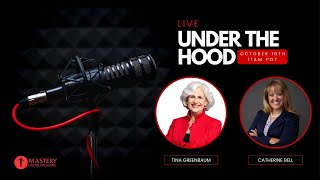
Catherine Bell went through foster care and was adopted at 16, then built a career as a business leader and nonprofit founder. She talks about the patterns that shaped her, like internalizing blame and learning by listening, and her work to increase adoptions from the 350,000 children available in the system.
Chapters
And welcome. Welcome.
So this is a very cozy, relaxed show with some really, really important messages, I think. And I'm delighted to have everybody here. Teresa, I know everybody that's here and we're delighted to have you. And at the same time, anybody listening to the replay, you will have a good bit of Catherine's wisdom to come along. Hi, Joda. Nice to see you too. And so my guest today is my very good and dear friend Katherine Bell. And Katherine is the co founder and the president of Titan Impact Group. She's got a pretty good resume here as a radio host, a founder, CEO and managing director of a real estate investment hedge fund, an owner of an investment bank, a buy and hold investor, an Airbnb investor. Do you think she's an investor? Yes. A flip fix and flip investor, A building developer, a mobile home park investor, and a private money lender that she has successfully completed hundreds of investment deals with her raving fans, AKA her investors. She's also the founder of the nonprofit Bell Community Empowerment Foundation. It has been her lifelong mission to educate empowerment, empower and inspire families to adopt all of the adoptable children in the foster care system. So welcome Catherine. You are having me very busy.
No, I always love hanging out with you.
We hang out quite frequently every week. My whole little group here. We're in a mastermind group of really fabulous women and kind of going through all of life's trials and tribulations and business trials. Trials and tribulations and support one another this show. The premise is that patterns that are created in childhood impact us as grown ups. Thus the name under the hood. So my first question, Katherine, can you tell us a little bit about your background and your family of origin?
So this is my least favorite thing to talk about. I was born to a 15 year old mother, birth mother, the birth father, he was 25. So you could do the math on that one. And I was in and out of multiple homes throughout my entire life. I've got two younger brothers that I was was providing and protecting, you know, from as young as I can remember. And I was actually finally adopted when I was 16. And so that there was a just a world of chaos inside of that. I went to 13 different schools, didn't actually learn how to read till I was in the eighth grade. Because I went to so many different schools, nobody figured out I couldn't read. But what I did learn how to do is how to listen inside of that because I was still managed to get straight A's, I knew that I figured out the school system. They just wanted an answer, and if I could figure out the answer and give them that answer, I was the winner.
Okay, so in that vein, in that vein, that same vein, Catherine, what kinds of behaviors and patterns did you develop in response to your upbringing? So one was the listening. What else?
So one of the things I'm clear, and it's showing up more and more every day, that I'm realizing, you know, there's no better personal development program than having kids of your own. And I have realized that one of the patterns that I have really become masterful at is watching other people's choices and being able to predict what the outcome is. And so from that, learning from their. Their choices and their mistakes and making different ones. I remember as a child watching these adults make some very interesting choices and scratching my head as a child thinking, wow, as people get older, they get way more stupid. Like, as a child, I remember thinking that because, you know, even as a child, I could see the probable predictable future of these choices that these adults were making. And that was perplexing to me. So today, you know, I can see in my business that one of the things I have is, you know, when somebody tells me who they are, I believe them. Their character shows up pretty quick. And listening to that, you know, it's the whole, I can't hear what you're saying because what you're doing is so loud. So I had a lifetime of observing people's interesting choices. So that. That was a big one. The other one is learning to find ways to. To learn. So for instance, for me, right, learn getting that I couldn't read. And to this day, like, my reading comprehension is really, really terrible. However, I have figured out it's about becoming resourceful, right? Like, it's not about resources, it's about resourcefulness. And I became extremely resourceful. So inside of that, you know, be it emails or government contracts, whatever it is I have to read, I actually will have one of our team members read it to me, or I have multiple software that will read it to me so I can actually get the information and be able to process it, to be able to move forward. Because rule number one, you never sign a contract without reading it, right? So again, it's figuring out those resources to be able to get what I need and to be able to listen. And inside of listening, I've become really, really skilled at listening and hearing what people are not saying as well as well, and being able to get those communications.
So for you, we could say that you're an auditory Learner.
Absolutely.
And an auditory listener. And that is your strength that you have identified and learned to use to your advantage. You know, Katherine's always talking about another audiobook that she's listening to and an audiobook that she's listening to. And I don't quite relate because I fall asleep when I'm listening to the audiobooks. So just, again, knowing. Knowing what your strengths are, what your weaknesses are, your modalities that really have helped you in your leadership skills. All right, now another question. So these are some of the ones that you have developed that have really helped you in your career, correct?
Yeah.
Yeah. Okay. Which ones did you gain that didn't help you, that you've had to kind of tweak and relearn? And some of the ones that you've actually had to honestly struggle with. True.
Right. So one of the most difficult ones for me, and it still haunts me today, and I'm seeing it, you know, show up in different areas, is the very first, earliest memory I ever had was with my birth mother. And I was probably, like, two and a half, three years old. I was like, little, little. And the memory is of her, like, over top of me pointing her finger, screaming in my. My face, you effed up my life. And to this day, whenever we have conversations, she still manages to bring that up that somehow I messed up her life and ruined it, or, you know, whatever the word is. And I, back in my 20s, I ended up doing some pretty intense personal development work and a whole lot of therapy and stuff to work through this. And what came of that message as a child was that I was terrified of hurting anybody, and I didn't want to ruin anybody's lives. I didn't want to hurt them. I mean, it was devastating to me because that I ruined her life. Right. Like, as a child, you don't have the cognitive abilities to work through that. So I made it mean, like, I really did ruin people's lives anyway. So going through and doing this personal development work, it was really interesting because I got to the point of, like, okay, so let's say that that's true. Let's say that I ruin people's lives. Like, let's go with that. So if I ruin people's lives, then what does that mean? Well, let's just say that, you know, what if. What if that was true and, like, okay, now what do I do? So if we back that up, if that one little egg was able to have that, like this, receive the sperm, and then turn form into an actual human Being right? Like, if it was that me, that little egg, was that I caused that, well, then clearly that must mean I'm the most powerful egg on the planet, right? So if I'm the most powerful egg on the planet, what else can I do, right? So now being the most powerful egg on the planet, oh, my goodness. What if that most powerful egg now has a say in ruining people's lives or making them better, then what could I do, right? And that, like, I remember that moment. I remember where I was standing. I remember the room. I just. I just remember that huge revelation. And all of a sudden now it was like, now I actually had the opportunity to make a difference. And from that point on, it was profound because now I had the ability to allow people into my. My life, into my heart, because I wasn't going to hurt them. I wasn't going to ruin their lives, you know, so it was. It was safe to be with me.
So how has this impacted, again, your business, you know, again, your personal life and our business go hand in hand, Right? How is this.
Because, yeah, well, you know, Tina, business is a team sport, right? If you can't create a team and you can't have teams around you, there's no way that I could scale my businesses, right? And so, like, having to deal with that and address that, and whenever it creeps in, like, it still creeps in today, when stuff doesn't go the way that I think it should, it's. I automatically internalize it, that it's my fault. It's my fault that it didn't happen. It's my fault the timeline wasn't kept. It's my fault. It's, you know, it's just all my fault. And I have to stop and get myself sorted out so that I can go, wait a second. Okay, is this my fault? Or, like, actually look at all the pieces and all the people and all the components and be able to, like, make sure that I'm having accurate thinking inside of where the responsibility lies and that it's not all me.
So what, what you bring up for me, okay, is what I call helicopter thinking, right? So we can be in a situation and be taken away by all this negative talk and, you know, all this programming and then again, be able to step back and see it. Oh, this is what I'm doing. This is what I'm noticing. So what I'm hearing you say is this ability to do this helicopter thinking, to really kind of look at, like, what's the truth here? What are all the affects, things that are actually going on, that are impacting what is actually happening.
Yeah.
And this is a skill. This is something that practiced over and over and over and over and over again. It then becomes automatic.
Yes, I get it.
You know, I'm in it. And at the same time, whoa, whoa, whoa. Right? What's happening?
Yeah.
Okay, so when did you notice. And I know you've done tons and tons and tons of personal growth. When did you notice that that was an absolute positive necessity in order for you to actually survive?
When you say that, what is the.
That the personal growth, you know, the training, goodness that, like, what you were doing, you know, because when we. When we have blind spots, we walk into walls.
So again, it was in my early 20s, and I, um. I just. I don't know where it came from. I was just intuitively I knew and understood that when we go to school, there's a few things we're never taught. We're never taught communication skills, we're never taught relationship skills, and we're never taught financial literacy. What the heck is the point of school? Like these. And we hear all the time, like, what are the things that cause relationships or marriages to break down? Right. So my whole life as a child, I remember saying, and my cousins actually bring this up, that I was adamant I was never getting married and I was never going to have kids, because in my experience, those two things harm children for life and scar them for life. And I was like, I had no desire to be any part of it. And so when I started, like, having conversations with people who had successful marriages, like my parents that adopted me at 16, I got really curious, like, wait, you have this amazing marriage, and you're not hurting each other and you're not hurting children? How are you doing this? And, you know, I just. I asked a lot of questions. I still ask a lot of questions. And I just started asking a lot of successfully married people, like, what is it that has your relationship be successful? And that was the thing, is that they worked on themselves every day. They worked on their relationship every day. And communication, right? So it's all about the communication, the financial literacy, the personal awareness and taking care of the relationship. And all of a sudden I got like, oh, my goodness. So these are skills that I could actually learn. And not only learn, but master. Oh, my goodness. That means maybe one day I could actually have a happy marriage, you know, and maybe have children.
Right. So I hope that you're all kind of hearing from Catherine's perspective. You know, Katherine's upbringing is not a Typical upbringing in our world that we live in. For most of us that are involved in, you know, high powered leadership things and business and so on. But the wonder with. And the questioning, Catherine, is really kind of what stands out to me. You know, that ability to just keep questioning is this really. So does this really have to be this way? And being able to be disruptive in your thinking and again, how this has carried on to all the businesses and all the wonderful successes that you've had, does it have to be this way?
Well, and I think that's the other thing that I'm realizing even more and more, Tina, is that what has me be so successful in business is because I was so resourceful as a kid in surviving that I've become really resourceful in business in the sense of I don't look for permission to do stuff. I just look for creative ways to get it done. And so I think way outside of the box, inside of making it happen, right? Like, and a lot of people have this, like, well, you got to go to school and you got to get this education and you need to have this document that says you learned this and then you can. I don't have any of that. I have. My brain works in the way of like, okay, so what do we need to get done? Okay, what things can I actually put in place to collapse timelines and add comments to bank accounts? That's how my brain works. Like, I just, I never, I don't think linearly, you know, because I'm always looking at, you know, worst case scenario. What is option A, option B, option C, option D, like, and then sometimes I just put them all into practice and go, right. And I think that that is what allows me to collapse timelines and add comms to bank accounts as quickly as I do. Because I don't have this. Like, it's gotta be this, this, this. You know, it's like people like, how did you start a hedge fund? I went and learned and then I did it. And you know, we kind of joke around about the. There was a movie way back 20 years ago called Legally Blonde, right? And she gets into Harvard, right? And there's that one moment where he goes, you got into. And she goes, but, like, it's hard, you know, like. And I just relate to that. Like, she just decided to do something. She went through all the steps and did it. And I feel like there's so many things in life that we all can do that. What? Like, it's hard, you know, like, anybody can do what I do. Exactly.
So a couple other questions, and then I'm going to open it up for questions because I'm sure people have things that they want to ask you as well. Who has inspired you?
So I'm from Canada, so a huge inspiration for me, funny enough, has actually been Lady Di, Lady Diana, because you understand, the monarch is still our monarch. And so she was always very, very present for me growing up. My whole child life, she was the up in Canada. The royal family is like everything they're doing is everywhere. So everything she did on the planet was really fascinating to me. And that was a huge inspiration. And then, I mean, there's lots of people that inspire me, but it's always stories of coming from nothing and creating extraordinary things. Like, I love Oprah Winfrey story, or I mean, like Warren Buffett, I mean, just all these amazing, you know, nerds, so to speak. Nerds rule the world. So another question created amazing things.
But I want to make sure that everybody knows that in terms of your passion for foster kids and your foundation and kind of just give us a little story with that.
I love it. So growing up in and out of multiple homes, it is not fun. I'm sure all of you can use your imagination. You've heard stories. It is not fun. And so being adopted when I was 16, I'm clear that that experience, obviously my family changed my life forever. The trajectory of my life changed forever, and I married an American. And we, after a few years of getting married, we discovered we couldn't actually have kids. This body's just not producing babies. So what are we going to do? Anyway, long story short, we ended up learning about what's called fostadopt.
And.
And what it is, is there are 500,000 children in the US foster care system. 350,000 of them are available for adoption today. So what that means is that for whatever reason, the parental rights have been severed and these children are now available for adoption. Now, here's the thing I'm clear about is that inside of that 350,000 children is that there's more than 350,000 congreg in this country. So what if. What if each congregation took on finding one family to adopt one child? I believe we could get this done in my lifetime, because here's the statistics on that. It cost taxpayers billions of dollars to keep these kids in foster care, right? So by having them have loving homes now, that tax burden is removed. But here's the bigger tragedy. When these children age out of foster care on their 18th birthday, it's called Black Bag Day. Meaning if they're in a foster home on that day, they're literally given a black trash bag. All their stuff goes into it, and they're out. That's it. That's the end. No skills, no services, no help, Nothing. On their 18th birthday, black bag Day, Statistically, those children will end up on drugs, prostitution, and incarcerated. That caused taxpayers billions more. So what if. What if we got those children all adopted? What if 1% of those children got as inspired as I got from being loved and nurtured and taken care of and I never had to have Black Bag Day? What if those 1% decided to go out and make a difference in the world? That would be 3,500 kids that go out and become adults and decide to make a difference in the world. Like, think about that impact that would have on this planet. So my nonprofit partners with these adoption agencies that specialize in this type of adoption and churches to partner with them to be able to get the word out. And I mean, because these kids and families come with a world of services so that they actually can thrive and be successful inside of this. Because it is a rough transition. Absolutely. Just like raising my own kids is, you know, I. Yes, I got my children out of foster care, but they were four months old, so they've been mine the whole time. And let me tell you, it is like. It is a challenge, you know, so. Oh, my gosh.
I wanted to be sure that people not only could hear what you're doing, Katherine, but. But the way that you think about it. Okay. If you can just listening to Katherine and listening to, you know, her very rational mind that also has a very, very, very big heart. And there's so much that people can learn from you and what you've been about and how you've gone about things and how you continue to. So I'm going to open it up. Is there anybody that has any questions for Katherine. On any of these subjects? Any subject? I'm sure she's pretty open to sharing. Sue, I don't have a question. I just want to remark it about what a tremendous thing you are doing and what you've come through and how you've changed and what you're doing to make things better for so many others, I. I think you're inspirational.
Thank you.
Absolutely. Who else? Jacob. I can see. Yes.
So I made that note about the future spinoff, collaboration, Mastery Under Trauma. But I think, Kathryn, your stories and the energy you have. I was a teacher for five years, and I saw students like you whose, whose intelligence, high intelligence was not being valued because the system is not built to value those. And so I would just, you know, what would be some just good words of advice that you would have for students that were, that were in your shoes that could, you know, help set them potentially on a path that could lead to some, some really cool outcomes and potentially generational wealth that can get them back on track.
So that's a brilliant question. And first of all, thank you for being a teacher. That's one of the hardest jobs ever. And I know for me, there were multiple times as a child that I honestly just wanted to end it all. Life was so horrible and so bad, and it was only because of my younger brothers of having to provide for and protect them that I stuck around. So if I could give anything, it's like, listen, just know this is just a chapter in your life and it's going to pass. And when you become an adult, you actually get say so in how your life goes. And here's the thing, just because you were born into something doesn't mean that you have to stay there the rest of your life. Like, good God, it is not a life sentence. So when you have, when you become an adult, like, you actually get the choice of, you know, yeah, what happened to you is not your fault. You didn't ask for this. You didn't vote on this. It is not fair. And what you choose to do with it 100% is up to you. So are you going to use this to grow from it and springboard off of it, or are you going to use this to become a victim and perpetuate on probably what you came out of? So you get to choose.
So that therein is the whole story. Children are victims. They are, I think, the only true victims that we have. Once we get to be adults and we get to make choices for ourselves, then no matter how bad it was, we're still responsible. And that message over and over and over again, that you have choice. And yes, right now you don't. But as adults, you do. And you're just a wonderful example of all the wonderful things that we believe about transformation and personal growth and combining it. I'm a social worker by training, and social work has this unique perspective of the individual and then how it interfaces with the environment. That's kind of really what you were talking about today. You as an individual, your gifts, your talents, your. Your beauty, all of who you are, and then how you manage that in a very, very difficult environment. And then what you're providing for other people. So thank you, my friend.
Thank you.
Off to school to visit the. The. She has a parent teachers conference in 15 minutes. So any other last thoughts from anybody? We've got about two minutes left. Arlaine. Yeah, I have a last thought.
And this is. I am also blessed to be able to hang out with Kathryn on a weekly basis. So this comes from that opportunity, and it kind of tags right into this question, but one of the most powerful things that you said at one point was the importance of having a dream carrier, that person that helps you carry your dream forward in those moments where you can't carry it yourself. And so as you talk to the kids, being able to encourage them to find that person that helps them hold on to their dreams, their future, and helps them carry it through in their deepest, darkest, hardest times. Yeah, agreed.
The message. It's a big message. Everybody shaking their head. Yeah. So I'm going to honor everybody's time. And Jacob says thank you for that. Thank you all for being here. We were a small group, but this goes out to everybody who signed up. We had a lot more people. Obviously, they can't make it. We were trying to figure out the best time to do this, but actually we're international because our wonderful, wonderful host is Louis and Lewis is in Glasgow. And we honor his time as well because we're so grateful for him. So thank you all and we'll see you next month. I have another wonderful, fabulous woman, Loretta Green, who will be with us, who's got another incredible story, and then Alex Minicucci after that, who was an entrepreneur, many, many serial entrepreneur many times over, with lots of great stories as well. So thank you all for being here.
Thank you, Tina.










