Your Path to a Trust-Driven Organization | Q&A Follow-Up Webinar | Titan Impact Group
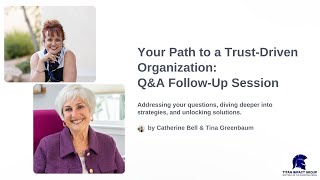
Catherine Bell and Tina discuss building trust through better communication and catching conflict early. Watch for disengagement, sarcasm, and gossip as warning signs. They cover communication styles, the cut-reframe-respond technique, and how personality assessments like DISC can help leaders understand their teams.
Chapters
Okay. And now let me share. So welcome everybody. We are on to this is webinar. It's a follow up webinar that Tina and I are doing for the Tuesday webinar. And it's all about, you know.
That.
What is that? Trust. The path to a trust driven organization, which, you know, we had dove dive. Oh my word, what is wrong with me? Okay. Took a deep dive into. There we go. I can talk. And with my good friend Tina. So if you missed it, the recording actually is in my YouTube channel. It's under the webinars that we're doing. And so we're going to go ahead and just dive in straight from here. And so I just want to welcome everybody back and any questions that you have, please drop them into the Q and A section because we will be answering those questions as we go on. And we know that trust in organizations, in families and relationships, I mean, it's paramount to absolutely everything. Right. So, Tina, let's go ahead and talk about. Yeah, just dive in to all the things.
Okay, so just as a little recap of what we did the other day, what we talked about, if you haven't had a chance to listen, I believe that, you know, as I was kind of digging into what is conflict actually made of. Right. I like kind of deep conversations and I like to get to the bottom line of something.
So.
Because then when we get to the root cause of things, then we can solve them. And so a lot of times people talk over each other. They're sitting at a meeting, they're looking over here, they procrastinate, they don't show up. There's all different kinds of ways for somebody who is actually watching and observing to recognize that things are not going well in an organization or in a family. And to start out with just kind of how I got here. My mother was a natural born. Untrained. Well, I would say she never went to school to become a therapist, but she was actually a natural born therapist. And in my family, I have a brother and a sister and a father that was very difficult and could go silent for days. My mother couldn't stand that tension in the household. And she would make us sit down and have difficult conversations. And I tell the story. I would frequently leave crying and didn't like what my brothers and sisters were telling me. But I did learn at that early age how to not run away from things that are not going well. So if we look at organizations and we look at how people communicate, how the leaders communicate, what the culture is, everything comes from the top. So if the top leadership is having their own level of difficulty, it will spread down to the entire organization. As we know, in organizations, when people are not happy today, they leave. They don't necessarily stay. So it's difficult holding on to top talent. It's difficult to have that environment of creativity and productivity. When an employee is afraid to speak to their manager because they're afraid they're going to get punished by it or there's something going to happen, there's a lot of tension. And so I like to come in and really kind of look at what's the underlying causes. Sometimes it's personality, sometimes it's values, sometimes it could be all kinds of things. But basically, I work with the concept that conflict arises because we don't understand each other.
Right.
And it takes effort and willingness and openness to put yourself out there and say actually what's really on your mind. And again, we may not. We, you know that famous saying, we agree to disagree, but we can usually find something that we agree upon.
Right.
That's the starting place. And again, this is a many, many layered pieces. So what are the early warning signs? We just kind of talked a little bit about it. People unengaged, not showing up, coming late, people short with each other, kind of just even a roll of the eyes is enough to let somebody know that you're displeased with them. But again, that's. We call that passive aggressive. Kathleen, what about you? Can you think of some other signs?
The. I think one of the ones that bothers me the most is sarcasm. I think there's. That's a very dangerous one. And kids, people are like, well, I'm just kidding. And it's like, hold on, like, so let's talk about sarcasm for a minute. Because I feel like there's a lot in our culture that somehow is left, like, unchecked.
And, and like, I agree. You know, somebody said to me this. I remember how many years ago this was. Many, many, many years ago. He said that sarcasm is a poor substitute for wit. Right, Right. So people think it's funny. I used to say to my kids all the time, if you think it's funny, the other person has to think it's funny, too. It's not at the expense of somebody else. And the other thing that about sarcasm is it's disarming. You're saying one thing, but I'm getting another message. And there's a lot of things that are unclear. And I personally, I agree with you. It's. It's Actually, one of my least favorite ways of communicating, and I don't do well with it at all.
It's like, say, well, I find it's destructive and undermining.
Absolutely.
Yeah. So I'd love to hear in the chat, you know, for you guys, like, what are some other ways that, you know, on teams or whatever that for you has been like, huh. So the other one. Gossiping. Gossiping. But gossiping from the. Like. Well, I'm not really gossiping. I'm just sharing. Or it really. What it is, is I remember learning this decades ago. It's the. You're gossiping to the purpose of getting agreement because you can't actually stand on your own two feet about what you're actually, you know, what you're wanting to say. And so getting that agreement now, it's like resentment gets built up for that other person rather than saying, hold on, and having a healthy conversation about it.
Absolutely. I call it like whispering down the lane. Yeah. One person starts and then another person goes, and another person goes, and people feed off of it. So. So again, I have some value systems that I work with, and one of them is, I'm not going to say anything about you that I wouldn't say to your face.
Yeah.
Or let you know that I'm actually saying it to somebody else.
So Jonathan just said, he says, I experience curveballs all the time. People are not honest, and when the issue is presented, it's too late. Yes, yes. And then they start. Then it's the. Should. Well, you should. You should have known. Like, hold on. If I had the information, I could have responded in a timely manner. Like, there's that. Yeah, let's talk about.
There's that. And also I would say if you. If you go back and just kind of look at the situation and, you know, without judgment, without kind of, you know, getting mad at yourself and beating yourself up, what were the signs that were there that I didn't see or that I didn't. I didn't acknowledge?
Right.
We see what we want to see. Yeah. Catherine and I talk about that. I call them sometimes veils of illusion. You know, I'm seeing what I want to see and I'm hearing what I want to hear. But at some point, there's some little noogie or some intuitive hit that I just don't pay attention to.
Right. Or don't know what to do any about. Like, I think that's the other piece. Like, it's there, but what do I do about it? How do I address it? How Do I say it it? So this is really great. So Jonathan's asking, what is a proactive way to get people to be more upfront with their angles, feelings and intentions? Such a great question.
Such a great question. Well, Jonathan, it starts out with you and the invitation that you actually invite people to speak up and let people know that you're not a mind reader and, and that you are open to conversation. Now again, I do believe that, and I said this the other day, that the way that we deal with conflict is the way that we learned how to deal with it when we were younger. How to deal with it or how not to deal with it. And so a lot of times what I have people do, and you could do this with your team and you could do it in a really kind of fun, non judgmental way, is have everybody kind of think back a little bit. What was it like in your household when people didn't get along? How did you learn or how did you watch your parents or not? You know, watch your parents do or not do or how did you learn to deal with those feelings yourself? And the more the thing about leadership, I like to say it's, it's about as narrow as a crease on a pair of pants. Everybody wants a leader and everybody wants to kill the leader off. Right? Right. So they want you to take charge and help them and tell them what to do. But man, if you get too strong or too authoritative is actually the way to think about it, you will get scapegoated and people will undermine you.
So, okay, so let's talk about that for a sec because I've had lots of employees and stuff, and here's been my observation, whatever unresolved issues people have with their parents, they will totally map onto you as the boss.
Yes, they will. Yes they will. You become the authority figure and they will deal with you the way that they have dealt with authority figures before.
Right. So it's the thing like I'm just looking at, like, so what are the solutions around this? Like, one of the best things I've ever learned was the seek, seek first to understand and then to be understood. So, so like, how do I teach people to come from that perspective?
So it's a bit of assertiveness training and these are kind of, kind of ways of thinking about communicating that, how to get a really good chance about getting what you want. So let's just say, Catherine, that you and I have a little bit of a disagreement. Right. And I'm really unhappy with you.
And.
I snap at you. Or I say, or I blame you. Blame is just the, a number one thing. You know, Katherine, I can't believe that you didn't do this and you didn't do that. And if you can kind of see, I'm kind of pointing my finger at you. So when I do this, what's your most natural response? Catherine? God, I can't believe you did that. Again, what's your most natural response?
What are you talking about?
It wasn't me, it was you. But we become defensive.
Yeah. Defensive, yes.
Right. We become, we start to shut down and we become defensive and we, we start blaming the other person. Right? So whether you're pointing the finger or not, as soon as you say you, we already know that you're into something where somebody is going to get defensive and, and if they're not aware of their own level of communication, they, they will fight back.
Right.
All right. Another style and I talked a little bit about this was that's aggressive. When somebody does that, they're attacking you. It's aggressive when somebody sits there and goes.
Right.
Doesn't say a word. They don't have to say a word. They just. By their actions, it's passive aggressive.
Yes.
And when somebody is passive aggressive with you, what does that feel like and what do you want to do in response?
I mean, it feels horrible.
Right. And it's just a little bit disarming. Right. It's like that sarcasm, because they don't really say anything.
Right. Okay, well, and then when you ask and they deny it.
Right. So we can. I'm going to, I'll get to that, that piece in one second. All right, so we've got aggressive, we've got passive aggressive, and then we have just plain passive.
Right.
Just don't respond. I don't say anything. How does that feel?
Right. Actually, there's somebody on the call who has somebody like that in their life. It's like, well, I didn't say no. What? I didn't say yes, like what?
Okay, so it all starts with how do we begin to solve? All starts with us. So in other words, when I'm approached in any one of those three different ways, I'm extremely aware of how it feels to me. Right. Okay. So number one, I recognize the feeling. I don't run away from it. That didn't feel good.
Right.
Okay, I have a little thing here that I did from my TedX talk a couple of years ago. Cut, reframe, respond.
Okay, so say. So say what? That is.
So cut means I notice. Wow, I just got Triggered. I was doing fine two minutes ago, and now I'm not feeling really good. So I'm going to stop, I'm not going to say anything right away because I have to figure out what's going on. So I, I, I, I feel different. I stop and I reframe, like, the thoughts and the feelings that are going on in my mind and my body. What's going on? Oh, just the way she looked at me triggered me. Now I can name it. Now I get to choose how I want to respond, right? I can choose to respond. I can say to you, you know, I just noticed that we were just sitting here and your eyes just kind of rolled up in your head. Is there something that you want to say? Is there something I said, something I did? Can we talk about it now? Again, when you come from that I feel place, from your own experience, you get a 50% chance of getting the response that you want. If you don't say anything, you get zero. So it doesn't mean that you always get what you want just by expressing yourself, but you got a good chance. You're making an opening. You're doing it in a way that. And if you could see my body language, you know, I'm sort of opening my arms, I'm opening my heart. I'm open to what it is that you have to say. I'm open. Even if you're mad at me, I'm open to it. Right?
Right.
So you begin to model that I'm approachable, that I hear you, I see you, I pick up the nuances of your unhappiness, and I'm willing to address it. Are you right? Now, again, we can't control the other person, but we certainly can create an environment where people feel that they can come and talk to you, that they can open up. And you, again, as a leader, the employer, the authority figure, is wonderful. Again, saying, when we look at authority as parents, we call it the nurturing, authoritative response. Sometimes, if you think about the great cave bear mother, okay, sometimes she licks her cubs, sometimes she can, you know, she licks the wounds, and sometimes she just smacks them and sends them out of the cave. It's all love, right? It's all love. It just comes in different ways, right? And so I like to say that there's not one right answer for always. There's not an always, never. You want to take in the situation, you want to take in the environment, you want to take in the person, their personality. Again, I've just been talking to somebody about you know, kind of personality tests. And certain people respond a certain way and certain people, you know, like the nurturing. Some people like to be left alone. Again, as the employer, it would do you really well to know who your employees are, what motivates them, what gets them excited, what kind of turns them off. It's a big job. The people job is an additional job to whatever it is that you're trying to do. But so important.
Yeah, absolutely. So Jonathan is asking, and I love this, so he's asking. My team is in pre conflict stage, meaning nothing is really confronted. We are supportive, but not dynamic. What is the secret to get people to perform and want to succeed? So this is where the toolkit comes in.
Yes, it does come in.
Great questions, Jonathan. Thank you.
Yes, great, great questions, Jonathan. So there's two kinds of motivation. One is called intrinsic and one is called extrinsic. And we do best with intrinsic motivation.
So let's say what that is.
Pardon?
Let's say what these are.
I am. I am. Okay. So the intrinsic motivations are the ones that I just get excited about. I was just on a conversation with somebody and he offered me a learning course. And I'm like, I'm really interested in the information. I said, how many hours? 16 hours. Oh, no problem. Okay. Now if you were. He offered me something to do, like with what Catherine does of the numbers and the spreadsheets, I would have said, well, thank you very much. But then she would say to me, but I'm going to pay you to do that. Okay. And I'm going to pay you good money to do it. I might choose to do it because I might. The reward of the money might be greater than my discomfort about doing it or. But in any case, it's an extrinsic reward. It's not. It's not something that I feel like I'd love to do, whether you paid me or you didn't pay me. So getting people motivated and getting them excited is to find out what excites them. You know, again, when Katherine sees a spreadsheet, she gets excited.
It's true if I want to make.
Her happy, you know, or I want to get the most out of her as my employee, I'm going to give her as much of that work as possible, whereas Tina doesn't really love that stuff. But you put her in front of other people and you get her to teach and you get her to talk and you get her to research of things that she gets excited about, you'll get a really, really fabulous Response.
So it's really understanding each individual personality.
Absolutely.
Yeah.
Absolutely. And again, in big companies it becomes more difficult, but there are tools of ways of understanding people that help employers kind of know, this is the person I can just leave alone. You know, my oldest son, you don't have to micromanage him. And he's out the door. Right. Give him a task and man, he'll come back with something that you are so proud of.
Right.
Somebody else might need a little bit more of that encouragement. I have a client and I think I said this on the call the other day, she said I wasn't born to be nobody and I, I like to work in a place where I'm somebody. She needs a lot of reward. Yeah, she needs a lot of reward. And with that reward she is unmatchable.
Right.
But without it, she shrivels up and she gets very depressed.
Right.
Okay. If you know that about her and you want to keep her because she's so fabulous at her job, reward her. All you have to do is say, hey, what a great job you did.
Right.
A little bit of acknowledgment goes a long way. Right. It's like those love languages. Yeah, five languages. How does this person respond and what motivates them? You know, how is your family? How's your kid?
Right.
Not so hard. But it takes a bit of awareness and consciousness. I hope that answers Jonathan's question. I'm not sure.
Does that answer Jonathan? He said yes and he said he.
Thinks he needed a survey. And there are survey, there are tests that as employers you can give to. And I'm just starting to the 16 hour course I'm going to take. I'm just going to start to study one, but there's a whole bunch of them where you can learn a lot about your people.
So one of the simple things that we've done in our team is we had everybody do a disc profile personality test. And that was really huge. And then we built a whole custom AI around it, which is a whole other course that I teach along with so much more. If you're interested in that course, of course, let me know because again, bringing AI into it, we uploaded the disc personality profiles and then for instance, when we have a sensitive topic or, you know, I wouldn't, I would want to say conflict, but definitely it could be, could go into a conflict if it's not dealt with. Um, literally I've said this is Catherine and I need to communicate this to this person. How is it that I can deliver it in Such a way that they can receive it. Because I always talk about what's more important, that it was delivered or that it was received. Right. And, and if I'm the one communicating, it's up to me to make sure it was received in the way that I intended it to be received. And so using the AI to be able to coach me through and literally craft a script or an email or a message that has it be able to be heard in that person's way that they need to receive it has been. It's taken so much brain damage for me, I off my plate so that it literally can be communicated that way. So that's been really interesting to be able to use AI in such a way that it helps absolutely my brain, my nerdy spreadsheet loving brain to be able to communicate to other people in their way that they hear, feel, receive, you know, that whole love language thing. So, yeah, that's been. Anyways, just one of the. One of the tools. Of course, Tina. Tina's been a huge resource for me. I call her a lot.
A lot.
She's like on speed dial for me to be able to have these conversations. So she's available for all of you as well. She's been a huge resource. Ooh. And yeah, anyways, that's a whole other thing. I was thinking the video we did yesterday. So we're resources for each other. Right. Which is really great. So, Tina, you have an assessment tool and then you've got different, obviously your books, your workshops. How can people get a hold of you if they're dealing with this? Because I don't know about you, but I don't know any other leader that is out there that doesn't deal with some version of this and like it. Honestly, some days it feels like brain damage. Right?
Absolutely. If you're dealing with people, you're dealing with issues and you're dealing with people issues. And the more people you have, the more issues that you have. But the good news is, I like to say there's only so many themes in the universe. There's just an infinite variation of them. So there's certain things that you're going to see over and over and over again. And once you sort of have, as I was saying to Catherine the other day, you have your own toolbox of this kind of person. I'm getting this response, and this kind of person. And you sort of build your own repertoire of being a masterful leader. And you can't do it without knowing yourself. I mean, all the change that you ever want to make in this world starts with the change that you make within yourself. And then it. And then it spreads. So the way to get in touch with me, Tinastery under pressure. Anything that you want to find me. Mastery Under Pressure is the name of my company. I do have a book. It's all about peak performance. And I am really developing workshops and, and speaking on, on conflict, looking at bias, looking at value systems and moral development and looking at personality types and. And communication skills. Lots of complex stuff. But again, it's. It's a toolbox that you learn and that you have forever. So working with teams, working with companies, working on, scaling it out at all different levels. And. Thank you, Jonathan. Yes, it is. It's just if you haven't studied this work, you couldn't possibly know it because it's an education. It's just tools.
Really is. Yeah.
Just as you know, I'm part of another group and, you know, business is an education. You know, some of us might be really kind of fabulous at kind of seeing it, but to run a really good business, you need to know things. And to run a really good personal, personal business, you need to know things. And that's what I am. I'm a teacher at heart.
Yep. So reach out to Tina. She's been a huge resource for me for over a decade for both business, personal, all the things. Again, this is just a muscle that I continue to go to work on personally and professionally. You do the communication, relationships, all the people. As long as we have people in our life, we're always going to have to keep developing this muscle. So you get to be irritated or fascinated by people and all the personalities, and we just get to be fascinated, entertained. So Tina is one of the people that has been a huge resource for me and I hope she is for you. So with that, I want to honor and respect everybody's time. Thank you for joining us today so much. And if you have other questions or whatever, like, again, reach out to us. You're not alone, you know, you're not alone in, you know, the icky, painful parts of, you know, being a human and all the relationships. And there's beautiful, amazing parts too, but they're all the parts. So I hope you have an extraordinary day, an extraordinary week. And Tina, thank you. Thank you for who you are, for me, for my kids, for our team, for, you know, all the people around, all the things, because, man, people do not fit into spreadsheets.
And I really wish. Love you.
Love you too. Thank you, everyone. I appreciate you. We'll see you next time.
Bye.
Bye.










