He scaled to $15M/yr selling to mid market enterprises
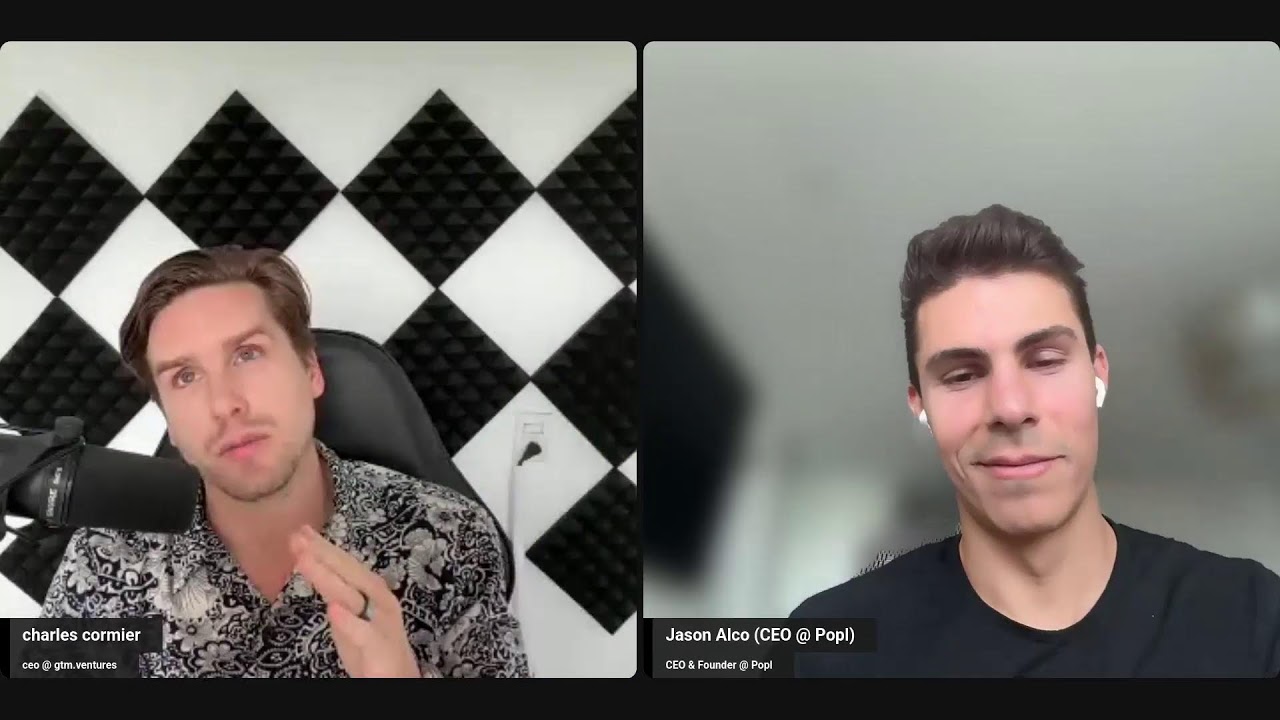
In this Founder Wisdom podcast episode, host Charles Cormier interviews Jason Alco, CEO of Popl, a YC Winter ’21‑backed AI‑powered go‑to‑market platform for in‑person events. The conversation explores why in‑person events constitute the "last trust layer" in a sales funnel saturated with AI‑driven digital outreach, and how Popl helps companies identify and engage high‑ticket prospects at conferences. Jason explains the importance of pre‑event intelligence—mapping key accounts and securing meetings before the show—to maximize ROI, especially for B2B firms with large contract values. He clarifies that in‑person interactions are not the closing moment but a powerful touchpoint that builds trust and accelerates downstream digital closing. The discussion also covers Popl’s evolution from a digital business‑card startup to a lead‑capture platform, the role of product‑market fit pivots, and growth levers such as Y Combinator focus, obsessive customer research, and a sales team of 25 leveraging events as a top‑of‑funnel engine. Jason outlines the ideal ICP (mid‑market to enterprise companies that attend multiple events), a usage‑based pricing model, and why early‑stage startups typically rely on digital channels before graduating to event‑driven growth. The hosts brainstorm event formats like speed‑networking, and Charles proposes a hybrid podcast‑lead‑gen approach using press passes to interview high‑profile attendees, which Jason validates as a high‑conversion tactic. Finally, they hint at a future Popl‑hosted “PopCon” for event marketers. Throughout, the dialogue blends practical sales tactics, strategic positioning, and founder‑level growth advice.
Chapters
Welcome to another Founder Wisdom podcast. We have Jason Alco with us today. He's the CEO of Popl, P-O-P-L, the YC Winter '21 companies. He's been on Forbes 30 Under 30. Popl is number one AI GTM platform for in-person events. Jason spends time, I guess, between New York, Miami, and SF. And yeah, it looks like a pretty sharp software. I can learn a lot from What he's organizing nowadays. So Jason, welcome to the pod. Tell us a bit more about yourself and what you've been up to.
Thank you, Charles. Yeah, thank you for having me. Very excited to be here. I've, uh, I've seen a lot of great podcasts you've done with, with great founders. And, um, so when you, when you sent me the email, I was like, let's set it up.
Excited to chat. Yeah, let's do it. Let's crack it. So yeah, your strategy to send sales rep to events, that's pretty fucking smart. I was trying to deploy that as well because I'm super busy as a CEO and founder. I'm in Oaxaca, Mexico of all places. So I need to take weird flights all the time, but I still see the light in events, right? Like shaking hands, especially when it comes to enterprise deals and earning 50-plus years old trust, I guess, right? So tell me about your strategy.
Yeah, Charles, I like to describe in-person events as the last trust layer. And what I mean by that is like with AI saturating digital channels such as cold emails, cold calling soon, right? Or at least it's allowing cold calling to be more at scale and other channels like that, like LinkedIn DMs, all of those are being done with AI now. So the last trust layer is in person because that's an actual layer where you're standing in front of the buyer, you're standing in front of the team. that's considering your solution. And so you're able to understand that like, hey, I have that touchpoint. It's a very powerful one, right? Like it's a more powerful touchpoint than a response on LinkedIn or a response via email because you're actually getting that face time. And so for us, that's our whole thesis, right? It's like we're building a platform for companies to go to market in person. And so not only are we building for that thesis, but we're also living it, right? by sending our own team to different events so that they can show people what we do. And they're also showing people what we do while they're having the pain point of what we solve. So while you're at an event, you're having the pain point that Popple solves so we can come and talk to you and say, hey, let's look to solve this right now.
Well, it's like my podcasting lead gen company and inviting people to podcast. So I do believe in that thesis for sure, must work for you. Let me play the devil's advocate for a couple of seconds though. Like in person, I don't have their LinkedIn. I don't know who they are. For example, when I meet you, right? Like I have a lead scoring engine that tells me everything, dude. Like up to even your, it gives an estimate of your net worth and who you're talking to. Wow. Who's your ICP? What questions I should ask you? What potential objections, right? So I have like all of this data. I mean, I wish we could do the same as with like HoloLens in real life and all of that. It's not, the tech is not there yet. So there's this problem. Then what if that person's already talking to someone else and in other circles, right? Like there's all these weird social dynamic. Then I can only talk to one person, right? I might spend the full event talking to one person to get in a deep conversation with them. So do you have like a system To bring what cold email and my podcasting approach could bring me, but in person?
Yeah, so it's a great call out. And so I think a couple different things to unpack there. First off, in person works better if you have a high ticket item. And what I mean by that is like if you're a company and you have a higher contract value for most of your customers, like for example, let's say you're Let's say we have 2 different companies and one of them is like, all right, our subscription for our customers is like $50 a year, right? So it's consumer versus another company where it's like, hey, every person I talk to could be a $60K deal a year, right? So $60K versus $50, very different basically cost per customer that you're gonna get paid as a business. For the consumer business where you're getting $50 a year per person, events are maybe not as powerful because you're just like you said, you're gonna need to meet so many people for $50 a year per person to really add up. But if you're the B2B company and it's like every person you speak to could be that $60K, $100K, $50K, whatever larger size deal, then in-person becomes valuable because every single touchpoint you have is a very strong touchpoint. And can result in that ROI. So that's kind of how we see it. It's like, you know, different types of businesses, B2C versus B2B.
So how do I identify a whale at an event? Because I'm high ticket, right? Like my products, they range up to $80K per year sometimes if we do clothing as a service for these clients. Do I know them by face, right? I know a lot of people there. Some of them might already be in my LinkedIn. How do I go to the well, right? Give me your system. What would you do if you're at an event and you want to close very high-ticket stuff?
Yeah, for sure. It's a great question because we do this too. We call it pre-event intelligence. And basically you don't wanna show up on the floor unprepared. You wanna have a plan even before your flight lands. And what I mean by that is you wanna map out who are the key accounts you wanna talk to? And then who is gonna be at the show for those accounts, right? And so you want a platform like Popple to help you with that, right? The last thing you wanna do is just show up and be like, oh wait, I think I recognize that person. I think I know that person. No, let's get you a plan. Let's have you show up and be like, all right, here are the key people that could be that $80K deal. And you'll be able to either go visit their booth or go to their happy hour, or either, or maybe you reach out to them beforehand and you actually proactively set up a meeting. But either way, you're being intentional with who you're meeting. You're not just kind of walking around the floor hoping you see a whale.
Interesting. So, okay, I have a spreadsheet, I have LinkedIn links and their profile pictures. Let's say, um, the, the confidence, right? Like, I haven't done in-person for a while. I mean, I do masterminds for my own company. So the last one was here in Oaxaca. I had my partners, I had clients, I had prospects. A bunch of things did go well, some things didn't go too well, but I mean, you're quite a confident and handsome guy. It might be easy for you, but for most people it's like, it's pretty hard. Any tips like, um, to walk up to them and increase your chances of closing? Like conversation openers, what is awkward, what is not, you know? Like teach autistic people how to socialize.
For sure, for sure. Okay, so 2-part answer to this. First, if you can book, get in contact with them and book a meeting before you're both there, always the best. 'Cause then you don't have to have that awkward like, oh, like, hey, you know, I know you from this, nice to meet you. So if you can just like email them beforehand or LinkedIn and just like, hey, I know you're going to this show, right? Which is a nice connection. I know you're going to this show. You gotta mention that. I'd love to chat with you. About X, Y, and Z. Can we set up 10 minutes, 15 minutes, 30 minutes, something super small and non-committal? And then you have that on the books. So always the best solution if you can. Now let's say you can't do that. The tactic I would recommend if you're gonna go cold walk up to someone and you know them but they don't know you is understand what you have in common. And use what you have in common to not be a cold intro. Make yourself a warm intro. And so let me give you an example. Let's say that like you have someone who could be a customer and you know what they do, right? Let's say that, you know, they sell boats, right? Let's say that like you know that they sell boats and you know that like, you know, something about their business. And let's say that you also have been on a boat. I don't know, just like spitballing here. You take what your experience is and you take what you know about their business and you go up to them and you show them that you have that knowledge. Hey, I know you're XYZ and you sell boats. It's an awesome business you have. Oh, thank you. Thank you. You're complimenting them. You know about them. It almost feels warm, almost like you got an intro today. And so then they're like, what's your name? Nice to meet you. And you're not starting from cold, right? 'Cause you're showing that you have that experience and it helps ground the conversation. And it really helps because you not only know their business, but you give them a nice compliment.
Yeah, bridge. I was with the VP sales of Carta yesterday, brought the company from 0 to $300 mil. And we worked, is it the same, the selling process online as Physical because we're talking him and I about like questions and just like having them open up at the beginning. That's a priority in person. Like how long is too much, right? It's like talking someone for like 30 minutes about their lives, getting them to open up. And when when should you close in with your request? What's the difference between online and physical? And I'm asking that for real, dude. Like I've only done sales. online in the past 10 years, right? And I've hyperscaled it. I've, I've never done a sale physically. Like, it's weird to say out loud, but I mean, that's the empire.
I hear you.
Fully online.
I hear you. By the way, Charles, real quick, my team is asking if they can watch this. Is there a link I can send them?
Yeah, yeah, the StreamYard, or they can go on my LinkedIn, YouTube, and X. It's live there. It's gonna pop up.
If you drop a— drop the link so I can send to them real quick.
Yeah, in the private chat here. Oh, it's the URL that it's here. Oh wait.
Oh yeah. Does this work?
I don't think it will, but just tell them to go on my LinkedIn or YouTube or X is going to be there. Yeah.
All right. I mean, yeah, ideally, because they don't want to— let's see.
It's in the chat. I see it.
I see it. Yep. Okay,
the second one, the second one, the LinkedIn one.
Anyone wants? All right, cool. All right, so it's a great question. You mentioned you've never actually sold in person.
Yeah, it's like what's the difference between this and and online, physical and online? What's the difference?
So this is a key insight, and I'm really glad you asked because in person. Is not really like, this is a myth. In-person is not for the close, in my opinion. In my opinion, in-person is for a powerful touchpoint along your journey to close. So in terms of selling SaaS, like a software business, selling something that it's helpful to show someone online, right? Like showing a demo, showing how the platform works. Those are actually better for— oh, did I lose you, Charles?
Yeah, we're back. Sorry about that.
Oh, lost it.
Yeah, go, go in the last 5 seconds.
All right, cool. So, um, Where did I— should I just start from?
Yeah, start from scratch, like key insight.
Okay, cool. So key insight about in-person is that in-person isn't for the close. In-person is for a powerful touchpoint along the journey, right? In order to close a deal in software sales, you have to have multiple touchpoints with that prospect and customer, right? You have to meet them, you have to show them the platform, you have to get through legal. You have to bring in other stakeholders, right? All these things are part of that process. And meeting in person is a very powerful touchpoint along the way. It's, I would argue, the most powerful, right? Because it's like, it's better than someone saying an email and saying like, nice to meet you. It's better than a LinkedIn DM. It's better than even a phone call, right? Because you're actually standing in front of them and you're building that trust. And so I think what you're saying is spot on, Charles, right? It's not for closing. You haven't actually closed the deal. In person. But what you do do is you build that connection with the buyer and then you're able to close them more easily back online.
Got it. What about start online and meet them physically at the closing stage?
Yeah. I mean, I don't, again, like you're not going to get a sign in DocuSign. Like I consider the closing stage like someone signs a DocuSign, right? Obviously the nature of that is literally digital. Right. So you technically can't get that in person unless like you're handwriting a contract in a room, which I don't really think people do anymore. But yeah, so given that it's probably gonna be a digital sign at the very closing stage, in person's the most powerful touchpoint, even more powerful than midway through, because at that point you're like kind of sealing the deal, right? It's basically like, all right, I'm about to like sign this and spend this much money. I don't know if I trust this guy, right? I don't know if I trust this guy. I don't know if I trust this business. But if you get that in-person touchpoint late, late in the game, man, it just, it does wonders because they're just like, not only do I like the business, but now I like the person, right? So I have a person that I can put to that, uh, to the business's name. We got that FaceTime, we're good to go.
Got it. What percentage of your contracts are closed online versus physically nowadays?
Uh, 100% online. We do not— we do not close in person. I mean, you know, like, you could, you could have like a handshake. You have like a human handshake that's like a, like a, okay, let's get this done, right? But it's not actually closed until the, the digital DocuSign is done. Uh, so basically 0% in person.
And you have a sales team of 25 persons. Is their main top of funnel events, or do you have other lead gen sources for them?
Yeah, we have a lot of other lead gen sources that are working wonders for us. I will say though, it's part of our proprietary situation. We're growing really fast and so I like to keep that secret sauce a bit quiet, but I will say sending them to events is a big strategy for us.
Interesting. How the hell do you grow to $1 million MRR? I believe that's been the trajectory you're on. Any tips for Founders, you've been at it for what, like 5, 7 years? That's the asterisk, but most founders never reach that level. What's the growth hacks here?
Yeah, so something I wanna talk about is product market fit, probably my favorite concept. And when you reach product market fit, companies or buyers start to kind of like bang on your door in order to buy your solution. And like the analogy I like to use is like one is pushing a boulder up a hill, right? Which I think is where most founders start at. You're pushing a boulder up a hill in order to grow. It's hard. You're working really hard at it and it's just like, it's pushing back on you 'cause of the gravity. Product market fit, once you have it, is actually the boulder flowing down the hill, right? So you're kind of chasing the boulder. And it's just growing on its own and doing so well, and you're just trying to keep up with the demand. I encourage founders to look for this product market fit wherever they can, and the way that they should look for it is through pivots and talking to their customers. This is what we did. It's what we did, Charles. We started off as a digital business card company, right? We were selling digital business cards to companies, and I gotta tell you, it was kind of like pushing the boulder up a hill. But people were buying, companies were buying these digital cards. But what we noticed is, all right, let's start talking to these customers and maybe there's another pivot here. Maybe there's another pivot here that'll help us grow faster. And so we looked at our best fit digital business card companies and we learned that they weren't using Popple for sharing their digital information. They were using the digital business cards to capture it. So when you meet someone in person, Charles, you can share information and you can receive information. There's the exchange. And we started to realize that, you know what these teams care about more than sharing? It's capturing. And so we're like, all right, there's another pivot in here. And so we pivoted from digital business cards, which is a sharing-first, basically a sharing-first product. We pivoted to more of a capture. which is more of a lead capture, which led us to event lead capture. And so now that we're here, we are seeing that boulder move down the hill and all it took was talking to our customers and learning why they were really using us and being open to taking the risk of pivoting. And so if you're a founder and you're in a situation right now where it's like, it's kind of working, but you're not seeing that strong product market fit, there might be a pivot or 2 in your business That if you look hard enough, you can find and it'll be successful for you.
Man, that's crazy. And how was the growth? Was it, I don't know, $10 grand a month, then $100 grand a month? Was there like one significant event that you can point to that brought you to where you are today?
Ooh, well, I mean, going through Y Combinator was a really big turning point for us. I gotta tell you, like early on, as a first-time founder, I didn't know what the hell I was doing. We were like trying to do everything for everyone, right? And so YC's, one of their big advice is focus. Pick one customer, pick one thing that you're doing and focus on that. You can't be everything for everyone. And so that focus really early on allowed us to propel to where we are today. And so that's a huge one. Also just talking to customers. That was a big one from YC that they really pushed hard. And like, this sounds simple, Charles, right? Like, oh, everyone talks to their customers. No, no, no. People make this mistake as founders. You can't just like have one meeting and call it a day. You have to study your customers, like actually figure out what their problems are. Why are you not solving them? Why are they churning? Anytime someone cancels, why do they cancel? Why aren't you solving their problem enough? You gotta be obsessed with these people. In order to build something that they're truly going to knock on your door for and get that ball rolling down the hill.
And who's your ICP? Is it mostly enterprise? Like, what are the plans as well that you offer them?
Yeah, our ICP is mid-market to enterprise companies, mostly B2B. Like I mentioned, they usually have to have higher contract sizes and they go to a certain number of shows per year. We are very particular about our customer. They have to like really truly need Popple, right? And so if you're not going to that many events, you don't really need Popple, to be honest. Like it's just not much of a need then. You need to have events as a massive go-to-market strategy that you're already trying to grow in order for us to be plugged in and make sense.
And I guess most enterprises do have an event strategy. Do you feel the In event in-person strategies picking up traction since COVID or is it losing traction because other methods are picking up speed?
It is a wonderful time right now, Charles, and it's because AI is saturating all those digital channels. So we have 2 types of customers that come to Popple. We have the established enterprise customers that have been running events for years, and they're like sitting over there like, ha, told you world, like Told you guys events work, and they've been doing events for years. They're like bought in, they have their whole strategy, so they come to us so that they can continue to grow. On the other side, there is brand new companies like new startups, new AI labs, and these companies are brand new to events and they're starting to realize, wait a second, we've never done these before, but they're actually very powerful. And so then you got the legacy guys basically saying, I told you so. And then you have the new companies who are saying, you're right. Okay, we're realizing this is huge. You got like Anthropic, you got OpenAI, they're hiring events roles for like hundreds of thousands a year. So clearly even the most AI native of companies are coming to events. It's an exciting time.
Yeah, just yesterday I was listening to the OpenAI Dev Day that was like 2 weeks ago on TBPN, right? Like that was pretty good. Okay, so as a— you don't target startups a lot, do you? Like, do you have plans for startups? Like, what does it— what's the pricing for enterprise? Starts at what, $100 a seat? Is it per seat? Like, tell me a bit more.
Yeah, so it's a good call out. We actually don't— like, we have some startups, but I will say that like the event strategy, really starts to become powerful once a company hits a certain size. And so if you're a startup, it's a little bit more cost-effective, it's more scalable, and it's just easier to start with a digital channel, right? It's easier to set up a sequencer in Apollo. It's easier to start cold calling. And also like SEO and other just digital channels are just an easier starting point. And so that's why you see a lot of startups really index on those first. Once a startup hits a certain point, whether it's like Series A or Series B or like just a certain level of growth, they then start thinking about events as an additional channel to add so they can continue to grow massively. And so we usually see companies come to us around the like, you know, late Series A, Series B stage where they're saying, we're gonna start doing events heavily. Can you guys be our like operating system for these events? And so yeah, generally if they're a smaller startup, we're like, probably not a great fit. Sometimes there's exceptions, but generally that's the rule. And then to answer your question on pricing, we actually, we price based on usage. So we're very usage-based and we are, we give custom pricing to different companies. So I can't speak too much about the details there, but it's based on how many events they're going to.
I want to run 2 things by you. If I would organize an event, I think I would organize like a speed networking— networking is probably not the right word, but just like speed meetings, right? Like 15-minute increments. I saw one event do it at scale, was like a family office or VC event, and my friend, he got there and he had like 20 meetings in one day of 15-minute increments. I found that pretty sharp. and aligned with like my own model, right? Like my days look like that every day, like meeting, meeting, meeting. It's super stacked, it's super efficient. What do you think about that model?
So I guess what is the model exactly? Is it the inviting people to a—
Well, you show up to an event and like rather than just showing with a blank schedule and just like, oh, let's see what happens once I'm there, you have in-person meetings stacked up one after the other and you know who you're going to speak to, whether it's a buyer, seller, or partnership. And it's way more efficient rather than just like wandering around and hoping serendipity kicks in.
Yeah, for sure. I'm a huge fan of pre-event planning and I think a lot of companies are making that mistake today where they're not planning enough, they're not setting up those meetings. It's when you have a platform like Popple that allows you to know who's attending and be able to reach out to certain teams and people that are gonna be there, it makes the success of the event that much stronger. And so I think you're spot on there. Don't show up without a plan. Like, make sure you have things booked in advance and use the digital channels, right? The LinkedIns, the cold calling, the email. Use those channels to get in contact with them and don't just be a cold call, like where it's just fully cold. Mention that you have that warm connection of, hey, we're both gonna be at this show, right? If you mention that, it's an immediate connection where it's like, you're going to this show, I'm going to the show, let's go, this is great. I like, you know, you and I both have great taste. And so it has that warm connection, allows them to be warmer on like setting up a meeting even before you hit the floor. So definitely encourage teams to do this. Don't show up unprepared.
And the second thing is very much aligned with your strategy of sending your rep to events, just that it has a special spice. I want your take on it. So I'm scaling podcast lead gen, right? So you talk to your ICP on podcasts, you do this at scale, you qualify them, you make sure they're a good fit. That's hyper-scalable. Had gigantic success with that. What if I deploy it physically, right? And I get a press pass at like a web summit and I send my guys to actually interview CEOs, founders, ballers, right, that would never fucking accept to meet me, like, or my guys physically, but they would accept an interview and we get them in the pipeline through that. What do you think about that method?
Yeah. Do you know the School of Hard Knocks, Charles?
Yeah, yeah, I know him.
Yeah.
So were you interviewed on there or?
I was, yeah, yeah. So I'm close with James. Awesome entrepreneur. Yeah. James, Josh, all those guys. So they're crushing it. But so they have mastered what you're talking about here. And that is that people in person are much more likely to join a podcast or do an interview because they're there in person, right? You're absolutely right. Like, let's say you reach out to like, you know, a Jeff Bezos or someone like that online. The likelihood that you're gonna get that guy or any of those, any of the greats, on an interview digitally like this is pretty low. But if you're at the same event as them and you say, hey, would love 5 minutes, 10 minutes for a quick interview, all of my followers are founders or great entrepreneurs and they really look up to you. They're so much more likely to say yes and to give you that time. And that's the beauty of in-person. Let's go. Right?
Let's press pass, right? So you can do it at scale. You can have many of these guys without paying a dime. I think that's also part of the genius When should we expect a Popple event?
Yeah, it's interesting. We're growing so fast, we don't really host our own events, but we have joked about having a PopCon where basically we have a full maybe event for event marketers where it's like everyone in our market, we invite them out and we talk about the future of lead capture events. Might be something we do. Yeah, we haven't done it yet, but it's in the back burner. We're thinking about it.
Nice, man. Where can people find out more about you?
Yeah, I'm on LinkedIn, I'm on Instagram, I'm on X, Jason Alco, same thing across the board. And my DMs are open. Any founders, entrepreneurs, if you guys have questions, let's chat.
There you go. So that's Jason and Charles, another founder.
More from Charles

Founder Wisdom: the audiobook, version 2 (5 hours of stories from founders and CEOs)

8 CEO Questions I Love Asking: the audiobook (64 founders answer, in their own words)