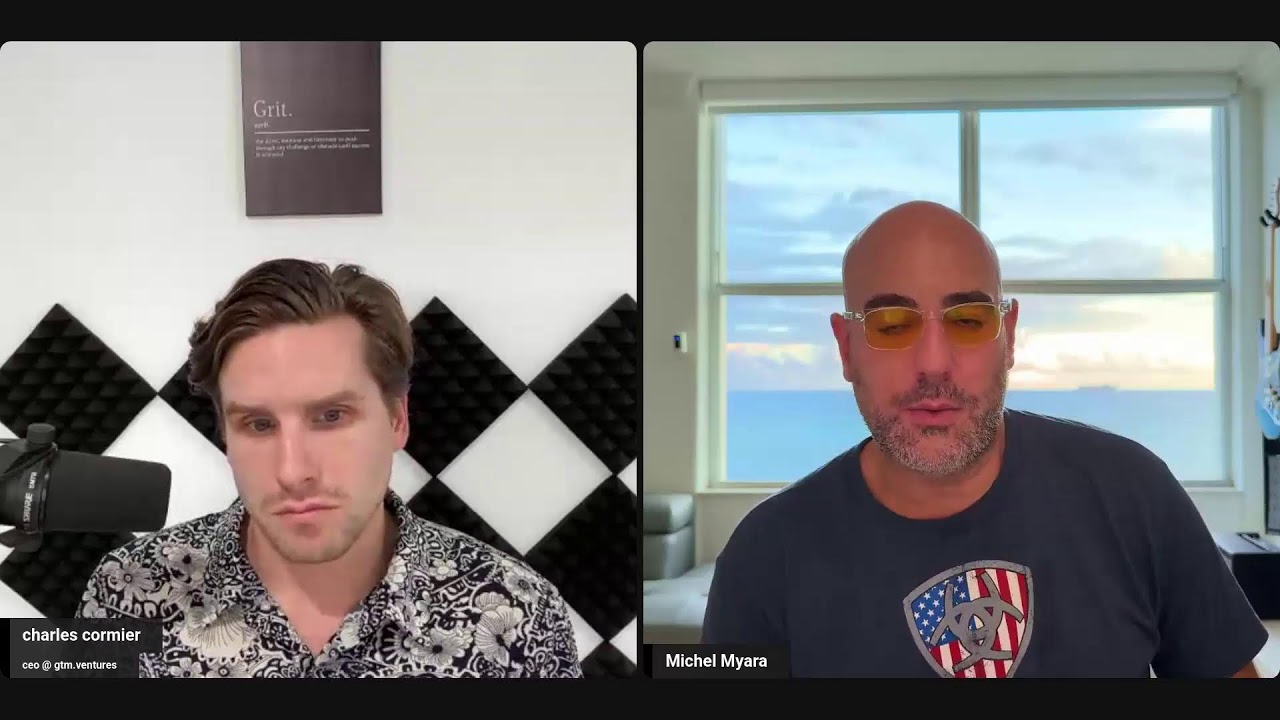
In this Founder Wisdom episode, Charles Cormier interviews Michel Myara, serial entrepreneur and founder of Simplicity Fintech, the company behind Looch – a mobile‑first, all‑in‑one fintech platform for founders. Myara recounts his transition from consumer‑goods (beverage) startups to fintech, driven by frustration with inventory‑heavy CPG cash cycles and a desire for a founder‑friendly operating system that unifies banking, accounting, cards, and payroll. He describes Looch’s design philosophy: seamless, mobile‑first, and integrated rather than a patchwork of third‑party tools, featuring an AI‑driven CFO, loss‑prevention, legal, and Gmail agents that automate fraud detection, compliance, and routine tasks. Myara shares a skeptical view of traditional venture capital, criticizing misaligned incentives and a focus on fundraising over building, and explains how Looch has bootstrapped via app‑store and Google ads, leveraging word‑of‑mouth and a peer‑to‑peer viral loop. Technically, Looch combines proprietary software with APIs from Stripe, Plaid, Mastercard, Finicity, and the IRS, hosted on AWS. The roadmap includes launching a custom payroll service, enhancing subscription management, and continuing multi‑feature improvements. Myara emphasizes the liberating effect of AI agents on his own anxiety and productivity, positioning Looch as a tool for neurodivergent or hyper‑focused founders seeking autonomy.
Chapters
Welcome to another Founder Wisdom podcast. We have Michel Miara with us today. Michel is a founder at a company called Simplicity Fintech. The main product is Looch. You can find it at looch.money. It's an interesting fintech company and glad to have Michel on today. I think he made the move from Santa Barbara to Miami nowadays. So Michel, welcome to the pod. Tell us a bit more about yourself.
Santa Monica, but Santa Monica to Miami Beach. Yeah, I'd love to tell you more about myself. Listen, I'm a serial founder. I don't think I'm someone that anyone would want to employ. I just, I've always really marched to the beat of my own drums. So for me, you know, startups is just kind of a way of life and At the end of the day, you know, one thing leads to another. So my background is a lot of consumer goods stuff, beverages. I've created a bunch of beverage brands and did that for a while. And as I was doing that, I learned to do my own accounting for my own companies because, you know, beverage is so inventory intensive. And I think most CPG companies don't really— I don't even think they know if they're profitable or not. They might think they know, but I don't think they really know. Because of the way the inventory turnover works and all that stuff. So I understood I had to learn accounting, and I started off with QuickBooks Manufacturing and Wholesale Edition, the CD-ROM that you would buy from Staples or whatever, and just, you know, self-taught accountant in a way. And then QuickBooks Online, then Xero, and I became really good at accounting, and I always had this this idea in my mind to have a full operating system, or let's just call it founder-friendly accounting, right? So an accounting app that incorporates the business banking and really every aspect of the business finances so that the founder can just focus on running their business.
Nice, dude. I wouldn't expect accountant to go in the same sentence as rebel though. How did— how does that happen?
I don't consider myself an accountant by any means. I learn things that I need to learn, just like when I got into tech 5 years ago. I mean, I had to learn. I'm just self-taught, period. So I learned accounting not because I wanted to identify as an accountant, not at all. I learned accounting because I wanted to, you know, I think all founders at the end of the day are control freaks. And I wanted to know how my business was doing, you know, Friday versus Monday of that week. So for me, learning the software was, it was just a tool. So it's something I had to do because I'm just, I've always been just very practical and hands-on. And again, when I got into tech 5 years ago, you know, we had a UI/UX designer. I didn't like the, you know, the designs, the vibe at all. And I just taught myself UI/UX design because, yeah, to me it's just all about the vision and the startup being really an extension of your personality. And I think all founders wear different hats. It's just You have no choice really.
Well, finance is super important as a founder. It's probably the skill I'm giving the most time nowadays. I mean, I've learned sales. I think sales is like what you need to start with because it's such a jungle out there. Product, thankfully nowadays we have Claude Code, right? And shit like that, which makes my life way more easy. And then management. And nowadays I don't manage humans, I manage agents. I think that's great. CPAs, I wouldn't say most CPAs make good founders. They're just too risk-averse, right? But it certainly helps to put words on numbers and have a mental idea for sure of where your business is going, if it's healthy or not, you know, like being a business doctor, if you want, like look at your business and be like, oh, this is wrong in my business. This might bite me in the ass 6 months from now. And for that reason, I need to be more conservative. I have like 2 clients that are building like CPA agents, right? And that's really important. But finance, I mean, mostly, I mean, I became a VC as of late and funding stuff is great. I know you have your opinions on VCs, which we'll get to, but financial engineering, creating financial products, right? Because I still think money's like the greatest invention in mankind, not even Wi-Fi, not even AI, it's like money. Like the fact that you can trade stuff with people and I think you can innovate on terms with people, right? Like, I think that term is— that skill is gigantic to have as a founder, in my opinion.
Yeah, I think you touched on a couple interesting points. People who work as CPAs or people who work maybe at a bank as like a business banking manager. In other words, people who have insight into businesses and do that for a living. Like you said, I think they're fascinated by what their clients do, but I don't think they would ever take that leap because for them there's just so much security And being that person for the businesses.
Identity, right? Like being Mr. Banker and being in control of and thinking you're all superior to these founders. The same stigma as VCs, right? VCs think they're the shit. Oh, everyone comes to me. I'm Mr. Important. I have the money. But wait till you get in the arena, Mr. VC. You're gonna see it's way harder than you think. On that point, though, I will say that some of my best clients throughout the years have been like ex-JPMorgan, now founders. They make such a savage type of founder because these guys have seen it on one side and said, fuck it, I don't want to continue there. I'm getting in the arena, right? And yeah, obviously they hit— they get a couple of slaps across the faces, but if they make it, they try. Same for ex-VCs, ex-PEs, now founders. If you see like both sides of the table, usually you make a very good operator.
And I think those guys were probably miserable to begin with when they were working at their corporate job. I don't know. I mean, I would say probably most people are miserable working at a corporate job, generally speaking. But I think the ones who leave and become founders, it's like they were fed up. It's just, it's a special breed at the end of the day. They They just couldn't take it anymore, and they'd almost prefer making sacrifices as far as their lifestyle and security is concerned than just you know continue in in the in in in the path that they were on. And with that kind of you know golden
shackles, right? It's like a caged lion. You can't cage a lion. And you said lifestyle. Well, running a business is lifestyle and is baller as fuck because you have like. Full autonomy. You don't have no one to tell you what to do. You're no one's bitch, right? So you don't answer to anyone. You're like a mercenary and that is very much satisfying. What do you think about the future? Do you think AI will slash most jobs, by the way? I tend to be one of these guys that think that agents are coming after all 9-to-5ers, basically.
I spent the last few months building agents and It's almost like you're building these, uh, offshoots of yourself that you— Yes. That just come to life when you flip the switch on, and they just want to be your slave 24/7. And it's just— I think, I mean, there's— it's in a way, it— I mean, we let go of a couple guys very recently. I mean, at the end of the day, Yeah, I think agents are gonna be doing all the work. So I'm like you, I manage agents for a living. Do I work? I don't work. My agents work, but I manage them and I oversee them and I guide them and I train them. But it's, to me, it's just been absolutely life-changing. I've actually seen, I'm someone who Actually suffered from anxiety for my whole life, and I've seen my anxiety levels really plummet once I started working with AI agents. It's just like, wow, like I'm a free man now. It's extremely liberating for a control freak, you know, slash constantly worrying type of founder to be empowered by these AI agents. And of course, the natural byproduct of that is letting go of people. And I think as founders, like for myself, I've always struggled with people, managing people, getting people to apply themselves the way I would in my work, getting people to embrace and share the vision. I think I have a very big heart. I'm a very compassionate person. But do I feel sorry for people being replaced by AI agents? The answer is absolutely not. I think these people, what they need to do is they need to go back to their former employers and thank them for having given them a job in the first place. Because let's face it, I mean, a lot of these people, you hear people who work in tech and it's like, how much are you making? Oh, I'm only making $160,000. My friend's making $220,000. And it's just like, but what are you doing? You know what I mean? Like, it's just like you're, you're, And they have a better caterer and we have this, these benefits and our, you know, our boss is super cool and we get to spend this much on trips. You know, it's, it's, there's this entitlement that comes with working for, for tech startups, especially the ones that were very well funded. And, and yeah, so, you know, I think the party's over for that, that type of person. The transition we're going through now is painful. It's going to be painful for a lot of people, but in the end, I think it's going to be very liberating. It's a blessing in disguise. So yeah, we could talk about AI agents replacing people who work at tech companies or tech startups, but another example would be just simply— I'm sure you see the Waymos everywhere and the Tesla robotaxis. Mm-hmm. They're putting the Uber drivers out of business. But I mean, who's genuinely happy being an Uber driver? I mean, I don't think God put you in this world to drive a car all day and ruin your health by being sedentary and eating junk food and, you know, just barely getting by. So now you can't be an Uber driver anymore because of the robotaxis, but, you know, it's gonna give you an opportunity to Do something that's truly suited for your personality. So I think humans are gonna have to, a lot of introspection to do and say, okay, what can I do that an agent or a robot can't do or won't replace me with?
Yeah, I guess like founders, most founders are different than most humans, but Yeah, I would take it even further than Ubers. It's like, do I want a human to pick me up and do small talk while I'm already listening to an audiobook or whatever? I mean, I'm a bit weird for these reasons, but I'd rather have a robot perfectly pick me up and go fastest from point A to point B without like any shitty music going on in the background and whatever. But yeah, all good. Okay, agents. Yeah, what kind of agents have you been deploying? I felt the same, right? Like my life has greatly been alleviated. I don't need to answer my mailbox nowadays, my LinkedIn message. Everything is sort of recursive and automatic on a daily basis. But yeah, what kind of agents are you deploying nowadays? What makes your life easier?
So the truth is we've been deploying agents for every single aspect of the company. You know, as a tech startup, as a mobile app, you know, we're a mobile app on The App Store, on Google Play, there's really, and it's really a blessing, there's no aspect of the company that an agent cannot handle. I'm, of course, a properly trained agent, and I'm not saying, you know, the agents can just be autonomous. But what comes to mind, you know, honestly, as a fintech with various ad campaigns and different parts of the world, we're getting hammered with bad actors and wannabe scammers and hackers and fraudsters. And it's just incredible how the agents are just catching everything, identifying the patterns no matter what the pattern. So I built one agent called, I called it the Loss Prevention Agent. And it's, It's just, I mean, it saved us so much trouble. Okay. But really, honestly, there's, there's, I mean, there's so many agents for, for everything. I'll give you like a very mundane example without getting into the, I dunno, the boring engineering aspects. I built an agent called the Gmail agent because, you know, we, you get spam every day, but a lot of these spams are, are lures. And I'm, I'm the kind of guy who always has to push back. Like, why do you think you can send me an email where if I click on something, it's phishing and, you know, you're trying to hack or whatever? So I have a Gmail agent that actually reports every single spam email and every phishing lure to every— to all the infrastructure they use. So like basically 3, 4 different companies will get a report for that one email. It does a spam sweep every single morning. Am I gonna eliminate phishing? Of course not, but it kind of feels good to, uh, to push back. That's not something a human would ever want to do. It's just a gigantic waste of time. You either move it to your spam box, you, you delete it. But yeah, it, it feels good to have these machines kind of fend for you. And, uh, I— we have— speaking of fending, I built a legal agent. I built a legal agent that Did the work that a law firm would have probably charged us at least $10,000 for. You know, it's, it's, uh, like I said, it's just, it's just extremely empowering. And for someone— because you keep saying, you know, yeah, founders do have it, your founders are not neurotypical— and for someone who's, uh, multitasking in his mind all the time, well, now, you know, you're just Managing this, switching from one agent to another is, is kind of cool. I can see how it could be overwhelming for the average person who wants to work on one task at a time, but for someone who's not neurotypical or someone who's neurodivergent, you know, managing multiple agents, running different aspects of the company, it, it's really cool. I think it's just very satisfying. All
right. And with Lush, how did you go from alcoholic beverages to fintech?
Well, I desperately wanted out of the inventory business. I think the inventory business is a no-win situation. Either the product's not doing well, now you're stuck with the inventory, or the product is doing well and now all your cash is tied up in receivables and prepayment for the next production runs. So either way, it's no-win because you just always need cash. You've never had— you can never get the see your cash. And it's also a game of musical chairs with just how fickle consumers are, where I've seen brands do like $80 million in one year, and then basically the brand was completely dead the following year. That's very short-lived trend that the lifecycle of a consumer brand is just so short. So it's just something that I— it didn't resonate well with my personality at all. I wanted out. I always knew tech was the move. It's what I always wanted to do. I think I was intimidated. I thought I was behind. I thought I was late to the game. And, you know, met up with my co-founder who's our CTO. And, you know, we just, we just started the company and I learned, you know, bits and pieces as I went along. And then AI comes along and now it's just I'm a tech founder,
right? And how is it better than Stripe or Wise? Or why should we use Lucid instead?
It's really the beauty with which everything is— everything comes together. So what I'm noticing in fintech is a lot of all the different fintechs are coming out with different features. What I notice in the fintech is everyone's trying to do everything. Okay. Yeah, I mean, it's like everyone's trying to do banking and spend corporate cards. Everyone's trying to do global payments. There are no more specialized fintechs, and the way they do it is very much patched together. Looch was really designed from the beginning to be a true seamless all-in-one. We're not all-in-one because we started off with card processing and decided to add, you know, layer on a new feature for our use, for our card processing users. Where we, we've, the, the idea for Looch was all-in-one, you know, right off the bat. And it's the way it's designed. It's not at all features that are patched together. It's extremely seamless. It's, and it's a mobile app and it's a mobile app. That can handle your accounting just as well as QuickBooks Online Advanced, by the way. But it's it's founder friendly. You know, the thing is with the current stack, whatever stack you have, maybe you're using Stripe for your card processing and you have corporate cards with Ramp, and maybe you have you know a bank account with a with a fintech or a neobank and stuff like that. I I always say all these companies that are using these the the typical stack, they are, they, they have what I call a dashboard person. There's always like this dashboard person that's kind of integrating everything and managing everything. So with Looch, you don't have that. I mean, you could pull out your phone anytime you want and get a very clear picture. And now we have an AI CFO that gives you a daily brief, you know, like your personal CFO, and it's completely free. It's right in the app. So ease of use and user experience.
And tell me how complex it was to create that. I think it's mobile first. Did you have to get compliance settled? Like, how fast did you get it launched?
We didn't get it launched fast at all. I've, you know, speaking of VCs, I've had VCs almost in shock when I told them how long we were— we had been working on it. It took— I mean, we started working on this 5 years ago, and we launched in February of this year on the App Store, and we only launched maybe a few couple weeks ago on Google Play. So when we're looking at like 4 and a half years of building, yeah, that's, that's everything. It's everything you said. It's the compliance. It's— and quite frankly, it's It's starting over a couple times because we, you know, we realized we just in the wrong direction and the long-term vision wasn't going to be, we weren't gonna be able to implement the long-term vision in the direction in which we were. So I think we started over a couple times and it, it's, it was a, it was a very lonely, painful 4 and a half years. And, and yeah, and I pitched VCs at the time. I'm like, yeah, we've been building this for 3 years, and they were in shock, like, 3 years? You know, well, yeah, I mean, that's, that's how long it takes to build something beautiful and something that, you know, that, that's just not just another tool or one-trick pony.
VCs, you pitched more than 100. Uh, why wouldn't you Why wouldn't they fund you, and what is your opposition against VCs, I guess?
I wouldn't call it an opposition, but I think what it is with the VCs is just what I— what my experience, what I've seen is some guy who is managing a bunch of money. It's not their money. The money comes from the LPs who are most of the time clueless. as to where their money is going or how it's being invested. And then this person is giving me an attitude. They don't get it. They're investing in fintechs that, as we speak right now, have already gone out of business. And it's just like, it's just like, dude, you don't fucking get it. I mean, I don't know. I mean, it's just like, don't you get it? Aren't you excited? And The questions they were asking me were the kind of questions you would get from someone who doesn't even follow what you're explaining. So they were just completely off topic. So I think there was— I just think it didn't click. There was a major disconnect. And then when I look at the press releases, what they're doing, the pattern is they're funding founders who are really good at raising money. That's what I've noticed. The companies who raise money, it's because the founder is a full-time money-raising person. And I know founders like that, and quite frankly, they're kind of scammers. They're kind of liars. And I mean, and then just like the amount of money, I mean, they like that money on fire. So yeah, I just don't want to play that game. I think people are only really good at one thing, and when a founder is good at building, they're not good at raising. And when they're good at raising, they're probably not very good at building. And it's, it's just, I didn't want to be part of that clique of those founders who are just constantly raising because that's all they're good at. But then they— I mean, it's extremely rare that these guys ever make— turn a profit.
So nowadays you don't need like extra capital, you have like enough users to self-fund, is that the situation?
That is the situation. It's a blessing to not have to kiss ass to people that I don't have much respect for. And how many users,
how did you get them? And are they mostly founders, CEOs?
We have all kinds of users. We've been doing really well with the, with Apple ads on the App Store. Been doing well now with Google ads, pretty much all it is. For us. Also, Looch is peer-to-peer. So when you pay, it's like Venmo. When you pay someone, it's just with their email address. They have to download the app to claim their funds. So there's that viral effect from the peer-to-peer. We create entities, right? Looch, you can create an LLC in Looch for $249 all in. EIN, registered agent, virtual office, trademark monitoring, state filing fee included. So it's, yeah, I mean, we're getting founders who are just getting starting off, just getting started off with their brand new LLC. We're getting more established companies, e-commerce. We have a WooCommerce plugin that works great for a lot of the e-commerce. We call 'em looch businesses. And it's very varied. I mean, yeah, like moving companies, Different types of consumer goods, services, online clothing lines. So we're kind of industry agnostic. So our ICP is really the hands-on founder who's just looking for something really simple.
Interesting. And the backend, is it like leveraging APIs like Stripe's or did you build the full thing?
Stripe is a major partner of ours. Uh, they've been fantastic, and we have other partners. So yeah, there's, uh, we built all of the Looch part, but yeah, for card processing, we do work with, uh, Stripe. And yeah, we have, we have different partners. Um, you know, we integrate with Plaid, we integrate with MasterCard, Finicity. I mean, we integrate with the IRS. We file— you can file a 1099 directly from Looch, and we file it directly with the IRS for $2, which is unheard of. Accountants charge $200 for that. So yeah, it's a mix of both. We have our proprietary software, and then we have backend APIs, but the backend is all Very much scalable. So yeah, you know, we're on AWS with all the bells and whistles.
And are you— how do you acquire your clients nowadays?
Well, you know, we started out with the Apple ads and the Google ads, and what we're noticing now is a bit of word of mouth. So that's been really cool. Yeah. And word of mouth is just It's really the best because you can run as many ads as you want. At the end of the day, when you're a new fintech and you're saying, you know, bank with us, let us be your business bank, that's a lot to ask from someone who's never heard of you. So yeah, it's really proving ourselves with the users we were getting by running ads. And then now we're seeing more of that word-of-mouth effect.
Yeah, I guess the best flywheel in your space, like send a link and if you want to receive payment from that person, then you need to sign up and then have the best signup ever, right? Like the fewest steps as possible. What's next for you, Michel? What's the priority? What do you want to accomplish this year?
A lot of things are in the works. You know, the, the way we're building this, it's kind of hard to say what's next because there's, there's like 5 or 6 or 7 different aspects of the software, of the platform that we're just improving simultaneously. We're not treating it as one feature at a time. We're treating it as multiple features that could all be improved. What I will say, you know, you know, to give you a clear answer, We'd love to launch payroll by the end of the year, and that is something really cool. You were talking about backend APIs. Yes, you do have payroll as a service and that sort of thing. We were able to build our own payroll from the ground up. So that's, that's something we're really looking forward to. A lot of our Lush businesses want payroll. And everything, everything we do is done our way, so it won't be your typical typical payroll. It'll just, it'll again just be extremely simple to run payroll, 5 taps at most from the app. And, but really also improving on the foundation that we laid with the current feature set with spend management and card processing. We have something called Stay Subscribed, which you could compare to Stripe's smart retries. So, for our users who use this for card processing, A lot of improvements on the subscription aspect of things, recurring billing, all that sort of thing.
There you go. Where can people find out more about you, Michel?
About me? Just on social media and have a little website, michelmihara.com. Hasn't been updated in a minute, but I would much rather people go to just looch.money and download the app. That's probably more interesting than me.
There we go. So it's Michel and Charles for another founder.
More from Charles

Founder Wisdom: the audiobook, version 2 (5 hours of stories from founders and CEOs)

8 CEO Questions I Love Asking: the audiobook (64 founders answer, in their own words)