Are You Missing This Coaching Blind Spot? The Impact of Neurodivergence.
This webinar, led by ICF/EMCC‑certified coach Alison and MCC coach Christoffel Sneijders (founder of 3 Brains Intelligence), explores how neurodivergence—such as ADHD, autism, dyslexia and related conditions—creates blind spots for coaches. The presenters discuss prevalence trends, the danger of over‑labeling, and the importance of meeting clients where they are. They introduce the "3 Brains" model (head, heart, gut) as a framework for understanding decision‑making and learning preferences. Throughout the session, they warn against "over‑efforting"—the coach’s tendency to over‑prepare and lose presence—and illustrate how specialist bias and cognitive dissonance can lead coaches to see traits of neurodivergent conditions everywhere, reducing curiosity and increasing bias. Practical guidance is offered for staying curious, avoiding premature categorisation, and maintaining presence. The workshop ends with live interaction, gratitude, and an invitation for further questions.
Chapters
That's absolutely grand. Today's session is not so much a presentation whereby we have all the answers. It's more of a workshop where we're looking to have, you know, a session to harness all the beautiful brains that we have in this session today to really make it interactive. So even if you're not on camera, if you can engage in the chat, we may take the mute off for you to share some thoughts. Please, please do speak up because our collective voices, we can all learn from each other beautifully. So without further ado, we'll get started. Chris, is that all right?
Yeah, let's start. Sorry, too much. Hey, Renata, I also saw that beautiful lady yesterday. You know, I have— we have recurring people here that makes it almost like a little family. It makes it even more cozy. Welcome, Renata. I know I interrupt you so many times, so please.
That's all right, I'm used to it.
Oh yes, so who's going to talk to you guys?
Yeah, so just a quick introduction for me. I'm an ICF EMCC certified self-leadership and mental fitness coach. I've been coaching for around 5 years. I help senior leaders, mostly in IT and finance, take back control, to cut through the mental noise that they tend to be grappling with so that they can lead themselves and lead others with confidence without burning out. My background's quite eclectic, although it was in IT. It's also been living and working in Japan, naturopathic nutrition, and that kind of tends to bring a more holistic lens to the work that I do. I studied with Chris a few years ago now in 3 Brains Coaching, and I'm also a positive intelligence coach, and I'm really passionate about helping people pilot their minds so that they can really reclaim their energy and lead themselves And with clarity and with presence. So if you haven't met Chris, over to you.
Yes. Now, some people I know. So Leona, I see you. Happy welcome to you and to all the people who saw yesterday or followed my training. And Chalmers, who woke up yesterday morning at 4 o'clock in the morning for me. Now, if I want to have a better compliment, not today. So MCC coach, founder of the 3 Brains Intelligence. Clinical hypnotherapist, psychotherapist, NLP, Reiki master, and a lot more from constellations to energy work. Why that? Because I was always interested, and I am still interested, what makes people change, what makes them tick, how do they change. I also teach on the business school here in Madrid and in Georgetown University. You don't see it on me, although I have some gray hair. 30 years already experience, 13,000 people trained. And I'm also self-diagnosed. Now, now, um, dyslexia, I'm actually diagnosed, uh, when I really messed up at 25 when I was in the IT and I could not write. Um, if you think, okay, so much energy, probably he is. I don't know. But at least why we have a passion for this, because Alison and I, if we would do self-diagnosis, we could probably hit one of those spectrums kind of things. And as I said, as Alison said, it's not about that we have the truth, but we also have an objective. And we go to the objectives. What do you think we're going to have, Alison?
Yeah. So today, um, just some quick takeaways, some soundbites. It's really today about uncovering the hidden influences, um, within our coaching sessions, um, helping you coach with greater awareness. Everything starts with awareness. And really wanting to express the need to continue to expand your coaching lens, and then also bringing together the whole mind and the body when we look at meeting the individual and best supporting them. So without further ado, we did say this was going to be a little bit of an interactive session. So I think, Chris, you have a poll up next.
Yeah, so because we wanted to know, so of course ADHD, uh, neurodiversity is rather, say, a word that is rather quote unquote popular, uh, more and more gets attention. And we like to see, hey, how is your experience with it? And I'm going to find the poll. There's the poll, 4 questions. And I can, I assume you see the questions now.
Yeah. So the questions, uh, there's a few questions in this pop-up just to make everybody aware, not one. So please do scroll down. Um, the first question is, what percentage of, uh, your coaching clients do you suspect may be neurodivergent, diagnosed or not?
And you can choose all different kinds of things and just tick a box. How much do you think it is?
And then question 2, how many clients with a known or confirmed neurodivergent identity have you coached?
So more than 10. Oh wow, we have some experts here. And three is: Do you have coached somebody with autism, ADHD, dyslexia, or another form of neurodivergency, whether disclosed or suspected? And last, do you consider yourself neurodivergent, formally diagnosed or self-diagnosed? No. Yes. Formally diagnosed. Self-identified. It's a pity I could not put actually also my answers in the poll. Otherwise, it would be fun. Could change. Yeah, a lot of people think they're not, uh, they're in the 85% score, so it makes sense.
Oh.
Some are formally diagnosed. Oh wow, now it gets more and more popular. When I was young, Allison, and that is only, uh, 34, 50, 60, a lot of the years ago, I was just seen as a busy child who was jumping on other school kids and could not really read well. That was rather an easy description, so they just let me play more outside.
Yeah.
So 78% of participants filled it out. That's rather amazing. Still one to go, or shall I do end poll? What do you think, Allison?
You're more Yeah, just if there's any key takeaways, any surprises in there for you, or any surprises in there for our attendees today.
The results. So now you see the results. The percent— question 1, question 1, what percentage do you think, do you suspect? 40% thinks between 10% and 25%. So that's why the reduced curve is still 1 out of 4, you could say. 2, how many clients do you know you have coached? 1, 2, 3. And there are also some experts in here, more than 10. Have you coached somebody who's really confirmed by the client? 64%. And, uh, what do you mean with newer diversity? Claudia just entered. Claudia, neurodivergence is actually in the next slide, but it means people with what you see here: autism, HDS, dyslexia, or an order form of neurodivergence that is Tourette's, dyspraxia. But the most popular one are autism, HDS, or dyslexia. Those are the most known, confirmed by the client. And do you consider yourself?
No.
At least we are in a happy group because at least Half of it says we don't know, but probably yes. So here, if we all have ADHD, we can go much quicker, Alison.
That's fun. Sometimes too quick.
And again, jumping between all different screens because we like to multitask, or at least that's what we think. Stop sharing. Thank you so much for all your honesty. And as this is now, we, uh, I have the recording, uh, the scores. I can also put it later on. So let's go on. So what is neurodivergence? The definition officially, Claudia? It's up to you, Alison. You describe it much better than I do.
So neurodivergence is the term that's described to talk about people whose brains work differently from what is considered typical or neurotypical. And these differences can affect how someone thinks, how they learn, how they feel, and how they interact with others and the world. That includes a number of conditions, and I think many of you here today are very familiar with these: autism, ADHD, dyslexia, which I am, dyspraxia, that's a tick for me as well, Tourette's, and others. Our view is really that being neurodivergent is just another way of experiencing, learning, and interacting with the world. that's really natural and actually a valuable part of our human diversity. You'll notice a little PS on the slide there. Over to you, Chris.
It's quite my PS, Alison, I will say. So what I really like to stress, because I saw in the research I did, many and a lot of doctors are also in there. The beauty of neurodivergence and actually everything almost that is in DSM-5, that's a the handbook of the psychologist, is only diagnosed by observations and interpretation. There is no medical test. You cannot test the hair, the blood, or the skin of somebody, or even a brain scan to see if somebody is neurodivergent.
Thank you.
So you can see in the brain that some other parts light up, but based on that, they cannot do any conclusion. Why do I say that? Because there's also so much research done. If you have any medication, say you have not something like this, but you're, um, you are depressed, you go to 10 psychologists, they have a chance that 5 psychologists say something different, from borderline to other kind of stuff. Okay, so I like to also put people there for when we observe and when we do an interpretation. It doesn't mean you are, it means people, one person or maybe 2 persons observed you like this. And let's say my, my strong point also to delabel what we label. Okay, let's go on. Well, is it popular to be this? Is it something you like to be part of the group? Bam, bam, bam. Alison, up to you. You love statistics.
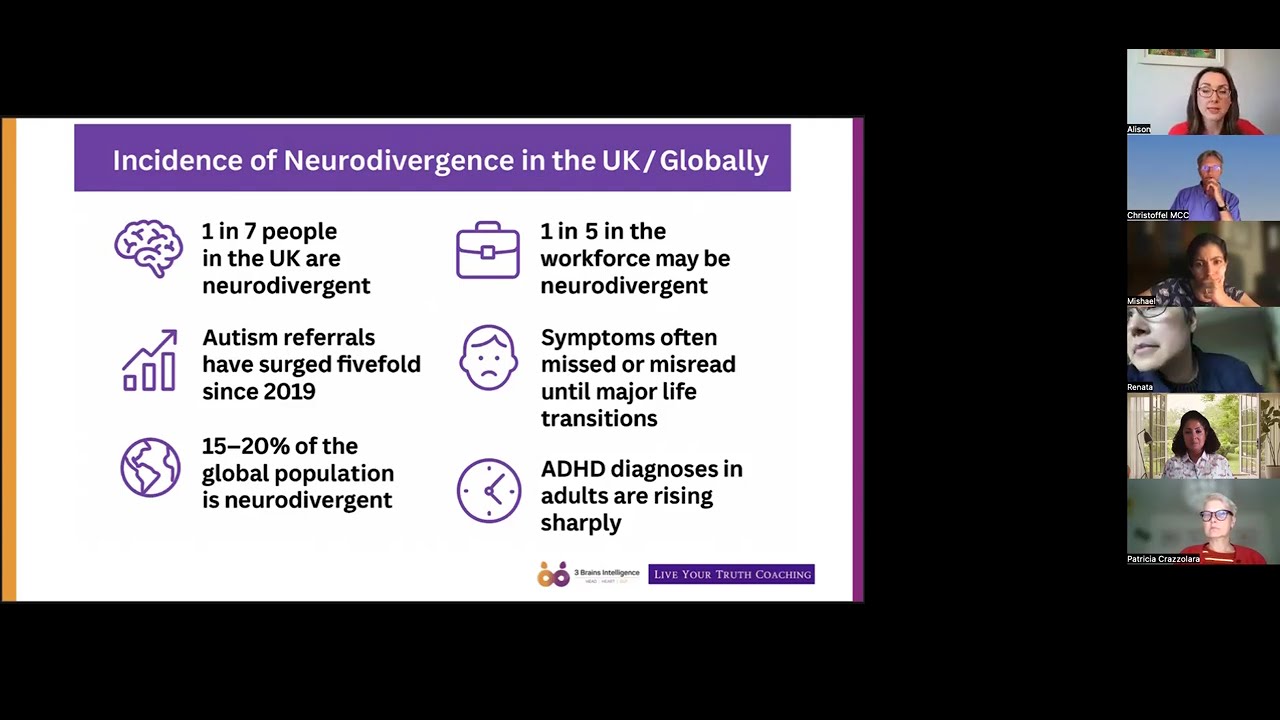
Yeah, I guess, um, it's kind of, um, useful to just get a sense of the lay of the land when we think about the stats out there that are available in the UK. and globally as to the incidence of neurodivergence as we know it today. So this is just a little snapshot taken from various sources, including various health bodies, scientific bodies, and so on. 1 in 7 people in the UK are neurodivergent. So it starts to paint a picture for you when you think about for every 7 people you meet, 1 is likely to have neurodivergent traits. Autism referrals have surged fivefold since 2019. A lot of the things around autism, ADHD, etc., there's been a lot of surges because of increased awareness, especially during the pandemic when a lot of people were sitting at home and they were watching YouTube and TikToks and what have you, that they were starting to become aware of neurodivergence and some of the traits, which prompted a lot of curiosity for individuals to go and be tested or to seek further information. And 1 in 5 of the workforce may be neurodivergent, and that certainly lends quite a change in dynamic to the workforce when you think about bringing groups and teams together successfully and making accommodations for different learning styles that your teammates might have. Symptoms are often missed or misread until much later in life, and I know plenty of folks have had that experience, especially women later in life around in menopause are finding out about being neurodivergent, as there's been some reports around menopause actually elevating some of the symptoms perhaps. ADHD diagnoses are rising sharply, and overall we're seeing between 15 and 20% of the global population being thought of as being neurodivergent. So the picture and the trends is certainly going up from my personal opinion and what I've seen from, you know, my diagnosis way back to today and how much it's been talked about. And that awareness is certainly generating more discussions, which can only be a good thing. Um, but what does it actually mean for us as coaches? And one of the things really is neurodivergence is everywhere. Um, you know, from the poll that we just did, you're likely coaching neurodiverse clients, whether it's disclosed or not disclosed, whether they've been diagnosed or not. And, you know, there's many people out there who are navigating neurodivergent traits without having the awareness that they are. Assumptions in the coaching space. As coaches, we tend to forget to do our own inner work as well as the art and the craft of the coaching itself. And I cannot stress this enough, that is so important for us to continue to elevate our own awareness. about our blind spots, about our filters, about our biases, about the paradigms and the way that we meet our clients. So it's important to think about that when we have those clients with us in the session. And then of course inclusivity boosts our impact. So in terms of adapting your approach as a coach, it's really just meeting that person and coaching the person. So it's not about fixing, it's about unlocking. those neurodivergent clients often need space to lead their way. So neurodivergent traits, in summary, they often go unspoken, but they definitely affect learning, decision-making, trust, and progress. So, Chris, I'm mindful that you and I have spoken about this. Oh, actually, before we go on, in terms of the incidence of neurodivergence, Um, you had some thoughts, um, given the trends over the last, what, 30 years or so? Would you like to share those?
Yes. As some people know, and Leona from Lebanon, just like me, loves also health, and she's more, even more in health than me. But if you look, say, at the general health statistics and general health, and you talk, say, about from, um, all the things that are increasing, it is from, um, how do you call it? From the celiac diseases and also to ADHD. And there is a rise of in the last 30 years, and all of them is more than 1,000%. So 30 years ago, ADHD was 1 out of 30, maybe 1 out of 100, at least what they saw. And the same as all those trends, there is a massive growth in those. The same as autoimmune diseases and other kind of things. And if you think about, say, evolution and genetics, it's impossible that we are so quick in evolution that in one generation there is a rise of more than 1,000% in all those kind of little traits we have. And so we can even assume, and many, many, many doctors and professors And researchers say that there's a huge link between all the things we now discuss and actually our lifestyle, the food, the herbicides, the pesticides, and other things we become aware of. Of course, there's a huge discussion in between. And the beauty is, if you now would follow any trends, you will become aware that the pharmaceutical industry, one of the most richest industries in the world, found also neurodiversity really as a new cash cow. And the neurodiversity pharmaceuticals are now sponsoring already the first workshops or workshops about ADHD. Already they have the 2 medications of Ritalin they sell, but they jump on even more and more on it. Well, a lot of other professors will share that actually ADHD is or a hormone imbalance or actually an insulin imbalance or a glucose imbalance. And if you change those, that actually the ADHD dropped massively. And so there's a lot of talks and thoughts about it. Is it actually a disorder, what they say? Is it a disease, what we should cure with pills? Is it actually a social, uh, um, thing based on what we eat and what we don't eat? Or is it maybe just a normal thing we have? Based on that, let's go to the next slide that actually was blocking out and just imagine if we would not have neurodivergent people in this world. And just imagine that we would coach these people to focus, to get in. Just imagine that we made of him a normal person. What would happen? You would not have Starlink, you would not have SpaceX, you would not have Tesla. Now we can discuss if that's a bad thing, but that will not be there.
No.
By the way, all your kids will be extremely disappointed because Pokémon would not exist if we had made him normal. And by the way, my beautiful phone, my beautiful computer, and all the other stuff I actually have— no, not my— would also not be there if he was not there. The same actually with probably you all bought once something with this shop. Just imagine if we made him totally also fit in, what would have happened? Or last but not least, we would not have any music or Virgin, those kind of stuff. So why this slide? So if you believe in evolution, and it is now, if you now believe in Darwin, the fittest wins, or you believe in Lamarck, the best adaptation wins, you could actually start thinking or start wondering, maybe this is what we all should have. Because they have massively success in what they're doing. Maybe actually this is the new, the new way of being. I don't know, but it's nice to share, to think about. So we spoke about actually our coaching, yeah. And I have a huge issue with labeling people because the moment you label, people start believing it, yeah. From I do to I am. So let's now think about, we're all coaches or work with people. What kind of criteria should we consider when we coach somebody? What do you think, Alison? Should we consider, uh, age in our coaching approach? Does it matter if somebody's 20 or 60 years old? What do you think?
Me personally, no.
Yeah.
Somebody else? Does it make, does it really make a huge difference?
Feel free to drop in the chat, um, what you think.
And of course, maybe your language is different because maybe the new generation of 20-year-olds talks about things you think, what are you talking about? And they say, I still not on, on the experience of difference. Absolutely, Thomas. Probably, uh, looking at you, Thomas, we both grew up with a phone that you still had to use your finger and, and dial it. And dial a number, and it had a cable on it, and you could only walk. Hey, your hands-free was one meter. So is it considered actually gender in coaching? Should we think about if you're male or female? Guys, thanks for sharing. Absolutely not. Because if you would do, you would probably right away would be seen as the hupplephobic. Mental state, stress, sad. Should you consider that? Probably yes, because it's a mood set that somebody comes in. Is it important to consider education? If it followed primary school versus university degree, should you ask that question? Hey Patricia Grasolara, did you study as a university or are you just followed primary school? Because that changed my coaching approach and I will use simpler words for you. Now, I think if you say that to your average client, you will almost get kicked out. Is it important how much you have to consider the MBTI score, the DISC score, the submodalities from NLP, maybe 3 brains preference in your coaching approach? Does it make sense to have that insight? Maybe yes. How much is it important to consider actually neurodivergence in a coaching approach? And last but not least, is it important to consider different learning styles and preferences in your coaching approach? I see Patricia now really nodding really hard. Okay. Okay. I will give you a high five right away, Patricia. I do agree with that one so much right away. Because what is now really important when we coach somebody? If, if you had to choose one of these 7, what's the most important one to know from a client? Please put in the chat if you had to choose between those 7, which is the most important, do you think? That one makes the most impact if you know. Thomas goes for 7, 7, 7. Okay, the 7s are in a winning mood now. 7, 7, 7, 7, 7, 7, 7.
Wow.
Mental state. Okay, 3, 3. How much mental state? Okay, this mental state, 3 is mental state. Thank you so much for sharing that. So Nervousness, agree, 3 or 7 is really important. And we could not agree more, Alison and I, by the way, when we made this. So that was the question. And by the way, I'm just curious, should we have a specialization to coach any of above criteria? Why I ask that? Because I see a lot of, and maybe some people did it or do it even, have a school in it, ADHD coaching or neurodivergent coaching. I see a lot of times ADHD coaching coming up. And, uh, the funny part is, as shared with Alison, um, 3 weeks ago, 4 weeks ago, I was in Paris at the ICF Global Conference. Uh, and we were in a group of 12 MCCs who are all experts in their field. At least they invited me, so I made at least one mistake, um, and was talking about the core competencies. Do the core competencies fit based on the research I did for 3,000 coaches? And of course, ADHD, neurodivergence, and all this kind of stuff came by. And the funny part is that I just kept my mouth shut because I have an opinion about it, that all the other 11 had something like, you know, it's not important really to put it in the core competences to know ADHD, neurodivergency, or those kind of things. Because actually they said, and we come back to it later, it's covered in the core competences already. How do you work with somebody? And I found it rather refreshing to come aware that all those coaches came all around the world. They came really from every continent, South America, North America, India, Asia, South Africa, Europe, and even, um, Middle East.
So it's—
I very, very much agree with, uh, Chalmers.
Yes. Yeah, it goes back to meeting where the client is. Uh, yes, absolutely. So let's go to the next slide, Alison. Yes. So this is just a little test for us. How do we put our lens on? So Alison, if you see emotional outbursts, irritable, uh, things and intense reactions, what do you think it is?
A poor night's sleep.
It could be both. It could be hormonal imbalance. Talk about the woman who has, say, by the way, in the menopause, and you know what's happening. I'm not a woman, so I don't know, but I know enough women who have those hot flashes and emotional outbursts and intense reactions. Chronic stress, or it could also be actually ADHD or autism.
Hmm.
Difficulty focusing, daydreaming, forgetfulness. Sleep deprivation, mental fatigue, high stress, HHD. What is it? The funny part is Allison actually has a really sore nerve in her back and is already taking.
Yes, sciatica.
So she has already four or five days. She is on four or five different kind of painkillers. And when we spoke two days ago in preparation again, she said. Sorry, I'm a little bit foggy. Uh, my mind is not running clearly.
It definitely wasn't.
So what is it actually? Yeah. What does she have from that moment? And we can go through all the ones. And as somebody else, you get the recording, and if you want, you can also get the slide pack of this. There's all the answers there. That is, what do we see in a person? And there are so many reasons why somebody does what they do. And it can be chronic or not chronic. But the question is always, if we see somebody, how do we know? Yeah, you see somebody for 1, 2, 3, 4, 5, 6, 10, 10, 10 times, and if they don't disclose or we don't ask, how do we know what's happening?
Yeah, Valerie's asking, how about those who don't trust easily?
Um, Valerie, 9— no, no, not 9 of 10, because that's the statistic I cannot back up with. Most people have trust issues is coming from, say, um, as you would ask, uh, Gabor Maté, childhood trauma. That is almost always somewhere connected what happened in their youth based on, say, highly impactful events.
Yeah.
So in my words, we'll come back later to that, where, say, the trust factor the connection part, the heart somewhere could not rely on a stable connection. So it learns sometimes it's yes, sometimes it's no. And they learn somewhere then we cannot trust actually our own intentions. We cannot trust other people. If people are bullied, by the way, they almost always have trust issues. And 1 out of 4 school students And university students, at least in the statistics from the USA, are bullied at school. And I'm also bullied at school. I was in the old days really a sweet boy. I changed that after being bullied for a long time. And I also know I got, I got the trust issue after that for a long time. So most of them are connected most times with highly impactful events, not so much with, say, neurodivergent things, not so much. autism could be because they have issues sometimes with reading the social cues.
Okay.
Let's go inside, Alison.
Yeah. So as the previous slide really illustrates, is there can be a lot of reasons behind the behaviors. And it's not for us to judge, it's not for us to label, and it's certainly not for us to feel like we need to diagnose. Neurodivergent individuals, they often have a dominant brain type, a hyper or hyposensitive brain, which really shapes how they learn, decide, and how they either move towards certain activities or move away from certain life experiences. This slide here, you might be wondering, what do we mean by dominant brain? What do we mean by hyper or hyposensitive brain? And it's at this point we'd probably like to introduce to you another thing to consider that might be behind the behaviour. So Chris is going to share with us a little bit about 3 Brains Intelligence.
Yeah, so now Leona knows it, and Thomas, who was yesterday, also knows it now. So Thomas, what is it? No kidding. I'm gonna put you in the spotlight, Chalmers.
Brain, heart, gut.
Ah, okay, there she is. And a little bit more extrovert. Beautiful. Leona, is that, is that right? Is that true? Yeah, it's true.
It's true.
Okay, so we have 2 people who say it's true. It's true. So science proved something amazing. We have a real brain in our gut, 500 million years old already, because we started all as a living gut. Actually, every cell in your body is actually a digestive system. Nutrition's going in, nutrition's going out. It has 500 million brain cells in your gut, scientifically proven in the Western world by Dr. Michael Gershwin. He wrote the book The Second Brain in '98. It's a real brain. It can think independently, it can memorize independently, it can make decisions independently. And if you don't believe me, I always like to give you one challenge and Thomas already knows that. So you write down a list of healthy food you like to buy in the grocery store, what you also like, by the way. Then you skip your breakfast, you skip your lunch, and you go really hungry for shopping. And then just look in your basket what you're going to take with you. I know for sure that everybody has something else in their basket than their original list. This is the power of your gut brain. It just overrides your beautiful logical list you have. The heart brain. Okay, who of you ever had his heart broken by one of those horrible boyfriends, girlfriends? Am I now the only one? Oh, nee, Michel's okay. That's good. I thought already, wow, I'm now really the only messed up. Your heart feels, and it's really proven by Dr. André Amour, l'amour, almost in French to love. And he proved in a research document in '94, he's a cardiologist, that we have a brain on top of the heart, next to the heart, 100,000 brain cells on average. If you're a non-social, non-social person, then it could decrease to 40. If you're a really social person like the Dalai Lama or the Pope or whomevers, you get more than 100,000. That came into this world something between 60 to 9 million years old when really the mammals came to this world. Then, of course, we have the beautiful thing in between our ears.
Do what?
Ninety million years old. It's something the same.
Yeah. How is this listening? So it's webinar.
Cerebrum, brain still, limbic brain, neocortex—all the three things. One beautiful thing, and I don't have all the slides, but Scholmer sold it yesterday. Um.
No, so this is all. Don't.
So if you mute everybody.
I just did it.
Okay. Yeah. So the beauty of our head, by the way, we don't have a reptilian brain. We don't have an emotional brain, and we don't have a human brain. They're all in here as one brain because they're actually, when we had them 90 million years ago, reptiles have the same idea to build it up as us. Luckily they don't, otherwise would we have really smart crocodiles? So that's not so. If you would now say, think about those 3 brains, and we go right away after this in a little poll. If you— what could be your preference? What do your brains do? And I just added that a little bit. So what do your 3 brains— what is your gut brain doing? So if you think about neurodivergent and how we make decisions, your gut brain only has 2 options to decide for you. It likes to go for achievements and winning. You eat or you don't eat. What's the strategy? Me first and being egocentric. So it helps you to make decisions to take care of yourself. What's the energy? Vulnerability and losing. So opening up. And when you talk about trusting, what was somebody asked? Your gut brain takes over when your heart is really painful. And it says we don't, we're not vulnerable anymore. We don't trust and we don't like to lose. Your heart brain is in charge of connecting and empathy. By the way, if you think, how do I come to these statements? That is, if you look at all the neurotransmitters these brains are capable of sending out through the body, they can come aware that these kind of traits are connected with it. That the heart can release oxytocin. Oxytocin is the bonding hormone. The gut brain cannot release oxytocin. What does the heart want? It wants to be us happy, you and me happy, and it loves to do self-sacrifice if, if needed. And the average coach knows that, that they will run really hard for their clients. And if the client calls, even if we stop working, we still pick up or WhatsApp him back or her back. And what is the energy of a heart? Is confrontation and rejection. And a beautiful head, Let's go back also there. Cause and effect analysis, the right prediction. It likes to give a perfect answer. It loves also procrastination and really dislikes guessing and mistakes. You also become aware when, say, the typical autism steps in, hey, that sounds a lot like the head. It's an overactivity from the head. If you would think about ADHD, it's almost an overactivity of the gut. Because the gut cannot sit still. Anyhow, if you think about making strategies and decisions in general, you will see they have different strategies. And it also makes sometimes when people are not aligned based on too much coffee, sleep deprivation, sleep deprivation, or even having, say, a different kind of wiring, that they are misaligned and some are more dominant than less dominant. If you ever did the three brains test, and I sent you an invite for that, you can even do that when I sold an email to you. You can see which brain of you is most dominant. Anyhow, what is the triggers for change? Just a little bit extra on that. If you like to escape pain, the gut brain will take over, or the head brain will take over and stop in a logical survival, like an air pilot that will just follow all the structure and all the processes. So when you put them in stress. They will go back to structure when they're head dominant. If they're happy, they go just doing what they love to do and engineer and make some new kind of things, all logical stuff. How do we decide? How does this one decide? It's always conscious. We're always aware of it. And they use cause and effect analysis, the memories, storage, and text.
I'm listening to something. Yeah, me too. Social survival.
So if your heart steps in, if it is in pain, it will do social survival. Who of you would be called a pleaser? I know coaches have that tendency to be a pleaser. And I see Patricia thinking, ah, I tilt my head. I'm not going to raise my hand this time. But, and Chalmers is moving her head. Most coaches have a pleaser attitude when you put it in stress. In pleasure, they still like to host everybody. They like to make everybody happy.
Could we just ask everybody to make sure that you're on mute, please?
Unless you really have to say something, interrupt me.
Yeah, unless— feel free otherwise. Thank you.
Yes, it's not up to your— by the way, I will come back to Thijs. We can talk to Thijs. What is said in the chat is also really good. Pleasure. How do they decide? It's all subconscious. Your heart makes decisions out that you know, and it's based on beliefs and values of bonding and rejection and all the memories that's there. It's— these are important if you, if you later go on also with, hey, the different kind of neurodivergent things, how do you make decisions. Last but not least, how does a gut make decisions? It becomes the Terminator, if you ever saw the movie. I'll be back. Schwarzenegger, if it likes to survive, it's me first. It pushes everybody aside to get there. In pleasure, it goes for the short attention span happiness things. So all the addictions, you could almost see also here in this, in this part, the gut brain loves addictions. And how does it make decisions, memory, and beliefs from winning and losing, or actually also not having pain? And again, you can make— oh, sorry, sorry. Okay.
No, no, no, no, my apologies. I thought you were going to pause there. It was just to say as well, in terms of which brain decides first, um, because we tend to think that everything comes out of the head brain, that everything is being driven by the head brain, but the heart can very quickly make a decision and then be translated into thought and action. So I just wanted you to touch upon that when you mentioned about the dominant brain and the high Cool. And hypersensitive.
Awesome. By the way, just for the statistics, because, um, Alison, you know, I love to share all facts. We know what, you know, what the amygdala is, if I pronounce it correctly. There's a little thing inside your head where they say, uh, that is, uh, responsible for all your emotions, all the things you do. By the way, do you know who's in charge of your amygdala? Partly your heart. Your heart, when it does boom boom boom boom, six milliseconds later, a signal is actually received in the amygdala that comes from your heart, and based on the signal from your heart, it starts sending out different kind of neurotransmitters to regulate the whole body and mind again. Your heart coherence is actually influencing how the amygdala is sending out different kind of neurotransmitters. So people who still believe they have an amygdala hijack. Uh-uh. Your heart is in charge and your heart is actually also listening to your gut. What should I do or don't do? Okay. How do they learn? Because we talked about learning was the most important thing actually to become aware of. So how, how does your gut learn, Alison?
I was just gonna ask you, were we still gonna do our poll just to check in with everybody for a little pause to see, does anybody have any inkling as to what head, what brain dominance Do they have, are they mostly head, heart, or perhaps gut? Um, just based on some of the insights that Christoffel's just shared.
So I launch it. So based on all the things I shared, what do you think is your preference? Are you more head, heart, or gut oriented? By the way, when I see the score here coming in, it is a beautiful, perfect coaching score. I did in my 3 Brains Preference Tests more than almost 3,000 tests now. And what we see here is almost the perfect score of the coach: 43, 33, 24.
Yeah, um, the head brain tends to, tends to win out. I'm head brain and you are gut brain, Chris, from memory.
Yeah, and actually I will say I'm heart-brain, gut-brain. More heart-brain. My girlfriend always says, yes, you made the score so you know how to answer it. You're gut-brain, heart-brain.
And in the chat, Michelle says, I'm not sure. What's your thoughts on that, Chris, in terms of somebody who's not sure which brain dominance they have?
It makes sense because if you look at scores, we are not something. If I say heart-brain-gut-brain, if I would do my scores, and it is a score from 2 to 105, I have 42 heart, 39 gut, and the rest is head. So I decide extremely spontaneous and action-minded, and I don't do any cause and effect analysis, at least in my normal decision-making. So for me, if you ask me, I doubt sometimes which is first and what is second. Sometimes 2 brains of us are really close and working together in decision-making. There's a lot of coaches, the head and the heart are really close to each other. And they say, I'm more logical and I'm more heart-brain focused. So it makes sense that you don't know for sure. And Michelle, I would just say, do my 3-brain preference test and maybe you get the confirmation that you're almost the same.
And what might that indicate then?
Uh, now actually, if you make a decision, you use those 2 brains to make your decision. So you swap between what is logical and what is good for others. Like if you say, if, if you make our decision, because Alison and I are a beautiful pair together, we're not a pair together, but we make a beautiful pair. Alison is much more head brain dominant. So she thinks about what she says, she thinks about preparation, and she makes sure that you're logical. That's why she also asked about the poll. Our brain dominant. So I live in the moment almost always. And oh, we have a nice thing, we're making presentation and I just forget all the structure, all the processes. So I follow what is good for me and what is good for others. I immigrated 3 times, once to Australia, once to Spain, and both also love Connected.
Chris, just to double-check, and I'm so sorry, I don't know how to pronounce your name. It said, I can't find the results, am I missing something? So is everybody able to see the poll results?
You should see it now, otherwise I put it in my screen so you see them.
I think you said they just came up. They just came up. Okay, great. Lovely. Thank you. Thanks. I just wanted to make sure that you saw that information. All right. Perfect. Thanks. Super. So, um, just to end the poll then, um, so when do the different brains learn?
Yes.
So, um, as we begin to get more familiar with the 3 brains, um, first up, the gut brain, is when I feel safe, um, and I have the trust to get into action, um, I have something positive to gain, and I agree with the what. And for the heart brain, it is about my new behavior will be appreciated. So you're thinking about oxytocin, creating those better bonds. You know, obviously things like the heart brain, I have no fear of being rejected and I agree with the whom. And lastly, we have the head brain.
And then we have Alison. Sorry.
Which Chris basically said a minute ago, that's me. I've thought about the consequences, the pros and the cons. It makes sense. Let's go ahead. Um, so I agree with the why, the what, the whom, and the how.
Yes. And why is it so important also to become aware? If you see me sitting still and see Alison sitting still in this presentation, you see me moving already around. But also when we make decisions, and especially when you talk about ADHD, a lot of ADHD actually could have a hormone imbalance and their gut brain is much more active because the gut brain likes to achieve, likes to do things. And it's why they say they have a short attention span. And the heart brain differently, but the same. The span of them to think and to concentrate is much shorter. Okay, so the same as in our opinion with neurodivergence, there are survival wisdom, not the problems to fix. And so if you ever do the score and you get a number back, if it's now extreme dominant in one or beautifully spread out together, it's not something you have to fix. You have all 3 of them based on biology. It's more to which one do you listen more.
Mm-hmm.
Yeah. So in our case, and in my case, I don't see anything as a problem. Yeah. The same as neurodivergence, we honor it as a form of wisdom that kept the person alive. And in our position, it's not to fix them actually, but to integrate them. The same if you look at neurodivergence. Hey, how do you do that? And the beauty is we spoke about that learning styles are actually the most important thing to know when you coach a client. I also come aware that in most coaching programs, learning styles are not discussed.
That's why.
So let's just bring one to the table and I give the words to Alison?
Um, so yeah, we— I don't know about anybody else on the call, but certainly learning styles wasn't really a massive feature in any of the coaching programs that I've done. And yet it determines, and hopefully today this is what's coming through, of how important it is when you meet that client in the moment. How do you meet them best is really by understanding their learning styles. in each coaching session when you're doing a particular exercise, not just as a one-off, one-time thing, but as an ongoing dialogue. So Kolb's learning styles can start to give us some insights to think about again as coaches, to really expand our awareness about how we perceive information and how we process it. So the different 4 learning types there are accommodating, feeling and doing, diverging, feeling and watching, converging, doing and thinking, And lastly, assimilating, whereby we're watching and thinking. Um, so again, bringing awareness to yourself as a coach. How do you learn best? How do your clients learn best? And how can you really come together in partnership? And Chris, any other thoughts?
To end on that, and that's, uh, the, the things that Kolb did, something amazing in my opinion. He made it extremely simple. He's like, you know, we perceive information and we can do that, say, by Like we do something and we feel how it is, concrete experience. We can start thinking about it. And how do we process it if we're going to make it an action? We can, we can do it, doing it, or we can start watching it, how to really learn it. And based on that, he made those 4 styles. The beauty is that if you think about those, it's almost what we all do. We watch something like we watch this. You think about it from, hey, what does it mean for me? How does it work? Maybe you start experiencing it from, hey, I like to just be the, the in a demo to come over here. How does it feel for me? And then you actually start doing it. So in the learning, if you do it, say, in a training, and maybe are some trainers, actually what we do in a beautiful training, you first start explaining what it is. So people can think about it. They watch maybe the demonstration. You let people be in the demonstration so they feel it, and then they can experiment with it, doing it by themselves. So you touch all the different learning styles from people so they can really embed it in happening. But we all have a preference actually. And I'm curious if you read this and about your own learning style, and we have a poll about this because I have huge in my notes poll. I made it here so, so huge I could not forget it. Otherwise, I really— otherwise I get here again, Chris, didn't you have a poll about this? Also, just one question. If you think about this, just to come aware, what would be your preference in learning?
Hopefully everyone can see the poll. Please let us know if you can't.
Now I launched it, so you should all—
I can see it, certainly. Just want to make sure. Yeah. Ah, super. Thanks, Renata. Thanks, sis. Doing and thinking so far.
Oh, scrolling through it. So conversion, doing and thinking. And we see actually the execs diverging, feeling and watching. We like to be in a demo and see the demo. Is in this moment the least convergence, or yes, diverging, and the other ones get more. So the beauty is, if you see those, these scores, that we all have different kind of learning scores. If you would put this actually by our own traits, you come over here, hey, how do you train those people actually? Because if you see this, does it make really an issue if somebody is neurodivergent or not? I would say no. I would do an end poll. You get the results, by the way, later also in there. You can also share the results so you can see them. You can see the shares. So 1/3, 30% says doing and feeling, or feeling and doing. That's hands-on practicing. Those people, by the way, Have the most chance on actually also having some ADHD traits or do a job that they— because they love to get into action right away. Feeling and watching, they are a little bit more the introvert kind of observers. They like to experience it and then see it. Doing and thinking, I like to do it and think about it. Okay, let me first think about it and let me then do it. Let me first explain. First, like to have explanation. I like to understand it before I start doing it. There's a little bit more head brain dominance, you could say, and assimilating, watching and thinking. There even more. They like to think about it first, explain it to me, and then let me see it. If you would connect with, and then we do stop sharing with the next slide because otherwise we give all the answers away. Bam bam bam bam. Let's click. Let's. Clink those together. If you go to autism or Asperger's, I put Asperger's in there because sometimes Asperger's is a diversion of autism to say it. Hey, it is watching and thinking what you just said. They love to see it and they love to think about it. And based on that, they make an action. They're less physical in the action mode. And I always say, uh, if you ever saw Who of you saw ever The Big Bang Theory, the soap series? Then you know Sheldon. There you have him. Okay. That is his learning style. Yes, he was, but he always says, I was always, he was diagnosed to be normal. ADHD, doing and thinking. Gut brain is active. They like to go in there. Gut brain likes to be in action. Because if the gut brain is not in action, it feels not always safe. Dyslexia, feeling and watching. They like to experience it. They like to see it because the auditory part is sometimes different in, in, in learning. They cannot read it so much, so they like to see it visually happening, or they like to experience, because that's the way they learn. Dyspraxia, always have issues with this. How do you learn if you have dyspraxia, Alison?
Yeah, experimentation. Um, yeah, dyspraxia, it's, uh, uh, the motor sequencing part is, um, definitely, uh, key for me anyway.
Yeah, action-oriented is motor sequencing, sentence to overwhelm frustration. I can get Alison extremely quickly frustrated just by Putting her right away on the spot to think, I love you too, Chris.
I'll get you back for this later.
Yeah, I know. And Tourette's, and say I love the Tourette people who have that because they can just sometimes just blur out something and I always have to laugh about it. They're so, they're so beautiful, genuine. Experiment and experience the same. And they like also to come aware of it. They like to have that feeling experience. They're more bodily oriented. The gut is strong. So what does it all mean if we start putting things together and we have, say, some conflicts? Let's call it— we're going to say when people have a dominance that is not stronger, let's say there's a dominance balance between the heart and the head, then in a neurodivergent example, they know they should speak up. The head is strong, but the heart is not strong enough. So they don't dare. Also because they don't know exactly how to connect with other people, what they should and shouldn't do. It's a logical thing here based on mirror neurons. Everybody has mirror neurons, but also the connection. Hey, how does it feel? Do I feel other people? Heart versus gut. And if you think, what kind of strange thing is this? Yes, it was the best thing we could find as an emoticon for the gut. I want to connect, but I feel unsafe in my body. That trauma-linked neurodivergence that we said actually in trust issues. And last but not least, gut versus head. I overthink every decision, freeze when it comes to act. Also popular in autism, ADHD, dyslexia. They know what to do. But they don't trust the body too much. In HCSD, sometimes it happens the other way around. So if you think about this, what should we do as coaches? And it was already said to Shalmer earlier, meet the clients where they are. And the beauty is, do you need a special training for this? Mm-hmm. And I loved, say, when we asked this question in the conference of ICF Global, 3 weeks ago when we asked this question and there was one person and he delivers some level 1, 2, and 3 training, is extremely successful. And he says, absolutely not. He said, and he knew all the core competence by head. He really knew he could declare, decorate them. I said, oh wow. So he said, go to competence, core Culture, uh, code words, trust and safety, is that it's already there what we should do as a client. Partners with the client to create a safe, supportive environment that allows the client to share freely, maintains a relationship of mutual respect and trust. Always. It doesn't matter actually how the client is. We work with what we see. We work with them in their context, including identity, environment, experience, values, and beliefs. Demonstrate respect and adapt your coaching to the client's style and language. So actually, it is in your core competence. You should already be able to do that. As he said to us, and he was really sitting on his chair, so you're all MCCs, you know this, this is in your core competence, you should already do this.
Yes.
It was really emotional. And the same if you think about the core competence, listens actively. And there's this almost the same definition: focus on what the client is and is not saying to fully understand what's being communicated in the context of the client systems and to support the client self-expression. Pay attention to the client's words, but it's, uh, Katarina, tone, body language, and emotions. Reflect or summarize to ensure clarity and understanding. Notice trends in the client behaviors and emotions across sessions. So in our core competencies as ICF coaches are if you all are ICF coaches, it is already part of our curriculum. It is already part of our core competencies, what we actually should be able to deal with. And if you saw prior to us, at least what we like to share, neurodivergence is actually almost a learning style. And maybe it's an extreme learning style. Okay, but if we go to the extremes, you will never find them in your coaching client because then you go to a therapist. In my opinion. Yeah. So what we said somewhere also 3 weeks ago, communicate on all levels, engage with the client through various channels, visual, verbal, nonverbal, gustatory, olfactory, smell and taste, as they say in NLP, energetic, somatic, in my words, head, heart, and gut. They didn't like to add that, and kinesthetic to fully connect and support their growth. And it was rather interesting that in the discussion we had 3 weeks ago with all those global experts, that they said we don't need the specialization. We actually have to start doing what is in the core competencies. I found it an interesting quote. So I know you love these ones. 3 questions to tune into your client. Alison, guide us through it, please.
Yeah, just to kind of jump off the back of what Christoffel was just saying about the core competencies, if you are an ICF certified coach, is to inherently trust in the coaching process, trust in the coaching competencies, trust in yourself, and trust the client. And really, it's what we're trying to share today is that neurodivergence is potentially a hidden blind spot, but it's something for us just to raise our awareness of, um, and factor in the importance of learning style in terms of how we best meet and we support our clients. So we wanted to just give you 3 starting points to get you thinking, to guide some reflection, so that when things feel off with a client or misaligned in a session and you're not really quite sure what's going on, Just some things to consider. Is the behaviour consistent or is it situational? So, for example, Christoffel said that, you know, the past week I've been quite drowsy when we've been meeting up to prepare this because I've been on strong painkillers. So it doesn't mean that I'm necessarily unfocused. There's other factors at play. It could be a poor night's sleep, it could be hormonal, it could be any number of factors. So really do consider, you know, what is going on behind the behaviour. You know, even a client who always talks quickly. I'm Scottish, and a lot of people say Scottish people talk quickly. It doesn't necessarily mean that I'm neurodivergent. It's just a style of talking, for example. So again, really encouraging you to stay curious. And then how does the client actually learn best? So how do you normally learn best is just, you know, ask them. A client who resists written tools might prefer visual prompts or some kind of verbal reflection. reflection. So it's really about not making assumptions and really remembering to adapt your approach. And then obviously one of the things, whether you're neurodivergent or not, is creating that coaching space that feels safe. And that involves you as a coach feeling safe and feeling regulated as you start your session. So you can think about exploring elements such as co-regulation, the pace, the level of coaching challenge that you contract with your client at the start of each session to really just check in with them in terms of what might be best during your time together. So for example, a client might seem impulsive, you know, what might they need in order to make aligned decisions? So just again, it is really back to staying curious, not being assumptive, and trusting in your ICF coaching core competencies.
Um, do the recap. And the question of Chalmers, is it important for the coach to understand if the, if they are neurodivergent? Uh, based on me, Chalmers, not. But I love to know how they learn. I will almost ask my clients, all of them, what's the best way for you to learn? How can I help you best in your learning? So there's the moment we— I'm sorry. Good job.
What about as the coach? As I'm listening to all of this today, I'm going, oh my gosh, is that me? And it's not something that I've ever thought about before. But as a coach, is it important for me to, to know for myself? And then it's like, if it is, Do you, what is the process then for better understanding?
So Laura raised her hand, maybe she likes to have an answer. I don't know. Do you like to give an answer or a question, Laura?
Otherwise, give an, um, maybe an added thought, uh, or somewhere around an answer. I'm not sure. Um, I think whether it's as a coach or as a coachee, it's not necessarily about, there is understanding the person in front of you, which you have to do regardless, right? Um, and you will have coachees that, you know, you sync up with really well, others less so, others that take a lot more adapting from your part. Um, I think one aspect that I'm a lot more mindful of, I don't think that you knowing whether you are or not a specific given label, um, and then that's in the view of a specific doctor as well, not necessarily you know, another doctor may have a different view, which doesn't help, will necessarily change your approach. Uh, understanding how you work and understanding what your strengths are will help you to then to, to better help your coachees though. And I think one aspect that we've not talked about today, and I'm kind of missing to be honest, is the bias. Um, because, because we are all biased. We will always be biased, and that's just a fact of life. There's no not being biased. But both in coach and in coachees, the current fashion— sorry to call it a fashion, but for me it's a fashion at the moment— around neurodiversity, which is becoming very much in talk. Everybody talks about it. It's very present. It means a lot of people either self-identify or are being identified by others. And I've had the example of people being told by coaches that they might be neurodivergent in good or poor ways, but also of coachees, for example, saying, yeah, well, actually, you know, it seems that I'm this, so I'm not going to be able to do that, and directly limiting themselves Etc. Does that make sense where I'm trying to go? Sorry, I've got a bit of a sniffle, so my brain is slow.
No, I—
You have sense. Sorry, Alison, you're so right.
No, I was just gonna say, Lori, I completely agree with you. We're never going to remove biases. It's part of our makeup. I think it brings it all back around to awareness. I think in terms of labels, this is perhaps where Christoffel and I've been going today with this. is to try and broaden that coaching lens and the need to keep broadening it, because no matter how much we can sit here and nod our heads, knowing is not doing. And so we really need to be mindful, again, back to really understanding ourselves as coaches, doing our own inner work, understanding true self-knowledge, our preference styles, our communication styles, how we show up because that can be useful communication to say to the client, listen, for example, me, when I'm coaching you, I might not always look at the screen. It doesn't mean that I'm not paying attention. It doesn't mean I'm not here. My neurodivergence tends to mean I don't tend to look at people. So for me to keep looking at you the whole time— but for some clients, that might break presence. So we find ways to, for example, work around that. And similarly, for the client, they might not know their learning styles. They might not know their preferences. And I've worked with quite a lot of neurodivergent clients who I've not advertised that. They've just come to work with me on something and it so happens, or they later go on to get diagnosed because that's what they feel is important to them, just to understand themselves better. I think fundamentally, in my opinion, is the key thing here, because without that self-understanding and that self-awareness, we're all acting blind. So that's my take. Christoffel, yours?
It's the same, man. And know yourself is one of the most important things. And you're right, labeling or biases we all have. What we try to do actually, Laura, is to get actually the bias out of this and don't label, don't have a bias. Of course you have an interpretation, but get the interpretation out of the system because the moment we assume, we make an ass of you or me, as they say in English. And so we love, you know, also in your recap, And there were 2 questions. So specific neurodiversity and ADHD coach training is not necessary, needed in your opinion? Uh, no, it's not needed. Um, I asked around with the 12 MCC coaches who all had more than 20 years experience in coaching, and we discussed, is it needed? And nobody said yes. They said no. If you have the core competencies, you can deal with the person as they are. We coach people As they say, as they said, and it's come from them, we coach the person, not the label. It makes sense to learn different kinds of coaching techniques. If it's now NLP, 3-Brain Coaching, Constellations, Gestalt, uh, maybe, uh, CBT if you like it. Techniques how you bring a client from A to B. That is, that makes sense to learn. But for the rest, not. I trained many, many, many, many IT people, and we could almost say 80% of our inner spectrum. We never discussed it and had amazing results. I just always asked them, how do you learn? What's the best way for you to what we do today to bring that somewhere in your learning package so that it sticks to you? And everybody had their own way. And when we connected with that, We brought them there. I coach always the, the person, not the label. And even because if you label somebody, they start believing. And research showed that if you say to a group of people, actually, you're not so smart, their results of the exam will be lower. If you say to people, you're actually much smarter, their results on the exam will be higher. There's massive research about that. So the moment you label a person, they start acting according to the label, and you cannot get them worse. Yeah, research shows that, eh?
Positive expectation tends to lend to those positive results. But if we start to see those labels in any negative light or unhelpful light, then it will impact us. The science and the psychology is there.
Yeah. And, uh, even I posted also on LinkedIn, but also somewhere else, but just Google Thomas Edison. He was almost kicked out of school because he was seen as stupid. He had something like ADHD, dyslexia, those kinds of stuff. And I think thanks to Thomas Edison, we have light. But what did his mom do? She put him out of school and did him home study because she thought he was amazing. He was unique. And based on the trust from his mom, he became also unique and he kept that quality there. If he had followed the mainstream school, he would probably be in one of those little strange cottages where you make toothpaste or whatever you make there. So learn how they learn and how they process.
And with Thomas Edison, his mother didn't tell him what the letter from the school actually said. And that was the key part. Um, again, Yeah.
You learn it later. Yes. Adapt how the learning process— actually, what you said already, question 7, you need to know how they are now. Did they have a bad day? Did they have too much coffee? Did they just have a fight? Did they have painkillers too much or not? And by the way, how do you learn? And last but not least, what is our role as coach? And then I step into the preacher role. Create a space for them to flourish, not to just fit in. Ask personalized questions, what fits to their, to them. Adapt your approach. Honor and utilize their inner intelligence. Make somebody feel special and they will become special. Make people, make somebody feel stupid and they will behave stupid, as they say. And by the way, Um, I can send it to you also if you like to have it. This is a 3-brain cheat sheet for coaches. This is one little, you could say, PDF sheet we made to give you a little overview about learning style, neurodivergent, and how your 3 brains fit in. So actually the whole presentation, you listened 1 hour to a presentation to get 1 slide as a synopsis. I have to agree, it's really rude. We didn't put it in the beginning. I said, who still likes to listen to Sorry to have tricked you all this time. My deep excuses for that. By the way, thank you for saying so. Send us an email or something else you like it. The recording will be available if you'd like to know more. I also will send out the slide deck. Click on, click to Alison for an email, click to me for an email, and we will love to discuss with you more, help you more, talk with you more, and do everything else. Last words for Alison, because we always give the honor to the female. What would my dad say? My dad would now get out of his grave and slap me for my ears.
Um, yeah, so just closing reflection really, um, is, um, what I've seen. I've had a lot of brand new coaches or people who are thinking about coaching come and reach out for a conversation about coaching in general. And one of the things that's come up today, uh, that comes up a lot is, oh my goodness, I need to know about this topic. So you could argue neurodivergence is a topic. Um, I need to know this thing to coach someone. And when you're starting out coaching, you can feel very performative. Um, but hopefully today, um, some of the, uh, insights and background we've given you around the behaviors that you might see in the coaching session, you don't need necessarily any specialist knowledge. You can, um, add specialist tools and techniques to your coaching kit bag if you'd like to. But if you are an ICF ICF certified coach, then you can trust that there's inherent value in your coaching process and those coaching competencies. The coaching competencies, if you're an ICF coach, you can look at them once and never look at them again. But actually, if you go back at the end of each of your coaching sessions and use those competencies by way of reflecting, you create a reflective practice after each coaching session, you will find it will naturally strengthen your ability to pick up on these nuances, these different behaviours in the coaching container or space that you hold with your client, and really encourage you to stay ever more curious to what might be happening. So just to close off in reflection, I'm mindful we have run over from time, so thank you for your patience. What's one insight, if anything, you're taking away from today that's either something we've shared or something that's come to you As you've been listening to us, I'd really love it if you would be happy to come off mute and perhaps share.
If you're still here, if you like it.
Yeah, to the 24 here still here. While I'm making— anybody care? Anybody care to share?
But sometimes it helps if you just pick somebody and ask what they think about it. That's always my strategy.
So then I'm happy to, I'm happy to share. I'll jump in.
Thanks, Judy.
Thank you so much, Judy.
I was just, uh, typing it in, in the chat. But, um, you know, overall, I really appreciate the, um, the message of, of, you know, a, a general understanding is, is all that we really need as, as a coach to successfully continue to coach neurodivergent, um, individuals. And, and neurodivergency is so, um, you know, so individual that, uh, you know, that, that message really gave me a lot of, um, a lot of comfort, I guess, in, in continuing.
Beautiful. Thank you. That is beautiful to hear, Judy, because that's actually what we intended, that to make you feel safe. You can work with every If you— I just delivered before this, uh, 3 Brain Coach training, and we did a beautiful session about limiting beliefs, etc., etc. But that's not important. I did a demonstration, and later when I stepped into one when they were doing an exercise together, okay, maybe I can help. And both reflected, Chris, you know what's the most beautiful thing you did? I think, nope. Is that your presence being there. And they didn't say about the good questions I made. I made amazing questions. I'm kidding. But it was more, you're there, you listen to the person, you don't judge, and you work with what is presented in the session. And that's actually what coaching is. Something is presented in the session. And what do you do with that? Because that's just a building block for the next question, for the next step. And you don't have to know, by the way, in that moment, are you autistic? Are you divergent? Are you actually male? Are you female? Are you 60? Do I— do you have your menopause? Um, by the way, did you just have a fight with your husband? Who cares in that moment? In that moment is, is what's happening. And if, if you get that trust back, it's amazing because you can work with everybody. Just be there. And I know Leona, and I'm just pointing her out But she was in our training, or my training, I would say. She lives in Lebanon, in Beirut. And maybe for you, you know what Beirut is. That is a country that is almost always in war, not because they want to be in war, but again, somewhere subjected to war. So when we were coaching and we were training, you hear the bombs clashing next to her house. So then if you coach a person or you work with a person, it's not actually if she's neurodivergent or deaf, it's more What did you deal with that moment? What is happening? And then you know, okay, somebody can be stressed. What makes sense to me? I would pee in my pants. So you work with what's coming to the table in that moment. And if you have a bad internet connection or a good internet connection, you work with those kind of things. Work with the person. That was good to see you, by the way, Leona. Or there's things you like to share.
We've got some, we've got some things in the chat from a few, a few folks. So Dr. Leona says, perceiving difference as uniqueness leads to many possibilities. And Judy says, I really appreciate your message that we don't need to be neurodivergent experts in order to successfully coach. Absolutely. And thank you, Francesca and Valerie. And Lynn. Yeah, anything else finally before we close off today?
A question or something you'd like to know?
Yeah, any questions or anything that's niggling you? We're happy to stay on for another couple of minutes if you really, you know, something's just bubbling under the surface that is bothering you and, you know, perhaps we can have a wee chat. It might be helpful for everyone. Any questions anybody has? Anything that isn't clear. I know that we kind of rushed through some sections in our enthusiasm.
That's a perception, Alison, that we rushed. For my ADHD, we went extremely slow. Some people find it quick, some people will find it slow. It's just, it's just a perception.
Absolutely.
For all the people who say, I still have a question, but I don't dare to speak out, You will get the presentation, the slide deck. Just email us. Alison and I are always more than willing to give you an answer on that.
Yeah, please feel free to reach out.
It sinks in and they think, shit, now we just stepped out of the presentation, out of workshop, and now I have my question. Why didn't you come 5 minutes earlier? Just send us an email and we'll come back to you. It's all pleasure. It's all pleasure because my objective is also as an MCC coach, as a mentor, as a supervisor, if you become better in your job, you will make so many people better in their job. And at the end, it will make the world a better place. And maybe then Leona will never experience war again. And that would be freaking amazing. Awesome.
I have a quick question. I'll jump in again.
That's okay.
Um, just, I was looking at the title. Um, are you missing something? Are you missing this coaching blind spot? And so I'm just Just like in a recap, when I think about that title, what, what do you mean? What do you mean about the coaching blind spot?
Now, one, ChatGPT found it a good idea, Julie. Let's honor them. And, and secondly, um, when we talk about the blind spot, that's actually what we talked about. Somebody else said the bias we have and the blind spots we have in looking at where do we look at? If you look at the Johari window, what some people know, from what I see about myself, what others see about myself, what I don't see about myself, what other people see, that's a blind spot.
Yeah.
So what do I see about a person, what they maybe don't see by themselves? One of the, one of the, one of the, uh, hey, by the way, um, should I know myself? Because if I see some traits, maybe I'm also those my own self-awareness is also a blind spot. And how do you work and don't work?
It was a little bit of a play on words to get you curious about the workshop, um, and about the blind spots in general, uh, but with a focus on neurodivergence. Because, um, I think it was Laurie, if she's still here, said it's the topic everybody's, you know, chatting about, um, which then does prompt a lot of newer coaches or coaches earlier they're on in their coaching journey, uh, to feel like, oh my gosh, I need to train on this now and I need to know these things, which can then lead us out of our coaching presence and our coaching craft into our heads, and we're not really fully with the client. So that's one of the things that I think is really important, that as coaches and the coaching industry evolves, There's always a lot of, um, how shall I say, um, impressions out there that you need to be a guru, that you need to have all the answers, that you need to be here and the coaching client is here, um, and that actually we're all just human and we're trying to reinforce that today through some of the messages we've shared and bring it back to here. We meet the client where we are as 2 humans sharing a space, and some of the ingredients and some of the conditions for success of that partnership, um, backed up with the learning styles and backed up with the coaching core competencies. So I think we can end up overcomplicating it. And as somebody else said, is having an awareness Um, just by itself, so that that prompts our curiosity, that prompts us to ask a question rather than jump to conclusion or assumption.
Right.
And then base how we might lead a client, unwittingly lead a client, based on an assumption that's happened so fast, so automatic in our brains, we haven't realized. So really just to encourage that curiosity a little bit longer. And ask questions and trust your client that they have the information. Sometimes we can be so performative and we can over-effort in the coaching session. Back to that, we feel we have to be here when we meet the client instead of here.
Mm-hmm.
And so that over-efforting can be felt, and you can come off a coaching session pretty stressed because you felt like, did I do, did I do it good enough? Did I, did I ask all the right questions? Did I, you know, So you get in your head and you're out of presence again. So there's a lot of distractions that can really take us off course as coaches, and it's something I see over and over again that we don't have to be topic experts, but we have to be aware of what are somebody's conditions for success as you meet them, but in life in general and in different situations, different contexts. that it's not one thing one time. Awareness is not one thing one time. It's a continuum. And to keep learning, um, would be really my last point on that. So yeah, I hope that helps a little bit.
Because the funny part is, to add on that, when we were, say, in that group of 12 experts all around the world from all kinds of places to talk about the core competencies, we did a little chat during dinner from, hey, what, what kind of studies did we do? What kind of coaching things we did. And nobody did something really special on, say, this kind of stuff. They did, uh, um, ORSK, CCT, uh, NLP, maybe Gestalt, maybe some CBT, maybe some medical coaching. I didn't know a little bit more, but, but nobody really said, okay, I'm coaching on a specific— I learned something about a specific topic because it does not help you to become most times the better coach. Most times it helps you actually to start looking blindfolded. Because if you're an ADHD coach, I always say, how many times did it happen? We call it in psychology cognitive dissonance, that you, uh, thinking of buying a new car or something else, or you buy a new jacket and you see it all the time in the street.
Red cars only.
Your focus is on it, so you start seeing it. And that's the same if you study Uh, they're really thinking, okay, let's learn about, uh, I'm gonna become a specialist in ADHD. You start seeing traits of people and start putting them in that little basket there. Because if you look at the traits of ADHD, I think there are 8, no, more than 8, I think 12 different kinds of criteria that could connect with ADHD. So how do you know somebody has it? If he has one trait or all 12, does he have it displayed always or sometimes? Now, before you know, if somebody has 2 traits, you start saying, oh, ADHD. Okay, let's do my ADHD cap on. If you talk about that, the same as autism. Yeah. If you're more focused and more introvert is one of the criteria of being, say, autism. Now, I think we all have moments we are focused or a little bit more introvert. That doesn't make us all autistic. Autism. Or connecting with people, not seeing people. So that's it. Yes. Encourage our curiosity, not our biases. Judy, beautifully said. So ladies, lovely. I think we come to call it a day, at least for me. Uh, it was amazing to see you all here. It was also amazing to see, uh, people I saw already earlier back in here. It almost feels like, hey, friends are coming back. It's almost like an and friendly session here. Somebody's now joining in. I think that person is 1.5 hours too late. I just— I'm going to say to her, sorry. For the person who just joined, sorry, the workshop or the webinar is actually over. So you can watch the recording. So for all the others I see and don't see, it was lovely that you were here, that you stayed with us. Alison and I feel extremely grateful that you were here. We'd love to hear back from you, whatever kind of question you have.
Yeah, thank you everyone. Really appreciate your participation and your curiosity. Bye-bye. Have a good one everyone. Bye.
More from Christoffel

AI Already Does 90% of Coaching, Here's What Makes You Irreplaceable | ICF Coaching Week 2026

Why You Don't Change Even When You Know the Answer How | 3 Brains Coaching | ICF Coaching Week 2026

Why You Don't Change Even When You Know the Answer How | 3 Brains Coaching | ICF Coaching Week 2026

AI Just Took Your Head Brain’s Job. What is left for you? | ICF ICW 2026 | 3 Brains Coaching

What C-Suite Leaders Have, and Middle Managers Don't, Based on 5.218 3 Brains Test | ICF ICW 2026

What C-Suite Leaders Have That Middle Managers Don't — Data from 5,218 Tests | 3 Brains Intelligence


Episode 160 The 3 Brains Advantage Getting Your Head, Heart, Gut to Sign the Same Contract


The 3 Brains Theory Explained: Is the Heart Really a Brain? Christoffel 3 Brains Intelligence
