Conversational Hypnosis - Improve Your Clients' Results With These Techniques: ICF Webinar Insights
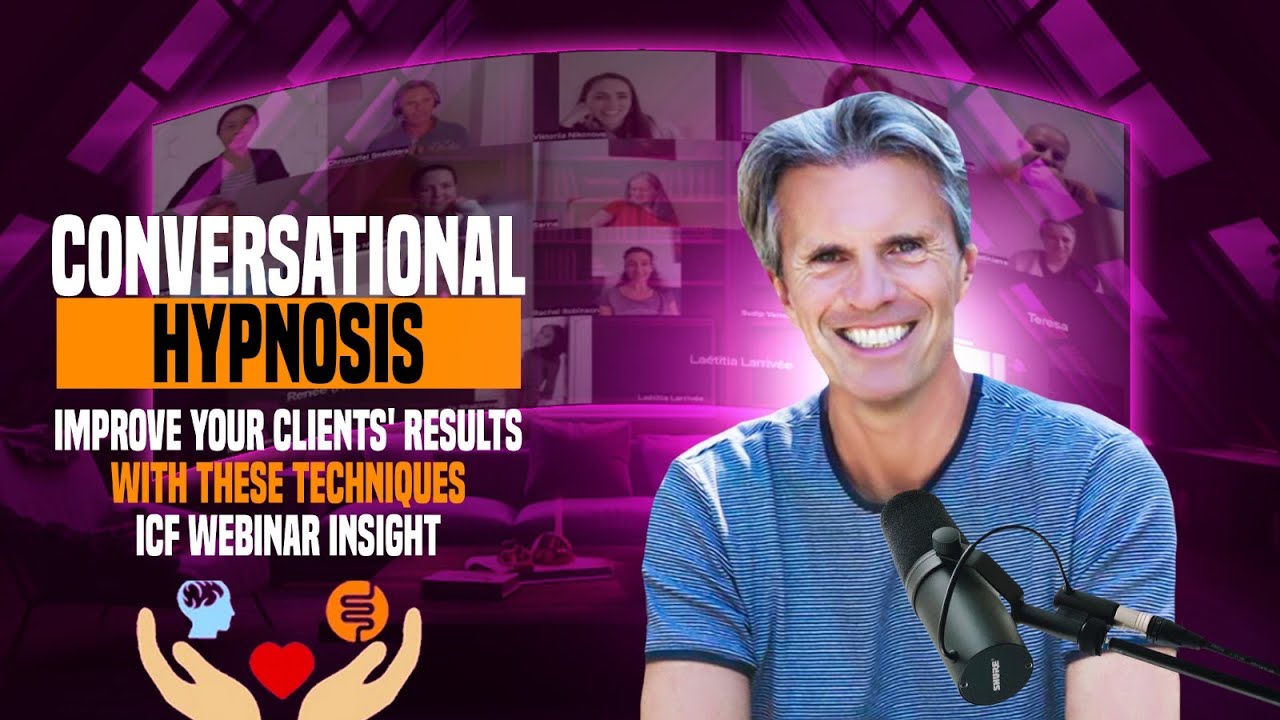
In this ICF‑style webinar, Christoffel Sneijders, a PCC coach and clinical hypnotherapist, demonstrates how conversational hypnosis can be woven into short coaching interactions (7‑10 minutes) to shift client states and beliefs. He explains the use of somatic cues, post‑hypnotic suggestions, and paradoxical true‑and‑false language patterns (e.g., “does your foot need a book?”) to create cognitive dissonance and facilitate change. Sneijders discusses the “three brains” model—head, heart, gut—citing Bruce Lipton and neuroscience to argue that early‑life negative programming can be re‑encoded at the heart and gut level through conversational techniques, not only deep trance. A vivid case study illustrates how a client, during a brief non‑deep session, helped Sneijders overcome a lifelong dyslexia‑related limiting belief in seconds, highlighting the power of external facilitation. The conversation also covers practical limits of self‑guided visualization versus guided hypnosis, the feasibility of deep hypnosis online (including safety statements for connection loss), and audience reflections on motivation, sleep, and social‑media stress. The session concludes with a call for feedback on developing a dedicated training program for coaches.
Chapters
o'clock, and hypnosis is one of my loves, just like coaching. And in the old days, and even now, you have coaching and you have therapy, and there is something like a Chinese wall in between that. And if you do therapy and you like to send it out for PCC marking or MCC marking or ACC marking, you get a huge red cross through it. Coaching is looking to the future, therapy is looking to the past. So hypnosis most times is connected with therapy— a scratch. But there is a solution, and it is actually working from a different kind of way how you can use it. So that's what we're going to talk about. One thing, um, of course, if you have a lot of background noise for whatever is happening You still have Netflix on, please turn it off, put yourself on mute. And on the other hand, of course, you can raise hands if you have a question or just pop in. For me, I love interaction because I know so much of this that I can talk weeks about it, and that's not my objective. My objective is that you have so many insights. How can you use it? What— how could it be useful for you? So that's my objective. So get out the best of it. Whatever kind of questions you have, the recording is on, so we officially start. The link between coaching and hypnosis, conversational hypnosis. Why do I dare to say such a bold statement? Because who am I and what do I do besides I'm an ICF PCC executive coach? Okay, so I tick all the boxes of coaching. I did my PCC markers. I'm also a visiting professor at the Business School Madrid, so I have a leadership cap on. And why this actually becomes interesting for this presentation, I'm accredited supervisor for clinical hypnotherapists and for coaches, and I'm also a clinical hypnotherapist. The last 10 years I've been working really as a clinical hypnotherapist. Mainly in Australia, where I have been living for almost 10 years, working with depression, PTSD, anxiety, and addictions. And of course, in my startup time, we stopped smoking and weight loss and all those kind of popular things that people like to come to for hypnosis or hypnotherapy. And I also have this— I had, I have to say had, thanks to COVID— I had a school in Australia where I was teaching clinical hypnotherapy. So people could become a clinical hypnotherapist, accredited training according to all the Australian hypnotherapy associations. And so I dare to say I know what I'm talking about. I have to go there. Besides that, 30 years in the field of coaching, training, therapy. So I also have enough credentials behind me that I saw a lot of people. And now it becomes interesting, some people already know that I'm also the founder of the 3 Brain Code certification training, and that somewhere sparked an idea that we can combine it. And last but not least, I just say it once, now not once, I wrote a book about it, How Men and Women Fit, Finally Understand Your Partner's 3 Brains Theory. So you buy that book, give it to your partner, say read it because you really need it, and at least you have a lot of fun. And it shares how the 3 brains work, but actually how we remember and how we make decisions and how we do all kinds of decisions. Now, what are we going to cover somewhere in this little webinar? And I know it sounds like a lot, so I do my best not to talk faster but to condense it. Where are all the issues and solutions coming from? And I know the word issue is almost like an ICF— we don't talk about issues, we talk about objectives or topics from the clients— but I thought let's now put issues in there. That's actually your decision-making in your 3 brains, and that's actually the root cause where it is. And of course it's simplified. The needed— well, so now I see that in my beautiful dyslexic moments I did not check what is there. I'm dyslexic, so sometimes I read something, I totally understand what's there, But I never read out all my text. I should have done. What is needed for change? Hypnosis. And what does it actually mean for brainwaves? To give also scientific explanation what is hypnosis. And then how do we access actually the 3 brains in a hypnotic state? What I mean, how can we access the person to make those changes? Then we talk about Erickson coaching/therapy or the language patterns they use. Dat is zomaar wat we gaan te coveren. Food for thought coming in. Besser van Kolk, writer of the one of the most popular therapy books, if called therapy books, from the last years, The Body Keeps the Scores, writes in his book an amazing sentence. He says, the memory of early life experiences are encoded in the viscera. The viscera is actually Everything underneath your diaphragm almost. Actually, you could say the whole body. Heartbreaking, gut-wrenching emotions, autoimmune disorders, skeletal, skeletal muscular problems are most times stored, coming from the mind-brain-body connection. And if this is true, that it's not only in the mind, it needs to change in how we work with people. He calls it the body keeps the score, not the head or the heart. Brain keeps the score, but the body— what he says actually, there's a connection between this one and that one. What makes sense. Bruce Lipton, maybe you heard of it. I just use some big names so at least to give credit. Bruce Lipton is extremely popular. Google him and you find thousands of YouTube videos. He wrote an amazing book, The Biology of Beliefs. He's really an amazing real doctor who became aware of cell biology and how actually the cell is operating. Now he writes actually the foundation of all your patterns are for 95% coded in your first 7 years of life. So everything you do, what is important, how you do relationships, how you do conflict, how you think you're good enough or not good enough, if you have to be perfectionist or not perfectionist, All those little things, or big things actually, are somewhere coded already in your first 7 years. And of course you can change them, but it takes a lot of time. In his own blunt way of stating things, he has another strong statement, and he says actually there are 4 ways to change this. One is hypnosis. Secondly is repetition until you are totally bored of all the repetition. High impact events. Actually, we have to create a trauma to override the trauma. This is a joke. And special, not spatial, special. As I come aware of, say my own. Spec. Okay, I will do three brain coaching, NLP, EMDR, the eye movements therapies that can have massive impact and change. And why does he say the first 7 years, or why does he say hypnosis? Because he says actually— okay, and I cannot do that when I'm in the presenting mode, I come aware— the first 7 years we live almost in a hypnotic state. When we go to brainwaves, I will give a little insight in that. The first 7 years of your life, the first 2 years you live in a deep, deep, deep hypnotic state. The other 5 years until you reach 6 or 7, you're in, say, a mediocre hypnotic state. It doesn't mean that we're all walking like zombies when we're kids, but only how our brains operate there. And also, it does not have the capacity to do a cause and effect analysis. And what I mean with a cause and effect analysis, then we do the second step. When do we as human beings Learn time. When do we learn next week, last week? When do we really know that concept? And you can put it in the chat or just keep silent or say something. It's actually again seven years, somewhere around seven. It is somewhere in the time that we start believing or actually stop believing that Santa Claus is real. I don't understand it, but I totally agree with what you say. So probably somebody is not muted and likes to say something in a language I'm totally not aware of. So before 7 years, you don't know what's last week and next week. This part of your brain, your head, does not— can make the connections what happened Prior and later. We learn it after that. That's totally okay, Elsa. I just zoned you out, but I'm just curious what kind of language you were talking because for me it was not understandable. So that's what Bruce Lipton says. Now, if we know this, you become aware our job is not there. Where is coaching written down here?
Not.
So we can discuss how effective is coaching. that's a joke because we all are it. But for really making long-lasting change, coaching, yeah, you could say based on all the research, is not the best. For new learnings where there are no connections with the past, coaching works amazing. For things we have to logically understand, coaching is amazing. Overriding emotions, coaching, do with all respect, S-U-C-K-S. It's not the best. And doing that is not because I don't like it, but it's just— let's call a spade a spade, as we say in Holland. If you don't like it, then I would say coach somebody out of an obesitas. Now, and it will be extremely hard to coach somebody out of an obesitas or an addiction. But with hypnosis, massive repetition, highly impactful events, actually you can do those kind of things to make distinction. Now coming back, what is causing all those beautiful things and all my blunt statements? Now everything we do comes from a decision. Ah, Elsa, amazing. Okay, next time I will listen better because I love Italian. So all the signals we receive from inside and outside, we only notice a few. What I mean with that, you're looking at your screen, but who do you see and what do you see? Do you only see your screen or do you also notice what's outside your screen? Now probably if you focus on the screen, you can still see what's outside the screen, but you don't Notice it. Something makes a decision inside you to block it out. Your heartbeat, your digestion, our breathing is based on decisions made inside us, conscious or unconscious. We can change our breathing, we can even change our heartbeat. Some other things we cannot change, but something inside us is making decisions. This one is not making a decision about your digestion. So where's it coming from? And sometimes we remember something, sometimes we forget. So who's now making the decisions inside us what is worth to remember and not? I know for sure, and it's not because you're not amazingly intelligent, but if you don't have an identical photographic memory, you cannot recall everything that has happened in this presentation. Even I cannot, although I'm the presenter. Something inside me makes a decision to remember and to forget. Who is that actually, or what is it actually? And when I said, when you look at the screen, what do you notice and not notice? And do you see that Mireia is actually touching her lip? Yeah, sorry, I was paying attention to somebody to say something. So thank you for at least cooperating by doing something where I at least could make an remark on it. So let's talk, okay, and if we have to itch, who's making decision actually to itch? Camilla asked a beautiful question there. Repetition, repetition, repetition, repetition. I love that word repetition. That it does not work if we want in contrast with our conditions. Doesn't mean then, for example, if you want to think positively but everything around you is toxic, yeah, what you want differs from your environment, then your efforts won't work. I like to say a beautiful Milton Erickson answer, yes and no. It means, if you like to, it's based on the law of The law of Webb is what fires together wires together. So we can create new memories or new ideas or new skills by creating new neural pathways in one of our brains. For doing so, just like a muscle, if I like to have a muscle like this, I have to do many times of repetitions. And you can get there. What is holding us back from the repetitions by our own internal beliefs, our own setup, or maybe influences from the external environment. Depends on your own conditioning how much you deal with it. So even if everybody says you're a loser, you can still be the most optimistic person who is if you start repeating that and keeping really believing that. On the other hand, if you don't If you're such a— if you're open for critique from the environment, you will stop after one time. So yes, you can, only it needs a massive amount of grit and resilience to do so, and discipline. Repetition means grit, so biting the bullet. That means discipline to really do it every time, and that makes it so hard because Your personal condition actually says, why would I change? Change takes energy. Energy is actually a life-threatening condition. If you have less energy, then you're less suitable to deal with the environment. So I only give you energy to change if you can convince me totally that it is useful. So your internal system will have a fight with you or discussion with you from, is this really needed what you want to do or not like to do? That somewhere also can stop you. I hope that answers your question, Pimila. Grit, resilience, discipline, because repetition takes so much effort. Hypnosis works faster. Yes, hypnosis works. What about the— Yeah, hypnosis works faster. Let me come back to it later. I'm not going to give the answer now, otherwise I'm going to mess up all my slides. But yes, it works much faster because we do something that makes it different. So we come back when we talk about 3 brains. Because just imagine when you make decisions, and I just put a lot of there, you don't have to answer more. How do you make the decision, or how do you discriminate actually, how do you distinguish when to hold on and when to let go of something? When you are— what you are and are not in control of, what you are, what you're not responsible for. What you feel or what you think. All those little questions are based on decisions. And what happens if we don't know the answer? We will fall back to a pattern that is somewhere learned many, many, many years ago to find some resolution. And most of them, we just choose something that fits the best for us. Based on the 3 brains, we come back later. So does our clients know that there are multiple choices? A lot of them don't, so we have to help them in that coaching part. How do you make the distinction between you know and you don't know? Most people respond reflectively, hence unconsciously, subconscious, whatever you like to call it. So the answer is no. Also written in the book Thinking Fast and Slow, System 1 and System 2. System 1 just gives an answer. System 2 really takes a lot of effort to give an answer. And I— the idea behind this one-on-one is everybody can pop out too. 17 multiplied by 25 minus 8 divided by 3. And we all stop and we have to start thinking about it. System 1, System 2. And then we could say perfectly, I don't know. So now what's the other part of this decision part? Who makes the decision inside us? And science discovered actually 30 years ago we have 3 brains. Science discovered, proven, not me saying it. We have a gut brain, 500 million neurons. It's written down in the book The Second Brain by neurobiologist Michael Gershon. 30 years of research he did In that, as he calls, shitty part of the body, and came aware that there are many, many intrinsic nerve systems that can operate totally independently. And if you think about evolution, just imagine where we're coming from. We're coming from bacteria, or one-cell organisms to make it easier. A one-cell organism gets some foods in, or Nutrition and poops out the waste material. Actually, a one-cell organism shows already where we're coming from. It's actually getting energy in, getting some waste material out. The first living organisms were actually almost a living gut, like sea cucumbers, worms, little. And now if you think about a sponge or those corals in the sea. They get some food in, get some food out. They're actually almost like a living gut, almost like a living stomach or living gut system. Nothing else. From that principle, he said the objective of us, our gut brain, 500 million brain cells, is to lust for life, need to survive, just like those organisms in the sea. The highest need— oh, I know that it went wrong and I did not change it— is establish personal success. How does it communicate to us? With neurotransmitters. And I'll go like this, otherwise I get totally crazy from all the little boxes. Neurotransmitters. And it has a nervous system. How does it communicate? It communicates with sensations like fear, anger, lust, desire, hunger, and disgust to let you run, fight, create little babies, put Food inside yourself or protect you from putting the wrong food in you. That's your gut brain, what kind of things it does. The brain in your gut brain actually is really a brain that can memorize because just imagine where do you feel fear? Fear you always feel in your tummy. You don't feel fear in your head or in your heart. You feel fear in your tummy. The gut brain can remember All life-dangering experiences. When your life is at stake, actually your gut brain takes over to rescue you and will put on a fight, will let you run like whatever to get away from it. Your heart brain, in the same period of time, neurocardiologist Andrea Moore wrote a book about, a research document about it. He called it the little brain. You have the second brain, the little brain, 100,000 on average brain cells on your heart, but only have one reason: belong, connect. Why is that based on evolution? Just think about yourself, how you were when you were half a year old, 6 months old. How much independency did you have? A giraffe or a zebra can run away in 30 minutes after birth. We, after half a year, can still lie on our back and scream for mama or daddy for food and absolutely clean my diaper. So we as human beings are totally dependent on the care from our parents. Hence the heart brain is there. It sends out oxytocin, the love hormone, actually for us to connect With the people who we love, every mom will secrete and produce massive amounts of oxytocin from her heart. So she loves her own baby. Even daddies can produce oxytocin for their own kid. And of course, we have a doom doom doom doom heartbeat, and that heartbeat gives actually instructions to your limbic brain, your amygdala. Seven milliseconds after a heartbeat, your amygdala gets instructions. What to do? Therefore, people think what's the amygdala? The amygdala is your little emotional part in your brain that sends out all the hormones based on the information it gets in the limbic brain. It gets information right away from your heart. Do this, do that. Of course, there's nerve systems all connected. What does your heart do as a coach? Love, compassion, connection, sadness, guilt. To connect. Reestablish connection or protect you from connection. Last one is head. What does your beautiful head does? And now it makes sense why hypnosis helps so good. Your head only likes to predict the future. Besides, because otherwise explain to me why do we have a memory? What is the biological reason that 20% of our energy consumption is consumed by that thing 1.5 kilos in our head to store all those memories, to know all those memories, if it's useless? Why would you spend 20% of your daily energy on that thing inside your head if it's useless? So all those memories are a database to help you to predict the future better. They're one big Google search engine to go from happened this once before, what was the solution, how can we do it, Let's predict. What does it do? And now it becomes really interesting because now you can see it has 2 things that does not have the heart or the gut. Your head is the only one that has time. Your head is the only one that knows yesterday and tomorrow. Your head is also the only one that knows English, Italian, Spanish, Turkish, Dutch, whatever language you talk. Your heart and your gut only know sensations. It can, it can transfer, so words we say can have an impact on our heart and our gut, but always need a translation. So how can we connect all these little dots up to now? The first 7 years of our life Actually, your gut brain and heart brain are massively stored with all the information about survival needs, about connection needs. Your beautiful head brain is still in an absorbing way from getting just the information in there stored like A, B, C, D without any critical thought in there. So when we coach people and when we go to conversational hypnosis, on the question why it goes quicker, on the question from Camilla, your heart and your gut don't know time. What does that mean? And I saw it in the people who are depressed, who have PTSD, who are anxious. Their heart and gut do not know it's going to happen tomorrow, so it does not make sense to think about it today. to worry about today. They also don't know last month, last year, or when you were 5 years old when your brother took your little toy away. It still acts like it is now. So when you think about therapy, we have to go to, hey, what happened to you when you were 5? What did your brother do when he took away your toy? And did he hit you with your toy? Oh, how did it make you feel?
Blah blah blah.
No, that emotion or feeling is for the heart or for the gut still in the now. It's still happening now. So we can coach people with conversational hypnosis on the things that holds them back 20, 30, 40 years ago in the now, because your heart and gut do not know it happened 30 years ago. It's still for them present. PTSD is a beautiful example. 10 years ago, they were in Afghanistan, they stepped on a bomb, or somebody else stepped on a bomb, and still they're now totally freaked out when they hear This sound, because their system does not know— their heart and gut does not know it happened 10 years ago. If the system would know it happened 10 years ago, they would know that it don't. So we can work with that. Now, where does it step in? Conversational hypnosis is using language to get into the heart and the gut and help to change that system. That's how it works. So On your question, Camilla, does it work better? Yes, because we can actually bypass all those critical thoughts we have. Because what is hypnosis? Step 3. Hypnosis is an inward focus state. That's why we sometimes ask, close your eyes. If people become aware I'm a clinical hypnotherapist, they'll say, oh well, I will keep my eyes open. Then I say, I can do conversational hypnosis with you with your eyes open. Actually, you have to have your eyes open. So maybe when you have your eyes open looking at me or looking at something else, you are already hypnotized without that you know. And then they totally freak out because they become aware of, oh shit, whatever I do, it's happening. It's a focused state on something. So it means besides inwards, you also focus on something. Most people focus on their breathing. It's also a relaxed state of their breathing. Physiologically, your breathing will slow down if your heartbeat will slow down. So you can help people to get into a relaxed state, hypnotic state, by changing their breathing. And how does it feel? It feels like being awake and asleep. That moment you wake up and think, I know I can, but I, I won't. You're still, you're still in a beautiful state. I love that state. That's why I love to snooze, because then I can repeat that state. This is not advice to snooze, by the way, because it's rather ineffective if you like to get up. And in brainwave language, it's an alpha, beta, or delta state. And I clicked to somebody to join the room, so that's why I now stopped. And it's a state, or it's a relaxed state, that we allow ourselves actually to— and then we come to your answer, Camilla— to turn off our survival radar and our critical mind. Our survival radar is actually your gut brain that is sensing all the time, is it safe, is it not safe? That is the moment that you enter a new room and actually have that half second, what's happening here? Your critical mind is— now I think everybody knows that critical voice you have sometimes in your mind, that if you didn't do your bed, a voice inside you said, are you going to leave your bedroom without making your bed? Or are Are you going to leave the kitchen without doing your plates? Are you really going to eat at McDonald's? All those kind of critical minds, what's going to say? And it's actually a state that we allow ourselves to learn and change, because when the survival radar are off, actually we can create easily new neurological pathways. If that's true, I don't know who's saying that. It's absolutely true. So okay, turn that lady off because I think she was saying something I didn't know. And by the way, hypnosis— now coming back to the next state— it's essential for a body and mind to achieve this state. So therefore, say, the hypnotic alpha, beta, delta state we always have when we sleep. If we would not have that for more than 6 days, you have really chronic issues. And if you sleep even less longer or for a long time, it could even be life-dangering. You could die from not having sleep because when we are in alpha, beta, alpha Now I see something is wrong because I say it again, this is a theta state. Theta, sorry, theta state. If we don't have that, then we would actually die because that's the moment we actually start rejuvenating all our body. So when do we experience it? Because hypnosis for some people sounds scary. How many times a day do you think Or believe you experience hypnosis? Just put it in the chat. How many times do you believe— do you have the idea that you experience hypnosis on a daily basis? For the person who has the right answer, uh, gets a free session. Every 30 minutes, I don't know, because then we have to think. The answer is actually really close to Christine, to Elsa. She did a great thing. It's something like 100 times a day. Every time we allow ourselves to focus on one thing or to relax. Zero. Lorraine, uh, love to, love to have that chat with you, Lorraine. Um, I, I have a guinea pig for later if I like to do a demo. I know, Lorraine, we will give your first experience today. Sorry, I'm Dutch, I'm cheeky, I love to make jokes. But every time you drive, you do sports, you cook, you watch television, you listen to music, you do daydreaming, you do meditation, etc., actually you're in a hypnotic state. So Lorraine just admitted she doesn't drive a car, she doesn't do sports, she doesn't cook, she doesn't watch television, she doesn't listen to music, daydreaming is also not happening, and meditation also not. Oh, Lorraine, really, really, really kidding. I love your honesty. And by the way, Kristen, this is 1,500. I don't know how many times that is in your awake state because my math now stops. Let's say you're 15 hours awake, that's 100 times an hour. That's a little bit a lot because it means it's twice a minute. I don't think we can get that number, but 100 times really you can experience at least. So there's nothing strange with it. One thing to clear out the myth of hypnosis: when I do clinical hypnotherapy and teach, people always say, um, I cannot be hypnotized. Now, we just said you hypnotize yourself 100 times a day. You can. The only thing is, when you're in that chair, you don't allow yourself because you have a control issue. And not because it's an issue, but something is stopping you inside. You lose control. Now, if that was true that you would lose control, I could take over control of you. I can tell you, I would absolutely find the guy who has a massive amount of bitcoins and say, just transfer to me, just give those billions to me. And I can tell you, it is not happening. I cannot hypnotize anybody to do anything. They did actually research. They found really suggestible people who are easy to hypnotize. And from the 15,000 people, they found one person who could actually really do something that he actually didn't want. It was something like doing a murder. One out of 15,000 of people who really could believe if you put an ice cube in their hands that it was warm. So just imagine if I put an ice cube in your hand that you would believe it's warm. Naturally you say, wow, it's hot, it's hot, I'm burning my hand. 15,000 of those were needed to find one person who actually could, was willing to pull the trigger. Now, and those people who are extremely suggestible are 1 out of 100 or something like that. So do the math, it's almost not happening. You can make do me anything? Absolutely, again, that not. You cannot lose control. I cannot make you do anything. So people say, okay, Chris, uh, I'm getting in your room, uh, just zap me. So sometimes when coaches say, Chris, I have an issue, can you just do your tricks and just zap me? So in half an hour I'm done. And I say, I can do that, it only costs you €15,000, this coaching session. And then silence. And they say, you make a joke. I said, that's what you started. And then we go on. Brainwaves, one little thing, if you know it or not, brainwaves, we have 4 different ones, excuse me for a minute. The beta waves is in the state that you're, as I'm now, highly active, extremely focused, you're working really hard. So it is an extreme focus state, you're working like your butt off. Sometimes it is that beautiful zone state, you're extremely, extremely high productive, or you're just extremely busy with something. Alpha state is the state that we just watch television and we're relaxed, we're just cooking steering the pot, whatever. Theta waves is actually deeper, deeper, deeper, and you have beautiful dreams. Delta waves are a deep dreamless state. You're in a state that I've put on your hand like this. If you were hypnotized, you would just keep it there and think their life is good. So this is conscious awake. Now, this is where we do conversational hypnosis most times in. This is when I really say, okay, now just close your eyes and relax. And it's allowed for yourself to make a decision how much you like to be relaxed. You can choose a light relaxation, a deep relaxation, or a medium relaxation. It doesn't matter as long as you choose whatever you like to choose. That's that. So To experience how it works, and I will now— oh, the elephant, there's not one— the lemon slice. Maybe you know that little trick, but it's a funny one. And I will not hypnotize you unless you want to be hypnotized, of course, but we just do a little system how actually easily— and I'm coming also back to the question of Camilla— how you can change things. The only thing I ask you is to listen. So put your phone away and those kind of stuff. You can sit relaxed or not relaxed, whatever you like. And just imagine for a moment that it's a really warm, warm, nice day. It's a nice, beautiful sunny day. And you're really getting thirsty. Because you're feeling hot and you like to have something like refreshing. You enter your own kitchen, you see a beautiful lemon lying on the cupboards. Well, beautiful yellow-greenish. It looks juicy, refreshing, and the color is amazing. You walk towards it and pick it up. You smell it. Ah, It smells really good. You feel it in your hands, the weight. You squeeze it a little bit softly, you think, okay, this is really ripe.
Mmm.
You turn around in your kitchen and looking for a knife to cut the lemon. Well, you find your knife, you cut the lemon in 4 pieces. You see and smell the drops jumping out of the lemon because it's really fresh and juicy. On your knife, on your cupboard, everywhere. You can even smell it. You take one of those 4 pieces, you feel how the juice is dripping on your hands, and you can really smell the refreshing fresh smell of the lemon. And softly and gentle, you bring that lemon slice to your mouth. You smell it. You become aware of all the details. Of the lemon, how it feels, how it touches your finger skins. You bring the lemon closer and closer to your mouth. You take a big juicy bite out of it, and you feel how the lemon juice connects with your tongue, your cheeks, your throat, and how it tastes, how it smells, and how it just does all the beautiful things in your body and mouth. And in your own time and pace, you can— if you had your eyes closed, you can open them again. If you had them open, keep them open. And just, you can unmute or not unmute, put it in the chat. What did you experience? Make an unmute and just share it. Lovely dudes. So Lorraine, the lady— I will ask you a question. I cannot, I cannot resist. Excuse me for that. What did you experience, Lorraine?
So yeah, I— when I took a chunky bite out of it, I could almost feel my cheeks going like tingly because like how a lemon would make you feel. So it was almost— it was crazy because I was like, this is crazy, but I could feel them pulsating almost.
I congratulate you, it's your first hypnotic experience of today. Thank you for sharing. And Maybe others also have the same experience, the craziness that you know I don't have a lemon in my hand and still that you have that salvation or taste or sensations in your own mind and body. Now this is actually how hypnosis works. When you are in that relaxed state, that alpha state, because we're now in an alpha state for most people, if I saw them, your mind is actually not seeing a difference anymore what is real and not real. Just like when you wake up in a dream or in a nightmare, you really believe you're there while you're just lying in your bed. And so our mind is so constructed, this one, that it doesn't see the difference. Oh, beautiful yellow-greenish colors. Latif Diva. Oh yes. So if I talk this story, most times also I really have to take care not to I was resisting the visualization because I wanted— I don't like lemon or sour things. I wanted to be over quickly, quickly taste it and be done with it. Isn't it beautiful how we then even can put our own internal system to resist actually to do that? And that's actually a beautiful example, Camilla, how sometimes we stop ourselves from changing, and also our clients do that. not because they want, or sometimes they want, but something inside of me stopping them. Now this is actually, say, I could say how hypnosis works. And I do share screen. If we have a little time extra, I can show you a little bit how you can do it by yourself, bring people into relaxed state, so then you come home later on, you can just do it. Where's my share screen? Because then comes the other stuff.
step.
Okay, so now we know where it's coming from— 3 brains, decision-making— what is hypnosis partly, or what does it do with our internal system. How do we now bring it into coaching? Because that's why you're here, besides hypnosis and tasting a lemon like Lorraine did. So what's Ericksonian coaching? Ericksonian coaching is coming from Milton Erickson. Milton Erickson was an amazing psychiatrist, psychologist, hypnotherapist, and he created actually this system. And I'll just call it totally because we don't have— but you can see it connects rather close with how ICF sees coaching. He says we have 4 main skills: observation, what's extremely important for coaching. You have cultivation on the other side, and cultivation is actually growing the client to solutions. We have to challenge the client to let them actively do things, to challenge his belief systems or thoughts, and we have to validate that everything he or she does is somewhere right. 4 skills. And those core competencies say we have to tailor our session, so use everything that is happening there and tailor it to where somebody is sitting, utilizing everything that's happening. So that is what I did with This is Lorraine, and when she touched her mouse and laid it on, I just utilized that she moves. Like I could say to Serena, her subconscious was just on her chin. Or with Victoria, who subconsciously said, you know, I have such a heavy head at 1.5 kilos, I really need support there. And that is just utilizing what's happening. So when I hear now a phone ringing there, I can just say, hey, and something is reminding me to take care of the time. Strategic, it means we have to have somewhere a plan where we like to go to. Destabilize actually the current thought or beliefs the client has, to experiment and be naturalistic, believing what we say in ICF coaching: all the clients have the resources to, to change. So you can see the Ericksonian concept is rather close to ICF. That's why I also love it. Erickson was really far, far, far away before many of us. So why Ericksonian language? Because this is the concept of invite the language. And by the way, I can send you also the slides, Serena, and everybody else. So pictures are okay. It's all about the relationship between language, your 3 brains, and creating excellence, whatever excellence means. The language needs are there to confuse the logical mind, so your limiting beliefs, critical voices, the other parts of your 3 brains are accessible to change, and change can happen. Then our experiences are gained from our neurological processes that come from our senses, the ones we have— taste, smell, sound— and our internal neurological processes. We make sense of all those sensations based on a translation system here. What I mean is that if it's 2 o'clock and your stomach is making a sound, you think, hey, I'm hungry. 2 o'clock, if you're in Spain at least, or Italy, because 2 o'clock is a normal time for lunch then. If you just did the pregnancy test and it was not, and you feel your tummy, then you say, oh, maybe I'm nervous. On the other hand, if you see your loved one in your tummy makes a little move, you say, oh wow, I'm so happy to see him. So the sensation of your tummy can have 3 totally different explanations based on the context. This one sees the context based on all those database memories and puts your sensation in the context and gives you an answer. That's why sometimes when you walk in a dark alley and a cat jumps out, you can almost have a heart attack. That's me at least, because dark alley, memory set, stories of, of the Dark Knight and all those Batman movies. Oh, the the criminals are walking here, every sound could be dangerous. So the first step, this one interprets this, hey, dark alley context, something is moving, danger. Until half a second later, I see a cat walking by and everything cools down again. That's what I mean with it. And language can affect the way we experience things, hence the lemon slice exercise. What are Ericksonian language patterns? And please fasten your seatbelts because now you're going to be astonished about the guy, because the guy has 41 language patterns. At least I found 41. If you go to Google it, most times you find 8 or 10 of them. In my research of now in my delivering my trainings. I also did NLP and all kinds of other kinds of things. I came aware there are, even with slight differences, 41 language patterns. Those language patterns we can use in conversational hypnosis to help the client to confuse this one, to get in that state and make also changes. What are language patterns? I have now, say, 2 examples for you. What's example 1? A presupposition. What do I mean with that? It's the linguistic equivalent of an assumption, but you do actually something else. Talking about the change like it's already happened. So resistance that could be part of the change has already passed. So it means sentences Do you want to have a quick or slow change? Actually applying already the change happened. Have you already noticed now all the things you have been learning? Implying that you already learned a lot of things in the last 52 minutes. And do you want to practice now or after you have seen all the different kind of options? Actually, I imply already you will practice. So based on the language patterns, we can actually— and there are setup questions, so it also fits in the ICF loving way of— we don't suggest, but you can ask questions. We give alternatives for the client actually to play with his critical mind. Another example is yes sets. Those are the most quote-unquote famous things you see. You see them in NLP, in sales trainings, and many things in most marketing advertising. which you can see them. What do I mean with it? That people, if they say a couple of times yes in their mind, they like to say yes the next time again. It's almost like a repetitional path of it. So you say things that are undeniable true, and then based on the automatic reflex, the next thing you suppose or propose Probably the client is also saying yes to. So as an example, are you looking at this slide? Are you noticing the examples and the explanation? Are you maybe wondering how easily it will be to learn all of those? So why don't go ahead and notice which one you already can remember? And before you know, a lot of people are already starting out doing this. Of course, you could say this manipulation is actually helping the client to see some things differently in your communication style. Now, there are much, much, much more— I said 4 defined language patterns— more how you can play with it. So before we go anything further, these are the 4 building blocks of, say, conversational hypnosis. Why I did this webinar has multiple reasons, because I came aware in ICF there's actually nothing about hypnosis, but it's an extremely amazing tool. So I thought actually also of making a program for it for us coaches, something like a 4 or 5 day program, apply for CCEUs. Doing that will probably take me $750 to $1,000 based on the system of ICF. So before I put a massive amount of time in making a program, getting it totally organized to send to ICF, really to make it, I have a later question for you. It's not a sales question. I don't ask you to sign up or whatever, but before I'm going to spend one week of making a program that they can apply for CCU and pay $1,000 I would love to hear later, you can email me later, whatever, if it is something you think coaches would be interested in or you are interested in. I will not ask you to sign up, it's much for me a choice if you like to do it. Now that's one question for later. The other question is, what are you discovering in this presentation? What kind of questions do you have? What would you like to know more of? So let's create an open Chat, what would you like to know more? Because these are the 4 building blocks and I sticked it within an hour, so we still have more than half an hour to really utilize it and tailor it to your needs. So this is the time to step in. What will the program focus on? I love you. Now actually, Camilla, what it now did, it will bring it much more. So it will bring the theory in one part But it will teach you how you can bring the conversational hypnosis in practice. So it means we dive deeper in the discrimination skills. So how do you distinguish the difference between— we give you many tools how you can bring people, or techniques how you can bring people in a relaxed state. We give you some science more about the 3 brains, what's happening, and much more. We focus on all kinds of techniques how you can do those talks in coaching. I thought you were going to show us how to use conversational hypnosis as a coach. Then I'm sorry I missed that little, little thing, because actually it's basing those— it is actually connecting those things. And my decision was actually to explain the 4 principles first, because I can show you what is going to happen. Of course, then if we like to do it And then I should do a demo, and I love to do demos, but I know one thing, if I do a demo now, then I have to explain all the different things I'm doing, and then I need the next 1.5 hours of you because there are all the concepts of Jupyter behind it. So excuse me, I chose for first setting the concepts there. I think coaching showcase will help us affect and Ask the questions also makes totally sense. Like I don't mind doing it, but I know that after that and many people have many questions, and I know that discussion will take many many times because then I have to go back to all the things. But what actually happens? Say somebody has stopped. And sorry, I see a hand off Surdip Firma. Excuse me if I pronounce it wrong.
That's fine. I just had a question, so I'll read. when I get a chance to ask.
So what's your question? What would you like to ask?
No, so Chris, this was in context to the visualization exercise you did. And I was just trying to wonder that, is it natural for everyone to always overestimate about whatever we are visualizing or feeling? So for example, the example alluded to about the lemon. If one is visualizing, my natural visualization or the imagination was of a very ripe, juicy, well-done, nice lemon. Now, you know, if I— you know, my question is, is that something which is natural that we tend to always overestimate or always see things as perfect? Or if, for example, if I were to just go by the comment which Camilla made, If I don't like lemon, why don't I actually visualize a very not so good, rotten, non-juicy lemon?
You give the answer by yourself almost. We, based on our experiences and what we prefer, we imagine what we see. And you saw maybe in my slides, I went through it really quick. I had an elephant there. Sometimes I do the imagination exercise of seeing an elephant. And I ask people to close their eyes and say, you imagine an elephant? And if I would ask you now, can you imagine an elephant? Then most people can, but they will go to their own memory how they see the elephant. If it's, say, Dumbo with big ears or a real elephant from nature. And Hugo already did it. So you will come to your own reflective mode. So if we like, as a therapist or coach— actually, I have to say as a coach— Guide that, we guide it actually with some instructions. So just imagine you would see an elephant walking in the fields in Africa. Then you actually guide the person to what you like to see a little bit more. And so if you talk about the lemon, you're not sure if people can imagine the lemon, you say it's juicy, fresh, and ripe. Okay, so you bring some details in your story. So that's, that's, that's a part in there, what you like to do. So it depends where you like to do, say, and people say, can you just do a demo? Because I know that people love demos and it works, right? Uh, and they're really pushing me. So okay, for the people who like to have a demo, I can do a 10-minute, 15-minute demo, don't have any issues with it. But if people ask for it You volunteer. I love to be always a little bit dickhead. And so who of those people who like to see a demo like to volunteer? Why is it now silent? Interesting. I can, if it's okay to keep my camera off. I would say yes and no, because we can do hypnosis, say, also on the phone. But if I don't see you, the utilization part is harder because I don't know what kind of environment you're in. You can be walking in the street, or you can be sitting in the car, or you can be just sitting at home in your thing. So that makes it a little bit harder for me to really also give the benefit of the demonstration. And so if somebody else likes to have the camera on, at least we can utilize— because when we talk about utilization, it's actually making aware of it. Rachel Robinson says, I do it. Okay, I saw her earlier, and there she is. So, okay, please unmute, and I'm going to pin you so I can see you all screen. Okay, thank you so much, Rachel, for stepping in. So, are you unmuted, Rachel?
I'm just gonna close my window.
Perfect.
Does the painting bother you?
No, no, no. As I spoke to you earlier, say, you know, I'm extremely focused on all those kind of things, but we can even start utilizing it. So that's perfect. So what kind of little topic— say little topic because in this little 10-minute demonstration, that's something— Chris, I'm actually clinically depressed already for 10 years, can you solve it in 10 minutes? It's maybe not the right thing to do. What kind of— but even if you want, we can even play with it because most of us like— what kind of topic do you have in mind that you feel comfortable with now to explore?
It's a topic that for a while I've been trying to find a solution. It's, I'm an entrepreneur, I love my coaching, but all the other stuff is hard to to get myself motivated to do, you know, looking for the clients, posting, all that other stuff that you have to do. And so if I can make it a small subject, is how to get myself motivated to start the work that I set myself to do every day and to stick it through.
I love that you call it a small topic, because if it's a small topic, how many years are you already playing with this?
So before we do it, um, something to do with like, I'd like to sleep better at night.
No, no, but it's okay. I say I just try to play with you. So, um, is it okay if we just, uh, for one moment tune in and just— I don't know, if you relax or you like to relax, what kind of techniques do we have for that?
I meditate.
Okay, and if you meditate, what kind of methodology do you use? Breathing or something else? Visualization?
It's the Kriya Yoga, so there's a little bit of 16 breathing breaths before and then meditation that I do for 15 minutes.
Okay, so just imagine that if you now just focus for a moment on your breathing. So you can really connect with your own body for a moment. While you focus on your breathing, you maybe can share again in a slow pace what would you like to get out of this little exploration we're doing.
I don't know if it's small, that's why.
That's okay, we can even make it big. You don't have to— if you like to talk about the motivation to do the things you want to do, it's okay.
Well, it's, um, just all about, um, Well, it's about taking action even when I'm not feeling, you know, motivation.
So I just saw that you were really talking about you're moving your feet, moving around, looking down. What are your feet telling you actually when you say, hey, I'd like to motivate myself and do the things I want to do, and you're moving around?
I have one foot on top of the other and it's like smushed down to the ground.
So if you would think about what's really stopping you for this moment to do those actions, you would really feel what is stopping you from those— following your own pathways, what would it be? Just take a deep breath and just Thanks very much.
I don't know, partially, uh, on one hand, um, I feel positive, like it's going to work, I'm going to succeed. On the other hand, I'm not even sure any of it's going to work. And I'm afraid, I guess, to make the— take the wrong step, the wrong decision.
The wrong step, the wrong decision. And isn't it interesting that when you talk about it earlier, that actually you had to pin your feet down? Because isn't it that when we start moving your left or your right feet, that Actually, we have to start somewhere left or right, and actually they already started to move. They were almost pinning them down because you didn't want to make them maybe the wrong move. So I'm just curious. Say you would follow your feet in moving, and moving really also to the solution you know you are, and maybe you have to walk a little bit longer. What would you choose to do?
I'm sorry, I didn't understand your question.
That's great, because the moment you don't understand, you start feeling them. So your feet were already moving, almost liking to walk or liking to do something, getting in action. You spoke about getting in action and don't know if I do the right thing in getting in action. Just like we sometimes don't know if we have to start with right or left foot walking. So just imagine that just like walking, you could trust. Because do you know which foot you're going to move first when you start walking, right or left?
Left.
Left, always left?
Well, I'm right-handed. I mean, normally right, but when you said it, I thought of my left foot.
Okay, so probably you don't know, but do you trust that when you start walking that your foot's Your feet will do the right thing?
Sure, yeah.
That's good. So just imagine that you could put that trust from your feet also in just start moving, doing the things you want to do. What would, what would you have to do then?
You're saying I should trust my feet and just move forward and take action?
I don't know if that's what it is, maybe what you took out of it. So say What would you take out of this? If I talk about your feet moving and trusting your feet that they move the right way, and actually you're talking, I don't know if whatever I'm going to do is going the right way. Let's say you would trust your feet, just like you trust your feet. What would your feet do if they would be conquered with that problem? Not knowing what to do.
I wouldn't take a step if I didn't know what to do. If I couldn't trust my feet, I would just sit here.
And isn't that what you're actually doing? So, so how do you bring trust to your own feet?
I guess I don't really think about it. I just get up and do it because I've done it before.
So if you use that internal wisdom you just said, don't you know already the answer for what the things you have to do, which you stated as an issue?
Just, just don't think about it, just do it? And don't worry about whether or not I'm going to fall on my face because I have a small percentage chance of falling down and tripping, but I don't worry about that. I just walk. So yeah, I guess I could try that. It's just, yeah, I mean, like if you said, okay, this is what you have to do and you'll succeed, I would like follow it by like a book. But then I feel like now I don't have that book to follow. I don't know what to do to succeed.
So just take— just let you take a deep breath again and really connect with your feet. Do your feet have a book what to follow? Do your feet have a program of, okay, take a step off? Because do your feet know how big the step has to be? 30 centimeters, 40 centimeters, or 1 or 2 foot, whatever measurements you take, or do they just adjust automatically almost when you're walking on the pavement or walking somewhere else?
Well, they do it automatically. Like you're saying, it's repetition, repetition, repetition. You know, when I learned, I mean, get up, you fall down, you get up, you fall down, and after a while you learn and then you don't have to think about it anymore.
So just imagine you take a deep breath again and really connect with your body. So How could you use all the things you just learned that you maybe are not aware of that you just learned, useful for the issue you just had? Say you would not think about it, but just feel about it.
What would happen? Oh, just feel about it. Okay. I guess I feel like, all right, I stuff If it doesn't work, doesn't matter. Try it again. Just keep on going until it becomes easy. Well, I feel, I feel, yeah, I guess I feel like I could take that step now. I mean, think about it more.
Maybe you can just put yourself in a beautiful state of what you do normally in relaxation and really embed what you just said to yourself. Just like when you do your yoga and you embed that stretch or that movement in your body, in your mind. Could you put— just share it actually, also put in the same way in your own body and mind.
So you're saying like try and feel that same feeling again, like think about my feet and try and feel that same feeling again? I just trust my feet to walk.
And just what you just said, actually, you're not afraid anymore, you just do it. So, and I said, just like you do yoga, you actually know how to bring that movements into your system and trust that you move. How could you bring your learnings just also so in your system, as you know you do, isn't it? And just imagine if we take a deep breath, because I cannot imagine if you do yoga you look up with your neck like this, breathing high. I cannot imagine that you do yoga like this, Rachel. That's Except then maybe that's the pose. So just imagine you go, say, in that relaxed state you also do in yoga when you do your exercises, and just then bring in all the learnings you just had inside yourself.
Bring in what?
Bring the learnings, what you just said, inside yourself, that you actually can do it, and breathe them in. And maybe feel, imagine, see actually how it is when you just start moving the things you just said. And with every breath you take while you do your yoga, And what you just learned could even be installed more. It's not for me to say it will, but it probably will. So knowing that we're in time, we're sometimes busy like 7, 8, 9 minutes, so we still can reflect on it. How are you in this moment after 7, 8 minutes?
Leo.
Besides, you have a beautiful cat next to you who likes attention.
Like, open the door back up.
I feel—
well, I feel good. Like, sometimes it's funny because I'll be like, okay, I feel good, but my head's like, no, that's not normal because you've been having problems. So, you know, I'm like, no, no, I feel good, but I'm not supposed to feel good because it's— yeah, it's a constant battle. So I'm saying that, no, I'm just gonna feel good. I'm gonna let myself feel good. I'm gonna keep that there and think about my feet moving forward and just, I'm going to move forward and take action and not think about it and just do it.
And every time you, every time you will stand up and move your feet, then what you just learned will actually get embedded more and more and more because you made now a decision to connect those two.
Okay, great. I like that. Walk a lot usually. If I can't do something, or maybe if I get to the office and think of something, get up and I'll walk around.
That's beautiful. Yeah, so based on time, you said you were busy, 7, 8, 9 minutes, people asked for a demo, so I thought, okay, let's do it. And thank you so much, really thank you so much for doing so. And I know that running from the spot or just touching down things, you We're not going to do everything we just explained because we just have to work with topics coming in. So I'll put it on the view I can see everybody. Questions or things we just observed, I'd like to ask about what happened there.
Yeah, quick one. And thank you, Rachel, as well. And I just wanted to say that you're not alone, Rachel, and everything you just said, I'm like, yeah, yeah, yeah, yeah, yeah. sleeping problems, all of the social media stuff. Love the coaching, but all of this other stuff, you're like, what? And then that motivation to get motivated to do it, because you're like, does that mean that I'm— because I'm not motivated to do it, does that mean that I'm doing the wrong thing, right? So everything you just said resonated. So you're not alone.
Yeah, well, I think many people have sometimes, in whatever area or field, hey, how do we get motivated to if it's not in my natural programming. So it makes total sense. So what we just picked out here was just one little— because I thought we have less than 10 minutes, we just picked one moment here, how we can embed in a conversational hypnosis. There's a little bit of somatic comments with some changing the language and how we can create at least within 7, 8 minutes a different kind of feeling. Like, I know, never say in 10 minutes I can solve everything because really then I should start charging $1,000 for 10 minutes. That's how it needs some time, because this problem that Rachel says is not coming from yesterday, and probably it's a longer embedded issue. So that's also there, but it just showed you, hey, to bring people into a little bit more relaxed state, letting them guiding in and out, because in a conversation with most people, they will go back to their head again. What happens is you just bring them slowly back. You connect different things, you make connections that are true and not true on the same moment. You link things and you use different kind of language patterns. Yeah, you use the post-hypnotic suggestion. Every time she— Rachel walks, she made the anchoring and the connection that walking actually helps her to embed this more. And it's actually true because every time she walks, she's actually moving without thinking if she makes a step of 1 feet, 2 feet, or 3 feet, but she has the internal wisdom in there. even though she doesn't know maybe sometimes what's happening. And so that connection will be there.
Yeah, and I love that you said, you know, does your feet need a book to learn to walk? I mean, that's so— I love that. It's like anyone can do anything. If you can walk, you can do it. Not even if you can walk, if you do simplest things, that's already ingrained in you. It's just a matter of training yourself, right?
That's what we do in the language practice. In that moment, we connect actually things that are true and not true in the same moment. Like a chair can think, does your feet need a book? Of course it's totally crazy because the feet don't need the book, they cannot read. But by connecting something that's not true, it makes totally— we believe it and makes sense. So that's the language patterns we use in those kind of things. And for me, it's hard to say, okay, I used A, B, C, D, because pathologists just blend them in, happening what is happening. If I watch back my recording probably and know exactly what I did. And the question for Camilla: is it possible to correct negative programming from childhood before 7 years old on the gut and heart brain level through conversational— is it conversational hypnosis, or is connection correction only possible through deep hypnosis? Now I have really good news for you, good news for you, Camilla. That is also possible, say, in conversational hypnosis. If you think about what Bruce Lipton said you need hypnosis, repetition, a really highly impactful event, or some other kind of little movements. Like, to make it extremely simple, your heart and your gut don't know that it is over, so they keep it alive and they keep it somewhere training and somewhere it is there. The moment actually you educate your heart or your gut it's over, boom, it's gone. Not that I like to sell my book, but in my book I have a story from one half page about a client of mine. When I saw a therapeutic client, she came in this drinking 2 bottles of wine, had some really bad experiences like a thought of being sexually abused, having an abortion, and she never got pregnant anymore after that. Many issues. And in One session using actually not deep hypnosis, because we're actually still talking, and she was actually a little bit afraid of hypnosis. We actually released that really deep, sad guilt feeling out of her heart. You can call it inner child work, you can give it a label. And after that one session, she was so extremely— now you can see it in my book— 1 million times better that for the first time in years she could laugh again. Actually, she almost forced me to write the book because when we spoke about it in a different session, I said, yeah, I think about writing a book about it, but you know, I'm dyslexic, so I can never write a book. And she really stood up and said, okay, Chris, now you listen to me, little boy. And it's like, holy fuck, what's happening? She said, so you let me solve this, this, this, this in a couple of sessions, and now you're going to post a limiting belief that you're dyslexic and cannot write a book? In my face, and I was sitting there thinking, "Oh wow! I don't know what to answer anymore." Now, hence, long story short, the book came thanks to Ghostwriters, and she actually in her session to me in ten seconds she changed a belief system I have already for now all my life. Now not all my life since I know I'm dyslexic since I went learn to write. I'm horrible in writing because I misspell, I miss words, I mess them up, and I don't see it. So from the early days of writing, I'm called stupid in writing. So she changed with that slap in my face actually belief system I had for many, many, many decades, and I create a solution to write a book. And so her change was actually done to me almost in 15 seconds as being a non-therapist. So we can make massive changes to people without even being in deep hypnosis. I can tell you I was not in hypnotic state. I was sitting there really paying attention. Oh, somebody calls me little boy, I have to listen now really carefully. She puts me in an extreme focused state. I was still aware and changed actually deep-rooted belief system in me. And so we can do amazing stuff. Other kind of questions in the things we had. Can we do this ourselves? Yes and no. Again, I know you don't like yes and no. Why it's hard? Because if you're in a meditational or the kind of state, then who is directing the language you like to say to yourself? It becomes harder. Yes, you can do visualization. Yes, you can do guided self-meditation. But it has less effect in that part because all the other things you are missing. So yes, it's the best to have an external person next to you who can help you and guide you in your pathway. Like, if we could— and say I'm the first one because I love to work on myself— I would have solved all my issues if I could do it all by myself. Pitifully, I have coaches and mentors and even therapists around me To help me with all my stuff, and I solved a lot of those. Because you need somebody sometimes to guide. I needed that woman to slap my face. Is deep hypnosis possible online?
Yes.
Two years ago, I took a plane from Australia to Spain to see my girlfriend, and then COVID really hit, and Australia closed borders. From that moment onwards, I was sitting in Spain without any clients, and I thought, you know, let's change my own belief system again. And I started to play with it. You can do beautiful hypnotic sessions, even deep hypnosis, online. The only thing is we have to put some regulations in there that say the internet connection breaks up, what almost never happens anymore, you just wake up again or you just get out of it. And sometimes I like a statement to say, after 2 minutes, if you don't hear anything You can just open your eyes and become aware life is beautiful. And the beauty is everybody does. So only one question responded to, and I will send you the recording and slides if you want, and I will send them to you. I only have one request: if you get those, just send me an email back if you think that this, what I've just shared, is worth putting one week of my investment and time in to create a training for this. I really love your feedback because you are maybe my potential clients or not, but you have an insight about your community of coaches, not coaches.
More from Christoffel

AI Already Does 90% of Coaching, Here's What Makes You Irreplaceable | ICF Coaching Week 2026

Why You Don't Change Even When You Know the Answer How | 3 Brains Coaching | ICF Coaching Week 2026

Why You Don't Change Even When You Know the Answer How | 3 Brains Coaching | ICF Coaching Week 2026

AI Just Took Your Head Brain’s Job. What is left for you? | ICF ICW 2026 | 3 Brains Coaching

What C-Suite Leaders Have, and Middle Managers Don't, Based on 5.218 3 Brains Test | ICF ICW 2026

What C-Suite Leaders Have That Middle Managers Don't — Data from 5,218 Tests | 3 Brains Intelligence


Episode 160 The 3 Brains Advantage Getting Your Head, Heart, Gut to Sign the Same Contract


The 3 Brains Theory Explained: Is the Heart Really a Brain? Christoffel 3 Brains Intelligence
