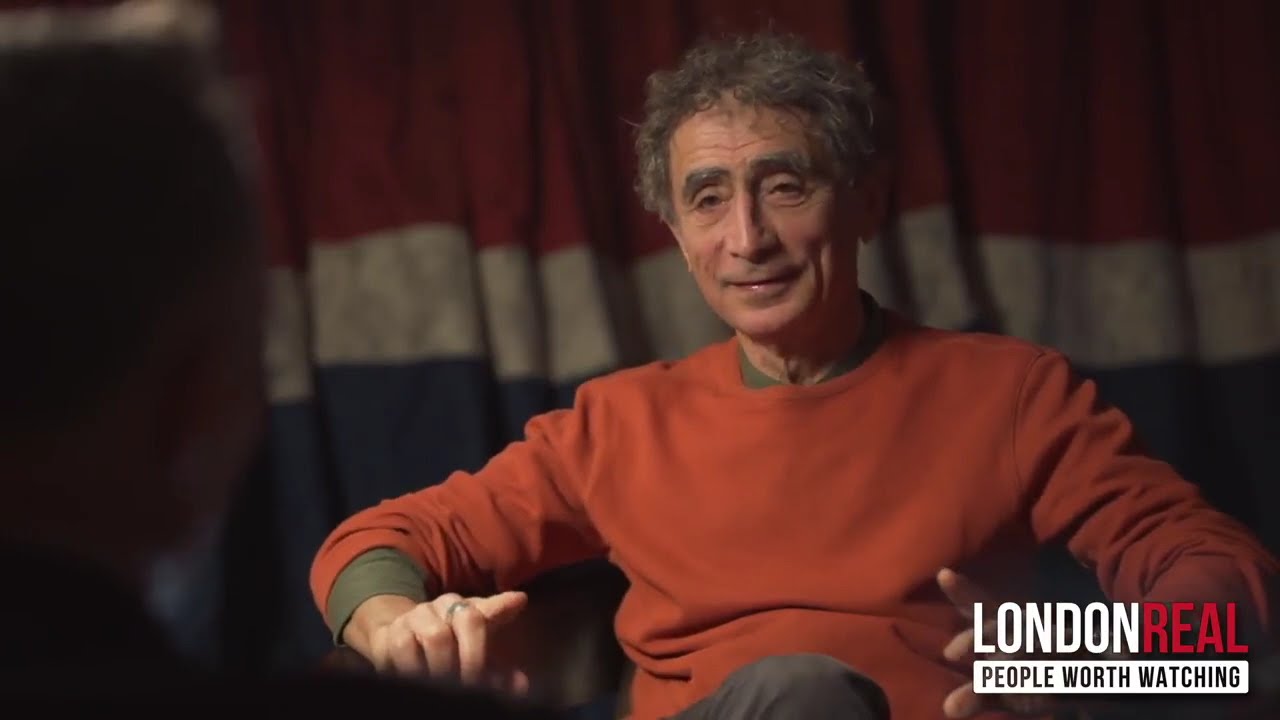
In this interview, Dr. Gabor Maté expands the discussion of trauma beyond addiction to argue that most chronic illnesses—including autoimmune diseases, cancers, and neurodegenerative disorders—have roots in early‑life emotional trauma. He explains that while trauma does not guarantee a specific disease, virtually every person with addiction or chronic illness has experienced significant trauma, which shapes emotional and behavioral patterns that generate chronic stress. This stress, in turn, dysregulates the integrated brain‑body‑immune system, leading to disease. Maté cites historical and contemporary examples (e.g., Jonathan Swift, Ronald Reagan, Betty Ford, Jacqueline du Pré, Stephen Hawking) and research findings (e.g., abused children have a 50‑fold increased risk of asthma; childhood abuse raises cancer risk by ~50%). He critiques the narrow biomedical model that treats disease as purely mechanical, urging physicians to acknowledge the limits of their knowledge and to incorporate trauma‑informed approaches in prevention and treatment. The conversation ends with a call to continue watching the full interview.
Talk to me about solutions or other ideas to challenge perspectives of either our society or an individual addict.
Well, can I broaden the discussion beyond addiction for a moment?
Please.
And then come back to the solutions, if that's okay?
Yeah.
Because although addictions are a very dramatic and very salient example of what happens to people as a result of trauma, it's not the only manifestation. I'm saying something much broader than that. I'm saying that most chronic illnesses also originate in trauma, including autoimmune disease and cancer and degenerative nervous system disorders and so on. That's harder to prove, but it's— the reason I'm mentioning it is because the solutions that we're going to talk about pertain to all health issues, not just to addiction.
Right.
Okay.
And these are bold statements to say that trauma causes cancer.
Well, I didn't exactly say that.
Okay. I'm sorry. What did you say then?
Well, if I— see, when you say— I don't say that trauma causes addiction in the sense that if trauma caused addiction, every time you saw trauma, you should see addiction, but you don't. What I'm saying is that everybody with addiction was traumatized. So trauma is one of the salient causes, but it's not a direct one-to-one relationship.
Okay.
Just to be scientific about it.
Okay.
Now, I'm saying the same thing about most cancers, and most autoimmune diseases as well, and most chronic degenerative nervous system disorders as well. So if you look at both the lives of people, as I have many, many times, with, say, autoimmune disease, there's significant childhood trauma. Based on that childhood trauma, then there's certain behavior and emotional patterns that the person adopts as a result of the trauma, and those emotional and behavioral problems then cause stress in their lives, and that stress then brings on the illness. That's my book, When the Body Says No. When people don't know how to say no, there's stress in their lives, the body will say it for them in the form of some kind of illness. And, uh, Typically, just as you and I may have become workaholics and successaholics as a result or as a compensation for the sense of not being good enough or not being wanted, so people can also cope with the same sense by becoming extra nice. By always supporting other people's emotional needs and ignoring their own, by never being angry, by repressing their anger. Now, when you do that, you're actually messing with your immune system. And the reason you're doing that is because, again, scientifically, this is just pure science, Our emotional functioning is not separable from our physiological functioning. The brain centers that regulate emotions are connected with the hormonal apparatus, the nervous system, the gut, the heart, and the immune organs. In fact, it's not even that they're connected, it's all one system. So things that happen to people emotionally will immediately have a physiological effect, as you would know if I screamed at you. Because your physiology would change like that. Well, this happens 24/7. Those interactions go on 24/7. Now, our emotional patterns are laid down in childhood. And so when you look at people with physical illnesses, and I don't care what— I looked at famous people like Jonathan Swift and his Alzheimer's, or Ronald Reagan and his Alzheimer's, or Betty Ford, the former American First Lady, and her breast cancer. Or Jacqueline du Pré, the great British cellist, with her multiple sclerosis, or any number of patients that I interviewed, it's always the same story of severely stressed childhood, self-repression as a way of coping, not as a personal fault, but as a way of coping, and then some kind of disease process in which that self-repression manifests itself. because of the unshakable unity of mind and body. So, lots of studies have shown that kids who are abused have 50 times the risk of asthma. 50 times.
50 times.
50 times. The more stressed your parents are, the more likely you have asthma. If you look at people with what is— what in Britain is called motor neuron disease, in America is called Lou Gehrig's disease or ALS, like Lou Gehrig himself, the baseball player, or Stephen Hawking, the physicist, emotionally deprived childhoods. And by the way, Hawking is an interesting example because he was told I think well over 50 years ago now, that he had 1 year to live, which kind of shows you that maybe we as doctors don't know everything, and that maybe the body has a way of— he's not healed from his disease, but he certainly has lived with it and thrived in many, many ways. Now, there's all kinds of reasons for that, but it just means that our narrow mechanical understanding of illness is insufficient. And when they tell somebody they want you to live, what they're saying is, we, with our limited awareness, have no other way of helping you. But instead of acknowledging that, we make it about the disease, that this can't be helped, this can't be healed. Then you have all these stories of people getting better from so-called terminal illnesses, you know.
No, which means we—
which means by definition we don't really understand I know, I know, that's exactly what it means. And again, if we only had the humility as physicians to say, well, you know what, this is as much as I know. You have now reached the limits of my knowledge. I personally don't know what to tell you anymore. And in my view, given what we know how to do, your chances aren't very good. But that's because of the limitations of what we know. Now that might— that would be an honest statement. But of course we don't— we mistake what we know with reality. So if we don't know it, it's not real. Because if it was real, we would know it. I mean, it's just circular thinking, but that's how we as doctors look at things. So what I'm saying is that I could give you a whole set of statistics on relationship between childhood trauma and autoimmune disease. A Canadian study that shows that if you're abused as a child, your risk of cancer goes up nearly 50%. And actually, abuse, by the way, is only one form of trauma. So yes, I'm making a bold statement, but there's all kinds of scientific reasons for me to make it.
Okay.
A lot of research behind it.
Continue watching this fascinating conversation for free by clicking on the link below to visit our website, learn from the best minds in the world, and connect with a community of passionate people building the best versions of themselves.