Hypnotherapy Explained | Mind, Subconscious & 3 Brains
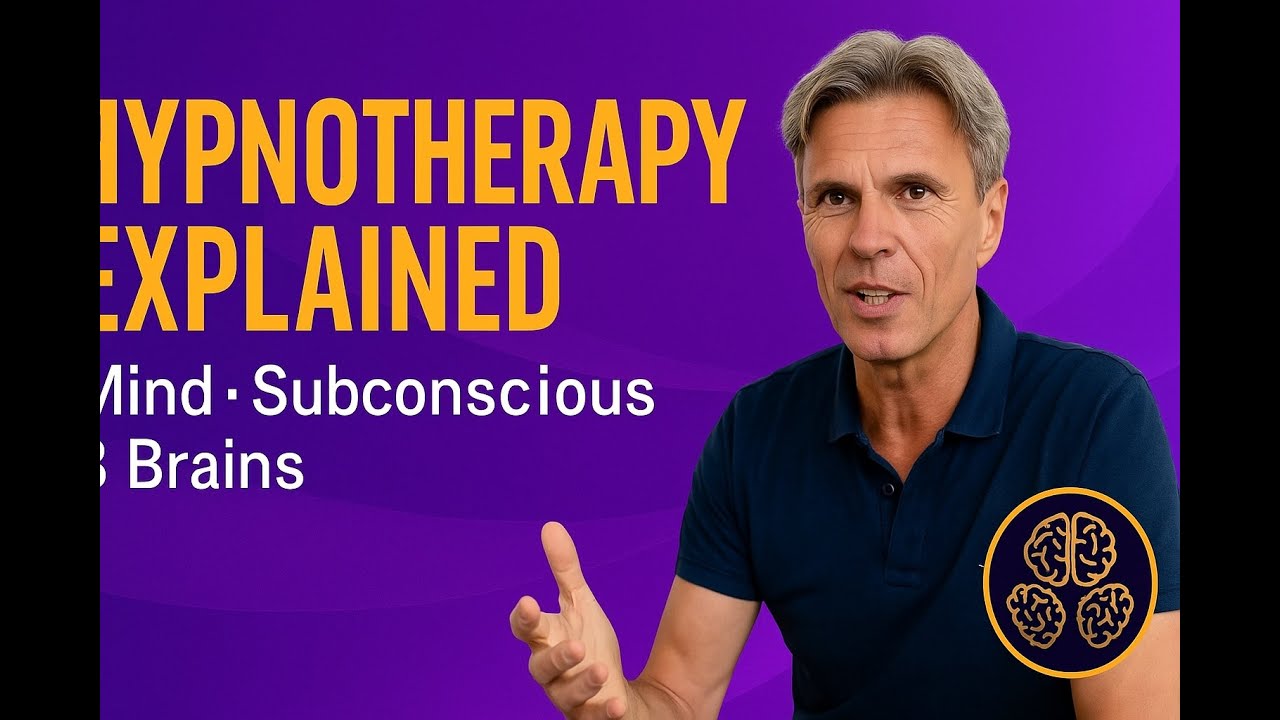
In this 2020 webinar Christoffel Sneijders, a clinical hypnotherapy supervisor, executive coach and associate professor, introduces the art and science of clinical hypnotherapy. He defines hypnosis as an inward‑focused, relaxed state that people experience daily (e.g., while watching TV, driving, or exercising) and explains how it differs from everyday attention. He outlines three historical generations of Western hypnosis – the authoritarian early school, the Ericksonian client‑centered approach, and his own “Awakening the Voices Inside” method that integrates a three‑brain model (head‑conscious, heart‑emotional, gut‑instinctual) and an energy field concept. Sneijders argues that most behavior change fails because conscious willingness is overridden by subconscious beliefs stored in the iceberg‑like subconscious mind. He presents research showing hypnotherapy’s superior success rates (e.g., 93 % recovery vs 72 % for behavior therapy) and explains why it works: it directly accesses the subconscious and aligns the three brains. He then describes the massive market need in Australia (≈45 % of the population will experience a mental‑health condition, high rates of depression, anxiety, addiction, stress and burnout) and critiques the limited efficacy of conventional psychology and corporate interventions. The second half of the webinar details his clinical hypnotherapy training program, its 23‑day, 8‑month structure, curriculum (hypnosis techniques, communication skills, interview protocols, brainwave education, 3‑brain assessment, belief‑pattern analysis, treatment mixes for common issues), and the added Advanced/NLP 3‑Brain Coach certification. He explains the non‑government regulatory framework, the role of the Hypnotherapy Council Australia and other professional bodies, and the benefits of association membership (insurance, health‑fund rebates). Finally, he offers practical business coaching on building a practice, digital marketing, ethics, and pricing, concluding with a limited‑time discount for webinar attendees.
Chapters
I would say hello everyone. It's almost time to start. I'm recording this on the on my computer, so later on this will be shared. This presentation, so you can. See it and watch it in your own time. I'll put the screen on play. So now everything is there. Yes. So I'd say welcome again to this webinar of clinical hypnotherapy. In my words, hypnotherapy is the art of making life changes possible. I'm going to talk about what is hypnotherapy on one part, and secondly also a little bit about what the clinical hypnotherapy training does. As you can see, you can follow 2 different kind of trainings at my school. So what is today's webinar going to be? Hi Ernie, also good to see and hear you. So today's webinar, what we're going to do, everything actually said in the email. We're going to touch down on all the different, different things about conscious, subconscious mind, What is hypnosis and all the other kind of things. If you have a question in between, you can always chat, or I will open, by the way, the chat, or you can also, what do I say, something. Okay, well, I'm there. I'm going to put the screen on again. So now I see everything. That doesn't work because then it's full screen. I cannot see what you're going to say to me. Now we're going to discuss all the different things we're going through today and Actually, who is me? Who's going to talk to you? Christoffel Sneijders. What's my experience? I'm a supervisor in clinical hypnotherapy. That means I, I discuss— What is— I supervise different people. So I was typing back to Scott if there are more. Yeah, there are now 2 people at least live, and some other people are also listening or calling in. So when we go back, what can I bring to you? What is— then I have to change the chat again where it is located, otherwise I cannot play this one for you. Yeah, now what can I bring to you? My experience. I said I'm a supervisor in clinical hypnotherapy. That means I supervise other clinical hypnotherapists throughout Australia. also a hypnotherapist. I work with depression, PTSD, anxiety, and addictions. That's my specialization. I'm a lead trainer for the training of hypnotherapy and NLP. I'm also an associate professor at the business school in Madrid. That's why I'm now in Madrid teaching leadership and organizational behavior, so really on the soft skills. I'm an executive business coach, so I coach people in the business world. And up to now, 30 years of working coaching, training, and therapy and consultancy. I did my math, more than 10,000 people were somewhere in my trainings or I worked one-to-one with them. And I worked in Europe, Middle East, and all the different kind of countries. And it gave me a beautiful insight actually what really works and doesn't work for people. I'll touch it shortly. I'm inventor of the 3 Brains Coach Therapy Certification. That's a special training part of Advanced where we make the subconscious even more tangible. Who's in the company? Who's in the team? That's Amanda Hassell. She would have loved to join this webinar, but she's now only moving houses, so it's totally in the boxes. She's one of the co-trainers. Julie Harris is the director and sometimes also steps in the training as to give a hand. And Jerry Hoekman is the CEO specialist and digital marketing specialist, and he comes and enters the training also to work on you to how to set up a business if you like to have a business. What should you do and shouldn't you do with websites, SEO, digital marketing? Let me go to hypnosis. What is actually hypnosis? To make it easy, it's an inward focus state. That means focusing actually on your own awareness, on your own body, being disconnected from everything we hear and everything we see in the outside world. That's why in hypnotherapy session we most times will ask people to close their eyes. So if your eyes are closed, you can only hear the sound coming in, but your sensory system, the digital sensory system of seeing everything, is just disconnected. So it's much easier to become aware how you breathe, how you act, and what you feel. It's also a focused state on one thing. So really, if you focus just on one thing, that can be whilst driving, that can be in a hypnotic state, that can even in the old, old, old days when we used that watch, but you see it sometimes You focus on one thing, and based on the focus state, you disconnect from the outside world. It is also a relaxed state of breathing. All 3 of them connected brings you in a beautiful state of hypnosis or relaxation. One of the 3 can bring you there, but most times it's not enough. They really have to dance together. How does it feel? It feels like that state between awake and sleep. You know that this morning I was just snoozing once or twice In that state when you're snoozed, but you're actually awake and actually asleep. In that moment, that's actually that state of hypnosis. That's how it feels. And it's also a state where we allow ourselves to have our survival mechanisms off. That means we don't put a fight-or-flight response or defend Defense mode right away there. Because we lower our defense, it's easier to make change. That's why we make change because we open ourselves up to new kind of ideas, new kind of advices, new kind of suggestions. And actually, the hypnotic state or that relaxed state is essential for a body and mind. To have a healthy life, that relaxed state that we get in, and if we touch some brainwaves, you also become aware of that, is essential actually to let your body and mind rejuvenate and that the processes in your body start doing the healing and also the physical healing. Relaxation after sport is one of those little things that actually the body does. To rejuvenate, and it's actually an inward-focused state. When do we experience hypnosis? Because it's seen on television that let me walk like a cuckoo or like a chicken. Actually, I can tell you guys, we experience hypnosis at least— I would— some churches say 100 times a day. I say 25 times a day. Everybody every day experiences hypnosis. And when do we experience it? When we allow ourselves to focus on one thing. So you're only watching the television, you're only watching your video, you're only watching— you're reading a book, you're only watching your iPhone. In that really focused state, you can touch on a hypnotic relaxed state. When you're driving, who did not experience once that you were driving for some time and you just forget, did I see that traffic light? Did I see that crossroad? Did I see whatever? And we did, but in a hypnotic state, we were totally focused on what we were doing. When people do sports, they can get into that flow, especially if you do, say, marathon or long-distance sports, you can really get into there. When you're doing cooking, a lot of people experience a hypnotic state when they're cooking and just focused on one thing, letting their mind flow away. When we watch television, as I said, if you watch a movie, you can really get in a hypnotic state and just zone out. Listening to music is a beautiful way to get in hypnotic state. And when you really get into the song, the world around you just stops for a minute. Of course, when we do daydreaming, makes sense, because then actually we are almost really in a hypnotic state because we are outside the realistic world. We can do it by ourselves by doing meditation. And all the other things I did, I miss out. So it's a normal part of our life, that hypnotic state. It is there to rejuvenate, as I said, and because it's a normal state of our body and mind, we can also use it in the therapy part of the world or even in a coaching part of the world. Now when you look at hypnosis, there are actually 3 different generations of Western hypnosis, and I talk about the Western world. The first ones that came into this world, that is, came in from mesmerizing and the therapy world beginning of the century up to somewhere the '60s, '70s. Although having said that, it's still being taught in Australia by some schools. It means actually in authoritarian way that the therapist or the coach is directing the client what he or she should do. So you put the responsibility of the change actually at the therapist or coach's hand, and he or she decides what's best for you to do. That means they will— actually, they will say to close your eyes and to start changing from A to B. So it could be from stop smoking, also to say sport more, or everything in between. You can also find it still in schools who use protocols and say we use the SWAN protocol or we use that protocol, because the protocol, or also scripts, actually describe how you should change and they're not tailored to the person. Sometimes NLP even does the same. Erickson stepped in. Erickson is the American hypnotherapist who died 30 years ago, but in the '50s till the beginning of the '80s really brought a new way of hypnosis or therapy into the world. And he loved to say every client is unique, so every client deserves a tailored session. and used the qualities of the client to make the change. And in that hypnotic state where the conscious mind is a bit dissociated, he used the qualities of the unconscious mind, like almost like a dance together. Now, the 3rd generation of Western hypnosis, what we teach at our school, is the Awakening the Voices Inside therapy. What What's the main difference? Where we always talk about conscious and subconscious mind, I will come back to that later. We also add that actually we have 3 brains, one in our head, one in our heart, and one in our gut. And we communicate with them so that actually all the things you have in your life are more tangible and more workable. Also, we connect with, say, the energy field we all have in between us. If you think about Reiki or think about other kind of things, we are all energy, and sometimes we can feel things, or we can feel things that happens. I think you all can remember sometimes you enter a room and it feels, say, happy or not happy, that room, or the energy of the people in that room feels different when you enter. And that's actually what we call the collective field of energy, and we work partly with that. Those are the 3 ways that's happening. Now actually, what is the— I say what's the market, but say you would like to use this as a trait, as a coach or a therapist. Is there business for us? Actually, it's massive, because in Australia it's estimated 45% of people will experience a mental health condition in their lifetime. That's 1 out of 2. So half of the people who are listening now will have somewhere— have it. Now, I had it once, so I'm already one. So who's next? In 1 year, so in 2020, 1 million will have depression and 2 million will have anxiety in Australia. That means 1 in 5 will experience mental illness. And maybe based on all the fires that are just devastating Australia, the anxiety or depression rate can go up. this year because there's so many losses done. And when you go to the research, 40.4 anxiety, 6.2 depression, and say substance, so addictions, 5%. That's 1 out of 4 if you also add addictions there. There's enough business for all of us, but it also means society really needs help. to deal with what's happening now. If you'd like to work in the business world, I can tell you it's also massive business there because 1 out of 5 Australians experience symptoms of stress or burnout and need some coaching or short intervention. As being also a business coach, I hear those questions a lot. It's not only about please coach my, my colleague or Or me, but also hey by the way I feel a lot of pressure on me. I cannot deal with it anymore, etc., etc. Can we work on that? So they almost ask a lot of times say therapy-related questions. Besides hypnotherapy, what is now done in the market to solve this? Just to put it in perspective, what's the most common way if you go to a GP? What will what will they say? Go to psychology. Actually, that has a success rate of 15 to 40% based on research done by the psychologist organizations by themselves. Counseling, even the success rate is lower. There are 10 different kinds of psychology treatments from psychoanalysis, say Freud, to CBT, the latest cognitive behavior therapy. That is cognitive behavior therapy means how you think and how you behave. So if I think I'm happy, I will behave I'm happy. So let's work on that part. If you'd like to go into companies, culture change projects have success rate from 1 out of 4 according to McKinsey, IBM, and Gallup organizations. And it's not me who says it, there are sources as you can see in the slides who support those findings. Is this really a great result? Nah, not for me. 'Cause it means 1 out of 4 success rate. That means 3 out of 4 are still not happy with our services. That also pushed me almost from being a coach and a business trainer as I started off 30 years ago to become much more and learn much more of the therapy world 'cause I really wanted to increase my success rate. So what is now being done about the success rates by psychologists and by the business world? In psychology, actually, they added mindfulness now. That is a 3,000-year-old methodology. And they add EMDR, eye movement desensitization, what actually means moving your eyes from left to right while you connect with the issue you have, or actually the trauma you have, and will disconnect the emotional Emotional connection. EMDR is no psychology-based; it's actually NLP-based eye movements. It doesn't have to do anything with you learn on in the university of psychology. So actually, what psychology is doing now is adding tools that don't have to do anything with psychology because they come aware psychology is not the solution. In the companies, what they do— and if you're working in a company, then maybe you saw it already— agile. Agile is hot. That's a new way of working. And we invent Scrum Masters, and everybody's responsible in the project, and those kind of stuff. And actually, the success rate is still poor because it's still less than 40%. It's rather a pity, I can tell you. So what should we actually change and why doesn't it work? Now let's now go to the subconscious and conscious mind. And what most literature said and how I was taught 30 years ago, say if you understand something, you're, you, you are willing to make a move because if it makes sense to do something, then do it. If it makes sense to wash your hands, wash your hands. And if you have the willingness then to wash your hands, it's going to happen, because I can understand that I have to wash my hands, but if I'm not willing, I will not do it. So if I'm willing to do so, it will happen. And if I have the ability to get up and walk now to the sink, now done. Now, with washing your hands, it can be, it can be done. But everybody who's a parent knows you can explain your kid to do something, but the willingness, ability Is not enough. And now think about about yourself and your own life, and think maybe about the things which have to be willing to do something. It even made sense. You had the ability to do so, and still, if you look back now, you did not change. That can be with the New Year's resolutions. It can be other kind of things: sporting more, eating less, drinking less. I don't know. Cleaning out your closets, clean the house, and still you fall back, say, in the old habit, and we blame the habits for not changing. Now, actually, it doesn't work like that. There is something that is stopping us, and now we're going to get into the science. What is actually stopping us, and how does it make the difference? And to show you how hard it is to change, there's research done by the Lung Society in America already 2007, and they checked hypnotherapy and NRP, that is, that's the nicotine replacement products. And they came aware if people use hypnotherapy, 50% stopped smoking. If they used hypnotherapy and nicotine replacement products, also 50% stopped. When they only use nicotine replacement products, only 50% stopped. So again, they came aware, hey, cognitive behavior therapy, actually what nicotine replacement products is, you use 6 weeks a replacement patch on your arm or use the sprays, and after 6 weeks of changing your behavior, 6 weeks of not smoking, you should not be willing to have that cigarette anymore. Now, and only 50% did that, and now 85% fell back into smoking. So again, they became aware, hey, that willingness, understanding, and ability is not good enough. What is happening? And in other research, they resulted that psychoanalysis only had 38% recovery, and Behavior therapy, 72%, and hypnotherapy, 93%. So there's a lot of research done also. Why is this working? What is happening actually now? And now we come to the answer: why is hypnotherapy so successful? The conscious and subconscious mind. I think you also these kind of pictures once. The iceberg. We have a conscious mind above the iceberg. We know what we're doing, and underneath the iceberg in the water is the subconscious mind, between 90 and 99%, depends what kind of picture you look at. And there's actually control of all the systems in the body. There are beliefs, there are traumas, there's everything. That's underneath the iceberg, underneath the water, so we cannot see it. Now here's actually the issue and the solution in the same moment. Why it doesn't work, psychology and culture change, and why hypnotherapy works. Because that willingness and understanding and ability is actually done in the conscious mind. And the beliefs that are in their subconscious mind that we don't see actually run our life. And what are beliefs? Now I just stated an amount of them. And I think we can all touch one of them. Beliefs as I'm not good enough, I'm too old, too fat, too short, too thin, too dark, etc., to do that. I have to be strong. I should not show emotions. I should take care of the other first before I take care of myself. I should be able to handle everything. I should be perfect and work harder and more than the rest. I have to be very ill to deserve to be taken care of. You cannot trust people. I never have enough time. Relationships are just too hard. If you're a woman, you cannot get ahead in life. I'm overweight because my family is big-boned. People always let you down. All those beliefs we have somewhere in our life that run our system. I did not put here one in, but some people say I have an addictive gene, or I'm Easily addicted. Now, that's actually also belief because there is no gene, there is in your DNA no gene that is connected to this addictiveness. That is just belief because you saw your parents doing it or your friends were doing it or somebody else. If you look at smoking as an example, 99% of the people start smoking based on peer group pressure during their school period. Most smokers start between 14 and 18 years young because at school their friends smoke and they start to smoke as a social action of peer group pressure. Now when they like to stop smoking after 20 years, they say, you know, smoking helps me to relax, uh, it just makes me think more clear, it gives me a break from work, and all those kind of things. You never hear the first sentence again, hey, I did it because my friends did it. And everybody who ever had a cigarette can remember the first cigarette is really horrible. When I took my first cigarette when I was 16, based on peer group pressure, I think I coughed my lungs out. And yet all my friends were laughing like hell because they really saw me turning green and pale. And after a couple of cigarettes, you feel strong and you think, I can. And those are the beliefs. Those beliefs are extremely strong. And how do they work? And how do they actually run your life? Now, and now there's an explanation actually how we work. What is invisible for others So I don't know what's happening with you, you don't miss me, is actually our instinct. Yes. We're all born with the desire to seek happiness, belong to our parents, our caregivers, otherwise don't survive, feel love, and avoid pain and fear. That's the deepest instinct we all have and we share with all the animals, at least the mammals, dogs, cats, cows, whatevers. horses, and we cannot declare it. We don't know that. We don't know actually how it's— how we like to connect or how we like to avoid fear of pain. If you change how you sit or how you stand, actually it's an action of avoiding pain, but you're not thinking of it. You just move. A little bit later in life, but still before our first 3, 5 years, when we're young, we learn the values from our parents, from our caregivers. We learn to have passion, trust. We learn sadness, anger, uncertainty, and loneliness. We learn all those emotions, how those feels, because we are connected inside in the social world with our parents or caregivers, siblings. We cannot declare that our body is in charge. And when we see our parents, we have an emotional reaction— happy, not happy, smiling, not smiling— and we don't think about it, it's just really in it. Later in life, when we go to school, we learn the justice systems— what should and shouldn't you do, listen to the teacher, not listen to the teacher. We learn the beliefs, what is right and wrong. We learn the rules at home, at school, and we learn shame and guilt— that we are too fat, too thin, too not. Everybody who goes in that age between 10 and 15 have some of that comparison with their friends. We can declare it partly, but still our body is in charge. Now what do we see when we work with people is actually how to communicate 100%. And what do you know from me? You know my voice, you hear still my little Dutch accent in my throat, you hear the Into the tonality, the speed, how I talk and don't talk. And that's visible for others. And easy to change the speed of pace I'm talking. And it's really hard to change my instinct. Now, where do we have all our issues? Actually, in that underneath that iceberg In that instinct, in those values, in those justice systems. There are our issues actually stored, the root cause of our issues. The issue now is what we do and what we act, what we see, but where it really is originating is really in that not declarative memory. Now, and how does it now work when we work with people? If you go to a psychologist, if you go to a coach, If you talk to your friends, it's actually what we call talk therapy. People talk to you and you have to understand it. We check the willingness, we check if you're able, and then we say, okay, now, now do it. Change not declarative memory. Now, I always like to challenge people in that part. We blink automatically. We blink between 10 and 30 times a minute. I always say to people, just stop blinking for a minute. You will become aware it's impossible to do so. You can open your eyes, and after 10, 20 seconds, you will blink because your subconscious mind, your body, just takes over. It's impossible not to do. Now, where does hypnotherapy step in? Boom! It steps in right away to the issues. It connects right away where we start because actually we talk to the subconscious mind. That's why it's so extremely successful. Now, what is now special in how we teach it and what I came aware of the last 10 years, we actually have 3 brains. Now, actually you could say we have 5, but 3 to make it extremely clear. We have one in our head, That we call the conscious mind, to make it black and white. And that's actually what we do now. We try to understand what is now being shared, not shared. Maybe you have questions in your head. How does it work? Why does it work like that? Hmm, what's there? Do to analyze what I'm saying and create somewhere an understanding and create maybe how it will work for you. The creative process is done in our logical mind, always one deep-rooted highest intention, that is to predict the future better. Everything we do with our heads has an objective: how can we do it better next time? Connected actually still with our deep-rooted basic system to survive. If we are smarter than yesterday, we have more survival success. Makes sense. What are the other two brains? What is our subconscious mind? We have a heart brain, 100,000 brain cells backed up by science, 100,000 brain cells. And we have a gut brain, 500 million brain cells. That's somewhere the size of a cat's brain. What do they do? The gut brain has as primary instinct survive. The test action is fight or flight. If it's too hot, we fly to air conditioning. If we cannot get out of the sun, we're going to fight the sun and just accept it. What's the goal? We want to have results. The survival brain, the gut brain, always likes to have results and always asks the question, how can I achieve this? And that actually, it's also in the bottom of the circle, is always in charge. It's that in the pyramid, the part. And if we don't feel safe, this one will take over. Then there's a heart brain, and the heart brain is love, and it's all about connection. We created that, if we can say created that, 60 million years ago, 60 million years ago, when we became mammals and we started to live in groups. The action is being connected, being connected with other people. The goal is really to be together. The question is with whom, or maybe with whom not. And that one can be in charge when you feel safe enough, it makes sense. Now, every issue we have is somewhere stored in one of those 3 brains, or in all 3 of them. Or they have the discussion together. It makes sense to do something. Only by making sense what I do, maybe I will hurt somebody, a family member, a friend, a colleague, or somebody else, or they will not be happy with it. But for my survival action, it's great. Let's do it. Now then, you somehow have a disconnection between the 3 brains, and somewhere we create an issue. The discussion I had yesterday, 2 days ago, I wanted to see the soccer game in Spain and my girlfriend wanted to have a nice dinner together. Now I think most blokes will remember or can connect with that one. You like to do A, your partner likes to do B. So will you choose for yourself, the survival mechanism, I like to see it, or do you connect, or do you listen to your heart, you connect with the partner? That discussion somewhere could create attention, especially then in communication If it goes wrong, that's how we work with it. What does all of this do? It's just a whole text. I can tell you, a client came in last year. It was one year ago. No, maybe two years ago now. It's now 2020. She was drinking two bottles of wine. She does already doing that for ten years. She was seeing a psychologist for the last five years. And when I asked her what, what, what's happening, actually during the interview, 3 things came up. As a child, she felt unloved by her mother. She learned she was unimportant and she has to be invisible. Others first. She had intrusive thoughts of being sexually assaulted by a friend of her brother when she was young. And 22 years ago, now probably 24 years ago, she became pregnant. She was single and in panic arranged termination. And now, 22 years later, she was still single, she still did not have kids, and had a lot of grief about it. And based on those 3 things, the last 10 years she was soothing the pain with 2 bottles of wine. Now, you could say that's not a happy issue. She said to me, I don't deserve happiness, I'm unworthy, I hate myself. Working with her with hypnosis and those 3 brains, I could talk to her gut and her heart in a hypnotic state, and it could help her to connect with the energy that is really inside her heart. And that's that self-love that was totally dismissed by her parents and by the sexual assault, and also hating herself. that she terminated her kid. She could forgive herself. The end of the session, it was the first time— this is a letter from her, that's why I have it like here— in that she could say, I love myself, I forgive myself. The depression lifted off her and she walked out with a big smile. 2 weeks later, I saw her again and she stopped drinking. In 2 weeks' time, she went from 10 years drinking to no drinking at all, except water and tea and coffee. but no alcohol at all anymore. In one session, she stopped drinking. We still needed a lot of other sessions, I can tell you, to solve the other issues which were there, because it's not something like a miracle cure and one session is over. But this is what happens if you use hypnosis and you connect it with the 3 brains. You can have massive results. And this is, say, in therapy. In the coaching world, I have similar successes. So when can hypnotherapy be really successful? When you have procrastination issues, and everybody has those. Because what is procrastination actually? That is discussion between your 3 brains. One brain says, yeah, it makes sense to finish it. The other brain says, I don't feel like it. And the third one says, maybe it's not smart to do so. A lot of people procrastinate Because they have the fear of the finishing. Because if they finish, they could be judged on the result of what they deliver. And somewhere on a subconscious fear to be judged, they don't finish. Doesn't make sense logically, but it's coming from the heart or the gut brain. The gut brain in that moment says, don't do it, you will get judged. And the heart brain feels that Connection of belonging, and if then is judged and maybe then disconnected from the person, it doesn't like to finish. Depression, I spoke about already. Depression is always connected with grief or loss. Grief of most times a person. that is not there anymore. It can also be a relationship that broke up, or a loss even from work, or loss of a hobby, or a loss of something else. And it could have suicidal thoughts because you think you're not good enough, or that actually the only solution is not being here anymore. Depression is not a physical thing, it's a mind thing. Addictions— now we spoke about, about 2 bottles of wine. Alcohol, smoking, gambling, drugs— extremely good in hypnotherapy. Why is that? Because addictions, to make it extremely black and white, are always a band-aid to soothe somewhere a pain. And the pain can be being alone, the pain can be not being good enough, the pain can be sexual assault, the pain can be being bullied, the The pain can be not being part of peer group. The pain can be whatever, and based on that, we can get somewhere in addiction. Eating disorders: overweight, bulimia, anorexia. Makes sense because nobody and not your body, nobody and your body likes to be overweight or likes to have bulimia or likes to have anorexia. Our body is made to be healthy and our body wants to be healthy. The fact that we eat too much or eat too less or vomit everything out means there is an issue underlying that makes us do so. Being stuck, and that means being stuck, I don't know what to do now anymore. Actually, that is not be able to choose out of alternatives we have. And it can be based on Fear can be based on people, can be based on other kind of things, and we can help people out of that. If you have ego or trust issues— ego is more that's about you, and you like to prove yourself, you have to be the best, bigger, whatever. Underneath ego, every ego is somewhere a fear, because if the ego gets lost. What is left? Yourself. And that self could be, say, not acknowledged, could not feel safe. Trust issues is the other part. Trust issues is actually that somewhere you have experienced that you cannot trust people because they cheated on you. And then so the experience steps in. Stress, anxiety, those 2 million people in Australia who suffer with it. Actually, stress and anxiety is a fear-based issue, and the fear is what will happen if I do or if I don't do that. If you have to perform somewhere in sport, in work, in whatever, and you have a fear of that you're not good enough, Stress or anxiety steps in. Post-traumatic stress, I think it will go up now with all the fires that are there. How do people deal with all the things they saw? And it cannot only be by really being in that fire now in Australia, but also seeing them on Facebook and all the Facebook posts about the animals that are burned, the The bushes that are totally burnt, the wasted land, the houses that are burnt, the dead people. Even just watching the news or watching social media can create post-traumatic stress syndrome. Self-esteem, confidence also works amazing on that because it's also connected with that anxiety and stress. How do you really get there? Phobias. From fears, from spiders to snakes to other kind of things. It's logical to have a fear for a spider, but not for every spider. Compulsive behaviors, the same. Compulsive behaviors is actually control mechanisms that you do to feel safe. If you close the door 5 times, then something good will happen, or not something bad will happen, actually. And all the habits we have, we can change them. And to sum up, actually everything we do is ineffective decision-making. How do you make decisions? Everything above this list is about the decision you make. Only it's not only rational, because decision-making can be a rational one, but most ineffective decision-making is when our 3 brains are not aligned. And when you think about relationships, you can see, hey, that person looks really great. Wow, let's have a relationship. But that's then only on the gut brain that she or he looks great. If she makes you feel extremely good and you feel the love, it's only a heart decision. If you think, hey, wow, the person has a lot of money or has a beautiful house, it's a— it can be a gut brain decision or it can be a head brain decision. Yes, our most ineffective decision-making is when our 3 brains are not aligned. By having that communication hypnotherapy with the 3 of them, massive changes happen. If you go back to hypnotherapy, what most people believe is that people cannot be hypnotized. I'm too strong-willed, I have strong minds. Actually, what people say is, I'm afraid to lose control, that's why I can't be hypnotized. As we came in the beginning of this webinar, we experience hypnosis 25 to 100 times a day if you watch the television, to do sports. So actually, everybody can. People say, I lose control, you can make me walk like a chicken. Now I can tell you, if people would lose control Being hypnotized, I would now be a millionaire and live in a penthouse. If I go to Bank West and say, hey guys, let me hypnotize you and give me a million, I can tell you I get kicked out of the, out of the bank, out of the office. You will not lose that, will not happen there. And I never got a free drink just by hypnotizing the bartender. You can't do anything that the same as lose control? Absolutely not. Everybody does this, goes on that stage in hypnosis, likes to do something strange. They give consent of doing something. They're more suggestible, more open for the things. Now, what's another myth? That people will come to you and say, hey, you can use hypnosis, zap me. Now, going back to the other things, I cannot zap somebody because I cannot change somebody's mind. I can only help them to change themselves. I spoke about brainwaves, and this is the chat for brainwaves. It doesn't walk in because I copied it from somewhere else, because this beautiful overview— in normal state, we are in beta waves. That means we're in an active normal state of consciousness. Our head brain is totally alert, and we do a lot of things. When we get more relaxed, and that's actually what we experience at 50 to 100 times a day, is alpha waves. We go into a light meditational state, a more relaxed state. Usually with eyes closed, but we can have our eyes open. We breathe a little bit more relaxed. And we just feel more at ease. This happens when most people are working in flow. They come at that state of being in mind. When we go a little bit deeper, the theta waves step up. And it means that when you look at the brain, that there are a whole sequence of how the brain acts is in a more, more, more slow state, as the waves already show you. And this is when we go in a deep meditation, or actually are also in a state between awake and sleeping. That's what happens when we have the delta waves. It's the deepest state of hypnosis, and also when we are in sleep. It is actually that our brain is totally almost turned off and is in a totally relaxed, deep, deep, deep, deep, deep, deep state. On this moment, actually, your heart brain and gut brain— actually, your gut brain is totally active and uses all his or her power to rejuvenate the body and make all the things work properly again. And brain waves are actually the connective state of how your brain works. And I'm curious When you think about yourself, you don't have to answer on this, but just think about your own mind. Let's do 1 minute of daydreaming. Say you could choose, what would you like to overcome? It's now 2020. Where would you like to without, or what would you like to live with this year? What would you like to achieve? I need to think about that achievement. And you imagine it. How does it make you feel? And you become aware that if you do so, you probably will get a physical feeling about it. Your heart or gut says something, or you feel more or less relaxed. You smile more, smile less. Your body will respond somewhere because you're thinking of something that you like to do, or something negative like to live without. If you think about all the qualities and possibilities and positives actually that each change will bring you, your body will react. This is partly how hypnosis works also, that The moment you talk to people, you let them imagine, you let them start focusing on things, people will change somewhere. You could think about installing new beliefs or getting rid of old beliefs. When we think of those kind of things, people will change. You ask people how life, a great life, will be. Always the question We have to ask people, are you willing to invest in that? And it means that willingness we spoke about— are people really willing to let go of life as it was now and step into what they really have? Because every coin has 2 sides. So that means if you do something, something else will not be done anymore. whatever it is. Now, if that is really compelling, you have the dialogue with the 3 brains on that moment, people will really change. And if we now step, say, in a different thing from how does hypnotherapy actually work in Australia, because you joined the therapy webinar, so let's share how it works in Australia in the last 10 minutes. Clinic hypnotherapy is non-government regulated. What actually means the government delegated the regulation to the associations. You have a couple of them. The main body is the HCA, Hypnotherapy Council Australia, and it's a governing body where all the schools, so my school, and all the associations are part of. And together we set actually the regulation and the rules. and keep the quality high, high, high standard. Because only if we had kept the quality high, high standard, we can stay non-government regulated. They have some associations: the AHA, Australian Hypnotherapy Association, Professional Hypnotherapy Registration, the Australian Society of Clinical Hypnotherapy. Those are the 3 main ones, you could say. AHA is the largest and oldest one, 1,200 members. PHA is really in Western Australia, something like 100 members in Western Australia. ASCH is in eastern states, and I think has 400 or 500 members. Those are the 3 ones, and they are actually in charge of the regulation. And the HEA really connects with everybody and connects also with the government to talk about all the different things. What does it mean? If you like to become a clinical hypnotherapist and you like to have comprehensive coverage from all practice insurance, but also that your clients could access health fund rebates, that means you have to be a member of an association, a professional member. So if the association says yes, you can be a professional member of me, those other 2 things can happen. And it means if you like to train to become a clinical hypnotherapist, you just have to find a school where you can join the associations with. You don't have to have a government-accredited course because it doesn't bring added value in this part. You have to find a school that really connects with the associations and is associated. Now, I said I'm a supervisor for all the hypnotherapy associations and for all the hypnotherapy— so I'm recognized, but also my school is recognized by all the associations because I'm also a supervisor. So our clinical hypnotherapy course is there. So say you would like to enroll in our training, you can become right away student member of one of the associations or all of them. It's free. And after the diploma, you can upgrade to professional membership. You can really The little sign on the door on your website, click with the therapist connected with MediBank and the other health insurance companies, and your clients could have a rebate if they have that insurance. Just a short 1-minute view from what will you learn. Say you like to learn more after this presentation, like to learn more from it. What will you learn? So what will we cover in our training? So you give an insight what will you learn. Of course, hypnosis— 15 different techniques how you can help people to get in a deepening state of hypnosis. We touch that, we touch on all the psychology and counseling techniques are there because they have valid insights. And if you use them on hypnosis, even more, because the thought process behind it has a lot of good things. We talk a lot about communication. Because it's all about communication. How do you connect with people? Because when a person steps in, within 45 minutes you have to have a relationship with a person, and the person trusts you enough that you could help him or her. So even if you don't like to be a therapist and just like to use it for work or for private situations, this is already amazing because you get a lot of insights how to communicate better. With your partner, with your parents, with your colleagues, with everybody. People who join my training who don't like to be a therapist say, Chris, I learned so much about communication. I'm a much better manager, salesperson, or even parent or partner because now I connect much better. And we go in all different skills from questioning to listening, how you deal with stress management, feelings, how to respond to feelings, and those kind of stuff. We give you a lot of insights how you can assess people, awareness and analysis, how people learn, how can you test 3 brains, what are the motivators for change, what are actually the self-defeating limiting beliefs, what are the most popular ones, we touched on some others, what are actually the major coping mechanisms people have to deal with unhappiness in their life. And it can be avoiding or humor or alcoholism or whatever. So we give you the insight. If you see a person, hey, this is a coping mechanism, probably he does this for this. So you can right away know what's happening. We give you beautiful interview techniques, 13 steps how you do the almost quote-unquote perfect interview. What are the 13 different kind of insights you have to discuss somewhere to have that overview of a person? And I said I'm also a business coach, and I use these interview techniques and self-awareness also when I work with clients to see, hey, what's actually happening with them? So I can point out people rather quickly. Analysis techniques and analysis. What is actually happening with them? How are they still connected to events that happened in their life— trauma, work, partners, etc.? And also, what are they actually still doing now to keep it alive? Those are the 40 different topics you can read at the past and at the bottom. So there are 40 different kind of patterns we do. To keep it, a belief system alive. One of them, as an example, is say talking in black and white. It's always this or it's never this. If you talk about always and never, it's a black and white, and it means if you connect it with an issue, it's really hard to see gray because it's black or white. Now hence you stay stuck in the solution. If you like to make a decision, you say it's left or right. But I don't know what I should choose. I don't like left, I don't like right. You keep stuck to that black and white and holds you stuck. If you see those 40 different kind of patterns people do connected with, say, what they do in life, you really can picture them out and really have an insight where should we change. What do you learn more? Of course, treatment techniques. I call them treat mix. How can you help people to go from A to B? From reframing an issue, talking in metaphors, going back to the past, going back to the future, and all the other things that are there. How can I disconnect emotionals— emotions from an event, from an issue? How can I not get emotional when I see my team loses, as an example? And all the different kind of things. And we focus especially for people like really become like a therapist. We have a couple of days really working on stop smoking, weight loss, anxiety, depression, grief and loss, kids, trauma and pain. Why is that? Because those are the most common issues people have, and we give you right away insights how to work on those. So when people leave our training, they feel confident that they can work on these kind of things. If that's in the business world, personal world, or in the therapy world. And of course, if you like to be a therapist, as I said, Jerry will come in to help you to find, hey, how do you build your own practice? What you do with social media, websites, SEO— how do you do that actually? And what should you not do? We talk about the ethics, more in brainwaves, neurotransmitter, neuron size, and what's actually doing there. And of course, where they said the head, heart, and gut brain. How they are really connected. That's what you will learn. Now I see it walks in wrong. This is actually— on the left side you see what you do in the Clean Hypnotherapy Training. On the right side you see what we also add in Advanced, but you also can take as a separate course, NLP, in a 3-Brain Coach Certificate. The right part is Advanced. That's what we do there. Further great to know, we are recognized by all associations. We have 23 days of training face-to-face over 8 months, 4 days, 3 days a month, a long weekend Friday, Saturday, Sunday. So in between you can practice at home, at work, somewhere else, so you really get it into your veins. And it's much more days than any other school. Most schools are between 12 and 16 days because it brings in more money to see people less. For me, I like that if you finish my course, you feel confident in working with it. All materials are included. And as I said, there will be an advanced training, part of it in therapy, business page. That's it. And a supervisor— I can supervise you if you'd like to join. Next month we are starting, really it's happening. These are the dates. I sent you the slides after this so you can read it by yourself on an easy moment. And you can see 2 days of working with clients in this 23 days. There are 2 days that we invite people or your friends or people we don't know, we post on Facebook, who always have a smoking issue or maybe another issue. In those 2 days During the training, you're going to work on them and you really learn how to do it. So before you finish the course, you worked with real people and really did real work. So when you finish the course, you know you can. That's it. This is the investment for everything, $6,500. Could say it's a lot of money, it's extremely cheap still. And why it's cheaper than the other schools? Because the venue is still cheap. If you like to do the advanced, those 8 days more, it's $2,000 more. That's it. And because you had, say, the interest in listening to this webinar, I really value that. I really feel grateful for that. I added one thing extra that if you would sign up, if you sign up this week, you get $250 off from the fees you just see there. Because yeah, you listen to this, you're enthusiastic, I hope. So I like to give you a little gift for that one. Last question and then we're really fixed in time. Wow, that's a great thing. How was this webinar for you? What do you like to know more? I will go off from the sharing screen. So what would you like to know more?
More from Christoffel

AI Already Does 90% of Coaching, Here's What Makes You Irreplaceable | ICF Coaching Week 2026

Why You Don't Change Even When You Know the Answer How | 3 Brains Coaching | ICF Coaching Week 2026

Why You Don't Change Even When You Know the Answer How | 3 Brains Coaching | ICF Coaching Week 2026

AI Just Took Your Head Brain’s Job. What is left for you? | ICF ICW 2026 | 3 Brains Coaching

What C-Suite Leaders Have, and Middle Managers Don't, Based on 5.218 3 Brains Test | ICF ICW 2026

What C-Suite Leaders Have That Middle Managers Don't — Data from 5,218 Tests | 3 Brains Intelligence


Episode 160 The 3 Brains Advantage Getting Your Head, Heart, Gut to Sign the Same Contract


The 3 Brains Theory Explained: Is the Heart Really a Brain? Christoffel 3 Brains Intelligence
