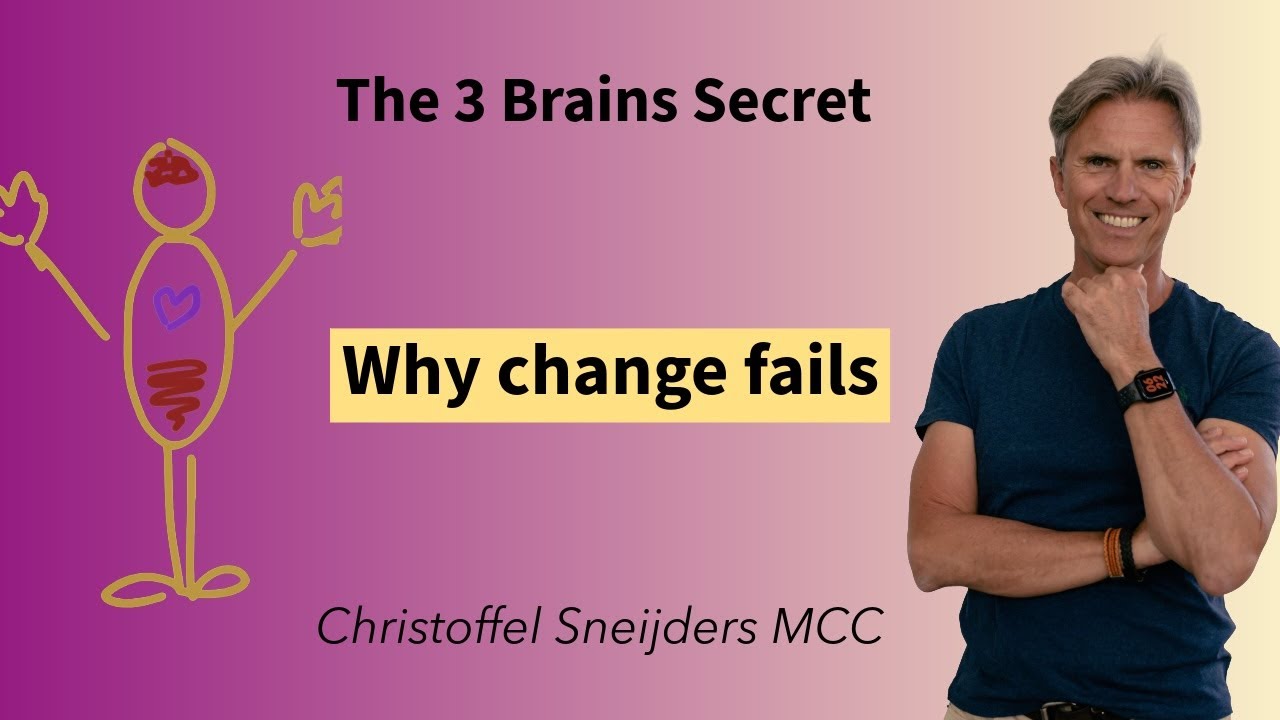
In this talk, Christoffel Sneijders argues that true happiness, health, and a flourishing life arise from an inside‑out process rather than from external, instant‑gratification impulses. He introduces a three‑brain model—head (logical), heart (love), and gut (fear/survival)—and explains how past hurts (bullying, break‑ups, failures) become stored in these brains, driving outside‑in behaviors. Sneijders proposes that instead of masking pain with external rewards, we should embody and integrate these experiences, turning them into “stones of wisdom.” He outlines three therapeutic pathways for this inside‑out work: (1) hypnotherapy, which accesses the head, heart, and gut subconsciously; (2) NLP, which works on conscious modalities but is limited by the critical mind; and (3) “emerging hypnotherapy,” a somatic/energy‑field approach that creates a dialogue among the three brains, allowing acknowledgment and transformation of pain. He critiques conventional talk therapy and CBT for not reaching the heart and gut, positioning his integrated methods as more powerful for lasting change.
Chapters
What do you think? Happiness comes from inside out. And health, would it also come from inside out? And really having a flourishing life, the things you really like to achieve, would it also come from inside out? Just imagine all those things are true. And I believe they are true, by the way. Then how is it possible that we have so much impulses from outside in to make us happy. Now actually, that's extremely easy to explain. And it is— just imagine we have 3 brains: a head, a heart, and a gut brain. The head is our logical brain, the heart is our love brain, and the gut is more our Fearful brain that likes to survive. And around us we have, say, an energy field. How we connect with other people, that we can feel the energy, and also the energy radiates inside us. Just imagine in your life you had some difficult periods, moments like you were bullied, like you were not good enough. Like your house was not fixed in the same moment, that you had a breakup, that whatever. And all those little pain moments are somewhere inside you. You can have them here, and you have all those thoughts that you're not good enough, and that you had a breakup, and that you don't finish your school in time or your work in time, and you have somewhere frustration. You can also have them in your heart from love, from breakups, from all those things that once you loved and just you got hurt. And of course here you can also have that fearful feeling of, oh, I feel it doesn't feel good, I feel tension, I feel whatever. Like people who go on a plane and have to go to the bathroom, of course their fight-or-flight response goes on and this part really starts going up. So we have a lot of fear there, of anger. If you like to solve those, what do most people do? They go from the outside in and they do some joy to solve it. And that's what we call buying, doing stuff, trying to actually to mask the pain with some Instant gratification. How can we solve that better? The best way to solve it is from the inside out and actually really changing this in something positive, in the fact that we learned the lessons from it. That means we don't like to get them out, because if you cut them out, we have holes somewhere and it's even more painful. But just Embody them, let them be part of us, and just use them as stones of wisdom we carry with us, as little letters of wisdom. How do we do that? We can have different kinds of ideas about it. If you use hypnotherapy for that, we go using the head, the heart, and the gut in a subconscious way. We go via the head down in the heart and the gut. That's relaxation, and we go there. And it works amazing. We have beautiful results in those. It's the most powerful tool almost in this world. Because if you use psychology, you talk to somebody, but the critical mind says, yeah, I know that, but... It's always a yes-but reaction. Yes-but means it stays there. You could even solve it here with CBT or whatever, but it doesn't sink in in the heart and the gut. If you use NLP, that works better because NLP connects with modalities also a bit. Also this. The only thing is NLP is done in the conscious mind, so it means the critical mind is somewhere always there if you're not really going into it. It becomes hard. The third path you can use almost is, say, besides hypnotherapy, is what I call emerging hypnotherapy. And it uses also the energy field and the somatic work. So we go inside via The connection— we connect, we go through the gut, the heart, and the head, and we go back again. It is a dialogue between all of us. So we acknowledge what is there, what is there, what is there, and we work with it.