Answering Your Questions (Again) | Simon Says: Episode 2
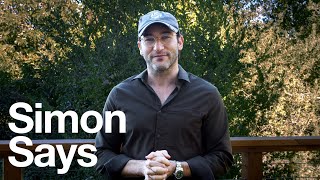
Simon Sinek answers viewer questions on motivation versus inspiration, why "human skills" matter more than "soft skills," and how to handle mental health at work. He covers decisiveness, procrastination, career changes, and the difference between confidence and ego.
Chapters
Hey, everyone. So a bunch of people wrote in some questions, and I thought I'd take a little time to answer them, so we'll just jump right in.
Does finding your why mean you'll always stay motivated? The simple answer is no. Finding your way does not mean you always stay motivated. It does mean you always stay inspired. Our motivation can come and go. A bad night's sleep, you can be unmotivated. A hard day at work, something goes wrong, motivation waxes and wanes. And that's why the why matters so much is because something that's so unstable, we want something that has some solidity, something foundational. A why means we always stay inspired because we always have a sense of where we come from, despite the daily comings and goings of our motivation. Next question. Oliver asks, what are the most important soft skills that. And how can we develop them? Okay, first of all, I hate the term soft skills. We talk about hard skills and soft skills as if they're in opposition. Those things are opposites. I like the term hard skills and human skills. Hard skills are the skills we need to do our job, and human skills are the skills we need to be better versions of ourselves. And we need both. So I'm going to restate your question, Oliver. What are the most important human skills we need and how can we develop them? Listening is the big one. I think it's one of the skills that is desperately lacking in our world and definitely in our places of work today and even in our relationships. So I think we can all learn to be better listeners, which also leads to all the other things having difficult conversations, how to do those, empathy.
How to give and receive feedback, have an effective confrontation. These are all necessary skills we need. I think listening and empathy are the two big that underlie. Okay, next.
Card'S upside down. Now. Steve asks, what's the greatest challenge we face regarding mental health in the workplace? Such a great question. The fact that we're even talking about mental health in the workplace. I think the biggest challenge we face is that companies recognize that mental health in the workplace is a thing. And again, it's about empathy. It's about seeing human beings as human beings, about seeing employees as people, not just functionaries, and understanding that people have good days and bad days, that people have stresses at home that affect how they feel. And someone's mental health really matters. It matters how they show up to do their work. It also really matters how they show up as a team member. So I think the biggest challenge we face regarding mental health in the workplace Is is just recognizing that it's a thing that companies have some responsibility to take care of the mental health of their people. Okay. Aditya asks, how can we play education as an infinite game? Great question. I think we have to accept that education is an infinite game. School is finite and the rules of school operate by the finite rules. We have grades, they're an agreed upon metric. We have an agreed upon objective. We have to get there by the end of the year. But even in school, even though sometimes it is competitive, the goal is how we can learn more and to show up with an infinite mindset. I'm going to school not just to get the, to become first. I'm going to school just so I can go on to get the best job or whatever it is, which is very, very egocentric. But rather I'm coming to school to learn. I'm coming to school to teach, I'm coming to school to enrich. I mean all of these ideas that there's more to school than simply objectives, finite objectives I think is really important. And I think educators and school systems need to start asking themselves, are we preparing our students to play in the infinite game? Are we just driving them to get the best grades, they can get into the best college or get the best job? Okay, next Howard asks how, how can we best deal with big egos in the workplace or elsewhere?
Well, big egos aren't the problem. Unhealthy egos are the problem. I hope you have a big ego. There's a big difference between being self confident and being conceited. Being self confident means you think you're good. Being conceited means you think you're better than other people. I hope you have big egos. Our goal is to help people build their confidence so, so that they see themselves as good. But we never want people to think themselves as better as others. So if we are working with people who think they are better than us, that's the question. So number one is sometimes big egos, unhealthy egos are masquerading as masquerade in place of insecurity. So sometimes attacking them and thinking that their egos are out size. Maybe they are just insecure and they're compensating for something. Maybe they're uncertain or unsure. So strangely enough, a little empathy matters. But if somebody truly does have an outsized ego that they think they're better than everyone else, just enjoy it, smile, go about your job, don't worry about it, as long as they're not. Because taking them on Is only going to create things and make things worse. Throughout my career, I've worked with people who like to posture and prove, and I just sort of smile and let them have their way. Kill them with kindness, you know, don't let it get to me, because if it gets to me, I become competitive with them, and I just sort of focus on the work that I'm doing.
Hopefully that helps a little bit. Okay, these are all over the place, so let's try another one Here. Emma asks, how can we learn to be more decisive?
It's about taking a risk, right? Making a decision now, with anything that we're learning, you can practice small. You don't have to start practicing being decisive with big things. You can start practicing being decisive with small things. What do you want for dinner tonight? Some people like, oh, I don't know, Whatever. It's all fine. Try just making a decision. I'm gonna have chicken tonight. That's what I'm gonna have for dinner tonight. I'd say, you know, do you want to eat in or to eat out of what restaurant? But we don't do that right now.
But start with little decisions. What movie do you want to watch? I can sit in front and flip through the channels, all the previews. I can sit for the length of a movie trying to decide what movie I want to watch. And then it's too late. And I don't end up watching a movie. Pick one. Just pick one. And I think if you can practice making lots and lots of little decisions, you'll build the muscle, and slowly you'll start making bigger decisions. Start small. Okay. Narjes asks, how can we break a procrastination habit? Oh, my God, I wish I knew. I've been putting that one off for a long time. I can tell you one thing that does work for me is I'm good at working with people. So I can procrastinate. Working out, for example, I'll do it tomorrow. I'll do it tomorrow. I'll do it tomorrow. And then before you know it, two weeks have passed. But if I have a buddy to work out with, even over facetime, I'm more likely to show up. So for me, some people who are more disciplined and more organized, having a plan and writing things down and keeping track of things, though, there's a metric that works for a lot of people. So every day you write down the thing you want to do, and so you, like, you don't want to break the habit. People like me, who that's good for like, two weeks, and then I fall off the bandwagon. Having an accountability partner where I actually enjoy doing something with someone, even if it's work, just having. If I have to do some work that I keep procrastinating, I'll call someone up and say, can we just work together? We'll turn on FaceTime and we'll just do our separate work. That. That helps a lot. Hope that helps. Try it tomorrow. Nina asks, what do you do if you're too far in your career to make a pivot but aren't feeling fulfilled? So the question is, are you ever too far in your career to make a pivot? Sometimes we have golden handcuffs, that's true. Where we're in a position where things are good and we don't want to let go and throw it away. There are ways to pivot inside our careers. But when you say make a pivot, I mean, if you're not enjoying yourself and it's just the stability or the salary that's making you not want to make a change. If you have a partner, talk to your partner. Because it's going to be something that you have to make that decision together. If you don't have a partner that you're with, talk to your friends and family. You will find that you'll have more courage to make a difficult decision like this. If you have at least one person who believes in you and loves you and says, you got this, even if it doesn't work out, I'll still be there with you. We'll figure this out together. How can we do this in a way that we can make you happy?
Try talking with somebody about it if you aren't feeling fulfilled. And by the way, if you're not feeling fulfilled, it's not necessarily you have to abandon your career. So sometimes you can find a new job within the company you're in. If you have a good relationship with your leader, sit down and say, I think I'm curious about other things.
And start poking around outside. So, yeah, your happiness is way more important. What else we got here?
Charlene asks, how do I manage the expectations of others, not setting them too high or too low? I struggle with this. I try and say yes to everybody. And what I've learned is saying no has been one of the most valuable skills I've learned. I'm still not great at it, because what I learned is when I try and say yes to everybody, I end up disappointing multiple people. And so learning to say no, saying, you know, and saying, ah, I so want to do that. Unfortunately, my schedule this week is insane and I just can't get to it this week.
You know, the old adage is also keep expectations low and then over deliver. That's also really fun to do. Obviously it's fun to set high expectations. But if you want to manage expectations, either be realistic or under promise. Here's one little trick that I learned. Somebody said, when can you have that done by and the mistake I used to make, I used to say Tuesday. Now I say next week, right? And then hopefully I'll get them to Tuesday and they're really excited. But if I get it to them on Friday, it's fine. What time do you want to meet? 3 o' clock or this afternoon. And that way I can better manage my work. If I'm bad at managing my workload or things are taking longer than I expect, I leave a little broader boundaries on the sandbox. That has helped me a great deal. I hope that helps you too, Charlene. Okay, last question from Anna. How can we balance? I've lost my balance. That was really funny. I actually lost my balance when I read the word balance. Okay, how can we balance full time work with creative projects creatively? So separation of church and state. I'm a great believer in it. Work is for work and home is for home. And sometimes they blend, sometimes we have to bring work home. But I'm a great believer. What's helped me, believe it or not, is scheduling time. So I'll actually schedule time for creative exercises. So in my schedule I'll have a block off that's for me to do creative things. And that way when I'm building my schedule or when things are coming in, somebody says, can you meet at 4 o' clock on Thursday? I say, sorry, I have something else then. What I have then is to do something creative, to do a creative exercise. So I found that to be really helpful also. That way I'm not left to the end of the day to do my creative things every day when I may be too tired to do anything. So sometimes I block off time or even take a day off simply to do something creative. I hope that helps. Thanks for the questions. Please write in more. I love getting these. I love sharing. Take care of yourself, take care of each other.
More from Clegg

The #1 Skill Gen Z Needs | Simon Sinek + Esther Perel | A Bit of Optimism Podcast







AI Won't Tell You the Full Truth | Arthur Brooks + Simon Sinek | A Bit of Optimism Podcast



How To Make the Best Decision | Arthur Brooks and Simon Sinek | A Bit of Optimism