Challenging Authority with Cameron and Tyler Winklevoss | A Bit of Optimism (Podcast): Episode 12
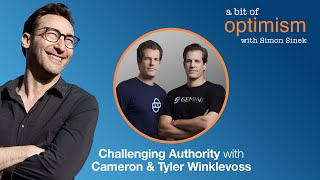
Cameron and Tyler Winklevoss talk to Simon Sinek about Facebook's early days at Harvard and why they see Bitcoin and crypto as a way to decentralize the internet and break up data silos. They argue that centralized platforms have created surveillance capitalism and bad algorithmic incentives that crypto could fix by returning ownership to users.
Chapters
Most people know Cameron and Tyler Winklevoss as co founders of Facebook and early investors in Bitcoin. But what drove them to Facebook and Bitcoin is actually a lifelong desire to stand up to authority and centralized power. And in this country where we value freedom and independence so much, it's actually ironic how much of our lives and how much of our information is actually actually controlled by only a few companies. So I thought it would be interesting to talk to them about what it'll take to break away from authority. This is a bit of optimism.
Cameron and Tyler, thanks so much for sitting down to talk with me firstly and I don't want to go down a rabbit hole with this, but I am just dying to know what was your original concept for Facebook way back in Harvard and did you ever imagine what it would become or did you have a glimpse of what it could become?
So we at the start of our junior year in college and one of the things that I think drew us there in Cambridge, Massachusetts was this idea that there's something like 50 different universities and colleges. It's a super cool area, environment and area, and probably one of the neatest academic and idea based communities I think in the US if not the world. And what we found as we approached our junior year, we were talking with our friend and who became our partner at that time, Divya Narendra. And we were like, wow, we can't believe we're already halfway through university. It's going so quickly. There's all these opportunities and we felt like we're running out of time and we've barely scratched the surface of the community where we're at currently or any of these other communities nearby. And what happens is you get into your track, you get into your major. In our case, we are rowers. So between those two, you have this amazing network of the boathouse and your teammates, but you do get locked in to these paths. And so we started to brainstorm, is there a technical solution to effectively constrain time and geography and can our fingers do the walking? And if we were to create a social network where people could link and connect with each other, that could be really interesting. And I think there's two critical points here. The real innovation, the key here is we identified that a Edu was part of your identity. And so if you had, let's say a Harvard Edu email address, there's a very high probability that you actually go to that institution. It's sort of like your online passport. And prior to that, places like Friendster and MySpace, you really didn't have an identity and there was no control of government who was who. And by using the edu, which could then later be expanded to a.com of, let's say a company, if you said, hey, I work at this company and you registered with that email address, we could immediately verify and authenticate that you were who you said you were. The other thing at that time was taking digital photos was becoming more and more cheaper and commonplace. So it was a lot easier to start getting your profile and your life online than it would have been even a couple of years before. I think that we felt at the time, if this works at Harvard, there's no real reason why it wouldn't work at any other college or university in the country. And that's a pretty big number of institutions and populations. And even if it didn't extend upwards into the professional 20 year olds or 30 year olds at that time, this generation was going to grow up and eventually leave school and they would take this network and all the affinities with them. So we felt like that there was real scale, well beyond just a fun project at a university. But you said, do you think that there's going to be 3 billion people on a network and people are gonna have more smart devices and more phones than people on the planet? I don't think we'd probably have quite imagined that all encompassing, but we knew it had legs.
The fact that you got that far as juniors in college, that really was the trajectory of what Facebook became. Makes me want to invest in anything that you're envisioning the future.
So I want to talk to you about the changing form of what authority looks like in the our modern day and age. The idea of who's responsible for letting information or decisions go in and out, the centralization or decentralization of power.
We got really fascinated with the centralization of authority when we found Bitcoin in 2012, because it basically started to create effectively a gold 2.0 in a decentralized form of money that's outside the system. It's really a new system and there is no central authority. It's literally a system of consensus. And the more we started thinking about the future and really the problems today, because I think to understand the future, you have to really understand what is broken today. And I think that when you look at the Internet, it has become more and more centralized and siloed and effectively, when you go online today, you are basically logging into one of six or so services, whether it's Facebook, Instagram, which really is Facebook, Netflix for your entertainment, LinkedIn and Apple your itunes and that part of your world. And so I think that when you look at the future, we see an unbundling and a decentralization of these different systems so that if you do want to speak on a social media platform, there isn't an arbiter, that's a central body telling you whether or not you may or may not contribute or what we would call deplatforming.
So it seems to be that the trajectory of money is going in the opposite direction as the trajectory of the Internet. So you're promoting the decentralization of money where the Internet is becoming more centralized.
The Internet started off as this utopian vision of everything being very open. And there's actually a computer in a museum somewhere in, I think it's Silicon Valley, where the guys who started Google were basically able to download the entire data of the Internet on a computer because it was open. Today you could never do that because the data is siloed by companies like Google and Facebook. So what started off as an open Internet, you're absolutely right, has turned into this dystopic landscape that is super centralized in these data cartels. And the term that has emerged is basically surveillance capitalism, where data is this good and you, the customer, are the product.
Have the Internet companies figured something out? And humankind, left to its own devices, seeks to exert control over others and control the gateway for selfish means.
I think that if a business is given the opportunity to become a monopoly, they will 100% take that route. The idea of absolute authority corrupts absolutely. I think that there are conveniences with centralized planning. Most people will tend to trade off convenience. They don't want to have two social networks. You don't want to upload cat memes to two different places. You're not going to see two TikToks because it tends to be winner take all. And the viral nature and effects of these things are huge.
I think the short answer is the technology didn't exist for the Internet to evolve early on any other other way, because the general business model was advertising revenue. And so it's an eyeball game. These networks are centrally controlled.
They attract eyeballs.
Networks have a huge winner take all effect. And then how do you make money with that? With crypto, that technological breakthrough that Bitcoin achieved, It's known as the Byzantine generals problem. It allows people around the world to cooperate. That's the mathematics behind mining and the cryptography. People are incentivized to be good Actors and agree on things. Fast forwarding now it's possible to create a Facebook or a Twitter where the people who tweet the best content get paid in Twitter coin. They get rewarded the same way an employee of a centralized company would get rewarded for doing a great job. So there is a world where the users of Facebook actually are earning the money as opposed to a few executives and the workforce actually at a company.
But these incentives, I mean, we know what happens inside companies, right? Which is when we only incentivize individual performance, we can sometimes create behaviors that are counter to the health of the company because you'll find employees stabbing each other in the back, hoarding information as opposed to sharing information. In the worst case scenarios, salespeople actually sabotaging each other so that they can get the bonuses. And we've seen this happen on the Internet as well with the monetization that's been created with YouTube videos. One of the most extreme cases that I can remember, and I'm sure you know this one as well, I think it was a boyfriend and girlfriend couple who were looking for ways to drive views so they can make the money from YouTube and they would do stupid tricks like so many people do. And one of the things they did was he held a big thick dictionary in front of his chest and she took a loaded gun and fired it at his chest, thinking that the dictionary would stop the bullet. And she shot him and killed him. Devastating story. And basically it was a stupid stunt simply to get more views. And so individuals, it seems, act the same way as companies, which is, when you incentivize me to get an eyeball, I'm going to do the most ridiculous and sometimes unethical things to get those eyeballs because it makes me rich. So companies are run by people. There seems to be no difference whether it's a corporate entity or individual doing those things.
Right, right.
Yeah. I mean, the thing is, the way they're monetizing, the way they're building the algorithms to effectively draw people in is not a healthy algorithm. I think you could argue that a lot of it sows division. It goes for the most polarizing clickbait type scenario and headlines, and it generally pulls in more negative sentiment. And they're addictive. It's the equivalent of McDonald's pumping their food full of sodium and all kinds of garbage to just keep people coming back. And the same is true for the white lab coats inside these companies, effectively building algorithms to keep people coming back and promote eyeballs. Amazon, for example, it's looking at what you've read and making a guess based on that. But there's no real serendipity to it. It's not really browsing. It's this robotic engine that's generating close approximations to what you've done in the past. What I find so fun about a bookstore is you can walk around and wander into a corner that you've never been in before and bump into something and get turned on to a book or an idea. It's effectively random in some ways. One of the bookstores I love in Manhattan, the Strand, I think it's got something like 25 miles of books. They've got a section on books that were once banned. And you find all these great books that content, those types of experiences are really hard to find on the Internet today. The serendipity and the openness, it's really what the platform is serving up to you and, and what is really in their best interests.
I find this idea so fascinating. I was actually thinking about it the other day, like I read the newspaper obsessively and I remember when I would have a physical newspaper, I would start on the front page, obviously, and I would leaf through the newspaper and I would read the stories that interested me. And I would always discover something that I didn't know would interest me because I was just leafing through the newspaper and the headline caught my eye and I learned about things that, that I would never ordinarily learn about. Then my newspaper went digital. And now the Internet companies, they attempt to give us the information they think we want, which sounds good, but all kinds of exploration, accidents, serendipity, all of these words for discovery have basically disappeared.
Yeah, and if you boil down the.
People who are actually making the, those.
Algorithms and decisions, it's very few people like CEOs sitting in enclaves and Silicon.
Valley and basically on one stretch of.
A mile of road. So it's scary how much influence that can have. And I think that makes the case for more decentralization.
Decentralization inherently is about discovery, right? There's exploration in decentralization. I remember reading a study about well intended citizens. They hear a story in the news and they want to do their own research. They want to find, quote, unquote, the truth. And so they go to Google, like we all do, to do research. And I think the word they used was Benghazi in this research. And what they found out was basically the people who were left leaning, the algorithm showed them left leaning research. The people who are right leaning gave them right leaning Research. So two well intended citizens actually got different information from their Google searches. Because Google's attempting to serve up what it thinks you want to see when you're trying to find the unvarnished truth. And so all it does is reinforce the left leaning narratives or the right leaning narratives. And by the way, the people who had no political leanings, Google gave travel advice.
Yeah, I mean people talk about search engine optimization, but really what they're talking about is Google optimization engine. When you're building your website, you are building it so that Google indexes it properly and that you rank as high as possible. And the difference of even one position in the search ranking could be the difference in a magnitude of traffic. Huge, huge difference depending on the term and how popular it is. Now there's obviously been some clear wins with Google effectively organizing the world's information over the better part of the last 20 years. But we're getting to a point now where just as you say, it's starting to move and sway in a certain direction. And I think that as we start to decouple that and there's other options that creates the more democratization if you will. And I think the publishing industry is a great place to look at. What does centralization look like? I know you remember the time when getting a record deal meant that you made it or you were likely to make it, but if you couldn't get signed by a label, forget it. You have no distribution, no channel, no ability to get your music or your movies or whatever art you're creating out there. And today it's never been easier to self publish or self broadcast. If you want to upload songs onto SoundCloud, you don't have to go through the A and R and then the record companies to get to basically the entire world. So in some ways the democratization of the Internet has been very powerful and impactful. But the challenge is that the new technology companies, there's few of them and far between. And so what is that next wave? It's maybe you're publishing to a decentralized blockchain and nobody can really pull that content or filter it or censor it, it's just there. But it's so early days that people are going to effectively go for the easy option. Right now if you think of like the Internet pre the first web browsers, it was a very challenging experience. And so we're kind of in that zone where people are starting to build these alternatives. But we need things like that new way to browse and access it. That's easy enough for the average consumer.
I just love this idea that for exploration and discovery to happen, there has to be decentralization. So to use your analogy of the music industry, which is it was more difficult for us to actually go on a journey of discovery because anything that we found was already vetted by authorities by the gatekeepers. The music companies, whether they chose to give one group a record deal or not, was not based on whether they thought it was, quote, unquote, good music. It was whether they thought it was sellable music.
Right.
And the modern version of that is Google determines what you find. And I just find this irony.
More from Clegg

The #1 Skill Gen Z Needs | Simon Sinek + Esther Perel | A Bit of Optimism Podcast







AI Won't Tell You the Full Truth | Arthur Brooks + Simon Sinek | A Bit of Optimism Podcast



How To Make the Best Decision | Arthur Brooks and Simon Sinek | A Bit of Optimism