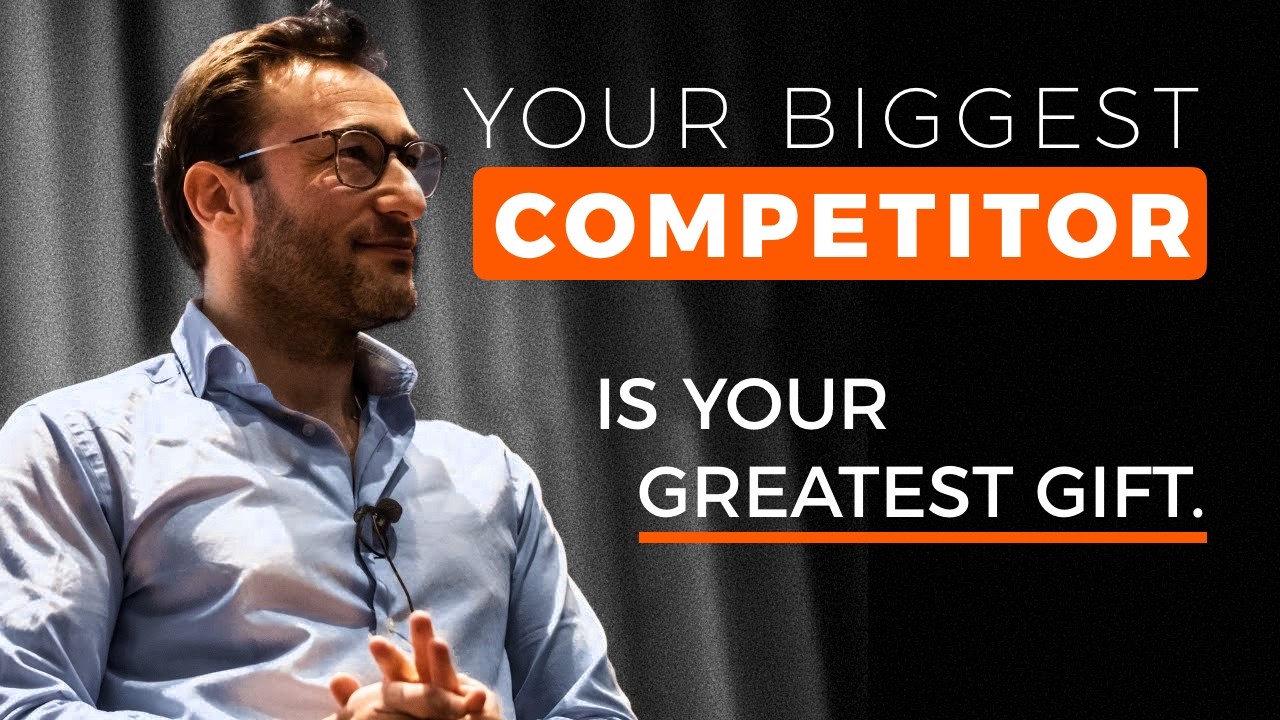
Simon Sinek distinguishes finite and infinite mindsets, arguing that worthy rivals aren't threats but gifts that expose your weaknesses and drive improvement. A rival who excels where you're weak forces continuous innovation, unlike monopolies that stagnate without challenge.
Chapters
The best way to understand the Infinite Game is think of it like you want to be healthy, right? So one of the things you want to do is lose a certain amount of weight by a certain date. Great. You do all the things you need to do. You eat right, you exercise, you're doing all the things. And every day you're weighing yourself. Sometimes you feel good, sometimes you feel bad. You're watching the metrics. And on the right day, on the right time, you hit your goal. Oh my God, I'm a hero. But the problem is you have to keep working out for the rest of your life, right? That's a— there's a context for it. And if you miss the goal, I think that's even more interesting. Nothing happens because the goal was arbitrary. The number was arbitrary and the date was arbitrary, right? What's more important is the trend. Like, were you trending towards losing weight? You're probably going to lose weight. You'll hit your goal a few weeks later, right? The trend data becomes more important than the absolute data. That's infinite mindset. So let's go back to this idea of competitors. First of all, the term is wrong. You only have competitors in finite games. Right? These are rivals. And some of them are worthy rivals. And a worthy rival is someone who does one or many things better than you, that when you hear their name, you get uncomfortable, you get angry, right? You become competitive mainly because you're insecure, right? But if you have an infinite mindset, an infinite mindset, a worthy rival is the greatest gift you can be given. Because when everything's going well, you become blind, which is why innovation starts starts to decline. This is why we hate monopolies. They're not innovative because nothing's challenging them. This is why we like Adam Smith capitalism. It's because choice makes us better at what we do. And so a worthy rival is an absolute gift because you say their strength has revealed to us our weakness. Now, let's not try and beat them. Wish them the best of luck. There's plenty of business for everybody.. Right? But what we can do is take the thing that we know that we can be better because we can see it and we can work harder and harder and harder to improve ourselves rather than beat them. That's the subtle difference. You're not trying to put them out of business or steal their market share. Right? That's a finite mindset that at some point, even if you win, whatever that means, you're going to get bitten in the ass because you you were too obsessed with putting them out of business rather than making yourself better, right? So they're a gift. And at some point, they may no longer be a worthy rival because you've improved that product or that service to a degree that it's not interesting anymore. So worthy rivals are an absolute gift for companies that are playing with an infinite mindset. We use it as a verb. Like, in our company, we don't believe we have any competition. But we know that there's many people and companies who do things better than us. And when we're pioneering something or trying to do something or trying to look at something new, we will say to somebody, "Can somebody go worthy rival this? Can somebody go find somebody in the marketplace who's better than this, better at this than we are?" Because we'll steal from them. We'll copy them, or we'll evaluate where we can be better. I want to find examples of outperforming me because all it does is push me harder. It's the difference between trying to get the— if you're running in a race, it's the difference between trying to get the guy in front of you to lose versus you running faster. Like, it's the difference between trying to trip them and do all the things so that you can win. But if your goal is not to win, but to use them as a pacer, that you just become a faster runner.