Dirty Hiring Practices HR Doesn’t Want You to Know
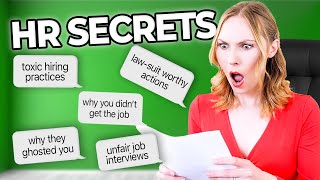
Madeline Mann, an HR professional, reveals six hiring secrets: managers prefer passive candidates, most interviewers lack training and use no rubrics, appearance influences decisions despite legal issues, "culture fit" masks personality bias, interviewers often avoid the process, and timing matters more than you'd think.
Chapters
Okay, after five years of putting out videos, I am going to reveal the dirty secrets about hiring that I saw for myself when I worked in human resources. I've had the better half of an oat milk matcha latte, so needless to say, I'm feeling a bit feisty working in hr. I will saw firsthand the underbelly of what goes on behind the scenes during the hiring process. And I also have so many insights from my friends in HR and recruiting and all of the things they've revealed about their companies. Stay to the end. End because if you've ever been ghosted by a company, this may be exactly why. And it is so frustrating. If you're new here, I'm Madeline Mann. I am a human resources leader and job search strategist who turns job seekers into job shoppers. You may have seen me on abc, Wall Street Journal, Forbes, and more. Subscribe to be reminded to do something good for your career. The first secret is Hiring managers prefer passive candidates. What do I mean by passive? It means that this person is not actively looking for a job. They are currently employed, they're likely thriving, they're happy, and the company wants to essentially be a home record. Now, this completely goes against what recruiters and HR care about. They don't care if you're employed, not employed, and actually they sometimes prefer if you are actively searching, you're an active candidate because that means you're more likely to respond to our messages to hey, do you want to come in for an interview? All of that. So really, HR and recruiting is very focused on filling the role as quickly as possible. Of course, not at the risk of not finding the right person. But yeah, we like it if you are an active candidate. Hiring managers, not so much. Why do they care so much that you are a passive candidate? Well, their mentality is if you are currently employed, if you are working for a company, ideally a competitor, and you are doing really well in that job, that means that you're a high performer. That means that that's the person they need hire so that the best people in the business are always employed or they're always happy where they are. They're always thriving. When I worked in recruiting, hiring managers would sometimes ask me, where did you find this candidate? I of course would answer them truthfully, but I wouldn't volunteer the information that someone had applied because I would notice a lot of hiring managers would have a bit of a bias of like, oh, they applied okay, they're maybe not as high in demand versus me saying I found Them and I have been tracking them down and asked them to interview and they're interviewing with us. That's the more of the passive way where I'm reaching out to these candidates and they are thinking, well, I'm currently happy at my job, but I guess I'll take the call. It's very silly. So what you can do with this information to help you in the job search is to position yourself more as a passive candidate. This is something I train my clients on of how to be a job shopper. And when you come off as a job shopper to a company, even if you're actively interviewing and you're actively on a job search, you come across as a passive candidate. You hit on a lot of the same competence triggers that a passive candidate would naturally hit on. And so if you want some more of those strategies, get a bit of taste of what I'm talking about with this job shopping strategies and all that. I will link a free class down below for you to take. The next secret is interviewers don't know how to interview. I worked in companies training teams and managers on how to interview. I thought it was going to be an absolute joy, an absolute pleasure. I mean, I train job seekers on how to interview well and that has been so fun. And I ended up leaving my whole role in HR and going and doing career coaching full time because it was so successful and so fulfilling to me. As I was doing this career coaching, I was also training hundreds and even thousands of people in these companies on how to interview candidates. And it was soul sucking. First of all, most people don't want to be trained on how to interview people properly. Why? Well, first of all, they don't see that there's a problem. There's a lot of unconscious incompetence when it comes to interviewing. A lot of people think that just because they've been doing it for a few years or even a few decades that they are good at interviewing. And that is simply not the case. I would give before and after questionnaires for the people who took this training and when I objectively asked them questions such as when you ask an interview question, do you have an idea of what a bad okay and good answer looks like for that question? Almost no one could say yes to that. No one had really scoped it out. And just other questions on this questionnaire where it really made it very clear that these people were not preparing for their interviews and not thinking through why they were asking certain questions. They were simply asking the question, hearing the candidate's answer and then determining, okay, I think I felt good about that question or that answer or not. We recently ran a hiring process within my business. For every interview question, every single person who was on the panel, they knew exactly the questions they were going to ask. Because structured interview processes lead to the most accurate results and the least biased results. So everyone knew what they're asking. No one was overlapping on questions so that we could get a really nice big spread and aggregate of information about candidates. For each question, we had a rating card of what a 1, 3, and 5 answer would look like so that it was very clear of what metrics were we using to measure this person. And it was so interesting about how we would still get swayed by certain personality or charisma. But then we'd say, hold up, let's look at the rubric. Let's look at the scorecard. This person has a lower score than this other person. We goes, wow, they really dazzled us. But the lower score really says it all. And that's what I'm talking about, is so interviewers don't put in this prep work of prepping themselves and prepping the other people on the interview panel to make sure that their measurements are accurate and not as biased as just human nature can be. I think back to some of the job searches that I did. I just remember being at this company and this happened several times, but this one time where every single interview, it was a panel, I think four, four different interviews all in one day. It was very exhausting. Each person asked me basically the same ex questions over and over again. And I was so exhausted by the end, and I thought, how are they going to actually evaluate me as a candidate? They're only just getting the same information over and over again. They're getting just 30 minutes deep of information on me versus, you know, it could be two or three hours worth of information. Had they all asked different questions and understood me from different angles. Have you ever been asked the same questions over and over by people at the same company? Put, yes, I've been asked the same questions before in the comments, even if that's been your experience. But one of the things that was really demoralizing about working in human resources, I absolutely loved working in hr. But you are constantly pushing hiring managers to do the right thing, to create a great panel of interviewers to make sure that each person knows exactly what they're evaluating and how to evaluate it, to take a lot of time with each candidate to make sure that you're fully understanding the breadth and depth of their expertise. But so many of these hiring managers are really busy and they also are kind of annoyed by the extra work that goes into building an amazing scorecard, prepping their panel of interviewers. And so instead of doing all that work that HR and recruiting is begging them to do and following up with them with so many emails, they instead just say, oh yeah, just let Tim. Tim will interview her after me. And I trust him. He can just come up with whatever questions he wants. Everyone is just interviewing this person as more of a way for each person in the panel to get buy in if this person gets hired versus evaluating this person properly and actually finding the best possible hire. I hope that distinction makes sense. It's actually one that can make a huge difference as far as finding the best candidates. It's pretty frustrating for the candidate and for human resources who is hurting these cats that are the hiring managers. Another secret about the hiring process that I learned from working in human resources is appearance matters. Now, don't come for me, Please don't cancel me. I am just the messenger here. But yeah, I mean, the way you look, the way you show up, people talk about it and it influences whether or not you land the job. Of course, if you took psychology 101, you would know about the halo effect. If someone is attractive, we attribute other positive attributes to them as well. But there's also a lot of other things. I would hear so many comments about the way people looked when I would be in these interview debriefs. And it would be things like, wow, he showed up to our video interview wearing a blazer. And I really appreciated how seriously he was taking this interview. The fact that he wore a blazer and the other candidates wore T shirts. Another thing that I've also heard plenty of times is the opposite of she wore a Nike sweatshirt to our interview. It just felt so unprofessional. Or even he came in wearing a suit. I thought he was an accountant. He seems way out of place. All of these are just complete judgments. It's not fair. As a human resources professional, we are leaping to cover people's mouth or delete their feedback that they've written down anything. Because this is not legal. You cannot hire someone based on the way they look. But to sit here and say, oh, appearance shouldn't matter, is a bit foolish. I think we can agree that people judge other people on their appearances. It is a human behavior. And I think we can all sit on our high horses and wag our finger at people for judging others for their appearance. And I think to a certain extent, those wags are warranted. They're warranted wags, but it's a human behavior. And I also remember we were hiring for a head recruiter, so this person would be talking to candidates. They would be really the face of our recruiting department. And this woman came into interview and she had colored hair, she had a septum piercing, she had tattoos. She looked a little severe to some people. It was brought up. She has such a visible role in our organization. Should we have someone who looks a bit severe in that position? Which is funny, it's a bit of UNO reverse, because we're judging that candidate on their appearance based on how we think job seekers are going to judge that person on their appearance. It's basically we all judge each other. Judge, judge, judge. My recruiter friends who have hired for executives, they have gotten the request from quite a few male executives that they want a female executive assistant and that she must be attractive. Again, this is a huge breach in what you should be looking for when employing someone. When I say that, I don't mean that all male executives ask for that. And I also don't mean that all executive assistants are female. There's so many amazing male executive assistants as well, as well as males who would love a male executive assistant as well. That is also just like a very clear cut. Wow. They're just coming right out with it. They're just not even hiding the fact that that is what they're looking for. A few more things about appearance to keep in mind. Is sitting up straight in your chair taking up space. This can already improve the way people think about you. And finally, eye contact. And I know that's a bit of an ableist thing to say, not everyone is able to comfortably make eye contact with others, but it does get brought up. Employers often perceive lack of eye contact with lying or bad communication. So I'm just passing that along to you. If it's difficult for you to make eye, just ignore this advice. But it is something that comes up. The next secret I learned from working in human resources is the term culture fit conceals personality biases. At this point, the term culture fit has calmed down quite a bit. It used to be all any would ever talk about. Culture fit, culture fit, culture fit. It was so freaking trendy. But one of the things that I noticed during that time is when there would be a candidate who'd go through the process and the interviewer just straight up didn't like them, just had a bad feeling about them. They would say not A culture fit. That was just their short, firm way of saying, I don't like them. This is problematic because what does that mean? Not a culture fit. That is such a broad thing to say. Of course, sometimes if they don't like the person, there is merit in that. I mean, we don't want to be hiring jerk wads, but I would always challenge that person. Okay, you can't just say they weren't a culture fit. What did they say that led you to this conclusion? And then they would say something like, well, they seemed full of themselves. I'd say, that's, again, that's interpretation. That's not what actually happened. Like, state, what did they do? What specifically did they say? Which side note, they should be taking notes in the interview so that they can reference these things. So many people don't take notes and they think they're going to remember. But then their interviews, hours or days later, when they rethink about what their thoughts are on that person, it becomes crafted and molded to just this gut feeling versus the cold, hard facts. And it was so interesting. I loved doing panel interviews where it's the candidate and then multiple people interviewing them. I know you probably hate those because it's kind of like, whoa, this is intimidating. But it actually plays to your advantage in some ways. What was so interesting is one person might say, that person seemed full of themselves. And then I asked, why do you say that? And they said, because they said X. And then the other people on the panel can say, well, no, I interpreted that differently, or, no, she said it this way or whatnot. And so it's so interesting and terrifying when you notice how each person interpreted that one interview that they all saw together to be different and had different interpretations of what that person was portraying. All of this is to say that the whole interpreting your answers in the interview process is so biased and fraught with personal perspectives that if you are ever on a page panel, you're evaluating someone else, always try to ask for more objective evaluations. Get to the actual meat of what happened so the rest of the group has a chance to appropriately evaluate the candidate and take into consideration all data points. The next secret I learned about the hiring process from working in human resources is interviewers hate interviewing. It makes complete sense when you think about it. The teams that need to hire people are the ones that have more work than they have people. So this team is overworked. And now you're saying, okay, in order for you to not be overworked anymore, you need to dedicate a Nice chunkier week to interviewing people, evaluating candidates, reading resumes, all of that. So you already have too much work. Now we're going to give this you this additional work. And so they are exhausted by the end of it. But it's also funny because people really like to be part of the hiring decision. So many times in my HR career, people would get butt hurt if they were not put on an interview panel. It'd be like offensive when really they're kind of also dreading be on the panel because it's going to take up so much time. It's these conflicting thoughts. But when they think of being on the interview panel, they think of sitting in that interview, conducting it and being done. When really there is so much more to hiring. There's building out the scorecard, understanding exactly the questions you're going to ask and what you're going to look for in those answers, writing out all of your interpretations of their interview afterwards as feedback, coming to the debriefs, all these things, this work that's outside of it, that a lot of interviewers and hiring managers just try to avoid, all those other pieces and just kind of show up to the interview a bit ill prepared. And then we as human resources and recruiters, we're then chasing these folks, just chasing them. Hey, could you give me the feedback on the person you interviewed three days ago? Yes, no, maybe. So what is it? But as I mentioned before, it's that there's a lot of avoidance behaviors. There's avoidance behaviors because it's a lot of work to do hiring, right. And people just want to show up to the interview. But also there's avoidance behaviors because especially hiring managers are terrified of making the wrong hiring decision. So while I'm chasing them, asking them for interview feedback, they are going back and forth of, ooh, I think I like this person, but I don't know if they're the right person. But should we just go out and see way more candidates? Even though you've already presented me me all the candidates that have what I want. And actually now I know I told you I wanted these skills, but I think I actually want this skill and this other leveling and they're going back and forth. You often think that a job description is a clear delineation of exactly what this role will be, but that job description gets edited a lot. Either it actually gets edited word for word or gets edited up here in the noodle of the hiring manager, which means that landing the job is a bit of a moving target. I know that's super frustrating to hear. It's super frustrating as a human resources professional and I know it's super frustrating as a job seeker as well. But the beautiful thing is the answer to this hiring manager's dilemma of just give me a great candidate so we can all move on with our lives and not be overworked anymore is for you to do well in the interview. They want you to do well in the interview. They want you to be the solution to their problems so they can stop the hiring process. So let's help out these companies, shall we? I'm going to give you a playlist of the top interview questions. Read the comments on those videos. People go absolutely bonkers. They have landed so many incredible life changing jobs from this playlist to help you ace these interviews. So I will go ahead and link that in the comments for you to review. And so so many hiring managers really hate this whole process. And that's why you may have heard of the hidden job market. So many of these managers don' put these jobs online. Instead they'll tap their network, they'll talk to their employees, hey, who do you know who could fill this role? Because they don't want to go through the hoopla of this whole folder. All that we were just talking about. And so that's something that I'm really focused on when I'm coaching my clients is tapping into that hidden job market, making sure that when these roles aren't posted online, you are still being evaluated for them. Again, I'll link that job shopping class class that you can take to give you a bit of a preview of this. Another secret I learned from working in human resources about the hiring process, and this one is a big one, is timing is everything. You need two things to land the job offer. The first is compatibility. But the second is timing so you could be perfectly in sync with this company. You have the right everything. But if the timing isn't right, the budget isn't there, they've already hired someone or they need someone to start sooner or something like that that you're done. That is why it's so important to implement job shopping strategies where you're not, you know, kind of just applying to jobs and waiting till all these jobs get so many applications but instead are implementing different touch points, communications, follow ups, relationship building so that you are getting the timing correct. You don't know what the right timing is, but there are so many strategies to be at the right place at the right time. If you've ever been ghosted by a company during the application process or the job interview process. My heart goes out to you because it is so frustrating. And if you could only see the cluster fluff that's going on inside of the business when they're ghosting you. I'm just thinking about how there's been times where we haven't been able to communicate with candidates as much as we wanted to because we had a big product launch and everyone was all hands on deck on that and just basically everyone dropped interviewing. So our candidates were like, hello, I thought I was in final rounds, but now you're waiting, you know, two, three weeks to schedule my next interview. What's going on? Other times there's financial issues you may have run into that where you don't necessarily know that as a candidate because a company probably isn't going to say, hey, we're having money troubles, but there's something weird about the budgets and they thought they had the money for this role, but now they're not sure. And, and it's kind of in limbo or simply a lot of times someone goes out of town, someone goes on vacation for two weeks, and that is the person who needs to interview you next. And so you're just sitting there waiting, thinking, okay, well, I guess my timing was off because now this is suddenly at a screeching halt. In all these situations, what's really good is to follow up. A lot of people don't follow up. If you do it the right way, it has tremendous results. And I did write these follow up email templates that have gotten so many people back in an interview process and talking to a company and landing offers. And so I will link those templates for you for free below. I've just seen so much of this absolute chaos inside of businesses and it's really awkward as a human resources professional to have to try to explain this to candidates or you're not actually even allowed to explain it. You just have to say, hey, sorry, it's going to take a few more weeks. And once I had to uninvite someone from a third round interview, I was so mad, I begged the hiring manager, hey, don't do this to them. I was like, this is such a bad look. Like, why did you invite them to the interview? Like, we really need to be better about this. I mean, it was awful. They were pretty upset and I was, I was miffed as well. And so to tie a bow on this, timing is tough. You can't know exactly what is the right timing. You can more just put up different strategies in order to manifest the right timing. That's what I focus on a lot with my clients is manifesting that, being in the right place, the right time, getting in for these jobs before they hit job boards. That's really where a lot of the top candidates come from. Or they get long in the process and they land the offer before you've even made it to the second round because they had the timing of right before the job hit online line. So that's really something I like to focus on because it helps you get that right timing. Do let me know which of these six secrets were the most surprising to you. I'm very interested to hear that. Be sure to like this video and subscribe to this channel. You've got this WI fi high five.
More from Clegg

The #1 Skill Gen Z Needs | Simon Sinek + Esther Perel | A Bit of Optimism Podcast







AI Won't Tell You the Full Truth | Arthur Brooks + Simon Sinek | A Bit of Optimism Podcast



How To Make the Best Decision | Arthur Brooks and Simon Sinek | A Bit of Optimism