Fight with Love, Fight for Love with Aloe Blacc | A Bit of Optimism (Podcast): Episode 19
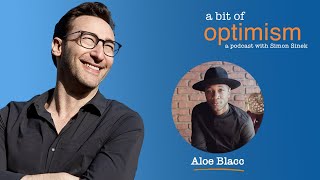
Transcript of a podcast conversation (Nov 24, 2020) between Simon Sinek and singer Aloe Blacc focusing on love, empathy, and purpose as antidotes to fear, polarization, and social fragmentation. They discuss personal upbringing, social media echo chambers, civil-rights fear, the role of purpose (often specific and human) in motivating people, military examples of love and fidelity, and Aloe Blacc’s intention to promote compassion through his music.
Chapters
In this crazy world we're living in, filled with fear and manipulation and uncertainty, there is one strategy to get through it all. Love. The Grammy nominated singer Alo Black is out there preaching love and inspiring us all to fight with love and fight for love. This is a bit of optimism.
It's good to see you.
Good to see you too.
One of my favorite things about you is you have this amazing calm about you. I don't think I've ever seen you get riled up. You're so even keeled. Have you always been that way or is it something you cultivated?
You know, I wouldn't say I've always been this way. I have a distinct memory of being in high school, playing a game of dodgeball. And on the other side of the line were two friends of mine, and they were targeting me in such a way that made me feel as though they were no longer my friends. And so I got so upset and I got so irate and I lost it. And when I lost it and I came back down and I got calm again, I said, I'm never gonna do that again. I'm never gonna lose my mind in that way. And since then, I've always balanced every situation and scenario and just paid attention to what is at stake and recognized cooler heads will prevail.
I'm a reactor. I used to have a terrible temper as a kid. I mean, like, terrible, terrible temper tantrums. And I used to break things and throw things. It was really bad. And I had this kite, it was like my pride and joy. This kite from Bali that you couldn't fly. It was just really cool and hanging on my wall with huge wings. And I was so angry one day I ripped it off the wall and like, destroyed this thing that I love out of anger. And then when I came down, I was like, oh, come on. I couldn't blame anyone because I broke my own thing. And like you, I was like, okay, this has got to stop. Because if I'm gonna break things that I care about, this has to stop now.
Were your parents calm?
No, my parents are from Panama. And so the energy is very Latin. Not to, like, stereotype people, but the way that they speak, the energy they speak with is just on another level from what I'd consider like the standard American speech of just like, how we're speaking right now, or even, like collegiate debate, you know, it wasn't collegiate debate. It was definitely at the loudest volume with the highest sense of emotion. And I recognized that. And I thought, is it really necessary? Is that really going to work. And so all these things I process and as I manage my own marriage with Maya, I think about like, I don't want to yell, I don't want to argue. I want to get down to solutions and facts.
Yeah. And we're living in a world that is so polarized right now where if I'm right, you must be wrong and I justify my rightness because I believe in my own convictions. So where's the lesson? Like how do we have belief in our convictions but not think that we're so right that everyone else is wrong? Or become close minded to another point.
Of view when we turn off the social media? The unfortunate thing about social media, the echo chamber, the algorithms that keep us amused and entertained by the thoughts and ideas that we already have shown the algorithm that we appreciate and that keep us interested in. And this is the issue, we're getting so much confirmation of our own biases from this algorithmic deluge of information that it's completely drowning out opposition or rationality.
Let me push you a little bit there. So let's pretend that social media goes dead for whatever reason. It's hacked Facebook and Instagram and Twitter, TikTok. It all just stops, it disappears. We still have our echo chambers. In our friend groups. We tend to share in general, hopefully the same values with all of our friends, but we tend to share similar belief sets as well and similar politics as our friends. And you and I have both been in these conversations where you sit amongst your friends and somebody starts something, whether it's political or something, and everybody chimes in and it's all the same conversation. We're not actually learning or adding to anything. And then we walk away going, that was great because all of our biases were affirmed by this friend group. How do we learn to want to be curious about someone outside our friend group or even invite someone into our friend group who shares our values but may have very different political opinions?
This is really difficult. And you're right, it's not just because of social media. These kind of things existed before. I think they're exacerbated certainly by technology.
I think we've also conflated politics and values.
And for me, the organization of society is politics. Like that's, that's pretty much it. So how do you organize society? That's politics. Well, you organize society based upon values.
So let me elaborate first what I mean about the conflation of politics and values, which is I have some friendships that I'm very proud of because we have very different political points of view. And the reason we still are good friends is because there are things that are more important to us than our political points of view. For example, being there for each other, offering each other a safe space to be our true selves. Listening, making sure the other person feels heard, empathy, you know, all of these things. The point is, our politics are separated from our friendship. Our politics are separated from our values. I think survival is what holds people together, guaranteed. And if you think about the evolution of the human being, we're not a very strong animal. Us versus elephant.
Even us versus horse. It's not going to go well for us.
Us versus microscopic virus.
We're not that strong. We couldn't survive in nature alone. We need each other. And so we had to adapt to become social. We had to learn things like trust, because literally our survival depended on it. And even getting along with people that we, quote, unquote, didn't like. Because you need me and I need you. Right. I think the evolution of politics, and that doesn't mean that there isn't conflict, of course, there's conflict, even amongst cooperative animals. But I think the evolution of politics is when things started to become more abstract, and then we start defending abstractions without actually finding out if it's true or not. And that goes back to your point of the echo chamber. William Ury, the guy who wrote Getting to Yes, was an amazing guy. He shared a statistic with me recently, which is when interviewing Republicans and Democrats, over 50% of Republicans believe that Democrats would do them harm, and over 50% of Democrats believe that Republicans would do them harm. The real number is 3%. And so what ends up happening is you now have two groups of people represented by people who are more interested in getting reelected than actually doing the right thing. So that's a whole different conversation. Who are now making decisions out of fear that the other would do them harm when the reality is neither presents a threat to the other. That's politics to me. It's making policy, it's making decisions, it's making a campaign promise. All based on an abstract concept that has no basis in fact whatsoever.
All right, so a false value.
False value.
And this abstraction is real when it comes to the point where someone's civil rights are being violated. Right. That abstraction is extremely real.
Yes, because now it's the impact of an abstraction. Right now I'm making policy or actually doing things based on abstraction. And the problem is the impact is very, very real.
That's something that I've been thinking about lately as well, like, yes, I may not agree with your beliefs, and you may be completely wrong if we were to do any scientific analysis on what you believe. But the fact that you believe it and that you have a strong conviction in it is still relevant because it is key to our ultimate survival as a species if we end up fighting over it. You know, if you believe it is worth life or death and you hear.
It in the rhetoric. Right. Let's go down an uncomfortable path. You raise civil rights.
Yeah.
And so when some people hear about the fear that African Americans have going outside or if you get pulled over for speeding, sure. The reaction is. But you have nothing to fear. It's a few bad apples. Like, most of the time it's going to be fine. Like, it's a very rational answer based on their perspective. And I heard a statement by a police chief very recently, because there's such anger against the police right now that he started talking about his officers. There's a lot of fear. And how he now is keenly aware that if one of his officers takes their squad car home and parks the police car in the driveway, that that then identifies him and makes his house a target. There's real fear. And in that experience, he instantly understands.
The fear a black person feels.
A black person feels all of a sudden, for the first time in his policing career, he's a white male. He has this incredible empathy that this cop is going to be afraid to walk outside of his front door. And now he understands the fear. The black man, that fear that exists. That, to me, is a perfect platform for them to relate to each other and for a conversation to start.
Yeah. And so recognizing these abstractions that ultimately can have real consequences to your existence.
Yeah. The fear is real.
Yeah, fear is real. And so how do we get people to recognize the value in having these alternate opinions and being open to discussing them is so difficult. I think I would say it comes down to how you're raised. Were you in a household or were you in a community that allowed open debate, respectful discussion, agreeing to disagree and still be cordial? That kind of thing is important because if you were raised in an environment where differing ideas meant fists and dueling, then that's going to be your response.
I want to keep going down this path of fear for a little longer. It's really interesting if you think about the society we're living in right now. There's fear mongering that is done for political gain. There is fear used even, quote, unquote, innocently in marketing. We see it on the news all the time. You know, can drinking water give you cancer? Tune in at 7. You know, like, we use fear to manipulate behaviors all the time. We do it with our kids.
It's done at work. You better do as you're told or you might get fired. And mass layoffs have become so pervasive. Like, fear is the thing that's driving a lot of behavior. And if fear is an abstraction, which has real impact. But if fear is an abstraction, what do we do as a society, what do we do as individuals to overcome our fears for the good of ourselves, our families, our communities, society, et cetera?
So the only thing, the only answer I have is love. I don't know exactly how to implement it in a policy, but this is what I do with my music. I try to promote the concept of compassion, empathy, love, togetherness, recognition, inspiring others, motivating others, being there for others and comforting people. Because as I was developing my career, there was a lot of angst, political angst and social angst. And I wanted to rage against the machine, like one of my favorite bands. And I thought, it's only going to make me tired. It's only going to make me a target. What if I try to throw love into the equation? How does the machine function when it's confronted with love? And I think it ends up being very difficult for fear to thrive where there is an abundance of love, because that abundance of love comforts another to feel like they will be protected, like they will be heard, like they will be valued. That abundance of love is such an important piece of what is missing in society and in our media. Like you said, the news media works based on fear. My music industry works based on fear. The majority of the top 10 songs are going to be about brokenheartedness. So the fear of rejection, violence and gunplay. So the fear of death. And then when you go to films and TVs, it's the same thing. It's, you know, the violence and the scary movies. So what I found to be the biggest challenge is to use love as my calling card in an industry that really thrives. Billions and billions of dollars off of putting pulling at your primordial fears.
This is a perfectly good segue. You grew up the son of a Marine. Your dad was a Marine. And I had the opportunity to spend some time with Marines. I have a soft spot in my heart for them. And I asked a Marine, what is the secret? Like, what is it that makes the Marine Corps so good? And he looked. This is a hardcore warrior. And he looked at me. And he said, love. He said love of love of country, love of Corps, love of your fellow Marine.
Yeah, that's it. I mean, and they make it so salient from the beginning. When you first get in, they completely destroy your concept of the world that you came from. And everything then becomes this new world that you're in. My dad was in the Marines for 30 years, and upon coming out, he's so indoctrinated in the system that the world outside is just very strange. The Marines have a motto, Semper fidelis. Always faithful. And that always faithful has order to it. You're always faithful to country, always faithful to God, always faithful to your fellow corpsmen. And you follow the chain of command. And in the real world, there is no fidelity. In the outside world, there's no promise of fidelity. And it really was. Still is. It's hard for him to manage that. There is no order out in this world.
What kind of love did you learn from your father that was different than the kind of love you learned from your mother?
My dad loves as a provider. My dad loves as a doer and a producer. And so what I learned from him was that love is making sure the people that you are responsible for are always taken care of. To any degree that you have to engage, you do it in order to make it happen. I remember hearing my dad talk about running 25, like they run marathons in boot camp. And him just saying what got me through the last five miles was thinking about you guys back at home. And that sticks with me today. I think about my kids, and of course, my life is completely different. And the amount of physical effort that I have to exert in order to provide for my family is way different. I still think about how much I'm willing to give to make sure that my family is taken care of. The nurturing kind of love came more from my mother. My dad's love was, I'm going to put tiles down in this bathroom, and you're going to sit and watch me do it, and you're going to help pass me a tool when I need it. Because if you know how to do, if you know how to produce, if you know how to create, then you will never be a spectator or subject to someone else's will. You'll be able to control your own will.
I had the opportunity to work out with the 101st Airborne, and we got up very early in the morning and we went to the parking lot and we're doing all these push ups. And, you know, on the asphalt, which is not fun. And at the end of, like, 20, 30 minutes, I was like, whew, Great workout, guys. That was the warmup.
But when we actually went and did the actual workout, we did something called a hero's workout. And what a hero's work at is. They pull out a piece of paper and they say, today we're working out for someone. And in this case, it was an airman, a fallen airman who had lost his life in combat. And before we work out, they read the circumstance in which he was killed. They tell us the name of his children, they tell us the name of his wife. They tell us where he's from, how old he was, and they say to us, today you're working out for him. I remember in the middle of the workout, and these are competitive guys, you know, but none of us were pushing ourselves to beat each other. We were pushing ourselves to outdo ourselves. And I remember, like, during a run, someone would be running past me, and he'd tap me on the back and go, keep going. And when we were dragging, I remember at one point where I would just. I just was, like, huffing and puffing. You thought of this fallen airman that we were working out for, and we had unsurmountable, insurmountable energy that just poured through our veins. Because now we were doing it for love.
Yeah.
We weren't doing it to prove anything. We weren't doing it to outdo anything. It wasn't competition. All the things that happen in the outside world, how we quote, unquote, drive performance, we pit people against each other, we offer them bonuses, all of these things. And we were pushing ourselves for love.
Yeah. You know, your question was, how do we overcome the fear? And what you've just now mentioned is the answer. What you suggest in this example is purpose. You had a purpose in Okinawa. I watched this documentary about what Okinawans live so long or have a high percentage of sensagenarians, and they have a philosophy of ikigai, or this concept of purpose. And everybody has a purpose. The older gentleman who still goes out to fish every day, even though there's young guys who can do it, his purpose is to fish. The older women, who certainly have their daughters to raise, the grandkids, still participate in the rearing of the children. And I think that is part of what love is, is finding purpose in doing for those around us.
I think you're onto something here that's really, really powerful, which is it has to be specific. We talked about abstraction when purpose is abstract. It actually doesn't work to be the best or to provide or to be, you know, to make an impact in the world. It's very abstract. And what was so profound.
For the marines, but also it was so profound in this hero's workout is we weren't working out for all the fallen soldiers, which is abstract, right. They don't have faces or names. What did Stalin supposedly say? You know, the death of one man is a tragedy. The death of a million is a statistic. And when we did this hero's workout and this person had a name and an identity and a family, all of a sudden it became non abstract. It became incredibly tangible and incredibly personal and incredibly inspiring. And perhaps purpose has to have a face and has to have a name.
You're right. And the biggest challenge then is the American ideology of rugged individualism where we don't have any purpose related to anyone else.
Right.
Just about. It's about self and how much you can do to get to where you want to get by any means necessary.
We over indexed and I think this is one of the reasons why somebody can be a bastard and all of a sudden they have a child and their whole life turns around because they say for the first time, I feel like everything I'm doing is for some all of a sudden purpose again. It has a face, it has a name.
We're going to need to figure out how to develop this concept and have everybody find purpose. Because at 13 years old, when arguably across any region around the world and across any time period, that's when you're supposed to rebel. How do you find purpose in order to grow into an individual who has love at the core rather than fear at the core.
And by the way, you don't have to know these people. Like you don't have to have a child. The purpose doesn't have to be for your child or your friend. Remember this hero's workout? None of us knew him. He was in the Air Force. I'm with the Army. I mean, it was in a completely different uniform. And if you think about Black Lives Matter, it's not an abstract thing. It was George Floyd. He had a name, he had a face. That's really important. Yeah, it was for someone.
Well, it's always for someone. And that's part of the call and movement for black lives is always to say their names so that they are again, not just statistic and not forgotten. And so that it becomes more salient and concrete. A human being's life was taken. Let's respect and value Life. And let's figure out how to reform a system that ultimately seems to be broken and likely is broken and needs to be corrected in order to protect and serve.
And just like this hero's workout, when we're exhausted and we don't feel like we have anything left to give, and we remind ourselves of their names, of their faces, of the details of their lives, we find the energy to persevere.
Yeah. In order for that to work, you have to have a bone of empathy. And so developing that is, I think, the precursor. Developing empathy is important, I believe, in order to recognize that kind of purpose where you're making it about someone. Yeah.
Goes back to love again.
Well, yeah, I just feel like that's the answer.
I mean, what we're theorizing is if you have love at home, you're more likely to develop that empathy muscle. If you don't have love in the home, or at least near the home school. You know, I think education plays a big part of it as well. I mean, we all know about the teachers who took a liking to us. We can remember their names and we can't remember all the other teachers. And every one of us is. We are who we are today in part because of these few people, this handful of people, whether it was a coach or a teacher, whoever it was, who, like, for some reason seemed to love us, seemed to take us under their wing.
Yeah. Because they had a boundless empathy, a boundless understanding of their purpose.
It makes me love what you do in your music even more. I like your music because I like the tunes. You know, I enjoy listening to your music. But now that I have a deeper understanding of the purpose of your music, it actually makes me like even the songs that I don't necessarily like, if that makes sense.
Gotcha. Yeah, no, I get you.
I now. I now respect the purpose of your music.
Right. So I think about the genre that I grew up in. Hip hop music. It educated me on how to write lyrics. It educated me on other genres because I was sampling music from classic rock and from jazz and from soul music. Listening to those lyricists and those musicians, being informed and educated and instructed on how to make music outside of the genre of hip hop. Yet hip hop was my forte at the time as a young kid, and the type of music that inspired me most was very conscious. It was about recognizing it was. There was a pro black movement within hip hop in the. In the 90s that spoke to the African diaspora. It spoke to having self pride and wanting to better the black community. And then there was a huge surge in.
Gangster rap, which then had a completely different narrative. While both narratives were true, gangster rap is a reflection of what is actually happening in the neighborhoods. The pro black movement was a reflection of what was growing in the neighborhoods to be a visionary movement towards the betterment of the black community. The industry favored the violence and the misogyny over the visionary positivity. And ultimately I decided that I wanted to continue this movement of positive visionary, but expand it beyond just the black community. Just make it a human message. And in opposition to what the popular use of the hip hop genre was at the time, which ended up becoming gangsta rap. And so when I had my first solo album, the title was Shine through, meaning to let your soul shine through the darkness, because if you allow the darkness to swallow up the light, then there will be no hope. My second solo album title was Good Things. Now, the album itself spoke to some of the hardships in politics, in inner city society.
In relationships, but I titled it Good Things in particular, to continue the theme of having hope. My third solo album was called Lift yout Spirit. So I use language in this way to continue to be a beacon of light and suggest positivity. And of course, this most recent album is called All Love Everything. And I'm just doubling down on love. All Love and Love Everything. There's no way around it.
Yeah. Here's what I've learned from you today. I've learned that purpose is specific, that purpose is human. That if we have purpose, we can endure when we can share the desire to advance for someone, that we find community and common cause, even if our politics are different. And this is what produces trust within this community, within this common cause. This drive to serve a human is love. Love for each other and love for what we're serving. And that goes back to that Love of country, love of Corps, love of. Love of your fellow Marine. I understand that better now.
I think that's important. What you said you started with purpose, but then you specify that purpose has to be for someone else. It can't be for yourself.
Right.
And maybe it can be. I'm just. No, I don't think positing.
I don't think it can be. I think. And I'm going to change my language. I used to say purpose is for something, but I think purpose is for someone.
I think it should be for someone. Something is still abstract.
Yeah.
Right. Because.
The thing could be an abstraction. Yeah.
Alo, you inspire me so much.
Oh, likewise. I'm so happy that we get a chance to have these conversations and just come to new realizations. Yeah.
This is great. Thank you so much for taking the time. I really appreciate it.
My pleasure. Thank you.
If you enjoyed this podcast and if you'd like to hear more, please subscribe wherever you like to listen to podcasts. Until then, take care of yourself, take care of each other.
More from Clegg

The #1 Skill Gen Z Needs | Simon Sinek + Esther Perel | A Bit of Optimism Podcast







AI Won't Tell You the Full Truth | Arthur Brooks + Simon Sinek | A Bit of Optimism Podcast



How To Make the Best Decision | Arthur Brooks and Simon Sinek | A Bit of Optimism