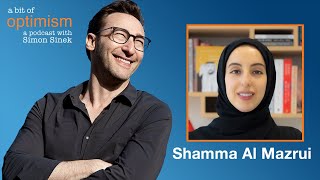
Shamma Al Mazrui became UAE Minister of State for Youth at 22 and created a ministry treating young people as assets, not problems. She points out that over 60% of the MENA population is under 35, and built the ministry on an evidence-based Youth Global Empowerment Policy with measurable outcomes across six pillars.
Questions this video answers
December 7, 2021
22
She was her country’s first Rhodes Scholar.
More than 60%
Chapters
If you think your kid's an overachiever, wait till you meet Shama Al Mazuri. She became the Minister of State for Youth affairs in the United Arab Emirates at the age of 22, which made her the youngest government minister in the world. She was also her country's first Rhodes Scholar. So I wanted to talk to Shama about the power of youth and why there aren't more ministers of youth in more governments. What I learned that youth brings is hope. This is a bit of optimism.
You are the Minister of Youth for an entire nation. And what I find so wonderful about that is if you consider the size of the youth population in every nation that most nations don't have a Minister of Youth. I live in the United States, and there's no Minister of Youth as a cabinet position. It existed in the UK for, I think, a year, and then it was folded into a different department, which basically deals with charitable giving. What was the birth? What was the decision that led to a nation deciding to have an entire cabinet position just to represent the youth of the nation? I find that so fascinating. It's so rare in the world.
That's a very good question. The Ministry of Youth in the UAE exists to connect youth to leaders and decision makers across all industries and sectors. And we empower youth to become the leaders and decision makers not only for tomorrow, but for today. Let's look at our region. In the Mena region, youth under 35 make up more than 60% of the population. And we believe it's very simple. A nation's ability to harness youth directly impacts its security, its gdp, its global positioning, and most important, the quality of life for every human being. And this ministry is based on two fundamental beliefs. Youth are the future, and governments must be directly involved. And to be honest, Simon, we can't afford to build a future that eliminates half of our population from contributing their voice, their talent, their ideas, their energy. And so one thing that's very interesting is we don't just involve youth. We let youth lead. And that's maverick. I think it's the UAE ua. We're taking very big risks on our biggest assets. The Ministry is a design theory startup in every sense of the word. I want to maybe touch base on the point that you said it's baffling to think of how widespread youth have been sidelined in strategies and in government around the world. And the significant challenge, I think, is that young people are seen as problems to manage rather than assets to leverage. And this is a sure failing strategy for nations in Our fast paced globalized world, it's abundantly clear what we resist persists.
Have you found that by giving youth a seat at government and their own ministry to lead and run themselves that the division between older generations and younger generations have narrowed? Because you know, it's always the older generations complaining about the younger generations and the younger generations complaining about the older generations. Is that still the case? Is that human nature or because they have a seat at the table, do you find less of that?
I believe that division has narrowed so much and it narrowed because of division of government and how it came from top down from leadership. We were just talking about how what we resist, persist and the kind of strategy we have in the way is where we nourish will flourish. So if the government resists the reality of youth today and tomorrow, they're going to fail their youth. Our global reality will be less abundant and more dangerous place now, on the contrary, this is our strategy, is where we nourish will flourish. If all governments make changes and take risks for youth to have abundant opportunities during this kind of precious formation time, it all comes down to how we listen. And it's communication every direction. It really sets the foundation when you work with young people because you need to understand them and include them.
One of the subjects that I talk about more than I think any other, when somebody says, you know, how do we teach leadership? And I always talk about that leadership. Education lacks teaching people how to listen empathetically. And certainly one of the things that we're struggling with in our country is we're so divided because both sides refuse to listen to each other. And when I say listen, meaning not hear the words that were spoken, but to try to understand the meaning behind those words and allow the other side to feel heard. And we don't teach listening, we don't teach it in our schools, we don't teach it in our governments, we don't teach it in our companies. And so the fact that you're teaching listening and you're using listening as sort of the single most important tool to benefit youth in the country is. It is so far ahead. I definitely hear it from companies in government. They claim they listen to youth. You know, government ministers sit around and a bunch of people talk and they take a bunch of pictures and then nothing. How do you build accountability in to ensure that the stuff that they're sharing with you, not all ideas are good ideas, but at least that they're heard and the good ones actually do get shuttled through.
I love this. 2 weeks ago the government approved a youth global empowerment policy. And you'd be like, well, how do you measure empowerment? It's not just a photo opportunity or a media kind of thing. So what happened two weeks ago is the cabinet approved a definition for youth empowerment, a measurable definition. And it created a manual and an assessment and an index. Basically, the youth empowerment manual was what it looks like for youth to be empowered. It assesses how we're doing against that definition. That's an assessment. And it compares youth empowerment efforts across all federal government. And that's our index. And the way we measure it is two ways. One is the government itself. The ministry every year has to submit an entity submission form to tell us how is it doing in terms of the six pillars, voice recognition, purpose, guidance, development and opportunity. The other one is we ask young people, so the young people in that ministry, and we ask them, do you really have opportunities for your development? How many of you have signed up for the federal government skills program? And so this is amazing because this is exactly the process and outcome we hope to achieve through this manual and assessment. And this is exactly the framework that will empower governments to move forward.
I mean, I'm sitting here with my mouth open, completely gobsmacked. I mean, I've talked to people in government many times and this does not sound like government where you have metrics and you're holding yourself accountable to these definitions and you're reporting back on whether youth feel included or empowered or that they're being heard. What is it about your government or your nation that is allowing you to be so nimble, so entrepreneurial? Here we like to think that we're the best at everything and we're really behind in this stuff. And even in the commercial sector, these metrics don't exist in the commercial sector at all. Is it just because you're a young nation? Is it because you have a majority young people? Is it the entrepreneurial spirit? What is it about the nation that is so forward thinking that you're doing so much more than so many others? I'm so blown away by the fact that you have these metrics.
The answer is simple. Our leaders listen. They organize and they act. They listen to our people. They listen to science, which is so important right now. Science and Covid. We listen to culture, we respond with the data they all give us and then they take decisive, organized action to achieve it. The UAE model is 1 end exclusion, bring inclusion. 2 end presumption assumption, start listening. 3 end being stuck in the past or future. Rev up your moral imagination, which is the ability to accept reality and the audacity, kind of to hope for a better future. And you might say, shiloh, hope. I know you always talk about hope. It's something so powerful. Our Mars mission is called hope, and I'll tell you why. Because we believe in the uae. How we hope determines how we live. And that's a central truth. I'd love to hear your thoughts on what is hope. And I'll tell you kind of our angle here.
I think hope, like optimism, it's the undying belief in a bright future. And no matter how dark the tunnel, you believe that the future is bright. I think.