How Rich People Think About Money (Psychology of Money)
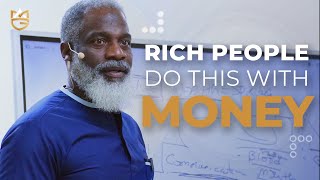
YouTube talk by Myron Golden about the 'psychology of money' which argues that whether someone becomes rich, middle class, or poor depends primarily on their mindset toward money rather than external factors. Golden uses an intersection/window analogy and a four-type taxonomy of money mindsets (Have a Job; Own a Job; Own a System; Sow money seeds) to explain how perspectives shape actions—working for time, building systems, and investing to generate recurring income.
Chapters
Hello, YouTube. My name is Myron golden and I want to share the psychology of money, rich, poor or middle class. Because the psychology you have around money is going to determine whether you're rich, poor or middle class.
Here we go.
You see, I got where I am.
Because I want Michelle Hand help me to stand, be an independent man.
On.
The shoulders of a giant. On the shoulders of a giant, y'.
All. I'm thankful. Most people make the mistake of thinking that the difference between rich people, poor people and middle class people is how much money they have. I submit to you that how much money you have has more to do with whether you have the psychology of a rich person, a middle class person or a poor person. So and the difference between how much money you make whether you're rich, poor or middle class has way more to do with your psychology than it does with your job. It has way more to do with your psychology than it does with the side of the tracks you grew up on. Has way more to do with your psychology than it does whether you're a man or a woman or whether you're black, white, Asian or Hispanic or whatever your ethnicity is. How much money you make is determined by whether you have the psychology of a rich person, a poor person or a middle class person. And when I discovered that, it was like game changer for me. So I'm going to give you a little bit of perspective. I'm going to give you first, first lesson on perspective is this. So if you are standing at an intersection, this is my best.
This is my best illustration of an intersection. You're standing at an intersection and you see an accident right there in that intersection. Now you're probably wondering, why did I mark an intersection with a dollar sign? Because if you have an accident, I guarantee you it's going to cost you some money. Right? Okay. And also for most people, if they make any real money in their life, they did it by accident. So those are the two reasons I mark the accident with a money sign. So when you, if what you see, you're all. If four people are, four different people are standing on this intersection, right. What they see is going to be completely different.
Because of one thing. What's that? That's their perspective.
If you think about it, perspective, your perspective on life is what contributes to your psychology. So your perspective on money. Four people are looking at the same accident. Did they see the same accident? Well, yeah, they saw the same accident, but did they see the same thing? They didn't. They all saw something different. Why? Because they were Looking at it from a different perspective. So if we take this intersection and we convert that intersection from an intersection into a window. So now we've got a window with four different window panes, right? So how we look at money is going to be determined. Our money psychology. Our money psychology. Wow, it worked. Well, our money psychology.
Is going to be determined by the perspective we have. Where are you looking at money from? Are you looking at money from the perspective of a rich person, a poor person, or a middle class person? And so that's going to be the thing that determines your money. And so the first piece of the psychology of money is how. What's your psychology around making money? Well.
If you're this person, your psychology around money, your name is probably Hajj. We're going to call you Hajj, right? You say Hodge. What's that mean? It means have a job. The way to make money is to have a job. What does that mean? That means you sell a whole bunch of your time for a little bit of somebody else's money, right? And the reason you do that is because your whole life you've been lied to. They told you your entire life that time is money. You've heard this your whole life. Time is money. Time is money. Time is money. Time is money is one of the most expensive lies you can ever buy. So don't buy the lie, it costs too much. So time is money. Time is not money. Time is infinitely more valuable than money. If you run out of money, you can get more money. But if you run out of time, you don't get more time. Right? I don't think there's anybody here. If I said I would write you a check for a million dollars a day today, that will clear the bank, by the way, I'll write you a check for a million dollars today. How many of you want that money? All you say, I want the money, I want the money. But if I said there's one stipulation, you have to end your life today and now nobody wants it. Why? Because all of us know the potential of tomorrow is greater than any amount of money today. That's going to cause us to lose all of our tomorrows. So hopefully what I'm saying is making sense to you. But if I said if the doctor told you today and you had a million dollars and all million dollars was your total life savings and the doctor told you you were going to die. But there's an antidote and it can save you and it's going to cost a million dollars and it's worked 100% of the time. We. Would you use that million dollars to buy that antidote? Of course you would. Why? Because intuitively, in your soul, your soul knows that time is more valuable than money. But your mind has been tricked by the cultural, hypnotic, societal mechanism into believing that time is money. But time is money is a lie. Don't buy the lie. It costs too much. Okay? So then what you do is you're like, this have a job thing ain't working. So you go over here. You go over here to this guy, you. And your name becomes Ozh. You say OJ Who's Ozh? OJ you own a job. And most people, what they do, they think they want to become entrepreneurs. And so what they do is they go out and they buy a business or they start a business where they are the only person working in that business. Well.
That'S not owning a business. Most people think they own a business. What they really own is a job. And I always said to people, well, you can get a job for free. Why would you want to go buy one, right? And so they're a person who goes out and buys some lawnmowers and they start a landscaping service. Or. Or they go out and buy some buckets and some mops and they start a cleaning service. What you should do instead is you should figure out how to create a system. I love what W. Edwards Denman said. He said systems under which people work account for 90% of the failure. Therefore, the key to success in any endeavor is to perfect the system. Oh, okay. Cool. Got it. So what do I want to do? You don't want to be this guy. You want to be this guy. You want to be os. Os. What's that? Own a system. What's a system? A system is some mechanism that you use that makes you money every month. Like, did you know that you could write a Kindle book a month if you wrote one Kindle book a month? And you could eventually get that Kindle book making you $1,000, right? So you're selling $1,000 worth of that Kindle book every month. By the end of 12 months, you got 12 books. Congratulations, you got a business. You got a system that's paying you $12,000, $12,000 a month if you have a membership site and the membership site.
Costs your members $97 a month. You go out and you get 200 members, you're making $20,000 a month. So think from a perspective of what kind of systems can I create that will pay me for the rest of my life. This is what a real business owner owns. A real business owner owns systems. So we have systems in place where we have hundreds and hundreds of dollars of book sales that come in every day, hundreds and hundreds, sometimes thousands and thousands of dollars of ticket sales for our events every day. And got transactions of products and offers that we've created that because we own a system. And then the last guy you want to become is you want to become the SMS smz. Okay, we'll call him Sam's. Okay, so Sam's. What does Sam's do? Sam's sows money seeds. What do you do there? You're investing your money. You're planting your money in the ground and making that money grow out of the ground. So now over here, your systems are making money down here. This is why these two people are sad. Because you're using your time to make money. You're using your time to make money. You're making more money but you have less time. Over here you were using time to make money. You have neither money nor time. Over here you have more money but you have no time to enjoy it. When you come up here now, you're finally making more money and you have the time to enjoy it. And then ultimately when this takes over, this space now you've got so much money coming in, you've got all the money you need and all the time to enjoy it. So what is the difference between the psychology of rich people, poor people, middle class people and I'm going to end with this. So.
Poor people have the psychology that makes them think the primary purpose of money is to pay bills and buy.
Stuff. Right? That's the primary purpose of money. Pay bills and buy stuff. So they'll go out and they'll find a job that gives them enough money to pay their bills and to buy stuff. Are y' all tracking. So what happens if this is what you think the purpose of money is? You will always be poor. You're not poor because of the job you have. You got the job you had because your psychology was the psychology of poverty. Okay, so middle class people, middle class people think the purpose of money is to create.
And maintain.
Maintain. I hope I spelled that right. Good credit. Why? So they can pay their bills on time and buy stuff that they can't really afford. So that's what. So a middle class person, they'll get a job that makes more money so they can buy things on time and then pay off today's junk with tomorrow's money. Right? That's the psychology of middle class people. Rich people believe that the primary. We're talking about primary. When we talk about psychology, I'm talking about the psychology between what you believe is the primary purpose.
Of money. So I want you to think about, just for a minute now while you're watching this video, think about how you think about money. When you think about money, do you think about all the stuff that you got to pay for and there's never enough money. That's because you only decided to figure out how to make enough money to pay for the stuff you buy, right? So rich people believe the psychology of rich people when it comes to the purpose of money. Rich people believe the primary purpose of money is to turn it into. Watch this now, more money. So the first thing you do when you get a dollar is you pay your electric bill, your water bill, your mortgage payment, your car insurance, your college loans, you buy food, you pay your utilities, you take yourself to the movies, or you take you and your family to the movies or out to dinner. And you spent this money because you, you gave yourself a temporary relief of the pain of being broke, right? Or you go out your car, it has 36,000 miles on it. Oh my goodness, it's so high mileage. I gotta go get a new car. And you really want a new car. Cause you're bored with your old car, right? But the reality is, all you have to do is think about it from a different perspective. So you make enough money, you go buy the stuff, you pay the bills, and you maintain good credit. You got your 750 credit score, your 850 credit score, and you're excited because now I can go buy anything I want even though I can't afford it. But when you really get it, when it really begins to make sense to you, what you're going to do is every time you get a dollar, you're going to say, how can I take this dollar and turn it into two? How can I take this dollar and turn it into ten? How can I take this dollar and turn it into 20? How can I take this dollar and turn it into 30 or 100 or $500? Because when I can take this dollar and turn it into more dollars. In my book, from the trash man to the cash Man, I call that holding onto your money long enough for it to get pregnant and have babies. You never spend the mama money, you only spend the baby money. That's what rich people think about. How can I turn this money into more money? Now here's the final thing I'M going to say is this. The other thing is middle class people and poor people are afraid to take their money and invest it in something that's going to make more money because rich people, I mean middle class people and poor people, these people want a guarantee. They want a guarantee right. But rich people want an opportunity.
So if you become the kind of person who seeks opportunities over guarantees and your primary purpose for money is to turn it into more money then every time you get money you're going to be looking for a way to turn it into more money. And congratulations you've developed the psychology of rich folks. Hope that helps. Like the comment like this video if it made sense to you comment on it. Subscribe like like comment subscribe share like all that fun stuff. Help the people you know if you think this information will be helpful for them. Hope it helped. Dr. MYRON golden signing out Bye for now.
More from Clegg

The #1 Skill Gen Z Needs | Simon Sinek + Esther Perel | A Bit of Optimism Podcast







AI Won't Tell You the Full Truth | Arthur Brooks + Simon Sinek | A Bit of Optimism Podcast



How To Make the Best Decision | Arthur Brooks and Simon Sinek | A Bit of Optimism