How to Find a Career that Does Good for the World (WITHOUT Sacrificing Pay) Ft. Roshan Paul
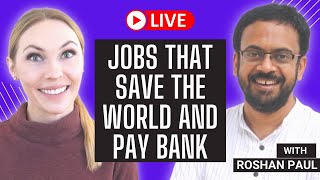
Roshan Paul, author of The New Reason to Work, talks with Madeline Mann about building a mission-driven career without taking a pay cut. Beyond nonprofits, paths include B Corps, corporate social-impact roles, and sustainability positions. Paul emphasizes transferable skills, learning through paid projects, and what he calls job search parkour to pivot quickly.
Chapters
Oh, this is self made millennial. I'm Madeline Mann and today we're talking about how to make sure that your next career move is meaningful work, is doing something great for the world and is something that really lights you up. And I think that there's this movement towards meaningful work right now and social impact. And many of us think that means you need to sacrifice pay. I need to work at a nonprofit, I need to be a teacher and I need to know sacrifice some of those things or others think you need to get a lot of schooling in order to have a job that is significant enough to make a big impact. And I need to work difficult hours by becoming a doctor or a nurse or a lawyer. But what if I told you that you could have exceptional impact on the world, do meaningful work and get paid great money and you would be also able to go home and eat dinner with your family every night and have this great life of flexibility.
And a lot of people don't realize the career opportunities that you can pursue today. And you can use those and get those jobs with your transferable skills. These are all skills and professions you've already worked in or you have the skills to transfer into and you can start making this happen within a matter of weeks instead of years. And so I'm actually proof of this. And you'll hear my story later today about how I was able to do amazing work and really work at a company that was doing good for the environment. And I also have a special guest, Roshan Paul is here and he's the author of the the New Reason to Work. Okay. And he's here to give us insights on how you can build the perfect mission driven career. Roshan, welcome.
Thanks so much, Madeline. Excited to be here.
Yes. So good to be here as well. And so I want to dive in here. So what, you know, you really put your all into writing this book, the New Reason to Work. What have you been seeing in. In the way people view work and the way that they've been approaching work historically that they needed essentially to look at this as like a new reason to work.
Exactly. So the subtitle of the book is how to Build a Career that will Change the World. And we see that that's the new reason to work. In a world where so many things from rising better technology to growth in human psychology, where we want to work for reasons other than just making money, it's really pushing organizations, pushing companies to make sure that they're catering to that as well, you know, But I think that there's also societal shift, you know, that's happening where people are realizing that work doesn't have to be transactional anymore. You know, it can be something that is not just about the money. Not about exchanging my expertise and time and effort for my power and status and identity, but actually about having a meaningful impact on the work. You know, the writer Annie Dillard, she says how we spend our days is how we spend our lives, you know, which I think is such a beautiful quote because it reminds us that, you know, that it's so important to consider how we're spending every day and whether that's something meaningful to us. And since we spend the majority of our adult lives working, then why not make that time highly meaningful and highly valuable, not just to us, but to society as a whole? So if there's one thing I'd like to change in society, it's this idea that work shouldn't be deeply meaningful and valuable to society. And that's what the whole book is about.
I love that. And that quote actually is something that I have repeated many times is we kind of think of our careers and our future as this kind of abstract thing of someday I'm going to do something really great for the world or someday I'm going to be in the job that I really love and like to. Your career is now the way we live our days is the way we live our lives. Like every single day that goes by is one fewer days that you are working towards something that actually matters to you. And I think, you know, we kind of almost see people who are doing good for the world as, as sometimes doing almost like charity or like, you know, like I'm going to go into, you know, the Peace Corps and I'm going to really dedicate my life or whatnot. When really, I mean, me working in, you know, in a B corp, you know, in my career, it was like no margin, no mission, like, like actually making money, being a thriving business, having employees who are, who are earning and learning and really adding big impact. I think that that's actually a disconnect. A lot of people have is like, wait, there's tons of companies out here who are doing great and making margin and so we don't have to actually have that trade off. Is that what you're seeing as well?
100%. You know, I think typically when people think about social impact, they think about either like on the really big picture, you're working for, you know, the government or USAID or the UN or at the, you know, at the local level. A local, like homeless shelter or soup kitchen, or you're a teacher. And all of this is valuable and important work, right. I'm not dissing it at all, but, but what most people aren't aware is that there's so many more options available today. Right? So you talked about B core, and the B core is like one part of the larger social business movement where companies, they don't just want to make money, they also want to make a difference in society. And the way they make a difference in society is by selling meaningful and valuable products and services to people. And so that's why if there's no margin, there's also no mission. But in addition, there's loads of other opportunities. So think about development consulting firms, right? So there are lots of consulting firms that are focused on consulting to organizations like foundations, like big nonprofits that are working on social impact. On the other hand, also, every single major consulting firm out there, like from McKinsey to Boston Consulting Group to Accenture, has a social impact practice too. So you can do impactful work even in some of these big gigantic consulting firms. You can also work as the director of social impact at any number of companies. I feel like on LinkedIn every day I get a message that so and so company is looking for a director of social impact. That's a really growing field as well, right? There are research firms and data analytics firms in the nonprofit and impact space. You could be the director of sustainability at a university. I mean, think of how many universities are in the country and what large carbon footprints they have. They're also getting into the sustainability game as well. And then there's a whole class of organizations that we call intermediaries. So these are organizations that provide services to the nonprofits and the governments that are working on the front lines, right? So think about training and capacity building organizations. Think about fellowship providers, think about ecosystem builders. You know, organizations are trying to build whole industries. These also exist. And these are probably the fastest growing organizations and they all pay pretty well. Now, they may not pay like, you know, a hedge fund or a corporate law firm, but most people don't need that kind of money either. They pay, you know, it's really good salaries and you can have a very sustainable lifestyle with that.
Yeah, exactly. I feel like that's, that's the thing is, is we need to open our minds. There's, there's all these different roles that are completely dedicated to these missions. Whatever mission is most valuable to you. I would even say, you know, in, in the past couple years, I'VE even seen kind of more of like the, the social justice aspect as well of like a lot of focus on diversity, equity, inclusion, like entire roles in businesses completely focused to that. And there these companies are like in the same thing is like I just see those roles constantly popping up everywhere. And so I think that there's, it's really cool to see companies putting their money where their mouth is with like hiring these roles. I personally worked at a B corp, right. And put yes or no in the chat. If you're familiar with what a B corp is. I know it's not something that everyone's familiar with, but exactly as Roshan said, it is a, it's a company that basically has to face like these pretty rigorous standards of are they doing, you know, basically good for the world? Like, are they meeting certain standards with their environmental practices? Are they meeting certain standards with their employee practices and the way that they conduct business in a way that's like net profitable for like the greater good. And what was really cool about doing that is I didn't have to switch careers. Like if I worked for a company, it was a B corp that was focused on renewable energy. Every single day I was going to work focused on wind energy and I was still working in hr. Like, I didn't have to change my career, I didn't have to take a pay cut. You know, it was really about finding a job where I said, okay, I'm still able to do my, my craft, what I'm, what I'm meant to do. I didn't have to change, you know, like get new schooling or anything. But I was able to do that every day. And we did have someone who, I can't remember exactly what her title was, but it was something like Head of Sustainability or Head of Social Impact. Like that was a literal job title, which is so cool to see that. And it was a whole department of how are we making sure that we are offsetting, you know, all of our carbon footprint and how are we making sure that our employee practices are highly sustainable? I would work with them on that. So it's really cool to see that these roles exist. And if you don't, if you don't want to, you know, if you don't want to kind of pivot careers into something that's completely focused on that, then you could do what I did, which was just find these companies, go to B Corp. I don't know if it's b corp.com or something like that, like where you can start finding these things and exactly I think a lot of these major companies have entire wings of their business that are focused on this because it's so important.
For sure. Yeah.
Seeing lots of. Let's see. I'm seeing. Okay, so I'm seeing about like, actually I would say more people have not heard of B Corpse than have in our audience. So that's really interesting, which makes me very excited because, you know, and if someone, if someone out there wants to kind of put in the chat the link to B Corpse and stuff like that, if someone wants to quickly Google that for, for the audience, that would be amazing. But yeah, I think that that's really.
Yeah, it's a great, it's a great group that is really trying to make business more sustainable and more conscious of the impact it's having in the world. So it's like this larger movement called conscious capitalism that says like we can still, you know, use the models and tools of capitalism, but like harness it for greater value to society as opposed to just immediate profits to shareholders, you know.
Totally. What would you say to Jared's statement here that says it seems like most of those job titles descriptions are going to want someone to have a BS in something niche. What would you say to this?
Yeah, I think that, you know, in the book we also like talk about six questions that can help you choose which type of organizations is, is best suited for you. And one of those questions is what does your previous skills and educational experience experiences set you up for? Right. So some of these organizations, particularly the more kind of bigger scale, more bureaucratic ones, they will be looking for like particular sets of like, you know, skills or educational.
Degrees. But there's a lot of other organizations that are open to having smart generalists, you know, who can prove themselves on the front lines, who can prove themselves day to day in their job. So a quick rule of thumb is that like the smaller organizations or startups.
Local organizations and companies that are moving quite quickly, they will be more open to any kind of bachelor's degree as long as you can show up, be highly committed, get stuff done on a day to day basis. Your really big companies or your really big nonprofits, they're going to be more looking for. All right, do you have a BS in the something that's quite niche. So I think like that's my unscientific rule of thumb for you is like smaller organizations, more flexibility, bigger organizations, more bureaucratic.
Right? Yeah, exactly. And, and you know, that is if you want to go for. Yeah, exactly, like the head of the head of sustainability, you know, you're focusing on these certain things. But yeah, if you just want to make sure that you're doing good for the world, like it, I think it really has to do with the company, right. Focusing on going to the right company. So, you know, every day I was not, I was focused on employees, right? I wasn't focused on, you know, making sure that, that more people had wind energy powered in their homes. But by, by proxy, you know, you're really helping those missions. So I agree. I just think, I think it's, it's dangerous for people to think, oh, in order to save the world, I need to go get another degree. And what I think there is, I think kind of a loophole is wherever you are, like in your current company, like if you are looking to get into like a role that is focused on sustainability, like start the club at your company, start the, the, the, I don't know, committee at your company that is focused on sustainability or something like that, or whatever is your, your goal the focus on, on, you know, de and I or whatever it is. And you start that committee and, and you're already building experience there, right? Like you're doing good for the company. The company's going to love it because you're, they're having someone focus on it. And then when you try to go to another company, you're like, hey, look at all these transferable skills I have. Plus I actually have built something like this at another company and make it sort of like your side project. So that I think can be really effective. We have this question from Ivan who says, how do you pivot from a traditional for profit industry to a B corp or a nonprofit? What would you say there?
Yeah, I think firstly, I just want to underline what you just said, Madeline, that sometimes you don't have to pivot. Like you could start a sustainability or a DEI kind of initiative within your existing organization. But let's say you do want to pivot. I think it's really valuable to understand.
What matters most to you at this particular stage in your life, right? So how important is it? So if you're working for BFORs or nonprofits, one important question for everyone to answer is are you more of a like beneficiaries, frontline kind of person like that you want to work directly with people who need the, you know, the services that the organization's providing? Or are you more like a systems level person who wants to work on changing policy or making a change on a really large scale? And it's actually different personality types that are drawn to both. It's really good to get experience of both as well before you decide. So that's one thing to try to answer for yourself. There's other questions, like how committed are you to a particular cause or a particular geography? Like, you have to stay in, I don't know, San Francisco, or do you not care? You're happy to live in San Francisco but travel all around the world. There are different kinds of organizations that will meet the needs of each of those different categories. Then I would say finally is kind of aligning who you are, your need to work, or your desire to do work that has an impact. Where is that desire coming from? Right. Like, what's the root of your passion or your sense of purpose that you want to use to move into a nonprofit? And if you can align that desire with the kinds of work that the organization does, you're more likely to kind of thrive over the long term and not feel like you're disconnected emotionally from who you are and the work that you, that you want to do. So. So, I mean, I can speak this at length as I used to run an organization that really helped people, like, we've helped like thousands of people make that switch. And the book, in the book, we have actually a character in the book who is, you know, a graphic designer working for 15 years and wants to make that switch. And you can read about her journey as she's making that switch into, you know, from a traditional job into the nonprofits.
Yeah. And I think one of the things that you're touching on that I am always focused on with my clients is let's slow down for a minute. Like, let's not just say, okay, I just saw this live with Roshan and Madeline and okay, I'm just gonna, you know, now I'm gonna be the, you know, manager of sustainability and blah, blah, and I'm gonna get this, this BS degree and I'm gonna do this, like, hold on, right? Like I, I work with my clients, I put them through what I call a one page career vision where it slows them down. And it says, let's not just jump to like the next career. That sounds interesting. Like, let's align it with our values. Let's align it with what our truly our strengths are. Let's also make sure that we know exactly what this, what this role is going to feel like once we get into it. I think way too many people hear about a job and the jobs that you name today. I think so many people are probably listening and be like, oh, I think I could do that. I could do that. Like, that's not. The first step is like, the first step is to really like soul search before you job. And, and don't just jump into this. And then for the love of God, please do not just go out there and start getting a degree. Like that is the thing is like maybe a degree is the right thing to do, but like make sure that, that you're, you're positive that this is the right next career step because you've taken the steps of the one page career vision or you've done another systematic process to know exactly what you want in your career before investing all of this time and money in, into something that, you know, might just end up on your resume. And it's kind of in, you know, the education section of your resume. I've just found as like a degree graveyard where just people are collecting degrees. They don't go anywhere with it because they realized it wasn't the right next path for them.
Yeah, yeah, absolutely. I can't tell you how many people I've met that fall into that category, you know, So I like how you said like the soul search before the job search. And I would say when you, if you, if you want to put a degree there, I would say a lot of people and society conditions us or our parents condition us to use the degree as the place where you do the soul search. And I think that that's a terrible idea because the degree won't give you that. However, if you've done the sole search and you say, all right, I want to make a pivot to sustainable design, let's say then getting a specialized degree, not an MBA or a public policy degree, but a degree in sustainable design, that makes a lot of sense. So the degree should come post the sole search so that you can build your credentials to do that job search. Right. But you also don't have to do a degree. And I want to make that clear as well. We talk about, there's a whole chapter in the book dedicated to designing your own education and realizing that education is something that we need to keep upskilling ourselves every three to five years because the world is changing so quickly. Who would have thought Covid would have come and how dramatically that that's changed the world of work for the foreseeable future. So things are going to keep coming and we're going to have to keep upskilling ourselves, you know, so how do you keep designing your own education? Right? And that should be a combination of like, you know, Knowledge, kinds of things. So, like courses, you know, podcasts, you know, but also real life experiences, like, you know, doing freelance or gig work, if you can, volunteering, internships, you know, active networking, informational interviews with people, and then also pairing all of that with a deep reflection on what are you learning from all of this? What is that teaching you about the kinds of work that you, that you want to do? You know, and I, and Madeline, if we have time, I can also share a story of how I've just been doing this. So, yeah, so I, you know, I just stepped down as CEO of the organization I started. I'm in my early 40s, and one of the reasons I stepped down was that I wanted to work in climate change, but I don't have any background in that. But I just feel so compelled because that is like the existence, existential issue for me for the next 10 years. And so I realized pretty quickly that given my background, even though I've done a lot of stuff, I don't have that climate science or tech background to get a job in climate change. So what I decided to do was just that. So I've done online courses, I've read books on climate, I'm listening to podcasts regularly. But I also started like, pinging my network and seeing where can I get freelance work in climate change and climate philanthropy. And so I started off in November, like, not knowing how to get into this. And today, today I have, like, I have five clients, but three of which are in the climate change work. And I'm learning, so I'm getting paid to learn about the field that I want to go into. And that's really exciting. And now it's narrowing down to, like, what I think I'm going to be doing for the next few years at least. So I'm actually in this funny position where, like, unlike most authors, I'm now, like, applying the advice from my book on myself and my own career. And I'm realizing, hey, yeah, that works. Like, you know, I've just been using that same framework we use in the book and realizing that now I've made that career switch and I'm going to be working in climate, you know, for the foreseeable future. And that was through this, like, designing my own education rather than, you know, avoiding the temptation to go get another degree in the space.
Yes. And what I love is that's so relatable, right? You're, you're a former CEO, a bestselling author, and you're like, I'm going to learn, like I'm. Now it's time to learn. Now it's time to take project work and this kind of stuff. Right. Like, it's not. That's. That's really what you've got to do. And what is so great about that is the world is moving so quickly that an education is simply not keeping up like, the traditional education. And what really matters to companies and businesses is. Yeah. You staying on the ball, you having this practical experience. Experience. Right. And what you said was, was key that a lot of people don't think about is you are being paid to learn.
Yes.
So many of us. I have a master's degree. I'm telling you right now, it cost me. I went to USC. It was like upwards of $60,000. Like, I paid for that. Right. Like, did I need that master's degree? Probably not. And what is. So. But the thing is, is that master's degree, these degrees, these certifications. Paved path.
Yeah.
Clear paved path. Oh, okay. But yet that path kind of leads to nowhere. Like, I mean, it leads to somewhere, but it. You. When you get a ride there, you think, oh, a job's at the end of this path. No, it's like, start of your. Your journey to then figure it out. And so really what you did is like, I'm going to take the. Less like this. There's actually no path here. Like, I'm kind of wandering through the forest, but I'm, like, leaving breadcrumbs, and I'm kind of like, stomping the ground for myself. And the path there is so much faster, so much quicker, so much more effective than, you know, kind of going this meandering route that so many other people take.
Right. And if you take the beaten path that everyone else has taken, you're competing with all of those people as well, you know? So I think, like, there's a great line from a Spanish poet where he says, there is no path. The path is made by walking. You know, And I think, like, that sums up for me, like, what, like, the smarter people or like, the people are willing to take those slight risks to say, like, I know that, like, I'm beating my own path here, but. But that's where, like, the more interesting and unexpected opportunities can lie. And if you go down the same route as everyone else, then you're competing with all of those people as well.
That's exactly. I had a post yesterday on LinkedIn where I said, if it's comfortable, then it's crowded.
Yeah.
Like, if you feel at ease, if you feel like, you know, exactly where you're going. Like, everyone's following the same path. Look, like you're just. You're one of. You're one of thousands. You're. You're just. You're just lined up, so you have to get uncomfortable. You probably got uncomfortable because you're like, okay, like, how am I going to find this. This contract work? Like, how am I going to, you know, I'm. I'm new to this. I'm really going to put my skills out there, even though I'm not, like, fully, you know, fully thrown into this industry at this point. Yeah. And that's why I love working with job seekers. This is like, one of the main things I coach people on is like, let's take the shortcut. Like, let's. Let's find this different path. I call it job search parkour. Where have you heard of the phrase parkour before?
Yes, I know what parkour is. Yeah. Yeah.
Okay. So it's like, you know, a creative way to get through, like, an urban environment. Right. Instead of walking, you're like jumping onto a railing and then you're sliding down and you're hopping onto a roof. So basically, like, so many people go try to go into the front door of a business, and that's kind of like an online application. Right. You're, like, just lining up out the door. Maybe you have your couple of certifications in your degree, and everyone else has the same certifications. And there's just this line that goes forever. What I say is, like, we're going to parkour our way into that building. We're going to get the right experiences, we're going to meet the right people, we're going to find our way, and we're going to jump onto the railing, we're going to pull ourselves up to the windowsill, we're going to hop in through the chimney and. And you're making this career transition in weeks instead of years.
Right, right. And the fact that you've done that is actually impressive to employers, you know, compared to everyone else who's, like, just lining up around the block. The fact that you figured out how to shimmy down, you know, from the roof and get in, or, you know, whatever the analogy is, that's impressive to people. Say, like, this is someone who knows how to get things done. This is someone who knows how to take the unexpected route, who's creative at product problem solving and coming up with new ways of doing things. And at the end of the day, that's what employers are looking for. That is like the soft skill of the 21st century is creative problem solving. You know, because again, we don't know whether it's a pandemic or a climate disaster or an economic crash or whatever, it's going to be coming down our path. We've got to be able to figure out how do we find answers to this, you know, so the people who can come up with answers are going to be in high demand.
Exactly. Okay. This has been such an amazing conversation. Roshan, how can we find you? How can we find your book, all that stuff?
Absolutely. So you can find me on LinkedIn. You know, Roshan Paul, I'm pretty easy to find and pretty easy to. You can connect with me there. The book is widely available on Amazon and on most, you know, online or, you know, physical booksellers. It's called the New Reason to Work, how to Build a Career that Will Change the World. It's pretty easy to read, if I do say so myself. It's written to be very engaging to be read in a weekend and it's very applicable. So there are lots of exercises that you can do that can help you to find your way. And it's like a half fictional, half nonfictional book. So it's a nonfiction book where we've got fictional characters who are like people just like you who are trying to make their way and they ask us the questions that, you know, we've been asked by our students for the last decade as well. So it's really written for job seekers who are trying to figure out that path to a more meaningful career.
I love it. Okay, well, everyone make sure you go out and grab the book. And Roshan, thank you so much for being here. I'm going to give you a wi Fi high five.
High five.
More from Clegg

The #1 Skill Gen Z Needs | Simon Sinek + Esther Perel | A Bit of Optimism Podcast







AI Won't Tell You the Full Truth | Arthur Brooks + Simon Sinek | A Bit of Optimism Podcast



How To Make the Best Decision | Arthur Brooks and Simon Sinek | A Bit of Optimism